Showing posts with label STS-134. Show all posts

Sunday, April 12, 2026

Photo of the Day: Marking 45 Years Since the Launch of STS-1...

Space shuttle Columbia lifts off from Launch Complex 39A at NASA's Kennedy Space Center in Florida...on April 12, 1981.
NASA

Hail, Columbia! Just thought I'd share this iconic image of NASA's first space-worthy orbiter lifting off from Kennedy Space Center's Launch Complex 39A on April 12, 1981. And two days later, this test flight—known as STS-1—would come to a successful end when astronauts Robert Crippen and John Young piloted Columbia to a landing in the middle of a dry lake bed at Edwards Air Force Base in California. And so began the 30-year space shuttle program that included such highlights as the launch of the Hubble Space Telescope, the deployment of the Magellan robotic probe to Venus, the send-off of the Galileo orbiter to Jupiter, and eventually, the commencement of construction on the International Space Station.

But sadly, this program would also include two tragedies that claimed the lives of 14 brave astronauts (in 1986 and 2003), and the in-flight loss of Columbia herself.

Even though Columbia didn't ultimately make her way into a museum like Enterprise, Discovery, Atlantis and Endeavour did, her legacy will live on. The storied space shuttle program gave rise to Artemis...which utilizes shuttle hardware on the Space Launch System and Orion, respectively, as they are now looking ahead to their third lunar flight on Artemis 3. Columbia may have spent all of her career in low-Earth orbit, but the amount of knowledge gleamed from flying her and her sister ships (excluding Enterprise, the orbiter prototype) for over three decades have no doubt played a role in guiding astronauts back to the Moon for the first time since Apollo 17 in 1972.

Columbia may be gone, but the spirit of human spaceflight (which began 60 years ago today with the launch of Soviet cosmonaut Yuri Gagarin on Vostok 1) remains stronger than ever. Ad astra.

Thursday, March 27, 2025

Meeting the Next Crew Dragon Astronauts to Fly to the ISS...

A group photo of the four-member crew for NASA's SpaceX Crew-11 mission to the International Space Station.
NASA

NASA Shares SpaceX Crew-11 Assignments for Space Station Mission (News Release)

As part of NASA’s SpaceX Crew-11 mission, four crew members from three space agencies will launch in the coming months to the International Space Station for a long-duration science expedition aboard the orbiting laboratory.

NASA astronauts Commander Zena Cardman and Pilot Mike Fincke, JAXA (Japan Aerospace Exploration Agency) astronaut Mission Specialist Kimiya Yui, and Roscosmos cosmonaut Mission Specialist Oleg Platonov will join crew members aboard the space station no earlier than July 2025.

The flight is the 11th crew rotation with SpaceX to the station as part of NASA’s Commercial Crew Program. The crew will conduct scientific investigations and technology demonstrations to help prepare humans for future missions to the Moon, as well as benefit people on Earth.

Cardman was previously assigned to NASA’s SpaceX Crew-9 mission, and Fincke was previously assigned to NASA’s Boeing Starliner-1 mission. NASA decided to reassign the astronauts to Crew-11 in overall support of planned activities aboard the International Space Station. Cardman carries her experience training as a commander on Dragon spacecraft, and Fincke brings long-duration spaceflight experience to this crew complement.

Selected as a NASA astronaut in 2017, Cardman will conduct her first spaceflight. The Williamsburg, Virginia, native holds a bachelor’s degree in Biology and a master’s in Marine Sciences from the University of North Carolina at Chapel Hill. At the time of selection, she had begun pursuing a doctorate in Geosciences.

Cardman’s research in geobiology and geochemical cycling focused on subsurface environments, from caves to deep-sea sediments. Since completing initial training, Cardman has supported real-time station operations and lunar surface exploration planning.

This will be Fincke’s fourth trip to the space station, having logged 382 days in space and nine spacewalks during Expedition 9 in 2004, Expedition 18 in 2008, and STS-134 in 2011, the final flight of space shuttle Endeavour. Throughout the past decade, Fincke has applied his expertise to NASA’s Commercial Crew Program, advancing the development and testing of the SpaceX Dragon and Boeing Starliner toward operational certification. The Emsworth, Pennsylvania, native is a distinguished graduate of the United States Air Force Test Pilot School and holds bachelors’ degrees from the Massachusetts Institute of Technology, Cambridge, in both Aeronautics and Astronautics, as well as Earth, Atmospheric and Planetary Sciences.

Fincke also has a master’s degree in Aeronautics and Astronautics from Stanford University in California. He is a retired U.S. Air Force colonel with more than 2,000 flight hours in more than 30 different aircraft.

With 142 days in space, this will be Yui’s second trip to the space station. After his selection as a JAXA astronaut in 2009, Yui flew as a flight engineer for Expedition 44/45 and became the first Japanese astronaut to capture JAXA’s H-II Transfer Vehicle. In addition to constructing a new experimental environment aboard Kibo, he conducted a total of 21 experiments for JAXA.

In November 2016, Yui was assigned as chief of the JAXA Astronaut Group. He graduated from the School of Science and Engineering at the National Defense Academy of Japan in 1992. He later joined the Air Self-Defense Force at the Japan Defense Agency (currently Ministry of Defense).

In 2008, Yui joined the Air Staff Office at the Ministry of Defense as a lieutenant colonel.

The Crew-11 mission will be Platonov’s first spaceflight. Before his selection as a cosmonaut in 2018, Platonov earned a degree in Engineering from Krasnodar Air Force Academy in Aircraft Operations and Air Traffic Management. He also earned a bachelor’s degree in State and Municipal Management in 2016 from the Far Eastern Federal University in Vladivostok, Russia.

Assigned as a test cosmonaut in 2021, Platonov has experience in piloting aircraft, zero gravity training, scuba diving and wilderness survival.

For more than two decades, people have lived and worked continuously aboard the International Space Station, advancing scientific knowledge and demonstrating new technologies, making research breakthroughs not possible on Earth. The station is a critical testbed for NASA to understand and overcome the challenges of long-duration spaceflight and to expand commercial opportunities in low-Earth orbit. As commercial companies focus on providing human space transportation services and destinations as part of a robust low-Earth orbit economy, NASA’s Artemis campaign is underway at the Moon, where the agency is preparing for future human exploration of Mars.

Source: NASA.Gov

Saturday, February 10, 2024

Photo of the Day: Endeavour in the City of Angels...

Secured within the perimeter of the future Samuel Oschin Air and Space Center, Endeavour's Space Shuttle Stack stands tall with the downtown Los Angeles skyline visible in the distance...as of February 10, 2024.
California Science Center

Just thought I'd share this awesome image—taken by a drone operated by the California Science Center—of Endeavour's Space Shuttle Stack proudly standing tall with the downtown Los Angeles skyline visible in the distance.

Following the winter storm that soaked Southern California for a couple of days last week, the Science Center took this opportunity to capture a soon-to-be-iconic image of NASA's youngest retired orbiter poised in a vertical launch position for the first time since mission STS-134 almost 13 years ago...with L.A.'s infamous smog layer nowhere to be seen in this picture.

Eventually, the Science Center will fully cover the Space Shuttle Stack in scaffolding and plywood for temporary protection as construction continues on the future Samuel Oschin Air and Space Center!

Wednesday, January 31, 2024

Go Endeavour! The World's Only Authentic Space Shuttle Stack Is Now Complete in Los Angeles...

At the California Science Center in Los Angeles, Endeavour's Space Shuttle Stack stands tall inside the construction site for the Samuel Oschin Air and Space Center...on January 30, 2024.
Richard T. Par

Just thought I'd end this month with these photos that I took at the California Science Center yesterday...showing the retired orbiter Endeavour now mated to her external tank and twin solid rocket boosters inside the future Samuel Oschin Air and Space Center!

The process to attach Endeavour to her external tank, ET-94, began late at night on Monday, January 29. It wasn't till the early morning hours on Tuesday that the orbiter was soft-mated to ET-94.

Endeavour was hard-mated today—with the giant yellow, metal sling being detached from the vehicle shortly afterwards. (See the X post at the very bottom of this entry.)

It was thrilling to see the world's only authentic Space Shuttle Stack now standing tall near downtown Los Angeles! I intend on heading back to the California Science Center this Friday (since a winter storm will be hitting Southern California tomorrow) to gaze at Endeavour as she is freely poised in an upright position for the first time since launching on mission STS-134 almost 13 years ago.

At the California Science Center in Los Angeles, Endeavour's Space Shuttle Stack stands tall inside the construction site for the Samuel Oschin Air and Space Center...on January 30, 2024.
Richard T. Par

At the California Science Center in Los Angeles, a retired F/A-18 Hornet photobombs Endeavour's Space Shuttle Stack as it stands tall inside the construction site for the Samuel Oschin Air and Space Center...on January 30, 2024.
Richard T. Par

At the California Science Center in Los Angeles, a selfie is taken with Endeavour's Space Shuttle Stack as it stands tall inside the construction site for the Samuel Oschin Air and Space Center...on January 30, 2024.
Richard T. Par

At the California Science Center in Los Angeles, another selfie is taken with Endeavour's Space Shuttle Stack as it stands tall inside the construction site for the Samuel Oschin Air and Space Center...on January 30, 2024.
Richard T. Par

At the California Science Center in Los Angeles, Endeavour's Space Shuttle Stack stands tall inside the construction site for the Samuel Oschin Air and Space Center...on January 30, 2024.
Richard T. Par


Wednesday, February 1, 2023

On This Day in 2003: The Columbia is Lost...

A video screenshot showing debris falling out of the sky after the orbiter Columbia disintegrated above Texas during re-entry into Earth's atmosphere...on February 1, 2003.

It was 20 years ago this morning, at 8:59 AM, EST (5:59 AM, PST), that tragedy took place in the skies above Texas and Louisiana.

15 minutes away from touching down at Kennedy Space Center's Shuttle Landing Facility in Florida to complete mission STS-107, Columbia fell short of its destination when the searing heat of re-entry penetrated the orbiter thanks to a hole in its left wing caused by a piece of foam that broke off of Columbia's external tank during its January 16 launch...and struck the wing's reinforced carbon–carbon panel less than a second later. The seven astronauts onboard didn't know what was about to befall them until it was too late.

Rest In Peace, Rick D. Husband, William C. McCool, David M. Brown, Kalpana Chawla, Michael P. Anderson, Laurel B. Clark and Ilan Ramon. As former President George W. Bush said in a nationally-televised speech to stunned Americans a few hours after the disaster:

"The cause in which they died will continue. Mankind is led into the darkness beyond our world by the inspiration of discovery and the longing to understand. Our journey into space will go on."

A group photo of the STS-107 astronauts that was recovered after the Columbia disaster.
NASA / Rick D. Husband

And indeed, our journey into space did go on. While President Bush announced in 2004 the eventual retirement of the space shuttle fleet, Columbia's sister ships Discovery, Atlantis and Endeavour flew long enough to see that the core assembly of the International Space Station was completed in 2011, the Hubble Space Telescope enjoyed a visit by servicing astronauts one last time in 2009, and the baton would be passed to commercial companies like SpaceX, as well as NASA's next spaceship and super heavy-lift booster: the Orion Multi-Purpose Crew Vehicle and the Space Launch System rocket.

The Columbia's loss led to the end of the Space Shuttle Program, but it also resulted in something grander: Our return to the Moon and beyond.

From the Vision for Space Exploration in 2004 to Constellation in 2006, and to the now-fledgling Artemis Program, humanity's journey back to deep space is only just beginning...

And that is the true legacy of the STS-107 astronauts. Ad astra.

A snapshot of NASA's Orion spacecraft with the Moon visible in the distance...on November 20, 2022.
NASA

Thursday, June 2, 2022

Construction Has Begun on Space Shuttle Endeavour's Permanent Exhibit in Los Angeles!

An artist's concept of the retired space shuttle Endeavour on display inside the Samuel Oschin Air and Space Center at Los Angeles' California Science Center.
California Science Center / ZGF

Just thought I'd share these great images of the Samuel Oschin Air and Space Center—space shuttle Endeavour's permanent home at Los Angeles' California Science Center—as a groundbreaking ceremony was held for its construction yesterday.

It will take around three years for the new Air and Space Center to be completed...with Endeavour being removed from her temporary exhibit at the Samuel Oschin Pavilion in late 2023 so that the vehicle can be placed at the new locale.

NASA employees who worked on the Space Shuttle Program as well as the Space Launch System rocket will then mate Endeavour to its ET-94 fuel tank (which arrived in Southern California six years ago) and twin solid rocket boosters (which are currently in storage at California's Mojave Air & Space Port) before the rest of the Air and Space Center is built around the vertical shuttle stack.

The groundbreaking ceremony occurred exactly 11 years after Endeavour landed at NASA's Kennedy Space Center in Florida for the last time...completing her final mission STS-134.

Another art concept of space shuttle Endeavour on display inside the Samuel Oschin Air and Space Center at Los Angeles' California Science Center.
California Science Center / ZGF

An artist's concept of other historical vehicles on display inside the Samuel Oschin Air and Space Center at Los Angeles' California Science Center.
California Science Center / ZGF

A composite image of the Samuel Oschin Air and Space Center at Los Angeles' California Science Center.
California Science Center / ZGF

Tuesday, June 1, 2021

On This Day in 2011: Endeavour Returns Home from Space for the Final Time...

The orbiter Endeavour is about to touch down on Runway 15 at Kennedy Space Center's Shuttle Landing Facility in Florida...successfully completing her final space shuttle mission, STS-134, on June 1, 2011.
NASA / Kevin O'Connell

It was a decade ago this morning that the orbiter Endeavour safely touched down on Runway 15 at Kennedy Space Center's Shuttle Landing Facility in Florida. After completing a 15-plus day mission that involved delivering the Alpha Magnetic Spectrometer to the International Space Station, Endeavour began a year's-long decommissioning process before she made her way to her final retirement home in Los Angeles. Most of her propulsion tanks, which carried toxic hypergolic fuel during STS-134, were removed to ensure that the orbiter would be safe for permanent display at the California Science Center the following year. Also, additional components in Endeavour's propulsion system were taken out so that they could eventually be utilized on the space shuttle's successor, the Space Launch System rocket.

With two missions down, only one flight remained before the space shuttle program officially came to an end in 2011. More on STS-135 next month.

Sunday, May 23, 2021

Photo of the Day: Endeavour at the ISS...

An image of orbiter Endeavour docked to the International Space Station...as seen by European Space Agency astronaut Paolo Nespoli aboard the Russian Soyuz TMA-20 capsule on May 23, 2011.
NASA / Paolo Nespoli

It was on this day a decade ago that an astronaut aboard a Russian Soyuz capsule took this image of the orbiter Endeavour docked to the International Space Station (ISS) during STS-134. With only one more flight, STS-135, left to go before the space shuttle program came to an end in 2011, NASA didn't want to pass up the chance to take long-distance photos of an orbiter docked to the ISS before that opportunity was permanently gone. That opportunity arrived on May 23, 2011...when European Space Agency astronaut Paolo Nespoli—who was heading back to Earth along with cosmonaut Dmitry Kondratyev and NASA astronaut Cady Coleman—snapped this picture from aboard their departing Soyuz TMA-20 spacecraft. This photo was taken as the shuttle-station complex was orbiting above our planet at an altitude of 220 miles...with the three Soyuz crew members landing in Kazakhstan a few hours later, ending a 159-day sojourn in space.

Here's hoping that once the Gateway is finally orbiting above the Moon a few years from now, NASA and its international partners will take the moment to photograph the lunar outpost with Orion and other Artemis spacecraft docked to it from afar. That is all.

Sunday, May 16, 2021

Commemorating 10 Years Since OV-105's Final Space Shuttle Mission...

Endeavour launches on her final space shuttle flight, STS-134, from NASA's Kennedy Space Center in Florida...on May 16, 2011.
NASA / Tony Gray and Tom Farrar

On this day in 2011, Endeavour launched on her final space shuttle flight, STS-134—which delivered the Alpha Magnetic Spectrometer to the International Space Station (ISS). Endeavour, officially designated Orbiter Vehicle (OV)-105, would remain in low-Earth orbit for a little over 15 days...before ending her storied, 19-year career on Runway 15 at Kennedy Space Center's Shuttle Landing Facility in Florida. Endeavour's career included such highlights as the first three-man extra-vehicular activity (on OV-105's maiden voyage, STS-49, in 1992), the first servicing mission to the Hubble Space Telescope (on STS-61, in 1993) and the first assembly flight to the ISS (on STS-88, in 1998). Ultimately, Endeavour would have 25 missions under her belt before eventually making her way to her final retirement home at Los Angeles' California Science Center in 2012. Ad astra.

Monday, April 12, 2021

Photo of the Day: Marking Four Decades Since the Launch of STS-1...

Space shuttle Columbia lifts off from Launch Complex 39A at NASA's Kennedy Space Center in Florida...on April 12, 1981.
NASA

Hail, Columbia! Just thought I'd share this iconic image of NASA's first space-worthy orbiter lifting off from Kennedy Space Center's Launch Complex 39A on April 12, 1981. And two days later, this test flight—known as STS-1—would come to a successful end when astronauts Robert Crippen and John Young piloted Columbia to a landing in the middle of a dry lake bed at Edwards Air Force Base in California. And so began the 30-year space shuttle program that included such highlights as the launch of the Hubble Space Telescope, the deployment of the Magellan robotic probe to Venus, the send-off of the Galileo orbiter to Jupiter, and eventually, the commencement of construction on the International Space Station. But sadly, this program would also include two tragedies that claimed the lives of 14 brave astronauts (in 1986 and 2003), and the in-flight loss of Columbia herself.

Even though Columbia didn't ultimately make her way into a museum like Enterprise, Discovery, Atlantis and Endeavour did, her legacy will live on. The storied space shuttle program gave rise to Artemis...which utilizes shuttle hardware on the Space Launch System and Orion as they are less than a year away from their much-anticipated journey on Artemis 1. Columbia may have spent all of her career in low-Earth orbit, but the amount of knowledge gleamed from flying her and her sister ships (excluding Enterprise, the orbiter prototype) for over three decades will no doubt play a role in guiding astronauts back to the Moon before the end of this decade. Columbia may be gone, but the spirit of human spaceflight (which began 60 years ago today with the launch of Soviet cosmonaut Yuri Gagarin on Vostok 1) remains stronger than ever. Ad astra.

Tuesday, July 10, 2018

New Hires at Mission Control...

Marcos Flores, Allison Bolinger, Adi Boulos, Rebecca Wingfield, Pooja Jesrani and Paul Konyha are the new members of Mission Control at NASA's Johnson Space Center in Houston, Texas.
NASA / Robert Markowitz

NASA Names Six New Flight Directors to Lead Mission Control (Press Release)

NASA has selected six women and men to join the elite corps of flight directors who will lead mission control for a variety of new operations at the agency’s Johnson Space Center in Houston.

The new flight directors will begin extensive training on flight control and vehicle systems, as well as operational leadership and risk management, before they are ready to sit behind the flight director console in mission control supporting NASA’s astronauts. When they do, they will become part of a group that numbers fewer than 100. This class will bring the total number of flight directors the agency has had to 97 since Christopher C. Kraft became the first flight director in 1958.

“This is an outstanding group of future tactical leaders for the Flight Operations Directorate,” said Brian Kelly, director of Flight Operations at Johnson. “We are excited to have them come on board.”

Joining the 26 active flight directors currently guiding mission control, this group will have the opportunity to oversee a variety of human spaceflight missions involving the International Space Station, including integrating American-made commercial crew spacecraft into the fleet of vehicles servicing the orbiting laboratory, as well as Orion spacecraft missions to the Moon and beyond.

“The job of flight director is not an easy one, and we make these selections very carefully,” said Holly Ridings, acting chief of the Flight Director Office at Johnson. “We had a great group of applicants, so we were able to choose six individuals who have worked in many areas of human spaceflight. They’ll bring a lot of good experience to the role that will serve NASA well as we undertake new and exciting missions.”

As flight directors, they will head teams of flight controllers, research and engineering experts, and support personnel around the world and make the real-time decisions critical to keeping NASA astronauts safe in space.

The new flight directors are:

Allison Bolinger (AL-luh-son BOWL-ing-er)

Bolinger, from Lancaster, Ohio, began her career at NASA as an intern in 2001, before earning her bachelor’s degree in aerospace engineering from Purdue University in 2004. Upon becoming a full-time NASA employee after graduation, she supported spacewalks in a variety of functions, including as a lead spacewalk flight controller for space shuttle Endeavour’s final mission, and several spacewalks since. Most recently, she has served as the deputy chief of the Neutral Buoyancy Laboratory, managing the facility’s daily operations.

Adi Boulos (ADD-ee BOO-luss)

Boulos grew up in Palos Hills, Illinois, and Fair Lawn, New Jersey, and holds a bachelor’s degree in aerospace engineering from the University of Illinois at Urbana Champaign. He began his career at NASA in 2008 and was one of the first flight controllers managing the space station’s core system computer networks in a position, known as Communications RF Onboard Networks Utilization Specialist (CRONUS). In addition to serving as a CRONUS specialist flight controller and as a CRONUS instructor, Boulos also worked with the Orion Program on spacecraft system recovery processes after major malfunctions.

Jose Marcos Flores (MAR-cos FLOOR-es)

Flores, who considers Caguas, Puerto Rico, to be his hometown, interned at multiple NASA centers while working on his bachelor’s degree in mechanical engineering at the University of Puerto Rico – Mayaguez. He came to Johnson Space Center full time in 2010 as a systems engineer, helping to develop a new space station simulator. He went on to become a flight controller managing the station’s power and external thermal control in a position known as Station Power, ARticulation, Thermal, and Analysis (SPARTAN). He also earned a master’s degree in aerospace engineering from Purdue University.

Pooja Joshi Jesrani (POO-juh jess-RAH-knee)

Jesrani was born in England but immigrated to Houston during childhood. Jesrani began interning with United Space Alliance (USA) before graduating from The University of Texas at Austin with a bachelor’s degree in aerospace engineering in 2007. In her work with USA and later NASA, she has supported the space station flight control team in many positions, including managing the life support and motion control systems, and then as a capsule communicator (CAPCOM), speaking directly with the astronauts in space. Recently, Jesrani has been working to integrate mission operations for upcoming commercial crew flights.

Paul Konyha III (PAWL CON-ya)

Konyha, was born in Manhasset, New York, and finished high school in Mandeville, Louisiana. He served in the United States Air Force from 1996 until 2016, when he retired as a lieutenant colonel after holding a number of operations, engineering and leadership positions for numerous space systems. Since then, he has led the design, test, operations and disposal of all Department of Defense (DOD) payloads on crewed spacecraft for the DOD’s Space Test Program office at Johnson Space Center. Konyha holds a bachelor’s degree in mechanical engineering from Louisiana Tech University and master’s degrees in military operational art and science, and science and astronautical engineering from Air University and the University of Southern California, respectively.

Rebecca J. Wingfield (re-BECK-uh WING-field)

Wingfield, from Princeton, Kentucky, interned at NASA’s Kennedy Space Center before graduating with a bachelor’s degree in mechanical engineering from the University of Kentucky in 2007. She joined the flight control team at Johnson Space Center in 2007 as a contractor with United Space Alliance, overseeing maintenance tasks that the astronauts perform in space. She went on to become a CAPCOM, speaking to the crew on behalf of the control team, and a chief training officer, preparing space station crews for their missions. She also holds a master’s degree in systems engineering from the University of Houston – Clear Lake.

****

Saturday, October 14, 2017

Back in the Day: Remembering Endeavour's Parade Five Years Ago...

Posing with space shuttle Endeavour near Los Angeles International Airport on October 12, 2012.

Just thought I'd re-post these photos that I took during the first two days of Endeavour's 3-day trek from Los Angeles International Airport to the California Science Center in downtown L.A. five years ago. The street journey for NASA's youngest retired space shuttle orbiter took place on October 12 - 14, 2012...prompting a million people to venture to Los Angeles over the course of that weekend to watch Endeavour as she ventured to her final resting spot in Exposition Park. Endeavour's permanent home, the Samuel Oschin Air and Space Center, should hopefully break ground at the Science Center sometime next year—for a grand opening in 2019. Stay tuned.

Space shuttle Endeavour is parked on the street near Los Angeles' well-known Randy's Donuts on October 12, 2012.

Space shuttle Endeavour is parked outside of the Baldwin Hills Crenshaw Plaza on October 13, 2012.

Posing with space shuttle Endeavour outside of the Baldwin Hills Crenshaw Plaza on October 13, 2012.

A Krispy Kreme Doughnuts store sign is dwarfed by space shuttle Endeavour outside of the Baldwin Hills Crenshaw Plaza, on October 13, 2012.

Space shuttle Endeavour towers above the crowd outside of the Baldwin Hills Crenshaw Plaza, on October 13, 2012.

Thursday, September 21, 2017

Back in the Day: Endeavour's Aerial Tour of the Golden State...

Endeavour and NASA 905 fly over the Hollywood Sign and Griffith Observatory in Los Angeles, on September 21, 2012.
REUTERS / Patrick Fallon

Just thought I'd re-post these amazing photos that were taken as Endeavour passed over various iconic locales of California prior to arriving in Los Angeles five years ago today. From the Golden Gate Bridge in the Bay Area to the Hollywood Sign, NASA's Jet Propulsion Laboratory, the battleship USS Iowa and Angel Stadium of Anaheim in SoCal, the pilots flying NASA 905 (a modified Boeing 747) that ferried Endeavour made sure that people living in different parts of the California coastline had the opportunity to spot NASA's youngest retired space shuttle orbiter in the sky one last time. The pilots did not disappoint. Well— Except those who were down in San Diego that day... Sorry.

Endeavour and NASA 905 fly over the Golden Gate Bridge in San Francisco on September 21, 2012.
NASA / Carla Thomas

Endeavour and NASA 905 fly over the Jet Propulsion Laboratory near Pasadena on September 21, 2012.
NASA / JPL - Twitpic.com

Endeavour and NASA 905 fly over the Honda Center and Angel Stadium of Anaheim in Orange County, on September 21, 2012.
NASA / Jim Ross

Endeavour and NASA 905 fly over the Queen Mary in Long Beach on September 21, 2012.
Matthew Brucker - Twitter.com

Endeavour and NASA 905 fly over the battleship USS Iowa in San Pedro on September 21, 2012.
NASA / Jim Ross

Endeavour and NASA 905 fly over the Los Angeles Memorial Coliseum and the California Science Center on September 21, 2012.
NASA / Jim Ross

Endeavour and NASA 905 fly over the Los Angeles International Airport (LAX) prior to touching down at LAX on September 21, 2012.
NASA / Scott Andrews

Sunday, February 19, 2017

SpaceX's Falcon 9 Rocket Finally Lifts Off from Historic Apollo and Space Shuttle Launch Pad in Florida...

SpaceX's Falcon 9 rocket lifts off from Launch Complex 39A at NASA's Kennedy Space Center in Florida...on February 19, 2017.
SpaceX

NASA Cargo Headed to Space Station Includes Important Experiments, Equipment (Press Release)

Major experiments that will look into a range of scientific disciplines from human health to atmospheric conditions on Earth are on their way to the International Space Station following liftoff at 9:39 a.m. EST aboard a SpaceX Falcon 9 rocket. About 5,500 pounds of research equipment, cargo and supplies are packed into the SpaceX Dragon spacecraft that is now in Earth orbit and headed to the station on the CRS-10 mission.

SpaceX’s Dragon cargo craft launched from Launch Complex 39A at NASA's Kennedy Space Center in Florida. This was the first commercial launch from Kennedy’s historic pad.

Astronauts Thomas Pesquet of ESA (European Space Agency) and Shane Kimbrough of NASA will use the space station’s robotic arm to capture Dragon when it arrives at the station. Live coverage of the rendezvous and capture will begin at 4:30 a.m. Wednesday, Feb. 22 on NASA TV and the agency’s website, with installation coverage set to begin at 8:30 a.m.

Research materials flying inside the Dragon's pressurized area include a crystal growth experiment that will crystallize a monoclonal antibody that is undergoing clinical trials for the treatment of immunological diseases. Growing the crystal in space will allow it develop more than it could on Earth where gravity causes crystals to collapse on themselves. Preserving these antibodies in crystals allows researchers a glimpse into how the biological molecules are arranged, which can provide new information about how they work in the body. So far, Earth-grown crystalline suspensions of monoclonal antibodies have proven to be too low-quality to fully model.

Better defining how some bacteria become drug-resistant is the focus of another experiment that aims to develop medicines that counter the resistance. Stem cells like those used to treat strokes and other occurrences also will be studied using experiment supplies brought up on this flight.

The equipment aboard the Dragon includes a major instrument that will survey Earth's upper atmosphere in a continuation of one of NASA's longest-running Earth-observing programs. Called SAGE III for Stratospheric Aerosol and Gas Experiment, the instrument examines the levels of ozone, aerosols, nitrogen dioxide and water vapor in the stratosphere and troposphere high above Earth. It is the latest version of an experiment that began in 1979 and has created a multi-decade record of measurements. The 2,200-pound instrument will be connected to the outside of the station to make daily observations for several years.

The mission is the company's tenth cargo flight to the station under NASA’s Commercial Resupply Services contract. Dragon's cargo will support dozens of the more than 250 science and research investigations during the station’s Expeditions 50 and 51.

Dragon is scheduled to depart the space station in late March, returning nearly 5,000 pounds of science, hardware and crew supplies.

For more than 16 years, humans have lived and worked continuously aboard the International Space Station, advancing scientific knowledge and demonstrating new technologies, making research breakthroughs not possible on Earth that will enable long-duration human and robotic exploration into deep space. A global endeavor, more than 200 people from 18 countries have visited the unique microgravity laboratory that has hosted more than 1,900 research investigations from researchers in more than 95 countries.

****

SpaceX's Falcon 9 rocket lifts off from Launch Complex 39A at NASA's Kennedy Space Center in Florida...on February 19, 2017.
SpaceX

The Falcon 9 first stage booster is about to touch down at a Cape Canaveral landing site following a successful launch from NASA's Kennedy Space Center a few miles away...on February 19, 2017.
SpaceX

SpaceX's Dragon capsule separates from its second stage motor following a successful launch from NASA's Kennedy Space Center in Florida...on February 19, 2017.
SpaceX

Wednesday, January 4, 2017

ISS Update: Two Astronauts to Venture Up to the Outpost for the First Time in 2018...

NASA astronauts Andrew Feustel and Jeanette Epps will fly up to the International Space Station for the first time in March and May 0f 2018, respectively.
NASA

NASA Assigns Upcoming Space Station Crew Members (Press Release)

NASA is assigning veteran astronaut Andrew Feustel and first-flight astronaut Jeanette Epps to missions aboard the International Space Station in 2018.

Feustel will launch in March 2018 for his first long-duration mission, serving as a flight engineer on Expedition 55, and later as commander of Expedition 56. Epps will become the first African American space station crew member when she launches on her first spaceflight in May 2018. She’ll join Feustel as a flight engineer on Expedition 56, and remain on board for Expedition 57.

“Each space station crew brings something different to the table, and Drew and Jeanette both have a lot to offer,” said Chris Cassidy, chief of the Astronaut Office at NASA’s Johnson Space Center in Houston. “The space station will benefit from having them on board.”

A native of Lake Orion, Michigan, Feustel was selected as part of the 2000 astronaut class and, in 2009, flew on the space shuttle Atlantis for the final servicing mission of NASA’s Hubble Space Telescope. He made his first trip to the space station in 2011 as a member of the STS-134 crew on space shuttle Endeavour’s final mission.

Feustel has a bachelor’s degree in solid Earth sciences and a master’s degree in geophysics from Purdue University in West Lafayette, Indiana. In 1995, he completed his doctorate in geological sciences, with a specialization in seismology, from Queen’s University in Kingston, Ontario, Canada.

Epps earned a bachelor’s degree in physics in 1992 at LeMoyne College in her hometown of Syracuse, New York. She went on to complete a master’s of science in 1994 and a doctorate in 2000 in aerospace engineering from the University of Maryland.

While earning her doctorate, Epps was a NASA Graduate Student Researchers Project fellow, authoring several journal and conference articles on her research. After completing graduate school, she went on to work in a research laboratory for more than two years, co-authoring several patents, before being recruited by the Central Intelligence Agency. She spent seven years as a CIA technical intelligence officer before being selected as a member of the 2009 astronaut class.

Feustel and Epps will join a long and distinguished line of astronauts who have crewed the International Space Station since November 2000. With the help of the more than 200 astronauts who have visited, the space station enables us to demonstrate new technologies and make research breakthroughs not possible on Earth. Its convergence of science, technology and human innovation provide a springboard to NASA's next giant leap in exploration, including the Journey to Mars.

****

Tuesday, June 14, 2016

Happy Flag Day!

A front view of space shuttle Endeavour inside the Samuel Oschin Pavilion at the California Science Center in Los Angeles, on November 16, 2012.

Just thought I'd share these pics that I took of Endeavour at the California Science Center almost four years ago to commemorate today's holiday. No, I'm not having a barbecue later!

Visiting space shuttle Endeavour inside the Samuel Oschin Pavilion at the California Science Center in Los Angeles, on November 16, 2012.

Thursday, March 3, 2016

Endeavour Update... The Orbiter Will Soon Be Joined By ET-94 In Los Angeles!

Space shuttle Endeavour launches from NASA's Kennedy Space Center in Florida on her final voyage to the International Space Station, on May 16, 2011.
NASA

California Science Center Foundation Announces Route for External Tank's Journey (Press Release)

Los Angeles – Today the California Science Center Foundation announced the route for “Mission 26: ET Comes Home,” the journey of the external tank (ET-94). It will travel from the Michoud Assembly Facility through the Panama Canal by barge to Los Angeles, then on through city streets, pulled by a truck on dollies, to its final destination near the California Science Center’s Samuel Oschin Pavilion. The entire journey will take six to eight weeks. ET-94 is expected to arrive around May 21, 2016.

Larger and longer than Endeavour, the ET was the Orbiter’s massive “gas tank” and contained the propellants used by the Space Shuttle Main Engines (though ET-94 is empty). The tank, the only major, non-reusable part of the space shuttle, is neither as wide as Endeavour (32 feet versus 78 feet) nor as high (35 feet versus 56 feet). Because of this, fewer utilities will be impacted and no trees will be removed along ET’s route from the coast to Exposition Park, though some light trimming may be necessary. The path it will take through the streets was planned with input from city officials, utilities and community groups.

The route is as follows –

- Marina Del Rey parking lot to Fiji Way
- Fiji Way to Lincoln (PCH)
- Lincoln to Mindanao Way
- Mindanao Way to CA-90
- CA-90 to Culver Blvd
- Culver Blvd. to Lincoln via transition ramp
- Lincoln to Loyola Blvd
- 
Loyola Blvd. to Westchester Pkwy
- Westchester Parkway turns into Arbor Vitae St. at Airport Blvd; Arbor Vitae St. to La Brea Ave
- La Brea Ave. to Manchester Blvd
- Manchester Blvd. to Vermont Ave
- Vermont Ave. to Martin Luther King Blvd.

 - Martin Luther King Blvd. to Exposition Park.

The journey through the streets to the Science Center is expected to take 13-18 hours.

“With the transfer of ET-94 from NASA, we will have the ability to preserve and display an entire stack of flight hardware, making the Samuel Oschin Air and Space Center an even more compelling educational experience. With the same outpouring of community support we saw with the arrival of Endeavour, we look forward to celebrating this gift from NASA as it journeys from the coast through city streets to the California Science Center,” notes California Science Center President Jeffrey N. Rudolph.

"We are honored that NASA has entrusted the California Science Center and the City of Los Angeles with this incredible piece of history,” said Mayor Eric Garcetti. "As the world’s last surviving flight-qualified space shuttle external tank journeys from the coast to its final home, it will inspire a new generation of Angelenos — who can dream the kind of dreams that make it possible for us to continue leading the world in innovation.”

Inglewood Mayor James T. Butts notes that “Inglewood is pleased to share another historic moment with the California Science Center in the transport of ET-94. Nearly 1.5 million people came out to cheer Endeavour years ago bringing joy to everyone, young and old. The event celebrated our sense of wonderment and community pride. Inglewood once again welcomes the ET to its home at the Science Center”

Mrs. Lynda Oschin, Chairperson and Secretary of the Mr. and Mrs. Oschin Family Foundation, adds "I'm so excited about this new addition to the Samuel Oschin Air and Space Center and look forward to joining the enthusiastic crowds as it makes it's way to the California Science Center."

The donation of this never-used artifact from NASA is significant, and allows the Science Center to fulfill its vision of building a full stack for Space Shuttle Endeavour’s final display in the launch position in the future Samuel Oschin Air and Space Center. This will mark the only time an ET has traveled through urban streets and will evoke memories of when Endeavour traveled 12-miles from the Los Angeles International Airport to the Science Center and was cheered on by a crowd of 1.5 million in 2012.

Ways the Public Can Support Mission 26: ET Comes Home

To follow ET-94’s journey from the Michoud Assembly Facility to the California Science Center, use the hashtag #ETComesHome.

Volunteer opportunities to help move ET-94 to the California Science Center will be available. Contact the California Science Center volunteer office at (213) 744-2124 or at VolunteerDept@cscmail.org for more information.

The California Science Center Foundation welcomes the public’s support of the EndeavourLA Campaign to create the Samuel Oschin Air and Space Center. Opportunities include sponsoring one of Endeavour’s thermal tiles with a gift of $1,000 and monthly payment options are available. For more information or to make a donation online, please visit EndeavourLA.org. ET-94 will also be the star attraction at the Science Center’s 18th Annual Discovery Ball on Friday, May 20, 2016 in Marina del Rey. Tables for our first-ever, off-site gala start at $10,000 (Ten people) or $2,500 for a pair of tickets. Contact galainfo@cscmail.org for reservations.

Source: California Science Center

****

Space shuttle fuel tank ET-94 is placed in horizontal position at NASA's Michoud Assembly Facility near New Orleans, Louisiana...on September 15, 2012.
NASA / MAF / Steven Seipel

Friday, January 1, 2016

Happy New Year, Everyone!

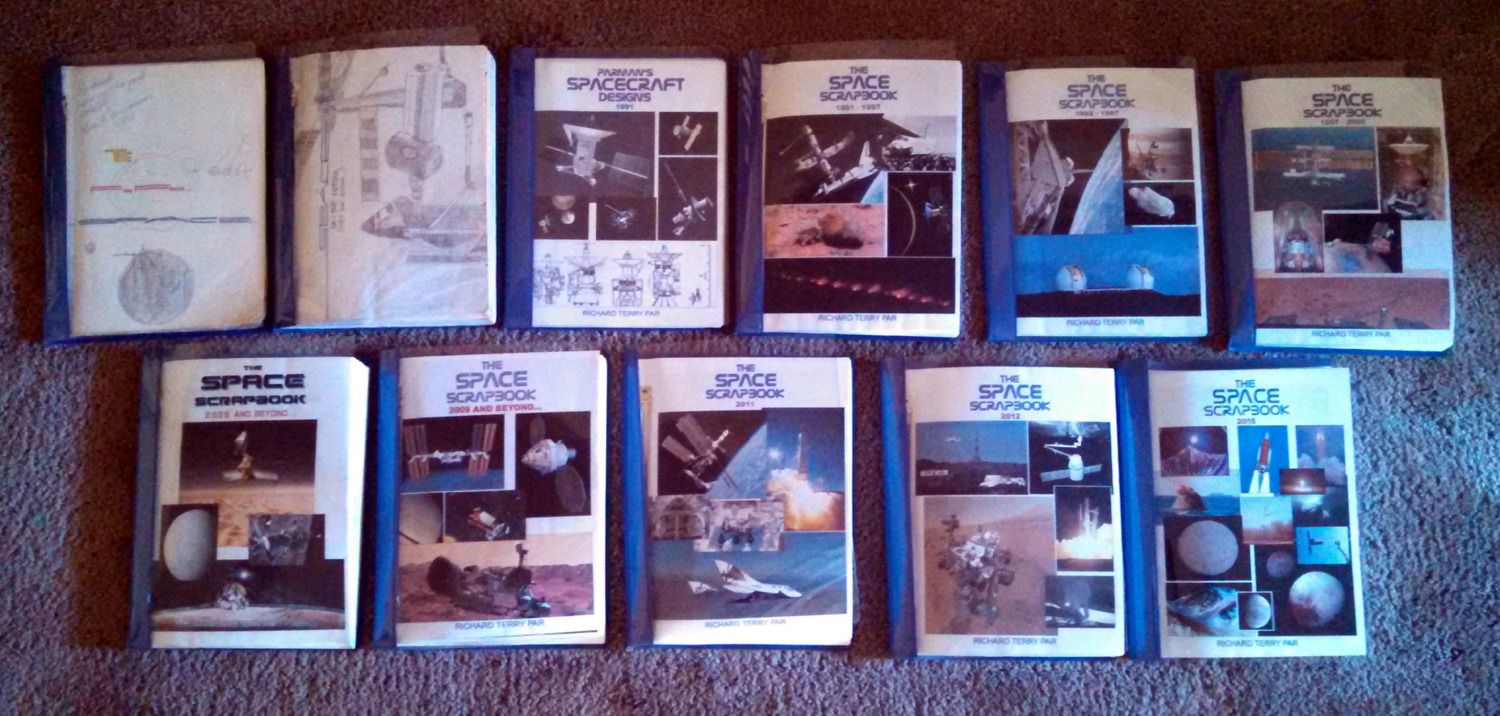
All of my space albums...for the rest of the world to see.

Just thought I'd share these new photos that I took of several albums that I created over 25 years (from 1990 to 2015). 2015 marked the final year that I collected space-related articles from various newspapers (mostly the Los Angeles Times) and compiled them in Acco plastic binders. If you click on the photo above to enlarge it, you'd see that there's a 2-year gap between the 2012 album and the one for last year. That's because 1.) I only had one more binder left and didn't feel like buying more, and 2.) I wanted to save the final binder for a year in which very significant space events took place. Those events originally were Dawn's arrival at dwarf planet Ceres last March and New Horizons' flyby of fellow dwarf planet Pluto last July...but I didn't know that 2015 would also mark the Planetary Society's successful test flight of its LightSail solar sail prototype last May, Blue Origin and SpaceX's triumph in safely landing rocket boosters back on the ground after launch last November and December, respectively, Japan finally inserting its Akatsuki spacecraft into orbit around Venus on December 6 (Pacific Time) following a 5-year delay due to a propulsion problem, and the historic discovery that water still flows on Mars last September.

My final album, THE SPACE SCRAPBOOK: 2015.

The coming years will also mark historic moments for spaceflight (especially in 2018...when the Space Launch System hopefully lifts off for the first time, Europe's second ExoMars mission heads to the Red Planet, and the James Webb Space Telescope is finally sent into the heavens)—but constantly browsing through every single page of a newspaper (except the sports section, obviously) to find a space article is time-consuming. It is time to move on... But don't worry; this blog will always be here for me to post press releases and personal news and pics in regards to the awesome events that take place in space exploration almost every day. Other than that, carry on— And have a great year!

Pages from my final album, THE SPACE SCRAPBOOK: 2015.

Thursday, May 28, 2015

Endeavour Update... Paving The Way for ET-94!

Space shuttle Endeavour launches from NASA's Kennedy Space Center in Florida on her final voyage to the International Space Station, on May 16, 2011.
NASA

California Science Center Foundation Announces Another Historic Space Artifact Journey Through Los Angeles City Streets (Press Release)

Los Angeles – Today the California Science Center Foundation announced the continuation of “Mission 26” with the acquisition and planned move of the only flight-qualified External Tank (ET-94) in existence from NASA’s Michoud Assembly Facility in New Orleans to the Science Center in Los Angeles. The donation of this never-used artifact from NASA is significant, and allows the Science Center to fulfill its vision of building a full stack for Space Shuttle Endeavour’s final display in the launch position in the future Samuel Oschin Air and Space Center. This will mark the only time an ET has traveled through urban streets and will evoke memories of when Endeavour traveled 12-miles from the Los Angeles International Airport to the Science Center and was cheered on by a crowd of 1.5 million in 2012. The ET-94 move is expected to take place sometime from the end of 2015 to early 2016, depending on weather conditions and the progress of cosmetic restorations.

The ET’s journey to the California Science Center and its subsequent attachment to the Orbiter will be historic. Following NASA’s customary transport methods for an External Tank, ET-94 will be shipped by barge. It will travel from the Michoud Assembly Facility through the Panama Canal to Los Angeles, then on through city streets to its final destination at the California Science Center’s Samuel Oschin Pavilion. The entire journey will take six to eight weeks.

Larger and longer than Endeavour, the ET was the Orbiter’s massive “gas tank” and contained the propellants used by the Space Shuttle Main Engines (though ET-94 is empty). The tank, the only major, non-reusable part of the space shuttle, is neither as wide as Endeavour (32 feet versus 78 feet) nor as high (35 feet versus 56 feet). Because of this, fewer utilities will be impacted and no trees will be removed along ET’s route from the coast to Exposition Park, though some trimming may be necessary. The path it will take through the streets is currently being planned with city officials, utilities and community groups.

“With this gift from NASA, we will have the ability to preserve and display an entire stack of flight hardware, making the Samuel Oschin Air and Space Center an even more compelling educational experience. It will allow future generations to experience and understand the science and engineering of the space shuttle,” notes California Science Center President Jeffrey N. Rudolph.

Los Angeles Mayor Eric Garcetti adds that, “We are thrilled that NASA has gifted the California Science Center and the city of Los Angeles with the last surviving flight-qualified space shuttle external tank (ET) in the world. The city plans to work with the Science Center to make this a great welcome and celebration as it did with Endeavour two and a half years ago. As it makes its journey, from the coast to the Science Center, it will inspire the next generation of scientists and engineers, contributing to LA’s trajectory of becoming a hub of technological innovation and the Science Center’s mission as a leader in science learning.”

Los Angeles City Councilman Curren Price adds that, “This is just the beginning of increased economic vitality and interest in science learning in this district, sparked by the California Science Center’s Mission 26. The Science Center has experienced a major increase in tourism since the arrival of Endeavour. We now expect to attract even more visitors from across the nation and around the world as the Science Center continues to build the full stack with the ET and later the Solid Rocket Boosters for the final launch display at the Samuel Oschin Air and Space Center. I am thrilled that another historic journey through the streets of Los Angeles will unite our community again in a welcoming celebration.”

Source: California Science Center

****

Space shuttle fuel tank ET-94 is placed in horizontal position at NASA's Michoud Assembly Facility near New Orleans, Louisiana...on September 15, 2012.
NASA / MAF / Steven Seipel

Friday, December 13, 2013

SpaceX To Make A Bigger Mark on America's Spaceport?

Space shuttle Endeavour stands poised for liftoff at Kennedy Space Center's Launch Complex 39A in Florida, on February 6, 2010.
NASA / Bill Ingalls

NASA Selects SpaceX to Begin Negotiations for Use of Historic Launch Pad (Press Release)

NASA has selected Space Exploration Technologies Corporation (SpaceX) of Hawthorne, Calif., to begin negotiations on a lease to use and operate historic Launch Complex (LC) 39A at the agency's Kennedy Space Center in Florida.

Permitting use and operation of this valuable national asset by a private-sector, commercial space partner will ensure its continued viability and allow for its continued use in support of U.S. space activities.

The reuse of LC-39A is part of NASA’s work to transform the Kennedy Space Center into a 21st century launch complex capable of supporting both government and commercial users. Kennedy is having success attracting significant private sector interest in its unique facilities. The center is hard at work assembling NASA’s Orion spacecraft and preparing its infrastructure for the Space Launch System rocket, which will launch from LC-39B and take American astronauts into deep space, including to an asteroid and Mars.

NASA made the selection decision Thursday after the U.S. Government Accountability Office (GAO) denied a protest filed against the Agency by Blue Origin LLC on Sept. 13. In its protest, Blue Origin raised concerns about the competitive process NASA was using to try to secure a potential commercial partner or partners to lease and use LC-39A. Blue Origin had argued the language in the Announcement for Proposals (AFP) favored one proposed use of LC-39A over others. The GAO disagreed.

While the GAO protest was underway, NASA was prohibited from selecting a commercial partner for LC-39A from among the proposals submitted in response to the agency's AFP that had been issued on May 23. However, while the GAO considered the protest, NASA continued evaluating the proposals in order to be prepared to make a selection when permitted to do so. After the GAO rendered its decision Thursday in NASA’s favor, the agency completed its evaluation and selection process.

NASA notified all proposers on Friday of its selection decision concerning LC-39A. Further details about NASA’s decision will be provided to each proposer when NASA furnishes the source selection statement to the proposers. In addition, NASA will offer each the opportunity to meet to discuss NASA’s findings related to the proposer’s individual proposal. NASA will release the source selection statement to the public once each proposer has been consulted to ensure that any proprietary information has been appropriately redacted.

NASA will begin working with SpaceX to negotiate the terms of its lease for LC-39A. During those ongoing negotiations, NASA will not be able to discuss details of the pending lease agreement. Since the late 1960s, Kennedy's launch pads 39 A and B have served as the starting point for America's most significant human spaceflight endeavors -- Apollo, Skylab, Apollo-Soyuz and all 135 space shuttle missions. LC-39A is the pad where Apollo 11 lifted off from on the first manned moon landing in 1969, as well as launching the first space shuttle mission in 1981 and the last in 2011.

Source: NASA.Gov

****

The Dragon CRS-2 spacecraft is berthed to the International Space Station, on March 3, 2013.
NASA