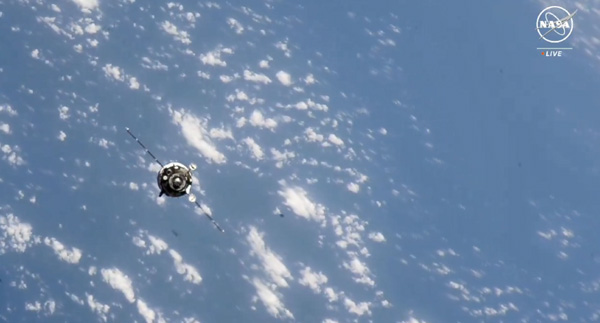
Showing posts with label Soyuz. Show all posts

Friday, January 9, 2026

The Latest Update on Crew-11's Departure from the ISS...

An infographic showing all of the vehicles that were docked or berthed to the International Space Station on December 8, 2025.
NASA

NASA, SpaceX Set Target Date for Crew-11’s Return to Earth (News Release)

NASA and SpaceX are targeting no earlier than 5 p.m. EST on Wednesday, January 14, for the undocking of the agency’s SpaceX Crew-11 mission from the International Space Station, pending weather conditions.

On January 8, NASA announced its decision to return the agency’s SpaceX Crew-11 mission to Earth from the space station earlier than originally planned as teams monitor a medical concern with a crew member currently living and working aboard the orbital laboratory, who is stable. Due to medical privacy, it is not appropriate for NASA to share more details about the crew member.

NASA astronauts Zena Cardman and Mike Fincke, JAXA (Japan Aerospace Exploration Agency) astronaut Kimiya Yui, and Roscosmos cosmonaut Oleg Platonov will splash down off the coast of California at approximately 3:40 a.m. on Thursday, January 15.

Mission managers continue monitoring conditions in the recovery area, as undocking of the SpaceX Dragon depends on spacecraft readiness, recovery team readiness, weather, sea states and other factors. NASA and SpaceX will select a specific splashdown time and location closer to the Crew-11 spacecraft undocking.

NASA’s coverage is as follows (all times Eastern and subject to change based on real-time operations):

Wednesday, January 14

3 p.m. – Hatch closure coverage begins

3:30 p.m. – Hatch closing

4:45 p.m. – Undocking coverage begins

5 p.m. – Undocking

Thursday, January 15

2:15 a.m. – Return coverage begins

2:50 a.m. – Deorbit burn

3:40 a.m. – Splashdown

5:45 a.m. – Return to Earth media news conference

NASA will share more details about its coverage plans in the coming days.

Source: NASA.Gov

Tuesday, December 9, 2025

NASA's First Korean-American Astronaut (Who's Also a Former Navy SEAL and Harvard Medical Doctor) Is Back on Earth...

The Soyuz MS-27 capsule carrying NASA astronaut Jonny Kim as well as Russian cosmonauts Sergey Ryzhikov and Alexey Zubritsky is about to touch down in Kazakhstan...on December 9, 2025 (Kazakh Time).
NASA / Bill Ingalls

Soyuz Crew Lands Ending Eight-Month Space Research Journey (News Release)

At 12:03 a.m. EST (10:03 a.m. local time), the Soyuz MS-27 spacecraft made a parachute-assisted landing on the steppe of Kazakhstan, southeast of the town of Dzhezkazgan.

NASA astronaut Jonny Kim and Roscosmos cosmonauts Sergey Ryzhikov and Alexey Zubritsky orbited Earth 3,920 times and traveled nearly 104 million miles over the course of their 245-day mission. The Soyuz MS-27 spacecraft launched and docked with the space station on April 8.

This was Kim’s first spaceflight, where he served as flight engineer for Expedition 72 and 73. This was also Zubritsky's first trip to the space station. Ryzhikov has now logged a total of 603 days in space during three trips to the orbital complex, ranking him 13th of all time.

The three crew members will fly by helicopter to Karaganda, Kazakhstan, where recovery teams are based. Kim will board a NASA aircraft and return to Houston, while Ryzhikov and Zubritsky will depart for their training base in Star City, Russia.

Source: NASA.Gov

****

NASA astronaut Jonny Kim poses with a Matryoshka Doll of himself after a Russian recovery team helped him egress from the Soyuz MS-27 capsule that brought him back to Earth from the International Space Station...on December 9, 2025 (Kazakh Time).
NASA / Bill Ingalls

Friday, May 16, 2025

Photos of the Day: Endeavour's Permanent Home Continues to Take Shape in Los Angeles...

Taking a selfie with the Samuel Oschin Shuttle Gallery that's currently under construction at the California Science Center in Los Angeles...on May 16, 2025.

Earlier today, I drove down to the California Science Center near downtown Los Angeles to check on the status of Endeavour's permanent home, the Samuel Oschin Air and Space Center.

As shown in these images, the diagrid structure that enshrouds Endeavour and her Space Shuttle Stack is close to being fully assembled; the only task that needs to be done now is install all of the stainless-steel skin panels around the structure's exterior. The steel panels are also being attached to the rest of the building that will house scores of aerospace exhibits once the Air and Space Center is complete.

The "Work in Progress (WIP)" exhibit, shown at the very bottom of this entry, displays flight artifacts that will eventually be moved into the Air and Space Center after the WIP exhibit permanently closes this Sunday, May 18. The artifacts include a flown SpaceX Dragon freighter (designated C108), a Rocket Lab Electron booster, a Space Shuttle Main Engine as well as a Gemini capsule and Apollo-Soyuz Command Module.

I look forward to visiting the Samuel Oschin Air and Space Center for another status check later this year!

A snapshot of the Samuel Oschin Shuttle Gallery that's currently under construction at the California Science Center in Los Angeles...on May 16, 2025.
Richard T. Par

Another snapshot of the Samuel Oschin Shuttle Gallery that's currently under construction at the California Science Center in Los Angeles...on May 16, 2025.
Richard T. Par

A snapshot of a retired A-12 Blackbird near the Samuel Oschin Shuttle Gallery at the California Science Center in Los Angeles...on May 16, 2025.
Richard T. Par

A snapshot of a retired F/A-18 Hornet and the Samuel Oschin Shuttle Gallery at the California Science Center in Los Angeles...on May 16, 2025.
Richard T. Par

A snapshot of the Samuel Oschin Air and Space Center that's currently under construction at the California Science Center in Los Angeles...on May 16, 2025.
Richard T. Par

Another snapshot of the Samuel Oschin Air and Space Center that's currently under construction at the California Science Center in Los Angeles...on May 16, 2025.
Richard T. Par

The 'Work in Progress' exhibit at the California Science Center in Los Angeles...on May 16, 2025.
Richard T. Par

Saturday, April 19, 2025

Two Cosmonauts and a Prolific Space Photographer Have Safely Returned to Earth...

Hanging under its main parachute, the Soyuz MS-26 capsule slowly approaches its landing site at Dzhezkazgan, Kazakhstan...on April 19, 2025 (Eastern Time).
NASA / Bill Ingalls

NASA Astronaut Don Pettit, Crewmates Complete Space Station Expedition (News Release)

NASA astronaut Don Pettit returned to Earth on Saturday, accompanied by Roscosmos cosmonauts Alexey Ovchinin and Ivan Vagner, concluding a seven-month science mission aboard the International Space Station.

The trio departed the space station at 5:57 p.m. EDT aboard the Soyuz MS-26 spacecraft before making a safe, parachute-assisted landing at 9:20 p.m. (6:20 a.m. on Sunday, April 20, Kazakhstan time), southeast of Dzhezkazgan, Kazakhstan. Pettit also celebrates his 70th birthday on Sunday, April 20.

Spanning 220 days in space, Pettit and his crewmates orbited the Earth 3,520 times, completing a journey of 93.3 million miles. Pettit, Ovchinin and Vagner launched and docked to the orbiting laboratory on September 11, 2024.

During his time aboard the space station, Pettit conducted research to enhance in-orbit metal 3D printing capabilities, advance water sanitization technologies, explore plant growth under varying water conditions, and investigate fire behavior in microgravity, all contributing to future space missions. He also used his surroundings aboard station to conduct unique experiments in his spare time and captivate the public with his photography.

This was Pettit’s fourth spaceflight, where he served as a flight engineer for Expeditions 71 and 72. He has logged 590 days in orbit throughout his career. Ovchinin completed his fourth flight, totaling 595 days, and Vagner has earned an overall total of 416 days in space during two spaceflights.

NASA is following its routine postlanding medical checks, with the crew returning to the recovery staging area in Karaganda, Kazakhstan. Pettit will then board a NASA plane bound for the agency’s Johnson Space Center in Houston. According to NASA officials at the landing site, Pettit is doing well and in the range of what is expected for him following return to Earth.

For more than two decades, people have lived and worked continuously aboard the International Space Station, advancing scientific knowledge and making research breakthroughs that are not possible on Earth. The station is a critical testbed for NASA to understand and overcome the challenges of long-duration spaceflight and to expand commercial opportunities in low-Earth orbit. As commercial companies focus on providing human space transportation services and destinations as part of a strong low-Earth orbit economy, NASA is focusing more resources on deep space missions to the Moon as part of Artemis in preparation for future astronaut missions to Mars.

Source: NASA.Gov

****

With NASA astronaut Don Pettit (left) and fellow cosmonaut Ivan Vagner (right) seated next to him, Alexey Ovchinin waves to the camera after the hatch to their Soyuz MS-26 capsule is opened after landing...on April 19, 2025 (Eastern Time).
NASA / Bill Ingalls


Friday, April 11, 2025

Snapshots of Two Russian Capsules at the ISS...

Two Soyuz crew capsules are docked at the Russian Orbital Segment of the International Space Station...on April 9, 2025.
NASA

The Soyuz MS-26 and MS-27 crew ships docked to the International Space Station (Photo Releases - April 9)

ABOVE: The Soyuz MS-26 (foreground) and MS-27 crew ships are pictured docked to the International Space Station's Rassvet module and Prichal module, respectively. The orbital outpost was soaring 261 miles above Wyoming at the time of this photograph.

BELOW: At right, is the 214 million-year-old Manicouagan crater located in Quebec as the orbital outpost soared 263 miles above far eastern Canada.

Source #1: NASA.Gov

Source #2: NASA.Gov

****

Two Soyuz crew capsules are docked at the Russian Orbital Segment of the International Space Station...on April 9, 2025.
NASA

Tuesday, April 8, 2025

NASA's First Korean-American Astronaut (Who's Also a Former Navy SEAL and Harvard Medical Doctor) Has Reached the ISS...

The Soyuz MS-27 rocket carrying three Expedition 72/73 space station crew members launches from Kazakhstan's Baikonur Cosmodrome on April 8, 2025 (Eastern Time).
NASA / Joel Kowsky

NASA Astronaut, Crewmates Arrive Safely at Space Station (News Release)

NASA astronaut Jonny Kim, accompanied by Roscosmos cosmonauts Sergey Ryzhikov and Alexey Zubritsky, arrived at the International Space Station on Tuesday, bringing the number of residents to 10 for the next two weeks.

The Soyuz MS-27 spacecraft carrying Kim, Ryzhikov and Zubritsky docked to the Prichal module at 4:57 a.m. EDT, following a three-hour, two-orbit journey to the space station. They launched at 1:47 a.m. (10:47 a.m. Baikonur time) from the Baikonur Cosmodrome in Kazakhstan.

When hatches open at approximately 7:20 a.m., the trio will join the Expedition 72 crew, including NASA astronauts Nichole Ayers, Anne McClain and Don Pettit, JAXA (Japan Aerospace Exploration Agency) astronaut Takuya Onishi, and Roscosmos cosmonauts Kirill Peskov, Ivan Vagner and Alexey Ovchinin.

NASA’s live coverage of hatch opening will begin at 7 a.m. on NASA+. Learn how to watch NASA content through a variety of platforms.

Expedition 73 will begin on Saturday, April 19, following the departure of Pettit, Ovchinin and Vagner, as they conclude a seven-month science mission aboard the orbiting laboratory.

Watch the ceremonial change of command at 2:40 p.m. on Friday, April 18, as Ovchinin transfers the distinction to Onishi, live on NASA+.

Throughout his eight-month stay aboard the orbital outpost, Kim will conduct scientific research in technology development, Earth science, biology, human research and more. This is the first flight for Kim and Zubritsky, and the third for Ryzhikov.

Source: NASA.Gov

****


Wednesday, August 28, 2024

A Former Navy SEAL and Harvard Medical Doctor Is Ready for His First Flight to Space...

The official NASA portrait of astronaut Jonny Kim.
NASA

NASA Assigns Astronaut Jonny Kim to First Space Station Mission (News Release)

During his first mission to the International Space Station, NASA astronaut Jonny Kim will serve as a flight engineer and member of the upcoming Expedition 72/73 crew.

Kim will launch on the Roscosmos Soyuz MS-27 spacecraft in March 2025, accompanied by Roscosmos cosmonauts Sergey Ryzhikov and Alexey Zubritsky. The trio will spend approximately eight months at the space station.

While aboard the orbiting laboratory, Kim will conduct scientific investigations and technology demonstrations to help prepare the crew for future space missions and provide benefits to people on Earth.

NASA selected Kim as an astronaut in 2017. After completing the initial astronaut candidate training, Kim supported mission and crew operations in various roles including the Expedition 65 lead operations officer, T-38 operations liaison, and space station capcom chief engineer.

A native of Los Angeles, Kim is a United States Navy lieutenant commander and dual designated naval aviator and flight surgeon. Kim also served as an enlisted Navy SEAL. He holds a bachelor’s degree in Mathematics from the University of San Diego and a medical degree from Harvard Medical School in Boston, and completed his internship with the Harvard Affiliated Emergency Medicine Residency at Massachusetts General Hospital and Brigham and Women’s Hospital.

For more than two decades, humans have lived and worked continuously aboard the International Space Station, advancing scientific knowledge, and making research breakthroughs not possible on Earth. The station is a critical testbed for NASA to understand and overcome the challenges of long-duration spaceflight and to expand commercial opportunities in low-Earth orbit. As commercial companies focus on providing human space transportation services and destinations as part of a robust low-Earth orbit economy, NASA is able to more fully focus its resources on deep space missions to the Moon and Mars.

Source: NASA.Gov

Friday, June 14, 2024

Photos of the Day: The ISS from High Above...

An image of the International Space Station that was taken by Maxar Technologies' WorldView-3 satellite from 276 kilometers (172 miles) above...on June 7, 2024.
Maxar Technologies

Just thought I'd share this amazing image that was taken of the International Space Station (ISS) by Maxar Technologies' WorldView-3 Earth-observation satellite...which launched aboard United Launch Alliance's (ULA) Atlas V rocket on August 13, 2014.

WorldView-3 was orbiting 276 kilometers (172 miles) above the ISS when this stunning picture was captured a week ago on June 7.

Speaking of ULA's Atlas V, the rocket's latest payload—Boeing's Starliner Calypso capsule—can be seen docked to the forward port of the station's Harmony module in this photo.

The annotated version of this image, showing five of the six visiting vehicles (Calypso, Crew Dragon Endeavour, Cygnus, Soyuz MS-25 as well as Progress 87 and 88) that are currently docked to the ISS, is posted below.

Calypso itself is currently set to return to Earth on June 22...landing at White Sands Space Harbor in New Mexico to complete Boeing's Crew Flight Test.

An annotated image showing five of the six visiting vehicles that are currently docked to the International Space Station...as of June 7, 2024.
Maxar Technologies / SpaceX FrontPage

Monday, March 25, 2024

The Seven ISS Residents Greet Three New Arrivals Aboard the Orbital Outpost...

The three crew members of Soyuz MS-25 take part in a welcome ceremony with the seven Expedition 70 residents aboard the International Space Station...on March 25, 2024.
NASA TV

Soyuz Hatches Open, Expedition 70 Welcomes Crew Aboard Station (News Release)

The hatches between the International Space Station and the newly-arrived Soyuz MS-25 spacecraft officially opened at 1:26 p.m. EDT. The arrival of three new crew members to the existing seven people already aboard for Expedition 70 temporarily increases the station’s population to 10.

NASA astronaut Tracy C. Dyson, Roscosmos cosmonaut Oleg Novitskiy and spaceflight participant Marina Vasilevskaya of Belarus joined NASA astronauts Loral O’Hara, Matthew Dominick, Mike Barratt and Jeanette Epps, as well as Roscosmos cosmonauts Oleg Kononenko, Nikolai Chub and Alexander Grebenkin, already living and working aboard the space station.

Dyson will spend six months aboard the station as an Expedition 70 and 71 flight engineer, returning to Earth in September with Oleg Kononenko and Nikolai Chub of Roscosmos, who will complete a year-long mission on the laboratory.

Novitskiy and Vasilevskaya will be aboard the station for 12 days, providing the ride home for O’Hara on Saturday, April 6, aboard Soyuz MS-24 for a parachute-assisted landing on the steppe of Kazakhstan. O’Hara will have spent 204 days in space when she returns.

Source: NASA.Gov

****

The Soyuz MS-25 capsule prior to docking to the International Space Station at 11:03 AM, EDT (3:30 PM, UTC) on March 25, 2024.
NASA TV

Sunday, March 24, 2024

New Members of the Expedition 70/71 Crew Launch Aboard a Soyuz Rocket to the ISS...

The Soyuz MS-25 rocket carrying three Expedition 70/71 space station crew members launches from Kazakhstan's Baikonur Cosmodrome on March 23, 2024.
NASA / Bill Ingalls

NASA Astronaut Tracy Dyson, Crewmates Safely En Route to Space Station (News Release - March 23)

Three crew members including NASA astronaut Tracy C. Dyson successfully launched at 8:36 a.m. EDT on Saturday from the Baikonur Cosmodrome in Kazakhstan to the International Space Station.

Dyson, along with her crewmates Roscosmos cosmonaut Oleg Novitskiy and spaceflight participant Marina Vasilevskaya of Belarus, will dock to the space station’s Prichal module about 11:09 a.m. on Monday, March 25, on the Soyuz MS-25 spacecraft.

Docking coverage will begin at 10:15 a.m. on NASA+, NASA Television, the NASA app, YouTube and the agency’s website. NASA will also air coverage, starting at 1:15 p.m., of the crew welcome ceremony on NASA+ once they are aboard the orbital outpost.

Learn how to stream NASA TV through a variety of platforms including social media.

When the hatches between the station and Soyuz open about 1:40 p.m., the new crew members will join NASA astronauts Loral O’Hara, Matthew Dominick, Mike Barratt and Jeanette Epps, as well as Roscosmos cosmonauts Oleg Kononenko, Nikolai Chub and Alexander Grebenkin, already living and working aboard the space station.

Novitskiy and Vasilevskaya will be aboard the station for 12 days, before providing the ride home for O’Hara on Saturday, April 6, aboard Soyuz MS-24 for a parachute-assisted landing on the steppe of Kazakhstan.

Dyson will spend six months aboard the station as an Expedition 70 and 71 flight engineer, returning to Earth in September with Oleg Kononenko and Nikolai Chub of Roscosmos, who will complete a year-long mission on the laboratory.

This will be the third spaceflight for Dyson, the fourth for Novitskiy, and the first for Vasilevskaya.

****

The Expedition 70/71 crew members that launched aboard the Soyuz MS-25 rocket to the International Space Station.
GCTC / Andrey Shelepin

Tuesday, March 5, 2024

Endeavour Has Arrived at the ISS...

With the four Crew-8 astronauts aboard, SpaceX's Dragon Endeavour capsule approaches the International Space Station for docking...on March 5, 2024.
NASA

Expedition 70 Welcomes Four New Crewmates, Quickly Gets to Work (News Release)

11 crew members now reside aboard the International Space Station following the arrival of the SpaceX Crew-8 mission early Tuesday morning. The four new Crew-8 members will spend the next few days getting used to life on orbit as four Expedition 70 crewmates pack up for their return to Earth.

The SpaceX Dragon Endeavour spacecraft docked to the forward port of the orbital outpost’s Harmony module at 2:28 a.m. EST on Tuesday. About an hour-and-a-half later, Crew-8 Commander Matthew Dominick, Pilot Mike Barratt, and Mission Specialists Jeanette Epps and Alexander Grebenkin opened Dragon’s hatch and entered Harmony - officially becoming station flight engineers.

Soon after, the new quartet, with the Expedition 70 septet, called down to Earth for welcome remarks.

Afterwards, the entire crew quickly got to work - first conducting a safety briefing, then unpacking new science and supplies, conducting health checks, and more. The crewmates transferred Dragon freezers containing research samples and installed them into science racks throughout the station.

Tuesday’s health studies included testing the inner-ear balance system, conducting eye scans with an ultrasound device, and evaluating a specialized suit’s ability to help a crew member readjust to Earth’s gravity.

The foursome will live aboard the space station for a six-month space research mission. They will take advantage of the microgravity environment to explore the mechanisms behind neurodegenerative disorders, how spaceflight affects plant growth to sustain crews, countering space-caused fluid shifts that create head and eye pressure in astronauts, and the potential for algae to improve spacecraft life support systems.

While Crew-8 gets up to speed with space station systems, four Expedition 70 crewmates are nearing their departure after a six-and-a-half-month mission on orbit. NASA astronaut Jasmin Moghbeli will lead Andreas Mogensen of ESA (European Space Agency), Satoshi Furukawa of JAXA (Japan Aerospace Exploration Agency) and Konstantin Borisov of Roscosmos back to Earth inside the SpaceX Dragon Endurance spacecraft.

The homebound quartet has been aboard the station since August 27, 2023, and is expected to undock from Harmony’s space-facing port no earlier than Monday, March 11.

The station’s other three crewmates, NASA astronaut Loral O'Hara and cosmonauts Oleg Kononenko and Nikolai Chub, have been aboard the station since September 15, when they docked to the Rassvet module inside the Soyuz MS-24 crew ship. O'Hara is due to return to Earth in April while Kononenko and Chub will stay in space for a few more months.

Source: NASA.Gov

****

Aboard the International Space Station, the seven-member Expedition 70 crew and the four Crew-8 astronauts unite to give welcome remarks after Crew-8's arrival at the orbital outpost...on March 5, 2024.
NASA TV

Thursday, February 1, 2024

Looking Ahead to the Ninth Crew-Rotation Flight to the ISS...

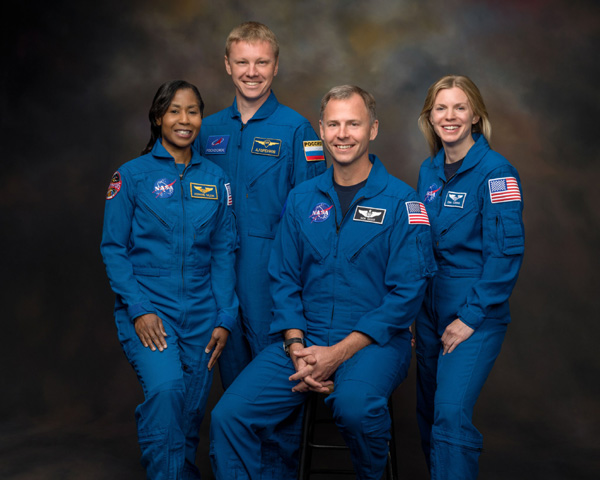
The astronauts who will fly on SpaceX's Crew-9 mission this summer: NASA astronaut Stephanie Wilson, Roscosmos cosmonaut Aleksandr Gorbunov, and NASA astronauts Nick Hague and Zena Cardman.
NASA

NASA Shares Assignments for Its SpaceX Crew-9 Space Station Mission (Press Release - January 31)

As part of NASA’s SpaceX Crew-9 mission, four crew members are preparing to launch to the International Space Station and conduct a wide-ranging set of operational and research activities for the benefit of all.

Launching aboard the Crew Dragon spacecraft, NASA astronauts Commander Zena Cardman, Pilot Nick Hague and Mission Specialist Stephanie Wilson, and Roscosmos cosmonaut Mission Specialist Aleksandr Gorbunov, will join Expedition 71 and 72 crew members no earlier than August. They will arrive at the space station for a short duration handover with NASA’s SpaceX Crew-8 mission.

This will be the first spaceflight for Cardman, who was selected as a NASA astronaut in 2017. The Williamsburg, Virginia, native holds a bachelor’s degree in Biology and a master’s in Marine Sciences from the University of North Carolina at Chapel Hill.

At the time of selection, Cardman was a doctoral candidate in geosciences. Her research focused on geobiology and geochemical cycling in subsurface environments, from caves to deep sea sediments.

Since completing initial training, Cardman has supported real-time station operations and development for lunar surface exploration.

With a total of 203 days in space, this will be Hague’s third launch and second mission to the orbiting laboratory. During his first launch in 2018, Hague and his crewmate, Roscosmos cosmonaut Alexey Ovchinin, experienced a rocket booster failure resulting in an in-flight launch abort.

The Soyuz MS-10 spacecraft landed safely. Five months later, Hague launched aboard Soyuz MS-12 and served as a flight engineer aboard the space station during Expeditions 59 and 60.

Hague and his crewmates participated in hundreds of experiments in biology, biotechnology, physical science and Earth science. Hague conducted three spacewalks, to upgrade space station power systems and install a docking adapter for commercial spacecraft.

As an active-duty colonel in the U.S. Space Force, Hague completed a developmental rotation at the Defense Department in Washington, where he served as the USSF director of test and evaluation from 2020 to 2022. In August 2022, Hague resumed duties at NASA working on the Boeing Starliner Program until this flight assignment.

A veteran of three spaceflights, STS-121, STS-120 and STS-131, Wilson has spent 42 days in space aboard three separate space shuttle Discovery missions. Before her selection as a NASA astronaut in 1996, she earned her bachelor’s degree in Engineering Science from Harvard University in Cambridge, Massachusetts, a master’s degree in Aerospace Engineering from the University of Texas in Austin, and worked at Martin Marietta and NASA’s Jet Propulsion Laboratory in Southern California.

During Wilson's first mission, STS-121 in July 2006, she and her crewmates spent 13 days in orbit. Wilson served as the robotic arm operator for spacecraft inspection, for the installation of the Leonardo Multi-Purpose Logistics Module, and for spacewalk support.

In October 2007, Wilson and her STS-120 crewmates aboard Discovery delivered the Harmony module to the station and relocated a solar array. In April 2010, Wilson and her STS-131 crewmates completed another mission to resupply the station, delivering a new ammonia tank for the station cooling system, new crew sleeping quarters, a window observation facility, and a freezer for experiments.

During her nearly 30 years with NASA, Wilson served as the integration branch chief for NASA’s Astronaut Office focusing on International Space Station systems and payload operations, and on a nine-month detail, served as the acting chief of NASA’s Program and Project Integration Office at the agency’s Glenn Research Center in Cleveland.

This will be Gorbunov’s first trip to space and the station. Born in Zheleznogorsk, Kursk region, Russia, he studied engineering with qualifications in spacecraft and upper stages from the Moscow Aviation Institute.

Gorbunov graduated from the military department with a specialty in operation and repair of aircraft, helicopters and aircraft engines. Before being selected as a cosmonaut in 2018, he worked as an engineer for Rocket Space Corporation Energia and supported cargo spacecraft launches from the Baikonur Cosmodrome.

This is the ninth rotational mission to the space station under NASA’s Commercial Crew Program, which works with the American aerospace industry to meet the goal of safe, reliable and cost-effective transportation to and from the orbital outpost on American-made rockets and spacecraft launching from American soil.

For more than two decades, humans have lived and worked continuously aboard the International Space Station, advancing scientific knowledge and demonstrating new technologies, making research breakthroughs not possible on Earth. The station is a critical testbed for NASA to understand and overcome the challenges of long-duration spaceflight and to expand commercial opportunities in low-Earth orbit.

As commercial companies focus on providing human space transportation services and destinations as part of a robust low-Earth orbit economy, NASA’s Artemis campaign is underway at the Moon where the agency is preparing for future human exploration of Mars.

****

Wednesday, September 27, 2023

An ISS Crew Member Has Returned Home After Making American Spaceflight History...

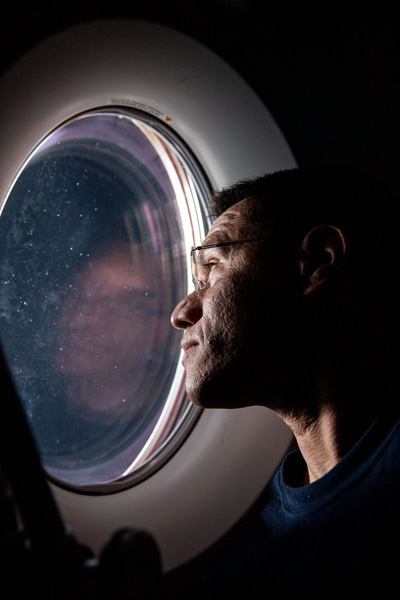
Looking out of a window aboard the International Space Station during his mission, NASA astronaut Frank Rubio is back on Earth after spending 371 days in low-Earth orbit.
NASA

Astronaut’s Record-Setting Mission Helps NASA Plan Deep Space Journeys (News Release)

NASA astronaut Frank Rubio set a new record on Monday, September 11 for the longest single spaceflight conducted by a U.S. astronaut.

Rubio arrived aboard the International Space Station on September 21, 2022, and returned home on Wednesday, September 27, after spending 371 days in low-Earth orbit. His mission breaks the previous record, held by NASA astronaut Mark Vande Hei, by 16 days.

This also marks the first time a U.S. astronaut has spent more than one year in space on a single mission.

Rubio originally was slated to spend six months in space before his mission was extended to more than a year. He returned in a Roscosmos Soyuz spacecraft with cosmonauts Sergey Prokopyev and Dmitri Petelin.

Throughout his record-breaking mission, Rubio contributed to several science experiments, including six studies geared towards understanding how spaceflight affects human physiology and psychology.

“Every day we spend up here, we know a little more about how the human body fares in space,” Rubio explained in a September 26 episode of the Spanish podcast Universo Curioso de la NASA. “We continue to do studies on the station that will help us when we continue exploring deeper and deeper into our solar system.”

Rubio is the first astronaut to participate in a study examining how exercising with limited gym equipment affects the human body. Recognizing that crew members traveling to the Moon and elsewhere will not have enough room in their spacecraft for a treadmill, researchers are eager to determine whether other exercise regimens could keep crews healthy on long missions.

So rather than running on the space station’s treadmill, Rubio exercised only on the space station’s bicycle and weightlifting machine.

Rubio is also one of a handful of astronauts to help researchers test whether an enhanced spaceflight diet can help humans better adapt to life in space. For this study, Rubio met with a specialist to create a customized diet loaded with nutrients, with an emphasis on foods such as fruits, vegetables and fish.

Scientists will evaluate whether consuming this diet boosted his immunity and improved how his gut microbe functioned.

For another experiment, Rubio helped nurture and monitor vegetables produced in the space station’s Vegetable Production System, or Veggie. Future deep space missions will require astronauts to grow fresh food in space as an alternative to prepackaged food.

This Veggie study evaluates protocols for growing produce in space, and whether plants grown in microgravity can help satisfy the dietary needs of astronauts on more distant spaceflight missions.

Rubio also provided biological samples, completed surveys and performed tests for a study collecting a core set of measurements from astronauts, called Spaceflight Standard Measures. The measurements serve as a baseline for how multiple systems in the body react to spaceflight, from human cognition to the immune system.

Other biological samples will be frozen and archived for future life science studies.

After his return, Rubio will provide researchers with feedback about any injuries like bruises that he may have acquired due to the forces of landing in the Soyuz spacecraft. His feedback will provide insight into whether extended spaceflight missions make people more vulnerable to injuries.

Such insight will be used to improve the design and landing systems of future spacecraft.

“Our understanding of how spaceflight affects the human body is mostly limited to astronauts on short-duration missions during the shuttle days and crew members on six-month missions aboard the space station,” said Steven H. Platts, chief scientist of NASA’s Human Research Program, which seeks to understand how the human body adapts to long-duration space missions.

When needed, the program also develops strategies that prevent or treat potential spaceflight health problems. “Rubio’s contributions,” Platts noted, “provide valuable information that will be used to help keep astronauts as healthy as possible on increasingly longer missions to the Moon, Mars and beyond.”

Source: NASA.Gov

****

Sunday, September 17, 2023

A Fellow Southern California Native Will Head Back to the ISS Next Year...

NASA astronaut Tracy C. Dyson will return to the International Space Station in March of next year.
NASA / Andrey Shelepin

NASA Astronaut Tracy C. Dyson Receives Second Space Station Assignment (Press Release - September 15)

NASA has assigned astronaut Tracy C. Dyson to her second long-duration mission to the International Space Station as a flight engineer and member of the Expedition 70/71 crew.

Dyson will launch on the Roscosmos Soyuz MS-25 spacecraft in March 2024 and spend approximately six months aboard the International Space Station. She will travel to the station with Roscosmos cosmonaut Oleg Novitskiy and spaceflight participant Marina Vasilevskaya of Belarus, both of whom will spend approximately 12 days aboard the orbital complex.

During her expedition, Dyson will conduct scientific investigations and technology demonstrations that help prepare humans for future space missions and benefit people on Earth. Among some of the hundreds of experiments ongoing during her mission, Dyson will continue to study how fire spreads and behaves in space with the Combustion Integrated Rack, as well as contribute to the long-running Crew Earth Observations study by photographing Earth to better understand how our planet is changing over time.

After completing her expedition, Dyson will return to Earth in fall 2024 with Roscosmos cosmonauts Oleg Kononenko and Nikolai Chub on the Soyuz MS-25 spacecraft. Kononenko and Chub are slated to launch Friday, September 15, with NASA astronaut Loral O’Hara on the Soyuz MS-24 spacecraft.

Kononenko and Chub will remain aboard the orbital laboratory for about one year. O’Hara, who will spend six months aboard the space station, will return with Novitskiy and Vasilevskaya on the Soyuz MS-24 spacecraft.

NASA selected Dyson as an astronaut in June 1998, and during her previous two flights, logged more than 188 days in space. Dyson first launched aboard the space shuttle Endeavour on STS-118 in 2007, serving as a mission specialist.

During STS-118, the crew successfully added the starboard-5 truss segment to the station’s “backbone” and a new gyroscope. In 2010, she served as flight engineer for Expedition 23/24 and performed three successful contingency spacewalks, logging 22 hours and 49 minutes outside the station as she helped remove and replace a failed pump module for one of two external ammonia circulation loops that keep internal and external equipment cool.

Dyson has worked inside the Mission Control Center at NASA’s Johnson Space Center in Houston as spacecraft communicator, known as capcom, for both space shuttle and space station operations. She also served as the lead capcom for various space station missions, as well as the development of the capcom cadre for Boeing’s Starliner Mission Operations Team.

Other technical assignments included leading the development of the spacewalk qualification training flow, which she helped to complete for the 2017 class of NASA astronauts.

Born in Arcadia, California, Dyson received a Bachelor of Science degree in chemistry from California State University, Fullerton, in 1993, and a doctorate in chemistry from the University of California, Davis, in 1997.

For more than 22 years, humans have continuously lived and worked aboard the International Space Station, advancing scientific knowledge and demonstrating new technologies, making research breakthroughs not possible on Earth. As a global endeavor, 244 people from 19 countries have visited the unique microgravity laboratory that has hosted more than 3,000 research and educational investigations from researchers in 108 countries and areas.

****

Saturday, August 26, 2023

ISS Update: Crew Dragon Endurance Is Headed Back to the Orbital Outpost...

A SpaceX Falcon 9 rocket carrying the Crew Dragon Endurance capsule lifts off from Kennedy Space Center's Launch Complex 39A in Florida...on August 26, 2023.
NASA / Joel Kowsky

NASA’s SpaceX Crew-7 Launches to International Space Station (Press Release)

An international crew of four representing four countries is in orbit following a successful launch to the International Space Station at 3:27 a.m. EDT on Saturday, August 26, from Launch Complex 39A at NASA’s Kennedy Space Center in Florida. The agency’s SpaceX Crew-7 mission is the seventh commercial crew rotation mission for NASA.

A SpaceX Falcon 9 rocket launched the Dragon spacecraft into orbit carrying NASA astronaut Jasmin Moghbeli, ESA (European Space Agency) astronaut Andreas Mogensen, JAXA (Japan Aerospace Exploration Agency) astronaut Satoshi Furukawa, and Roscosmos cosmonaut Konstantin Borisov, for a science expedition aboard the orbital laboratory.

“Crew-7 is a shining example of the power of both American ingenuity and what we can accomplish when we work together,” said NASA Administrator Bill Nelson. “Aboard station, the crew will conduct more than 200 science experiments and technology demonstrations to prepare for missions to the Moon, Mars and beyond, all while benefitting humanity on Earth. By partnering with countries around the world, NASA is engaging the best scientific minds to enable our bold missions, and it’s clear that we can do more – and we can learn more – when we work together.”

During Dragon’s flight, SpaceX will monitor a series of automatic spacecraft maneuvers from its mission control center in Hawthorne, California, and NASA teams will monitor space station operations throughout the flight from the Mission Control Center at the agency’s Johnson Space Center in Houston.

Named Endurance, the Dragon spacecraft will dock autonomously to the space-facing port of the station’s Harmony module at 8:39 a.m. on Sunday, August 27. NASA Television, the NASA app and the agency’s website will provide live coverage of docking and hatch opening.

NASA will also cover welcome remarks by the crew aboard the orbital outpost at 11:30 a.m.

Crew-7 will join the space station’s Expedition 69 crew of NASA astronauts Stephen Bowen, Woody Hoburg and Frank Rubio, as well as UAE (United Arab Emirates) astronaut Sultan Alneyadi, and Roscosmos cosmonauts Sergey Prokopyev, Dmitri Petelin and Andrey Fedyaev. For a short time, the number of crew aboard the space station will increase to 11 until Crew-6 members Bowen, Hoburg, Alneyadi and Fedyaev return to Earth a few days later.

Crew-7 will conduct new scientific research to benefit humanity on Earth and prepare for human exploration beyond low-Earth orbit. Experiments include the collection of microbial samples from the exterior of the space station, the first study of human response to different spaceflight durations, and an investigation of the physiological aspects of astronauts' sleep.

These are just some of the science experiments and technology demonstrations that will take place during their mission.

“The International Space Station is an incredible science and technology platform that requires people from all around the world to maintain and maximize its benefits to people on Earth,” said Ken Bowersox, associate administrator, Space Operations Mission Directorate at NASA Headquarters in Washington. “It’s great seeing Crew-7 launch with four crew members representing four countries who will live and work on humanity’s home in space as we continue the nearly 23 years of a continuous human presence aboard the microgravity laboratory.”

The Crew-7 mission enables NASA to maximize use of the space station, where astronauts testing technologies, performing science and developing the skills needed to operate future commercial destinations in low-Earth orbit and explore farther from Earth. Research conducted aboard the space station provides benefits for people on Earth and paves the way for future long-duration trips to the Moon through NASA’s Artemis missions.

Meet Crew-7

This is Moghbeli’s first trip into space since her selection as a NASA astronaut in 2017. The New York native earned a bachelor’s degree in aerospace engineering with information technology at the Massachusetts Institute of Technology in Cambridge, and a Master of Science in aerospace engineering from the Naval Postgraduate School in Monterey, California.

Moghbeli, a helicopter and Marine Corps test pilot, has more than 150 combat missions and 2,000 hours of flight time in over 25 different aircraft. She is also a graduate of the U.S. Naval Test Pilot School in Patuxent River, Maryland.

As mission commander, Moghbeli is responsible for all phases of flight, from launch to re-entry. She will serve as an Expedition 69/70 flight engineer aboard the station.

Mogensen was selected as an ESA astronaut in 2009 and became the first Danish citizen in space after launching aboard a Soyuz for a 10-day mission to the space station in 2015. He is from Copenhagen, Denmark.

Mogensen completed undergraduate studies and received a master's degree in aeronautical engineering from Imperial College London in England before gaining his doctorate in aerospace engineering from the University of Texas at Austin. Mogensen has since served as a crew member for NASA Extreme Environment Mission Operations undersea missions 17 and 19.

Mogensen was the European astronaut liaison officer at NASA Johnson from 2016 to 2022, working as a capsule communicator for astronauts aboard the station and as ground support for spacewalks. As the pilot on Crew-7, he is responsible for spacecraft systems and performance aboard the station.

Mogensen will serve as an Expedition 69 flight engineer and Expedition 70 commander.

Furukawa is making his second trip to space, having spent 165 days aboard the space station as part of Expeditions 28 and 29 in 2011. He is from Kanagawa, Japan, and was selected as a JAXA astronaut in 1999.

Furukawa is a physician and received his medical degree from the University of Tokyo, and later a doctorate in medical science from the same university. He served as a crew member on the 13th NEEMO mission, and later, was appointed head of JAXA’s Space Biomedical Research Group.

Aboard the station, Furukawa will become a flight engineer for Expedition 69/70.

Borisov is making his first trip to space and will serve as a mission specialist, working to monitor the spacecraft during the dynamic launch and entry phases of flight. He entered the Roscosmos Cosmonaut Corps as a test cosmonaut candidate in 2018 and will serve as a flight engineer for Expedition 69/70.

****

Thursday, April 27, 2023

Russia Will Support ISS Through 2028, While the U.S. and Its Other Partners Will Do So Through 2030...

The International Space Station as seen by the departing Expedition 56 crew aboard Russia's Soyuz MS-08 capsule...on October 4, 2018.
Roscosmos / NASA

Partners Extend International Space Station for Benefit of Humanity (News Release)

The International Space Station partners have committed to extending the operations of this unique platform in low-Earth orbit where, for more than 22 years, humans have lived and worked for the benefit of humanity, conducting cutting-edge science and research in microgravity. The United States, Japan, Canada and the participating countries of ESA (European Space Agency) have confirmed that they will support continued space station operations through 2030, and Russia has confirmed that it will support continued station operations through 2028.

NASA will continue to work with its partner agencies to ensure an uninterrupted presence in low-Earth orbit, as well as a safe and orderly transition from the space station to commercial platforms in the future.

“The International Space Station is an incredible partnership with a common goal to advance science and exploration,” said Robyn Gatens, director of the International Space Station Division at NASA Headquarters in Washington. “Extending our time aboard this amazing platform allows us to reap the benefits of more than two decades of experiments and technology demonstrations, as well as continue to materialize even greater discovery to come.”

Since its launch in 1998, the International Space Station has been visited by 266 individuals from 20 countries. The space station is a unique scientific platform where crew members conduct experiments across multiple disciplines of research, including Earth and space science, biology, human physiology, physical sciences and technology demonstrations that could not be done on Earth.

The crew living aboard the station are the hands of thousands of researchers on the ground conducting more than 3,300 experiments in microgravity. Now, in its third decade of operations, the station is in the decade of results when the platform can maximize its scientific return.

Results are compounding, new benefits are materializing, and innovative research and technology demonstrations are building on previous work.

The space station is one of the most complex international collaborations ever attempted. It was designed to be interdependent, relies on contributions from across the partnership to function, and no partner currently has the capability to operate the space station without the other.

With a continued foothold in low-Earth orbit, NASA’s Artemis missions are underway, setting up a long-term presence at the Moon for science and exploration.

Source: NASA.Gov

Wednesday, January 18, 2023

SpaceX's Endurance Capsule May Come Home with an Extra Crew Member Due to Last Month's Soyuz Leak...

A snapshot of SpaceX's Crew Dragon capsule docked to the International Space Station's Harmony module.
NASA

NASA Astronauts Complete Seat Liner Move (News Release)

On January 17, NASA Flight Engineer Josh Cassada, with assistance from NASA Flight Engineer Nicole Mann, worked inside the SpaceX Dragon Endurance crew ship collecting tools and readying the spacecraft for a seat liner move. The seat liner move, completed today, January 18, ensures that NASA Flight Engineer Frank Rubio will be able to return to Earth in the unlikely event of an emergency evacuation from the International Space Station.

Rubio originally launched to the station with cosmonauts Sergey Prokopyev and Dmitri Petelin aboard the Soyuz MS-22 crew ship on September 21, 2022. The change allows for increased crew protection by reducing the heat load inside the MS-22 spacecraft for Prokopyev and Petelin in case of an emergency return to Earth.

Source: NASA.Gov

****
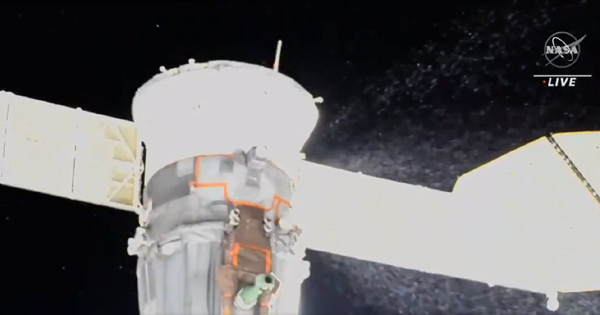
A video screenshot of coolant leaking from the Soyuz MS-22 capsule at the International Space Station...on December 14, 2022.
NASA TV

Thursday, December 22, 2022

The ISS Gets a New Set of Solar Wings Almost Three Weeks After Receiving the Previous One...

NASA astronaut Josh Cassada works on prepping a new iROSA assembly before it is attached to the International Space Station and deployed...on December 22, 2022.
NASA / Frank Rubio

NASA Spacewalkers Install Station’s Fourth Roll-Out Solar Array (News Release)

Expedition 68 Flight Engineers Josh Cassada and Frank Rubio of NASA concluded their spacewalk at 3:27 p.m. EST after 7 hours and 8 minutes.

Cassada and Rubio completed their major objectives for today to install an International Space Station Roll-Out Solar Array (iROSA) on the 4A power channel on the port truss. The iROSAs will increase power generation capability by up to 30%, increasing the station’s total available power from 160 kilowatts to up to 215 kilowatts.

It was the 257th spacewalk in support of space station assembly, upgrades and maintenance, and was the third spacewalk for both astronauts.

Cassada and Rubio are in the midst of a planned six-month science mission living and working aboard the microgravity laboratory to advance scientific knowledge and demonstrate new technologies for future human and robotic exploration missions, including lunar missions through NASA’s Artemis program.

While Thursday’s spacewalk was underway, NASA Space Station Program Manager Joel Montalbano and Roscosmos Human Spaceflight Executive Director Sergei Krikalev participated in an audio-only media teleconference. The two space executives discussed the ongoing investigation of an external leak detected on the Soyuz MS-22 crew ship.

Ground teams continue to assess data and options for the safe return of crew to Earth.

Listen to the teleconference here.

Source: NASA.Gov

****
Thursday, December 15, 2022

One of Russia's Two Lifeboats at the ISS Is Experiencing an Issue...

A video screenshot of coolant leaking from the Soyuz MS-22 capsule at the International Space Station...on December 14, 2022.
NASA TV

Mission Controllers Assess Soyuz Coolant Leak (News Release)

Ground teams at Mission Control in Moscow continue to assess a coolant leak detected from the aft end of the Soyuz MS-22 spacecraft docked to the International Space Station. As a result, the planned December 14 Roscosmos spacewalk was canceled to allow time to evaluate the fluid and potential impacts to the integrity of the Soyuz spacecraft.

NASA and Roscosmos will continue to work together to determine the next course of action following the ongoing analysis. The crew members aboard the space station are safe, and were not in any danger during the leak.

The Soyuz MS-22 spacecraft carried NASA astronaut Frank Rubio and Roscosmos cosmonauts Sergey Prokopyev and Dmitri Petelin into space after launching from the Baikonur Cosmodrome in Kazakhstan on September 21.

Source: NASA.Gov

****

Wednesday, October 12, 2022

Photos of the Day: Starship Super Heavy Is Whole Again...

SpaceX's Starship Super Heavy rocket stands tall at the pad in Starbase, Texas...on October 11, 2022.
SpaceX

Just thought I'd share these images released by SpaceX after Starship Serial No. 24 and Super Heavy Booster 7 were stacked for the first time at Starbase in Texas yesterday.

The last time Starship Super Heavy was fully assembled atop the Orbital Launch Mount was earlier this year...with Starship 20 and Booster 4 on the pad.

In other Starship news, Dennis Tito—an American entrepreneur who became the first space tourist to visit the International Space Station via Russia's Soyuz capsule in 2001—will fly around the Moon (along with his wife Akiko) on the vehicle's second flight. Click here for more details.

Starship SN24 is hoisted into the air to be mated with Super Heavy Booster 7 atop the Orbital Launch Mount at Starbase, Texas...on October 11, 2022.
SpaceX

Starship SN24 is almost raised into position above Super Heavy Booster 7 atop the Orbital Launch Mount at Starbase, Texas...on October 11, 2022.
SpaceX

Starship SN24 is about to be mated to Super Heavy Booster 7 atop the Orbital Launch Mount at Starbase, Texas...on October 11, 2022.
SpaceX