Showing posts with label Cygnus. Show all posts

Thursday, March 5, 2026

Japan's Newest Space Freighter Is Ready to Depart from the ISS...

Japan's new HTV-X1 freighter is grappled by the Canadarm2 robotic arm after the cargo craft arrived at the International Space Station...on October 29, 2025.
NASA

Canadarm2 Grips Cargo Spacecraft, Spacewalk Prep and Biology Continue (News Release)

A JAXA (Japan Aerospace Exploration Agency) cargo spacecraft is in the grasp of the Canadarm2 robotic arm following its detachment from the International Space Station’s Harmony module on Thursday. The Expedition 74 crew continued its spacewalk preparations, transferred more cargo, and conducted biology research throughout the day.

The HTV-X1 cargo spacecraft was uninstalled from Harmony with Canadarm2 at 2:26 p.m. EST on Thursday and maneuvered to an overnight parking position. During the crew’s sleep shift, Japanese mission controllers will conduct a laser-ranging sensor demonstration test with HTV-X1 still held by the robotic arm.

Then at 12 p.m. EST on Friday, robotics controllers will command the Canadarm2 to release HTV-X1 into Earth orbit. The spacecraft will remain at a safe distance from the station for approximately three months while conducting a series of remotely-controlled science experiments. NASA will broadcast the release live, beginning at 11:45 a.m. Friday on NASA+, Amazon Prime and the agency’s YouTube channel.

While robotic operations continued outside the space station, the astronauts pressed ahead with spacewalk preparations. NASA flight engineers Jessica Meir, Chris Williams and Jack Hathaway gathered together and reviewed the tools and equipment required to install a modification kit and route cables for a future roll-out solar array on the port side of the orbital outpost. NASA will soon announce the date and name the two spacewalkers who will exit the station’s Quest airlock into the vacuum of space for the roll-out solar array preparation work.

ESA (European Space Agency) astronaut Sophie Adenot began her shift packing cargo for disposal inside Northrop Grumman’s Cygnus XL cargo spacecraft attached to the Unity module’s Earth-facing port. Cygnus will conclude its mission soon at the orbital outpost that began on September 18 with its robotic capture and installation to Unity. Adenot also worked in the Kibo laboratory module removing computer and electronics hardware for stowage and later reuse.

Cosmonauts Sergey Kud-Sverchkov and Sergei Mikaev teamed up early Thursday for a Roscosmos digestion study. Shortly after waking, the duo scanned their stomachs with an ultrasound device before eating their breakfast. After their meal, the station commander and flight engineer repeated the stomach scans helping researchers understand how the digestive system adapts to weightlessness.

Flight Engineer Andrey Fedyaev kicked off his shift servicing the Elektron oxygen generator and its components in the station’s Roscosmos segment. Fedyaev then inspected video recording gear, downloaded video and imagery for mission controllers, and installed automated Earth observation hardware to capture imagery of islands across the Asia-Pacific region.

Source: NASA.Gov

Friday, January 9, 2026

The Latest Update on Crew-11's Departure from the ISS...

An infographic showing all of the vehicles that were docked or berthed to the International Space Station on December 8, 2025.
NASA

NASA, SpaceX Set Target Date for Crew-11’s Return to Earth (News Release)

NASA and SpaceX are targeting no earlier than 5 p.m. EST on Wednesday, January 14, for the undocking of the agency’s SpaceX Crew-11 mission from the International Space Station, pending weather conditions.

On January 8, NASA announced its decision to return the agency’s SpaceX Crew-11 mission to Earth from the space station earlier than originally planned as teams monitor a medical concern with a crew member currently living and working aboard the orbital laboratory, who is stable. Due to medical privacy, it is not appropriate for NASA to share more details about the crew member.

NASA astronauts Zena Cardman and Mike Fincke, JAXA (Japan Aerospace Exploration Agency) astronaut Kimiya Yui, and Roscosmos cosmonaut Oleg Platonov will splash down off the coast of California at approximately 3:40 a.m. on Thursday, January 15.

Mission managers continue monitoring conditions in the recovery area, as undocking of the SpaceX Dragon depends on spacecraft readiness, recovery team readiness, weather, sea states and other factors. NASA and SpaceX will select a specific splashdown time and location closer to the Crew-11 spacecraft undocking.

NASA’s coverage is as follows (all times Eastern and subject to change based on real-time operations):

Wednesday, January 14

3 p.m. – Hatch closure coverage begins

3:30 p.m. – Hatch closing

4:45 p.m. – Undocking coverage begins

5 p.m. – Undocking

Thursday, January 15

2:15 a.m. – Return coverage begins

2:50 a.m. – Deorbit burn

3:40 a.m. – Splashdown

5:45 a.m. – Return to Earth media news conference

NASA will share more details about its coverage plans in the coming days.

Source: NASA.Gov

Thursday, August 1, 2024

Looking Ahead to Crew Dragon's Tenth Government Flight to the ISS...

A group photo of the four-member crew for NASA's SpaceX Crew-10 mission to the International Space Station.
NASA

NASA Shares its SpaceX Crew-10 Assignments for Space Station Mission (News Release)

As part of NASA’s SpaceX Crew-10 mission, four crew members are preparing to launch for a long-duration stay aboard the International Space Station.

NASA astronauts Commander Anne McClain and Pilot Nichole Ayers, JAXA (Japan Aerospace Exploration Agency) astronaut Mission Specialist Takuya Onishi, and Roscosmos cosmonaut Mission Specialist Kirill Peskov will join astronauts at the orbiting laboratory no earlier than February of 2025.

The flight is the 10th crew rotation with SpaceX to the station as part of NASA’s Commercial Crew Program. While aboard, the international crew will conduct scientific investigations and technology demonstrations to help prepare humans for future missions and benefit people on Earth.

Selected by NASA as an astronaut in 2013, this will be McClain’s second spaceflight. A colonel in the U.S. Army, she earned her bachelor’s degree in Mechanical Engineering from the U.S. Military Academy at West Point, New York, and holds master’s degrees in Aerospace Engineering, International Security and Strategic Studies.

McClain was an instructor pilot in the OH-58D Kiowa Warrior helicopter and is a graduate of the U.S. Naval Test Pilot School in Patuxent River, Maryland. The Spokane, Washington, native has more than 2,300 flight hours in 24 rotary and fixed-wing aircraft, including more than 800 in combat, and was a member of the U.S. Women’s National Rugby Team.

On her first spaceflight, McClain spent 204 days as a flight engineer during Expeditions 58 and 59 and was the lead on two spacewalks, totaling 13 hours and 8 minutes. Since then, she has served in various roles, including branch chief and space station assistant to the chief of NASA’s Astronaut Office.

Ayers is a major in the U.S. Air Force and the first member of NASA’s 2021 astronaut class named to a crew. The Colorado native graduated from the Air Force Academy in Colorado Springs with a bachelor’s degree in Mathematics and a minor in Russian, where she was a member of the academy’s varsity volleyball team.

Ayers later earned a master’s in Computational and Applied Mathematics from Rice University in Houston. She served as an instructor pilot and mission commander in the T-38 ADAIR and F-22 Raptor, leading multinational and multiservice missions worldwide.

Ayers has more than 1,400 total flight hours, including more than 200 in combat.

With 113 days in space, this mission will also mark Onishi’s second trip to the space station. After being selected by JAXA in 2009, he flew as a flight engineer for Expeditions 48 and 49 and became the first Japanese astronaut to robotically capture the Cygnus spacecraft.

Onishi also constructed a new experimental environment aboard Kibo, the station’s Japanese experiment module. Since his spaceflight, Onishi became certified as a JAXA flight director, leading the team responsible for operating Kibo from JAXA Mission Control in Tsukuba, Japan.

Onishi holds a bachelor’s degree in Aeronautics and Astronautics from the University of Tokyo and was a pilot for All Nippon Airways, flying more than 3,700 flight hours in the Boeing 767.

NASA’s SpaceX Crew-10 mission will also be Peskov’s first spaceflight. Before his selection as a cosmonaut in 2018, he earned a degree in Engineering from the Ulyanovsk Civil Aviation School and was a co-pilot on the Boeing 757 and 767 aircraft for airlines Nordwind and Ikar.

Assigned as a test-cosmonaut in 2020, Peskov has additional experience in skydiving, zero-gravity training, scuba diving and wilderness survival.

For more than two decades, people have lived and worked continuously aboard the International Space Station, advancing scientific knowledge and demonstrating new technologies, making research breakthroughs not possible on Earth. The station is a critical testbed for NASA to understand and overcome the challenges of long-duration spaceflight and to expand commercial opportunities in low-Earth orbit.

As commercial companies focus on providing human space transportation services and destinations as part of a robust low-Earth orbit economy, NASA’s Artemis campaign is underway at the Moon, where the agency is preparing for future human exploration of Mars.

Source: NASA.Gov

Friday, June 14, 2024

Photos of the Day: The ISS from High Above...

An image of the International Space Station that was taken by Maxar Technologies' WorldView-3 satellite from 276 kilometers (172 miles) above...on June 7, 2024.
Maxar Technologies

Just thought I'd share this amazing image that was taken of the International Space Station (ISS) by Maxar Technologies' WorldView-3 Earth-observation satellite...which launched aboard United Launch Alliance's (ULA) Atlas V rocket on August 13, 2014.

WorldView-3 was orbiting 276 kilometers (172 miles) above the ISS when this stunning picture was captured a week ago on June 7.

Speaking of ULA's Atlas V, the rocket's latest payload—Boeing's Starliner Calypso capsule—can be seen docked to the forward port of the station's Harmony module in this photo.

The annotated version of this image, showing five of the six visiting vehicles (Calypso, Crew Dragon Endeavour, Cygnus, Soyuz MS-25 as well as Progress 87 and 88) that are currently docked to the ISS, is posted below.

Calypso itself is currently set to return to Earth on June 22...landing at White Sands Space Harbor in New Mexico to complete Boeing's Crew Flight Test.

An annotated image showing five of the six visiting vehicles that are currently docked to the International Space Station...as of June 7, 2024.
Maxar Technologies / SpaceX FrontPage

Friday, August 4, 2023

The S.S. Laurel Clark Has Docked to the ISS...

A video screenshot showing Northrop Grumman's Cygnus freighter, dubbed the S.S. Laurel Clark after the late NASA astronaut who flew on space shuttle Columbia's final mission, about to be berthed to the International Space Station...on August 4, 2023.
NASA TV

Cygnus Installed on Station, Crew Begins Cargo Ops (News Release)

Northrop Grumman’s Cygnus spacecraft installation at the International Space Station is now complete. Cygnus, carrying over 8,200 pounds of cargo and science experiments, launched atop the company’s Antares rocket at 8:31 p.m. EDT on Tuesday, August 1, from NASA’s Wallops Flight Facility in Virginia.

At 5:52 a.m., NASA astronaut Woody Hoburg, along with NASA astronaut Frank Rubio as backup, captured Cygnus using the station’s Canadarm2 robotic arm.

Highlights of space station research facilitated by delivery aboard this Cygnus are:

- The final iteration of a series of spacecraft fire protection experiments

- A new potable water dispenser that provides hot water and improved sanitization

- Neural cells that will be cultured into 3D cell models for gene therapy testing

- A probe that measures plasma density of the upper atmosphere

- A memory card that contains creative works from students around the world

Cygnus will remain at the space station until October before it departs for a destructive re-entry into Earth’s atmosphere.

Source: NASA.Gov

Tuesday, August 1, 2023

ISS Update: The Final Antares 230+ Rocket Has Taken Flight...

An Antares 230+ rocket, the final booster in this class before the Antares 330 makes its debut a few years from now, launches a Cygnus resupply freighter to the International Space Station from NASA's Wallops Flight Facility in Virginia...on August 1, 2023.
NASA

Science, Hardware Launch on NASA’s Northrop Grumman Cargo Mission (Press Release)

A Northrop Grumman Cygnus resupply spacecraft is on its way to the International Space Station with more than 8,200 pounds of NASA science investigations and cargo after launching at 8:31 p.m. EDT on Tuesday, from the agency’s Wallops Flight Facility in Virginia.

NASA Television, the NASA app and the agency’s website will provide live coverage of the spacecraft’s rendezvous with the space station beginning at 4:30 a.m. on Friday, August 4.

Cygnus is scheduled for capture by the Canadarm2 robotic arm at 5:55 a.m., which will be operated by NASA astronaut Woody Hoburg with assistance from NASA astronaut Frank Rubio.

Installation coverage will resume at 7:30 a.m. Watch all events at:

https://www.nasa.gov/live

Northrop Grumman’s 19th cargo flight to the space station is the eighth under its Commercial Resupply Services 2 contract with NASA. The Cygnus spacecraft launched on the company’s Antares 230+ rocket from the Mid-Atlantic Regional Spaceport’s Pad-0A on Wallops Island.

The resupply mission will support dozens of research experiments conducted during Expedition 69.

Included among the investigations are:

Testing gene therapy: Neuronix, sponsored by the International Space Station National Laboratory, demonstrates the formation of 3D neuron cell cultures in microgravity and tests a neuron-specific gene therapy.

Experimenting with fire: The sixth Spacecraft Fire Experiments (Saffire-VI) is the last in a series to test flammability at different oxygen levels and to demonstrate fire detection and monitoring as well as post-fire cleanup capabilities. This experiment will take place after the spacecraft has departed the space station.

Measuring atmospheric density: The Multi-Needle Langmuir Probe, an investigation from ESA (European Space Agency), monitors plasma densities in the ionosphere – where Earth’s atmosphere meets space.

Better water for explorers: A water system launched in fall 2008 provides water for crew consumption and food preparation on the space station. A new system, Exploration PWD, uses advanced water sanitization and microbial growth reduction methods and dispenses hot water.

High-flying art: For I-Space Essay, JAXA (Japan Aerospace Exploration Agency) is sending a memory card that contains digital works created by students, such as pictures and poetry, to the space station.

Robotic helper: A cube-shaped Astrobee robot is on its way back to the space station to help reduce the amount of time astronauts spend on routine tasks.

Hardware upgrades to improve outcomes for researchers

Cygnus will also deliver a condensation module and heat transfer system for the Flow Boiling and Condensation Experiment that will help researchers better understand heat distribution and flow. Such knowledge could be used to enhance mechanisms that protect astronauts from the extreme hot and cold temperatures of space.

The station’s Cold Atom Lab, which makes use of the microgravity environment of space to study quantum phenomena in ways that aren’t possible on Earth, will get an upgrade that will give scientists more data in a wider variety of experimental conditions.

These are just a sample of the hundreds of investigations conducted aboard the orbiting laboratory in the areas of biology and biotechnology, physical sciences, and Earth and space science. Such research benefits humanity and lays the groundwork for future human exploration through the agency’s Artemis missions, which will send astronauts to the Moon to prepare for future expeditions to Mars.

Northrop Grumman named the Cygnus S.S. Laurel Clark after late NASA astronaut and crew member of NASA’s STS-107 mission aboard space shuttle Columbia, Laurel Clark.

The Cygnus spacecraft will remain at the space station until October before it departs and disposes of several thousand pounds of trash through its destructive re-entry into Earth’s atmosphere.

****

Tuesday, May 31, 2022

European Companies Continue Work on Artemis 4's Orion Service Module and Lunar Gateway Components...

At Thales Alenia Space in Turin, Italy, work continues on the European Service Module that will fly on NASA's Artemis 4 mission.
Thales Alenia Space

Orion’s European Service Module 4 Successfully Completed Integration Activities in Thales Alenia Space’s Turin Plant (News Release)

Thales Alenia Space is responsible for the primary and the secondary structure, and thermo-mechanical systems of ESA's European Service Modules (ESM)

Turin (Italy) - Thales Alenia Space, a joint venture between Thales (67%) and Leonardo (33%), has successfully completed the activities related to the final integration of the critical systems of Orion’s European Service Module 4. The module is now on its way to Airbus Defence and Space’s clean rooms in Bremen, Germany. There, it will complete the integration and carry out final tests, supported by Thales Alenia Space engineers on-site.

The Orion spacecraft was designed to take astronauts back to the Moon, as part of NASA's Artemis Program. The overall European Service Module has been developed on behalf of ESA, providing the structure, propulsion, power, thermal control, and primary life support. Specifically, ESM4 - as part of the Artemis IV mission - will drive the International Habitat (I-HAB) to the Lunar Gateway, docking with the Habitation and Logistics Outpost (HALO) to further enhance human living capabilities in lunar orbit.

In addition to ESM 4, as for previous modules 1, 2 and 3, Thales Alenia Space will provide Airbus - Orion's ESM module prime contractor - with the critical subsystems of the forthcoming ESM 5 and 6 service modules, including structure, micro-meteorite protection, thermal control, storage, and distribution of consumables. These subsystems are crucial parts of the modules as they ensure vital and safe conditions for the crew during the entire mission.

Leonardo is also partnering in the program, supplying the photovoltaic panels (PVA) and Power Control and Distribution Units (PCDU) for ESM modules 1 to 6.

Thales Alenia Space has completed the final pre-integration phase of ESM 4's thermo-mechanical system, including the assembly of components for the Thermal Control System (TCS) and the Consumable Storage System (CSS) subsystems. Following the check of the components under Thales Alenia Space’s responsibility (including vital elements such as the system pump and radiators) with the relevant functional checks and the final completion of the activities by the prime contractor, ESM 4 will then be delivered to Kennedy Space Center in Florida, USA. Thales Alenia Space will continue to play its role of paramount importance while its engineers will contribute to the packing phase activities during transport.

In addition to being responsible for the thermo-mechanical systems for the Orion European Service Module, the company is heavily involved in Lunar Gateway, providing ESPRIT and I-HAB pressurized modules to ESA. The welding of HALO is also underway at Thales Alenia Space’s plant in Turin.

Leveraging on its one-of-a-kind legacy onboard Cygnus and the International Space Station, for which the company has provided the major part of its habitable modules, Thales Alenia Space has now become a top industrial partner onboard Lunar Gateway and Axiom commercial space station. The world leader in orbital infrastructures, the company is also involved in several studies with the Italian Space Agency (ASI) and ESA - both on the surface and in lunar orbit, as well as supporting major space exploration missions.

Source: Thales Alenia Space

****

An artist's concept of NASA's Gateway space station orbiting our Moon...with Mars in the distance.
Thales Alenia Space

Saturday, December 4, 2021

NASA Will Help Fund Three Private Microgravity Outposts in Low-Earth Orbit...

An artist's concept of the Orbital Reef space station.
Blue Origin / Sierra Space / Boeing / Redwire Space / Genesis Engineering Solutions / ASU

NASA Selects Companies to Develop Commercial Destinations in Space (Press Release - December 2)

NASA has signed agreements with three U.S. companies to develop designs of space stations and other commercial destinations in space. The agreements are part of the agency’s efforts to enable a robust, American-led commercial economy in low-Earth orbit.

The total estimated award amount for all three funded Space Act Agreements is $415.6 million. The companies that received awards are:

- Blue Origin of Kent, Washington, for $130 million
- Nanoracks LLC, of Houston for $160 million
- Northrop Grumman Systems Corporation of Dulles, Virginia, for $125.6 million

NASA seeks to maintain an uninterrupted U.S. presence in low-Earth orbit by transitioning from the International Space Station to other platforms. These awards will stimulate U.S. private sector development of commercial, independent space stations that will be available to both government and private-sector customers.

“Building on our successful initiatives to partner with private industry to deliver cargo, and now our NASA astronauts, to the International Space Station, NASA is once again leading the way to commercialize space activities,” said NASA Administrator Bill Nelson. “With commercial companies now providing transportation to low-Earth orbit in place, we are partnering with U.S. companies to develop the space destinations where people can visit, live, and work, enabling NASA to continue forging a path in space for the benefit of humanity while fostering commercial activity in space.”

The awards are the first in a two-phase approach to ensure a seamless transition of activity from the International Space Station to commercial destinations. During this first phase, private industry, in coordination with NASA, will formulate and design commercial low-Earth orbit destination capabilities suitable for potential government and private sector needs. The first phase is expected to continue through 2025.

Blue Origin and Sierra Space have partnered to develop Orbital Reef, a commercially owned and operated space station to be built in low-Earth orbit, which will start operating in the second half of this decade. Orbital Reef teammates include Boeing, Redwire Space, Genesis Engineering, and Arizona State University. Orbital Reef’s human-centered space architecture is designed to be a “mixed-use space business park” that provides essential infrastructure needed to support all types of human spaceflight activity in low-Earth orbit and can be scaled to serve new markets.

The station’s shared infrastructure will support the proprietary needs of diverse U.S. and international users, tenants, and visitors, including those representing research, industry, government, and the commercial sector. Features such as reusable space transportation and advanced automation can minimize cost and complexity to enable the widest range of users. Accommodations, vehicle docking ports, and utilities can all be scaled with growth in market demand.

Nanoracks’ commercial low-Earth orbit destination, in collaboration with Voyager Space and Lockheed Martin, is called Starlab. Starlab is targeted for launch in 2027 on a single flight as a continuously crewed, commercial space station dedicated to conducting advanced research, fostering commercial industrial activity, and ensuring continued U.S. presence and leadership in low-Earth orbit. Starlab is designed for four astronauts and will have power, volume, and a payload capability equivalent to the International Space Station.

Starlab will host the George Washington Carver Science Park featuring four main operational departments – a biology lab, plant habitation lab, physical science and materials research lab, and an open workbench area – to meet the needs of researchers and commercial customers for commercial space activities. The station will be built with flexible growth in mind, featuring interfaces both internal and external to the spacecraft to allow Nanoracks to expand the architecture as new demand sources are identified, and new markets emerge.

Northrop Grumman’s design for a modular, commercial destination in low-Earth orbit is built on decades of experience supporting NASA, defense, and commercial programs. The design leverages flight-proven elements, such as the Cygnus spacecraft that provides cargo delivery to the International Space Station, to provide a base module for extended capabilities including science, tourism, industrial experimentation, and the building of infrastructure beyond initial design.

Multiple docking ports will allow future expansion to support crew analog habitats, laboratories, crew airlocks, and facilities capable of artificial gravity, in support of multiple customers. This Space Act Agreement will enable Northrop Grumman to provide a detailed commercialization, operations, and capabilities plan, as well as space station requirements, mission success criteria, risk assessments, key technical and market analysis requirements, and preliminary design activities. Northrop Grumman’s team includes Dynetics, with other partners to be announced.

For the second phase of NASA’s approach to a transition toward commercial low-Earth orbit destinations, the agency intends to certify for NASA crew member use commercial low-Earth orbit destinations from these and potential other entrants, and ultimately, purchase services from destination providers for crew to use when available. This strategy will provide services the government needs at a lower cost, enabling NASA to focus on its Artemis missions to the Moon and on to Mars while continuing to use low-Earth orbit as a training and proving ground.

NASA estimates the agency’s future needs in low-Earth orbit will require continuous accommodations and training for at least two crew members, as well as the ability to support a national orbiting laboratory and the performance of approximately 200 investigations annually to support human research, technology demonstrations, biological and physical science.

Developing commercial destinations in low-Earth orbit is part of NASA’s broader efforts to build a robust low-Earth orbit economy, including supporting commercial activity and enabling the first private astronaut mission to the space station. In addition to these new awards NASA selected Axiom Space in January 2020 to design and develop commercial modules to attach to the station. NASA and Axiom recently completed the preliminary design review of two modules as well as the critical design review of the module’s primary structure.

By transitioning to a model where commercial industry owns and operates the assets in low-Earth orbit and where NASA is one of many customers, the agency can save on costs to live and work in low-Earth orbit and focus on pushing innovation and exploration of the Moon and Mars through NASA’s Artemis missions.

****

An artist's concept of the Starlab space station in low-Earth orbit.
Nanoracks / Voyager Space / Lockheed Martin

An artist's concept of Northrop Grumman’s free-flyer commercial destination, with a Cygnus freighter and SpaceX's Crew Dragon capsule attached to it, in low-Earth orbit.
Northrop Grumman

Thursday, August 12, 2021

ISS Update: The S.S. Ellison Onizuka Is Now Berthed to the Orbital Outpost...

An infographic showing where Crew Dragon, Soyuz, Progress and the Cygnus freighter are currently docked to the International Space Station.
NASA

Earlier today, Northrop Grumman's Cygnus cargo freighter—christened the S.S. Ellison Onizuka in honor of the fallen space shuttle Challenger astronaut—was successfully berthed to the International Space Station (ISS). The freighter was bolted in place to the Earth-facing port of the Unity module at 9:42 AM, Eastern Daylight Time (6:42 AM, Pacific Daylight Time).

The S.S. Onizuka, which launched two days ago and brought 8,200 pounds of science experiments and supplies to the ISS, will remain at the orbital outpost till November. Trash will be loaded onto the Cygnus spacecraft before it is unberthed from the space station and intentionally conducts a destructive re-entry into Earth's atmosphere.

Tuesday, August 10, 2021

ISS Update: The S.S. Ellison Onizuka Is Headed to the Orbital Outpost...

A Cygnus spacecraft--named the S.S. Ellison Onizuka after the fallen space shuttle Challenger astronaut--launches aboard an Antares 230+ rocket from NASA's Wallops Flight Facility in Virginia...on August 10, 2021.
NASA / Jamie Adkins

NASA Science, Cargo Launches on Northrop Grumman Resupply Mission (Press Release)

A Northrop Grumman Cygnus resupply spacecraft is on its way to the International Space Station with more than 8,200 pounds of science investigations and cargo after launching at 6:01 p.m. EDT Tuesday from NASA’s Wallops Flight Facility in Virginia. At 8:46 p.m., the spacecraft’s solar arrays successfully deployed to collect sunlight to power Cygnus on its journey to the station.

Cygnus is scheduled to arrive at the space station around 6:10 a.m. Thursday, Aug. 12. NASA Television, the NASA app, and the agency’s website will provide live coverage of the spacecraft’s approach and arrival beginning at 4:45 a.m.

NASA astronaut Megan McArthur will use the space station’s robotic Canadarm2 to capture Cygnus upon its arrival, while ESA (European Space Agency) astronaut Thomas Pesquet monitors telemetry during rendezvous, capture, and installation on the Earth-facing port of the Unity module.

This is Northrop Grumman’s 16th cargo flight to the space station and is the fifth under its Commercial Resupply Services 2 contract with NASA. Cygnus launched on an Antares 230+ rocket from the Virginia Mid-Atlantic Regional Spaceport’s Pad 0A at Wallops.

The resupply flight will support dozens of new and existing investigations. Included in the scientific investigations Cygnus is delivering to the space station are:

From dust to dwelling

Using resources available on the Moon and Mars to build structures and habitats could reduce how much material future explorers need to bring from Earth, significantly reducing launch mass and cost. The Redwire Regolith Print (RRP) study demonstrates 3D printing on the space station using a material simulating regolith, or loose rock and soil, found on the surfaces of planetary bodies such as the Moon. Results could help determine the feasibility of using regolith as the raw material and 3D printing as a technique for on-demand construction of habitats and other structures on future space exploration missions.

Maintaining muscles

As people age and become more sedentary on Earth, they gradually lose muscle mass, a condition called sarcopenia. Identifying drugs to treat this condition is difficult because it develops over decades. Cardinal Muscle tests whether microgravity can be used as a research tool for understanding and preventing sarcopenia. The study, funded by the National Science Foundation in collaboration with the ISS U.S. National Laboratory, seeks to determine whether an engineered tissue platform in microgravity forms the characteristic muscle tubes found in muscle tissue. Such a platform could provide a way to rapidly assess potential drugs prior to clinical trials.

Taking the heat out of space travel

Longer space missions will need to generate more power, producing more heat that must be dissipated. Transitioning from current single-phase heat transfer systems to two-phase thermal management systems reduces size and weight of the system and provides more efficient heat removal. Because greater heat energy is exchanged through vaporization and condensation, a two-phase system can remove more heat for the same amount of weight than current single-phase systems. The Flow Boiling and Condensation Experiment (FBCE) aims to develop a facility for collecting data about two-phase flow and heat transfer in microgravity. Comparisons of data from microgravity and Earth’s gravity are needed to validate numerical simulation tools for designing thermal management systems.

Cooler re-entries

The Kentucky Re-Entry Probe Experiment (KREPE) demonstrates an affordable thermal protection system (TPS) to protect spacecraft and their contents during re-entry into Earth’s atmosphere. Making these systems efficient remains one of space exploration’s biggest challenges, but the unique environment of atmospheric entry makes it difficult to accurately replicate conditions in ground simulations. TPS designers rely on numerical models that often lack flight validation. This investigation serves as an inexpensive way to compare these models to actual flight data and validate possible designs. Before flying the technology on the space station, researchers conducted a high-altitude balloon test to validate performance of the electronics and communications.

Getting the carbon dioxide out

Four Bed CO2 Scrubber demonstrates a technology to remove carbon dioxide from a spacecraft. Based on the current system and lessons learned from its nearly 20 years of operation, the Four Bed CO2 Scrubber includes mechanical upgrades and an improved, longer-lasting absorbent material that reduces erosion and dust formation. Absorption beds remove water vapor and carbon dioxide from the atmosphere, returning water vapor to the cabin and venting carbon dioxide overboard or diverting it to a system that uses it to produce water. This technology could improve the reliability and performance of carbon dioxide removal systems in future spacecraft, helping to maintain the health of crews and ensure mission success. It has potential applications on Earth in closed environments that require carbon dioxide removal to protect workers and equipment.

Mold in microgravity

An ESA investigation, Blob, allows students aged 10 to 18 to study a naturally-occurring slime mold, Physarum polycephalum, that is capable of basic forms of learning and adaptation. Although it is just one cell and lacks a brain, Blob can move, feed, organize itself, and even transmit knowledge to other slime molds. Students replicate experiments conducted by ESA astronaut Thomas Pesquet to see how the Blob’s behavior is affected by microgravity. Using time-lapse video from space, students can compare the speed, shape, and growth of the slime molds in space and on the ground. The French space agency Centre National d'Etudes Spatiales and the French National Center for Scientific Research coordinate Blob.

These are just a few of the hundreds of investigations currently being conducted aboard the orbiting laboratory in the areas of biology and biotechnology, physical sciences, and Earth and space science. Advances in these areas will help keep astronauts healthy during long-duration space travel and demonstrate technologies for future human and robotic exploration missions as part of NASA’s Moon and Mars exploration approach, including lunar missions through NASA’s Artemis program.

Cygnus also will deliver a new mounting bracket that astronauts will attach to the port side of the station’s backbone truss during a spacewalk planned for late August. The mounting bracket will enable the installation of one of the next pair of new solar arrays at a later date.

The Cygnus spacecraft will remain at the space station until November before it disposes of several thousand pounds of trash through its destructive re-entry into Earth’s atmosphere.

****

Friday, July 9, 2021

Artemis Update: The Gateway Moves One Step Closer to Becoming a Cornerstone for Sustainable Lunar Exploration...

An artist's concept of NASA's Gateway space station in orbit around the Moon.
NASA

NASA, Northrop Grumman Finalize Moon Outpost Living Quarters Contract (Press Release)

NASA and Northrop Grumman of Dulles, Virginia, have finalized a contract to develop the Habitation and Logistics Outpost (HALO) for Gateway, which will be a critical way station and outpost in orbit around the Moon as part of NASA’s Artemis program.

NASA and its commercial and international partners are building Gateway to support science investigations and enable surface landings at the Moon, which will help prepare astronauts for future missions to Mars.

The firm, fixed-price contract is valued at $935 million. Under the contract, Northrop Grumman will be responsible for attaching and testing the integrated HALO with the Power and Propulsion Element (PPE) being built by Maxar Technologies. Northrop Grumman will also lead the integrated PPE and HALO spacecraft turnover and launch preparation with SpaceX, and support activation and checkout of HALO during the flight to lunar orbit. NASA is targeting November 2024 to launch the integrated spacecraft on a SpaceX Falcon Heavy rocket.

“NASA is building the infrastructure to expand human exploration further out into the solar system than ever before, including Gateway, the lunar space station that will help us make inspirational scientific discoveries at and around the Moon. Just as importantly, these investments will help NASA carry out the United States’ horizon goal: to further develop and test the technology and science needed for a human trip to Mars,” said NASA Administrator Bill Nelson. “The HALO is a critical component of Gateway, and this exciting announcement today brings us one step closer to landing American boots on both the Moon and Mars.”

HALO is where astronauts will live and conduct research while visiting the Gateway. The pressurized living quarters will provide command and control systems for the lunar outpost, and docking ports for visiting spacecraft, such as NASA’s Orion spacecraft, lunar landers, and logistics resupply craft. The HALO module will serve as the backbone for command and control and power distribution across Gateway and will perform other core functions, including hosting science investigations via internal and external payload accommodations and communicating with lunar surface expeditions. HALO also will enable the aggregation of additional habitable elements to expand Gateway capabilities. Immediately after launch, the Heliophysics Environmental and Radiation Measurement Experiment Suite, built by NASA’s Goddard Space Flight Center in Greenbelt, Maryland, will begin conducting research outside of the integrated spacecraft.

“This is a major step on the path for Artemis, not just for NASA, but for the combined team, including our commercial and international partners,” said Kathy Lueders, NASA associate administrator for Human Explorations and Operations. “Gateway will provide unprecedented access to the Moon and symbolizes the expansion of our partnerships into deep space.”

The integrated PPE and HALO will be the Gateway’s foundation, enabling humanity’s first permanent outpost in orbit around the Moon. Located tens of thousands of miles from the lunar surface at its farthest point and within easy range of lunar landers at its closest, the Gateway will be in a near-rectilinear halo orbit. This orbit will allow NASA and its international and commercial partners to conduct unprecedented deep space science and technology investigations, and conduct sustainable lunar exploration.

“This action puts in place the final contract component of a diverse, multi-faceted team – distributed across the country and within some international partner facilities – working together to create and implement the initial Gateway capability. We are excited to work with Northrop Grumman and all the partners to deliver the cornerstone of sustainable human exploration in cis-lunar space,” said Dr. Jon Olansen, NASA’s manager of the HALO project.

HALO leverages contributions from the Gateway international partners for robust capabilities. Batteries provided by the Japan Aerospace Exploration Agency (JAXA) will power HALO until PPE solar arrays can be deployed and during eclipse periods. Robotic interfaces provided by the Canadian Space Agency will host payloads and provide base points for Canadarm3 robotic operations. ESA (European Space Agency) will provide a lunar communications system to enable high-data-rate communications between the lunar surface and Gateway. With three docking ports, HALO will be the hub for international Gateway expansion in the future, including an international habitat that ESA and JAXA will provide, and an ESA-provided refueling module. The docking ports also will host a human landing system for lunar surface expeditions and logistics resupply spacecraft. As the Gateway hub, HALO will provide power, data, airflow to each of these ports, as well as thermal conditioning to assist future elements and spacecraft in controlling the temperature of their equipment and habitable environment.

“Leveraging our success with our Cygnus spacecraft, Northrop Grumman is perfectly positioned to deliver the HALO module, a critical piece for NASA’s Artemis program and our journey to the Moon and beyond,” said Frank DeMauro, vice president and general manager for tactical space systems at Northrop Grumman. “After recently completing a successful preliminary design review, we now look forward to completing the detailed design efforts and eventually bringing HALO to life in our Gilbert, Arizona, facility while also providing integration services for the final, combined vehicle before launch.”

HALO’s design is based on Northrop Grumman’s Cygnus spacecraft, which has completed 15 resupply missions to the International Space Station to date. A previous contract for HALO, awarded in June 2020, funded work through preliminary design review, one of a series of checkpoints for the complex engineering project. The review process for the module, completed in May, assessed all of the spacecraft’s design to ensure the overall system is safe and reliable for flight and meets NASA’s mission requirements.

****

Friday, April 23, 2021

ISS Update: Crew Dragon Endeavour Officially Begins Her Second Trip to the Orbital Outpost...

The Falcon 9 rocket carrying Dragon Endeavour and her four Crew-2 astronauts head to the International Space Station...on April 23, 2021.
SpaceX

NASA’s SpaceX Crew-2 Astronauts Headed to International Space Station (Press Release)

NASA’s SpaceX Crew-2 astronauts are in orbit following their early morning launch bound for the International Space Station for the second commercial crew rotation mission aboard the microgravity laboratory. The international crew of astronauts lifted off at 5:49 a.m. EDT Friday from Launch Complex 39A at NASA’s Kennedy Space Center in Florida.

The SpaceX Falcon 9 rocket propelled the Crew Dragon spacecraft with NASA astronauts Shane Kimbrough and Megan McArthur, along with JAXA (Japan Aerospace Exploration Agency) astronaut Akihiko Hoshide and ESA (European Space Agency) astronaut Thomas Pesquet, into orbit to begin a six-month science mission on the space station.

During Crew Dragon’s flight, SpaceX will command the spacecraft from its mission control center in Hawthorne, California, and NASA teams will monitor space station operations throughout the flight from Mission Control Center at the agency’s Johnson Space Center in Houston.

“It has been an incredible year for NASA and our Commercial Crew Program, with three crewed launches to the space station since last May,” said NASA Acting Administrator Steve Jurczyk. “This is another important milestone for NASA, SpaceX, and our international partners at ESA and JAXA, and for the future of scientific research onboard the space station. It will be an exciting moment to see our crews greet one another on station for our first crew handover under the Commercial Crew Program.”

The Crew Dragon spacecraft, named Endeavour, will dock autonomously to the forward port of the station’s Harmony module about 5:10 a.m. Saturday, April 24. NASA Television, the NASA app, and the agency’s website are providing ongoing live coverage through docking, hatch opening, and the ceremony to welcome the crew aboard the orbital outpost.

“I’m really proud of the SpaceX team and honored to be partnered with NASA and helping JAXA and ESA as well,” said Elon Musk, Chief Engineer at SpaceX. “We’re thrilled to be a part of advancing human spaceflight and looking forward to going beyond Earth orbit to the Moon and Mars and helping make humanity a space-faring civilization and a multi-planet species one day.”

The Crew-2 mission is the second of six crewed missions NASA and SpaceX will fly as part of the agency’s Commercial Crew Program. This mission has several firsts, including:

- First commercial crew mission to fly two international partners;
- First commercial crew handover between astronauts on the space station as Crew-1 and Crew-2 astronauts will spend about five days together on station before Crew-1 returns to Earth;
- First reuse of the Crew Dragon spacecraft and Falcon 9 rocket on a crew mission – Crew Dragon Endeavour flew the historic Demo-2 mission and the Falcon 9 flew astronauts on the Crew-1 mission; and,
- First time two commercial crew spacecraft will be docked to station at the same time.

“When I see a launch I immediately think of what it took to reach this milestone and the dedication of all the people who made it happen,” said Steve Stich, manager of NASA’s Commercial Crew Program. “There’s obviously a long way to go, but now we can celebrate the Crew-2 launch and look forward to seeing them join their other Expedition 65 colleagues as we prepare to bring Crew-1 home next week.”

Kimbrough, McArthur, Hoshide, and Pesquet will join the Expedition 65 crew of Shannon Walker, Michael Hopkins, Victor Glover, and Mark Vande Hei of NASA, as well as Soichi Noguchi of JAXA and Roscosmos cosmonauts Oleg Novitskiy and Pyotr Dubrov. For a short time, the number of crew on the space station will increase to 11 people until Crew-1 astronauts Walker, Hopkins, Glover, and Noguchi return a few days later.

This the second commercial crew mission to fly a JAXA astronaut. When Hoshide joins astronaut Noguchi during the commercial crew handover period, it will mark the first time two JAXA astronauts are on station at the same time.

“I am extremely honored to witness the successful launch today. It is my utmost pleasure and also for Japan that Japanese astronauts Soichi Noguchi and Aki Hoshide boarded the operational spacecraft of Crew Dragon twice in a row,” said Hiroshi Sasaki, Vice President for Human Spaceflight and Space Exploration. “I believe this is brought by the many years of close cooperation cultivated amongst the international partners, especially between U.S. and Japan through the ISS program. I hope Aki will play an integral role as the second Japanese ISS commander along with his colleague astronauts, creating fruitful outcomes and expanding the human frontier to the Lunar Gateway, the surface of the Moon and even beyond.”

Crew-2 also is the first commercial crew mission to fly an ESA astronaut. Pesquet is the first of three ESA crew members assigned to fly to station on commercial crew spacecraft, kicking off a continuous stay of ESA astronauts on the space station for about a year and a half – in total – for the first time in more than 20 years.

"This is a thrilling time for human spaceflight and this new success of the Commercial Crew Program embodies it – congratulations once again to NASA and SpaceX,” said David Parker, director of human and robotic exploration at ESA. “Starting with astronaut Thomas Pesquet, ESA is delighted to join this new space station chapter, paving the way to the future of exploration side by side with diverse partners. Six months of excellent science and state-of-the-art technology demonstrations now await him, and we know he cannot wait to start working."

Crew-2 Astronauts

Shane Kimbrough is commander of the Crew Dragon spacecraft and the Crew-2 mission. Kimbrough is responsible for all phases of flight, from launch to re-entry. He also will serve as an Expedition 65 flight engineer aboard the station. Selected as a NASA astronaut in 2004, Kimbrough first launched aboard space shuttle Endeavour for a visit to the station on the STS-126 mission in 2008, and then aboard a Russian Soyuz spacecraft for his first long-duration mission for Expedition 49/50 in 2016. He has spent a total of 189 days in space and performed six spacewalks. Kimbrough also is a retired U.S. Army colonel and earned a bachelor’s degree in aerospace engineering from the United States Military Academy at West Point, New York, and a master’s degree in operations research from the Georgia Institute of Technology in Atlanta.

Megan McArthur is the pilot of the Crew Dragon spacecraft and second-in-command for the mission. McArthur is responsible for spacecraft systems and performance. She also will be a long-duration space station crew member, making her first trip to the space station. Selected as an astronaut in 2000, McArthur launched on space shuttle Atlantis as a mission specialist on STS-125, the final Hubble Space Telescope servicing mission, in 2009. McArthur operated the shuttle’s robotic arm over the course of the 12 days, 21 hours she spent in space, capturing the telescope and moving crew members during the five spacewalks needed to repair and upgrade it. She holds a bachelor’s degree in aerospace engineering from the University of California, Los Angeles and a doctorate in oceanography from the University of California, San Diego.

Akihiko Hoshide is a mission specialist for Crew-2. As a mission specialist, he will work closely with the commander and pilot to monitor the spacecraft during the dynamic launch and re-entry phases of flight. Once aboard the station, Hoshide will become a flight engineer for Expedition 65. Hoshide joined the National Space Development Agency of Japan (NASDA, currently JAXA) in 1992 and was selected as an astronaut candidate in February 1999. Hoshide is a veteran of two spaceflights. In June 2008, he flew to the International Space Station on the STS-124 mission to deliver the Japanese Experiment Module Kibo to the station. From July to November 2012, he stayed on the space station for 124 days as a flight engineer for the Expedition 32/33 mission. The Crew Dragon will be the third spacecraft that Noguchi has flown to the orbiting laboratory.

Thomas Pesquet also will be a mission specialist for Crew-2, working with the commander and pilot to monitor the spacecraft during the dynamic launch and re-entry phases of flight. Pesquet also will become a long-duration crew member aboard the space station. He was selected as an astronaut candidate by ESA in May 2009 and worked as a Eurocom, communicating with astronauts during spaceflights from the mission control center. He previously flew as part of Expeditions 50 and 51, launching aboard a Russian Soyuz spacecraft in October 2016 and spending 196 days in space, returning to Earth in June 2017. His mission also included two spacewalks to maintain the station: one to replace batteries on an electrical channel, and one to detect a cooling leak and service the robotic arm.

Mission Objectives

The Crew-2 members will conduct science and maintenance during a six-month stay aboard the orbiting laboratory and will return no earlier than Oct. 31. The Crew Dragon spacecraft can stay in orbit for at least 210 days, which is a NASA requirement.

Adding more crew members aboard the microgravity laboratory increases the time available for scientific activities. The November 2020 arrival of the Crew-1 astronauts more than doubled crew hours spent on scientific research and support activities, and Crew-2 will continue the important investigations and technology demonstrations that are preparing for future Artemis missions to the Moon, helping us improve our understanding of Earth’s climate, and improving life on our home planet. An important scientific focus on this expedition is continuing a series of Tissue Chips in Space studies. Tissue chips are small models of human organs containing multiple cell types that behave much the same as they do in the body. Another important element of Crew-2’s mission is augmenting the station’s solar power system by installing the first pair of six new ISS Roll-out Solar Arrays.

Crew Dragon also is delivering almost 250 pounds of cargo, new science hardware, and experiments, including a university student-led investigation to study possible causes for suppressed immune response in microgravity.

During their stay on the orbiting laboratory, Crew-2 astronauts expect to see a range of U.S. commercial spacecraft, including the Northrop Grumman Cygnus; SpaceX cargo Dragon; Boeing CST-100 Starliner, on its uncrewed flight to station; and NASA’s SpaceX Crew-3 Dragon; which is targeted for launch no earlier than Oct. 23. During Crew-2, astronauts also will conduct a variety of spacewalks outside the space station, including the solar array installation.

At the conclusion of the mission, the Crew-2 astronauts will board Crew Dragon, which will then autonomously undock, depart the space station, and re-enter Earth’s atmosphere. Crew Dragon also will return to Earth important and time-sensitive research. NASA and SpaceX are capable of supporting seven splashdown sites located off Florida's east coast and in the Gulf of Mexico. Upon splashdown, the SpaceX recovery ship will pick up the crew and return to shore.

NASA’s Commercial Crew Program is delivering on its goal of safe, reliable, and cost-effective transportation to and from the International Space Station from the United States through partnership with American private industry. This partnership is changing the arc of human spaceflight history by opening access to low-Earth orbit and the International Space Station to more people, more science, and more commercial opportunities.

The space station remains the springboard to NASA's next great leap in space exploration, including future missions to the Moon and, eventually, to Mars. For more than 20 years, humans have lived and worked continuously aboard the International Space Station, advancing scientific knowledge and demonstrating new technologies, making research breakthroughs not possible on Earth. As a global endeavor, 243 people from 19 countries have visited the unique microgravity laboratory that has hosted more than 3,000 research and educational investigations from researchers in 108 countries and areas.

Source: NASA.Gov

****
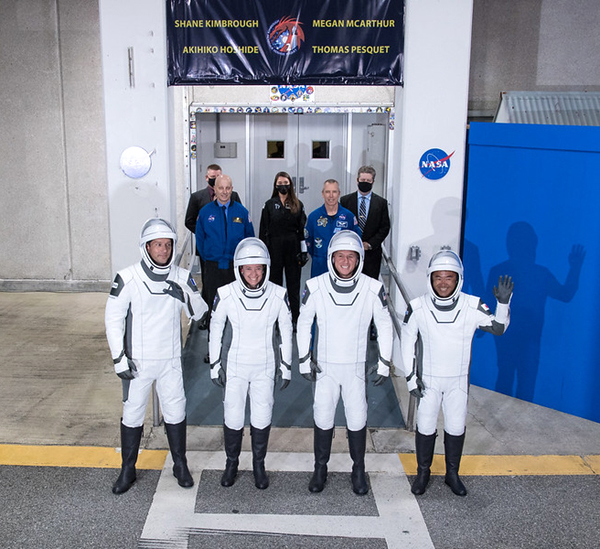
The four Crew-2 astronauts greet their families and friends outside of the Neil A. Armstrong Operations and Checkout Building before heading to Launch Complex 39A, where Falcon 9 and Dragon Endeavour await, at NASA's Kennedy Space Center in Florida...on April 23, 2021.
NASA / Aubrey Gemignani

European Space Agency astronaut Thomas Pesquet and Japan Aerospace Exploration Agency astronaut Akihiko Hoshide can be seen walking through the Crew Access Arm to Dragon Endeavour at Kennedy Space Center's Launch Complex 39A...on April 23, 2021.
NASA / Joel Kowsky

The engine plume from the Falcon 9 rocket carrying the Crew-2 astronauts is visible from the U.S. Capitol Building in Washington, DC...on April 23, 2021.
NASA / Bill Ingalls

Sunday, November 15, 2020

ISS Update: SpaceX Has Officially Begun Crew Rotation Missions to the Orbital Outpost!

A Falcon 9 rocket carrying the Crew Dragon capsule Resilience lifts off from Launch Complex 39A at NASA's Kennedy Space Center in Florida...on November 15, 2020.
SpaceX

NASA’s SpaceX Crew-1 Astronauts Headed to International Space Station (Press Release)

An international crew of astronauts is en route to the International Space Station following a successful launch on the first NASA-certified commercial human spacecraft system in history. NASA’s SpaceX Crew-1 mission lifted off at 7:27 p.m. EST Sunday from Launch Complex 39A at the agency’s Kennedy Space Center in Florida.

The SpaceX Falcon 9 rocket propelled the Crew Dragon spacecraft with NASA astronauts Michael Hopkins, Victor Glover, and Shannon Walker, along with Soichi Noguchi of the Japan Aerospace Exploration Agency (JAXA), into orbit to begin a six-month science mission aboard the space station.

“NASA is delivering on its commitment to the American people and our international partners to provide safe, reliable, and cost-effective missions to the International Space Station using American private industry,” said NASA Administrator Jim Bridenstine. “This is an important mission for NASA, SpaceX and our partners at JAXA, and we look forward to watching this crew arrive at station to carry on our partnership for all of humanity.”

The Crew Dragon spacecraft, named Resilience, will dock autonomously to the forward port of the station’s Harmony module about 11 p.m. Monday, Nov. 16. NASA Television and the agency’s website are providing ongoing live coverage through docking, hatch opening, and the ceremony to welcome the crew aboard the orbiting laboratory.

"I could not be more proud of the work we've done here today,” said Gwynne Shotwell, president and chief operating officer of SpaceX. “Falcon 9 looked great, Dragon was dropped off into a beautiful orbit about 12 minutes into the mission, and we'll get more data as we go.”

The Crew-1 mission is the first of six crewed missions NASA and SpaceX will fly as part of the agency’s Commercial Crew Program. This mission has several firsts, including:

- The first flight of the NASA-certified commercial system designed for crew transportation, which moves the system from development into regular flights;
- The first international crew of four to launch on an American commercial spacecraft;
- The first time the space station’s long duration expedition crew size will increase from six to seven crew members, which will add to the crew time available for research; and
- The first time the Federal Aviation Administration has licensed a human orbital spaceflight launch.
- The astronauts named the Crew Dragon spacecraft Resilience, highlighting the dedication teams involved with the mission have displayed and to demonstrate that when we work together, there is no limit to what we can achieve. They named it in honor of their families, colleagues, and fellow citizens.

“Watching this mission launch is a special moment for NASA and our SpaceX team,” said Steve Stich, manager of NASA’s Commercial Crew Program. “We are looking forward to getting this crew to station to continue our important work, and I want to thank the teams for the amazing effort to make the next generation of human space transportation possible.”

During flight, SpaceX commands the spacecraft from its mission control center in Hawthorne, California, and NASA teams monitor space station operations throughout the flight from the Mission Control Center at the agency’s Johnson Space Center in Houston.

Hopkins, Glover, Walker, and Noguchi will join the Expedition 64 crew of Commander Sergey Ryzhikov and Flight Engineer Sergey Kud-Sverchkov, both of the Russian space agency Roscosmos, and Flight Engineer Kate Rubins of NASA.

“It is an honor to have our Japanese astronaut launch on this Crew-1 Dragon as the first astronaut of the International Partner participating in the ISS program,” said Hiroshi Sasaki, JAXA vice president. “We look forward to having him conduct lots of science and demonstrate the technology, for here on Earth and for the future. I would also like to thank NASA and SpaceX for their tremendous effort to make this happen.”

Rubins, Hopkins, Glover, Walker, and Noguchi will participate in a live crew news conference from orbit at 9:55 a.m. Thursday, Nov. 19, on NASA TV and the agency’s website.

Crew-1 Astronauts

Michael Hopkins is commander of the Crew Dragon spacecraft and the Crew-1 mission. Hopkins is responsible for all phases of flight, from launch to re-entry. He also will serve as an Expedition 64 flight engineer aboard the station. Selected as a NASA astronaut in 2009, Hopkins spent 166 days in space as a long-duration crew member of Expeditions 37 and 38 and completed two spacewalks totaling 12 hours and 58 minutes. Born in Lebanon, Missouri, Hopkins grew up on a farm outside Richland, Missouri. He has a bachelor’s degree in aerospace engineering from the University of Illinois, and a master’s degree in aerospace engineering from Stanford University. Before joining NASA, Hopkins was a flight test engineer with the U.S. Air Force. Follow Hopkins on Twitter.

Victor Glover is the pilot of the Crew Dragon spacecraft and second-in-command for the mission. Glover is responsible for spacecraft systems and performance. He also will be a long-duration space station crew member. Selected as an astronaut in 2013, this is his first spaceflight.

The California native holds a Bachelor of Science degree in general engineering from California Polytechnic State University, a Master of Science degree in flight test engineering and a master’s degree military operational art and science from Air University, and a Master of Science degree in systems engineering from Naval Postgraduate School. Glover is a naval aviator and was a test pilot in the F/A‐18 Hornet, Super Hornet, and EA‐18G Growler aircraft. Follow Glover on Twitter and Instagram.

Shannon Walker is a mission specialist for Crew-1. As a mission specialist, she works closely with the commander and pilot to monitor the vehicle during the dynamic launch and re-entry phases of flight. She also is responsible for monitoring timelines, telemetry, and consumables. Once aboard the station, Walker will become a flight engineer for Expedition 64. Selected as a NASA astronaut in 2004, Walker launched to the International Space Station aboard the Russian Soyuz TMA-19 spacecraft as the co-pilot, and spent 161 days aboard the orbiting laboratory. More than 130 microgravity experiments were conducted during her stay in areas such as human research, biology, and materials science. A Houston native, Walker received a Bachelor of Arts degree in physics from Rice University, as well as a Master of Science degree and a doctorate in space physics, both from Rice University, in 1992 and 1993, respectively.

Soichi Noguchi also is a mission specialist for Crew-1, working with the commander and pilot to monitor the vehicle during the dynamic launch and re-entry phases of flight, and keeping watch on timelines, telemetry and consumables. Noguchi also will become a long-duration crew member aboard the space station. He was selected as an astronaut candidate by the National Space Development Agency of Japan (NASDA, currently the Japan Aerospace Exploration Agency) in May 1996. Noguchi is a veteran of two spaceflights. During STS-114 in 2005, Noguchi became the first Japanese astronaut to perform a spacewalk outside the space station. He performed a total of three spacewalks during the mission, accumulating 20 hours and 5 minutes of spacewalking time. He launched aboard a Soyuz spacecraft in 2009, to return to the station as a long-duration crew member. The Crew Dragon will be the third spacecraft Noguchi has flown to the orbiting laboratory. Follow Noguchi on Twitter and Instagram.

Mission Objectives

The crew will conduct science and maintenance during a six-month stay aboard the orbiting laboratory and will return in spring 2021. It is scheduled to be the longest human space mission launched from the United States. The Crew Dragon spacecraft is capable of staying in orbit for at least 210 days, as a NASA requirement.

Crew Dragon also is delivering more than 500 pounds of cargo, new science hardware and experiments inside, including Food Physiology, a study of the effects of an optimized diet on crew health and, Genes in Space-7, a student-designed experiment that aims to better understand how spaceflight affects brain function, enabling scientists to keep astronauts healthy as they prepare for long-duration missions in low-Earth orbit and beyond.

Among the science and research investigations the crew will support during its six-month mission are a study using chips with tissue that mimics the structure and function of human organs to understand the role of microgravity on human health and diseases and translate those findings to improve human health on Earth, growing radishes in different types of light and soils as part of ongoing efforts to produce food in space, and testing a new system to remove heat from NASA’s next generation spacesuit, the Exploration Extravehicular Mobility Unit (xEMU).

During their stay on the orbiting laboratory, Crew-1 astronauts expect to see a range of uncrewed spacecraft including the next generation of SpaceX cargo Dragon spacecraft, the Northrop Grumman Cygnus, and the Boeing CST-100 Starliner on its uncrewed flight test to the station. They also will conduct a variety of spacewalks and welcome crews of the Russian Soyuz vehicle and the next SpaceX Crew Dragon in 2021.

At the conclusion of the mission, the Crew-1 astronauts will board Crew Dragon, which will then autonomously undock, depart the space station, and re-enter Earth’s atmosphere. Crew Dragon also will return to Earth important and time-sensitive research. NASA and SpaceX are capable of supporting seven splashdown sites located off Florida's east coast and in the Gulf of Mexico. Upon splashdown, the SpaceX recovery ship will pick up the crew and return to shore.

NASA’s Commercial Crew Program is delivering on its goal of safe, reliable, and cost-effective transportation to and from the International Space Station from the United States through a partnership with American private industry. This partnership is changing the arc of human spaceflight history by opening access to low-Earth orbit and the International Space Station to more people, more science, and more commercial opportunities.

The space station remains the springboard to NASA's next great leap in space exploration, including future missions to the Moon and, eventually, to Mars. For more than 20 years, humans have lived and worked continuously aboard the International Space Station, advancing scientific knowledge and demonstrating new technologies, making research breakthroughs not possible on Earth. As a global endeavor, 242 people from 19 countries have visited the unique microgravity laboratory that has hosted more than 3,000 research and educational investigations from researchers in 108 countries and areas.

Source: NASA.Gov

****

Crew-1 astronauts Shannon Walker, Victor Glover, Mike Hopkins and Soichi Noguchi greet the crowd gathered outside the Neil A. Armstrong Operations and Checkout Building prior to heading out to Launch Complex 39A to board their Falcon 9 rocket for flight...on November 15, 2020.
NASA / Joel Kowsky

Thursday, August 20, 2020

Artemis 3 Update #2: Blue Origin Unveils a Full-Scale Mockup of Its Lunar Lander...

A full-scale engineering mockup of Blue Origin's Human Landing System is on display at NASA's Johnson Space Center in Houston, Texas.
Blue Origin

Blue Origin-Led National Team Delivers Lunar Lander Engineering Mockup to NASA (News Release)

Today, the Blue Origin-led Human Landing System (HLS) National Team – comprised of Blue Origin, Lockheed Martin, Northrop Grumman, and Draper – delivered an engineering mockup of a crew lander vehicle that could take American astronauts to the Moon. The lander is set up in the Space Vehicle Mockup Facility (SVMF), NASA Johnson Space Center’s (JSC) iconic Building 9.

The full-scale engineering mockup showcases two elements of the National Team’s multi-element architecture – the Ascent Element (AE) and Descent Element (DE). Standing at more than 40 feet, it is the Blue Origin National Team’s update to Apollo’s Lunar Module (LM) and will be used to validate the National Team’s approaches for getting crew, equipment, supplies, and samples off and on the vehicle. The team will collaborate with NASA organizations including JSC’s Astronaut Office to perform engineering and crew operations tests with astronauts aiming to fly the final system within several years.

“Testing this engineering mockup for crew interaction is a step toward making this historic mission real,” said Brent Sherwood, vice president of Advanced Development Programs, Blue Origin. “The learning we get from full-scale mockups can’t be done any other way. Benefitting from NASA’s expertise and feedback at this early stage allows us to develop a safe commercial system that meets the agency’s needs.”

The National Team HLS design leverages significant prior work, flight heritage, and a modular solution. Modular solutions help to enable faster progress due to the independent development and testing of each element, which permits ongoing improvements and evolution without impacting the full system. This also provides flexibility in the use of different launch vehicles and different concepts of operations.

The Descent Element is based on Blue Origin’s Blue Moon cargo lander and BE-7 LOX/hydrogen engine, both in development for more than three years. The Ascent Element incorporates avionics, software, life support hardware, crew interfaces, and mission operations from Lockheed Martin’s human-rated, deep-space Orion vehicle that will fly on the Artemis I and II missions. A consistent cockpit experience and training from Orion to the AE makes the end-to-end mission safer for Artemis. The Transfer Element, a propulsive stage that starts the lander on its descent trajectory from lunar orbit, is based on Northrop Grumman’s Cygnus vehicle that provides logistics resupply to the International Space Station; and Draper provides descent guidance and avionics to the National Team.

“Each partner brings its own outstanding legacy to the National Team. These include developing, integrating, and operating human-rated spacecraft, launch systems and planetary landers. Together we form an excellent team to send our next astronauts to the Moon in 2024,” said Kirk Shireman, vice president of Lunar Campaigns at Lockheed Martin Space. “Augmenting state of the art tools with physically being able to see, interact, and evaluate a full-up lander in person is critical. It will inform our design and requirements earlier in the program allowing us to accelerate our development and meet the 2024 lunar landing goal.”

The mockup will remain at JSC through early 2021 for a series of tests and simulations. Over the coming months, the National Team will continue to build and increase mockup fidelity. NASA’s Human Landing System Program is managed at Marshall Space Flight Center in Huntsville, Alabama.

Source: Blue Origin

Monday, June 22, 2020

ISS Update: Making the Orbital Outpost Available to More Private Companies...

As seen through a Cupola window, Northrop Grumman's Cygnus vehicle is being maneuvered by the International Space Station's Canadarm2, while SpaceX's Dragon cargo freighter is visible behind it.
NASA

NASA Moving Forward to Enable a Low-Earth Orbit Economy (Press Release)

One year ago, NASA announced the agency is opening the space station for business, enabling commercial and marketing opportunities on the station, and the agency has moved forward toward its ultimate goal in low-Earth orbit to partner with industry to achieve a strong ecosystem in which NASA is one of many customers purchasing services and capabilities at lower cost. Providing expanded opportunities at the International Space Station to manufacture, market and promote commercial products and services will help catalyze and expand space exploration markets for many businesses.

The new policy includes activities that can be as simple as a product pictured in space for use in marketing materials or a company flying and returning commemorative or other items to be sold after having been in space. NASA crew members on the station also can support these activities behind the scenes. The key is that the activity must require the unique microgravity environment, have a nexus to the NASA mission, or support the development of a sustainable low-Earth orbit economy.

U.S. entities can continue to submit proposals for such activities. NASA has received five proposals so far for commercial and marketing opportunities on the station, and the first of those agreements is already now at the station, launched on the SpaceX CRS-20 mission. The agency has two signed Reimbursable Space Act Agreements (RSAA), is processing two, and is evaluating one more. NASA is making available annually 90 hours of crew time and 175 kg of cargo launch capability but will limit the amount provided to any one company.

NASA also enabled private astronaut missions to the station, ensuring the ability to accommodate two missions each year at the space station of up to 30 days duration. The agency has an agreement in place with KBR to train private astronauts using NASA facilities. NASA has an agreement with Axiom Space for developing plans to enable private astronaut missions to the space station. In addition, the agency signed an agreement with Virgin Galactic as it develops a program to identify candidates interested in purchasing private astronaut missions to the station then procures the transportation, on-orbit resources, and ground resources for private astronaut missions.

Axiom Space and SpaceX made a separate agreement for a future private astronaut mission to the station. And SpaceX also announced an agreement for another private astronaut mission not to the space station, an example of NASA enabling a broader market in space. Axiom’s partnership with SpaceX for a private astronaut mission and Virgin Galactic’s plans to develop a new private orbital astronaut readiness program directly support NASA’s broad strategy to facilitate the commercialization of low-Earth orbit by U.S. entities.

NASA awarded a contract to Axiom Space to provide at least one habitable commercial module to be attached to the International Space Station. NASA also intends to support development of free-flying commercial destinations with release of a solicitation soon.

These companies are willing to make these commitments because they can see the long-term potential to sell services to both the U.S. government and to private citizens. They are putting their private capital at risk in these developments for future profit, whether from the U.S. government flying astronauts, or other missions for private astronauts.

NASA also is providing seed money for seven proposals to enable enterprising companies to mature their concepts and stimulate scalable demand for existing and future platforms in space. One example is the work LambdaVision is doing to produce protein-based artificial retinas in space that would be returned to Earth for surgical implant to restore sight for patients suffering from degenerative retinal diseases.

At release, NASA provided a forecast of its minimum long-term, low-Earth orbit requirements, representing the type and amount of services that NASA intends to purchase when those services become commercially available.

Creating a robust economy in low-Earth orbit will be dependent on bringing many new companies and people into that economy, and will require the development of not only the supply of services but also the demand for those capabilities. We are continuing to see new entrants enabled by the new commercial use policy, and via research and development being conducted through the ISS National Laboratory. NASA continues to work with industry to reduce areas of uncertainty regarding the future of these commercial activities.

NASA’s goal is to achieve a robust economy in low-Earth orbit from which the agency can purchase services as one of many customers. A robust commercial space economy ensures national interests for research and development in low-Earth orbit are fulfilled while allowing NASA to focus government resources on deep space exploration through the Artemis program and land the first woman and next man on the surface of the Moon in 2024.

Source: NASA.Gov

****

Saturday, June 6, 2020

Artemis Update: The Development of NASA's Lunar Space Station Continues to Move Along...

An artist's concept of NASA's Gateway orbiting the Moon.
NASA

NASA Awards Northrop Grumman Artemis Contract for Gateway Crew Cabin (Press Release - June 5)

NASA has finalized the contract for the initial crew module of the agency’s Gateway lunar orbiting outpost.

Orbital Science Corporation of Dulles, Virginia, a wholly owned subsidiary of Northrop Grumman Space, has been awarded $187 million to design the habitation and logistics outpost (HALO) for the Gateway, which is part of NASA’s Artemis program and will help the agency build a sustainable presence at the Moon. This award funds HALO’s design through its preliminary design review, expected by the end of 2020.

“This contract award is another significant milestone in our plan to build robust and sustainable lunar operations,” said NASA Administrator Jim Bridenstine. “The Gateway is a key component of NASA’s long-term Artemis architecture and the HALO capability furthers our plans for human exploration at the Moon in preparation for future human missions to Mars.”

The HALO will be the pressurized living quarters where astronauts will spend their time while visiting the Gateway. About the size of a small studio apartment, it will provide augmented life support in tandem with NASA’s Orion spacecraft.

The preliminary design review is one of a series of checkpoints in the design life cycle of a complex engineering project before hardware manufacturing can begin. As the review process progresses, details of the vehicle’s design are assessed to ensure the overall system is safe and reliable for flight and meets all NASA mission requirements.

This cost plus incentive fee contract allows Northrop Grumman to finalize the design of all systems and subsystems. It also provides for the company to award initial subcontracts for long-lead hardware elements. A second contract action is expected to be definitized by the end of the year for Northrop Grumman to fabricate and assemble HALO for integration with the Gateway’s power and propulsion element (PPE) by the end of 2023.

These first two elements of the Gateway – HALO and PPE – will launch together in 2023. This is a recent update to the agency’s plans to build a sustainable presence at the Moon as part of the Artemis program. The decision to integrate the elements on the ground prior to launch – an outcome of the agency’s program status assessment – reduces both cost and technical risks while enhancing the likelihood of mission success by eliminating the need for the two elements to dock in the orbit around the Moon where the Gateway will operate.

“We’re making significant progress on these first two elements, including incorporation of components from ESA (European Space Agency), the Canadian Space Agency, the Japan Aerospace Exploration Agency, and payloads from our research communities,” said Dan Hartman, Gateway program manager at NASA’s Johnson Space Center in Houston. “The new plan to integrate the two elements of Gateway demonstrates the capabilities of the agency and our partners to be flexible and reassess plans as needed. By launching the elements together, we’re able to significantly reduce Gateway’s risk profile and increase cost effectiveness.”

The PPE, being designed and built by Maxar Technologies, is equipped with high-power, 60-kilowatt solar electric propulsion. In addition to providing power and communications, its substantial maneuvering capabilities will allow the Gateway to change orbits and enable crews to reach any part of the Moon’s surface.

Northrop Grumman’s habitation module, developed through NASA’s NextSTEP initiative, is based on its Cygnus spacecraft currently being used to deliver cargo to the International Space Station. The company’s existing production capability and manufacturing assets allow it to build the HALO with limited schedule risk. NASA’s Launch Services Program will select a launch provider for PPE and HALO by late fall 2020.

Charged with returning to the Moon in the next four years, NASA’s Artemis program will reveal new knowledge about the Moon, Earth, and our origins in the solar system. The Gateway is a vital part of NASA’s deep space exploration plans, along with the Space Launch System (SLS) rocket, Orion spacecraft, and the Human Landing System that will carry astronauts to the surface of the Moon in preparation for NASA to sending humans on a historic first journey to Mars.

****