Showing posts with label Demo-2. Show all posts

Wednesday, April 1, 2026

THE FIRST CREWED LUNAR FLIGHT SINCE 1972 HAS BEGUN!

NASA's Space Launch System rocket lifts off on Artemis 2 from Kennedy Space Center's Launch Complex 39B in Florida...on April 1, 2026.
NASA / Keegan Barber

Liftoff! NASA Launches Astronauts on Historic Artemis Moon Mission (News Release)

Spurred by American ingenuity, astronauts on NASA’s Artemis II mission are in flight, preparing for the first crewed lunar flyby in more than 50 years.

NASA’s SLS (Space Launch System) rocket lifted off from Launch Complex 39B at the agency’s Kennedy Space Center in Florida at 6:35 p.m. EDT Wednesday, sending four astronauts aboard the Orion spacecraft on a planned test flight around the Moon and back.

“Today’s launch marks a defining moment for our nation and for all who believe in exploration. Aboard Orion are four remarkable explorers preparing for the first crewed flight of this rocket and spacecraft, a true test mission that will carry them farther and faster than any humans in a generation,” said NASA Administrator Jared Isaacman. “Artemis II is the start of something bigger than any one mission. It marks our return to the Moon, not just to visit, but to eventually stay on our Moon Base, and lays the foundation for the next giant leaps ahead.”

The successful launch is the beginning of an approximately 10-day mission for NASA astronauts Reid Wiseman, Victor Glover, Christina Koch and CSA (Canadian Space Agency) astronaut Jeremy Hansen. As the first crewed mission of NASA’s Artemis program, among its objectives, the flight will demonstrate life support systems for the first time with crew and lay the foundation for an enduring presence on the Moon ahead of future missions to Mars.

After reaching space, Orion deployed its solar array wings, enabling the spacecraft to receive energy from the Sun, while the crew and engineers on the ground immediately began transitioning the spacecraft from launch to flight operations to start checking out key systems.

“Artemis II is a test flight, and the test has just begun. The team that built this vehicle, repaired it, and prepared it for flight has given our crew the machine they need to go prove what it can do,” said NASA Associate Administrator Amit Kshatriya. “Over the next 10 days, Reid, Victor, Christina and Jeremy will put Orion through its paces so the crews who follow them can go to the Moon’s surface with confidence. We are one mission into a long campaign, and the work ahead of us is greater than the work behind us.”

About 49 minutes into the test flight, the SLS rocket’s upper stage fired to put Orion into an elliptical orbit around Earth. A second planned burn by the stage will propel Orion, which the crew named Integrity into a high-Earth orbit extending about 46,000 miles beyond Earth. After the burn, Orion will separate from the stage, flying free on its own.

In several hours, a ring on the rocket’s upper stage, which will be a safe distance away from the spacecraft, will deploy four CubeSats – small satellites from Argentina’s Comisión Nacional de Actividades Espaciales, German Aerospace Center, Korea AeroSpace Administration, and Saudi Space Agency – to perform scientific investigations and technology demonstrations.

The spacecraft will remain in high-Earth orbit for about a day, where the crew will conduct a manual pilot demonstration to test Orion’s handling capabilities. The astronauts, with Mission Control Center teams at NASA’s Johnson Space Center in Houston, will continue checking spacecraft systems.

If all systems remain healthy, mission controllers will give Orion’s European-built service module a command to conduct the translunar injection burn on Thursday, April 2. This move is an approximately six-minute firing to send the spacecraft on a trajectory that will simultaneously carry crew around the Moon, while also harnessing lunar gravity to slingshot them back to Earth.

During a planned multi-hour lunar flyby on Monday, April 6, the astronauts will take photographs and provide observations of the Moon’s surface as the first people to lay eyes on some areas of the far side. Although the lunar far side will only be partially illuminated during the flyby, the conditions should create shadows that stretch across the surface, enhancing relief and revealing depth, ridges, slopes and crater rims that are often difficult to detect under full illumination. Crew observations and other human health scientific investigations during the mission, such as AVATAR, will inform science during future Moon missions.

Following a successful lunar flyby, the astronauts will return to Earth and splash down in the Pacific Ocean.

As part of the Golden Age of innovation and exploration, NASA will send Artemis astronauts on increasingly difficult missions to explore more of the Moon for scientific discovery, economic benefits, and to build on our foundation for the first crewed missions to Mars.

Source: NASA.Gov

****

The Artemis 2 astronauts greet the crowd outside the Neil A. Armstrong Operations and Checkout Building, prior to taking a van to Kennedy Space Center's Launch Complex 39B to board their Space Launch System rocket and Orion capsule for flight...on April 1, 2026.
NASA / Aubrey Gemignani

Kennedy Space Center employees gather along a road to bid farewell to the Artemis 2 crew...as their van makes its way to Launch Complex 39B on April 1, 2026.
NASA / Aubrey Gemignani

NASA's Space Launch System rocket lifts off on Artemis 2 from Kennedy Space Center's Launch Complex 39B in Florida...on April 1, 2026.
NASA / Keegan Barber

A large crowd watches as NASA's Space Launch System rocket lifts off on Artemis 2 from Kennedy Space Center's Launch Complex 39B in Florida...on April 1, 2026.
NASA / Keegan Barber

Another crowd watches as NASA's Space Launch System rocket lifts off on Artemis 2 from Kennedy Space Center's Launch Complex 39B in Florida...on April 1, 2026.
NASA / Bill Ingalls

NASA's Space Launch System rocket makes its way out of Earth's atmosphere as it begun the Artemis 2 astronauts' journey to the Moon...on April 1, 2026.
NASA / Joel Kowsky

The twin solid rocket boosters are jettisoned from NASA's Space Launch System rocket after they complete their part in sending the Artemis 2 astronauts to the Moon...on April 1, 2026.
Brian Lail

Orion's Interim Cryogenic Propulsion Stage separates from the Space Launch System's core stage booster around 8 minutes after liftoff from NASA's Kennedy Space Center in Florida...on April 1, 2026.
NASA

Orion and its four Artemis 2 astronauts orbit the Earth following a successful launch from NASA's Kennedy Space Center in Florida...on April 1, 2026.
NASA

Friday, June 21, 2024

Calypso's Landing Date Is Now Up in the Air...

Boeing's Starliner Calypso capsule, with NASA astronauts Butch Wilmore and Suni Williams aboard, approaches the International Space Station for docking...on June 6, 2024.
NASA

NASA, Boeing Adjust Timeline for Starliner Return (News Release)

NASA and Boeing leadership are adjusting the return to Earth of the Starliner Crew Flight Test spacecraft with agency astronauts Butch Wilmore and Suni Williams from the International Space Station. The move off Wednesday, June 26, deconflicts Starliner’s undocking and landing from a series of planned International Space Station spacewalks while allowing mission teams time to review propulsion system data.

Listen to a full replay of the June 18 media briefing where NASA and Boeing leadership discussed the ongoing efforts.

“We are taking our time and following our standard mission management team process,” said Steve Stich, manager of NASA’s Commercial Crew Program. “We are letting the data drive our decision making relative to managing the small helium system leaks and thruster performance we observed during rendezvous and docking. Additionally, given the duration of the mission, it is appropriate for us to complete an agency-level review, similar to what was done ahead of NASA’s SpaceX Demo-2 return after two months on orbit, to document the agency’s formal acceptance on proceeding as planned.”

A media telecon with mission leadership will follow the readiness review’s conclusion, and the agency will share those details as they are solidified. Boeing’s Starliner spacecraft remains cleared for return in case of an emergency on the space station that required the crew to leave orbit and come back to Earth.

Mission managers are evaluating future return opportunities following the station’s two planned spacewalks on Monday, June 24, and Tuesday, July 2.

“Starliner is performing well in orbit while docked to the space station,” said Stich. “We are strategically using the extra time to clear a path for some critical station activities while completing readiness for Butch and Suni’s return on Starliner and gaining valuable insight into the system upgrades we will want to make for post-certification missions.”

Wilmore and Williams remain integrated with the Expedition 71 crew, assisting with station operations as needed and completing add-on in-flight objectives for NASA certification of Starliner.

“The crew’s feedback has been overwhelmingly positive, and they know that every bit of learning we do on the Crew Flight Test will improve and sharpen our experience for future crews,” said Mark Nappi, vice president and program manager, Boeing’s Starliner Program.

The crew is not pressed for time to leave the station since there are plenty of supplies in orbit, and the station’s schedule is relatively open through mid-August.

Source: NASA.Gov

Sunday, September 3, 2023

Endeavour Has Completed Her Fourth Flight to the ISS...

A fiery trail created by SpaceX's Crew Dragon Endeavour capsule as she re-entered Earth's atmosphere can be seen above NASA's Kennedy Space Center in Florida...on September 4, 2023 (Eastern Time).
SpaceX

NASA’s SpaceX Crew-6 Safely Returns to Earth Near Florida Coast (Press Release)

After splashing down safely in a SpaceX Dragon spacecraft off the coast of Jacksonville, Florida early Monday morning, NASA’s SpaceX Crew-6 completed the agency’s sixth commercial crew rotation mission to the International Space Station. The international crew of four spent 186 days in orbit.

NASA astronauts Stephen Bowen and Woody Hoburg, as well as UAE (United Arab Emirates) astronaut Sultan Alneyadi and Roscosmos cosmonaut Andrey Fedyaev, returned to Earth at 12:17 a.m. EDT. Teams aboard SpaceX recovery vessels retrieved the spacecraft and its crew.

After returning to shore, the crew will fly to NASA’s Johnson Space Center in Houston.

“After spending six months aboard the International Space Station, logging nearly 79 million miles during their mission, and completing hundreds of scientific experiments for the benefit of all humanity, NASA’s SpaceX Crew-6 has returned home to planet Earth,” said Administrator Bill Nelson. “This international crew represented three nations, but together they demonstrated humanity’s shared ambition to reach new cosmic shores. The contributions of Crew-6 will help prepare NASA to return to the Moon under Artemis, continue onward to Mars, and improve life here on Earth.”

The Crew-6 mission lifted off at 12:34 a.m. EST on March 2, 2023, on a SpaceX Falcon 9 rocket from NASA’s Kennedy Space Center in Florida. About 25 hours later, Dragon docked to the Harmony module’s space-facing port.

On May 6, the crew completed a port relocation maneuver to the Earth-facing port ahead of the arrival of a SpaceX Dragon cargo spacecraft carrying new solar arrays, science investigations and supplies to the orbiting laboratory. The crew undocked from the space station at 7:05 a.m. on Sunday, to begin the trip home.

Bowen, Hoburg, Alneyadi and Fedyaev traveled 78,875,292 miles during their mission, spent 184 days aboard the space station, and completed 2,976 orbits around Earth. The Crew-6 mission was the first spaceflight for Hoburg, Alneyadi and Fedyaev.

Bowen has logged 227 days in space over four flights.

Throughout their mission, the Crew-6 members contributed to a host of science and maintenance activities and technology demonstrations. Bowen conducted three spacewalks, joined by Hoburg for two, and Alneyadi for one, preparing the station for and installing two new IROSAs (International Space Station Roll-Out Solar Arrays) to augment power generation for the station.

The crew contributed to hundreds of experiments and technology demonstrations, including assisting a student robotic challenge, studying plant genetic adaptations to space, and monitoring human health in microgravity to prepare for exploration beyond low-Earth orbit and to benefit life on Earth. The astronauts released Saskatchewan’s first satellite which tests a new radiation detection and protection system derived from melanin, found in many organisms, including humans.

This was the fourth flight of the Dragon spacecraft, which was named Endeavour by retired NASA astronauts Bob Behnken and Doug Hurley on its first voyage for the agency’s SpaceX Demonstration Mission 2. The spacecraft will return to Florida for inspection and processing at SpaceX’s refurbishing facility at Cape Canaveral Space Force Station, where teams will inspect the spacecraft, analyze data on its performance, and prepare it for its next flight.

The Crew-6 mission is part of NASA’s Commercial Crew Program, and its return to Earth follows on the launch of NASA’s SpaceX Crew-7, which docked to the station on August 27, beginning another long-duration science expedition.

The goal of NASA’s Commercial Crew Program is safe, reliable and cost-effective transportation to and from the International Space Station and low-Earth orbit, which maximizes research time and increases opportunities for discovery aboard humanity’s microgravity laboratory and testbed for exploration, including helping NASA prepare for human exploration of the Moon and Mars.

****

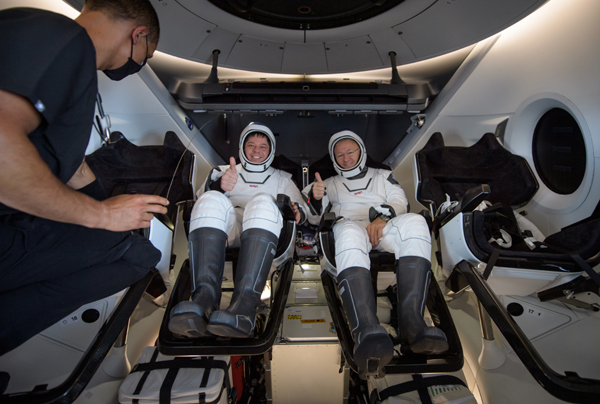
The Crew-6 astronauts pose for the camera after the hatch is opened on their Endeavour capsule once she was safely placed aboard a SpaceX recovery vessel deployed off the coast of Jacksonville, Florida...on September 4, 2023 (Eastern Time).
NASA / Joel Kowsky

Tuesday, January 31, 2023

Bob and Doug Receive Accolades by the White House for Their Historic Demo-2 Mission in 2020...

Former NASA astronauts Bob Behnken and Doug Hurley pose with Vice President Kamala Harris after she awarded them the Congressional Space Medal of Honor at the White House...on January 31, 2023.
NASA / Joel Kowsky

VP Awards Former NASA Astronauts Congressional Space Medal of Honor (Press Release)

On behalf of President Joe Biden, Vice President Kamala Harris awarded former NASA astronauts Douglas Hurley and Robert Behnken the Congressional Space Medal of Honor Tuesday for their bravery in NASA’s SpaceX Demonstration Mission-2 (Demo-2) to the International Space Station in 2020. Hurley and Behnken are the first recipients of the honor since 2006 and accepted the awards during a televised event in Washington.

“Bob and Doug, together, have written the first page of a new chapter in the history of American spaceflight,” said Harris, who chairs the National Space Council. “Bob and Doug represent the best of our nation – there’s no question about it. The courage; the commitment; the brilliance; the vision; the ability to see and understand what is possible and then to go for it, represents the best of who we are as a nation.”

The Congressional Space Medal of Honor was authorized by Congress in 1969 to recognize an astronaut who in the performance of duties has distinguished himself or herself by exceptionally meritorious efforts and contributions to the welfare of the nation and humanity. The honor has now been awarded to 30 people, including the crews of the Apollo 1, Challenger and Columbia disasters who received the award posthumously.

“The American story is about innovation, exploration and pioneers who forge ahead. And Doug Hurley and Bob Behnken represent the American story,” said NASA Administrator Bill Nelson. “When Doug and Bob launched into history, a new era of human spaceflight took flight. The Demo-2 mission showcased American leadership and technological ingenuity and inspired countless minds to dare to dream to fly among the stars. Congratulations to Doug and Bob on this well-deserved honor!”

On May 30, 2020, a SpaceX Falcon 9 rocket carrying the company’s Crew Dragon spacecraft lifted off to the space station, marking the first mission to launch with astronauts as part of NASA’s Commercial Crew Program. Demo-2, a mission more than a decade in the making, was the first time American astronauts had launched from American soil on an American rocket since the conclusion of the Space Shuttle Program in 2011.

Source: NASA.Gov

****

At Launch Complex 39A, NASA astronauts Doug Hurley and Bob Behnken pose in front of the Falcon 9 rocket that sent them to the International Space Station on May 30, 2020.
NASA

Thursday, November 10, 2022

An Accomplished Space Explorer Will Soon Leave America's Astronaut Corps...

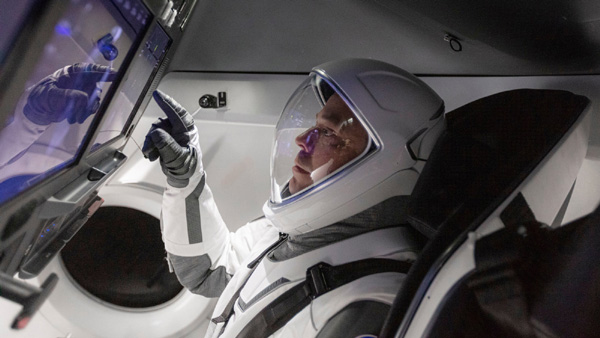
Inside SpaceX's Crew Dragon capsule, NASA astronaut Bob Behnken prepares for launch on the historic Demo-2 mission...which lifted off for the International Space Station on May 30, 2020.
SpaceX

Pioneering Astronaut Bob Behnken Retires from NASA (Press Release)

NASA astronaut and former U.S. Air Force Col. Bob Behnken is retiring from NASA after 22 years of service. His last day with the agency is Friday, November 11.

“Bob Behnken is a distinguished and talented astronaut, and an effective ambassador for our never-ending mission to explore the cosmos,” said Administrator Bill Nelson. “Bob and fellow NASA astronaut Doug Hurley launched into history with their impeccable command of NASA and SpaceX’s Demo-2 mission, and played a pivotal role in helping a new era of commercial space take flight. Along with the entire NASA family, I appreciate Bob’s service to our country and wish him all the best in his next endeavor.”

Behnken’s career highlights included 93 days in space on two space shuttle Endeavour flights and the first crewed flight of the SpaceX Dragon spacecraft.

Behnken was pilot and joint operations commander for the first crewed flight test of the SpaceX Dragon. Known as Demo-2, that flight launched Behnken and former NASA astronaut Doug Hurley to the International Space Station on May 30, 2020, and safely returned them to Earth on August 2, 2020.

The Demo-2 flight inaugurated a new era of human spaceflight, which continues today with reliable crew launches to the space station from American soil on commercially built and owned spacecraft. As a space station crew member for 62 days, Behnken performed four spacewalks with former NASA astronaut Chris Cassidy and contributed more than 100 hours to the orbiting laboratory’s scientific investigations.

“Bob served and led the astronaut office with calm hands and exceptional expertise,” said Reid Weisman, chief of the astronaut office at NASA’s Johnson Space Center in Houston. “There are few as experienced and trusted in this industry. We will miss him, and we wish him well in his next endeavor.”

Behnken joined NASA at Johnson in July 2000 as an astronaut candidate. On his first spaceflight, in 2008, Behnken was a space shuttle Endeavour mission specialist for the STS-123 delivery of the Japan Aerospace Exploration Agency’s Kibo laboratory and the Canadian Space Agency’s Special Purpose Dexterous Manipulator (Dextre) to the space station. Behnken performed three spacewalks, and operated the station’s robotic arm both with and without Dextre attached.

Behnken flew again in 2010, as a mission specialist for STS‐130, which delivered the station’s Tranquility module and its cupola, the station’s seven‑window Earth-facing observation post. He served as the mission’s lead spacewalker, performing three additional spacewalks to install the newly-arrived module. Behnken completed 10 spacewalks across his three missions, spending more than 61 hours working in the vacuum of space.

“Bob served the agency in a vital role as an astronaut and contributed greatly to some of NASA’s most important and groundbreaking endeavors,” said Kathryn Lueders, associate administrator for space operations at NASA Headquarters. “During his career, he flew missions to help build a world-class science laboratory in space, flew the first commercial crew spacecraft to orbit, and left his mark in the astronaut corps. All of these contributions to human spaceflight will continue to benefit all of us as we continue to push new boundaries.”

Behnken also supported NASA astronauts on Earth in a variety of roles. Following the completion of two years of training and evaluation, he was assigned technical duties in the astronaut office, supporting space shuttle launch and landing activities. Behnken trained as an International Space Station crew member following the loss of space shuttle Columbia in 2003 and as a mission specialist for STS-400, the launch-on-need rescue flight for the last Hubble servicing mission. He served as NASA’s chief astronaut from 2012 to 2015, and deputy of NASA’s Flight Operations Directorate from September 2021 to April 2022.

“I am humbled to have had the opportunity to represent our nation as a NASA astronaut, and thankful to have been a part of the team that returned human spaceflight to the United States back in 2020,” said Behnken. “I am so looking forward to seeing and being amazed by what people of this great agency will accomplish next.”

Behnken grew up in St. Ann, Missouri, and graduated from Pattonville High School in Maryland Heights, Missouri. He earned dual Bachelor of Science degrees in physics and mechanical engineering from Washington University in St. Louis in 1992, a Master of Science in mechanical engineering from the California Institute of Technology in Pasadena in 1993, and a Doctorate in mechanical engineering from the California Institute of Technology in 1997. Behnken was commissioned via the Air Force Reserve Officers’ Training Corps and attended the Air Force Test Pilot School at Edwards Air Force Base in California.

Before retiring from active military service in February 2022, Behnken had achieved the rank of colonel and flown more than 2,000 flight hours in more than 25 different types of aircraft.

****

NASA astronauts Bob Behnken and Doug Hurley (now retired as well) give thumbs-up before they egress from SpaceX's Dragon Endeavour capsule...after successfully completing the historic Demo-2 mission on August 2, 2020.
NASA / Bill Ingalls

Wednesday, October 5, 2022

ISS Update: Crew Dragon Endurance Is Headed Back to the Orbital Outpost...

A SpaceX Falcon 9 rocket carrying the Crew Dragon Endurance capsule lifts off from Kennedy Space Center's Launch Complex 39A in Florida...on October 5, 2022.
NASA / Joel Kowsky

NASA’s SpaceX Crew-5 Launches to International Space Station (Press Release)

The crew members assigned to NASA’s SpaceX Crew-5 mission are in orbit following their launch to the International Space Station noon EDT Wednesday, from Launch Complex 39A at NASA’s Kennedy Space Center in Florida. The international crew will serve as the agency’s fifth commercial crew rotation mission with SpaceX aboard the orbital laboratory.

A SpaceX Falcon 9 rocket propelled the Dragon Endurance spacecraft into orbit carrying NASA astronauts Nicole Mann as mission commander, and Josh Cassada, pilot. JAXA (Japan Aerospace Exploration Agency) astronaut Koichi Wakata and Roscosmos cosmonaut Anna Kikina, also aboard the Dragon, will serve as mission specialists for their science expedition in microgravity aboard the space station.

“Missions like Crew-5 are proof we are living through a golden era of commercial space exploration. It’s a new era powered by the spirit of partnership, fueled by scientific ingenuity, and inspired by the quest for new discoveries,” said NASA Administrator Bill Nelson. “During their stay aboard the International Space Station, Crew-5 will conduct more than 200 science experiments and technology demonstrations, including studies on printing human organs in space and better understanding heart disease. While our eyes are focused upward on the heavens, let us never forget these missions will also better life here on Earth.”

This is the first spaceflight for Mann, Cassada, and Kikina, and the fifth for Wakata. This is the sixth SpaceX flight with NASA astronauts – including the Demo-2 test flight in 2020 to the space station – as part of the agency’s Commercial Crew Program.

During Dragon’s flight, SpaceX will monitor a series of automatic spacecraft maneuvers from its mission control center in Hawthorne, California, and NASA teams will monitor space station operations throughout the flight from the Mission Control Center at the agency’s Johnson Space Center in Houston.

Dragon will dock autonomously to the space-facing port of the station’s Harmony module around 4:57 p.m. Thursday, October 6. NASA Television, the NASA app and the agency’s website will provide live coverage of docking and hatch opening. NASA also will cover the ceremony to welcome the crew aboard the orbital outpost about 8:15 p.m.

Mann, Cassada, Wakata, and Kikina will join the space station’s Expedition 68 crew of NASA astronauts Bob Hines, Kjell Lindgren, Frank Rubio, and Jessica Watkins, ESA (European Space Agency) astronaut Samantha Cristoforetti, and Roscosmos cosmonauts Sergey Prokopyev and Dmitri Petelin. For a short time, the number of crew aboard the space station will increase to 11 people until Crew-4 astronauts Hines Lindgren, Watkins and Cristoforetti return to Earth a few days later.

Crew-5 will spend several months aboard the space station conducting new scientific research in areas such as cardiovascular health, bioprinting and fluid behavior in microgravity to prepare for human exploration beyond low-Earth orbit and to benefit life on Earth.

“The International Space Station continues to serve a critical role in helping NASA and our partners understand and maximize the unique attributes of the microgravity environment,” said Kathryn Lueders, associate administrator for NASA’s Space Operations Mission Directorate in Washington. “I am grateful to the many people who worked to ensure a safe Crew-5 launch despite the recent hurricane so the crew can fulfill their mission to the orbiting laboratory.”

The Crew-5 mission continues NASA’s efforts to maintain American leadership in human spaceflight. Regular commercial crew rotation missions enable NASA to continue the important research and technology investigations taking place aboard the station. Such research benefits people on Earth and lays the groundwork for future human exploration through the agency’s Artemis missions, which will send astronauts to the Moon to prepare for future expeditions to Mars.

Meet Crew-5

As commander, Mann is responsible for all phases of flight, from launch to re-entry, and will serve as an Expedition 68 flight engineer. This will be her first spaceflight since becoming an astronaut in 2013. Mann was born in Petaluma, California, and will be the first indigenous woman from NASA in space. She is a colonel in the U.S. Marine Corps, and she served as a test pilot in the F/A-18 Hornet and Super Hornet.

Cassada is the spacecraft pilot and second in command for the mission. He is responsible for spacecraft systems and performance. Aboard the station, he will serve as an Expedition 68 flight engineer. This will be his first flight since his selection as an astronaut in 2013. Cassada grew up in White Bear Lake, Minnesota, and is a physicist and U.S. Navy test pilot.

Wakata will be making his fifth trip to space and as a mission specialist he will work closely with the commander and pilot to monitor the spacecraft during the dynamic launch and re-entry phases of flight. Once aboard the station, he will serve as a flight engineer for Expedition 68. With Crew-5’s launch, Dragon will be the third different type of spacecraft Wakata has flown to space.

Kikina will be making her first trip to space, and will serve as a mission specialist, working to monitor the spacecraft during the dynamic launch and re-entry phases of flight. She will be a flight engineer for Expedition 68.

****

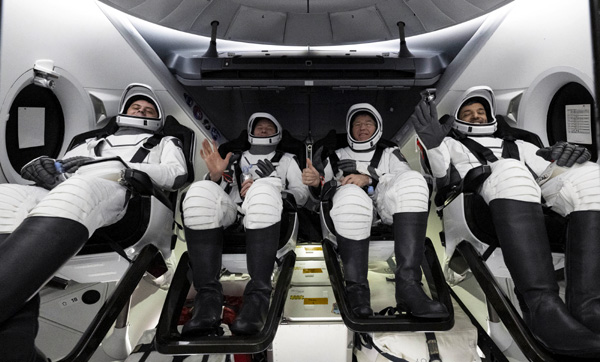
Inside SpaceX's Crew Dragon Endurance capsule, the four Crew-5 astronauts are strapped into their seats for launch...on October 5, 2022.
SpaceX


Wednesday, April 27, 2022

ISS Update: Four New Crew Members and a DNA Biobank Are Now Headed to the Orbital Outpost...

A SpaceX Falcon 9 rocket carrying the Crew Dragon Freedom capsule lifts off from Kennedy Space Center's Launch Complex 39A in Florida...on April 27, 2022.
NASA / Kim Shiflett

NASA’s SpaceX Crew-4 Astronauts Launch to International Space Station (Press Release)

NASA’s SpaceX Crew-4 astronauts are in orbit following their launch to the International Space Station at 3:52 a.m. EDT Wednesday, April 27, from Launch Complex 39A at NASA’s Kennedy Space Center in Florida. The international crew of astronauts will serve as the fourth commercial crew rotation mission aboard the space station.

A SpaceX Falcon 9 rocket propelled the Dragon spacecraft into orbit carrying Mission Commander Kjell Lindgren, Pilot Bob Hines, and Mission Specialist Jessica Watkins, all NASA astronauts, and Mission Specialist Samantha Cristoforetti of ESA (European Space Agency). The crew will conduct a science expedition in microgravity aboard the space station.

“Liftoff! The past few days at Kennedy Space Center have been inspiring and busy with the return of the Axiom crew and now the successful launch of Crew-4 astronauts to the International Space Station,” said NASA Administrator Bill Nelson. “Aboard station, Kjell, Bob, Jessica, and Samantha will carry out research investigations that will help NASA prepare for longer duration stays on the Moon – and eventually Mars. These missions wouldn’t be possible without the dedicated NASA and SpaceX teams here on Earth. Godspeed, Crew-4!”

This Crew-4 mission is the first launch for Hines and Watkins, and the second flight to the station for Lindgren and Cristoforetti. It launched in a new Dragon spacecraft, named Freedom by the crew, and a Falcon 9 booster flying its fourth mission into space. This is the fifth SpaceX flight with NASA astronauts – including the Demo-2 test flight in 2020 to the space station – as part of the agency’s Commercial Crew Program.

During Dragon’s flight, SpaceX will monitor a series of automatic spacecraft maneuvers from its mission control center in Hawthorne, California, and NASA teams will monitor space station operations throughout the flight from the Mission Control Center at the agency’s Johnson Space Center in Houston.

Dragon will dock autonomously to the space-facing port of the station’s Harmony module around 8:15 p.m. Wednesday, April 27. NASA Television, the NASA app, and the agency’s website are providing ongoing live coverage through docking, and hatch opening. NASA also will cover the ceremony to welcome the crew aboard the orbital outpost about 2:40 a.m. on Thursday, April 28.

“NASA, SpaceX and our international partners have worked tirelessly to ensure that the International Space Station continues conducting important research in microgravity, and working on a whole host of activities that benefit humanity and opens up access to more people in space,” said Kathryn Lueders, associate administrator for NASA’s Space Operations Mission Directorate in Washington. “Crew-4’s launch, less than two days after the return of the first all-private mission to station, exemplifies the spirit and success of the Commercial Crew Program to help maximize use of low-Earth orbit for years to come, testing the technologies we need for the Artemis program and beyond.”

Lindgren, Hines, Watkins, and Cristoforetti will join the space station’s Expedition 67 crew of Raja Chari, Thomas Marshburn, and Kayla Barron, all NASA astronauts, Matthias Maurer of ESA, and cosmonauts Oleg Artemyev, Sergey Korsakov, and Denis Matveev of Roscosmos. For a short time, the number of crew aboard the space station will increase to 11 people until Crew-3 astronauts Chari, Marshburn, Barron, and Maurer return to Earth a few days later.

Crew-4 is the third commercial crew mission to fly an ESA astronaut.

“It gives me great pleasure to see the successful launch of Samantha Cristoforetti and her Crew-4 colleagues. Samantha will take over from Matthias Maurer and continue to represent Europe and support European experiments aboard the space station throughout her mission,” says ESA Director General Josef Aschbacher.

ESA Director of Human and Robotic Exploration David Parker adds, “Samantha has been an excellent role model – even more so as on the space station she will take on the role of USOS lead, responsible for operations within the U.S. Orbital Segment of the International Space Station, comprising of American, European, Japanese and Canadian modules and components.”

The Crew-4 astronauts will spend several months aboard the space station conducting new scientific research in areas such as materials science, health technologies, and plant science to prepare for human exploration beyond low-Earth orbit and to benefit life on Earth.

The Crew-4 mission continues NASA’s efforts to maintain American leadership in human spaceflight. Regular, long-duration commercial crew rotation missions enable NASA to continue the important research and technology investigations taking place aboard the station. Such research benefits people on Earth and lays the groundwork for future exploration of the Moon and Mars, starting with the agency’s Artemis missions, which includes landing the first woman and person of color on the lunar surface.

Lindgren is commander of the Dragon spacecraft and the Crew-4 mission. He is responsible for all phases of flight, from launch to re-entry, and will serve as an Expedition 67 flight engineer. This will be Lindgren’s second spaceflight since becoming an astronaut in 2009. In 2015, he spent 141 days aboard the orbital laboratory as a flight engineer for Expeditions 44 and 45. Board-certified in emergency medicine, he previously worked at NASA Johnson as a flight surgeon supporting space station training and operations and served as a deputy crew surgeon for space shuttle flight STS-130 and Expedition 24. Lindgren was born in Taipei, Taiwan, and spent most of his childhood in England before graduating from the U.S. Air Force Academy.

Hines is the pilot of the Dragon spacecraft and second in command for the mission. He is responsible for spacecraft systems and performance. Aboard the station, he will serve as an Expedition 67 flight engineer. This will be his first flight since his selection as an astronaut in 2017. Hines has served more than 22 years in the U.S. Air Force as a test pilot, fighter pilot, and instructor pilot. Before his selection in 2017, he was a research pilot at Johnson.

Watkins is a mission specialist for Crew-4 and will work closely with the commander and pilot to monitor the spacecraft during the dynamic launch and re-entry phases of flight. Once aboard the station, she will seve as a flight engineer for Expedition 67. Watkins grew up in Lafayette, Colorado, and studied geology at Stanford University, Palo Alto, California, and the University of California, Los Angeles. As a geologist, she studied the surface of Mars and was a science team collaborator at NASA’s Jet Propulsion Laboratory near Pasadena, California, working on the Mars Science Laboratory rover Curiosity. She also was selected as a NASA astronaut in 2017, and this will be her first trip to space.

Cristoforetti will also serve as a mission specialist, working to monitor the Dragon spacecraft during the dynamic launch and re-entry phases of flight. She will serve as a flight engineer for Expedition 67. This will be her second trip to space following five months in 2015 as a flight engineer for Expeditions 42 and 43. Born in Milan, Italy, she was a fighter pilot in the Italian Air Force prior to being selected as an ESA astronaut in 2009. In 2019, she served as commander for NASA’s 23rd Extreme Environment Mission Operations mission on a 10-day stay in Aquarius, the world’s only undersea research station.

****

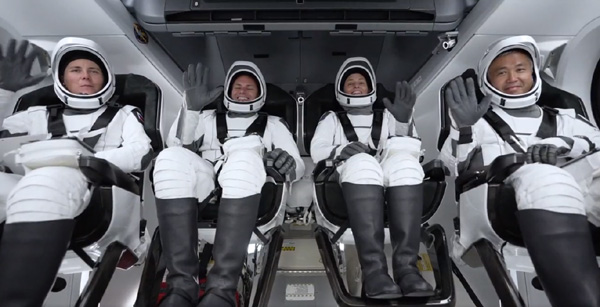
Inside SpaceX's Crew Dragon Freedom capsule, the four Crew-4 astronauts are strapped into their seats for launch...on April 27, 2022.
SpaceX

LifeShip's biobank capsule--which contains the DNA samples of 500 plant and animal species, as well as those of 2,000 humans (including mine)--is now headed to the International Space Station courtesy of the Crew-4 mission.
LifeShip

DIRECTLY ABOVE: LifeShip's biobank capsule—which contains the DNA samples of 500 plant and animal species, as well as those of 2,000 humans (including mine)—is now headed to the International Space Station courtesy of the Crew-4 mission!

Monday, February 14, 2022

The Visionary Behind Inspiration4 Is About to Embark on Another Ambitious Project with SpaceX...

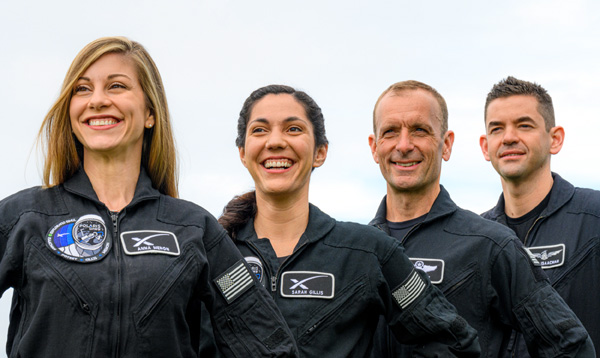
Polaris Dawn astronauts from left to right: mission specialist and medical officer Anna Menon, mission specialist Sarah Gillis, mission pilot Scott 'Kidd' Poteet and mission commander Jared 'Rook' Isaacman.
Polaris Program

Polaris Program will Undertake a Series of Pioneering SpaceX Dragon Missions, Demonstrating New Technologies and Culminating in the First Human Spaceflight on Starship (Press Release)

Led by tech entrepreneur and Inspiration4 commander Jared Isaacman, this program will advance deep space exploration while raising global awareness for St. Jude Children’s Research Hospital®.

LOS ANGELES, CA (February 14, 2022) Today Jared Isaacman, founder and CEO of Shift4 (NYSE: FOUR), announced the Polaris Program, a first-of-its-kind effort to rapidly advance human spaceflight capabilities, while continuing to raise funds and awareness for important causes here on Earth. The program will consist of up to three human spaceflight missions that will demonstrate new technologies, conduct extensive research, and ultimately culminate in the first flight of SpaceX’s Starship with humans on board.

The first mission, Polaris Dawn, is targeted for no earlier than the fourth quarter of this year and will be commanded by Isaacman, an accomplished pilot and astronaut who led Inspiration4, the world’s first all-civilian mission to orbit that helped raise over $240 million for St. Jude Children’s Research Hospital®.

“The Polaris Program is an important step in advancing human space exploration while helping to solve problems through the use of innovative technology here on Earth,” said Isaacman. “On Polaris Dawn, we endeavor to achieve the highest Earth orbit ever flown in addition to conducting the world’s first commercial spacewalk and testing of Starlink laser-based communication. Alongside these important objectives, we will be supporting scientific research to advance both human health interests on Earth and our understanding of human health during future long-duration spaceflights.” Building upon the Inspiration4 mission, Polaris Dawn will continue to raise funds and awareness for St. Jude Children’s Research Hospital®.

THE POLARIS DAWN MISSION

SpaceX’s Falcon 9 rocket will launch the Polaris Dawn mission from Launch Complex 39A at Kennedy Space Center in Florida. Dragon and the Polaris Dawn crew will spend up to five days in orbit, flying higher than any Dragon mission to date and endeavoring to reach the highest Earth orbit ever flown.

While in orbit, SpaceX mission control will carefully monitor Dragon and the crew as they:

– Attempt the first-ever commercial spacewalk with SpaceX-designed extravehicular activity (EVA) spacesuits, upgraded from the current intravehicular (IVA) suit. The development of this suit and the execution of the EVA will be important steps toward a scalable design for spacesuits on future long-duration missions.

- Become the first crew to test Starlink laser-based communications in space, providing valuable data for future space communications systems necessary for human spaceflight to the Moon, Mars, and beyond.

- Conduct scientific research designed to advance both human health on Earth and our understanding of human health during future long-duration spaceflights. This includes, but is not limited to:

-- Using ultrasound to monitor, detect, and quantify venous gas emboli (VGE), contributing to studies on human prevalence to decompression sickness;
-- Gathering data on the radiation environment to better understand how space radiation affects human biological systems;
-- Providing biological samples toward multi-omics analyses for a long-term Biobank; and
-- Research related to Spaceflight Associated Neuro-Ocular Syndrome (SANS), which is a key risk to human health in long-duration spaceflight.

SpaceX and Polaris Dawn will also collaborate with the Translational Research Institute for Space Health (TRISH), BioServe Space Technologies at the University of Colorado Boulder, Space Technologies Lab at Embry Riddle Aeronautical University, Weill Cornell Medicine, Johns Hopkins University Applied Physics Laboratory, the Pacific Northwest National Laboratory, and the U.S. Air Force Academy.

THE POLARIS DAWN CREW

The Polaris Dawn mission has many first-time objectives, so the Polaris Program chose a crew of experts who know each other well and have a foundation of trust they can build upon as they undertake the challenges of this mission. The crew includes:

MISSION COMMANDER, JARED “ROOK” ISAACMAN

In addition to commanding Inspiration4, Isaacman has over 7,000 flight hours of aviation experience, including ratings in multiple experimental and ex-military aircraft. He set speed-around-the-world records in 2008 and 2009, as well as 100 air show performances as a member of the Black Diamond Jet Team, all of which were dedicated to charitable causes. In 2011, Isaacman co-founded what would become the world’s largest private air force, Draken International, to provide realistic adversary training for the United States Department of Defense.

MISSION PILOT, SCOTT “KIDD” POTEET

Poteet is a retired U.S. Air Force Lieutenant Colonel who served 20 years in various roles to include Commander of the 64th Aggressor Squadron, USAF Thunderbird Demonstration Pilot, #4 Slot, USAF Weapons School Graduate, Operational Test and Evaluation Pilot, and F-16 Flight Examiner. Kidd is a command pilot with over 3,200 flying hours in the F-16, A-4, T-38, T-37, T-3 and Alpha jet. He logged over 400 hours of combat time in support of various operations around the world. Following his Air Force career, Kidd served as the Director of Business Development at Draken International as well as the Vice President of Strategy at Shift4 Payments. He most recently served as the Mission Director of Inspiration4.

MISSION SPECIALIST, SARAH GILLIS

Gillis is a Lead Space Operations Engineer at SpaceX, responsible for overseeing the company’s astronaut training program. This includes the development of mission-specific curriculum and training execution for both NASA and commercial astronauts who fly aboard the Dragon spacecraft. She prepared NASA astronauts for the first Demo-2 and Crew-1 missions, and most recently directly trained the Inspiration4 astronauts, the first all-civilian crew to go to orbit. Sarah is an experienced mission control operator, who has supported real-time operations for Dragon’s cargo resupply missions to and from the International Space Station as a navigation officer, and as a crew communicator for Dragon’s human spaceflight missions.

MISSION SPECIALIST & MEDICAL OFFICER, ANNA MENON

Menon is a Lead Space Operations Engineer at SpaceX, where she manages the development of crew operations and serves in mission control as both a Mission Director and crew communicator. During her tenure at SpaceX, Menon has led the implementation of Dragon’s crew capabilities, helped create the crew communicator operator role, and developed critical operational responses to vehicle emergencies, such as a fire or cabin depressurization. Anna served in mission control during multiple cargo and crew Dragon missions, including Demo-2, Crew-1, CRS-22, and CRS-23. Prior to SpaceX, she worked for seven years at NASA as a biomedical flight controller for the International Space Station.

Source: Polaris Program

****

An artist's concept of an astronaut performing an extra-vehicular activity from a Spacex Crew Dragon capsule in low-Earth orbit.
Polaris Program

Monday, December 6, 2021

The Newest Members of the Artemis Team Have Been Revealed!

The newest astronaut members of NASA's Artemis Team pose for a group photo at the Johnson Space Center in Houston, Texas.
NASA

NASA Selects New Astronaut Recruits to Train for Future Missions (Press Release)

NASA has chosen 10 new astronaut candidates from a field of more than 12,000 applicants to represent the United States and work for humanity’s benefit in space.

NASA Administrator Bill Nelson introduced the members of the 2021 astronaut class, the first new class in four years, during a Monday, Dec. 6 event at Ellington Field near NASA’s Johnson Space Center in Houston.

“Today we welcome 10 new explorers, 10 members of the Artemis generation, NASA’s 2021 astronaut candidate class,” Nelson said. “Alone, each candidate has ‘the right stuff,’ but together they represent the creed of our country: E pluribus unum – out of many, one.”

The astronaut candidates will report for duty at Johnson in January 2022 to begin two years of training. Astronaut candidate training falls into five major categories: operating and maintaining the International Space Station's complex systems, training for spacewalks, developing complex robotics skills, safely operating a T-38 training jet, and Russian language skills.

Upon completion, they could be assigned to missions that involve performing research aboard the space station, launching from American soil on spacecraft built by commercial companies, as well as deep space missions to destinations including the Moon on NASA’s Orion spacecraft and Space Launch System rocket.

“Each of you has amazing backgrounds,” Pam Melroy, former NASA astronaut and NASA’s deputy administrator, told the candidates. “You bring diversity in so many forms to our astronaut corps and you stepped up to one of the highest and most exciting forms of public service.”

Applicants included U.S. citizens from all 50 states, the District of Columbia, and U.S. territories Puerto Rico, Guam, the Virgin Islands, and Northern Mariana Islands. For the first time ever, NASA required candidates to hold a master’s degree in a STEM field and used an online assessment tool. The women and men selected for the new astronaut class represent the diversity of America and the career paths that can lead to a place in America’s astronaut corps.

The 2021 astronaut candidates are:

Nichole Ayers, 32, major, U.S. Air Force, is a native of Colorado who graduated from the U.S. Air Force Academy in Colorado Springs, Colorado, in 2011 with a bachelor’s degree in mathematics with a minor in Russian. She later earned a master’s degree in computational and applied mathematics from Rice University. Ayers is an experienced combat aviator with more than 200 combat hours and more than 1,150 hours of total flight time in the T-38 and the F-22 Raptor fighter jet. One of the few women currently flying the F-22, in 2019 Ayers led the first-ever all-woman formation of the aircraft in combat.

Marcos BerrĆ­os, 37, major, U.S. Air Force, grew up in Guaynabo, Puerto Rico. While a reservist in the Air National Guard, BerrĆ­os worked as an aerospace engineer for the U.S. Army Aviation Development Directorate at Moffett Federal Airfield in California. He is a test pilot who holds a bachelor’s degree in mechanical engineering from the Massachusetts Institute of Technology and a master’s degree in mechanical engineering as well as a doctorate in aeronautics and astronautics from Stanford University. A distinguished pilot, BerrĆ­os has accumulated more than 110 combat missions and 1,300 hours of flight time in more than 21 different aircraft.

Christina Birch, 35, grew up in Gilbert, Arizona, and graduated from the University of Arizona with a bachelor’s degree in mathematics and a bachelor’s degree in biochemistry and molecular biophysics. After earning a doctorate in biological engineering from MIT, she taught bioengineering at the University of California, Riverside, and scientific writing and communication at the California Institute of Technology. She became a decorated track cyclist on the U.S. National Team.

Deniz Burnham, 36, lieutenant, U.S. Navy, calls Wasilla, Alaska, home. A former intern at NASA’s Ames Research Center in Silicon Valley, California, Burnham serves in the U.S. Navy Reserves. She earned a bachelor’s degree in chemical engineering from the University of California, San Diego, and a master’s degree in mechanical engineering from the University of Southern California in Los Angeles. Burnham is an experienced leader in the energy industry, managing onsite drilling projects throughout North America, including in Alaska, Canada, and Texas.

Luke Delaney, 42, major, retired, U.S. Marine Corps, grew up in Debary, Florida. He holds a degree in mechanical engineering from University of North Florida and a master’s degree in aerospace engineering from the Naval Postgraduate School. He is a distinguished naval aviator who participated in exercises throughout the Asia Pacific region and conducted combat missions in support of Operation Enduring Freedom. As a test pilot, he executed numerous flights evaluating weapon systems integration, and he served as a test pilot instructor. Delaney most recently worked as a research pilot at NASA’s Langley Research Center, in Hampton, Virginia, where he supported airborne science missions. Including his NASA career, Delaney logged more than 3,700 flight hours on 48 models of jet, propeller, and rotary wing aircraft.

Andre Douglas, 35, is a Virginia native. He earned a bachelor’s degree in mechanical engineering from the U.S. Coast Guard Academy, a master’s degree in mechanical engineering from the University of Michigan, a master’s degree in naval architecture and marine engineering from the University of Michigan, a master’s degree in electrical and computer engineering from Johns Hopkins University, and a doctorate in systems engineering from the George Washington University. Douglas served in the U.S. Coast Guard as a naval architect, salvage engineer, damage control assistant, and officer of the deck. He most recently was a senior staff member at the Johns Hopkins University Applied Physics Lab, working on maritime robotics, planetary defense, and space exploration missions for NASA.

Jack Hathaway, 39, commander, U.S. Navy, is a native of Connecticut. He earned bachelors’ degrees in physics and history from the U.S. Naval Academy and completed graduate studies at Cranfield University in England and the U.S. Naval War College. A distinguished naval aviator, Hathaway flew and deployed with Navy’s Strike Fighter Squadron 14 aboard the USS Nimitz and Strike Fighter Squadron 136 aboard the USS Truman. He graduated from Empire Test Pilots’ School, supported the Joint Chiefs of Staff at the Pentagon, and was most recently assigned as the prospective executive officer for Strike Fighter Squadron 81. He has more than 2,500 flight hours in 30 types of aircraft, more than 500 carrier arrested landings, and flew 39 combat missions.

Anil Menon, 45, lieutenant colonel, U.S. Air Force, was born and raised in Minneapolis, Minnesota. He was SpaceX’s first flight surgeon, helping to launch the company’s first humans to space during NASA’s SpaceX Demo-2 mission and building a medical organization to support the human system during future missions. Prior to that, he served NASA as the crew flight surgeon for various expeditions taking astronauts to the International Space Station. Menon is an actively practicing emergency medicine physician with fellowship training in wilderness and aerospace medicine. As a physician, he was a first responder during the 2010 earthquake in Haiti, 2015 earthquake in Nepal, and the 2011 Reno Air Show accident. In the Air Force, Menon supported the 45th Space Wing as a flight surgeon and the 173rd Fighter Wing, where he logged over 100 sorties in the F-15 fighter jet and transported over 100 patients as part of the critical care air transport team.

Christopher Williams, 38, grew up in Potomac, Maryland. He graduated from Stanford University in 2005 with a bachelor’s degree in physics and a doctorate in physics from MIT in 2012, where his research was in astrophysics. Williams is a board-certified medical physicist, completing his residency training at Harvard Medical School before joining the faculty as a clinical physicist and researcher. He most recently worked as a medical physicist in the Radiation Oncology Department at the Brigham and Women's Hospital and Dana-Farber Cancer Institute in Boston. He was the lead physicist for the Institute’s MRI-guided adaptive radiation therapy program. His research focused on developing image guidance techniques for cancer treatments.

Jessica Wittner, 38, lieutenant commander, U.S. Navy, is a native of California with a distinguished career serving on active duty as a naval aviator and test pilot. She holds a Bachelor of Science in aerospace engineering from the University of Arizona, and a Master of Science in aerospace engineering from the U.S. Naval Postgraduate School. Wittner was commissioned as a naval officer through an enlisted-to-officer program and has served operationally flying F/A-18 fighter jets with Strike Fighter Squadron 34 in Virginia Beach, Virginia, and Strike Fighter Squadron 151 in Lemoore, California. A graduate of U.S. Naval Test Pilot School, she also worked as a test pilot and project officer with Air Test and Evaluation Squadron 31 in China Lake, California.

With the addition of these 10 members of the 2021 astronaut candidate class, NASA has now selected 360 astronauts since the original Mercury Seven in 1959.

“We’ve made many giant leaps throughout the last 60 years, fulfilling President Kennedy’s goal of landing a man on the Moon,” said Johnson center Director Vanessa Wyche. “Today we reach further into the stars as we push forward to the Moon once again and on to Mars with NASA’s newest astronaut candidate class.”

Source: NASA.Gov

****

Wednesday, July 21, 2021

On This Day in 2011: The Space Shuttle Program Comes to a Successful End...

The orbiter Atlantis deploys her drogue chute as she touches down on the Shuttle Landing Facility's Runway 15 at NASA's Kennedy Space Center in Florida...completing mission STS-135 on July 21, 2011.
NASA / Kenny Allen

A decade ago today, the orbiter Atlantis safely touched down on the Shuttle Landing Facility's Runway 15 at NASA's Kennedy Space Center in Florida—successfully completing flight STS-135, and bringing the space shuttle program to a triumphant end. With the International Space Station (ISS) fully stocked for the next twelve months thanks to supplies brought to the orbital outpost via the Raffaello Multi-Purpose Logistics Module, the main STS-135 payload, Atlantis returned home after a mission that concluded the shuttle's 13-year involvement with the ISS program. Russia's Soyuz capsule was the only crewed vehicle to visit the station for the next nine years, but the shuttle program left behind an enduring legacy which would be continued when SpaceX's Crew Dragon Endeavour lifted off for the outpost in May of last year. And the shuttle's imprint can once again be felt inside Kennedy Space Center's Vehicle Assembly Building...with the Space Launch System undergoing stacking operations (for Artemis 1) that once took place on the shuttle and Apollo Saturn V rockets before it.

It is refreshing to know that as one chapter in NASA's human spaceflight history ended, a new one is finally unfolding in its place. Ad astra.

The Space Launch System rocket undergoes stacking operations for Artemis 1 inside the Vehicle Assembly Building at NASA's Kennedy Space Center in Florida...on July 8, 2021.
NASA / Glenn Benson

Friday, July 16, 2021

The Storied Career of a Space Pioneer Has Come to an End...

Former U.S. Marine Colonel Doug Hurley is now a retired NASA astronaut.
SpaceX

Trailblazing Astronaut Doug Hurley Retires from NASA (Press Release)

NASA astronaut and former U.S. Marine Col. Doug Hurley is retiring from NASA after 21 years of service. His last day with the agency is July 16.

“Doug Hurley is an exceptional astronaut whose leadership and expertise have been invaluable to NASA’s space program,” said NASA Administrator Bill Nelson. “His impact on the agency transcends his impressive work in spaceflight, inspiring us to take on bold endeavors. I extend my deepest gratitude to Doug and wish him success in his next adventure.”

Hurley’s career highlights include 93 days in space on missions that include the final space shuttle flight and the first crewed flight of the SpaceX Crew Dragon spacecraft.

Hurley was spacecraft commander on the first crewed flight of the SpaceX Crew Dragon, which launched May 30, 2020, and safely returned to Earth Aug. 2, 2020. The flight was the fifth time in history that NASA astronauts have flown on a new U.S. spacecraft and marked a new era of human spaceflight, enabling crewed launches to the International Space Station from American soil on commercially built and owned spacecraft. As a space station crew member for 62 days, he and crewmate Bob Behnken contributed more than 100 hours supporting the orbiting laboratory’s scientific investigations.

“Doug Hurley is a national hero,” said Reid Weisman, chief of the Astronaut Office at NASA’s Johnson Space Center in Houston. “He is a pioneer in human spaceflight who inspires the next generation. Doug made significant impacts everywhere he served at NASA. Our very best wishes for him, his family, and his future pursuits. We thank Doug for his service.”

Hurley joined NASA at Johnson in August 2000 as an astronaut candidate. On his first spaceflight, in 2009, Hurley was pilot for the STS-127 flight of space shuttle Endeavour, helping deliver and install the final two components of the International Space Station’s Japanese Experiment Module, Kibo, and its Exposed Facility and Experiment Logistics Module. He flew again in 2011, as the pilot for STS‐135, which was the 33rd flight of space shuttle Atlantis, the 37th shuttle mission to the space station, and the 135th and final mission of NASA’s Space Shuttle Program.

“Doug brought experience and leadership vital to our continued success in human spaceflight. He shared his critical learning from his missions during many years in human spaceflight to a new team,” said Kathy Lueders, associate administrator for human exploration and operations at NASA Headquarters. “Many of us know and love him as one of the dads on NASA’s SpaceX Demo-2 test flight – it’s personal to fly a member of our NASA family, and important for the team working these missions always to keep in mind he and his family is in our hands.”

Through a variety of roles, Hurley also supported NASA astronauts on Earth. Following the completion of two years of training and evaluation, he was assigned technical duties in the Astronaut Office, which included lead astronaut support personnel at NASA’s Kennedy Space Center in Florida, for space shuttle missions STS‐107 and STS‐121. He was shuttle landing and rollout instructor, served on the Columbia Reconstruction Team at Kennedy, and worked in the Astronaut Office’s Exploration Branch in support of the Orion Program. He also was NASA’s director of operations in Russia, based at the Gagarin Cosmonaut Training Center in Star City, and assistant director for the Commercial Crew Program for the Flight Operations Directorate.

“For 21 years, I’ve had the incredible honor of participating in the American space program and working alongside the extremely dedicated people of NASA. To have had a place in the assembly of the International Space Station, and the Space Shuttle Program including flying on its final mission, STS-135, has been a tremendous privilege,” said Hurley. “To then have had the opportunity to be at the forefront of the Commercial Crew Program, specifically working with SpaceX, on to commanding the first flight of Crew Dragon, and finally, as a perfect end to my flying career, serving onboard the space station as a resident crew member. On personal level, there were many significant life moments, too, at NASA that have had their forever impact on me. The loss of my colleagues on space shuttle Columbia. And meeting my wife here and starting our family. It is truly humbling when reflecting back on it all.”

Hurley was born in Endicott, New York, but considers Apalachin, New York, his hometown. He graduated from Owego Free Academy, in Owego, New York, and received a Bachelor of Science degree in civil engineering from Tulane University in New Orleans.

Source: NASA.Gov

Thursday, July 8, 2021

Remembering STS-135: Marking One Decade Since the Last Space Shuttle Mission Took Flight...

Space shuttle Atlantis lifts off from Launch Complex 39A at NASA's Kennedy Space Center in Florida...beginning mission STS-135 on July 8, 2011.
NASA / Bill Ingalls

It was on this day back in 2011 that Atlantis took off from Launch Complex 39A at NASA's Kennedy Space Center in Florida...beginning mission STS-135 to the International Space Station (ISS) that lasted 8 days, 15 hours and 21 minutes, and successfully concluded the 30-year space shuttle program. 10 years later, this anniversary is marked by privately-made capsules (SpaceX's Crew Dragon and soon, Boeing's Starliner) transporting astronauts to the ISS, two super heavy-lift rockets—NASA's Space Launch System and SpaceX's Starship vehicles—that will return crew to the lunar surface via the Artemis program within the next five years, and other commercial companies such as Blue Origin and Virgin Galactic now on the verge of sending paying passengers into space using their suborbital New Shepard and SpaceShipTwo vehicles, respectively.

The time period between 2011 and 2020 (when SpaceX's Demo-2 flight resumed crewed launches from U.S. soil for the first time since STS-135) was marked by delays and uncertainty in America's human spaceflight program, but this new decade should end with mankind moving ever so closer to maintaining a sustainable presence at the Moon, and finally, sending humanity on a much-awaited voyage to Mars. The future of space exploration has never been more promising than this!

Monday, May 17, 2021

SpaceX Update: A Fourth and Final Member Is Added to Crew Dragon's Next Flight to the ISS This October...

NASA astronaut Kayla Barron is the fourth and final member of SpaceX's Crew-3 mission...which launches to the International Space Station in late October.
NASA / Bill Ingalls

Kayla Barron Joins NASA’s SpaceX Crew-3 Mission to Space Station (Press Release)

NASA has assigned Kayla Barron to serve as a mission specialist for the agency’s SpaceX Crew-3 mission to the International Space Station, which is targeted to launch as early as Oct. 23.

This will be the first spaceflight for Barron, who became a NASA astronaut in January 2020 after completing two years of training. She will join NASA astronauts Raja Chari and Tom Marshburn, as the mission’s commander and pilot, respectively, and ESA (European Space Agency) astronaut Matthias Maurer, who also will serve as a mission specialist.

This will be the third crew rotation mission on SpaceX’s human space transportation system and its fourth flight with astronauts, including the Demo-2 test flight, to the space station through NASA’s Commercial Crew Program.

Barron was born in Pocatello, Idaho, but considers Richland, Washington, her hometown. She earned a bachelor’s degree in systems engineering from the U.S. Naval Academy in Annapolis, Maryland, in 2010. She earned a master’s degree in nuclear engineering from the University of Cambridge in England, in 2011, as Gates Cambridge Scholar. Lt. Cmdr. Barron earned her submarine warfare officer qualification and deployed three times while serving aboard the USS Maine. At the time of her selection as an astronaut candidate in 2017, she was serving as the flag aide to the superintendent of the U.S. Naval Academy.

NASA previously assigned Chari, Marshburn, and Maurer to the mission in December 2020. This will be the first spaceflight for Chari and Maurer. It will be the third spaceflight for Marshburn, who previously served as a crew member of the space shuttle STS-127 mission in 2009 and Expedition 34/35 aboard the space station, which concluded in 2013.

When Barron, Chari, Marshburn, and Maurer arrive at the orbiting laboratory, they will become expedition crew members for the duration of their six-month science mission. The crew will have a slight overlap with the Crew-2 astronauts, who arrived April 24. This will mark the second time commercial crew missions have overlapped on the station. The Crew-1 astronauts, who ended their mission with a splashdown off the coast of Panama City, Florida, on Sunday, May 2, were aboard the station with the Crew-2 astronauts for a seven-day direct crew handover. Increasing the total number of astronauts aboard the station enables the agency to boost the number of science investigations conducted in the unique microgravity environment.

****

Friday, April 23, 2021

ISS Update: Crew Dragon Endeavour Officially Begins Her Second Trip to the Orbital Outpost...

The Falcon 9 rocket carrying Dragon Endeavour and her four Crew-2 astronauts head to the International Space Station...on April 23, 2021.
SpaceX

NASA’s SpaceX Crew-2 Astronauts Headed to International Space Station (Press Release)

NASA’s SpaceX Crew-2 astronauts are in orbit following their early morning launch bound for the International Space Station for the second commercial crew rotation mission aboard the microgravity laboratory. The international crew of astronauts lifted off at 5:49 a.m. EDT Friday from Launch Complex 39A at NASA’s Kennedy Space Center in Florida.

The SpaceX Falcon 9 rocket propelled the Crew Dragon spacecraft with NASA astronauts Shane Kimbrough and Megan McArthur, along with JAXA (Japan Aerospace Exploration Agency) astronaut Akihiko Hoshide and ESA (European Space Agency) astronaut Thomas Pesquet, into orbit to begin a six-month science mission on the space station.

During Crew Dragon’s flight, SpaceX will command the spacecraft from its mission control center in Hawthorne, California, and NASA teams will monitor space station operations throughout the flight from Mission Control Center at the agency’s Johnson Space Center in Houston.

“It has been an incredible year for NASA and our Commercial Crew Program, with three crewed launches to the space station since last May,” said NASA Acting Administrator Steve Jurczyk. “This is another important milestone for NASA, SpaceX, and our international partners at ESA and JAXA, and for the future of scientific research onboard the space station. It will be an exciting moment to see our crews greet one another on station for our first crew handover under the Commercial Crew Program.”

The Crew Dragon spacecraft, named Endeavour, will dock autonomously to the forward port of the station’s Harmony module about 5:10 a.m. Saturday, April 24. NASA Television, the NASA app, and the agency’s website are providing ongoing live coverage through docking, hatch opening, and the ceremony to welcome the crew aboard the orbital outpost.

“I’m really proud of the SpaceX team and honored to be partnered with NASA and helping JAXA and ESA as well,” said Elon Musk, Chief Engineer at SpaceX. “We’re thrilled to be a part of advancing human spaceflight and looking forward to going beyond Earth orbit to the Moon and Mars and helping make humanity a space-faring civilization and a multi-planet species one day.”

The Crew-2 mission is the second of six crewed missions NASA and SpaceX will fly as part of the agency’s Commercial Crew Program. This mission has several firsts, including:

- First commercial crew mission to fly two international partners;
- First commercial crew handover between astronauts on the space station as Crew-1 and Crew-2 astronauts will spend about five days together on station before Crew-1 returns to Earth;
- First reuse of the Crew Dragon spacecraft and Falcon 9 rocket on a crew mission – Crew Dragon Endeavour flew the historic Demo-2 mission and the Falcon 9 flew astronauts on the Crew-1 mission; and,
- First time two commercial crew spacecraft will be docked to station at the same time.

“When I see a launch I immediately think of what it took to reach this milestone and the dedication of all the people who made it happen,” said Steve Stich, manager of NASA’s Commercial Crew Program. “There’s obviously a long way to go, but now we can celebrate the Crew-2 launch and look forward to seeing them join their other Expedition 65 colleagues as we prepare to bring Crew-1 home next week.”

Kimbrough, McArthur, Hoshide, and Pesquet will join the Expedition 65 crew of Shannon Walker, Michael Hopkins, Victor Glover, and Mark Vande Hei of NASA, as well as Soichi Noguchi of JAXA and Roscosmos cosmonauts Oleg Novitskiy and Pyotr Dubrov. For a short time, the number of crew on the space station will increase to 11 people until Crew-1 astronauts Walker, Hopkins, Glover, and Noguchi return a few days later.

This the second commercial crew mission to fly a JAXA astronaut. When Hoshide joins astronaut Noguchi during the commercial crew handover period, it will mark the first time two JAXA astronauts are on station at the same time.

“I am extremely honored to witness the successful launch today. It is my utmost pleasure and also for Japan that Japanese astronauts Soichi Noguchi and Aki Hoshide boarded the operational spacecraft of Crew Dragon twice in a row,” said Hiroshi Sasaki, Vice President for Human Spaceflight and Space Exploration. “I believe this is brought by the many years of close cooperation cultivated amongst the international partners, especially between U.S. and Japan through the ISS program. I hope Aki will play an integral role as the second Japanese ISS commander along with his colleague astronauts, creating fruitful outcomes and expanding the human frontier to the Lunar Gateway, the surface of the Moon and even beyond.”

Crew-2 also is the first commercial crew mission to fly an ESA astronaut. Pesquet is the first of three ESA crew members assigned to fly to station on commercial crew spacecraft, kicking off a continuous stay of ESA astronauts on the space station for about a year and a half – in total – for the first time in more than 20 years.

"This is a thrilling time for human spaceflight and this new success of the Commercial Crew Program embodies it – congratulations once again to NASA and SpaceX,” said David Parker, director of human and robotic exploration at ESA. “Starting with astronaut Thomas Pesquet, ESA is delighted to join this new space station chapter, paving the way to the future of exploration side by side with diverse partners. Six months of excellent science and state-of-the-art technology demonstrations now await him, and we know he cannot wait to start working."

Crew-2 Astronauts

Shane Kimbrough is commander of the Crew Dragon spacecraft and the Crew-2 mission. Kimbrough is responsible for all phases of flight, from launch to re-entry. He also will serve as an Expedition 65 flight engineer aboard the station. Selected as a NASA astronaut in 2004, Kimbrough first launched aboard space shuttle Endeavour for a visit to the station on the STS-126 mission in 2008, and then aboard a Russian Soyuz spacecraft for his first long-duration mission for Expedition 49/50 in 2016. He has spent a total of 189 days in space and performed six spacewalks. Kimbrough also is a retired U.S. Army colonel and earned a bachelor’s degree in aerospace engineering from the United States Military Academy at West Point, New York, and a master’s degree in operations research from the Georgia Institute of Technology in Atlanta.

Megan McArthur is the pilot of the Crew Dragon spacecraft and second-in-command for the mission. McArthur is responsible for spacecraft systems and performance. She also will be a long-duration space station crew member, making her first trip to the space station. Selected as an astronaut in 2000, McArthur launched on space shuttle Atlantis as a mission specialist on STS-125, the final Hubble Space Telescope servicing mission, in 2009. McArthur operated the shuttle’s robotic arm over the course of the 12 days, 21 hours she spent in space, capturing the telescope and moving crew members during the five spacewalks needed to repair and upgrade it. She holds a bachelor’s degree in aerospace engineering from the University of California, Los Angeles and a doctorate in oceanography from the University of California, San Diego.

Akihiko Hoshide is a mission specialist for Crew-2. As a mission specialist, he will work closely with the commander and pilot to monitor the spacecraft during the dynamic launch and re-entry phases of flight. Once aboard the station, Hoshide will become a flight engineer for Expedition 65. Hoshide joined the National Space Development Agency of Japan (NASDA, currently JAXA) in 1992 and was selected as an astronaut candidate in February 1999. Hoshide is a veteran of two spaceflights. In June 2008, he flew to the International Space Station on the STS-124 mission to deliver the Japanese Experiment Module Kibo to the station. From July to November 2012, he stayed on the space station for 124 days as a flight engineer for the Expedition 32/33 mission. The Crew Dragon will be the third spacecraft that Noguchi has flown to the orbiting laboratory.

Thomas Pesquet also will be a mission specialist for Crew-2, working with the commander and pilot to monitor the spacecraft during the dynamic launch and re-entry phases of flight. Pesquet also will become a long-duration crew member aboard the space station. He was selected as an astronaut candidate by ESA in May 2009 and worked as a Eurocom, communicating with astronauts during spaceflights from the mission control center. He previously flew as part of Expeditions 50 and 51, launching aboard a Russian Soyuz spacecraft in October 2016 and spending 196 days in space, returning to Earth in June 2017. His mission also included two spacewalks to maintain the station: one to replace batteries on an electrical channel, and one to detect a cooling leak and service the robotic arm.

Mission Objectives

The Crew-2 members will conduct science and maintenance during a six-month stay aboard the orbiting laboratory and will return no earlier than Oct. 31. The Crew Dragon spacecraft can stay in orbit for at least 210 days, which is a NASA requirement.

Adding more crew members aboard the microgravity laboratory increases the time available for scientific activities. The November 2020 arrival of the Crew-1 astronauts more than doubled crew hours spent on scientific research and support activities, and Crew-2 will continue the important investigations and technology demonstrations that are preparing for future Artemis missions to the Moon, helping us improve our understanding of Earth’s climate, and improving life on our home planet. An important scientific focus on this expedition is continuing a series of Tissue Chips in Space studies. Tissue chips are small models of human organs containing multiple cell types that behave much the same as they do in the body. Another important element of Crew-2’s mission is augmenting the station’s solar power system by installing the first pair of six new ISS Roll-out Solar Arrays.

Crew Dragon also is delivering almost 250 pounds of cargo, new science hardware, and experiments, including a university student-led investigation to study possible causes for suppressed immune response in microgravity.

During their stay on the orbiting laboratory, Crew-2 astronauts expect to see a range of U.S. commercial spacecraft, including the Northrop Grumman Cygnus; SpaceX cargo Dragon; Boeing CST-100 Starliner, on its uncrewed flight to station; and NASA’s SpaceX Crew-3 Dragon; which is targeted for launch no earlier than Oct. 23. During Crew-2, astronauts also will conduct a variety of spacewalks outside the space station, including the solar array installation.

At the conclusion of the mission, the Crew-2 astronauts will board Crew Dragon, which will then autonomously undock, depart the space station, and re-enter Earth’s atmosphere. Crew Dragon also will return to Earth important and time-sensitive research. NASA and SpaceX are capable of supporting seven splashdown sites located off Florida's east coast and in the Gulf of Mexico. Upon splashdown, the SpaceX recovery ship will pick up the crew and return to shore.

NASA’s Commercial Crew Program is delivering on its goal of safe, reliable, and cost-effective transportation to and from the International Space Station from the United States through partnership with American private industry. This partnership is changing the arc of human spaceflight history by opening access to low-Earth orbit and the International Space Station to more people, more science, and more commercial opportunities.

The space station remains the springboard to NASA's next great leap in space exploration, including future missions to the Moon and, eventually, to Mars. For more than 20 years, humans have lived and worked continuously aboard the International Space Station, advancing scientific knowledge and demonstrating new technologies, making research breakthroughs not possible on Earth. As a global endeavor, 243 people from 19 countries have visited the unique microgravity laboratory that has hosted more than 3,000 research and educational investigations from researchers in 108 countries and areas.

Source: NASA.Gov

****
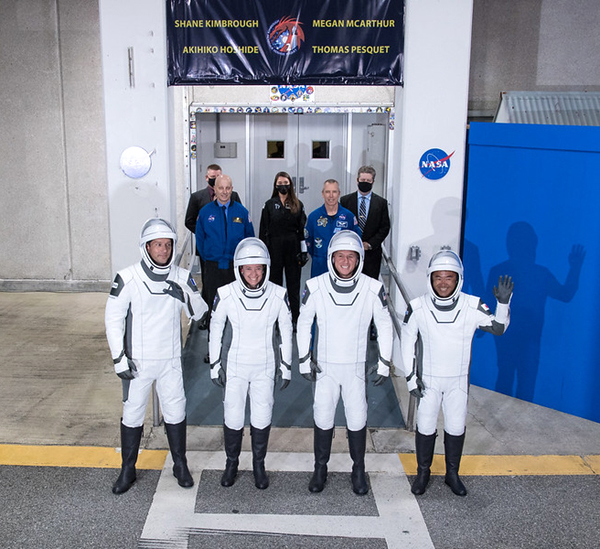
The four Crew-2 astronauts greet their families and friends outside of the Neil A. Armstrong Operations and Checkout Building before heading to Launch Complex 39A, where Falcon 9 and Dragon Endeavour await, at NASA's Kennedy Space Center in Florida...on April 23, 2021.
NASA / Aubrey Gemignani

European Space Agency astronaut Thomas Pesquet and Japan Aerospace Exploration Agency astronaut Akihiko Hoshide can be seen walking through the Crew Access Arm to Dragon Endeavour at Kennedy Space Center's Launch Complex 39A...on April 23, 2021.
NASA / Joel Kowsky

The engine plume from the Falcon 9 rocket carrying the Crew-2 astronauts is visible from the U.S. Capitol Building in Washington, DC...on April 23, 2021.
NASA / Bill Ingalls