Showing posts with label Crew-1. Show all posts

Monday, April 3, 2023

THE FIRST HUMANS TO FLY TO THE MOON SINCE 1972 HAVE BEEN REVEALED!

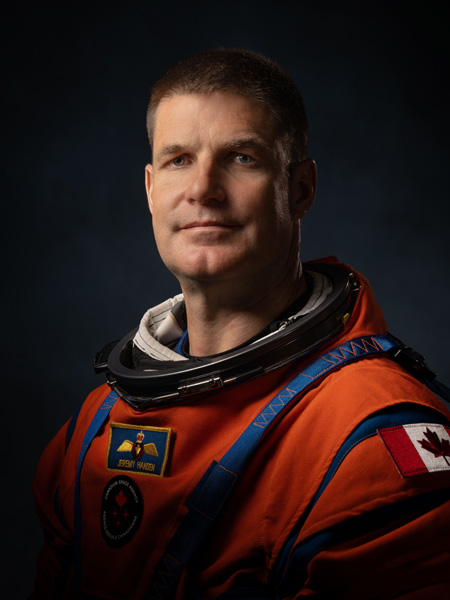
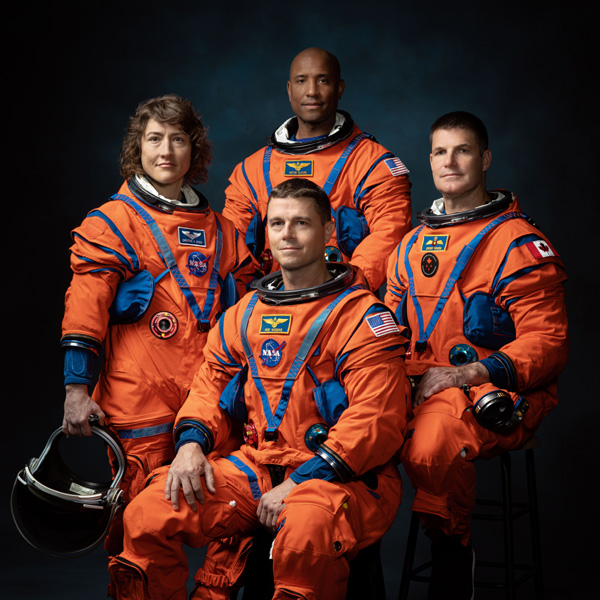
A group portrait of Artemis 2 astronauts (from clockwise) Reid Wiseman, Christina Koch, Victor Glover and Jeremy Hansen.
NASA

NASA Names Astronauts to Next Moon Mission, First Crew Under Artemis (Press Release)

NASA and the Canadian Space Agency (CSA) announced the four astronauts who will venture around the Moon on Artemis II, the first crewed mission on NASA’s path to establishing a long-term presence at the Moon for science and exploration through Artemis. The agencies revealed the crew members on Monday during an event at Ellington Field near NASA’s Johnson Space Center in Houston.

“The Artemis II crew represents thousands of people working tirelessly to bring us to the stars. This is their crew, this is our crew, this is humanity's crew,” said NASA Administrator Bill Nelson. “NASA astronauts Reid Wiseman, Victor Glover, and Christina Hammock Koch, and CSA astronaut Jeremy Hansen, each has their own story, but, together, they represent our creed: E pluribus unum – out of many, one. Together, we are ushering in a new era of exploration for a new generation of star sailors and dreamers – the Artemis Generation.”

The crew assignments are as follows: Commander Reid Wiseman, Pilot Victor Glover, Mission Specialist 1 Christina Hammock Koch and Mission Specialist 2 Jeremy Hansen. They will work as a team to execute an ambitious set of demonstrations during the flight test.

The approximately 10-day Artemis II flight test will launch on the agency’s powerful Space Launch System rocket, prove the Orion spacecraft’s life-support systems, and validate the capabilities and techniques needed for humans to live and work in deep space.

“We are going back to the Moon and Canada is at the center of this exciting journey,” said the Honorable François-Philippe Champagne, the minister responsible for the Canadian Space Agency. “Thanks to our longstanding collaboration with NASA, a Canadian astronaut will fly on this historic mission. On behalf of all Canadians, I want to congratulate Jeremy for being at the forefront of one of the most ambitious human endeavors ever undertaken. Canada’s participation in the Artemis program is not only a defining chapter of our history in space, but also a testament to the friendship and close partnership between our two nations.”

The flight, set to build upon the successful uncrewed Artemis I mission completed in December, will set the stage for the first woman and first person of color on the Moon through the Artemis program, paving the way for future long-term human exploration missions to the Moon, and eventually Mars. This is the agency’s Moon to Mars exploration approach.

“For the first time in more than 50 years, these individuals – the Artemis II crew – will be the first humans to fly to the vicinity of the Moon. Among the crew are the first woman, first person of color and first Canadian on a lunar mission, and all four astronauts will represent the best of humanity as they explore for the benefit of all,” said Director Vanessa Wyche, NASA Johnson. “This mission paves the way for the expansion of human deep space exploration and presents new opportunities for scientific discoveries, commercial, industry and academic partnerships and the Artemis Generation.”

Meet Artemis II Astronauts

This will be Wiseman’s second trip into space, serving previously as a flight engineer aboard the International Station for Expedition 41 from May through November 2014. Wiseman has logged more than 165 days in space, including almost 13 hours as lead spacewalker during two trips outside the orbital complex.

Prior to his assignment, Wiseman served as chief of the Astronaut Office from December 2020 until November 2022.

The mission will be Glover’s second spaceflight, serving previously as pilot on NASA’s SpaceX Crew-1, which landed on May 2, 2021, after 168 days in space. As a flight engineer aboard the space station for Expedition 64, he contributed to scientific investigations, technology demonstrations, and participated in four spacewalks.

Koch will also be making her second flight into space on the Artemis II mission. She served as flight engineer aboard the space station for Expedition 59, 60 and 61.

Koch set a record for the longest single spaceflight by a woman with a total of 328 days in space and participated in the first all-female spacewalks.

Representing Canada, Hansen is making his first flight to space. A colonel in the Canadian Armed Forces and former fighter pilot, Hansen holds a Bachelor of Science in space science from Royal Military College of Canada in Kingston, Ontario, and a Master of Science in physics from the same institution in 2000, with a research focus on Wide Field of View Satellite Tracking.

Hansen was one of two recruits selected by CSA in May 2009 through the third Canadian Astronaut Recruitment Campaign and has served as Capcom in NASA's Mission Control Center at Johnson and, in 2017, became the first Canadian to be entrusted with leading a NASA astronaut class, leading the training of astronaut candidates from the United States and Canada.

“I could not be prouder that these brave four will kickstart our journeys to the Moon and beyond,” said Director of Flight Operations Norm Knight, NASA Johnson. “They represent exactly what an astronaut corps should be: a mix of highly capable and accomplished individuals with the skills and determination to take on any trial as a team. The Artemis II mission will be challenging, and we’ll test our limits as we prepare to put future astronauts on the Moon. With Reid, Victor, Christina and Jeremy at the controls, I have no doubt we’re ready to face every challenge that comes our way.”

Through Artemis missions, NASA will use innovative technologies to explore more of the lunar surface than ever before. We will collaborate with commercial and international partners and establish the first long-term presence on the Moon.

Then, we will use what we learn on and around the Moon to take the next giant leap: sending the first astronauts to Mars.

****

Three Americans and one Canadian will return humanity to the Moon for the first time in 50 years.
NASA

NASA astronaut and Artemis 2 mission specialist Christina Koch.
NASA

Canadian Space Agency astronaut and Artemis 2 mission specialist Jeremy Hansen.
NASA

NASA astronaut and Artemis 2 pilot Victor Glover.
NASA

NASA astronaut and Artemis 2 commander Reid Wiseman.
NASA


Monday, February 14, 2022

The Visionary Behind Inspiration4 Is About to Embark on Another Ambitious Project with SpaceX...

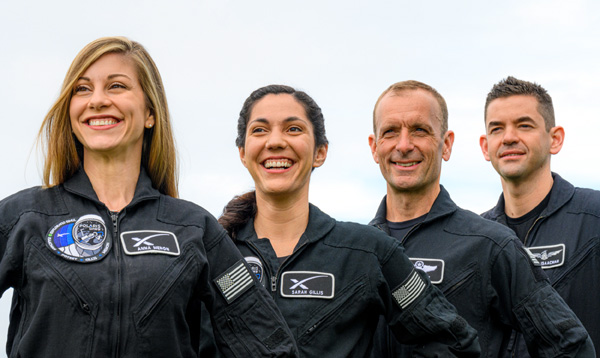
Polaris Dawn astronauts from left to right: mission specialist and medical officer Anna Menon, mission specialist Sarah Gillis, mission pilot Scott 'Kidd' Poteet and mission commander Jared 'Rook' Isaacman.
Polaris Program

Polaris Program will Undertake a Series of Pioneering SpaceX Dragon Missions, Demonstrating New Technologies and Culminating in the First Human Spaceflight on Starship (Press Release)

Led by tech entrepreneur and Inspiration4 commander Jared Isaacman, this program will advance deep space exploration while raising global awareness for St. Jude Children’s Research Hospital®.

LOS ANGELES, CA (February 14, 2022) Today Jared Isaacman, founder and CEO of Shift4 (NYSE: FOUR), announced the Polaris Program, a first-of-its-kind effort to rapidly advance human spaceflight capabilities, while continuing to raise funds and awareness for important causes here on Earth. The program will consist of up to three human spaceflight missions that will demonstrate new technologies, conduct extensive research, and ultimately culminate in the first flight of SpaceX’s Starship with humans on board.

The first mission, Polaris Dawn, is targeted for no earlier than the fourth quarter of this year and will be commanded by Isaacman, an accomplished pilot and astronaut who led Inspiration4, the world’s first all-civilian mission to orbit that helped raise over $240 million for St. Jude Children’s Research Hospital®.

“The Polaris Program is an important step in advancing human space exploration while helping to solve problems through the use of innovative technology here on Earth,” said Isaacman. “On Polaris Dawn, we endeavor to achieve the highest Earth orbit ever flown in addition to conducting the world’s first commercial spacewalk and testing of Starlink laser-based communication. Alongside these important objectives, we will be supporting scientific research to advance both human health interests on Earth and our understanding of human health during future long-duration spaceflights.” Building upon the Inspiration4 mission, Polaris Dawn will continue to raise funds and awareness for St. Jude Children’s Research Hospital®.

THE POLARIS DAWN MISSION

SpaceX’s Falcon 9 rocket will launch the Polaris Dawn mission from Launch Complex 39A at Kennedy Space Center in Florida. Dragon and the Polaris Dawn crew will spend up to five days in orbit, flying higher than any Dragon mission to date and endeavoring to reach the highest Earth orbit ever flown.

While in orbit, SpaceX mission control will carefully monitor Dragon and the crew as they:

– Attempt the first-ever commercial spacewalk with SpaceX-designed extravehicular activity (EVA) spacesuits, upgraded from the current intravehicular (IVA) suit. The development of this suit and the execution of the EVA will be important steps toward a scalable design for spacesuits on future long-duration missions.

- Become the first crew to test Starlink laser-based communications in space, providing valuable data for future space communications systems necessary for human spaceflight to the Moon, Mars, and beyond.

- Conduct scientific research designed to advance both human health on Earth and our understanding of human health during future long-duration spaceflights. This includes, but is not limited to:

-- Using ultrasound to monitor, detect, and quantify venous gas emboli (VGE), contributing to studies on human prevalence to decompression sickness;
-- Gathering data on the radiation environment to better understand how space radiation affects human biological systems;
-- Providing biological samples toward multi-omics analyses for a long-term Biobank; and
-- Research related to Spaceflight Associated Neuro-Ocular Syndrome (SANS), which is a key risk to human health in long-duration spaceflight.

SpaceX and Polaris Dawn will also collaborate with the Translational Research Institute for Space Health (TRISH), BioServe Space Technologies at the University of Colorado Boulder, Space Technologies Lab at Embry Riddle Aeronautical University, Weill Cornell Medicine, Johns Hopkins University Applied Physics Laboratory, the Pacific Northwest National Laboratory, and the U.S. Air Force Academy.

THE POLARIS DAWN CREW

The Polaris Dawn mission has many first-time objectives, so the Polaris Program chose a crew of experts who know each other well and have a foundation of trust they can build upon as they undertake the challenges of this mission. The crew includes:

MISSION COMMANDER, JARED “ROOK” ISAACMAN

In addition to commanding Inspiration4, Isaacman has over 7,000 flight hours of aviation experience, including ratings in multiple experimental and ex-military aircraft. He set speed-around-the-world records in 2008 and 2009, as well as 100 air show performances as a member of the Black Diamond Jet Team, all of which were dedicated to charitable causes. In 2011, Isaacman co-founded what would become the world’s largest private air force, Draken International, to provide realistic adversary training for the United States Department of Defense.

MISSION PILOT, SCOTT “KIDD” POTEET

Poteet is a retired U.S. Air Force Lieutenant Colonel who served 20 years in various roles to include Commander of the 64th Aggressor Squadron, USAF Thunderbird Demonstration Pilot, #4 Slot, USAF Weapons School Graduate, Operational Test and Evaluation Pilot, and F-16 Flight Examiner. Kidd is a command pilot with over 3,200 flying hours in the F-16, A-4, T-38, T-37, T-3 and Alpha jet. He logged over 400 hours of combat time in support of various operations around the world. Following his Air Force career, Kidd served as the Director of Business Development at Draken International as well as the Vice President of Strategy at Shift4 Payments. He most recently served as the Mission Director of Inspiration4.

MISSION SPECIALIST, SARAH GILLIS

Gillis is a Lead Space Operations Engineer at SpaceX, responsible for overseeing the company’s astronaut training program. This includes the development of mission-specific curriculum and training execution for both NASA and commercial astronauts who fly aboard the Dragon spacecraft. She prepared NASA astronauts for the first Demo-2 and Crew-1 missions, and most recently directly trained the Inspiration4 astronauts, the first all-civilian crew to go to orbit. Sarah is an experienced mission control operator, who has supported real-time operations for Dragon’s cargo resupply missions to and from the International Space Station as a navigation officer, and as a crew communicator for Dragon’s human spaceflight missions.

MISSION SPECIALIST & MEDICAL OFFICER, ANNA MENON

Menon is a Lead Space Operations Engineer at SpaceX, where she manages the development of crew operations and serves in mission control as both a Mission Director and crew communicator. During her tenure at SpaceX, Menon has led the implementation of Dragon’s crew capabilities, helped create the crew communicator operator role, and developed critical operational responses to vehicle emergencies, such as a fire or cabin depressurization. Anna served in mission control during multiple cargo and crew Dragon missions, including Demo-2, Crew-1, CRS-22, and CRS-23. Prior to SpaceX, she worked for seven years at NASA as a biomedical flight controller for the International Space Station.

Source: Polaris Program

****

An artist's concept of an astronaut performing an extra-vehicular activity from a Spacex Crew Dragon capsule in low-Earth orbit.
Polaris Program

Monday, May 17, 2021

SpaceX Update: A Fourth and Final Member Is Added to Crew Dragon's Next Flight to the ISS This October...

NASA astronaut Kayla Barron is the fourth and final member of SpaceX's Crew-3 mission...which launches to the International Space Station in late October.
NASA / Bill Ingalls

Kayla Barron Joins NASA’s SpaceX Crew-3 Mission to Space Station (Press Release)

NASA has assigned Kayla Barron to serve as a mission specialist for the agency’s SpaceX Crew-3 mission to the International Space Station, which is targeted to launch as early as Oct. 23.

This will be the first spaceflight for Barron, who became a NASA astronaut in January 2020 after completing two years of training. She will join NASA astronauts Raja Chari and Tom Marshburn, as the mission’s commander and pilot, respectively, and ESA (European Space Agency) astronaut Matthias Maurer, who also will serve as a mission specialist.

This will be the third crew rotation mission on SpaceX’s human space transportation system and its fourth flight with astronauts, including the Demo-2 test flight, to the space station through NASA’s Commercial Crew Program.

Barron was born in Pocatello, Idaho, but considers Richland, Washington, her hometown. She earned a bachelor’s degree in systems engineering from the U.S. Naval Academy in Annapolis, Maryland, in 2010. She earned a master’s degree in nuclear engineering from the University of Cambridge in England, in 2011, as Gates Cambridge Scholar. Lt. Cmdr. Barron earned her submarine warfare officer qualification and deployed three times while serving aboard the USS Maine. At the time of her selection as an astronaut candidate in 2017, she was serving as the flag aide to the superintendent of the U.S. Naval Academy.

NASA previously assigned Chari, Marshburn, and Maurer to the mission in December 2020. This will be the first spaceflight for Chari and Maurer. It will be the third spaceflight for Marshburn, who previously served as a crew member of the space shuttle STS-127 mission in 2009 and Expedition 34/35 aboard the space station, which concluded in 2013.

When Barron, Chari, Marshburn, and Maurer arrive at the orbiting laboratory, they will become expedition crew members for the duration of their six-month science mission. The crew will have a slight overlap with the Crew-2 astronauts, who arrived April 24. This will mark the second time commercial crew missions have overlapped on the station. The Crew-1 astronauts, who ended their mission with a splashdown off the coast of Panama City, Florida, on Sunday, May 2, were aboard the station with the Crew-2 astronauts for a seven-day direct crew handover. Increasing the total number of astronauts aboard the station enables the agency to boost the number of science investigations conducted in the unique microgravity environment.

****

Sunday, May 2, 2021

SpaceX Update: Crew Dragon Resilience Is Back on Earth...

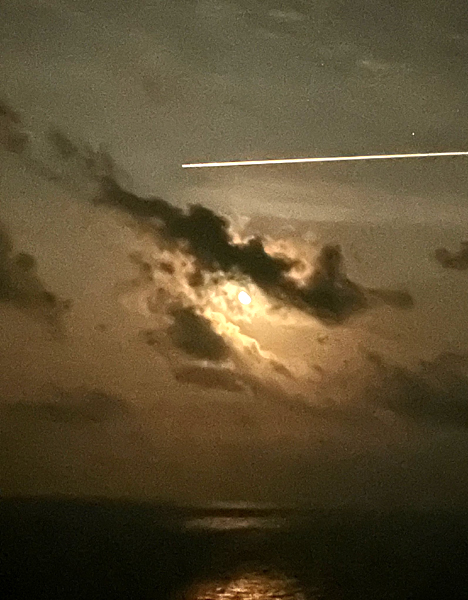
Crew Dragon Resilience re-enters Earth's atmosphere above the Gulf of Mexico...on May 2, 2011.
Photo by BigBoatDriver - Twitter.com

Crew-1 Astronauts Safely Splash Down After Space Station Mission (Press Release)

Four astronauts splashed down safely in the Gulf of Mexico Sunday, completing NASA’s first commercial crew, long-duration mission aboard the International Space Station. The return comes nearly six months after the crew members arrived at the microgravity laboratory and also marks the longest-duration mission of a crewed American spacecraft to date.

SpaceX’s Crew Dragon, carrying NASA astronauts Michael Hopkins, Victor Glover, and Shannon Walker, and Japan Aerospace Exploration Agency astronaut Soichi Noguchi, returned to Earth in a parachute-assisted splashdown at 2:56 a.m. EDT off the coast of Panama City, Florida. Crews aboard SpaceX recovery vessels successfully recovered the spacecraft and astronauts. After returning to shore, the astronauts will fly back to Houston.

“Welcome home Victor, Michael, Shannon, and Soichi, and congratulations to the teams at NASA and SpaceX who worked so hard to ensure their safe and successful splashdown,” said Sen. Bill Nelson, who was confirmed by the Senate to serve as NASA Administrator on April 29. “We’ve accomplished another incredible spaceflight for America and our commercial and international partners. Safe, reliable transportation to the International Space Station is exactly the vision that NASA had when the agency embarked on the commercial crew program.”

NASA’s SpaceX Crew-1 mission launched Nov. 15, 2020, on a Falcon 9 rocket from the agency’s Kennedy Space Center in Florida. The astronauts named the spacecraft Resilience, in honor of their families, colleagues, and fellow citizens and highlighting the dedication displayed by the teams involved with the mission and demonstrating that there is no limit to what humans can achieve when they work together. Crew Dragon Resilience docked to the Harmony module’s forward port of the space station Nov. 16, nearly 27 hours after liftoff.

Overall, Hopkins, Glover, Walker, and Noguchi traveled 71,242,199 statute miles during their 168 days in orbit (with 167 days aboard the space station), completing 2,688 orbits around Earth. With splashdown, the crew also broke the American crewed spacecraft mission duration record of 84 days, 1 hour, 15 minutes, set by the final Skylab crew in February 1974.

Crew-1 also is the first night splashdown of a U.S. crewed spacecraft since Apollo 8’s predawn return in the Pacific Ocean on Dec. 27, 1968, with NASA astronauts Frank Borman, Jim Lovell and Bill Anders.

Throughout their mission, the Crew-1 astronauts contributed to scientific investigations and technology demonstrations, in addition to spacewalks and public engagement events, while aboard the orbiting laboratory. From studying protein crystal development to advance new drug discoveries, to demonstrating robotic assistant technologies, their work advances exploration of the universe while bringing benefits back to Earth.

They also grew crops in both the Advanced Plant Habitat and Veggie plant growth facilities, and conducted tests of a new method for producing semiconductor crystals. The astronauts contributed hundreds of pictures of Earth as part of the Crew Earth Observation investigation, one of the longest-running investigations aboard the space station, which contributes to tracking of natural disasters and changes to our home planet. The crew also tested a new tape dispenser, designed and produced by students as part of the High Schools United with NASA to Create Hardware (HUNCH), during the mission.

In early 2021, the Crew-1 astronauts had significant roles to play in five spacewalks outside the orbiting laboratory. Glover completed his first four spacewalks, including three alongside Hopkins, whose total number of spacewalks is now five. Noguchi joined NASA’s Kate Rubins on the fourth spacewalk of each of their careers. During the spacewalks, the astronauts connected cables on the recently installed Bartolomeo science platform, prepared the station for upcoming solar array upgrades, serviced the station’s cooling system, and completed other station maintenance tasks.

On April 5, all four Crew-1 astronauts boarded Resilience for a port relocation maneuver, moving their spacecraft from the forward-facing port to the space-facing port on the Harmony module. The move allowed for the forward-facing port to receive four Crew-2 astronauts upon their arrival to the station April 24. Later this year, SpaceX’s 22nd Commercial Resupply Services mission is scheduled to dock at the newly vacant zenith port, bringing with it the first pair of new solar arrays.

The Crew-1 flight is part of NASA’s Commercial Crew Program, which has worked with the U.S. aerospace industry to launch astronauts on American rockets and spacecraft from American soil to the space station.

The second splashdown of the Commercial Crew Program comes just over one week after the launch of NASA’s SpaceX Crew-2 mission, the second long-duration mission. The Crew-2 astronauts launched April 23 and will live and work aboard the station until their return to Earth in about six months.

Resilience will return to SpaceX’s Dragon Lair in Florida for inspection and processing. There, teams will examine the spacecraft’s data and performance throughout the flight. The next NASA and SpaceX crewed mission is Crew-3, currently targeted for launch no earlier than Oct. 23. Crew-2 astronauts are scheduled to return to Earth Oct. 31, about a week after welcoming their Crew-3 colleagues to the orbiting outpost.

The goal of NASA’s Commercial Crew Program is safe, reliable, and cost-effective transportation to and from the International Space Station. This has already been proven to provide additional research time and increase the opportunity for discovery aboard humanity’s testbed for exploration, including helping us prepare for human exploration of the Moon and Mars.

****

As seen from Tampa, Florida, Crew Dragon Resilience re-enters Earth's atmosphere above the Gulf of Mexico...on May 2, 2011.
Photo by Kyle Montgomery - Twitter.com

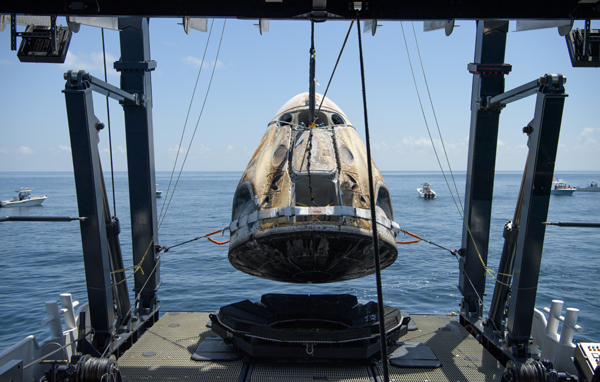
With the Crew-1 astronauts waiting patiently onboard, Resilience is about to be placed onto the deck of SpaceX's GO Navigator recovery ship in the Gulf of Mexico...on May 2, 2011.
NASA / Bill Ingalls

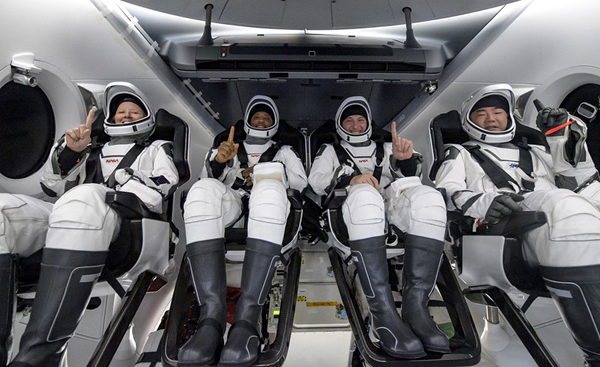
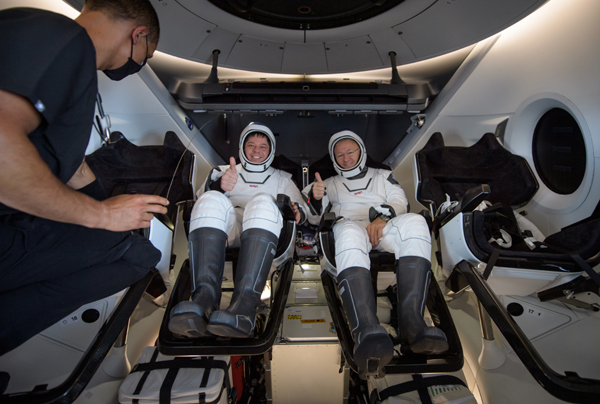
The Crew-1 astronauts take one last group photo aboard Resilience before disembarking from their capsule for the return trip back to Houston, Texas...on May 2, 2011.
NASA / Bill Ingalls

Saturday, May 1, 2021

The National Space Council Has a New Leader...

U.S. Vice President Kamala Harris speaks with NASA astronaut and Crew-1 member Victor Glover aboard the International Space Station...on February 24, 2021.
NASA

Sen. Bill Nelson Statement on National Space Council (Press Release)

The following is a statement from Sen. Bill Nelson, who the U.S. Senate confirmed as the 14th NASA administrator on April 29, regarding the announcement Saturday that Vice President Kamala Harris will chair the National Space Council:

“The Vice President is the perfect person to lead the federal government’s space policy, which is increasingly complex, with many nations in space.

“Vice President Lyndon Johnson was the first chair of the National Space Council when America initially ventured beyond Earth. Now, Vice President Harris will coordinate our nation’s efforts to ensure America continues to lead in space. It is an exciting time for our space program.”

****

Saturday, April 24, 2021

SpaceX Update: Endeavour Has Docked with the ISS...

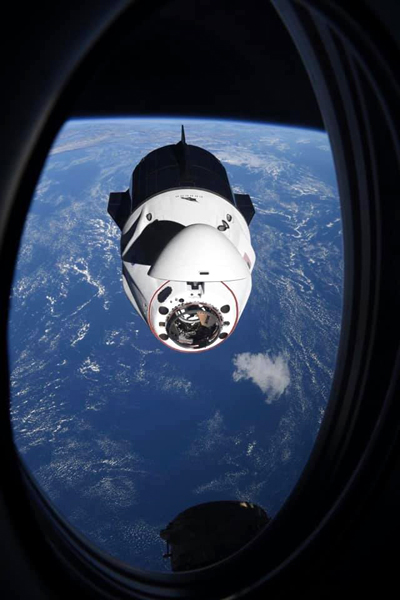
As seen from inside Crew Dragon Resilience, Crew Dragon Endeavour is about to dock with the International Space Station (ISS) on April 24, 2021.
NASA - Mike Hopkins

Earlier today, Crew Dragon Endeavour ended her almost 24-hour chase of the International Space Station (ISS) when she finally docked to the orbital outpost at 5:08 AM, Eastern Daylight Time (2:08 AM, Pacific Daylight Time). For the next four days, the ISS will be populated by 11 crew members (four astronauts from the newly-arrived Crew-2, four astronauts from Crew-1 and one astronaut, plus two cosmonauts, who launched aboard Russia's Soyuz MS-18 vehicle from Baikonur Cosmodrome in Kazakhstan on April 9). The Crew-1 astronauts will then board their Crew Dragon Resilience vehicle on April 28 and return to Earth for a splashdown in the Atlantic Ocean...off the coast of Florida later that day.

Crew-3 is set to launch to the ISS no earlier than late October—while Resilience will be refurbished and reused for the 3-day Inspiration4 mission, which will have an all-civilian crew, that's scheduled to fly in mid-September.

With the arrival of Crew-2 on April 24, the ISS will be populated by 11 astronauts until April 28...when Crew-1 returns to Earth for a splashdown off the coast of Florida.
NASA TV

Friday, April 23, 2021

ISS Update: Crew Dragon Endeavour Officially Begins Her Second Trip to the Orbital Outpost...

The Falcon 9 rocket carrying Dragon Endeavour and her four Crew-2 astronauts head to the International Space Station...on April 23, 2021.
SpaceX

NASA’s SpaceX Crew-2 Astronauts Headed to International Space Station (Press Release)

NASA’s SpaceX Crew-2 astronauts are in orbit following their early morning launch bound for the International Space Station for the second commercial crew rotation mission aboard the microgravity laboratory. The international crew of astronauts lifted off at 5:49 a.m. EDT Friday from Launch Complex 39A at NASA’s Kennedy Space Center in Florida.

The SpaceX Falcon 9 rocket propelled the Crew Dragon spacecraft with NASA astronauts Shane Kimbrough and Megan McArthur, along with JAXA (Japan Aerospace Exploration Agency) astronaut Akihiko Hoshide and ESA (European Space Agency) astronaut Thomas Pesquet, into orbit to begin a six-month science mission on the space station.

During Crew Dragon’s flight, SpaceX will command the spacecraft from its mission control center in Hawthorne, California, and NASA teams will monitor space station operations throughout the flight from Mission Control Center at the agency’s Johnson Space Center in Houston.

“It has been an incredible year for NASA and our Commercial Crew Program, with three crewed launches to the space station since last May,” said NASA Acting Administrator Steve Jurczyk. “This is another important milestone for NASA, SpaceX, and our international partners at ESA and JAXA, and for the future of scientific research onboard the space station. It will be an exciting moment to see our crews greet one another on station for our first crew handover under the Commercial Crew Program.”

The Crew Dragon spacecraft, named Endeavour, will dock autonomously to the forward port of the station’s Harmony module about 5:10 a.m. Saturday, April 24. NASA Television, the NASA app, and the agency’s website are providing ongoing live coverage through docking, hatch opening, and the ceremony to welcome the crew aboard the orbital outpost.

“I’m really proud of the SpaceX team and honored to be partnered with NASA and helping JAXA and ESA as well,” said Elon Musk, Chief Engineer at SpaceX. “We’re thrilled to be a part of advancing human spaceflight and looking forward to going beyond Earth orbit to the Moon and Mars and helping make humanity a space-faring civilization and a multi-planet species one day.”

The Crew-2 mission is the second of six crewed missions NASA and SpaceX will fly as part of the agency’s Commercial Crew Program. This mission has several firsts, including:

- First commercial crew mission to fly two international partners;
- First commercial crew handover between astronauts on the space station as Crew-1 and Crew-2 astronauts will spend about five days together on station before Crew-1 returns to Earth;
- First reuse of the Crew Dragon spacecraft and Falcon 9 rocket on a crew mission – Crew Dragon Endeavour flew the historic Demo-2 mission and the Falcon 9 flew astronauts on the Crew-1 mission; and,
- First time two commercial crew spacecraft will be docked to station at the same time.

“When I see a launch I immediately think of what it took to reach this milestone and the dedication of all the people who made it happen,” said Steve Stich, manager of NASA’s Commercial Crew Program. “There’s obviously a long way to go, but now we can celebrate the Crew-2 launch and look forward to seeing them join their other Expedition 65 colleagues as we prepare to bring Crew-1 home next week.”

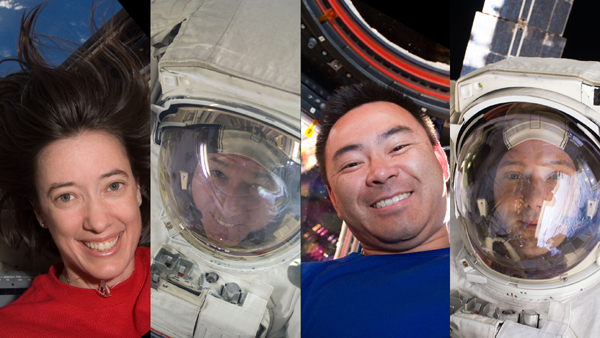
Kimbrough, McArthur, Hoshide, and Pesquet will join the Expedition 65 crew of Shannon Walker, Michael Hopkins, Victor Glover, and Mark Vande Hei of NASA, as well as Soichi Noguchi of JAXA and Roscosmos cosmonauts Oleg Novitskiy and Pyotr Dubrov. For a short time, the number of crew on the space station will increase to 11 people until Crew-1 astronauts Walker, Hopkins, Glover, and Noguchi return a few days later.

This the second commercial crew mission to fly a JAXA astronaut. When Hoshide joins astronaut Noguchi during the commercial crew handover period, it will mark the first time two JAXA astronauts are on station at the same time.

“I am extremely honored to witness the successful launch today. It is my utmost pleasure and also for Japan that Japanese astronauts Soichi Noguchi and Aki Hoshide boarded the operational spacecraft of Crew Dragon twice in a row,” said Hiroshi Sasaki, Vice President for Human Spaceflight and Space Exploration. “I believe this is brought by the many years of close cooperation cultivated amongst the international partners, especially between U.S. and Japan through the ISS program. I hope Aki will play an integral role as the second Japanese ISS commander along with his colleague astronauts, creating fruitful outcomes and expanding the human frontier to the Lunar Gateway, the surface of the Moon and even beyond.”

Crew-2 also is the first commercial crew mission to fly an ESA astronaut. Pesquet is the first of three ESA crew members assigned to fly to station on commercial crew spacecraft, kicking off a continuous stay of ESA astronauts on the space station for about a year and a half – in total – for the first time in more than 20 years.

"This is a thrilling time for human spaceflight and this new success of the Commercial Crew Program embodies it – congratulations once again to NASA and SpaceX,” said David Parker, director of human and robotic exploration at ESA. “Starting with astronaut Thomas Pesquet, ESA is delighted to join this new space station chapter, paving the way to the future of exploration side by side with diverse partners. Six months of excellent science and state-of-the-art technology demonstrations now await him, and we know he cannot wait to start working."

Crew-2 Astronauts

Shane Kimbrough is commander of the Crew Dragon spacecraft and the Crew-2 mission. Kimbrough is responsible for all phases of flight, from launch to re-entry. He also will serve as an Expedition 65 flight engineer aboard the station. Selected as a NASA astronaut in 2004, Kimbrough first launched aboard space shuttle Endeavour for a visit to the station on the STS-126 mission in 2008, and then aboard a Russian Soyuz spacecraft for his first long-duration mission for Expedition 49/50 in 2016. He has spent a total of 189 days in space and performed six spacewalks. Kimbrough also is a retired U.S. Army colonel and earned a bachelor’s degree in aerospace engineering from the United States Military Academy at West Point, New York, and a master’s degree in operations research from the Georgia Institute of Technology in Atlanta.

Megan McArthur is the pilot of the Crew Dragon spacecraft and second-in-command for the mission. McArthur is responsible for spacecraft systems and performance. She also will be a long-duration space station crew member, making her first trip to the space station. Selected as an astronaut in 2000, McArthur launched on space shuttle Atlantis as a mission specialist on STS-125, the final Hubble Space Telescope servicing mission, in 2009. McArthur operated the shuttle’s robotic arm over the course of the 12 days, 21 hours she spent in space, capturing the telescope and moving crew members during the five spacewalks needed to repair and upgrade it. She holds a bachelor’s degree in aerospace engineering from the University of California, Los Angeles and a doctorate in oceanography from the University of California, San Diego.

Akihiko Hoshide is a mission specialist for Crew-2. As a mission specialist, he will work closely with the commander and pilot to monitor the spacecraft during the dynamic launch and re-entry phases of flight. Once aboard the station, Hoshide will become a flight engineer for Expedition 65. Hoshide joined the National Space Development Agency of Japan (NASDA, currently JAXA) in 1992 and was selected as an astronaut candidate in February 1999. Hoshide is a veteran of two spaceflights. In June 2008, he flew to the International Space Station on the STS-124 mission to deliver the Japanese Experiment Module Kibo to the station. From July to November 2012, he stayed on the space station for 124 days as a flight engineer for the Expedition 32/33 mission. The Crew Dragon will be the third spacecraft that Noguchi has flown to the orbiting laboratory.

Thomas Pesquet also will be a mission specialist for Crew-2, working with the commander and pilot to monitor the spacecraft during the dynamic launch and re-entry phases of flight. Pesquet also will become a long-duration crew member aboard the space station. He was selected as an astronaut candidate by ESA in May 2009 and worked as a Eurocom, communicating with astronauts during spaceflights from the mission control center. He previously flew as part of Expeditions 50 and 51, launching aboard a Russian Soyuz spacecraft in October 2016 and spending 196 days in space, returning to Earth in June 2017. His mission also included two spacewalks to maintain the station: one to replace batteries on an electrical channel, and one to detect a cooling leak and service the robotic arm.

Mission Objectives

The Crew-2 members will conduct science and maintenance during a six-month stay aboard the orbiting laboratory and will return no earlier than Oct. 31. The Crew Dragon spacecraft can stay in orbit for at least 210 days, which is a NASA requirement.

Adding more crew members aboard the microgravity laboratory increases the time available for scientific activities. The November 2020 arrival of the Crew-1 astronauts more than doubled crew hours spent on scientific research and support activities, and Crew-2 will continue the important investigations and technology demonstrations that are preparing for future Artemis missions to the Moon, helping us improve our understanding of Earth’s climate, and improving life on our home planet. An important scientific focus on this expedition is continuing a series of Tissue Chips in Space studies. Tissue chips are small models of human organs containing multiple cell types that behave much the same as they do in the body. Another important element of Crew-2’s mission is augmenting the station’s solar power system by installing the first pair of six new ISS Roll-out Solar Arrays.

Crew Dragon also is delivering almost 250 pounds of cargo, new science hardware, and experiments, including a university student-led investigation to study possible causes for suppressed immune response in microgravity.

During their stay on the orbiting laboratory, Crew-2 astronauts expect to see a range of U.S. commercial spacecraft, including the Northrop Grumman Cygnus; SpaceX cargo Dragon; Boeing CST-100 Starliner, on its uncrewed flight to station; and NASA’s SpaceX Crew-3 Dragon; which is targeted for launch no earlier than Oct. 23. During Crew-2, astronauts also will conduct a variety of spacewalks outside the space station, including the solar array installation.

At the conclusion of the mission, the Crew-2 astronauts will board Crew Dragon, which will then autonomously undock, depart the space station, and re-enter Earth’s atmosphere. Crew Dragon also will return to Earth important and time-sensitive research. NASA and SpaceX are capable of supporting seven splashdown sites located off Florida's east coast and in the Gulf of Mexico. Upon splashdown, the SpaceX recovery ship will pick up the crew and return to shore.

NASA’s Commercial Crew Program is delivering on its goal of safe, reliable, and cost-effective transportation to and from the International Space Station from the United States through partnership with American private industry. This partnership is changing the arc of human spaceflight history by opening access to low-Earth orbit and the International Space Station to more people, more science, and more commercial opportunities.

The space station remains the springboard to NASA's next great leap in space exploration, including future missions to the Moon and, eventually, to Mars. For more than 20 years, humans have lived and worked continuously aboard the International Space Station, advancing scientific knowledge and demonstrating new technologies, making research breakthroughs not possible on Earth. As a global endeavor, 243 people from 19 countries have visited the unique microgravity laboratory that has hosted more than 3,000 research and educational investigations from researchers in 108 countries and areas.

Source: NASA.Gov

****

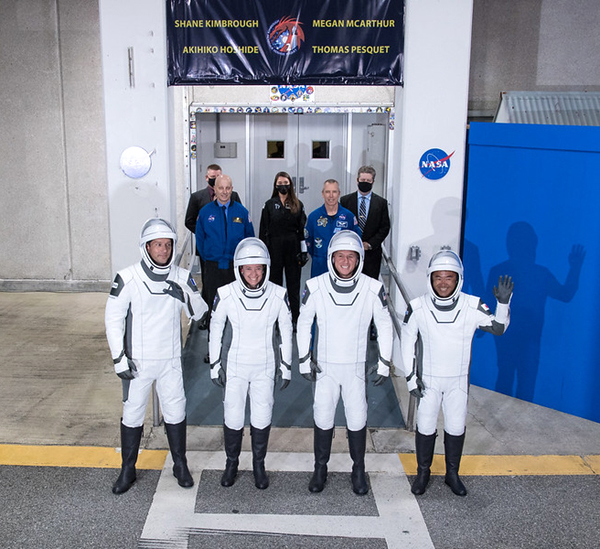
The four Crew-2 astronauts greet their families and friends outside of the Neil A. Armstrong Operations and Checkout Building before heading to Launch Complex 39A, where Falcon 9 and Dragon Endeavour await, at NASA's Kennedy Space Center in Florida...on April 23, 2021.
NASA / Aubrey Gemignani

European Space Agency astronaut Thomas Pesquet and Japan Aerospace Exploration Agency astronaut Akihiko Hoshide can be seen walking through the Crew Access Arm to Dragon Endeavour at Kennedy Space Center's Launch Complex 39A...on April 23, 2021.
NASA / Joel Kowsky

The engine plume from the Falcon 9 rocket carrying the Crew-2 astronauts is visible from the U.S. Capitol Building in Washington, DC...on April 23, 2021.
NASA / Bill Ingalls

Thursday, April 1, 2021

Inspiration4 Update: The Full Crew for This Historic Space Voyage Has Been Revealed...

Inspiration4 astronauts Christopher Sembroski, Hayley Arceneaux, Sian Proctor and Jared Isaacman pose for a group photo at Kennedy Space Center's Launch Complex 39A.
SpaceX

Final Crew Members Named for World’s First All-Civilian Mission to Space (Press Release - March 30)

New Crew Members Representing Prosperity and Generosity Join Hope and Leadership to Complete the Crew Manifest

CAPE CANAVERAL, Fla.-- Inspiration4, the world’s first all-civilian mission to space, announced the final two members of the four-person crew that will undertake a historic voyage to the stars later this year. Christopher Sembroski of Everett, WA and Dr. Sian Proctor of Tempe, AZ will join previously announced crew member Hayley Arceneaux under the command of Jared Isaacman. SpaceX’s Falcon 9 rocket will launch the crew aboard a Dragon spacecraft later this year.

Sembroski and Proctor will represent the mission pillars of:

- Prosperity Dr. Proctor, a 51-year-old entrepreneur, educator, trained pilot and active voice in the space exploration community, was awarded her seat by being selected as the top entrant of an independently judged online business competition that attracted approximately 200 entries and was conducted by the eCommerce platform Shift4Shop.

“This opportunity is proof that hard work and perseverance can pay off in unimaginable ways,” said Dr. Proctor. “I have always believed that I was preparing for something special, and that moment has arrived with Inspiration4.”

Proctor will serve as the Mission Pilot and back up the commander and support related needs throughout the mission.

- Generosity Sembroski, a 41-year-old aerospace industry employee at Lockheed Martin and United States Air Force veteran, contributed to a special fundraising campaign for St. Jude Children’s Research Hospital® that offered an Inspiration4 seat to a lucky donor after receiving nearly 72,000 entries. Since it was first announced in February, the campaign has raised approximately $113M with new support opportunities to come in the near future, including chances to sign up at www.stjude.org/Inspiration4 and fundraise to qualify for Inspiration4-themed incentive items, special experiences, collectible merchandise, flight-related campaign information and more.

“Although I’ve been fortunate to have spent years in the aerospace industry, I never imagined having the opportunity to reach the stars, especially through something as simple as supporting St. Jude,” said Sembroski. “I am honored to occupy the Generosity seat and look forward to using this platform to encourage everyone to be generous to others in whatever ways they are able.”

Sembroski will serve as the Mission Specialist and will help manage payload, science experiments, communications to mission control and more.

Inspiration4 is completed by the other mission pillars of Leadership, represented by Isaacman, and Hope, represented by Arceneaux. Isaacman, the 38-year-old founder and CEO of Shift4 Payments (NYSE: FOUR) and a world record-holding pilot, created the Inspiration4 mission and donated the three crew seats to inspire humanity and raise money for the lifesaving mission of St. Jude. Arceneaux is a 29-year-old physician assistant who works at St. Jude Children’s Research Hospital in Memphis, TN and joined Inspiration4 last month. In addition to working at St. Jude, she was treated as a child for bone cancer at the preeminent care and research hospital and vowed to return to serve others. Arceneaux will serve as Medical Officer overseeing medical care and experiments on the mission.

“Inspiration4’s goal is to inspire humanity to support St. Jude here on Earth while also seeing new possibilities for human spaceflight,” said Isaacman. “Each of these outstanding crew members embodies the best of humanity, and I am humbled to lead them on this historic and purposeful mission and the adventure of a lifetime.”

All crew members will undergo commercial astronaut training by SpaceX on the Falcon 9 launch vehicle and Dragon spacecraft – the very same Dragon spacecraft currently attached to the International Space Station supporting the Crew-1 mission. Once Dragon returns the Crew-1 astronauts back home to Earth, the SpaceX team will inspect and refurbish the spacecraft ahead of the Inspiration4 mission. Crew member training will include a specific focus on orbital mechanics, operating in microgravity, zero gravity, and other forms of stress testing. The crew will receive emergency preparedness training, spacesuit and spacecraft ingress and egress exercises, as well as partial- and full-mission simulations.

The mission is being targeted for no earlier than Sept. 15, 2021. It will launch from historic Launch Complex 39A at NASA’s Kennedy Space Center in Florida and will be carefully monitored at every step by SpaceX mission control as the spacecraft orbits the planet every 90 minutes along a customized flight path. The crew is targeting an approximate 540 km orbit, flying further than any human since Hubble, for an expected mission duration of approximately three days. In advance of the mission, the crew is working closely with SpaceX and multiple organizations to identify scientific research opportunities they can support while in orbit. Upon conclusion of the multi-day journey, Dragon will reenter Earth’s atmosphere for a soft-water landing off the coast of Florida.

To learn more about Inspiration4 and how to support and follow this historic journey to space, visit www.Inspiration4.com and follow the mission on social media on Twitter (@inspiration4x), Facebook (@inspiration4mission), Instagram (@inspiration4) and YouTube (@Inspiration4) to receive the latest news on mission training, preparation and timing.

****

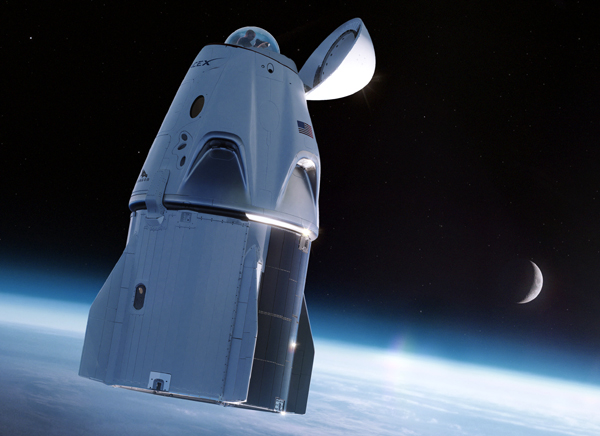
An artist's concept of Inspiration4's Crew Dragon spacecraft...which will have a viewing cupola installed for the four all-civilian astronauts to observe Earth and the cosmos.
SpaceX

Monday, March 29, 2021

ISS Update: The Crew-1 Astronauts Will Relocate the Resilience Capsule at the Orbital Outpost in Preparation for Crew-2's Arrival Next Month...

A snapshot of SpaceX's Crew Dragon capsule docked to the International Space Station's Harmony module.
NASA

NASA TV to Air First US Commercial Crew Port Relocation on Space Station (Press Release)

NASA’s SpaceX Crew-1 astronauts aboard the International Space Station will mark another first for commercial spaceflight Monday, April 5, when the four astronauts will relocate the Crew Dragon spacecraft to prepare for the arrival of new crew members in late April and the upcoming delivery of new solar arrays this summer.

Live coverage will begin at 6 a.m. EDT on NASA Television, the NASA app, and the agency’s website.

NASA astronauts Michael Hopkins, Victor Glover, and Shannon Walker, along with Japan Aerospace Exploration Agency (JAXA) astronaut Soichi Noguchi, will undock Crew Dragon Resilience from the forward port of the station’s Harmony module at 6:29 a.m. and dock to the space-facing port at 7:15 a.m.

The relocation will free Harmony’s forward port for the docking of Crew Dragon Endeavour, set to carry four crew members to the station on NASA’s SpaceX Crew-2 mission. NASA astronauts Shane Kimbrough and  Megan McArthur, JAXA astronaut Aki Hoshide, and ESA (European Space Agency) astronaut Thomas Pesquet are scheduled to launch to the station Thursday, April 22, from Launch Complex 39A at NASA’s Kennedy Space Center in Florida.

The Crew-1 astronauts will depart the station and return to Earth in late April or early May, leaving the space-facing port of Harmony vacant. A Dragon cargo spacecraft carrying several tons of supplies and the first set of new solar arrays for the space station is scheduled to launch this summer, and requires the space-facing port position to enable robotic extraction of the arrays from Dragon’s trunk using Canadarm2.

This will be the first port relocation of a Crew Dragon spacecraft. NASA’s SpaceX Crew-1 mission lifted off Nov. 15, 2020, and docked to the space station Nov. 16. The mission is the first of six certified crew missions NASA and SpaceX planned as a part of the agency’s Commercial Crew Program.

****

Saturday, February 27, 2021

ISS Update: The U.S. Vice President Celebrates Black History Month by Chatting with the SpaceX Crew-1 Pilot Aboard the Orbital Outpost...

U.S. Vice President Kamala Harris speaks with NASA astronaut Victor Glover aboard the International Space Station...on February 24, 2021.
NASA

Vice President Kamala Harris Calls NASA Astronaut Victor Glover (Press Release)

In celebration of Black History Month, NASA astronaut Victor Glover welcomed Vice President Kamala Harris to the International Space Station for a virtual chat.

In the video recorded Feb. 24 and shared Saturday, the conversation ranged from the legacy of human spaceflight to observing Earth from the vantage of the space station, Glover’s history-making stay aboard the orbiting laboratory, and preparing for missions from the Moon to Mars.

Victor Glover is a long-duration crew member on the International Space Station. He served as the Crew Dragon pilot and second-in-command for NASA’s SpaceX Crew-1 mission. Glover is responsible for spacecraft systems and performance.

Selected as an astronaut in 2013, the California native holds a Bachelor of Science degree in general engineering from California Polytechnic State University, a Master of Science degree in flight test engineering and a master’s degree military operational art and science from Air University, and a Master of Science degree in systems engineering from Naval Postgraduate School. Glover is a naval aviator and was a test pilot in the F/A‐18 Hornet, Super Hornet, and EA‐18G Growler aircraft. Follow Glover on Twitter and Instagram.

For more than 20 years, humans have lived and worked continuously aboard the International Space Station, advancing scientific knowledge and demonstrating new technologies, making research breakthroughs not possible on Earth. As a global endeavor, 242 people from 19 countries have visited the unique microgravity laboratory that has hosted more than 3,000 research and educational investigations from researchers in 108 countries and areas. The space station remains the springboard to America's Moon to Mars exploration approach, including Artemis missions to the Moon to prepare for human exploration of the Red Planet.

****

Sunday, August 2, 2020

Demo-2 Update: Dragon Endeavour's Historic Mission Has Finally Come to a Successful End!

SpaceX's Dragon Endeavour capsule, carrying NASA astronauts Bob Behnken and Doug Hurley onboard, is about to splash down into the Gulf of Mexico off the coast of Pensacola, Florida...on August 2, 2020.
NASA / Bill Ingalls

NASA Astronauts Safely Splash Down after First Commercial Crew Flight to Space Station (Press Release)

Two NASA astronauts splashed down safely in the Gulf of Mexico Sunday for the first time in a commercially built and operated American crew spacecraft, returning from the International Space Station to complete a test flight that marks a new era in human spaceflight.

SpaceX’s Crew Dragon, carrying Robert Behnken and Douglas Hurley, splashed down under parachutes in the Gulf of Mexico off the coast of Pensacola, Florida at 2:48 p.m. EDT Sunday and was successfully recovered by SpaceX. After returning to shore, the astronauts immediately will fly back to Houston.

“Welcome home, Bob and Doug! Congratulations to the NASA and SpaceX teams for the incredible work to make this test flight possible,” said NASA Administrator Jim Bridenstine. “It’s a testament to what we can accomplish when we work together to do something once thought impossible. Partners are key to how we go farther than ever before and take the next steps on daring missions to the Moon and Mars.”

Behnken and Hurley’s return was the first splashdown for American astronauts since Thomas Stafford, Vance Brand, and Donald “Deke” Slayton landed in the Pacific Ocean off the coast of Hawaii on July 24, 1975, at the end of the Apollo-Soyuz Test Project.

NASA’s SpaceX Demo-2 test flight launched May 30 from the Kennedy Space Center in Florida. After reaching orbit, Behnken and Hurley named their Crew Dragon spacecraft “Endeavour” as a tribute to the first space shuttle each astronaut had flown aboard.

Nearly 19 hours later, Crew Dragon docked to the forward port of the International Space Station’s Harmony module May 31.

“On behalf of all SpaceX employees, thank you to NASA for the opportunity to return human spaceflight to the United States by flying NASA astronauts Bob Behnken and Doug Hurley,” said SpaceX President and Chief Operating Officer Gwynne Shotwell. “Congratulations to the entire SpaceX and NASA team on such an extraordinary mission. We could not be more proud to see Bob and Doug safely back home—we all appreciate their dedication to this mission and helping us start the journey towards carrying people regularly to low Earth orbit and on to the Moon and Mars. And I really hope they enjoyed the ride!”

Behnken and Hurley participated in a number of scientific experiments, spacewalks and public engagement events during their 62 days aboard station. Overall, the astronaut duo spent 64 days in orbit, completed 1,024 orbits around Earth and traveled 27,147,284 statute miles.

The astronauts contributed more than 100 hours of time to supporting the orbiting laboratory’s investigations. Hurley conducted the Droplet Formation Study inside of the Microgravity Science Glovebox (MSG), which evaluates water droplet formation and water flow. Hurley also conducted the Capillary Structures investigation, which studies the use of different structures and containers to manage fluids and gases.

Hurley and Behnken worked on numerous sample switch outs for the Electrolysis Measurement (EM) experiment, which looks at bubbles created using electrolysis and has implications for numerous electrochemical reactions and devices. Both crew members also contributed images to the Crew Earth Observations (CEO) study. CEO images help record how our planet is changing over time, from human-caused changes – such as urban growth and reservoir construction – to natural dynamic events, including hurricanes, floods, and volcanic eruptions.

Behnken conducted four spacewalks while on board the space station with Expedition 63 Commander and NASA colleague Chris Cassidy. The duo upgraded two power channels on the far starboard side of the station’s truss with new lithium-ion batteries. They also routed power and Ethernet cables, removed H-fixtures that were used for ground processing of the solar arrays prior to their launch, installed a protective storage unit for robotic operations, and removed shields and coverings in preparation for the arrival later this year of the Nanoracks commercial airlock on a SpaceX cargo delivery mission.

Behnken now is tied for most spacewalks by an American astronaut with Michael Lopez-Alegria, Peggy Whitson, and Chris Cassidy, each of whom has completed 10 spacewalks. Behnken now has spent a total of 61 hours and 10 minutes spacewalking, which makes him the U.S. astronaut with the third most total time spacewalking, behind Lopez-Alegria and Andrew Feustel, and the fourth most overall.

The Demo-2 test flight is part of NASA’s Commercial Crew Program, which has worked with the U.S. aerospace industry to launch astronauts on American rockets and spacecraft from American soil to the space station for the first time since 2011. This is SpaceX’s final test flight and is providing data on the performance of the Falcon 9 rocket, Crew Dragon spacecraft and ground systems, as well as in-orbit, docking, splashdown, and recovery operations.

Crew Dragon Endeavour will return back to SpaceX’s Dragon Lair in Florida for inspection and processing. Teams will examine the spacecraft’s data and performance from throughout the test flight. The completion of Demo-2 and the review of the mission and spacecraft pave the way for NASA to certify SpaceX’s crew transportation system for regular flights carrying astronauts to and from the space station. SpaceX is readying the hardware for the first rotational mission, called Crew-1, later this year. This mission would occur after NASA certification, which is expected to take about six weeks.

The goal of NASA’s Commercial Crew Program is safe, reliable and cost-effective transportation to and from the International Space Station. This could allow for additional research time and increase the opportunity for discovery aboard humanity’s testbed for exploration, including helping us prepare for human exploration of the Moon and Mars.

****

SpaceX recovery teams and unauthorized boaters gather around the Dragon Endeavour capsule after it splashed down into the Gulf of Mexico off the coast of Pensacola, Florida...on August 2, 2020.
NASA / Bill Ingalls

The Dragon Endeavour capsule, with NASA astronauts Doug Hurley and Bob Behnken onboard, is lowered onto the deck of SpaceX's 'GO Navigator' recovery ship in the Gulf of Mexico...on August 2, 2020.
NASA / Bill Ingalls

NASA astronauts Bob Behnken and Doug Hurley give thumbs-up before they egress from SpaceX's Dragon Endeavour capsule...after successfully completing the historic Demo-2 mission on August 2, 2020.
NASA / Bill Ingalls

Tuesday, July 28, 2020

Four Astronauts Have Been Selected for Crew Dragon's Second Operational Flight Next Year...

The astronauts who will fly on SpaceX's Crew-2 mission next year: NASA astronauts Megan McArthur and Shane Kimbrough, JAXA (Japan Aerospace Exploration Agency) astronaut Akihiko Hoshide and ESA (European Space Agency) astronaut Thomas Pesquet.
NASA

NASA Announces Astronauts to Fly on SpaceX Crew-2 Mission to Space Station (Press Release)

NASA and its international partners have assigned crew members for Crew-2, which will be the second operational SpaceX Crew Dragon flight to the International Space Station as part of NASA’s Commercial Crew Program.

NASA astronauts Shane Kimbrough and Megan McArthur will serve as spacecraft commander and pilot, respectively, for the mission. JAXA (Japan Aerospace Exploration Agency) astronaut Akihiko Hoshide and ESA (European Space Agency) astronaut Thomas Pesquet will join as mission specialists.

Crew-2 is targeted to launch in spring 2021, following the successful completion of both NASA’s SpaceX Demo-2 test flight mission, which is expected to return to Earth Aug. 2, and the launch of NASA’s SpaceX Crew-1 mission, which is targeted for late September. The Crew-2 astronauts will remain aboard the space station for approximately six months as expedition crew members, along with three crewmates who will launch via a Russian Soyuz spacecraft. The increase of the full space station crew complement to seven members – over the previous six – will allow NASA to effectively double the amount of science that can be conducted in space.

This will be Kimbrough’s third trip to space and his second long-duration stay at the space station. Born in Killeen, Texas, and raised in Atlanta, Kimbrough was selected as an astronaut in 2004. He first launched aboard space shuttle Endeavour for a visit to the station on the STS-126 mission in 2008, then aboard a Russian Soyuz spacecraft for Expedition 49/50 in 2016. He has spent a total of 189 days in space, and performed six spacewalks. Kimbrough also is a retired U.S. Army colonel and earned a bachelor’s degree in aerospace engineering from the United States Military Academy at West Point, New York, and a master’s degree in operations research from the Georgia Institute of Technology in Atlanta.

McArthur will be making her second trip to space, but her first to the station. She was born in Honolulu but considers California to be her home state. After being selected as an astronaut in 2000, she launched on space shuttle Atlantis as a mission specialist on STS-125, the final Hubble Space Telescope servicing mission, in 2009. McArthur operated the shuttle’s robotic arm over the course of the 12 days and 21 hours she spent in space, capturing the telescope and moving crew members during the five spacewalks needed to repair and upgrade it. She holds a bachelor’s degree in aerospace engineering from the University of California, Los Angeles, and a doctorate in oceanography from the University of California, San Diego.

This will be Hoshide’s third spaceflight. He was part of the STS-124 mission aboard space shuttle Discovery in 2008 and a crew member for Expeditions 32 and 33, launching aboard a Russian Soyuz spacecraft in 2012 for a 124-day visit to the station. Pesquet previously flew as part of Expeditions 50 and 51, launching aboard a Russian Soyuz spacecraft and spending 196 days in space.

NASA’s Commercial Crew Program is working with the American aerospace industry as companies develop and operate a new generation of spacecraft and launch systems capable of carrying crews to low-Earth orbit and the space station. Commercial transportation to and from the station will provide expanded utility, additional research time, and broader opportunities for discovery on the orbital outpost.

For almost 20 years, humans have lived and worked continuously aboard the International Space Station, advancing scientific knowledge and demonstrating new technologies, making research breakthroughs not possible on Earth. As a global endeavor, 240 people from 19 countries have visited the unique microgravity laboratory that has hosted more than 3,000 research and educational investigations from researchers in 108 countries.

The station is a critical testbed for NASA to understand and overcome the challenges of long-duration spaceflight. As commercial companies focus on providing human transportation services to and from low-Earth orbit, NASA is free to focus on building spacecraft and rockets for deep space missions to the Moon and Mars.

****

Friday, July 24, 2020

Waiting for Endeavour's Return: The Crew Dragon Spacecraft Will Head Back to Earth About a Week from Now...

Two fast boats approach the Crew Dragon spacecraft as it is about to splash down into the Atlantic Ocean on March 8, 2019...completing the Demo-1 mission to the International Space Station.
NASA / Cory Huston

Top 10 Things to Know for NASA’s SpaceX Demo-2 Return (News Release)

History was made May 30 when NASA astronauts Robert Behnken and Douglas Hurley launched from American soil in a commercially-built and operated American crew spacecraft on its way to the International Space Station. The SpaceX Dragon Endeavour spacecraft lifted off on the company’s Falcon 9 rocket from Launch Complex 39A at NASA’s Kennedy Space Center in Florida and docked with the space station on May 31. Now, Behnken and Hurley are ready to return home in Endeavour for a splashdown off the coast of Florida, closing out a mission designed to test SpaceX’s human spaceflight system, including launch, docking, splashdown, and recovery operations.

1. Where will Behnken and Hurley splash down?

NASA and SpaceX are capable of supporting seven splashdown sites off the coast of Florida for the return of Crew Dragon on its Demo-2 test flight with NASA astronauts Robert Behnken and Douglas Hurley from the International Space Station as part of the agency’s Commercial Crew Program. The seven potential splashdown sites for Crew Dragon are off the coasts of Pensacola, Tampa, Tallahassee, Panama City, Cape Canaveral, Daytona, and Jacksonville.

2. How will a splashdown location be chosen?

Splashdown locations are selected using defined priorities, starting with selecting a station departure date and time with the maximum number of return opportunities in geographically diverse locations to protect for weather changes. Teams also prioritize locations which require the shortest amount of time between undocking and splashdown based on orbital mechanics, and splashdown opportunities that occur in daylight hours.

Check out the Departure and Splashdown Criteria Fact Sheet for an in-depth look at selecting return locations, decision points during return, and detailed weather criteria.

3. How long will it take for Behnken and Hurley to return to Earth?

Return time for Behnken and Hurley will vary depending on the undock and splashdown opportunities chosen, with the primary opportunity taking between six and 30 hours.

4. What does the return look like? What are the major milestones?

Crew Dragon’s return home will start with undocking from the International Space Station. At the time of undock, Dragon Endeavour and its trunk weigh approximately 27,600 pounds. NASA will provide live coverage of the return from undocking all the way through splashdown.

There will be two very small engine burns immediately after hooks holding Crew Dragon in place retract to actually separate the spacecraft from the station. Once flying free, Dragon Endeavour will autonomously execute four departure burns to move the spaceship away from the space station and begin the flight home. Several hours later, one departure phasing burn, lasting about six minutes, puts Crew Dragon on the proper orbital path to line it up with the splashdown zone.

Shortly before the final deorbit burn, Crew Dragon will separate from its trunk, which will burn up in Earth’s atmosphere. The spacecraft then executes the deorbit burn, which commits Crew Dragon to return and places it on an orbit with the proper trajectory for splashdown. After trunk separation and the deorbit burn are complete, the Crew Dragon capsule weighs approximately 21,200 pounds.

5. How fast will Dragon Endeavour be going when it re-enters the Earth’s atmosphere? How hot will it get?

Crew Dragon will be traveling at orbital velocity prior to re-entry, moving at approximately 17,500 miles per hour. The maximum temperature it will experience on re-entry is approximately 3,500 degrees Fahrenheit. The re-entry creates a communications blackout between the spacecraft and Earth that is expected to last approximately six minutes.

6. When do the parachutes deploy?

Dragon Endeavour has two sets of parachutes that will deploy once back inside Earth’s atmosphere to slow down prior to splashdown. Two drogue parachutes will deploy at about 18,000 feet in altitude while Crew Dragon is moving approximately 350 miles per hour. Four main parachutes will deploy at about 6,000 feet in altitude while Crew Dragon is moving approximately 119 miles per hour.

7. Who recovers the crew and the Dragon Endeavour capsule from the water? What vehicles and personnel are involved?

For splashdown at any of the seven potential sites, SpaceX personnel will be on location to recover the capsule from the water. Two recovery ships, the Go Searcher and the Go Navigator, split locations between the Gulf of Mexico and the Atlantic Ocean off the coast of Florida. On either ship will be more than 40 personnel from SpaceX and NASA, made up of spacecraft engineers, trained water recovery experts, medical professionals, the ship’s crew, NASA cargo experts, and others to assist in the recovery.

8. How long after splashdown until Behnken and Hurley are out of the capsule?

Immediately after splashdown has occurred, two fast boats with SpaceX personnel deploy from the main recovery ship. The first boat checks capsule integrity and tests the area around the Crew Dragon for the presence of any hypergolic propellant vapors. Once cleared, the personnel on the boats begin preparing the spaceship for recovery by the ship. The second fast boat is responsible for safing and recovering Crew Dragon’s parachutes, which have at this point detached from the capsule and are in the water.

At this point the main recovery vessel can move in and begin to hoist the Crew Dragon capsule onto the main deck. Once the capsule is on the recovery vessel, it is moved to a stable location for the hatch to be opened for waiting medical professionals to conduct initial checks and assist Behnken and Hurley out of Dragon Endeavour.

This entire process is expected to take approximately 45 to 60 minutes, depending on spacecraft and sea state conditions.

9. Where do Behnken and Hurley go after they are out of the capsule?

Immediately after exiting the Crew Dragon capsule, Behnken and Hurley will be assisted into a medical area on the recovery ship for initial assessment. This is similar to procedures when welcoming long-duration crew members returning home on Soyuz in Kazakhstan.

After initial medical checks, Behnken and Hurley will be returned to shore either by traveling on the primary recovery ship or by helicopter. Helicopter returns from the recovery ship are the baseline for all splashdown zones except for the Cape Canaveral splashdown site, with travel times ranging from approximately 10 minutes to 80 minutes. The distance from shore will be variable depending on the splashdown location, ranging from approximately 22 nautical miles to 175 nautical miles.

Once returned to shore, both crew members will immediately board a waiting NASA plane to fly back to Ellington field in Houston.

10. What happens next?

Meanwhile, Dragon Endeavour will be returned back to the SpaceX Dragon Lair in Florida for inspection and processing. Teams will examine the data and performance of the spacecraft throughout the test flight to complete the certification of the system to fly operational missions for NASA’s Commercial Crew and International Space Station Programs. The certification process is expected to take about six weeks.

Following successful certification, the first operational mission will launch with Crew Dragon commander Michael Hopkins, pilot Victor Glover, and mission specialist Shannon Walker – all of NASA – along with Japan Aerospace Exploration Agency (JAXA) mission specialist Soichi Noguchi. They will launch on the Crew-1 mission from Launch Complex 39A at NASA’s Kennedy Space Center in Florida. The four crew members will spend six months on the space station.

The launch is targeted for no earlier than late-September.

Source: NASA.Gov

****

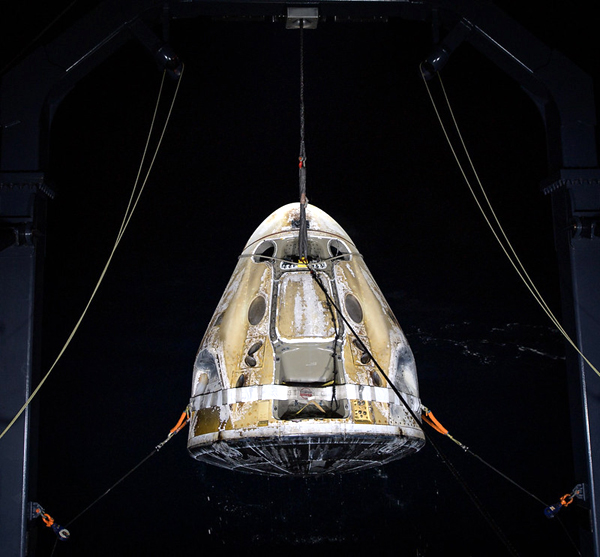
Bearing the burn marks of re-entry, the Crew Dragon Demo-1 capsule is placed aboard SpaceX's 'Go Searcher' recovery ship in the Atlantic Ocean...on March 8, 2019.
NASA TV

Tuesday, March 31, 2020

A Fourth Crew Member Has Been Added to SpaceX's Crew-1 Mission...

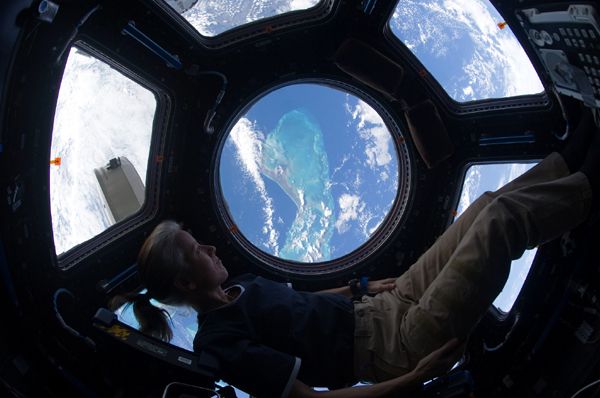
NASA astronaut Shannon Walker gazes out of the International Space Station's Cupola at a Caribbean island over 200 miles beneath her...on November 25, 2010.
NASA

NASA Adds Shannon Walker to First Operational Crewed SpaceX Mission (Press Release)

NASA has assigned astronaut Shannon Walker to the first operational crewed flight of the SpaceX Crew Dragon spacecraft on a mission to the International Space Station.

Walker will join NASA astronauts Michael Hopkins and Victor Glover Jr., as well as Soichi Noguchi of the Japan Aerospace Exploration Agency (JAXA), for a six-month expedition aboard the unique space laboratory.

This mission will be the first in a series of regular, rotational flights to the station following NASA’s certification of the new crewed system following completion and validation of SpaceX’s test flight with astronauts, known as Demo-2. This test is expected to take place in mid-to-late May as part of NASA’s Commercial Crew Program.

Pending the successful Demo-2 test, Walker, Glover, Hopkins, and Noguchi will launch aboard Crew Dragon on SpaceX’s Falcon 9 rocket from Launch Pad 39A at NASA’s Kennedy Space Center in Florida. That launch is targeted for later this year.

Walker was born in Houston and began her career at NASA’s Johnson Space Center in Houston in 1987 as a robotics flight controller for the space shuttle with Rockwell Space Operations Co. She became a NASA employee in 1995, working on robotics and avionics hardware for the station with the program’s international partners. She also coordinated on-orbit problem resolution in the Mission Evaluation Room at Johnson and in Moscow and served as acting manager of the On-Orbit Engineering Office before NASA selected her for the 2004 astronaut class. As an astronaut, she spent 163 days as a flight engineer aboard the space station for Expeditions 24 and 25 in 2010. Walker earned a bachelor’s degree in physics and a master’s and doctorate in space physics, all from Rice University in Houston.

NASA already assigned Glover and Hopkins to the first operation SpaceX crewed mission in August 2018. This will be the first spaceflight for Glover and the second for Hopkins, who lived aboard the space station from September 2013 to March 2014 as part of Expeditions 37 and 38.

It will be the third spaceflight for Noguchi, who was a space shuttle crew member on the STS-114 mission in 2005 and a space station crew member from December 2009 to June 2010 as part of Expeditions 22 and 23.

NASA’s Commercial Crew Program is working with the American aerospace industry as companies develop and operate a new generation of spacecraft and launch systems capable of carrying crews to low-Earth orbit and to the space station. Commercial transportation to and from the station will provide expanded utility, additional research time and broader opportunities for discovery on the orbital outpost.

The station is a critical testbed for NASA to understand and overcome the challenges of long-duration spaceflight. As commercial companies focus on providing human transportation services to and from low-Earth orbit, NASA is free to focus on building spacecraft and rockets for deep space missions.
Source: NASA.Gov