Showing posts with label Skylab. Show all posts

Sunday, May 14, 2023

On This Day in 1973: America's First Space Station Takes Flight...

An uncrewed Saturn V rocket carrying the Skylab space station launches from Launch Complex 39A at NASA's Kennedy Space Center in Florida...on May 14, 1973.
NASA

Skylab (Photo Release)

This photograph shows the launch of the SA-513, a modified unmanned two-stage Saturn V vehicle for the Skylab-1 mission, which placed the Skylab cluster into low-Earth orbit on May 14, 1973. The initial step in the Skylab mission was the launch of a two-stage Saturn V booster, consisting of the S-IC first stage and the S-II second stage, from Launch Complex 39A at the Kennedy Space Center in Florida.

Its payload was the unmanned Skylab, which consisted of the Orbital Workshop, the Airlock Module, the Multiple Docking Adapter, the Apollo Telescope Mount and an Instrument Unit.

Source: NASA.Gov

****

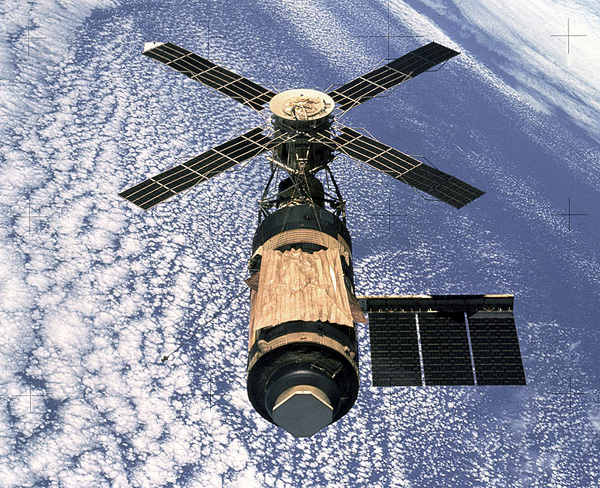
A snapshot of Skylab in low-Earth orbit...as seen by the Skylab 4 astronauts on February 8, 1974.
NASA

Wednesday, January 4, 2023

Inspiration4's Jared Isaacman and His Next Crew Continue to Prep for Their Historic Flight Aboard SpaceX's Crew Dragon This Year...

The Polaris Dawn astronauts and a team of medical professionals take part in a decompression sickness study at NASA's Johnson Space Center in Houston, Texas...on December 18-20, 2022.
Polaris Program / John Kraus

Polaris Dawn Crew Participates in a Decompression Sickness Study at NASA’s Johnson Space Center (News Release - January 3)

The Polaris Dawn crew participated in a decompression sickness (DCS) study to characterize the risk of the planned Polaris Dawn decompression profile in the 20 Foot Chamber at NASA’s Johnson Space Center in Houston, Texas, on December 18-20. The facility originally served as a platform for similar atmospheric modulation tests in the early 1970s ahead of NASA’s missions to Skylab, the United States’ first space station.

The risk of decompression sickness is lowered when the amount of nitrogen is reduced in one’s body. Current extravehicular activity (EVA) decompression models – such as those used on the International Space Station – achieve this during a long-duration 100% oxygen prebreathe exercise in an airlock.

The Dragon spacecraft, however, does not have an airlock, requiring the entire vehicle (including crewmembers) to decompress down to vacuum with a limited prebreathe. In anticipation of the mission’s EVA attempt, this study characterized DCS risk for Polaris Dawn and will help SpaceX develop a new decompression model for EVAs from Dragon.

Decompression sickness is more commonly known as “the bends” and is typically associated with scuba diving. When a rapid drop in air pressure occurs, nitrogen gas bubbles can form in the body and cause pain in the joints, damage skin, or create feelings of numbness, tingling in muscles, or physical fatigue.

With potential DCS symptoms being vague and individual susceptibility varying significantly, it was important that the crew got experience monitoring and reporting DCS symptoms, in addition to understanding the likelihood for DCS to occur during the actual EVA.

The crew lived in the chamber for just under two days, simulating the mission’s expected pressure and oxygen profiles to determine how likely it is for DCS symptoms to occur – if at all. Throughout the test, a team of medical professionals monitored the crew for symptoms, ready to intervene and provide immediate medical treatment if necessary.

In addition to characterizing DCS risk, the event allowed for the crew and teams to practice monitoring for and reporting EVA-related medical information over communication loops ahead of the mission’s actual spacewalk.

Source: Polaris Program

****

Polaris Dawn astronauts Jared Isaacman, Scott Poteet, Sarah Gillis and Anna Menon pose for a group photo during their decompression sickness study at NASA's Johnson Space Center last December.
Polaris Program

An artist's concept of an astronaut performing an extra-vehicular activity from a Spacex Crew Dragon capsule in low-Earth orbit.
Polaris Program

Tuesday, January 3, 2023

Remembering Apollo 7's Lunar Module Pilot...

A file photo of NASA astronaut Walter Cunningham...who was the lunar module pilot for the Apollo 7 mission in October of 1968.
NASA

Apollo Astronaut Walter Cunningham Dies at 90 (Press Release)

Former astronaut Walter Cunningham, who flew into space on Apollo 7, the first flight with crew in NASA’s Apollo Program, died early Tuesday morning in Houston. He was 90 years old.

“Walt Cunningham was a fighter pilot, physicist and an entrepreneur – but, above all, he was an explorer. On Apollo 7, the first launch of a crewed Apollo mission, Walt and his crewmates made history, paving the way for the Artemis Generation we see today,” said NASA Administrator Bill Nelson. “NASA will always remember his contributions to our nation’s space program and sends our condolences to the Cunningham family.”

Cunningham was born on March 16, 1932, in Creston, Iowa. He graduated from Venice High School, in Venice, California, before going on to receive a Bachelor of Arts with honors in physics in 1960 and a Master of Arts with distinction in physics in 1961 from the University of California at Los Angeles.

He then completed a doctorate in physics with exception of thesis at the Advanced Management Program in the Harvard Graduate School of Business in 1974.

The Cunningham family offered the following statement: “We would like to express our immense pride in the life that he lived, and our deep gratitude for the man that he was – a patriot, an explorer, pilot, astronaut, husband, brother and father. The world has lost another true hero, and we will miss him dearly.”

He joined the Navy in 1951 and served on active duty with the U.S. Marine Corps, retiring with the rank of colonel. He flew 54 missions as a night fighter pilot in Korea.

Cunningham worked as a scientist for the Rand Corporation for three years. While with Rand, he worked on classified defense studies and problems related to the Earth's magnetosphere.

Cunningham has accumulated more than 4,500 hours of flying time in 40 different aircraft, including more than 3,400 in jet aircraft.

Cunningham was selected as an astronaut in 1963 as part of NASA's third astronaut class.

“On behalf of NASA's Johnson Space Center, we are beholden to Walt's service to our nation and dedication to the advancement of human space exploration,” said Vanessa Wyche, center director. “Walt's accomplished legacy will continue to serve as an inspiration to us all.”

Prior to his assignment to the Apollo 7 crew, Cunningham was on the prime crew for Apollo 2 until it was cancelled and the backup lunar module pilot for Apollo 1.

On October 11, 1968, Cunningham piloted the 11-day flight of Apollo 7, the first human flight test of the Apollo spacecraft. With Walter M. Schirra, Jr. and Donn F. Eisele, he tested maneuvers necessary for docking and lunar orbit rendezvous using the third stage of their Saturn IB launch vehicle.

The crew successfully completed eight tests, igniting the service module engine, measuring the accuracy of performance of all spacecraft systems, and providing the first live television transmission of onboard crew activities. The 263-hour, 4.5-million-mile flight splashed down on October 22, 1968, in the Atlantic Ocean.

Cunningham’s last assignment at NASA Johnson was chief of the Skylab branch of the Flight Crew Directorate. In this capacity, he was responsible for the operational inputs for five major pieces of manned space hardware, two different launch vehicles and 56 major experiments that comprised the Skylab Program.

Cunningham retired from NASA in 1971 and would go on to lead multiple technical and financial organizations. He served in senior leadership roles with Century Development Corp., Hydrotech Development Company and 3D International.

Cunningham was also a longtime investor and entrepreneur, organizing small businesses and private investment firms. He was also a frequent keynote speaker and radio talk show host.

His numerous awards include the NASA Exceptional Service Medal and NASA Distinguished Service Medal. For his service he was inducted into the Astronaut Hall of Fame, International Space Hall of Fame, Iowa Aviation Hall of Fame, San Diego Air and Space Museum Hall of Fame, and Houston Hall of Fame.

Cunningham and the Apollo 7 crew also earned an Emmy in the form of the National Academy of Television Arts and Sciences Special Trustee Award.

****

Thursday, January 13, 2022

Kennedy Space Center Commemorates a Special Anniversary This Year...

A low-angle view of the Vehicle Assembly Building at NASA's Kennedy Space Center in Florida.
NASA

Kennedy at 60: Vehicle Assembly Building Ready for New Era of Launch Vehicles (News Release)

Standing 525 feet-tall and containing 130 million cubic feet of interior space, the iconic Vehicle Assembly Building (VAB) at Kennedy Space Center in Florida has been a shining beacon for NASA’s space program since the early 1960s. This is the facility where launch vehicles for the Apollo, Skylab and space shuttle programs were stacked and processed before their rollout to Launch Complex 39A or B for liftoff into space.

As the center celebrates its 60th anniversary this year, the VAB is the site where the next generation of launch vehicles will be stacked and processed for NASA’s Artemis missions to the Moon and beyond.

“We have witnessed the beginning of some of the most historical moments of the space program within the walls of the VAB. Saturn V, space shuttle, and now the Space Launch System – each launch vehicle started their journey in the VAB,” said Explorations Ground Systems (EGS) Program Manager, Mike Bolger. “The work that has taken place to get us to this moment with SLS fully stacked in High Bay 3 has been remarkable, and we cannot wait to see it roll out to Launch Pad 39B where it will serve as NASA’s next giant leap in deep space exploration with the launch of Artemis I.”

Currently, the agency’s massive Space Launch System (SLS) rocket and Orion spacecraft for Artemis I are undergoing integrated testing stacked atop the mobile launcher in High Bay 3 before being readied for a trial run to Pad B. The high bay was upgraded by EGS beginning in 2014. The project removed old platforms and installed 10 levels of new work platforms. A total of 20 platform halves surround the rocket and spacecraft to provide access for testing and processing before SLS and Orion roll out atop the crawler-transporter along the crawlerway to Pad B.

Initially conceived as the Vertical Assembly Building, it was renamed the Vehicle Assembly Building in 1965 during construction. The Max O. Urbahn architectural firm in New York City designed it. The VAB spans 8 acres and is one of the largest buildings in the world by volume. At a width of 518 feet, the building is made of 65,000 cubic yards of concrete and its frame contains 98,590 tons of steel. Completed in 1966, the building includes a low bay, four high bays, a transfer aisle, and several heavy-lift cranes.

To date, 12 Apollo missions, four Skylab missions, one Apollo-Soyuz Test Project, one Ares I mission, and all 135 space shuttle missions were processed through the VAB.

The VAB has received a number of distinctions. It was listed in the National Register of Historic Places on Jan. 21, 2000. In January 2020, the American Society of Civil Engineers designated the VAB as a National Historic Civil Engineering Landmark. The Florida Association of The American Institute of Architects honored the facility and its adjacent Launch Control Center with a “Test of Time” design award, recognizing the contributions of the architects and engineers of these unique buildings.

Contrary to popular stories circulated during construction, the VAB, which is mostly not air-conditioned, does not create its own weather – reports of indoor rain, clouds, or fog are myths.

Jose Perez Morales, the EGS senior project manager for the VAB and Pad 39B elements, has worked at Kennedy since 1985. “Because of the massive amount of steel and volume of the building, temperatures inside the VAB can fluctuate from very cold to very hot depending on the outside weather,” Perez Morales said. “To prevent the formation of a wind tunnel in the transfer aisle during high winds, the procedure is to close the north and south doors.”

The VAB sports a large American flag – a 209-foot-tall, 110-foot-wide stars and stripes painted on the exterior of its south side. Each star measures six feet across, and the blue field is the size of a basketball court. The flag originally was painted onto the VAB in 1976 for the Bicentennial Exposition on Space and Technology. A 12,300-square-foot NASA logo also adorns the south side of the facility.

Recently, the flag and NASA logo were repainted using more than 500 gallons of paint. A giant Artemis banner also was added above the low bay entrance, signifying NASA’s goal through Artemis missions to establish a sustainable human presence on and around the Moon to prepare for missions to Mars.

Source: NASA.Gov

****

An unobstructed view of the Space Launch System rocket as it sits atop its mobile launcher inside the Vehicle Assembly Building at NASA's Kennedy Space Center in Florida...on September 17, 2021.
NASA / Frank Michaux

Sunday, May 2, 2021

SpaceX Update: Crew Dragon Resilience Is Back on Earth...

Crew Dragon Resilience re-enters Earth's atmosphere above the Gulf of Mexico...on May 2, 2011.
Photo by BigBoatDriver - Twitter.com

Crew-1 Astronauts Safely Splash Down After Space Station Mission (Press Release)

Four astronauts splashed down safely in the Gulf of Mexico Sunday, completing NASA’s first commercial crew, long-duration mission aboard the International Space Station. The return comes nearly six months after the crew members arrived at the microgravity laboratory and also marks the longest-duration mission of a crewed American spacecraft to date.

SpaceX’s Crew Dragon, carrying NASA astronauts Michael Hopkins, Victor Glover, and Shannon Walker, and Japan Aerospace Exploration Agency astronaut Soichi Noguchi, returned to Earth in a parachute-assisted splashdown at 2:56 a.m. EDT off the coast of Panama City, Florida. Crews aboard SpaceX recovery vessels successfully recovered the spacecraft and astronauts. After returning to shore, the astronauts will fly back to Houston.

“Welcome home Victor, Michael, Shannon, and Soichi, and congratulations to the teams at NASA and SpaceX who worked so hard to ensure their safe and successful splashdown,” said Sen. Bill Nelson, who was confirmed by the Senate to serve as NASA Administrator on April 29. “We’ve accomplished another incredible spaceflight for America and our commercial and international partners. Safe, reliable transportation to the International Space Station is exactly the vision that NASA had when the agency embarked on the commercial crew program.”

NASA’s SpaceX Crew-1 mission launched Nov. 15, 2020, on a Falcon 9 rocket from the agency’s Kennedy Space Center in Florida. The astronauts named the spacecraft Resilience, in honor of their families, colleagues, and fellow citizens and highlighting the dedication displayed by the teams involved with the mission and demonstrating that there is no limit to what humans can achieve when they work together. Crew Dragon Resilience docked to the Harmony module’s forward port of the space station Nov. 16, nearly 27 hours after liftoff.

Overall, Hopkins, Glover, Walker, and Noguchi traveled 71,242,199 statute miles during their 168 days in orbit (with 167 days aboard the space station), completing 2,688 orbits around Earth. With splashdown, the crew also broke the American crewed spacecraft mission duration record of 84 days, 1 hour, 15 minutes, set by the final Skylab crew in February 1974.

Crew-1 also is the first night splashdown of a U.S. crewed spacecraft since Apollo 8’s predawn return in the Pacific Ocean on Dec. 27, 1968, with NASA astronauts Frank Borman, Jim Lovell and Bill Anders.

Throughout their mission, the Crew-1 astronauts contributed to scientific investigations and technology demonstrations, in addition to spacewalks and public engagement events, while aboard the orbiting laboratory. From studying protein crystal development to advance new drug discoveries, to demonstrating robotic assistant technologies, their work advances exploration of the universe while bringing benefits back to Earth.

They also grew crops in both the Advanced Plant Habitat and Veggie plant growth facilities, and conducted tests of a new method for producing semiconductor crystals. The astronauts contributed hundreds of pictures of Earth as part of the Crew Earth Observation investigation, one of the longest-running investigations aboard the space station, which contributes to tracking of natural disasters and changes to our home planet. The crew also tested a new tape dispenser, designed and produced by students as part of the High Schools United with NASA to Create Hardware (HUNCH), during the mission.

In early 2021, the Crew-1 astronauts had significant roles to play in five spacewalks outside the orbiting laboratory. Glover completed his first four spacewalks, including three alongside Hopkins, whose total number of spacewalks is now five. Noguchi joined NASA’s Kate Rubins on the fourth spacewalk of each of their careers. During the spacewalks, the astronauts connected cables on the recently installed Bartolomeo science platform, prepared the station for upcoming solar array upgrades, serviced the station’s cooling system, and completed other station maintenance tasks.

On April 5, all four Crew-1 astronauts boarded Resilience for a port relocation maneuver, moving their spacecraft from the forward-facing port to the space-facing port on the Harmony module. The move allowed for the forward-facing port to receive four Crew-2 astronauts upon their arrival to the station April 24. Later this year, SpaceX’s 22nd Commercial Resupply Services mission is scheduled to dock at the newly vacant zenith port, bringing with it the first pair of new solar arrays.

The Crew-1 flight is part of NASA’s Commercial Crew Program, which has worked with the U.S. aerospace industry to launch astronauts on American rockets and spacecraft from American soil to the space station.

The second splashdown of the Commercial Crew Program comes just over one week after the launch of NASA’s SpaceX Crew-2 mission, the second long-duration mission. The Crew-2 astronauts launched April 23 and will live and work aboard the station until their return to Earth in about six months.

Resilience will return to SpaceX’s Dragon Lair in Florida for inspection and processing. There, teams will examine the spacecraft’s data and performance throughout the flight. The next NASA and SpaceX crewed mission is Crew-3, currently targeted for launch no earlier than Oct. 23. Crew-2 astronauts are scheduled to return to Earth Oct. 31, about a week after welcoming their Crew-3 colleagues to the orbiting outpost.

The goal of NASA’s Commercial Crew Program is safe, reliable, and cost-effective transportation to and from the International Space Station. This has already been proven to provide additional research time and increase the opportunity for discovery aboard humanity’s testbed for exploration, including helping us prepare for human exploration of the Moon and Mars.

****

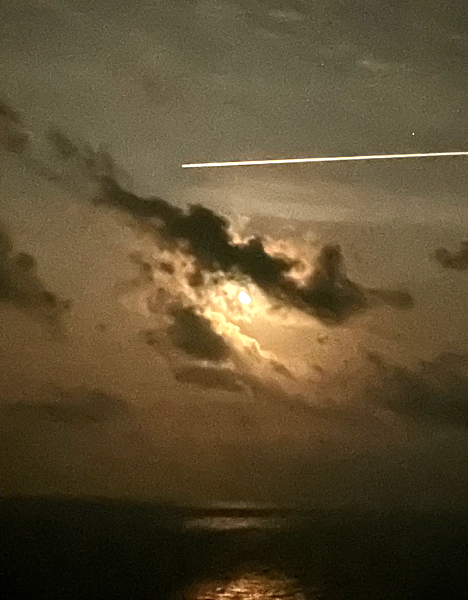
As seen from Tampa, Florida, Crew Dragon Resilience re-enters Earth's atmosphere above the Gulf of Mexico...on May 2, 2011.
Photo by Kyle Montgomery - Twitter.com
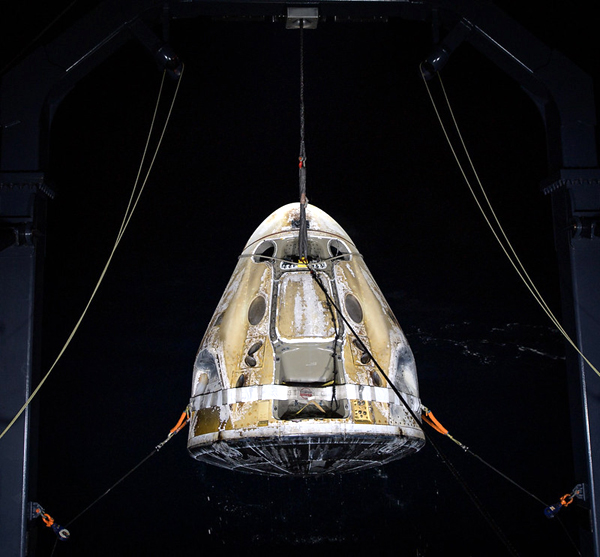
With the Crew-1 astronauts waiting patiently onboard, Resilience is about to be placed onto the deck of SpaceX's GO Navigator recovery ship in the Gulf of Mexico...on May 2, 2011.
NASA / Bill Ingalls

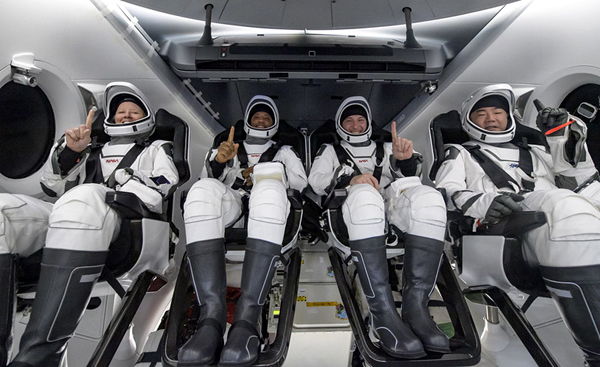
The Crew-1 astronauts take one last group photo aboard Resilience before disembarking from their capsule for the return trip back to Houston, Texas...on May 2, 2011.
NASA / Bill Ingalls

Saturday, May 26, 2018

Remembering Alan Bean (1932-2018)...

Apollo 12 astronaut Alan Bean holds a soil sample container while walking on the surface of the Moon...on November 20, 1969.
NASA / Charles Conrad

NASA Administrator Reflects on Legacy Record-Breaking Skylab, Apollo Astronaut (Press Release)

The following is a statement from NASA Administrator Jim Bridenstine on the passing of Apollo and Skylab astronaut Alan Bean:

“Alan Bean once said ‘I have the nicest life in the world.’ It’s a comforting sentiment to recall as we mourn his passing.

“As all great explorers are, Alan was a boundary pusher. Rather than accepting the limits of technology, science, and even imagination, he sought to advance those lines -- in all his life’s endeavors. Commissioned in the U.S. Navy in 1955, he chose the challenging pursuit of flight training and, after four years as a Naval pilot, decided to challenge himself further by attended the Navy Test Pilot School and becoming a test pilot.

“He joined NASA’s astronaut corps in 1963 and, just six years later, was piloting the lunar module for the Apollo 12 mission. During that mission, he walked on the Moon. Yet he pushed farther. In 1973, Alan commanded the Skylab Mission II and broke a world record with a 59-day flight traversing 24.4 million miles. In all, he had a hand in breaking 11 world records in the areas of space and astronautics.

“After logging 1,671 hours and 45 minutes in space, Alan passed the baton to the next generation of astronauts and changed fronts, looking to push the boundaries of his own imagination and ability as an artist. Even in this endeavor, his passion for space exploration dominated, as depicted most powerfully is his work ‘Hello Universe.’ We will remember him fondly as the great explorer who reached out to embrace the universe.”


****

A snapshot of Alan Bean shaving aboard the Skylab space station...on August 8, 1973.
NASA

Saturday, December 23, 2017

Photos of the Day #2: The Falcon Heavy's First Payload Is Revealed!

The Tesla Roadster that the Falcon Heavy will send towards Mars on its maiden flight is about to be enshrouded by the rocket's two huge payload fairings.
Elon Musk / SpaceX

Yesterday, SpaceX revealed on social media that it is indeed launching a Tesla Roadster towards Mars via a Falcon Heavy rocket next month. The sleek, electric-powered sports coupe can be seen in these photos mounted to its second stage adapter...with the Falcon Heavy's two huge payload fairings ready to enshroud it.

The rocket should undergo a static-fire test at Kennedy Space Center's Launch Complex 39A in Florida before the end of this week. And sometime in January, Elon Musk's newest rocket will hopefully become the world's most powerful launch vehicle (before NASA's Space Launch System comes online in late 2019 or early 2020, that is) to take flight since a Saturn V sent Skylab to low-Earth orbit in 1973. Carry on.

The Tesla Roadster that the Falcon Heavy will send towards Mars on its maiden flight is about to be enshrouded by the rocket's two huge payload fairings.
Elon Musk / SpaceX

The Tesla Roadster that the Falcon Heavy will send towards Mars on its maiden flight is about to be enshrouded by the rocket's two huge payload fairings.
Elon Musk / SpaceX

The Tesla Roadster that the Falcon Heavy will send towards Mars on its maiden flight is about to be enshrouded by the rocket's two huge payload fairings.
Elon Musk / SpaceX

Wednesday, June 3, 2015

Marking A Milestone: Five Decades of Extravehicular Activities...

STS-41B astronaut Bruce McCandless guides his Manned Maneuvering Unit hundreds of feet away from the space shuttle Challenger (not visible)...on February 7, 1984.
NASA

NASA Celebrates 50 Years of Spacewalking (Press Release)

In this Feb. 7, 1984 photograph taken by his fellow crewmembers aboard the Earth-orbiting Space Shuttle Challenger on the STS-41B mission, NASA astronaut Bruce McCandless II approaches his maximum distance from the vehicle. McCandless became the first astronaut to maneuver about in space untethered, during this first "field" tryout of a nitrogen-propelled, hand-controlled backpack device called the Manned Maneuvering Unit (MMU).

For 50 years, NASA has been "suiting up" for spacewalking. The first American to conduct a spacewalk, astronaut Edward H. White II, floated into the vastness of space on the Gemini IV mission on June 3, 1965. For more than 20 minutes, White maneuvered himself around the Gemini spacecraft as it traveled from over Hawaii to the Gulf of Mexico--making his orbital stroll 6,500 miles long. At the end of the 20-minute spacewalk, White was exuberant. "This is the greatest experience," he said. "It's just tremendous."

Since this historic first, NASA astronauts have performed spacewalks, or extravehicular activity (EVA) in NASA-speak, on the Gemini, Apollo, Skylab, Space Shuttle and International Space Station programs. Astronauts have explored the lunar surface, completed 82 spacewalks outside of the space shuttle, and 187 spacewalks, to date, outside the International Space Station. A total of 166 hours of spacewalks were carried out to service the Hubble Space Telescope. Today, NASA is developing new advanced spacesuits for use by astronauts as they travel to new deep-space locations on the journey to Mars. The next-generation suit will incorporate a number of technology advances to shorten preparation time, improve safety and boost astronaut capabilities during spacewalks and surface activities.

Source: NASA.Gov

****

NASA astronaut Sunita Williams (center frame) and JAXA astronaut Aki Hoshide (seen as a silhouette to the right of Williams) participate in a spacewalk outside of the International Space Station, on August 30, 2012.
NASA

Friday, December 13, 2013

SpaceX To Make A Bigger Mark on America's Spaceport?

Space shuttle Endeavour stands poised for liftoff at Kennedy Space Center's Launch Complex 39A in Florida, on February 6, 2010.
NASA / Bill Ingalls

NASA Selects SpaceX to Begin Negotiations for Use of Historic Launch Pad (Press Release)

NASA has selected Space Exploration Technologies Corporation (SpaceX) of Hawthorne, Calif., to begin negotiations on a lease to use and operate historic Launch Complex (LC) 39A at the agency's Kennedy Space Center in Florida.

Permitting use and operation of this valuable national asset by a private-sector, commercial space partner will ensure its continued viability and allow for its continued use in support of U.S. space activities.

The reuse of LC-39A is part of NASA’s work to transform the Kennedy Space Center into a 21st century launch complex capable of supporting both government and commercial users. Kennedy is having success attracting significant private sector interest in its unique facilities. The center is hard at work assembling NASA’s Orion spacecraft and preparing its infrastructure for the Space Launch System rocket, which will launch from LC-39B and take American astronauts into deep space, including to an asteroid and Mars.

NASA made the selection decision Thursday after the U.S. Government Accountability Office (GAO) denied a protest filed against the Agency by Blue Origin LLC on Sept. 13. In its protest, Blue Origin raised concerns about the competitive process NASA was using to try to secure a potential commercial partner or partners to lease and use LC-39A. Blue Origin had argued the language in the Announcement for Proposals (AFP) favored one proposed use of LC-39A over others. The GAO disagreed.

While the GAO protest was underway, NASA was prohibited from selecting a commercial partner for LC-39A from among the proposals submitted in response to the agency's AFP that had been issued on May 23. However, while the GAO considered the protest, NASA continued evaluating the proposals in order to be prepared to make a selection when permitted to do so. After the GAO rendered its decision Thursday in NASA’s favor, the agency completed its evaluation and selection process.

NASA notified all proposers on Friday of its selection decision concerning LC-39A. Further details about NASA’s decision will be provided to each proposer when NASA furnishes the source selection statement to the proposers. In addition, NASA will offer each the opportunity to meet to discuss NASA’s findings related to the proposer’s individual proposal. NASA will release the source selection statement to the public once each proposer has been consulted to ensure that any proprietary information has been appropriately redacted.

NASA will begin working with SpaceX to negotiate the terms of its lease for LC-39A. During those ongoing negotiations, NASA will not be able to discuss details of the pending lease agreement. Since the late 1960s, Kennedy's launch pads 39 A and B have served as the starting point for America's most significant human spaceflight endeavors -- Apollo, Skylab, Apollo-Soyuz and all 135 space shuttle missions. LC-39A is the pad where Apollo 11 lifted off from on the first manned moon landing in 1969, as well as launching the first space shuttle mission in 1981 and the last in 2011.

Source: NASA.Gov

****

The Dragon CRS-2 spacecraft is berthed to the International Space Station, on March 3, 2013.
NASA

Wednesday, November 20, 2013

Happy Birthday, ISS!

Astronaut James H. Newman waves during a spacewalk that combined the first components of the International Space Station (ISS) during the STS-88 shuttle mission, which flew in December of 1998.
NASA

Celebrating Fifteen Years of the International Space Station (Press Release)

Astronaut James H. Newman waves during a spacewalk preparing for release of the first combined elements of the International Space Station. The Russian-built Zarya module, with its solar array panel visible here, was launched into orbit fifteen years ago on Nov. 20, 1998. Two weeks later, on Dec. 4, 1998, NASA's space shuttle Endeavour launched Unity, the first U.S. piece of the complex. Endeavour's forward section is reflected in Newman's helmet visor in this image. During three spacewalks on the STS-88 mission, the two space modules built on opposite sides of the planet were joined together in space, making the space station truly international.

Since that first meeting of Zarya and Unity, the space station grew piece by piece with additions from each of the international partners built across three continents and leading to the largest and most complex spacecraft ever constructed. The space station, now four times larger than Mir and five times larger than Skylab, represents a collaboration between NASA, Roscosmos, the European Space Agency, the Japanese Aerospace Exploration Agency and the Canadian Space Agency, representing 15 countries in all.

In support of station assembly and maintenance, station and shuttle crews have conducted 174 spacewalks totaling almost 1,100 hours – the equivalent to nearly 46 days of spacewalks to build and maintain the complex. The station, with a mass of almost a million pounds and the size of a football field, is second only to the moon as the brightest object in the night sky. Over the years, a great deal of research has been done on the space laboratory, which has already yielded tremendous results toward various fields. The science of the space station has provided benefits to humankind in areas such as human health, Earth observation and education. Many more results and benefits for both space exploration and life on Earth are expected in the coming years.

Source: NASA.Gov

****

The ISS with space shuttle Endeavour docked to it, as seen from a Russian Soyuz vehicle after it undocked from the orbital outpost on May 23, 2011.
Roscosmos / ESA / NASA

Wednesday, December 19, 2012

Apollo 17: 40 Years Ago Today... At 2:25 PM, Eastern Standard Time on December 19, 1972, the Apollo 17 command module America safely splashed down into the Pacific Ocean after successfully completing NASA's sixth and final sojourn (excluding Apollo 13) to the surface of the Moon. What would follow a year later would be the launch of the United States' first manned space station, Skylab, to LEO (Low-Earth Orbit)—and the continued development of the space shuttle...which was formally approved several months before the liftoff of Apollo 17 by President Nixon, on January 5, 1972.

With the Apollo and space shuttle programs now a thing of the past, it is up to NASA receiving proper funding by Congress to support the development of commercial spacecraft such as Dream Chaser and the CST-100 (SpaceX's Dragon has already proved its mettle...twice) that will continue performing the orbiters' duties in LEO, and finally bringing Apollo's official BEO (Beyond Earth Orbit) successor, the Space Launch System, to fruition.

The USS Ticonderoga waits in the background as recovery operations are conducted on Apollo 17's America command module in the Pacific Ocean, on December 19, 1972.
NASA

Thursday, November 10, 2011

Smoke billows from the A-2 test stand at NASA’s Stennis Space Center in Mississippi...where the J-2X engine was successfully test-fired on November 9, 2011. NASA TV SPACE LAUNCH SYSTEM Update... Yesterday, NASA successfully test-fired the J-2X engine that will power the Space Launch System’s upper stage motor once the heavy-lift rocket becomes flight-worthy as early as 2017. The test-fire, which took place at the Stennis Space Center in Mississippi, lasted for exactly 499.97 seconds. Click on the video below to watch a replay of the 8-minute-long ground test. The J-2X is an updated version of the J-2 liquid-fueled engine that powered the second stage of the Saturn V rocket during the Apollo and Skylab programs almost 50 years ago.