Showing posts with label EFT-1. Show all posts

Thursday, December 5, 2024

The Next SLS Launch Is Now Targeted for Spring of 2026...

A snapshot of Orion's Artemis 1 heat shield at NASA's Kennedy Space Center in Florida...on February 3, 2023.
NASA

NASA Shares Orion Heat Shield Findings, Updates Artemis Moon Missions (News Release)

Through the Artemis campaign, NASA will land the next American astronauts and first international astronaut on the South Pole region of the Moon. On Thursday, NASA announced the latest updates to its lunar exploration plans.

Experts discussed results of NASA’s investigation into its Orion spacecraft heat shield after it experienced an unexpected loss of charred material during re-entry of the Artemis I uncrewed test flight. For the Artemis II crewed test flight, engineers will continue to prepare Orion with the heat shield already attached to the capsule. The agency also announced that it is now targeting April 2026 for Artemis II and mid-2027 for Artemis III.

The updated mission timelines also reflect time to address the Orion environmental control and life support systems.

“The Artemis campaign is the most daring, technically challenging, collaborative, international endeavor humanity has ever set out to do,” said NASA Administrator Bill Nelson. “We have made significant progress on the Artemis campaign over the past four years, and I’m proud of the work our teams have done to prepare us for this next step forward in exploration as we look to learn more about Orion’s life support systems to sustain crew operations during Artemis II. We need to get this next test flight right. That’s how the Artemis campaign succeeds.”

The agency’s decision comes after an extensive investigation of an Artemis I heat shield issue showed that the Artemis II heat shield can keep the crew safe during the planned mission with changes to Orion’s trajectory as it enters Earth’s atmosphere and slows from nearly 25,000 mph to about 325 mph before its parachutes unfurl for safe splashdown in the Pacific Ocean.

“Throughout our process to investigate the heat shield phenomenon and determine a forward path, we’ve stayed true to NASA’s core values; safety and data-driven analysis remained at the forefront,” said Catherine Koerner, associate administrator, Exploration Systems Development Mission Directorate at NASA Headquarters in Washington. “The updates to our mission plans are a positive step toward ensuring we can safely accomplish our objectives at the Moon and develop the technologies and capabilities needed for crewed Mars missions.”

NASA will continue stacking its SLS (Space Launch System) rocket elements, which began in November, and prepare it for integration with Orion for Artemis II.

Throughout the fall months, NASA, along with an independent review team, established the technical cause of an issue seen after the uncrewed Artemis I test flight in which charred material on the heat shield wore away differently than expected. Extensive analysis, including from more than 100 tests at unique facilities across the country, determined that the heat shield on Artemis I did not allow for enough of the gases generated inside a material called Avcoat to escape, which caused some of the material to crack and break off. Avcoat is designed to wear away as it heats up, and is a key material in the thermal protection system that guards Orion and its crew from the nearly 5,000° Fahrenheit of temperatures that are generated when Orion returns from the Moon through Earth’s atmosphere.

Although a crew was not inside Orion during Artemis I, data shows that the temperature inside Orion remained comfortable and safe had crew been aboard.

Engineers are already assembling and integrating the Orion spacecraft for Artemis III based on lessons learned from Artemis I and implementing enhancements to how heat shields for crewed returns from lunar landing missions are manufactured to achieve uniformity and consistent permeability. The skip entry is needed for return from speeds expected for lunar landing missions.

“Victor, Christina, Jeremy and I have been following every aspect of this decision and we are thankful for the openness of NASA to weigh all options and make decisions in the best interest of human spaceflight. We are excited to fly Artemis II and continue paving the way for sustained human exploration of the Moon and Mars,” said Reid Wiseman, NASA astronaut and Artemis II commander. “We were at the agency’s Kennedy Space Center in Florida recently and put eyes on our SLS rocket boosters, the core stage and the Orion spacecraft. It is inspiring to see the scale of this effort, to meet the people working on this machine, and we can’t wait to fly it to the Moon.”

Wiseman, along with NASA astronauts Victor Glover and Christina Koch and CSA (Canadian Space Agency) astronaut Jeremy Hansen, will fly aboard the 10-day Artemis II test flight around the Moon and back. The flight will provide valuable data about Orion systems needed to support crew on their journey to deep space and bring them safely home, including air revitalization in the cabin, manual flying capabilities, and how humans interact with other hardware and software in the spacecraft.

With Artemis, NASA will explore more of the Moon than ever before, learn how to live and work farther away from home, and prepare for future human exploration of the Red Planet. NASA’s SLS, Exploration Ground Systems and Orion spacecraft, along with the Human Landing System, next-generation spacesuits, Gateway lunar space station, and future rovers are NASA’s foundation for deep space exploration.

Source: NASA.Gov

****

Inside the Vehicle Assembly Building at NASA's Kennedy Space Center in Florida, both aft assemblies for the Space Launch System's twin solid rocket boosters are now placed atop Mobile Launcher 1...on November 22, 2024.
NASA / Glenn Benson

Tuesday, November 8, 2022

Images of the Day: A Blood Moon and the Mega-Moon Rocket...

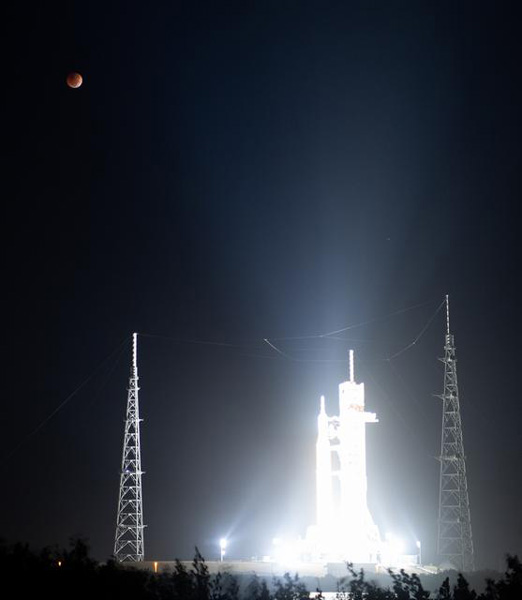
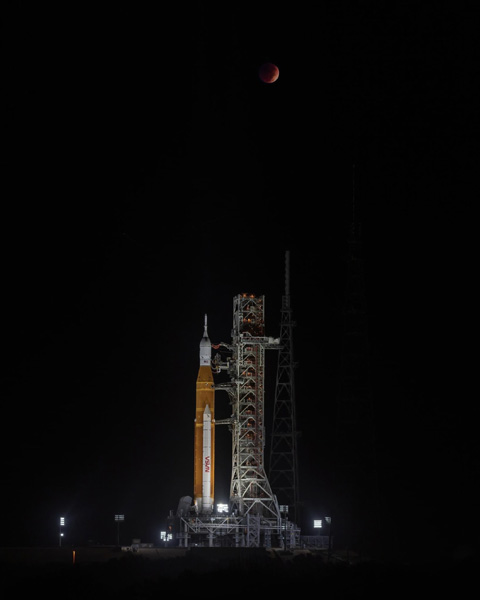
NASA's Space Launch System rocket stands tall at Kennedy Space Center's Pad 39B in Florida as a total lunar eclipse looms high above it...on November 8, 2022.
NASA / Joel Kowsky

As of right now, there's a chance that NASA's Space Launch System rocket won't launch as scheduled on November 14 due to Tropical Storm Nicole...which should make landfall in Florida tomorrow. November 16 is reportedly the earliest date that Artemis 1 can get off the ground.

Stay tuned for more information.

****

Total Lunar Eclipse (Photo Release)

The Moon is seen during a total lunar eclipse above NASA’s Space Launch System (SLS) rocket—with the Orion spacecraft aboard—atop a mobile launcher at Launch Complex 39B, Tuesday, November 8, 2022, at NASA’s Kennedy Space Center in Florida.

NASA’s Artemis I flight test is the first integrated test of the agency’s deep space exploration systems: the Orion spacecraft, SLS rocket and supporting ground systems.

Source: NASA.Gov

****

NASA's Space Launch System rocket stands tall at Kennedy Space Center's Pad 39B in Florida as a total lunar eclipse looms high above it...on November 8, 2022.
NASA / Sean Cannon

Wednesday, July 13, 2022

SLS Update: Up to 30,000 Workforce Members Will Be Honored on the Mega-Moon Rocket's First Flight...

These microchips containing the names of up to 30,000 employees who worked on the Artemis 1 mission will fly aboard NASA's Orion spacecraft to the Moon.
University of Houston / Dr. Long Chang

Orion to Fly Thousands of Names of Artemis I Team Members to the Moon (News Release)

The names of nearly 30,000 people whose work made NASA’s Artemis I mission possible will fly inside the Orion spacecraft on its upcoming journey around the Moon. Even though there will be no people aboard Orion for its first flight test with the Space Launch System (SLS) rocket, the spacecraft will carry the tribute on tiny, engraved microchips.

Among the names are team members from NASA, ESA (European Space Agency), industry partners, and suppliers who have contributed to building hardware, developing systems, supporting mission operations, and working on the Orion, SLS, and Exploration Ground Systems programs required for flight. The effort is being done to express gratitude to the dedicated employees who have contributed their time and effort to the flight.

The microchips can hold more than a million etched names using a printing process called electron beam lithography. They will be loaded onto the spacecraft as part of the Artemis I Official Flight Kit. The kit includes mementos for educational engagement and posterity packed in Orion’s storage area. Similar microchips have flown on other NASA missions as part of outreach campaigns that allowed the public to fly their names in space, including Orion’s Exploration Flight Test-1, and on NASA’s Perseverance Mars Rover.

The chips will include names from large and small contractors who provided key elements or components.

“Our company has been involved in the Orion program from day one, and we are truly honored to see what it has evolved into,” said Mike Riley, CEO of AMRO Fabricating Corp., in South El Monte, California. AMRO manufactures significant components of the pressure vessel — the underlying structure of Orion’s crew module that provides the air-tight, habitable space — as well as large structures for the SLS barrels.

“We are really excited to be part of this critical and historic piece of hardware that will take humans back to the Moon,” Riley said.

Over in the Midwest, Major Tool & Machine in Indianapolis, Indiana, develops critical components for Orion and for the SLS solid rocket boosters and RS-25 engines.

“The excitement from our customers about NASA’s return to the Moon has trickled down to every one of our four hundred employees in Indianapolis,” said Danny Antle, Major Tool & Machine’s vice president of business development. “We’re honored to be a part of the industry team.”

The names of international team members also will be aboard for the journey to Moon, including those from Airbus, ESA’s lead contractor responsible for building the Orion European Service Module that powers and propels the spacecraft in space.

"It is fantastic to be part of the Artemis adventure, and the entire Airbus team is so excited to be propelling Orion with the European Service Module,” said Didier Radola, Airbus head of Moon programs. “By flying our names aboard the maiden Artemis flight to the Moon, a small part of each of us will be flying up there too."

After the mission, the microchips will be presented to key stakeholders in the U.S. and Europe to provide a physical representation of the NASA, industry workforce, and extended team members instrumental to the historic flight.

Source: NASA.Gov

****

NASA's Space Launch System rocket at Kennedy Space Center's Launch Complex 39B in Florida...with the Full Moon looming large behind it on March 18, 2022.
United Launch Alliance / Ben Cooper

Friday, September 10, 2021

Artemis 3 Update: The Orion Crew Module for NASA's Lunar Landing Mission Achieves a Manufacturing Milestone...

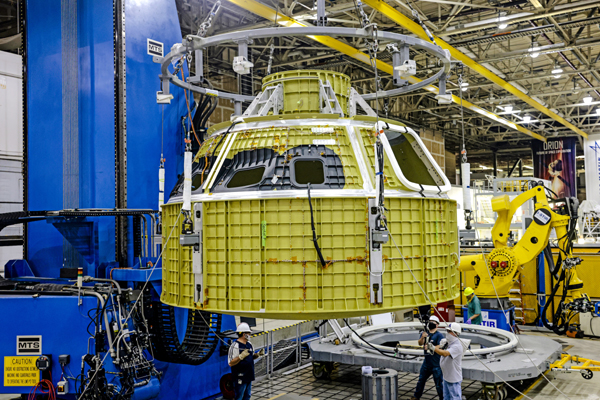
The pressure vessel for the Orion spacecraft that will fly on the Artemis 3 mission is completed at NASA's Michoud Assembly Facility in New Orleans, Louisiana...as of August 27, 2021.
NASA / Eric Bordelon

Next Generation of Orion Spacecraft in Production for Future Artemis Missions (News Release)

Over the next decade, NASA’s Orion spacecraft will carry astronauts during Artemis missions to the Moon to help prepare for human missions to Mars. Work on the spacecraft for Artemis I is nearly complete, Artemis II is well underway, and NASA is making progress on vehicles for the missions beyond.

The agency recently completed welding on the Artemis III Orion pressure vessel, the underlying frame of the air-tight capsule for astronauts called the crew module. This structure is the first major piece of hardware in Orion’s production phase with lead contractor Lockheed Martin.

“NASA is shifting its focus from the development phase to the production phase for the Orion spacecraft to enable a long-term presence on and around the Moon,” said Cathy Koerner, Orion program manager.

The development phase — called design, development, test, and evaluation (DDT&E) — is when Orion’s requirements are defined, the design undergoes review and refinement, and the spacecraft and its systems go through rigorous testing.

“All of the intensive testing we’ve done has proven out the design of Orion’s structure,” said Stu McClung, chief of staff for Orion program, planning, and control. “A structure that’s well understood and defined gives us high confidence to move forward into the production phase.”

Each component of Orion has undergone thorough testing since the beginning of DDT&E to prepare Orion for this transition. This includes Exploration Flight Test-1, Orion’s first flight test in 2014 that demonstrated its space-worthiness in a high-Earth orbit, and tested the spacecraft’s heat shield during entry into Earth’s atmosphere and the capsule’s recovery systems.

NASA has also completed successful testing of Orion’s parachute system, as well as the launch abort system with two flight tests known as Pad Abort-1 and Ascent Abort-2. Simulated in-space environments testing also verified that Orion’s systems will perform as expected during Artemis missions, among countless other tests of the spacecraft.

The DDT&E phase will officially conclude with the Artemis II mission, the first test flight with crew. Although no structural changes on the vehicle are expected to come from Artemis I and II, the mission outcomes may drive minor changes or upgrades into subsequent builds.

“As we fly, we will learn and adapt the spacecraft to the missions as needed,” said Assistant Orion Program Manager Paul Marshall. This could include modifying crew systems or crew interfaces to help astronauts perform future missions as smoothly as possible.

In the production phase, engineers will apply refinements to Orion’s design to ensure that manufacturing and assembly are as efficient as possible. One of many improvements was reducing the number of welded pieces that make up Orion’s pressure vessel. The pressure vessel’s original design had 33 welded pieces, which was streamlined to seven for Artemis I and up, to improve manufacturability and save more than 700 pounds of excess weight.

With these seven welds recently completed on the Artemis III pressure vessel at NASA’s Michoud Assembly Facility in New Orleans — and structural design changes and testing complete — a more efficient and streamlined production line for spacecraft begins. Under the Orion Production and Operations Contract (OPOC) awarded to Lockheed Martin, NASA committed to ordering a minimum of six and a maximum of 12 Orion spacecraft. The agency ordered three Orion spacecraft in 2019 for Artemis missions III through V, and plans to order three additional Orion capsules in fiscal year 2022 for Artemis missions VI through VIII.

“Our strategy to go from design and development to production focuses on optimization by making changes in several different areas to emerge with a more efficient flow,” said Kelly DeFazio, program director for production operations at Lockheed Martin.

Some examples of optimizing Orion production include:

- Changing the organizational structure of employees from a large, integrated product team structure centered on design, development, and qualification, to smaller multifunctional work teams focused on production throughput and quality of product.
- Incorporating systems to identify and address constraints in production flow, and the use of smart tools like augmented reality on the production floor.
- The opening of Lockheed Martin’s Spacecraft, Test, Assembly and Resource (STAR) Center in Titusville, Florida, earlier this summer to streamline manufacturing capacity.
- Reusing Orion crew modules and high-value systems, combined with the ability to bulk buy material and components, which contribute to considerable cost reductions compared to spacecraft produced under DDT&E.

“Our production plan activates unique manufacturing efficiencies that ensure we achieve the desired mission cadence while driving cost reductions,” said Marshall.

Those savings give NASA more resources to invest in developing the elements needed to pursue the lunar exploration campaign in the coming years, he added.

“The transition into production provides the opportunity to shift the focus of the Orion workforce to defining, implementing, and executing the exploration missions that Orion is built to fly,” said Marshall.

Source: NASA.Gov

****

The European Service Module that will be attached to Orion for the Artemis 3 mission undergoes assembly in Bremen, Germany.
AirbusSpace

Wednesday, September 30, 2020

Artemis Update: A Classic NASA Logo Will Fly on Orion and the Space Launch System Starting Next Year...

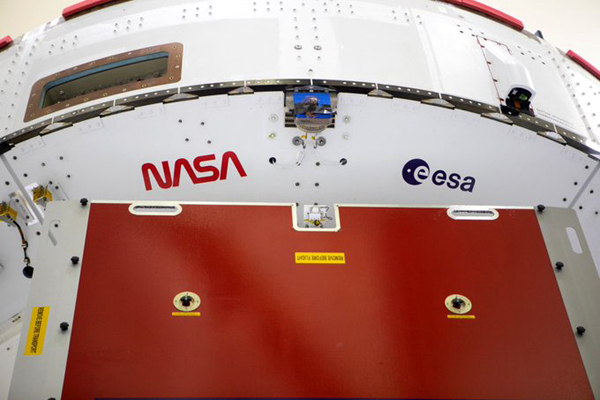
The NASA 'worm' and ESA (European Space Agency) logo are visible below the Crew Module Adapter of the Orion capsule that will launch on Artemis 1 next year.
NASA

Artemis I Rocket and Spacecraft Receive “Worm” Welcome (News Release)

NASA is headed back to the Moon as part of the Artemis program – and the agency’s “worm” logo will be along for the ride on the first integrated mission of the powerful Space Launch System (SLS) rocket and Orion spacecraft. Teams at NASA’s Kennedy Space Center in Florida have applied the historic logo in bright red on visible parts of the Artemis I rocket and spacecraft.

“After almost three decades, our famous logotype is back in action, and it is thrilling for all of us that worked on the original design to have it return in such an impressive way.” said Richard Danne, of the design team at Danne & Blackburn who originally created the logo. “It is particularly exciting to be involved with the Artemis program, so full of potential beginning with this promising first mission.”

The bold, sleek design of the “worm” logo was officially introduced in 1975 and was incorporated into many of the agency’s next-generation programs. It was retired in 1992, but made a comeback in 2020 as the agency ushers in a new, modern era of human spaceflight.

The worm began making an appearance on the SLS twin solid rocket boosters in late August when workers with NASA’s Exploration Ground Systems and their contractor Jacobs started painting the iconic design across two of the booster segments. The team used a laser projector to mask off the logo with tape, then painted the first coat of the logo inside the center’s Rotation, Processing and Surge Facility. The job was completed by adding a second coat of paint, followed by multiple clear coats on the booster.

“The most technically challenging task was identifying the correct sizing and location of where the logo was to go,” said William Richards, an engineer with Jacobs, the lead contractor supporting booster stacking operations. “New laser technology helped us lay it out in the correct position to mask off for the painting and correctly shape the letters, especially the curve of the ‘S’.”

After the boosters are transferred to the Vehicle Assembly Building for stacking, technicians will secure an access panel across the middle section of the boosters and paint it to complete the insignia. The worm will be visible as the boosters are stacked on top of the mobile launcher, while the rocket is on the launch pad, and as it soars through Earth’s atmosphere during launch.

The worm and ESA (European Space Agency) logo were recently applied to the Orion spacecraft as well. Technicians cut the emblems into flight-proof decals and adhered them to the underside of Orion’s crew module adapter (CMA). ESA is providing Orion’s service module, which is the powerhouse that fuels and propels the spacecraft. These bold images will be seen from cameras at the end of Orion’s solar arrays as the spacecraft travels toward the Moon and back.

The decals were affixed to the spacecraft by Frank Pelkey, a technician who previously painted the U.S. flag on the spacecraft that flew on NASA’s Exploration Flight Test-1. “I felt a great sense of pride when painting the U.S. flag on Orion’s first flight,” said Pelkey. “It was that same feeling of gratitude to be selected to apply the NASA and ESA logos to the vehicle for the first Artemis mission.”

Later this year, teams will apply an American flag and the primary NASA logo with the blue sphere, known as the “meatball,” to the crew module, in addition to a decal of the worm on the outer band of the CMA. These logos will also be seen during the mission while Orion is in space, and the worm on the CMA band will be visible while on the launch pad as well.

Also to be applied early next year and visible from the launch pad, the meatball and an ESA logo will be shown on the fairings that cover the service module, and the American flag will appear on the Interim Cryogenic Propulsion Stage, as well as the launch abort system along with the words “United States.”

In June, Northrop Grumman, the prime contractor for the boosters, delivered the Artemis I rocket motors to Kennedy where assembly of the entire five-segment booster has started. The twin boosters will help propel the SLS rocket on its first flight in 2021. Shortly after launch from Pad 39B, the boosters will separate from the rocket as the core stage continues to send Orion to space. After the core stage’s job is complete, the rocket’s upper stage sends Orion toward the Moon, and then Orion continues the rest of its journey around the Moon and back powered by the European-provided service module. Artemis II in 2023 will be the first flight test with crew. In 2024, NASA will send the first woman and next man to surface of the Moon on the Artemis III mission, and establish sustainable exploration by the end of the decade.

Source: NASA.Gov

****

The NASA worm is painted on the side of two segments that will fly on the twin solid rocket boosters of the Space Launch System (SLS) during Artemis 1 next year.
NASA

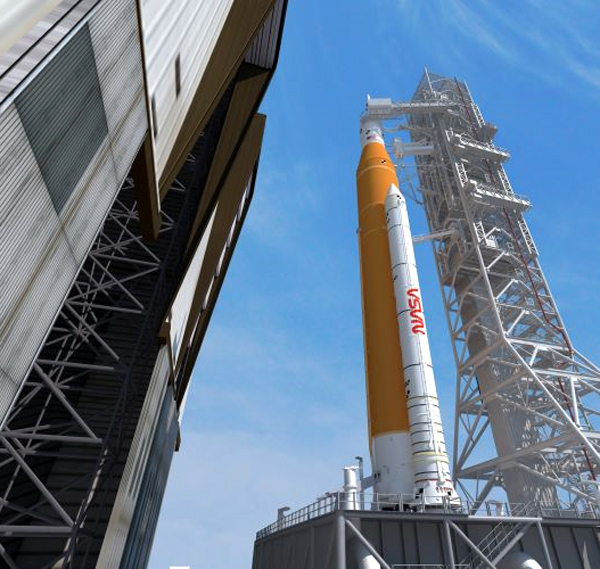
An artist's concept of the SLS rolling out of the Vehicle Assembly Building at NASA's Kennedy Space Center in Florida.
NASA

An artist's concept of the SLS on the pad at Kennedy Space Center's Launch Complex 39B in Florida.
NASA


Tuesday, June 27, 2017

Image of the Day: Orion's Airbags...

An animated GIF showing Orion's crew module uprighting system being tested at NASA's Johnson Space Center in Houston, Texas.
NASA

Orion Crew Module Uprighting System (News Release)

NASA’s Orion program is evaluating an updated design to the crew module uprighting system, the system of five airbags on top of the capsule that inflate upon splashdown. In high waves or wind over the ocean, the uprighting bags are responsible for turning Orion right side up if the capsule lands upside down or turns over when it returns to Earth. Engineers have retooled the design of the bags after they didn’t properly inflate during Exploration Flight Test-1.

The testing occurred at the Neutral Buoyancy Lab at NASA’s Johnson Space Center in Houston. The team is evaluating the bags during both normal inflation and failure scenarios to validate computer models. The testing in the calm waters of the pool is helping the team prepare for a late-summer complement of uprighting system tests in the Gulf of Mexico off the coast of Galveston, Texas.

Source: NASA.Gov

Wednesday, October 12, 2016

EM-1 Update: Space Launch System Components Ready to be Tested...

An aerial view of the launch vehicle stage adapter (LVSA) article being installed inside a test stand at NASA's Marshall Space Flight Center in Huntsville, Alabama...on October 12, 2016.
NASA / MSFC / Brian Massey

The Pressure is On for SLS Hardware in Upcoming Test (News Release)

Engineers are getting ready to put the pressure on hardware for the world's most powerful rocket, NASA’s Space Launch System, as part of a rigorous test series to ensure each structure can withstand the incredible stresses of launch. SLS and the agency’s Orion spacecraft will travel to new destinations in deep space as NASA continues to prepare for its Journey to Mars.

"Not only is this series more cost effective by testing several qualification articles together, but it also helps us to understand how the flight-like hardware will interface together," said Mike Roberts, mechanical team lead in the Engineering Directorate at NASA's Marshall Space Flight Center in Huntsville, Alabama.

A 65-foot-tall test stand at Marshall is being readied for the upcoming test series, where two simulators and four qualification articles of the upper part of the SLS will be stacked and then pushed, pulled and twisted by forces similar to those experienced in flight. "We have to make sure all the hardware is structurally sound and will not compromise under the incredible amounts of force," said Dee VanCleave, lead test engineer for the structural loads test at Marshall. "The best way to verify these major structures are ready for launch is to test them."

The qualification articles and simulators will be stacked in order from bottom to top in a test structure with "spiders" – given that name because the hardware has 8-16 legs that span out from the center. The spider's design helps distribute the load evenly in the test stand. The pieces are:

- Core stage simulator -- a duplicate of the top of the SLS core stage that is approximately 10 feet tall and 27.5 feet in diameter. It was designed and built at Marshall.
- Launch vehicle stage adapter (LVSA) -- connects the SLS core stage and the interim cryogenic propulsion stage (ICPS). The ICPS is a liquid oxygen/liquid hydrogen-based system that will give Orion the big, in-space push needed to fly beyond the moon before it returns to Earth on the first flight of SLS in 2018. The LVSA test hardware is 26.5 feet tall, with a bottom diameter of 27.5 feet and a top diameter of 16.8 feet. It was designed and built by prime contractor Teledyne Brown Engineering of Huntsville.
- Frangible joint assembly -- part of the separation system on the SLS. The flight version will have small explosive devices installed that will separate the ICPS from the rest of the rocket in space. Only the structural part of the frangible joint assembly is included for this test series. It was designed and built by The Boeing Co. in Huntsville and United Launch Alliance of Decatur.
- ICPS -- The qualification test article, without the engine, is around 29 feet tall and 16.8 feet in diameter. It will be filled with liquid nitrogen for testing, rather than liquid oxygen and liquid hydrogen. "Liquid nitrogen is the safest cryogenic media to use for testing," VanCleave said. The ICPS was designed and built by Boeing and United Launch Alliance.
- Orion stage adapter connects the Orion to the ICPS. It is 4.8 feet tall, with a 16.8-foot bottom diameter and 18-foot top diameter. It was designed and built at Marshall. The adapter technology was used for Orion’s first test flight in December 2014.
- Orion spacecraft simulator a replica of the bottom portion of the exploration vehicle that will carry the crew to space, provide emergency abort capability, sustain the crew during the space travel, and provide safe re-entry from deep space return velocities. The simulator also was designed and built at Marshall, and is 4.5 feet tall and 18 feet in diameter.

The qualification articles are almost exact to flight hardware specifications. The core stage simulator was loaded into the test stand Sept. 21, with the LVSA following on Oct. 12. The other three qualification articles and the Orion simulator will complete the stack later this fall. Testing is scheduled to begin in early 2017.

Ready, Set, Test

Approximately 50 test cases are planned for the series. The qualification test articles will be outfitted with 28 mechanical load lines, which will use hydraulic pressure to push and pull on the test articles. The ICPS tanks also will be filled with liquid nitrogen, which will subject the hardware to pressure as high as 56 pounds per square inch -- relative to atmospheric pressure. More than 170,000 pounds of liquid nitrogen will be used in the tanks for most of the load cases, and 500,000 pounds of axial hydraulic force will be applied to the entire test stack. Engineers will not test to failure for this series.

Data from the tests will be recorded through 1,900 instrumentation channels, measuring the strain on the test articles, temperature, deflection and other factors. The test data will be compared to computer models to verify the integrity of the hardware and ensure it can withstand the forces it will experience during flight. This also will be a type of practice run for assembly operations before the rocket hardware is stacked in the Vehicle Assembly Building at Kennedy Space Center in Florida ahead of launch.

The initial SLS configuration will have a minimum 70-metric-ton (77-ton) lift capability and be powered by twin solid rocket boosters and four RS-25 engines. The next planned upgrade of SLS will use a powerful exploration upper stage for more ambitious missions with a 105-metric-ton (115-ton) lift capacity. A third configuration will add a pair of advanced solid or liquid propellant boosters to provide a 130-metric-ton (143-ton) lift capacity. In each configuration, SLS will continue to use the same core stage and four RS-25 engines.

Source: NASA.Gov

****

The LVSA article is installed inside a test stand at NASA's Marshall Space Flight Center in Huntsville, Alabama...on October 12, 2016.
NASA / MSFC / David Olive

Tuesday, May 24, 2016

Orion Update: Construction Begins on the European Service Module...

At NASA Glenn's Plum Brook Station in Sandusky, Ohio, engineers work on a test version of the Orion spacecraft's service module...on February 20, 2016.
NASA / Christopher J. Lynch (Alcyon Technical Services)

Airbus Defence and Space Starts Orion Service Module Assembly (Press Release - May 19)

- During Exploration Mission-1, Orion will fly more than 64,000 km beyond the Moon

- Service module provides power and propulsion for Orion and life support systems for astronauts

Airbus Defence and Space, the world’s second largest space company, has started assembling the European Service Module (ESM), a key element of NASA’s next-generation Orion spacecraft that will transport astronauts into deep space for the first time since the end of the Apollo program.

In November 2014, Airbus Defence and Space was chosen by the European Space Agency (ESA) as prime contractor to develop and build the ESM, which will supply propulsion, power, thermal control, air and water for astronauts on missions beyond the Moon and to Mars. The ESM sits below the Crew Module.

Integrating more than 20,000 parts and components in the ESM flight model ranging from electrical equipment to rocket engines, solar arrays, tanks for propellant and life support consumables as well as hundreds of meters of cables and tubes marks a major milestone for the Orion program. After the arrival of the flight model structure from Thales Alenia Space Italy the assembly is being carried out at Airbus Defence and Space’s site at Bremen, Germany, where officials from ESA, NASA, Airbus Defence and Space and partners gave an update on the Orion program’s progress on May 19.

“With the Orion Service Module, we are part of an historic space mission,” said François Auque, Head of Space Systems. “We will make sure this mission is a success, working hand in hand with our customers ESA and NASA and our industrial partner Lockheed Martin Space Systems.”

The second test flight of the Orion vehicle and its first atop NASA’s Space Launch System rocket is known as Exploration Mission-1. This 2018 mission will be un-crewed and travel more than 64,000 km beyond the Moon to demonstrate the spacecraft’s performance. The first crewed mission, Exploration Mission-2, will be launched as early as 2021.

The Orion spacecraft is designed to take humans further than they have ever been before. The exploration vehicle will carry the crew to space, provide emergency abort capability, sustain the crew during space travel, and provide safe re-entry from deep space return velocities. Orion ushers in a new era of space exploration, with missions envisaged beyond the Moon, to an asteroid mass delivered to lunar orbit and Mars.

The ESM is cylindrical in shape and about four metres in diameter and in height. It features the ATV’s distinctive four-wing solar array (19 metres across unfurled) that generates enough electricity to power two households. Its 8.6 tonnes of propellant will power one main engine and 32 smaller thrusters. The ESM has a total mass of just over 13 tonnes. In addition to the main propulsion capability for the Orion spacecraft, the ESM will perform orbital maneuvering and attitude control functions. It also provides the main elements of the life support system such as water and oxygen for the crew while providing power and thermal control while it is docked to the crew module. The unpressurised service module can also be used to carry additional cargo.

In managing the development and construction of the ESM, Airbus Defence and Space is drawing on its extensive experience as prime contractor of ESA’s Automated Transfer Vehicle (ATV), which made regular deliveries of experiment equipment, spare parts, food, air and water for the crews on board the International Space Station.

Source: Airbus Defence and Space

****

A computer-generated image depicting the Orion spacecraft as its flies past the Moon several days after the launch of Exploration Mission 1...in November of 2018.
NASA

Monday, May 9, 2016

SLS Update: An SRB Is All Set for Next Month's QM-2 Test...

At the Orbital ATK facility in Promontory, Utah, the solid rocket motor that will be used for the Qualification Motor-2 demonstration on June 28 is now installed on its test stand.
Orbital ATK / NASA

Orbital ATK Completes Installation of World's Largest Solid Rocket Motor for Upcoming Ground Test (Press Release)

Promontory, Utah – Orbital ATK, a global leader in aerospace and defense technologies, in partnership with NASA, has completed installing the second Space Launch System (SLS) booster qualification motor, QM-2, in a specialized test stand in Utah in preparation for a June 28 static-fire test. QM-2 is the second of two Orbital ATK-developed motors to support qualification of the boosters for NASA’s SLS, which is a heavy-lift rocket designed to enable exciting new deep space exploration missions. The first qualification motor, QM-1, completed a successful test last spring.

“Testing before flight is critical to ensure reliability and safety when launching humans into space,” said Charlie Precourt, Vice President and General Manager of Orbital ATK’s Propulsion Systems Division. “This ground test is an important step in qualifying NASA’s new five-segment solid rocket motor, the largest solid rocket motor ever built for flight, for planned SLS missions to deep space.”

While last year’s QM-1 test validated motor performance at the upper end of the propellant temperature range, Orbital ATK personnel are cooling QM-2 to 40 degrees Fahrenheit to test its lower temperature capabilities against the required temperature range. Lying horizontally in the test stand, the motor is 154 feet in length and 12 feet in diameter. When fired, QM-2 will produce 3.6 million pounds of maximum thrust.

Orbital ATK and NASA will use measurements from more than 530 data channels to evaluate motor performance, acoustics, motor vibrations, nozzle modifications, insulation upgrades, Booster Separation Motor structural dynamic response and nozzle vectoring parameters. The full-scale motor test will further improve the safety, technology and knowledge of solid rocket motors.

The SLS five-segment motor is based on the design heritage of the flight-proven solid rocket boosters used on NASA’s Space Shuttle and incorporates new technologies and updated materials.

“Throughout the Space Shuttle Program, we regularly monitored and enhanced our motor design, and we have made further modifications to our booster for NASA’s new SLS,” said Precourt, a four-time space shuttle astronaut and former chief of the astronaut office. “Having personally experienced the power of these motors and been a part of these modifications, I can attest to their reliability.”

The SLS, along with NASA’s Orion spacecraft, provides a flexible deep space exploration platform to take humans and cargo to multiple destinations across our solar system. Orion successfully experienced its first flight test in December 2014, orbiting twice around the Earth and flying as far away as 3,600 miles – more than 15 times farther than the International Space Station and farther than a human spaceflight vehicle has traveled in 40 years.

The first test flight of SLS and Orion together, called Exploration Mission-1, is scheduled for 2018. EM-1 will use two of Orbital ATK’s five-segment solid rocket boosters.

A network of hundreds of suppliers representing 49 states supports the SLS and Orion programs. Orbital ATK has 29 key SLS booster suppliers across 16 states including Alabama, Arizona, California, Connecticut, Indiana, Kentucky, Massachusetts, Minnesota, New Jersey, New York, North Carolina, Ohio, Pennsylvania, Texas, Utah and Wisconsin.

Source: Orbital ATK

Friday, January 1, 2016

Happy New Year, Everyone!

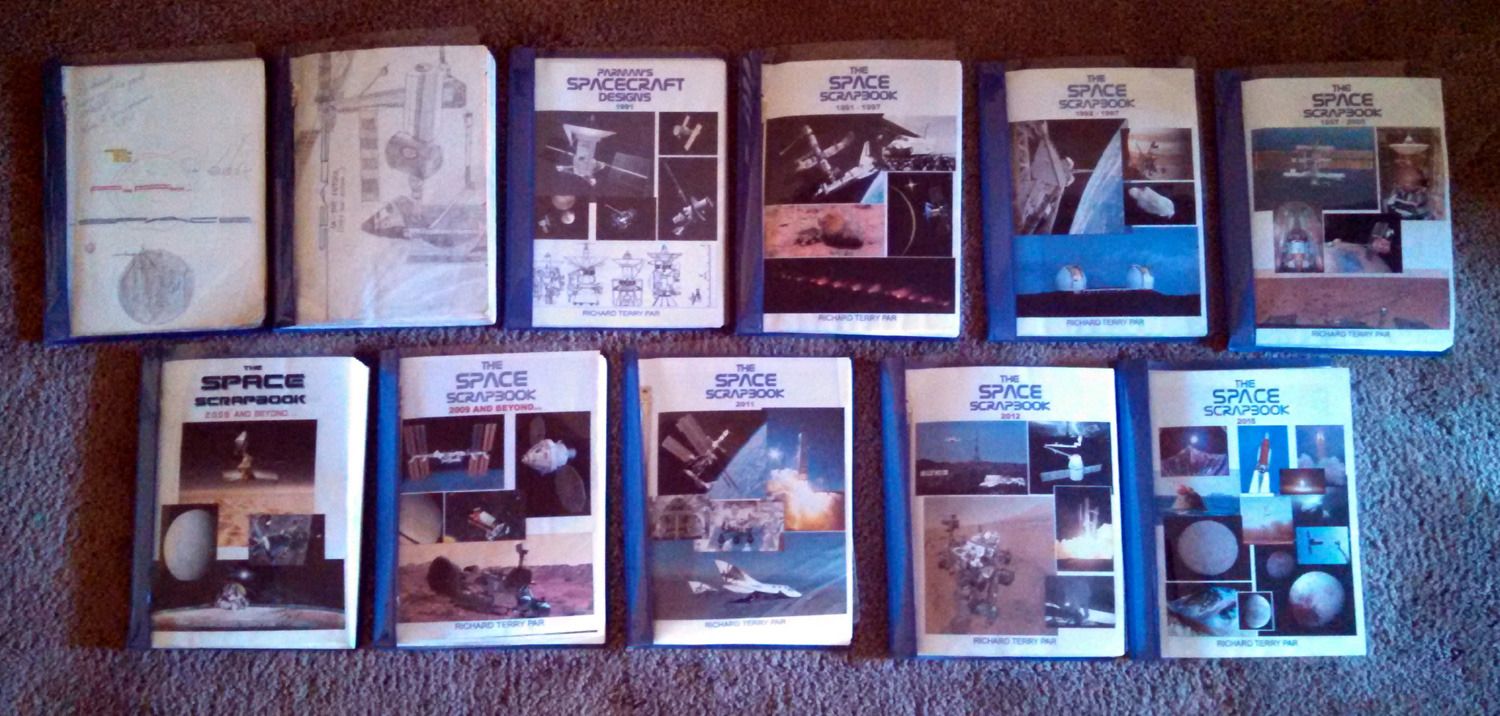
All of my space albums...for the rest of the world to see.

Just thought I'd share these new photos that I took of several albums that I created over 25 years (from 1990 to 2015). 2015 marked the final year that I collected space-related articles from various newspapers (mostly the Los Angeles Times) and compiled them in Acco plastic binders. If you click on the photo above to enlarge it, you'd see that there's a 2-year gap between the 2012 album and the one for last year. That's because 1.) I only had one more binder left and didn't feel like buying more, and 2.) I wanted to save the final binder for a year in which very significant space events took place. Those events originally were Dawn's arrival at dwarf planet Ceres last March and New Horizons' flyby of fellow dwarf planet Pluto last July...but I didn't know that 2015 would also mark the Planetary Society's successful test flight of its LightSail solar sail prototype last May, Blue Origin and SpaceX's triumph in safely landing rocket boosters back on the ground after launch last November and December, respectively, Japan finally inserting its Akatsuki spacecraft into orbit around Venus on December 6 (Pacific Time) following a 5-year delay due to a propulsion problem, and the historic discovery that water still flows on Mars last September.

My final album, THE SPACE SCRAPBOOK: 2015.

The coming years will also mark historic moments for spaceflight (especially in 2018...when the Space Launch System hopefully lifts off for the first time, Europe's second ExoMars mission heads to the Red Planet, and the James Webb Space Telescope is finally sent into the heavens)—but constantly browsing through every single page of a newspaper (except the sports section, obviously) to find a space article is time-consuming. It is time to move on... But don't worry; this blog will always be here for me to post press releases and personal news and pics in regards to the awesome events that take place in space exploration almost every day. Other than that, carry on— And have a great year!

Pages from my final album, THE SPACE SCRAPBOOK: 2015.

Friday, November 20, 2015

Orion Update: Getting a Shiny New Makeover for 2018...

An artist's concept of the Orion capsule with silver-coated heat titles.
NASA

Engineers Refine Thermal Protection System for Orion’s Next Mission (Press Release - November 19)

When it comes to a spacecraft enduring the extremely hot and fast journey from deep space back to Earth, NASA’s Orion can withstand the heat. Engineers developing Orion’s thermal protection system have been improving the spacecraft’s heat shield design and manufacturing process since the vehicle successfully traveled to space for the first time last year. They are now enhancing the overall system in advance of the spacecraft’s next mission – a flight that will put Orion through the harshest set of conditions yet.

Orion’s thermal protection system is one of the most critical parts of the spacecraft and is responsible for protecting it and the future astronauts it will carry home from deep space destinations. It consists of the spacecraft’s main heat shield that faces into the atmosphere on reentry to slow the spaceship down and also the grid of tiles known as the back shell. During Orion’s next mission atop the agency’s Space Launch System rocket, called Exploration Mission-1 (EM-1), the spacecraft will be in space for more than three weeks and return to Earth under even faster and hotter conditions than during its last flight.

“Orion’s thermal protection system is essential to successful future missions,” said John Kowal, NASA’s thermal protection system lead for Orion. “As we move toward building the system for EM-1, we’ve been able to take advantage of what we learned from building and flying Orion to refine our processes going forward.”

During EM-1, Orion will endure a more intense re-entry environment. While the spacecraft encountered speeds of 30,000 feet per second during Exploration Flight Test-1 and temperatures of approximately 4,000 degrees Fahrenheit, it will experience a faster return from lunar velocity of about 36,000 feet per second. While the speed difference may seem subtle, the heating the vehicle sees increases exponentially as the speed increases. The work engineering teams across the country are doing prepares Orion’s heat shield to perform re-entry during any of missions planned near the moon or in high lunar orbit (NASA’s “Proving Ground”) in the coming years.

For these future Orion missions, a silver, metallic-based thermal control coating will also be bonded to the crew module’s thermal protection system back shell tiles. The coating, similar to what is used on the main heat shield, will reduce heat loss during phases when Orion is pointed to space and therefore experiencing cold temperatures, as well as limit the high temperatures the crew module will be subjected to when the spacecraft faces the sun. The coating will help Orion’s back shell maintain a temperature range from approximately -150 to 550 degrees Fahrenheit prior to entry and also will protect against electrical surface charges in space and during re-entry.

“You’re trying to hit this sweet spot because when you’re looking at the sun, you don’t want to get too hot, and then when you’re not looking at the sun and instead in darkness, you don’t want to lose all the heat that the spacecraft generates,” said Kowal.

Engineers have also refined the design in ways that improve the manufacturing process and reduce the mass of the spacecraft for the upcoming exploration missions. Instead of a monolithic outer layer, the heat shield will be made of approximately 180 blocks that can be made simultaneously with the other heat shield components to streamline the labor-and-time-intensive manufacturing process.

In addition, engineers have found ways to reduce the mass of the heat shield’s underlying structure, which is composed of a titanium skeleton and carbon fiber skin. Teams have optimized the thickness of the skeleton and the skin based on the pressures that different areas will experience during flight and reentry, adding more fidelity to the overall structure while allowing it to be lighter.

NASA’s prime contractor for Orion, Lockheed Martin, recently completed a heat shield manufacturing development unit that engineers will use to verify the improved manufacturing process before it is used on hardware for flight. Teams have already begun building Orion’s heat shield for EM-1.

Source: NASA.Gov

****

Protected by silver-coated heat titles, the Orion capsule re-enters Earth's atmosphere in this artist's concept.
NASA

Thursday, September 24, 2015

Orion's Heat Shield: Lessons Learned from EFT-1...

A test version of the upgraded heat shield that will fly on the Orion spacecraft during Exploration Mission-1 in 2018.
Lockheed Martin

NASA Applies Insights for Manufacturing of Orion Spacecraft Heat Shield (Press Release)

When it comes to building a spacecraft fit for a journey to Mars, improvements happen brick by brick and block by block. Orion Program leaders have decided to begin building Orion’s heat shield in blocks rather than as a monolithic structure, a move that signals the insights gained as a result of testing the design in space.

Engineers building NASA’s Orion are making manufacturing improvements for the spacecraft ahead of its missions to deep space destinations near the moon and on the journey to Mars. Program leaders opted to begin building Orion’s heat shield in blocks rather than as a monolithic structure, a move that signals the insights gained as a result of testing the design in space.

The heat shield is one of the most critical elements of Orion and protects it and the future astronauts inside from searing temperatures experienced during reentry through Earth’s atmosphere when they return home. For Exploration Mission (EM)-1, the top layer of Orion’s heat shield that is primarily responsible for helping the crew module endure reentry heat will be composed of approximately 180 blocks that can be built in stages, easing the labor-intensive manufacturing process.

“The heat shield we put to the test during Orion’s flight test last December met every expectation we had and gave us a tremendous amount of data on its thermal and mechanical performance,” said Mark Kirasich, Acting Orion Program Manager. “But the process of building the heat shield as a single piece for that flight also gave us insight into how we could improve the way we build this essential element of the spacecraft.”

Orion’s flight test, known as Exploration Flight Test-1 or EFT-1, provided an opportunity to develop confidence in the overall system and provide insight that can't be gained from models in the laboratory. The heat shield experienced temperatures of about 4,000 degrees Fahrenheit and speeds approximately 80 percent of what it will endure when it comes back from missions near the moon, all while keeping the temperature inside the crew module in the mid-70s. Post-flight examinations of the heat shield confirmed it performed well within expected tolerances.

The heat shield was composed of a titanium skeleton and carbon fiber skin that gave the crew module its circular shape on the bottom and provided structural support, on top of which a fiberglass-phenolic honeycomb structure was placed. The honeycomb structure had 320,000 tiny cells that were individually filled by hand with an ablative material called Avcoat designed to wear away as Orion returned to Earth through the atmosphere. During the labor-intensive process, each individual cell was filled by hand as part of a serial process, cured in a large oven, X-rayed and then robotically machined to meet precise thickness requirements.

However, during the manufacture of the heat shield for Orion’s flight test, engineers determined that the strength of the Avcoat/honeycomb structure was below expectations. While analysis showed, and the flight proved, that the heat shield would work for the test, the EM-1 Orion will experience colder temperatures in space and hotter temperatures upon reentry, requiring a stronger heat shield.

Through lessons and data obtained from building and flying the heat shield, the team was able to make a design update for the Avcoat block design that will meet the EM-1 strength requirements. It is also expected to provide a cost savings and shorten the current heat shield manufacturing timeline by about two months. Engineers have now folded the update into the design review that will lock down the design for the next version.

Across the country, elements of the Orion spacecraft for EM-1 are coming together. This month welding began on the next Orion destined for space at NASA’s Michoud Assembly Facility in New Orleans. In October, NASA will see the arrival of a test version of Orion’s ESA (European Space Agency)-provided service module for testing and analysis at the agency’s Plum Brook Station near Sandusky, Ohio, and is scheduled to complete its critical design review, a months-long review that demonstrates Orion is ready to proceed to full-scale fabrication, assembly, integration and testing.

Source: NASA.Gov

****

Orion's heat shield is installed onto the spacecraft at NASA's Kennedy Space Center in Florida...during Exploration Flight Test-1 launch preparations last year.
NASA

Wednesday, September 16, 2015

Orion Update: EM-2 May Launch No Later Than Early 2023...

At NASA's Johnson Space Center in Houston, Texas, spacesuit engineers demonstrate how four crew members would be arranged for launch inside the Orion spacecraft, using a mockup of the capsule.
NASA

NASA Completes Key Milestone for Orion Spacecraft in Support of Journey to Mars (Press Release)

NASA’s mission to send astronauts to deep space destinations where no other human has traveled has taken another important step forward with the completion of a critical milestone for the Orion spacecraft currently in production.

Agency officials have completed a rigorous technical and programmatic review, confirming continued support of the program and establishing NASA’s commitment to the program’s technical, cost, and schedule baseline. This is the first time NASA has reached this level of progress for a spacecraft designed to take humans into deep space beyond the moon, including to an asteroid placed in lunar orbit and on the journey to Mars.

“Our work to send humans out into the solar system is progressing,” said NASA Administrator Charles Bolden. “Orion is a key piece of the flexible architecture that will enable humanity to set foot on the Red Planet, and we are committed to building the spacecraft and other elements necessary to make this a reality.”

A successful test of an uncrewed Orion capsule, Exploration Flight Test-1 (EFT-1), flew in December 2014, providing important data that allowed engineers to identify risks associated with deep space flight and re-entry and use that knowledge to improve the design of Orion for its next test flights, Exploration Missions 1 and 2 (EM-1 and EM-2).

Performance data has helped to improve manufacturing processes, as well. Engineers have already incorporated many of these improvements into elements of the EM-1 design, including the crew compartment or pressure vessel, which now is in fabrication and assembly at companies across the country. The vessel is comprised of seven panels or sections, and the first two of these were welded together last week. When complete, this capsule will launch on NASA’s Space Launch System (SLS) rocket on the first fully integrated flight test, EM-1.

Astronauts will fly on Orion for the first time on EM-2. That mission will build on the results of the EM-1 flight with additional requirements that the Orion capsule includes fully integrated environmental control and life support systems; controls; and communications designed specifically for the human operation; and advanced launch and re-entry spacesuits for the crew. The recent review, culminating in what is known within NASA as Key Decision Point C (KDP-C), includes all of these technological advancements, and approval represents agency support for this work and the Orion program plan.

The decision commits NASA to a development cost baseline of $6.77 billion from October 2015 through the first crewed mission (EM-2) and a commitment to be ready for a launch with astronauts no later than April 2023. The commitment is consistent with funding levels in the president’s budget request. Conservative cost and schedule commitments outlined in the KDP-C align the Orion Program with program management best practices that account for potential technical risks and budgetary uncertainty beyond the program's control.

“As we take these steps to develop the capabilities we need to send astronauts deep into space, we’re also aligning how we manage our human exploration systems development programs to ensure we are prepared for unforeseen future hurdles,” said Robert Lightfoot, NASA associate administrator. “We’re committing to this funding and readiness level to stay on the journey we’ve outlined to get to Mars.”

Orion engineers now are executing a rigorous review of the spacecraft’s engineering design and technical progress of the vehicle systems and subsystems. This critical design review (CDR) will demonstrate Orion is ready to proceed to full-scale fabrication, assembly, integration and testing. NASA’s SLS Program recently completed this milestone, and its Ground Systems Development and Operations (GSDO) Program will begin its review this fall.

“The Orion Program has done incredible work, progressing every day and meeting milestones to prepare for our next missions,” said William Gerstenmaier, the agency’s associate administrator for Human Exploration and Operations at NASA Headquarters. “The team will keep working toward an earlier readiness date for a first crewed flight, but will be ready no later than April 2023, and we will keep the spacecraft, rocket and ground systems moving at their own best possible paces.”

In the coming months, Orion will complete its CDR; see the arrival of a test version for the European Space Agency-provided service module at NASA’s Plum Brook Station near Sandusky, Ohio; perform a series of parachute tests; and complete the welding of the crew pressure vessel. Although Orion’s readiness date for EM-1 was not formally part of the KDP-C milestone commitment, engineers continue to work toward a commitment for SLS and GSDO to be ready for the uncrewed mission in fall 2018, and NASA will set an integrated launch date after GSDO’s critical design review is completed.

Source: NASA.Gov

****

A computer-generated image depicting the Orion spacecraft as its flies past the Moon several days after the launch of Exploration Mission 1...in November of 2018.
NASA

Wednesday, September 9, 2015

SLS Update: Paving the Way for the Mega-Rocket's Assembly...

A test version of the Space Launch System's Launch Vehicle Stage Adapter (LVSA) is assembled at NASA's Marshall Space Flight Center in Huntsville, Alabama.
NASA / MSFC / Emmett Given

Construction Begins on Test Version of Important Connection for SLS (Press Release)

Strong connection points between the stages of NASA’s Space Launch System (SLS) -- the agency’s advanced launch vehicle for exploration beyond Earth’s orbit into deep space -- are essential to ensure that the rocket will withstand the loads it may experience during flight. The Launch Vehicle Stage Adapter, or LVSA, plays an important role in connecting two major sections of the rocket -- the core stage and the upper stage.

The upper stage, known as the Interim Cryogenic Propulsion Stage, gives the Orion spacecraft the big, in-space push needed to fly beyond the moon before the spacecraft returns to Earth for the first flight test of SLS. The Orion spacecraft is connected to the upper stage with the Orion Stage Adapter.

Welding of the major panels of a test version of the LVSA began in August at NASA's Marshall Space Flight Center in Huntsville, Alabama, where the agency manages the SLS program.

Marshall engineers, in close partnership with prime contractor Teledyne Brown Engineering of Huntsville, are applying friction-stir-welding capabilities and equipment. The friction-stir-welding process joins large pieces of the LVSA by stirring their edges together without completely melting the metal, resulting in a stronger weld than in standard welding practices. The Marshall weld team also developed an innovative modular tooling concept, which can make different size adapters using the same machinery – reducing costs and build time.

“We are starting to see the test version of the LVSA take shape,” said Brent Gaddes, adapter manager for SLS. “This is a unique structure, which presents some challenges due to its large size and conical shape. However, we have a very capable team, both with Marshall and Teledyne Brown, and are building on our experience with the stage adapter that was used on Orion’s first test flight in 2014.”

Engineers have already completed structural test articles of the Orion stage adapter, core stage simulator and Orion spacecraft simulator. A test article for the interim cryogenic propulsion stage is currently in production at United Launch Alliance in Decatur, Alabama. When the test versions of all the parts are completed, engineers will stack them and move the 56-foot tall structure to a Marshall test stand for testing to verify the integrity of the hardware and ensure it can withstand the loads it may experience during flight.

The first flight test of the SLS will feature a Block I configuration for a 70-metric-ton (77-ton) lift capacity and carry an uncrewed Orion spacecraft beyond low-Earth orbit to test the performance of the integrated system. As the SLS evolves, it will provide an unprecedented lift capability of 130 metric tons (143 tons) to enable missions even farther into our solar system.

Source: NASA.Gov

****

An infographic showing the LVSA's location on NASA's Space Launch System.
NASA / MSFC

Tuesday, September 8, 2015

Orion Update: Construction Begins on the EM-1 Spacecraft!

Welding begins on the first two components (the tunnel and forward bulkhead) of the Orion EM-1 spacecraft at NASA's Michoud Assembly Facility in Louisiana.
NASA

First Pieces of NASA’s Orion for Next Mission Come Together at Michoud (Press Release)

NASA is another small step closer to sending astronauts on a journey to Mars. On Saturday, engineers at the agency’s Michoud Assembly Facility in New Orleans welded together the first two segments of the Orion crew module that will fly atop NASA’s Space Launch System (SLS) rocket on a mission beyond the far side of the moon.

“Every day, teams around the country are moving at full speed to get ready for Exploration Mission-1 (EM-1), when we’ll flight test Orion and SLS together in the proving ground of space, far away from the safety of Earth,” said Bill Hill, deputy associate administrator for Exploration Systems Development at NASA Headquarters in Washington. “We’re progressing toward eventually sending astronauts deep into space.”

The primary structure of Orion’s crew module is made of seven large aluminum pieces that must be welded together in detailed fashion. The first weld connects the tunnel to the forward bulkhead, which is at the top of the spacecraft and houses many of Orion’s critical systems, such as the parachutes that deploy during reentry. Orion’s tunnel, with a docking hatch, will allow crews to move between the crew module and other spacecraft.

“Each of Orion’s systems and subsystems is assembled or integrated onto the primary structure, so starting to weld the underlying elements together is a critical first manufacturing step,” said Mark Geyer, Orion Program manager. “The team has done tremendous work to get to this point and to ensure we have a sound building block for the rest of Orion’s systems.”

Engineers have undertaken a meticulous process to prepare for welding. They have cleaned the segments, coated them with a protective chemical and primed them. They then outfitted each element with strain gauges and wiring to monitor the metal during the fabrication process. Prior to beginning work on the pieces destined for space, technicians practiced their process, refined their techniques and ensured proper tooling configurations by welding together a pathfinder, a full-scale version of the current spacecraft design.

NASA’s prime contractor for the spacecraft, Lockheed Martin, is doing the production of the crew module at Michoud.

Through collaborations across design and manufacturing, teams have been able to reduce the number of welds for the crew module by more than half since the first test version of Orion’s primary structure was constructed and flown on the Exploration Flight Test-1 last December. The Exploration Mission-1 structure will include just seven main welds, plus several smaller welds for start and stop holes left by welding tools. Fewer welds will result in a lighter spacecraft.

During the coming months as other pieces of Orion’s primary structure arrive at Michoud from machine houses across the country, engineers will inspect and evaluate them to ensure they meet precise design requirements before welding. Once complete, the structure will be shipped to NASA’s Kennedy Space Center in Florida where it will be assembled with the other elements of the spacecraft, integrated with SLS and processed before launch.

Source: NASA.Gov

****

The seven major components that make up the pressure vessel of the Orion EM-1 spacecraft.
NASA

Wednesday, August 12, 2015

Orion Update: Beginning the Process of Finalizing the Spacecraft's Design...

A computer-generated image depicting the Orion spacecraft as its flies past the Moon several days after the launch of Exploration Mission-1...in late 2018.
NASA

Orion Begins Critical Design Review Milestone (Press Release)

NASA’s Orion Program kicked off its critical design review at the agency’s Johnson Space Center in Houston the week of Aug. 3, a major program milestone that will ensure the spacecraft’s design is ready for its deep space missions atop NASA’s Space Launch System (SLS) rocket.

Orion, which successfully flew about 3,600 miles into space last year during an uncrewed flight test, is being developed to send astronauts to new destinations in the solar system, including an asteroid and on toward Mars. During its next mission, Orion will venture to a distant lunar orbit beyond the far side of the moon.

“Our team across the country has been working incredibly hard to develop a spacecraft capable of expanding humanity’s frontier in the solar system,” said Mark Geyer, Orion Program manager. “Since even before flying Orion in space last year, we’ve been moving at full steam toward our first flight on SLS, and this review gives us a chance to make sure all systems and their designs meet our requirements and are in sync before we continue pressing ahead.”

The review is a months-long process where engineers delve into the details of the spacecraft’s systems and subsystems to evaluate their maturity and involves thousands of documents. The milestone is a rallying point for those with technical stakes in successfully building and flying future Orion missions to ensure all elements are in sync before moving ahead with full-scale fabrication, assembly, integration and testing.

It will include an evaluation of common aspects of the spacecraft for Exploration Mission (EM)-1 and the spacecraft for EM-2, the first Orion mission with astronauts, such as the spacecraft’s structures, pyrotechnics, Launch Abort System, guidance, navigation and control and software, among many other elements. Systems unique to EM-2 will be addressed at a later critical design review for the mission in the fall of 2017.

Not only will Orion technical experts take a close look at the spacecraft, but engineers working on SLS, which recently completed its own critical design review, the ground systems needed for launch and other elements needed to execute successful missions, such as mission operations and safety and mission assurance, will be on hand during the review to provide insight.

“We’re working through our critical design review now so that we can balance evaluating individual components with the hardware manufacturing needs we have to start our assembly and integration activities,” said Geyer.

The Orion Program’s critical design review is targeted for completion in late October.

Source: NASA.Gov

****

A computer-generated image depicting the Orion spacecraft firing its main engine as it heads back to Earth...following a flyby of the Moon during Exploration Mission-1 in late 2018.
NASA

Monday, March 9, 2015

(Post-)EFT-1 Update: Deconstructing Orion...

Inside the Launch Abort System Facility at NASA's Kennedy Space Center in Florida, engineers inspect the Orion EFT-1 spacecraft after its heat shield (visible in the background) was removed...on February 13, 2015.
NASA / Jim Grossmann

Taking a Closer Look at Orion After Successful Flight Test (Press Release)

Engineers across the country have been busy taking a closer look at NASA's Orion spacecraft and the data it produced during its successful flight test in December 2014. Inside the Launch Abort System Facility at NASA's Kennedy Space Center in Florida, Orion was lifted using a special crane for removal of its heat shield on Feb. 13, 2015. In the background, technicians move the heat shield on a work stand. The spacecraft’s heat shield protected Orion as it reentered Earth’s atmosphere at searing temperatures. Removing the back shell allows the team to get a closer look at Orion’s systems to see how they fared during the trip to space. The heat shield was removed in preparation for shipment to NASA’s Marshall Space Flight Center in Huntsville, Alabama, where special equipment will be used to remove its ablative material. From there, the heat shield will be shipped to NASA’s Langley Research Center in Hampton, Virginia, where it will be outfitted on a test article for water impact testing.

Meanwhile, NASA and Lockheed Martin, the prime contractor for Orion, continue to take a look at the data the flight test produced to validate pre-flight models and improve the spacecraft’s design. Analysis of data obtained during its two-orbit, four-and-a-half hour mission Dec. 5 will provide engineers detailed information on how the spacecraft fared.

Source: NASA.Gov

Thursday, February 19, 2015

(Post-)EFT-1 Update: Lessons Learned From the Historic Flight...

A Delta IV Heavy rocket carrying the Orion spacecraft lifts off from Cape Canaveral Air Force Station in Florida...beginning Exploration Flight Test (EFT)-1 on December 5, 2014.
NASA / Sandra Joseph and Kevin O'Connell

NASA’s Orion Flight Test Yields Critical Data as Engineers Improve Spacecraft for Next Mission (Press Release)

NASA’s Orion spacecraft continues on the agency’s journey to Mars as engineers analyze data from the spacecraft’s December flight test and make progress developing and building the spacecraft for its first mission atop NASA Space Launch System (SLS) heavy-lift rocket. On future missions, Orion will send astronauts to an asteroid and onward toward the Red Planet.

At machine houses across the country, elements of the primary structure for the next Orion to fly in space are coming together. Avionics components are being built and simulators for the ESA (European Space Agency)-built service module that will house the spacecraft’s propulsion and solar arrays are being delivered. By the end of the year, engineers hope to have the primary structure for Orion’s next mission to NASA’s Kennedy Space Center in Florida for processing. Meanwhile, every piece of data and each element of the spacecraft flown in the December test is being analyzed and compared to pre-flight models to improve Orion’s design.

“Orion’s flight test was a big success and what we learned is informing how we design, develop and build future Orions that will help us pioneer deep space destinations,” said Mark Geyer, NASA’s Orion Program manager. “Taking a look at all the flight test data is a huge part of the development process and a key part off in why we flew a test flight. We have critical work happening this year, both on the data analysis and development side, to keep us moving toward our first mission with SLS.”

Engineers and technicians at Kennedy, where Orion was assembled and returned after its flight test, recently took off the back shell and heat shield that protected Orion during its reentry to Earth’s atmosphere, to unload unused propellants and allow for a close-up analysis of the spacecraft’s systems.

One of the main objectives of Orion’s flight, which sent the vehicle 3,600 miles into space during a two-orbit, 4.5-hour test, was to test how the spacecraft would fare returning to Earth at high speeds and temperatures.

“The heat shield looks in great shape,” said Michael Hawes, Orion Program manager for Lockheed Martin, NASA’s prime contractor for the spacecraft. “The char on the shield is consistent. If you look at it now, you’d see a few big holes because we’ve taken core samples. We’ve also done a total laser scan of the surface of the heat shield. That’ll give us a very detailed engineering base of knowledge of what the heat shield did.”

In March, the heat shield will be shipped to NASA’s Marshall Space Flight Center in Huntsville, Alabama, where the ablative material on the heat shield will be taken off. From there, the heat shield structure will be shipped to the agency’s Langley Research Center in Hampton, Virginia, where it will be reused on a test capsule for water impact testing. NASA and Lockheed Martin also are taking a look at potential modifications to the heat shield’s design to make it even stronger.

Evaluating how the thermal protection system fared during Orion’s reentry wasn’t the only critical objective of the flight. The test also provided important insight into key separation events, including whether the Launch Abort System and protective fairings came off at the right times, how the parachutes assisting Orion during its descent fared and how the operations to recovery Orion from the Pacific Ocean progressed.

According to Hawes, all of the spacecraft separation events happened within fractions of a second of when predictive models said they would occur; Orion’s 11 parachutes worked to allow the spacecraft to touchdown in the Ocean relatively gently; and the recovery team of NASA, U.S. Navy and Lockheed Martin personnel recovered it within about six hours.

The flight also examined the performance of a 3-D printed vent. It performed well, so teams will be looking at other hardware that could be made using the additive manufacturing process.

Engineers are taking a closer look at the crew module uprighting system airbags on top of the crew module, which help keep Orion stable in the water after splashdown. Only two of five of the bags properly inflated during the December flight test. Initial analysis of the gas and plumbing system for the bags came up clean, and engineers suspect a possible issue with the bags themselves.

“We’re in the midst of troubleshooting that now,” Hawes said.

Orion’s flight test yielded millions of elements of data, every piece of which is providing unique insight into how to improve the spacecraft’s design so that it can safely send astronauts on their way to Mars and return them home.

Source: NASA.Gov

****

The USS Anchorage approaches the Orion EFT-1 spacecraft in preparation for the capsule being towed back to the ship for securing aboard the vessel, on December 5, 2014.
NASA

Wednesday, January 7, 2015

(Post-)EFT-1 Update: Orion Is Back Home in Florida...

NASA Administrator Charles Bolden (third from right) is among a crowd of onlookers who inspect the Orion EFT-1 spacecraft as it is put on display inside the Launch Abort System Facility at Kennedy Space Center in Florida...on January 6, 2015.
NASA / Cory Huston

Orion Spacecraft in Post-Mission Processing at Kennedy Space Center (Press Release)

Bearing the marks of a spacecraft that has returned to Earth through a searing plunge into the atmosphere, NASA's Orion spacecraft is perched on a pedestal inside the Launch Abort System Facility at Kennedy Space Center, where it is going through post-mission processing. NASA Administrator Charles Bolden, third from right, looks over the Orion spacecraft on the morning of Jan. 6, 2015. At far right is Jules Schneider, Lockheed Martin manager. Standing near Bolden is Paul Cooper, a Lockheed Martin manager. At far left is Kennedy Space Center Associate Director Kelvin Manning.

Orion was returned to Kennedy Space Center following a successful Dec. 5, 2014 flight test. Although the spacecraft Bolden looked over did not fly with a crew aboard during the flight test, Orion is designed to carry astronauts into deep space in the future setting NASA and the nation firmly on the journey to Mars.

Source: NASA.Gov

Tuesday, December 9, 2014

(Post-)EFT-Update: Orion is Back on Terra Firma!

After arriving in Naval Base San Diego, California, the Orion EFT-1 spacecraft is brought out of the well deck of the USS Anchorage via forklift...on December 8, 2014.
NASA / Amber Philman

Yesterday afternoon, the USS Anchorage arrived at Naval Base San Diego after completing a 3-day trip that began once the U.S. warship retrieved the Orion spacecraft from the Pacific Ocean last Friday. Having traveled 60,000 miles in space during Exploration Flight Test 1 and 600 miles from its splashdown zone to Southern California, Orion will now make a 2,500-mile roadside trip back to NASA's Kennedy Space Center in Florida. This Orion capsule will be refurbished and reused during the Ascent Abort 2 test at Cape Canaveral in 2018. The next Orion to fly into space (on Exploration Mission 1) is now in production by Lockheed Martin...at the Michoud Assembly Facility near New Orleans, Louisiana.

With the Orion EFT-1 spacecraft aboard, the USS Anchorage arrives at Naval Base San Diego, California, after a 3-day trip from Orion's splashdown zone in the Pacific Ocean...on December 8, 2014.
NASA

With the Orion EFT-1 spacecraft aboard, the USS Anchorage arrives at Naval Base San Diego, California, after a 3-day trip from Orion's splashdown zone in the Pacific Ocean...on December 8, 2014.
NASA

With the Orion EFT-1 spacecraft aboard, the USS Anchorage arrives at Naval Base San Diego, California, after a 3-day trip from Orion's splashdown zone in the Pacific Ocean...on December 8, 2014.
NASA

The Orion EFT-1 spacecraft is about to be placed inside a makeshift structure at Naval Base San Diego's Mole Pier for temporary storage, on December 9, 2014.
NASA / Cory Huston

The Orion EFT-1 spacecraft is about to be placed inside a makeshift structure at Naval Base San Diego's Mole Pier for temporary storage, on December 9, 2014.
NASA / Cory Huston