Showing posts with label Lunar Terrain Vehicle. Show all posts

Tuesday, March 24, 2026

Artemis Update: The Lunar Gateway Has Been Shelved in Favor of a Moon Base, While a Nuclear-powered Mission Heads to Mars in 2028...

An artist’s concept of Phase 3 of NASA’s Artemis Moon Base.
NASA

NASA Unveils Initiatives to Achieve America’s National Space Policy (News Release)

As part of its Ignition event on Tuesday, NASA announced a series of transformative agencywide initiatives designed to achieve the president's National Space Policy and advance American leadership in space. These actions reflect the urgency of the moment, but also the tremendous opportunity ahead for world-changing science and discovery.

“NASA is committed to achieving the near‑impossible once again, to build a Moon base, establish an enduring presence, and do the other things needed to ensure American leadership in space. This is why it is essential we leave an event like Ignition with complete alignment on the national imperative that is our collective mission. The clock is running in this great‑power competition, and success or failure will be measured in months, not years,” said NASA Administrator Jared Isaacman.

“If we concentrate NASA’s extraordinary resources on the objectives of the National Space Policy, clear away needless obstacles that impede progress, and unleash the workforce and industrial might of our nation and partners, then returning to the Moon and building a base will seem pale in comparison to what we will be capable of accomplishing in the years ahead.”

NASA Associate Administrator Amit Kshatriya said, “Today we are aligning NASA around the mission. On the Moon, we are shifting to a focused, phased architecture that builds capability landing by landing, incrementally, and in alignment with our industrial and international partners. In low-Earth orbit (LEO), we are recognizing where the market is and where it isn’t, recognizing the incredible value of the International Space Station, and building a transition that builds a competitive commercial ecosystem rather than forcing a single outcome the market cannot support.

"In our science missions, we are opening the lunar surface to researchers and students nationwide, and with Space Reactor‑1 Freedom, we are finally putting nuclear propulsion on a trajectory out of the laboratory and into deep space. And this is all possible by investing in our people, bringing critical skills back into the agency, putting our teams where the machines are being built, and creating real pathways for the next generation of NASA leaders. Our workforce is the jewel of NASA, and from their leaders, they need clear mission goals, the tools to execute, and to get out of their way. This is what Ignition is about.”

Going back to the Moon

The announcements build on recent updates to the Artemis program, including standardizing the SLS (Space Launch System) rocket configuration, adding an additional mission in 2027, and undertaking at least one surface landing every year thereafter. Under this previously updated architecture, Artemis III – scheduled for 2027 – will focus on testing integrated systems and operational capabilities in Earth orbit in advance of the Artemis IV lunar landing.

Looking beyond Artemis V, NASA announced on March 24 that it will begin to incorporate more commercially-procured and reusable hardware to undertake frequent and affordable crewed missions to the lunar surface, initially targeting landings every six months, with the potential to increase cadence as capabilities mature.

To achieve an enduring human presence on the Moon, NASA also announced a phased approach to building a lunar base. As part of this strategy, the agency intends to pause Gateway in its current form and shift focus to infrastructure that enables sustained surface operations. Despite challenges with some existing hardware, the agency will repurpose applicable equipment and leverage international partner commitments to support these objectives.

In the coming days, NASA will release Requests for Information (RFIs) and draft Requests for Proposals (RFPs) to ensure continued progress in meeting national objectives.

Building the Moon Base

NASA’s plan for establishing a sustained lunar presence will roll out in three deliberate phases.

-- Phase One: Build, Test, Learn
NASA shifts from bespoke, infrequent missions to a repeatable, modular approach. Through CLPS (Commercial Lunar Payload Services) deliveries and the LTV (Lunar Terrain Vehicle) program, the agency will increase the tempo of lunar activity, sending rovers, instruments and technology demonstrations that advance mobility, power generation (including radioisotope heater units and radioisotope thermoelectric generators), communications, navigation, surface operations, and a wide range of scientific investigations.

-- Phase Two: Establish Early Infrastructure
With lessons from early missions in hand, NASA moves toward semi‑habitable infrastructure and regular logistics. This phase supports recurring astronaut operations on the surface and incorporates major international contributions, including JAXA’s (Japan Aerospace Exploration Agency) pressurized rover, and potentially other partner scientific payloads, rovers, and infrastructure/transportation capabilities.

--Phase Three: Enable Long‑Duration Human Presence
As cargo‑capable Human Landing Systems (HLS) come online, NASA will deliver heavier infrastructure needed for a continuous human foothold on the Moon, marking the transition from periodic expeditions to a permanent lunar base. This will include ASI’s (Italian Space Agency) Multi-purpose Habitats (MPH), CSA’s (Canadian Space Agency) Lunar Utility Vehicle, and opportunities for additional contributions in habitation, surface mobility and logistics.

Ensuring American presence in low-Earth orbit

While building a sustainable lunar architecture, NASA is also reaffirming its commitment to low-Earth orbit. For more than two decades, the International Space Station has served as a world‑class orbital laboratory, enabling more than 4,000 research investigations, supporting more than 5,000 researchers, and hosting visitors from 26 countries. The space station required 37 shuttle flights, 160 spacewalks, two decades, and more than $100 billion to design, develop and build.

The orbital laboratory cannot operate indefinitely. The transition to commercial stations must be thoughtful, deliberate and structured to support long‑term industry success.

NASA is introducing and seeking industry feedback on an additional LEO strategy that preserves all current pathways while adding a phased, International Space Station‑anchored approach to avoid any gap in U.S. human presence and mature a robust commercial ecosystem. Under this alternative approach, NASA would procure a government‑owned Core Module that attaches to the space station, followed by commercial modules that are validated using International Space Station capabilities and later detach into free flight. After maturing technical and operational capabilities and market demand is realized, the stations would detach and NASA would be one of many customers purchasing commercial services.

To stimulate the orbital economy, NASA would expand industry opportunities, including private astronaut missions, commander seat sales, joint missions, multiple module competitions, and prize‑based awards.

An industry RFI opens on Wednesday, March 25, to inform partnership structures, financing, and risk mitigation.

Advancing world-changing discovery with current, developing science missions

In a Golden Age of exploration and discovery, NASA takes full advantage of every opportunity to get science into space. The James Webb Space Telescope continues to transform our understanding of the early Universe, Parker Solar Probe has flown through the atmosphere of the Sun, NASA has shown that it can defend the planet by deflecting asteroids, and Earth science data is used extensively by American companies, U.S. agriculture, and disaster relief. On the International Space Station, NASA is conducting groundbreaking experiments in quantum science.

Future opportunities will advance U.S. leadership in space science. The Nancy Grace Roman Space Telescope, launching as early as this fall, will advance our understanding of dark energy, and has created a new standard for the management of large science missions. Dragonfly will launch a nuclear-powered octocopter in 2028, arriving at Saturn’s moon Titan in 2034 to explore its complex, organic-rich environment.

In 2028, NASA will launch and deliver ESA’s (European Space Agency) Rosalind Franklin Rover to Mars, with NASA’s contributed mass spectrometer for the Mars Organic Molecule Analyzer (MOMA) instrument, which may result in the most advanced detection and analysis of organic matter ever conducted on Mars. A new Earth science mission launching next year will measure for the first time the evolution of the dynamics within convective storms to improve the prediction of extreme weather events up to six hours before the storm occurs.

The agency detailed how advancements in lunar science will also be afforded by the build out of the Moon Base and underpin future Moon and Mars exploration. With an accelerated CLPS cadence, targeting up to 30 robotic landings starting in 2027, NASA is expediting delivery of science and technology to the lunar surface. There will be many opportunities for payload delivery including rovers, hoppers and drones with contributions welcomed from industry, academia and international partners.

Near-term payloads include the VIPER rover and the LuSEE‑Night mission. An RFI will be released on March 24 that calls for payloads capable of supporting NASA’s science and technology goals for additional 2027 and 2028 flights. It will enable students and researchers across the country to work on scientific instruments for use on the surface of the Moon in the years ahead.

This RFI will also solicit payloads incorporated on future missions to Mars including the Mars Telecom Network (MTN) and a nuclear technology demonstration mission.

The agency intends to partner with philanthropic and privately-funded research organizations with shared objectives in space science.

Other RFIs released on March 24 will strengthen “Science as a Service” partnerships and commercial capabilities, allowing NASA to streamline legacy operations and focus investment on the transformational missions that only the agency can lead.

Finally, NASA will unveil a previously unseen pair of images from the James Webb and Hubble Space Telescopes. These images show the planet Saturn in unprecedented detail in both infrared and visible wavelengths.

America underway on nuclear power in space

In addition to these scientific missions, after decades of study and in response to the National Space Policy, NASA announced a major step forward in bringing nuclear power and propulsion from the lab to space.

NASA will launch the Space Reactor‑1 Freedom, the first nuclear-powered interplanetary spacecraft, to Mars before the end of 2028, demonstrating advanced nuclear electric propulsion in deep space. Nuclear electric propulsion provides an extraordinary capability for efficient mass transport in deep space and enables high power missions beyond Jupiter where solar arrays are not effective.

When SR-1 Freedom reaches Mars, it will deploy the Skyfall payload of Ingenuity‑class helicopters to continue exploring the Red Planet. SR-1 Freedom will establish flight heritage nuclear hardware, set regulatory and launch precedent, and activate the industrial base for future fission power systems across propulsion, surface, and long‑duration missions. NASA and its U.S. Department of Energy partner will unlock the capabilities required for sustained exploration beyond the Moon and eventual journeys to Mars and the outer Solar System.

None of these endeavors can succeed without the NASA workforce. As previously announced, the agency is rebuilding its core competencies, converting thousands of contractor positions to civil service, and restoring the engineering, technical and operational strengths expected of the world’s premier space organization.

NASA is expanding opportunities for interns and early‑career professionals and, in partnership with the U.S. Office of Personnel Management and NASA Force, is creating new pathways for experienced industry talent to serve through term‑based appointments. The agency is also seeking to open opportunities for NASA employees to gain valuable experience working within the most technologically-advanced space industry in history.

The changes announced on March 24 will be implemented during the coming months, with teams agencywide ensuring a smooth transition while advancing key programs and partnerships.

NASA will embed subject‑matter experts across the supply chain – at every major vendor, subcontractor and critical‑path component – to challenge assumptions, solve problems, accelerate production, and help ensure that the right outcomes are achieved.

Through these reforms, NASA is strengthening its ability to deliver on the president’s National Space Policy and ensure continued American superiority in space.

Source: NASA.Gov

****

A screenshot from an animated video depicting the SR‑1 Freedom spacecraft approaching Mars.
NASA

New images of Saturn that were taken by NASA's James Webb and Hubble Space Telescopes, respectively, in 2024.
NASA, ESA, CSA, STScI, Amy Simon (NASA-GSFC), Michael Wong (UC Berkeley); Image Processing: Joseph DePasquale (STScI)

An infographic showing the Core Module that would be attached to the International Space Station to pave the way for future commercial space stations in low-Earth orbit.

The Interstellar Probe project, which was studied by the Johns Hopkins University Applied Physics Laboratory a few years ago, may be one of many potential science missions pursued under the new National Space Policy over the next decade.

Tuesday, July 8, 2025

The Latest Update on Artemis 3 and Beyond...

Wearing the AxEMU spacesuit, Axiom Space astronaut Koichi Wakata poses with the American flag inside the Neutral Buoyancy Laboratory at NASA's Johnson Space Center in Houston, Texas.
NASA

Axiom Space’s Next-Gen Spacesuit is Crew Tested for First Time in NASA’s Neutral Buoyancy Lab (News Release)

In June, Koichi Wakata, Axiom Space astronaut and Chief Technology Officer, was the first to test the Axiom Extravehicular Mobility Unit (AxEMU) in NASA’s Neutral Buoyancy Laboratory (NBL).

The Axiom Space-developed spacesuit will enable astronauts to explore the Moon for the first time in over 50 years as part of the Artemis III mission to the lunar South Pole.

The tests were first conducted with Wakata, followed by NASA spacesuit engineers Kristine Davis and Richard Rhodes, and focused on the integration of the AxEMU into the NBL facility. The NBL is one of the world's largest indoor pools, used for astronaut training and mission preparation, allowing astronauts to simulate lunar surface tasks in partial gravity or spacewalks in zero gravity.

The Axiom Space Extravehicular Activity (EVA) program team tested the operations and capabilities of the communications, breathing and cooling systems of the spacesuit in the pool. The team worked to familiarize the NBL divers with the AxEMU’s operations and support systems.

In preparation of the Artemis III mission, Axiom Space and NASA’s Artemis Program teams will continue to conduct tests in the NBL to train for EVA tasks on the lunar surface.

The AxEMU continues to undergo extensive testing to ensure that it will be ready to support Artemis III. This year, the EVA program team accomplished several key achievements, including completing its first three crewed tests in the NBL; 23 tests in NASA’s Active Response Gravity Offload System (ARGOS) that provides a simulated reduced gravity environment; multiple field evaluations using lunar tools; and lunar regolith challenge testing demonstrating that the suit exceeds its mission requirements in this area. The spacesuit continues to undergo integrated tests with the Lunar Terrain Vehicles (LTVs) and is scheduled to enter the Critical Design Review (CDR) later this year.

Axiom Space remains laser-focused on the development of this next-generation spacesuit providing astronauts with increased flexibility, mobility and safety capabilities. Stay tuned to axiomspace.com/axiom-suit for more updates.

Source: Axiom Space

****

Friday, December 20, 2024

The Latest Update on the Lunar Terrain Vehicle...

The Lunar Terrain Vehicle prototypes provided by Venturi Astrolab, Intuitive Machines and Lunar Outpost on display at NASA's Johnson Space Center in Houston, Texas.
NASA / Bill Stafford

New Commercial Artemis Moon Rovers Undergo Testing at NASA (News Release - December 18)

Through NASA’s Artemis campaign, astronauts will land on the lunar surface and use a new generation of spacesuits and rovers as they live, work and conduct science in the Moon’s South Pole region, exploring more of the lunar surface than ever before. Recently, the agency completed the first round of testing on three commercially owned and developed LTVs (Lunar Terrain Vehicle) from Intuitive Machines, Lunar Outpost and Venturi Astrolab at NASA’s Johnson Space Center in Houston.

As part of an ongoing year-long feasibility study, each company delivered a static mockup of their vehicle to Johnson at the end of September, initiated rover testing in October and completed the first round of testing in December inside the Active Response Gravity Offload System (ARGOS) test facility. Lunar surface gravity is one-sixth of what we experience here on Earth, so to mimic this, ARGOS offers an analog environment that can offload pressurized suited subjects for various reduced gravity simulations.

NASA’s engineering teams conducted tests where suited NASA astronauts and engineers performed tasks, maneuvers and emergency drills on each rover. With astronauts acting as the test subjects, these human-in-the-loop tests are invaluable as crewmembers provide critical feedback on each rover’s design functionality, evaluate display interfaces and controls, and help identify potential safety concerns or design issues. This feedback is shared directly with each commercial provider, to incorporate changes based on lessons learned as they evolve their rover design.

“We are excited to have mockups from all three LTV commercial providers here at Johnson Space Center,” said Steve Munday, LTV project manager. “This is the first major test milestone within the Lunar Terrain Vehicle Services contract and to have actual rovers delivered only four months after these companies were awarded is remarkable.”

Testing consisted of NASA astronauts and engineers taking turns wearing both NASA’s Exploration Extravehicular Mobility Unit planetary prototype spacesuit as well as Axiom Space’s Axiom Extravehicular Mobility Unit lunar spacesuit. The test teams performed evaluations to understand the interactions between the crew, the spacesuits and the LTV mockups.

While wearing NASA’s prototype spacesuit, crew members were suspended from ARGOS – allowing teams to mimic the one-sixth gravitational field of the lunar surface. This allowed the crewmembers to conduct tasks on the outside of each rover, such as gathering or storing lunar geology tools, deploying science payloads, and handling cargo equipment, as if they are walking on the Moon.

While wearing Axiom Space’s pressurized spacesuit, teams evaluated the level of ease or difficulty in mobility that crewmembers experienced when entering and exiting the rovers, the crew compartment and design, and the functionality of interacting with display interfaces and hand controls while wearing thick spacesuit gloves.

As part of testing, teams also conducted emergency drills, where engineers simulated rescuing an incapacitated crew member. As part of NASA’s requirements, each rover must have a design in place that enables an astronaut to single-handedly rescue their crewmates in the event of an emergency.

Since NASA selected the companies, Intuitive Machines, Lunar Outpost and Venturi Astrolab have been working to meet NASA’s requirements through the preliminary design review. In 2025, the agency plans to issue a request for task order proposals to any eligible providers for a demonstration mission to continue developing the LTV, deliver it to the surface of the Moon, and validate its performance and safety ahead of Artemis V, when NASA intends to begin using the LTV for crewed operations.

Through Artemis, NASA will send astronauts – including the next Americans and first international partner astronaut – to explore the Moon for scientific discovery, technology evolution, economic benefits and to build the foundation for future crewed missions to Mars.

Source: NASA.Gov

Thursday, December 5, 2024

The Next SLS Launch Is Now Targeted for Spring of 2026...

A snapshot of Orion's Artemis 1 heat shield at NASA's Kennedy Space Center in Florida...on February 3, 2023.
NASA

NASA Shares Orion Heat Shield Findings, Updates Artemis Moon Missions (News Release)

Through the Artemis campaign, NASA will land the next American astronauts and first international astronaut on the South Pole region of the Moon. On Thursday, NASA announced the latest updates to its lunar exploration plans.

Experts discussed results of NASA’s investigation into its Orion spacecraft heat shield after it experienced an unexpected loss of charred material during re-entry of the Artemis I uncrewed test flight. For the Artemis II crewed test flight, engineers will continue to prepare Orion with the heat shield already attached to the capsule. The agency also announced that it is now targeting April 2026 for Artemis II and mid-2027 for Artemis III.

The updated mission timelines also reflect time to address the Orion environmental control and life support systems.

“The Artemis campaign is the most daring, technically challenging, collaborative, international endeavor humanity has ever set out to do,” said NASA Administrator Bill Nelson. “We have made significant progress on the Artemis campaign over the past four years, and I’m proud of the work our teams have done to prepare us for this next step forward in exploration as we look to learn more about Orion’s life support systems to sustain crew operations during Artemis II. We need to get this next test flight right. That’s how the Artemis campaign succeeds.”

The agency’s decision comes after an extensive investigation of an Artemis I heat shield issue showed that the Artemis II heat shield can keep the crew safe during the planned mission with changes to Orion’s trajectory as it enters Earth’s atmosphere and slows from nearly 25,000 mph to about 325 mph before its parachutes unfurl for safe splashdown in the Pacific Ocean.

“Throughout our process to investigate the heat shield phenomenon and determine a forward path, we’ve stayed true to NASA’s core values; safety and data-driven analysis remained at the forefront,” said Catherine Koerner, associate administrator, Exploration Systems Development Mission Directorate at NASA Headquarters in Washington. “The updates to our mission plans are a positive step toward ensuring we can safely accomplish our objectives at the Moon and develop the technologies and capabilities needed for crewed Mars missions.”

NASA will continue stacking its SLS (Space Launch System) rocket elements, which began in November, and prepare it for integration with Orion for Artemis II.

Throughout the fall months, NASA, along with an independent review team, established the technical cause of an issue seen after the uncrewed Artemis I test flight in which charred material on the heat shield wore away differently than expected. Extensive analysis, including from more than 100 tests at unique facilities across the country, determined that the heat shield on Artemis I did not allow for enough of the gases generated inside a material called Avcoat to escape, which caused some of the material to crack and break off. Avcoat is designed to wear away as it heats up, and is a key material in the thermal protection system that guards Orion and its crew from the nearly 5,000° Fahrenheit of temperatures that are generated when Orion returns from the Moon through Earth’s atmosphere.

Although a crew was not inside Orion during Artemis I, data shows that the temperature inside Orion remained comfortable and safe had crew been aboard.

Engineers are already assembling and integrating the Orion spacecraft for Artemis III based on lessons learned from Artemis I and implementing enhancements to how heat shields for crewed returns from lunar landing missions are manufactured to achieve uniformity and consistent permeability. The skip entry is needed for return from speeds expected for lunar landing missions.

“Victor, Christina, Jeremy and I have been following every aspect of this decision and we are thankful for the openness of NASA to weigh all options and make decisions in the best interest of human spaceflight. We are excited to fly Artemis II and continue paving the way for sustained human exploration of the Moon and Mars,” said Reid Wiseman, NASA astronaut and Artemis II commander. “We were at the agency’s Kennedy Space Center in Florida recently and put eyes on our SLS rocket boosters, the core stage and the Orion spacecraft. It is inspiring to see the scale of this effort, to meet the people working on this machine, and we can’t wait to fly it to the Moon.”

Wiseman, along with NASA astronauts Victor Glover and Christina Koch and CSA (Canadian Space Agency) astronaut Jeremy Hansen, will fly aboard the 10-day Artemis II test flight around the Moon and back. The flight will provide valuable data about Orion systems needed to support crew on their journey to deep space and bring them safely home, including air revitalization in the cabin, manual flying capabilities, and how humans interact with other hardware and software in the spacecraft.

With Artemis, NASA will explore more of the Moon than ever before, learn how to live and work farther away from home, and prepare for future human exploration of the Red Planet. NASA’s SLS, Exploration Ground Systems and Orion spacecraft, along with the Human Landing System, next-generation spacesuits, Gateway lunar space station, and future rovers are NASA’s foundation for deep space exploration.

Source: NASA.Gov

****

Inside the Vehicle Assembly Building at NASA's Kennedy Space Center in Florida, both aft assemblies for the Space Launch System's twin solid rocket boosters are now placed atop Mobile Launcher 1...on November 22, 2024.
NASA / Glenn Benson

Monday, October 28, 2024

The Latest Update on the First Crewed Mission to the Lunar Surface in Over 50 Years...

An image taken by NASA's Lunar Reconnaissance Orbiter that shows the nine candidates for the Artemis 3 landing site at the Moon's south polar region.
NASA

NASA Provides Update on Artemis III Moon Landing Regions (News Release)

As NASA prepares for the first crewed Moon landing in more than five decades, the agency has identified an updated set of nine potential landing regions near the lunar South Pole for its Artemis III mission. These areas will be further investigated through scientific and engineering study. NASA will continue to survey potential areas for missions following Artemis III, including areas beyond these nine regions.

Artemis will return humanity to the Moon and visit unexplored areas. NASA’s selection of these regions shows our commitment to landing crew safely near the lunar South Pole, where they will help uncover new scientific discoveries and learn to live on the lunar surface,” said Lakiesha Hawkins, assistant deputy associate administrator, Moon to Mars Program Office.

NASA’s Cross Agency Site Selection Analysis team, working closely with science and industry partners, added, and excluded potential landing regions, which were assessed for their science value and mission availability.

The refined candidate Artemis III lunar landing regions are, in no priority order:

- Peak near Cabeus B
- Haworth
- Malapert Massif
- Mons Mouton Plateau
- Mons Mouton
- Nobile Rim 1
- Nobile Rim 2
- de Gerlache Rim 2
- Slater Plain

These regions contain diverse geological characteristics and offer flexibility for mission availability. The lunar South Pole has never been explored by a crewed mission and contains permanently shadowed areas that can preserve resources, including water.

“The Moon’s South Pole is a completely different environment than where we landed during the Apollo missions,” said Sarah Noble, Artemis lunar science lead at NASA Headquarters in Washington. “It offers access to some of the Moon’s oldest terrain, as well as cold, shadowed regions that may contain water and other compounds. Any of these landing regions will enable us to do amazing science and make new discoveries.”

To select these landing regions, a multidisciplinary team of scientists and engineers analyzed the lunar South Pole region using data from NASA’s Lunar Reconnaissance Orbiter and a vast body of lunar science research. Factors in the selection process included science potential, launch window availability, terrain suitability, communication capabilities with Earth, and lighting conditions. Additionally, the team assessed the combined trajectory capabilities of NASA’s SLS (Space Launch System) rocket, the Orion spacecraft and Starship HLS (Human Landing System) to ensure safe and accessible landing sites.

The Artemis III geology team evaluated the landing regions for their scientific promise. Sites within each of the nine identified regions have the potential to provide key new insights into our understanding of rocky planets, lunar resources and the history of our Solar System.

“Artemis III will be the first time that astronauts will land in the south polar region of the Moon. They will be flying on a new lander into a terrain that is unique from our past Apollo experience,” said Jacob Bleacher, NASA’s chief exploration scientist. “Finding the right locations for this historic moment begins with identifying safe places for this first landing, and then trying to match that with opportunities for science from this new place on the Moon.”

NASA’s site assessment team will engage the lunar science community through conferences and workshops to gather data, build geologic maps and assess the regional geology of eventual landing sites. The team will also continue surveying the entire lunar South Pole region for science value and mission availability for future Artemis missions. This will include planning for expanded science opportunities during Artemis IV, and suitability for the LTV (Lunar Terrain Vehicle) as part of Artemis V.

The agency will select sites within regions for Artemis III after it identifies the mission’s target launch dates, which dictate transfer trajectories, or orbital paths, and surface environment conditions.

Under NASA’s Artemis campaign, the agency will establish the foundation for long-term scientific exploration at the Moon, land the first woman, first person of color and its first international partner astronaut on the lunar surface, and prepare for human expeditions to Mars for the benefit of all.

Source: NASA.Gov

Wednesday, October 16, 2024

The Latest Update on Artemis 3 and Beyond...

An image of the AxEMU spacesuit that will be worn by astronauts on the Moon for NASA's Artemis 3 mission and beyond.
Axiom Space / Prada

Axiom Space, Prada Unveil Spacesuit Design for Moon Return (News Release)

At the International Astronautical Congress in Milan, Italy, Axiom Space and Prada revealed for the first time today the flight design of the Axiom Extravehicular Mobility Unit (AxEMU) spacesuit that will be used for NASA’s Artemis III mission.

The outer-layer design and materials work was jointly developed starting when the two industry leaders came together, blending creativity and engineering to enhance the next-generation spacesuit design.

“Our elite teams have redefined spacesuit development, establishing new pathways to innovative solutions and applying a state-of-the-art design approach for the AxEMU,” said Matt Ondler, Axiom Space President. “We have broken the mold. The Axiom Space-Prada partnership has set a new foundational model for cross-industry collaboration, further expanding what’s possible in commercial space.”

During development, Axiom Space used a dark cover layer for display purposes only to conceal the suit’s proprietary technology. However, the spacesuit worn on the lunar surface will be made from a white material that reflects heat and protects astronauts from extreme high temperatures and lunar dust.

Lorenzo Bertelli, Prada Group Chief Marketing Officer and Head of Corporate Social Responsibility said, “Going beyond our limits is one of the company’s values that perfectly reflects the spirit of the Prada brand and my parents’ vision. I’m very proud of the result we’re showing today, which is just the first step in a long-term collaboration with Axiom Space. We’ve shared our expertise on high-performance materials, features and sewing techniques, and we learned a lot. I’m sure we’ll continue to explore new challenges, broaden our horizons, and build new scenarios together.”

Prada’s in-depth knowledge and experience on materials and production processes supported innovative work in addition to the spacesuit cover layer. Prada’s design and product development team worked alongside Axiom Space engineers on customized material recommendations and features that would both protect astronauts against the unique challenges of the lunar environment and visually inspire future space exploration.

Prada’s expertise enabled advanced technologies and innovative sewing methods to bridge the gap between highly-engineered functionality and an aesthetically-appealing white outer layer, providing astronauts with an increased level of comfort while improving the materials’ performance.

The AxEMU program epitomizes how the commercial space industry is enabling non-traditional partnerships to enhance space exploration capabilities. Since being awarded its first Artemis task order in 2022, valued at $228 million, Axiom Space has capitalized on the public-private agreement with NASA, seeking out renowned experts in diverse industries to aid in developing and designing this next-generation spacesuit.

“We are pioneering a new era in space exploration where partnerships are imperative to the commercialization of space,” said Russell Ralston, Executive Vice President of Extravehicular Activity, Axiom Space. “Partnerships build a strong, cohesive team, enabling industry experts to provide cutting-edge technology, specialized products and services to drive innovation. For the first time, we are leveraging expertise in other industries to craft a better solution for space.”

AxEMU Development

Advancing NASA’s Exploration Extravehicular Mobility Unit (xEMU) spacesuit design, the AxEMU provides increased flexibility, performance and safety, as well as specialized tools to aid in exploring the lunar south pole. The suit accommodates a wide range of crewmembers, including males and females from the first to 99th percentile (anthropomorphic sizing).

The AxEMU will withstand extreme temperatures at the lunar south pole and endure the coldest temperatures in the permanently shadowed regions for at least two hours. Astronauts will be able to perform spacewalks for at least eight hours.

The AxEMU incorporates multiple redundant systems and an onboard diagnostic system to ensure safety for crewmembers. The suit also uses a regenerable carbon dioxide scrubbing system and a robust cooling technology to remove heat from the system.

The AxEMU includes advanced coatings on the helmet and visor to enhance the astronauts’ view of their surroundings, as well as custom gloves made in-house featuring several advancements over the gloves used today. The spacesuit architecture includes life support systems, pressure garments, avionics and other innovative systems to meet exploration needs and expand scientific opportunities.

Axiom Space developed the AxEMU using a single, foundational architecture. The architecture is evolvable, scalable and adaptable for missions on the lunar surface and in low-Earth orbit (LEO).

Axiom Space has iteratively improved this next-gen spacesuit over the past two years to support the Artemis III mission. The AxEMU has undergone extensive testing and simulations with a wide range of astronauts and engineers at state-of-the-art Axiom Space, SpaceX and NASA facilities.

Testing was conducted underwater to simulate the lunar environment with an unoccupied spacesuit at NASA’s Neutral Buoyancy Laboratory (NBL) and reduced gravity simulations at NASA’s Johnson Space Center.

The AxEMU suit is nearing the final developmental stage. It completed a successful pressurized simulation with Artemis III partners – NASA, SpaceX, and Axiom Space – marking the first test of its kind since the Apollo era.

The AxEMU will continue to undergo testing including crewed underwater tests at the NBL facility, integrated tests with the Artemis Lunar Terrain Vehicle prototypes, and will enter the critical design review phase in 2025.

Source: Axiom Space

****

Another image of the AxEMU spacesuit that will be worn by astronauts on the Moon for NASA's Artemis 3 mission and beyond.
Axiom Space / Prada

Wednesday, July 3, 2024

The Second of Two Alternate Astronauts Has Been Chosen for Orion's First Crewed Lunar Flight...

NASA astronaut Andre Douglas is a backup crew member for the Artemis 2 mission to the Moon.
NASA / Josh Valcarcel

NASA Announces Its Artemis II Backup Crew Member for Moon Mission (News Release)

NASA has selected astronaut Andre Douglas as its backup crew member for the agency’s Artemis II test flight, the first crewed mission under NASA’s Artemis campaign.

Douglas will train alongside NASA astronauts Reid Wiseman, Victor Glover and Christina Koch, and Canadian Space Agency (CSA) astronaut Jeremy Hansen.

In the event that a NASA astronaut is unable to take part in the flight, Douglas would join the Artemis II crew.

“Andre’s educational background and extensive operational experience in his various jobs prior to joining NASA are clear evidence of his readiness to support this mission,” said Joe Acaba, chief astronaut at NASA’s Johnson Space Center in Houston. “He excelled in his astronaut candidate training and technical assignments, and we are confident he will continue to do so as NASA’s backup crew member for Artemis II.”

The CSA announced Jenni Gibbons as its backup crew member in November 2023. Gibbons would step into the mission to represent Canada should Hansen not be available.

“Canada’s seat on the historic Artemis II flight is a direct result of our contribution of Canadarm3 to the lunar Gateway. Jenni Gibbons’ assignment as backup is of utmost importance for our country,” said CSA President Lisa Campbell. “Since being recruited, Jenni has distinguished herself repeatedly through her work with NASA and the CSA. She is also a tremendous role model for Canada’s future scientists, engineers and explorers.”

The selection of Douglas and Gibbons as backup crew members for Artemis II is independent of the selection of crew members for Artemis III. NASA has not yet selected crew members for Artemis flights beyond Artemis II.

All active NASA astronauts are eligible for assignment to any human spaceflight mission.

The approximately 10-day Artemis II test flight will launch on the agency’s powerful SLS (Space Launch System) rocket, prove the Orion spacecraft’s life-support systems, and validate the capabilities and techniques needed for humans to live and work in deep space.

More on Artemis II Backup Crew

Douglas graduated from NASA’s astronaut candidate training program in March 2024. He is a Virginia native and earned a bachelor’s degree in Mechanical Engineering from the U.S. Coast Guard Academy in New London, Connecticut, as well as four post-graduate degrees from various institutions, including a doctorate in Systems Engineering from George Washington University in Washington.

Douglas served in the U.S. Coast Guard as a naval architect, salvage engineer, damage control assistant and officer of the deck. He also worked as a staff member at the Johns Hopkins University Applied Physics Laboratory in Laurel, Maryland, working on maritime robotics, planetary defense and space exploration missions for NASA.

Douglas participated in the Joint EVA and Human Surface Mobility Test Team 5, working with a specialized group that develops, integrates and executes human-in-the-loop tests, analog missions and Moonwalks. Most recently, Douglas worked with teams on the development of the Lunar Terrain Vehicle, pressurized rover, lunar Gateway and lunar spacesuit.

Gibbons was recruited as a CSA astronaut in 2017 and completed her basic training in 2020. Since then, Gibbons has continued to serve Canada’s space program and has worked in different positions, including Mission Control as a capsule communicator (CAPCOM) during spacewalks, and commercial spacecraft and daily International Space Station operations.

Gibbons holds an honors bachelor’s degree in Mechanical Engineering from McGill University in Montreal. While at McGill, she conducted research on flame propagation in microgravity in collaboration with CSA and Canada’s National Research Council Flight Research Laboratory in Ontario.

Gibbons holds a doctorate in engineering from Jesus College at the University of Cambridge, England.

Under NASA’s Artemis campaign, the agency is establishing the foundation for long-term scientific exploration at the Moon, land the first woman, first person of color and its first international partner astronaut on the lunar surface, and prepare for human expeditions to Mars for the benefit of all.

Source: NASA.Gov

****

CSA astronaut Jenni Gibbons is Canada's backup crew member for the Artemis 2 mission to the Moon.
Canadian Space Agency

Monday, June 10, 2024

Training Continues for the First Moonwalk since 1972...

Fully-suited astronauts conduct mission-like maneuvers in the full-scale mockup of the Starship Human Landing System's (HLS) airlock...on April 30, 2024.
SpaceX

NASA Astronauts Practice Next Giant Leap for Artemis (News Release - June 4)

The physics remain the same, but the rockets, spacecraft, landers and spacesuits are new as NASA and its industry partners prepare for Artemis astronauts to walk on the Moon for the first time since 1972.

NASA astronaut Doug “Wheels” Wheelock and Axiom Space astronaut Peggy Whitson put on spacesuits, developed by Axiom Space, to interact with and evaluate full-scale developmental hardware of SpaceX’s Starship HLS (Human Landing System) that will be used for landing humans on the Moon under Artemis. The test, conducted April 30, marked the first time that astronauts in pressurized spacesuits interacted with a test version of Starship HLS hardware.

“With Artemis, NASA is going to the Moon in a whole new way, with international partners and industry partners like Axiom Space and SpaceX. These partners are contributing their expertise and providing integral parts of the deep space architecture that they develop with NASA’s insight and oversight,” said Amit Kshatriya, NASA’s Moon to Mars program manager. “Integrated tests like this one, with key programs and partners working together, are crucial to ensure systems operate smoothly and are safe and effective for astronauts before they take the next steps on the Moon.”

The day-long test, conducted at SpaceX headquarters in Hawthorne, California, provided NASA and its partners with valuable feedback on the layout, physical design, mechanical assemblies and clearances inside the Starship HLS, as well as the flexibility and agility of the suits, known as the AxEMU (Axiom Extravehicular Mobility Unit).

To begin the test, Wheelock and Whitson put on the spacesuits in the full-scale airlock that sits on Starship’s airlock deck. Suits were then pressurized using a system immediately outside the HLS airlock that provided air, electrical power, cooling and communications to the astronauts.

Each AxEMU also included a full-scale model of the Portable Life Support System, or “backpack,” on the back of the suits. For Artemis moonwalks, each crew member will put on a spacesuit with minimal assistance, so the team was eager to evaluate how easily the suits can be put on, taken off, and stowed in the airlock.

During the test, NASA and SpaceX engineers were also able to evaluate placement of mobility aids, such as handrails, for traversing the hatch. Another set of mobility aids, straps hanging from the ceiling in the airlock, assisted the astronauts when entering and removing the AxEMU suits.

The astronauts also practiced interacting with a control panel in the airlock, ensuring that controls could be reached and activated while the astronauts were wearing gloves.

“Overall, I was pleased with the astronauts’ operation of the control panel and with their ability to perform the difficult tasks they will have to do before stepping onto the Moon,” said Logan Kennedy, lead for surface activities in NASA’s HLS Program. “The test also confirmed that the amount of space available in the airlock, on the deck, and in the elevator, are sufficient for the work our astronauts plan to do.”

The suited astronauts also walked from Starship’s airlock deck to the elevator built for testing. During Artemis missions, the elevator will take NASA astronauts and their equipment from the deck to the lunar surface for a moonwalk and then back again.

Whitson and Wheelock practiced opening a gate to enter the elevator while evaluating the dexterity of the AxEMU suit gloves, and practiced lowering the ramp that astronauts will use to take the next steps on the Moon.

The steps that the astronauts took in the spacesuits through full-scale builds of the Starship hatch, airlock, airlock deck and elevator may have been small, but they marked an important step toward preparing for a new generation of moonwalks as part of Artemis.

For the Artemis III mission, SpaceX will provide the Starship HLS that will dock with Orion in lunar orbit and take two astronauts to and from the surface of the Moon. Axiom Space is providing a new generation of spacesuits for moonwalks that are designed to fit a wider range of astronauts.

With Artemis, NASA will explore more of the Moon than ever before, learn how to live and work away from home, and prepare for future human exploration of the Red Planet. NASA’s SLS (Space Launch System) rocket, exploration ground systems and Orion spacecraft, along with the human landing system, next-generation spacesuits, Gateway lunar space station, and future rovers are NASA’s foundation for deep space exploration.

Source: NASA.Gov

****

On April 30, 2024, NASA astronaut Doug Wheelock and Axiom Space astronaut Peggy Whitson were able to test the agility of the AxEMU spacesuits by conducting movements and tasks similar to those necessary during lunar surface exploration on Artemis missions...such as operating the elevator gate on Starship HLS.
SpaceX

Wednesday, April 3, 2024

Looking Ahead to the Next Lunar Rover for Astronauts...

An artist's concept of Lunar Outpost's Lunar Dawn rover.
Lunar Outpost

NASA Selects Companies to Advance Moon Mobility for Artemis Missions (News Release)

NASA has selected Intuitive Machines, Lunar Outpost and Venturi Astrolab to advance capabilities for a Lunar Terrain Vehicle (LTV) that Artemis astronauts will use to travel around the lunar surface, conducting scientific research during the agency’s Artemis campaign at the Moon and preparing for human missions to Mars.

The awards leverage NASA’s expertise in developing and operating rovers to build commercial capabilities that support scientific discovery and long-term human exploration on the Moon. NASA intends to begin using the LTV for crewed operations during Artemis V.

“We look forward to the development of the Artemis Generation lunar exploration vehicle to help us advance what we learn at the Moon,” said Vanessa Wyche, director of NASA’s Johnson Space Center in Houston. “This vehicle will greatly increase our astronauts’ ability to explore and conduct science on the lunar surface while also serving as a science platform between crewed missions.”

NASA will acquire the LTV as a service from industry. The indefinite-delivery/indefinite-quantity, milestone-based Lunar Terrain Vehicle Services contract with firm-fixed-price task orders has a combined maximum potential value of $4.6 billion for all awards.

Each provider will begin with a feasibility task order, which will be a year-long special study to develop a system that meets NASA’s requirements through the preliminary design maturity project phase. The agency will issue a subsequent request for task order proposal to eligible provider(s) for a demonstration mission to continue developing the LTV, deliver it to the surface of the Moon, and validate its performance and safety ahead of Artemis V.

NASA anticipates making an award to only one provider for the demonstration. NASA will issue additional task orders to provide unpressurized rover capabilities for the agency’s moonwalking and scientific exploration needs through 2039.

The LTV will be able to handle the extreme conditions at the Moon’s South Pole and will feature advanced technologies for power management, autonomous driving, and state-of-the-art communications and navigation systems. Crews will use the LTV to explore, transport scientific equipment and collect samples of the lunar surface, much farther than they could on foot, enabling increased science returns.

Between Artemis missions, when crews are not on the Moon, the LTV will operate remotely to support NASA’s scientific objectives as needed. Outside those times, the provider will have the ability to use their LTV for commercial lunar surface activities unrelated to NASA missions.

“We will use the LTV to travel to locations we might not otherwise be able to reach on foot, increasing our ability to explore and make new scientific discoveries,” said Jacob Bleacher, chief exploration scientist in the Exploration Systems Development Mission Directorate at NASA Headquarters in Washington. “With the Artemis crewed missions, and during remote operations when there is not a crew on the surface, we are enabling science and discovery on the Moon year-round.”

NASA provided technical requirements, capabilities and safety standards needed for LTV development and operations, and the selected companies have agreed to meet the key agency requirements. The contract request for proposal required each provider to propose a solution to provide end-to-end services, including LTV development, delivery to the Moon and execution of operations on the lunar surface.

Through Artemis, NASA will send astronauts – including the first woman, first person of color and its first international partner astronaut – to explore the Moon for scientific discovery, technology evolution, economic benefits and to build the foundation for crewed missions to Mars. Advanced rovers, along with the agency’s SLS (Space Launch System) rocket and Orion spacecraft, commercial human landing systems and next-generation spacesuits, and Gateway are NASA’s foundation for deep space exploration.

Source: NASA.Gov

****

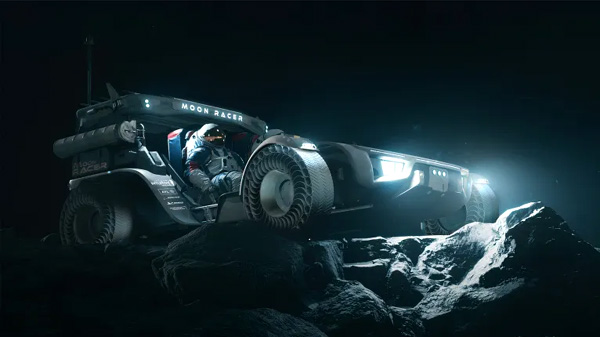
An artist's concept of Intuitive Machines' Moon RACER rover.
Intuitive Machines

An artist's concept of Venturi Astrolab's FLEX rover.
Astrolab

Tuesday, March 19, 2024

A Rover Will Soon Be Selected for Future Astronauts to Ride on the Moon...

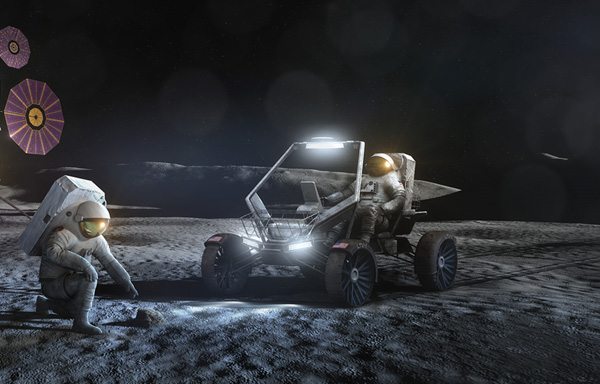
An artist's concept of two astronauts riding in a Lunar Terrain Vehicle across the Moon's surface.
NASA

NASA to Select Lunar Terrain Vehicle for Artemis Missions (News Release)

NASA will host a news conference to announce the company, or companies, selected to move forward in developing the LTV (Lunar Terrain Vehicle), which will help Artemis astronauts explore more of the Moon’s surface on future missions. The televised event will take place at 4 p.m. EDT (3 p.m. CDT) on Wednesday, April 3, at the agency’s Johnson Space Center in Houston.

The news conference will air live on NASA+, NASA Television, the NASA app and the agency’s website. Learn how to stream NASA TV through a variety of platforms including social media.

Event participants will include:

- Vanessa Wyche, director, NASA Johnson

- Jacob Bleacher, chief exploration scientist, NASA Headquarters

- Lara Kearney, manager, Extravehicular Activity and Human Surface Mobility Program, NASA Johnson

International media interested in participating in person must request credentials by 6 p.m. on Thursday, March 21. U.S. media interested in attending in person must request credentials by 6 p.m. on Wednesday, March 27.

All media interested in participating by phone must request details by 2 p.m. on April 3. To participate, contact the NASA Johnson newsroom at 281-483-5111 or jsccommu@mail.nasa.gov.

NASA’s media accreditation policy is online.

Through Artemis, NASA will land the first woman, first person of color and its first international partner astronaut on the surface of the Moon to explore for scientific discovery, economic benefits and to build the foundation for crewed missions to Mars.

Source: NASA.Gov

****

Another art concept of two astronauts riding in a Lunar Terrain Vehicle across the Moon's surface.
NASA

Friday, May 26, 2023

NASA Sets Its Sights on a Next-Generation Moon Rover for Astronauts...

An artist's concept of two astronauts riding in a Lunar Terrain Vehicle across the Moon's surface.
NASA

NASA Pursues Lunar Terrain Vehicle Services for Artemis Mission (Press Release)

NASA is seeking industry proposals for a next-generation LTV (Lunar Terrain Vehicle) that will allow astronauts to go farther and conduct more science than ever before as they explore the south polar region of the Moon during Artemis missions.

Artemis astronauts will drive to explore and sample more of the lunar surface using the LTV than they could on foot. NASA will contract LTV as a service from industry rather than owning the rover.

Contracting services from industry partners allows NASA to leverage commercial innovation and provide the best value to U.S. taxpayers while achieving its human spaceflight scientific and exploration goals.

“We want to leverage industry’s knowledge and innovation, combined with NASA’s history of successfully operating rovers, to make the best possible surface rover for our astronaut crews and scientific researchers,” said Lara Kearney, manager of NASA’s Extravehicular Activity and Human Surface Mobility program at the agency’s Johnson Space Center in Houston.

The LTV will function like a cross between an Apollo-style lunar rover and a Mars-style uncrewed rover. It will support phases driven by astronauts and phases as an uncrewed mobile science exploration platform, similar to NASA’s Curiosity and Perseverance Mars rovers.

This will enable continued performance of science even when crews are not present on the lunar surface. Artemis astronauts will use the LTV to traverse the lunar surface and transport scientific equipment, extending the distances they can cover on each moonwalk.

Under the Lunar Terrain Vehicle Services request for proposals, NASA has provided requirements for companies interested in developing and demonstrating the LTV, including an approach that encourages companies to produce an innovative rover for use by NASA and other commercial customers for multiple years.

Engineers will be able to operate the LTV remotely to transport cargo and scientific payloads between crewed landing sites, enabling additional science returns, resource prospecting and lunar exploration. This will expand scientific research opportunities on the Moon during uncrewed operations, allow scientists to investigate future surface mission locations, and inform research goals and objectives for each site.

To handle the unique environment near the lunar South Pole, which includes permanently-shadowed regions and extended periods without sunlight, the LTV will need to incorporate several systems to support both crewed and uncrewed operations. Some of the more critical systems include advanced power management, semi-autonomous driving, state-of-the-art communication and navigation systems, and protection from the extreme environment.

As part of the proposals, companies are required to provide end-to-end services, from development and delivery to the lunar surface, to execution of operations. Each rover must be able to carry two suited astronauts, accommodate a robotic arm or mechanism to support science exploration, and survive the extreme temperatures at the lunar South Pole.

The company will be asked to successfully demonstrate the LTV in the lunar environment prior to using it in a crewed capacity.

NASA intends to use the LTV for crewed operations beginning with Artemis V in 2029. Prior to crew arrival, the rover will be used for uncrewed and commercial activities once it lands on the lunar surface.

Proposals for the LTV services contract are due on July 10, 2023, with the contract award scheduled for November 2023. This request for proposals incorporates feedback from industry through a draft request for proposals and a previous request for information.

Through Artemis, NASA will send astronauts – including the first woman and first person of color – to explore the Moon for scientific discovery, economic benefits and to build the foundation for crewed missions to Mars. Together, NASA’s Space Launch System rocket, Orion spacecraft, Gateway lunar orbital outpost, advanced spacesuits and rovers, and human landing systems are the agency’s foundation for deep space exploration.

Source: NASA.Gov

Wednesday, November 2, 2022

Conceptual Planning Continues for the Lunar Rover That Will Be Utilized in the Artemis Program...

An artist's concept of two astronauts exploring the Moon's surface using a Lunar Terrain Vehicle.
NASA

NASA Makes Progress with New Lunar Terrain Vehicle Moon Rover Services (News Release)

As astronauts explore the South Pole region of the Moon during Artemis missions, they will be able to go farther and conduct more science than ever before thanks to a new Lunar Terrain Vehicle (LTV). Instead of owning the vehicle, NASA plans to contract it as a service from industry.

The draft request for proposals for the LTV Services (LTVS) contract is now ready for industry to review, and NASA will accept feedback until December 1. The draft outlines NASA’s expectation for use of the LTV on the lunar surface in the 2028 timeframe. After taking industry feedback into account, NASA plans to issue a final request for proposals by early 2023.

“This draft is one of the first important steps in this exciting project that will allow astronauts to explore farther on the Moon than ever before,” says Lara Kearney, manager of the Extravehicular Activity (EVA) and Human Surface Mobility (HSM) Program at NASA’s Johnson Space Center in Houston. “Gaining industry feedback is crucial as we move forward in issuing a final request for proposal.”

This iconic style of unpressurized, human-class rover—which debuted during the Apollo missions—is a cornerstone in NASA’s plans to develop a long-term presence on the lunar surface. While those human-driven vehicles expanded lunar exploration capabilities significantly, the new Artemis LTV will feature multiple upgrades and advanced technology.

Because Artemis missions will be targeting the lunar South Pole area, the new LTV must be able to withstand and operate in cold and unique lighting conditions. The Artemis LTV is also expected to be able to cover a range of hundreds of miles per year, enabling access to diverse locations that will facilitate science discoveries, resource prospecting and exploration. It will also be capable of remote operation and will be available for other commercial uses when not carrying out NASA research and operations.

Contracting services from industry partners allows NASA to leverage commercial innovation and provide the best value to U.S. taxpayers while achieving its human spaceflight and exploration goals. The contract will support continued science and long-term human exploration at the Moon under Artemis, which will land the first woman and first person of color on the lunar surface.

Source: NASA.Gov