Showing posts with label Artemis 5. Show all posts

Wednesday, August 5, 2026

The Latest Update on the Fifth Space Launch System...

At NASA's Michoud Assembly Facility in New Orleans, Louisiana, the engine section barrel for Artemis 5's Space Launch System rocket stage is about to be loaded into the vertical assembly center...on August 5, 2026.
Morgan Parker

Artemis V Engine Section Barrel Enters Vertical Assembly Center (Photo Release)

Teams at Michoud Assembly Facility in New Orleans load the 25-foot-long engine section barrel into the vertical assembly center on August 5, 2026. The engine section will be used on the SLS (Space Launch System) rocket’s core stage for the agency’s Artemis V mission. On the vertical assembly center tooling, teams will mate the flight hardware to a ring, which will serve as an attachment point for the liquid hydrogen tank later in the production process.

The engine section is one of five major elements that make up the 212-foot-tall SLS rocket stage; and houses various avionic systems, the engine thrust structure, and four RS-25 engines. The core stage produces more than two million pounds of thrust to help launch NASA’s Orion spacecraft, astronauts and supplies beyond Earth’s orbit and to the lunar surface for Artemis.

Source: NASA.Gov

****

At NASA's Michoud Assembly Facility in New Orleans, Louisiana, the engine section barrel for Artemis 5's Space Launch System rocket stage is loaded into the vertical assembly center...on August 5, 2026.
Morgan Parker

Tuesday, March 24, 2026

Artemis Update: The Lunar Gateway Has Been Shelved in Favor of a Moon Base, While a Nuclear-powered Mission Heads to Mars in 2028...

An artist’s concept of Phase 3 of NASA’s Artemis Moon Base.
NASA

NASA Unveils Initiatives to Achieve America’s National Space Policy (News Release)

As part of its Ignition event on Tuesday, NASA announced a series of transformative agencywide initiatives designed to achieve the president's National Space Policy and advance American leadership in space. These actions reflect the urgency of the moment, but also the tremendous opportunity ahead for world-changing science and discovery.

“NASA is committed to achieving the near‑impossible once again, to build a Moon base, establish an enduring presence, and do the other things needed to ensure American leadership in space. This is why it is essential we leave an event like Ignition with complete alignment on the national imperative that is our collective mission. The clock is running in this great‑power competition, and success or failure will be measured in months, not years,” said NASA Administrator Jared Isaacman.

“If we concentrate NASA’s extraordinary resources on the objectives of the National Space Policy, clear away needless obstacles that impede progress, and unleash the workforce and industrial might of our nation and partners, then returning to the Moon and building a base will seem pale in comparison to what we will be capable of accomplishing in the years ahead.”

NASA Associate Administrator Amit Kshatriya said, “Today we are aligning NASA around the mission. On the Moon, we are shifting to a focused, phased architecture that builds capability landing by landing, incrementally, and in alignment with our industrial and international partners. In low-Earth orbit (LEO), we are recognizing where the market is and where it isn’t, recognizing the incredible value of the International Space Station, and building a transition that builds a competitive commercial ecosystem rather than forcing a single outcome the market cannot support.

"In our science missions, we are opening the lunar surface to researchers and students nationwide, and with Space Reactor‑1 Freedom, we are finally putting nuclear propulsion on a trajectory out of the laboratory and into deep space. And this is all possible by investing in our people, bringing critical skills back into the agency, putting our teams where the machines are being built, and creating real pathways for the next generation of NASA leaders. Our workforce is the jewel of NASA, and from their leaders, they need clear mission goals, the tools to execute, and to get out of their way. This is what Ignition is about.”

Going back to the Moon

The announcements build on recent updates to the Artemis program, including standardizing the SLS (Space Launch System) rocket configuration, adding an additional mission in 2027, and undertaking at least one surface landing every year thereafter. Under this previously updated architecture, Artemis III – scheduled for 2027 – will focus on testing integrated systems and operational capabilities in Earth orbit in advance of the Artemis IV lunar landing.

Looking beyond Artemis V, NASA announced on March 24 that it will begin to incorporate more commercially-procured and reusable hardware to undertake frequent and affordable crewed missions to the lunar surface, initially targeting landings every six months, with the potential to increase cadence as capabilities mature.

To achieve an enduring human presence on the Moon, NASA also announced a phased approach to building a lunar base. As part of this strategy, the agency intends to pause Gateway in its current form and shift focus to infrastructure that enables sustained surface operations. Despite challenges with some existing hardware, the agency will repurpose applicable equipment and leverage international partner commitments to support these objectives.

In the coming days, NASA will release Requests for Information (RFIs) and draft Requests for Proposals (RFPs) to ensure continued progress in meeting national objectives.

Building the Moon Base

NASA’s plan for establishing a sustained lunar presence will roll out in three deliberate phases.

-- Phase One: Build, Test, Learn
NASA shifts from bespoke, infrequent missions to a repeatable, modular approach. Through CLPS (Commercial Lunar Payload Services) deliveries and the LTV (Lunar Terrain Vehicle) program, the agency will increase the tempo of lunar activity, sending rovers, instruments and technology demonstrations that advance mobility, power generation (including radioisotope heater units and radioisotope thermoelectric generators), communications, navigation, surface operations, and a wide range of scientific investigations.

-- Phase Two: Establish Early Infrastructure
With lessons from early missions in hand, NASA moves toward semi‑habitable infrastructure and regular logistics. This phase supports recurring astronaut operations on the surface and incorporates major international contributions, including JAXA’s (Japan Aerospace Exploration Agency) pressurized rover, and potentially other partner scientific payloads, rovers, and infrastructure/transportation capabilities.

--Phase Three: Enable Long‑Duration Human Presence
As cargo‑capable Human Landing Systems (HLS) come online, NASA will deliver heavier infrastructure needed for a continuous human foothold on the Moon, marking the transition from periodic expeditions to a permanent lunar base. This will include ASI’s (Italian Space Agency) Multi-purpose Habitats (MPH), CSA’s (Canadian Space Agency) Lunar Utility Vehicle, and opportunities for additional contributions in habitation, surface mobility and logistics.

Ensuring American presence in low-Earth orbit

While building a sustainable lunar architecture, NASA is also reaffirming its commitment to low-Earth orbit. For more than two decades, the International Space Station has served as a world‑class orbital laboratory, enabling more than 4,000 research investigations, supporting more than 5,000 researchers, and hosting visitors from 26 countries. The space station required 37 shuttle flights, 160 spacewalks, two decades, and more than $100 billion to design, develop and build.

The orbital laboratory cannot operate indefinitely. The transition to commercial stations must be thoughtful, deliberate and structured to support long‑term industry success.

NASA is introducing and seeking industry feedback on an additional LEO strategy that preserves all current pathways while adding a phased, International Space Station‑anchored approach to avoid any gap in U.S. human presence and mature a robust commercial ecosystem. Under this alternative approach, NASA would procure a government‑owned Core Module that attaches to the space station, followed by commercial modules that are validated using International Space Station capabilities and later detach into free flight. After maturing technical and operational capabilities and market demand is realized, the stations would detach and NASA would be one of many customers purchasing commercial services.

To stimulate the orbital economy, NASA would expand industry opportunities, including private astronaut missions, commander seat sales, joint missions, multiple module competitions, and prize‑based awards.

An industry RFI opens on Wednesday, March 25, to inform partnership structures, financing, and risk mitigation.

Advancing world-changing discovery with current, developing science missions

In a Golden Age of exploration and discovery, NASA takes full advantage of every opportunity to get science into space. The James Webb Space Telescope continues to transform our understanding of the early Universe, Parker Solar Probe has flown through the atmosphere of the Sun, NASA has shown that it can defend the planet by deflecting asteroids, and Earth science data is used extensively by American companies, U.S. agriculture, and disaster relief. On the International Space Station, NASA is conducting groundbreaking experiments in quantum science.

Future opportunities will advance U.S. leadership in space science. The Nancy Grace Roman Space Telescope, launching as early as this fall, will advance our understanding of dark energy, and has created a new standard for the management of large science missions. Dragonfly will launch a nuclear-powered octocopter in 2028, arriving at Saturn’s moon Titan in 2034 to explore its complex, organic-rich environment.

In 2028, NASA will launch and deliver ESA’s (European Space Agency) Rosalind Franklin Rover to Mars, with NASA’s contributed mass spectrometer for the Mars Organic Molecule Analyzer (MOMA) instrument, which may result in the most advanced detection and analysis of organic matter ever conducted on Mars. A new Earth science mission launching next year will measure for the first time the evolution of the dynamics within convective storms to improve the prediction of extreme weather events up to six hours before the storm occurs.

The agency detailed how advancements in lunar science will also be afforded by the build out of the Moon Base and underpin future Moon and Mars exploration. With an accelerated CLPS cadence, targeting up to 30 robotic landings starting in 2027, NASA is expediting delivery of science and technology to the lunar surface. There will be many opportunities for payload delivery including rovers, hoppers and drones with contributions welcomed from industry, academia and international partners.

Near-term payloads include the VIPER rover and the LuSEE‑Night mission. An RFI will be released on March 24 that calls for payloads capable of supporting NASA’s science and technology goals for additional 2027 and 2028 flights. It will enable students and researchers across the country to work on scientific instruments for use on the surface of the Moon in the years ahead.

This RFI will also solicit payloads incorporated on future missions to Mars including the Mars Telecom Network (MTN) and a nuclear technology demonstration mission.

The agency intends to partner with philanthropic and privately-funded research organizations with shared objectives in space science.

Other RFIs released on March 24 will strengthen “Science as a Service” partnerships and commercial capabilities, allowing NASA to streamline legacy operations and focus investment on the transformational missions that only the agency can lead.

Finally, NASA will unveil a previously unseen pair of images from the James Webb and Hubble Space Telescopes. These images show the planet Saturn in unprecedented detail in both infrared and visible wavelengths.

America underway on nuclear power in space

In addition to these scientific missions, after decades of study and in response to the National Space Policy, NASA announced a major step forward in bringing nuclear power and propulsion from the lab to space.

NASA will launch the Space Reactor‑1 Freedom, the first nuclear-powered interplanetary spacecraft, to Mars before the end of 2028, demonstrating advanced nuclear electric propulsion in deep space. Nuclear electric propulsion provides an extraordinary capability for efficient mass transport in deep space and enables high power missions beyond Jupiter where solar arrays are not effective.

When SR-1 Freedom reaches Mars, it will deploy the Skyfall payload of Ingenuity‑class helicopters to continue exploring the Red Planet. SR-1 Freedom will establish flight heritage nuclear hardware, set regulatory and launch precedent, and activate the industrial base for future fission power systems across propulsion, surface, and long‑duration missions. NASA and its U.S. Department of Energy partner will unlock the capabilities required for sustained exploration beyond the Moon and eventual journeys to Mars and the outer Solar System.

None of these endeavors can succeed without the NASA workforce. As previously announced, the agency is rebuilding its core competencies, converting thousands of contractor positions to civil service, and restoring the engineering, technical and operational strengths expected of the world’s premier space organization.

NASA is expanding opportunities for interns and early‑career professionals and, in partnership with the U.S. Office of Personnel Management and NASA Force, is creating new pathways for experienced industry talent to serve through term‑based appointments. The agency is also seeking to open opportunities for NASA employees to gain valuable experience working within the most technologically-advanced space industry in history.

The changes announced on March 24 will be implemented during the coming months, with teams agencywide ensuring a smooth transition while advancing key programs and partnerships.

NASA will embed subject‑matter experts across the supply chain – at every major vendor, subcontractor and critical‑path component – to challenge assumptions, solve problems, accelerate production, and help ensure that the right outcomes are achieved.

Through these reforms, NASA is strengthening its ability to deliver on the president’s National Space Policy and ensure continued American superiority in space.

Source: NASA.Gov

****

A screenshot from an animated video depicting the SR‑1 Freedom spacecraft approaching Mars.
NASA

New images of Saturn that were taken by NASA's James Webb and Hubble Space Telescopes, respectively, in 2024.
NASA, ESA, CSA, STScI, Amy Simon (NASA-GSFC), Michael Wong (UC Berkeley); Image Processing: Joseph DePasquale (STScI)

An infographic showing the Core Module that would be attached to the International Space Station to pave the way for future commercial space stations in low-Earth orbit.

The Interstellar Probe project, which was studied by the Johns Hopkins University Applied Physics Laboratory a few years ago, may be one of many potential science missions pursued under the new National Space Policy over the next decade.

Monday, March 9, 2026

The Latest Update on the Next Flight of SLS, as Well as the Moon Rockets for Artemis 4 and Beyond...

The Mobile Launcher carrying NASA's Artemis 2 rocket slowly exits the Vehicle Assembly Building to begin rollout to Launch Complex 39B at Kennedy Space Center in Florida...on January 17, 2026.
NASA / Reid Wiseman

NASA to Share Artemis II Flight Readiness Review Update (News Release)

NASA will host a news conference at 3 p.m. EDT on Thursday, March 12, to highlight progress towards the Artemis II crewed mission around the Moon. The media briefing will take place from the agency’s Kennedy Space Center in Florida after the conclusion of an Artemis II Flight Readiness Review.

The news conference will stream live on the agency’s YouTube channel. Learn how to stream NASA content through a variety of online platforms, including social media, as available.

NASA participants include:

-- Lori Glaze, acting associate administrator, Exploration Systems Development Mission Directorate
-- John Honeycutt, chair, Artemis II Mission Management Team
-- Shawn Quinn, manager, Exploration Ground Systems Program
-- Norm Knight, director, Flight Operations Directorate

This event is open in-person for media previously credentialed at NASA Kennedy for the Artemis II launch. To participate virtually, media must RSVP for call details no later than 30 minutes prior to the start of the event to the newsroom at NASA Kennedy: ksc-newsroom@mail.nasa.gov. NASA’s media credentialing policy is online.

NASA is continuing work on the SLS (Space Launch System) rocket and Orion spacecraft in NASA Kennedy’s Vehicle Assembly Building before a second rollout to the launch pad later this month ahead of a potential launch in April.

As part of a Golden Age of innovation and exploration, NASA will send Artemis astronauts on increasingly difficult missions to explore more of the Moon for scientific discovery, economic benefits, and to build on our foundation for the first crewed missions to Mars.

Source: NASA.Gov

****


Friday, February 27, 2026

America's Plan to Return Humans to the Moon Has Changed...

An illustration showing the updated lunar exploration architecture for NASA's Artemis program.
NASA

NASA Adds Mission to Artemis Lunar Program, Updates Architecture (News Release)

As part of a Golden Age of exploration and discovery, NASA announced on Friday that the agency is increasing its cadence of missions under the Artemis program to achieve the national objective of returning American astronauts to the Moon and establishing an enduring presence. This includes standardizing vehicle configuration, adding an additional mission in 2027, and undertaking at least one surface landing every year thereafter.

As teams prepare to launch Artemis II in the weeks ahead, the Artemis III mission, now in 2027, will be designed to test out systems and operational capabilities in low-Earth orbit to prepare for an Artemis IV landing in 2028. This new mission will endeavor to include a rendezvous and docking with one or both commercial landers from SpaceX and Blue Origin, in-space tests of the docked vehicles, integrated checkout of life support, communications and propulsion systems, as well as tests of the new Extravehicular Activity (xEVA) suits. NASA will further define this test flight after completing detailed reviews between NASA and our industry partners.

The agency will share the specific objectives for the updated Artemis III mission in the near future.

NASA’s recently announced workforce directive is a key factor in enabling this acceleration. NASA will rebuild core competencies in the civil servant workforce including more in-house and side-by-side development work with our Artemis partners, enabling a safer, more reliable, and faster launch cadence.

“NASA must standardize its approach, increase flight rate safely, and execute on the President’s national space policy. With credible competition from our greatest geopolitical adversary increasing by the day, we need to move faster, eliminate delays, and achieve our objectives,” said NASA Administrator Jared Isaacman. “Standardizing vehicle configuration, increasing flight rate and progressing through objectives in a logical, phased approach, is how we achieved the near-impossible in 1969 and it is how we will do it again.”

“After successful completion of the Artemis I flight test, the upcoming Artemis II flight test, and the new, more robust test approach to Artemis III, it is needlessly complicated to alter the configuration of the SLS and Orion stack to undertake subsequent Artemis missions,” said NASA Associate Administrator Amit Kshatriya. “There is too much learning left on the table and too much development and production risk in front of us. Instead, we want to keep testing like we fly and have flown. We are looking back to the wisdom of the folks that designed Apollo.

"The entire sequence of Artemis flights needs to represent a step-by-step build-up of capability, with each step bringing us closer to our ability to perform the landing missions. Each step needs to be big enough to make progress, but not so big that we take unnecessary risk given previous learnings. Therefore, we want to fly the landing missions in as close to the same Earth ascent configuration as possible – this means using an upper stage and pad systems in as close to the ‘Block 1’ configuration as possible.

"We will work with our partners that have been developing the evolved block configuration of these systems to take proper actions to align their efforts towards this goal and announce the details of those changes once they are finalized. We will take a similar approach to in-space, landing and surface EVA operations as well, as we evolve the mission sequence in the spirit of the Apollo mindset, which was obsessed with system reliability and crew safety as the keys to mission success.”

“Boeing is a proud partner to the Artemis mission and our team is honored to contribute to NASA’s vision for American space leadership,” said Steve Parker, Boeing Defense, Space & Security president and CEO. “The SLS core stage remains the world’s most powerful rocket stage, and the only one that can carry American astronauts directly to the Moon and beyond in a single launch. As NASA lays out an accelerated launch schedule, our workforce and supply chain are prepared to meet the increased production needs. With a rocket designed at NASA’s Marshall Space Flight Center in Huntsville, Alabama, built at America’s rocket factory at NASA’s Michoud Assembly Facility in New Orleans, and integrated at NASA’s Kennedy Space Center in Florida, we are ready to meet the increased demand.”

The announcement came during a news conference at NASA Kennedy where leaders also discussed the status of the Artemis II mission. NASA rolled the SLS and Orion spacecraft to the Vehicle Assembly Building (VAB) on February 25 for repairs ahead of the next launch opportunities for the test flight in April.

Once the Artemis II hardware was back in the VAB, teams immediately began work on the helium issue discovered on the Interim Cryogenic Propulsion Stage and prepared for several actions including replacing batteries in the flight termination system, end-to-end testing for range safety requirements, and more.

“I’m grateful to Administrator Isaacman for taking this bold step and moving quickly to assure we have the support and resources needed to launch Artemis astronauts to the Moon every year,” said Lori Glaze, acting associate administrator for Exploration Systems Development Mission Directorate at NASA Headquarters in Washington. “Our team is up to the challenge of a successful Artemis II mission, and soon thereafter, enabling a more frequent cadence of Moon missions.”

Source: NASA.Gov

****

NASA's Artemis 2 rocket heads back to Kennedy Space Center's Vehicle Assembly Building in Florida for upcoming repairs to its Interim Cryogenic Propulsion Stage...on February 25, 2026.
NASA / Cory S Huston

Wednesday, November 12, 2025

The Latest Update on the Fifth Planned SLS Flight...

A next-generation RS-25 engine for Artemis 5 is tested on the Fred Haise Test Stand at NASA's Stennis Space Center in Bay St. Louis, Mississippi...on November 12, 2025.

L3Harris Successfully Tests Second RS-25 Engine for Artemis V (Press Release)

STENNIS SPACE CENTER, Miss. — NASA and L3Harris Technologies (NYSE: LHX) have successfully test-fired the second RS-25 engine that will support the core stage of the Space Launch System (SLS) rocket for NASA’s Artemis V mission.

L3Harris’ RS-25 rocket engines are critical to the Artemis program’s success, with four RS-25s powering every SLS rocket, enabling the U.S. to help establish a sustainable presence on the Moon and prepare for future missions to Mars.

“As we approach America’s 250th anniversary next year, it’s fitting that we’re advancing the Artemis program that embodies the pioneering spirit of our nation,” said Kristin Houston, President, Space Propulsion and Power Systems, Aerojet Rocketdyne, L3Harris. “By leveraging advanced manufacturing techniques, we’re delivering engines that are more cost effective while maintaining the power and reliability needed to propel Artemis missions to the Moon and beyond.”

NASA conducted the test at its Stennis Space Center, which demonstrated the engine’s performance and reliability during a 500-second firing that reached 111% of its rated power level. This test marked the second flight-ready RS-25 engine produced using modern manufacturing techniques, including 3D printing, which reduce production costs by 30% compared to earlier RS-25 engines that powered the space shuttle.

The first four Artemis missions use upgraded RS-25 engines originally designed for the space shuttle program, while the fifth mission will debut the newly-produced RS-25 engines.

Source: L3Harris Technologies

****

A next-generation RS-25 engine for Artemis 5 is tested on the Fred Haise Test Stand at NASA's Stennis Space Center in Bay St. Louis, Mississippi...on November 12, 2025.

A next-generation RS-25 engine for Artemis 5 is tested on the Fred Haise Test Stand at NASA's Stennis Space Center in Bay St. Louis, Mississippi...on November 12, 2025.

Monday, June 23, 2025

The Latest Update on the Planned Artemis 5 Mission...

A next-generation RS-25 engine is tested on the Fred Haise Test Stand at NASA's Stennis Space Center in Bay St. Louis, Mississippi...on June 20, 2025.
NASA

NASA Tests New RS-25 Engine (News Release)

NASA tested RS-25 engine No. 20001 on June 20, at the Fred Haise Test Stand at NASA’s Stennis Space Center at Bay St. Louis, Mississippi. Test teams fired the engine for almost eight-and-a-half minutes (500 seconds), the same amount of time that RS-25 engines fire during a launch of an SLS (Space Launch System) rocket on Artemis missions to the Moon. The Artemis campaign will explore the Moon for scientific discovery, economic benefits, and to build the foundation for the first crewed missions to Mars – for the benefit of all.

Four RS-25 engines, built by contractor L3Harris Technologies (formerly Aerojet Rocketdyne), help power each SLS launch, producing up to 2 million pounds of combined thrust. During the test, operators also fired engine No. 20001 up to the 111% power level, the same amount of thrust needed to launch an SLS rocket, carrying the Orion spacecraft, to orbit. The full-duration “hot fire” was the first test since NASA completed certification testing for new production RS-25 engines in 2024.

All RS-25 engines are tested and proven flightworthy at NASA Stennis. The test was conducted by a team of operators from NASA, L3Harris and Syncom Space Services, prime contractor for site facilities and operations.

Source: NASA.Gov

Friday, February 28, 2025

The Latest Update on Gateway...

The Power and Propulsion Element for NASA's Gateway lunar space station undergoes assembly and installations at Maxar Space Systems in Palo Alto, California.
Maxar Space Systems

NASA Prepares Gateway Lunar Space Station for Journey to Moon (News Release - February 25)

Assembly is underway for Gateway's Power and Propulsion Element, the module that will power the lunar space station's journey to and around the Moon as part of NASA’s Artemis campaign.

NASA’s Artemis IV astronauts will be the first to inhabit the Gateway lunar space station, opening the door to greater exploration of the Moon and paving the way to Mars. Gateway’s Power and Propulsion Element, which will make the station the most powerful solar electric spacecraft ever flown, takes shape at Maxar Space Systems. In lunar orbit, Gateway will allow NASA to conduct unique science and exploration while preparing astronauts to go to the Red Planet.

Technicians install key hardware on the element’s Propulsion Bus Module following installation of both electric propulsion and chemical propulsion control modules. The image above highlights a propellant tank exposed on the right, positioned within the central cylinder of the element.

The Power and Propulsion Element will launch with Gateway’s HALO (Habitation and Logistics Outpost) ahead of NASA’s Artemis IV mission. During Artemis IV, V and VI, international crews of astronauts will assemble the lunar space station around the Moon and embark on expeditions to the Moon’s South Pole region.

The Power and Propulsion Element is managed out of NASA’s Glenn Research Center in Cleveland and built by Maxar Space Systems in Palo Alto, California.

Gateway is an international collaboration to establish humanity’s first lunar space station as a central component of the Artemis architecture designed to return humans to the Moon for scientific discovery and chart a path for the first human missions to Mars.

Source: NASA.Gov

****

The Power and Propulsion Element for NASA's Gateway lunar space station undergoes assembly and installations at Maxar Space Systems in Palo Alto, California.
Maxar Space Systems

An artist's concept of NASA's Gateway lunar space station cruising through space.
NASA / Maxar Space Systems

Thursday, February 20, 2025

Testing Will Soon Begin on a Newly-built Engine for the Space Launch System...

The first new production RS-25 engine is installed on the Fred Haise Test Stand at NASA's Stennis Space Center near Bay St. Louis, Mississippi...on February 18, 2025.
NASA / Danny Nowlin

NASA Stennis Teams Install New Production RS-25 Engine for Upcoming Hot Fire (News Release)

NASA marked a key milestone on February 18 with installation of RS-25 engine No. E20001, the first new production engine to help power the SLS (Space Launch System) rocket on future Artemis missions to the Moon.

The engine, built by lead SLS engines contractor L3Harris (formerly Aerojet Rocketdyne), was installed on the Fred Haise Test Stand in preparation for acceptance testing next month. It represents the first of 24 new flight engines being built for missions, beginning with Artemis V.

The NASA Stennis test team will conduct a full-duration, 500-second hot fire, providing critical performance data to certify the engine for use on a future mission. During missions to the Moon, RS-25 engines fire for about 500 seconds and up to the 111% power level to help launch SLS, with the Orion spacecraft, into orbit.

The engine arrived at the test stand from the L3Harris Engine Assembly Facility on the engine transport trailer before being lifted onto the vertical engine installer (VEI) on the west side deck. After rolling the engine into the stand, the team used the VEI to raise and secure it in place.

The upcoming acceptance test follows two certification test series that helped verify the new engine production process and components meet all performance requirements. Four RS-25 engines help launch SLS, producing up to 2 million pounds of combined thrust.

All RS-25 engines for Artemis missions are tested and proven flightworthy at NASA Stennis prior to use. RS-25 tests are conducted by a team of operators from NASA, L3Harris, and Syncom Space Services - prime contractor for site facilities and operations.

Source: NASA.Gov

****

The first new production RS-25 engine is transported to the Fred Haise Test Stand at NASA's Stennis Space Center near Bay St. Louis, Mississippi...on February 18, 2025.
NASA / Danny Nowlin

The first new production RS-25 engine is hoisted into the air to be installed on the Fred Haise Test Stand at NASA's Stennis Space Center near Bay St. Louis, Mississippi...on February 18, 2025.
NASA / Danny Nowlin

The first new production RS-25 engine is installed on the Fred Haise Test Stand at NASA's Stennis Space Center near Bay St. Louis, Mississippi...on February 18, 2025.
NASA / Danny Nowlin

Friday, December 20, 2024

The Latest Update on the Lunar Terrain Vehicle...

The Lunar Terrain Vehicle prototypes provided by Venturi Astrolab, Intuitive Machines and Lunar Outpost on display at NASA's Johnson Space Center in Houston, Texas.
NASA / Bill Stafford

New Commercial Artemis Moon Rovers Undergo Testing at NASA (News Release - December 18)

Through NASA’s Artemis campaign, astronauts will land on the lunar surface and use a new generation of spacesuits and rovers as they live, work and conduct science in the Moon’s South Pole region, exploring more of the lunar surface than ever before. Recently, the agency completed the first round of testing on three commercially owned and developed LTVs (Lunar Terrain Vehicle) from Intuitive Machines, Lunar Outpost and Venturi Astrolab at NASA’s Johnson Space Center in Houston.

As part of an ongoing year-long feasibility study, each company delivered a static mockup of their vehicle to Johnson at the end of September, initiated rover testing in October and completed the first round of testing in December inside the Active Response Gravity Offload System (ARGOS) test facility. Lunar surface gravity is one-sixth of what we experience here on Earth, so to mimic this, ARGOS offers an analog environment that can offload pressurized suited subjects for various reduced gravity simulations.

NASA’s engineering teams conducted tests where suited NASA astronauts and engineers performed tasks, maneuvers and emergency drills on each rover. With astronauts acting as the test subjects, these human-in-the-loop tests are invaluable as crewmembers provide critical feedback on each rover’s design functionality, evaluate display interfaces and controls, and help identify potential safety concerns or design issues. This feedback is shared directly with each commercial provider, to incorporate changes based on lessons learned as they evolve their rover design.

“We are excited to have mockups from all three LTV commercial providers here at Johnson Space Center,” said Steve Munday, LTV project manager. “This is the first major test milestone within the Lunar Terrain Vehicle Services contract and to have actual rovers delivered only four months after these companies were awarded is remarkable.”

Testing consisted of NASA astronauts and engineers taking turns wearing both NASA’s Exploration Extravehicular Mobility Unit planetary prototype spacesuit as well as Axiom Space’s Axiom Extravehicular Mobility Unit lunar spacesuit. The test teams performed evaluations to understand the interactions between the crew, the spacesuits and the LTV mockups.

While wearing NASA’s prototype spacesuit, crew members were suspended from ARGOS – allowing teams to mimic the one-sixth gravitational field of the lunar surface. This allowed the crewmembers to conduct tasks on the outside of each rover, such as gathering or storing lunar geology tools, deploying science payloads, and handling cargo equipment, as if they are walking on the Moon.

While wearing Axiom Space’s pressurized spacesuit, teams evaluated the level of ease or difficulty in mobility that crewmembers experienced when entering and exiting the rovers, the crew compartment and design, and the functionality of interacting with display interfaces and hand controls while wearing thick spacesuit gloves.

As part of testing, teams also conducted emergency drills, where engineers simulated rescuing an incapacitated crew member. As part of NASA’s requirements, each rover must have a design in place that enables an astronaut to single-handedly rescue their crewmates in the event of an emergency.

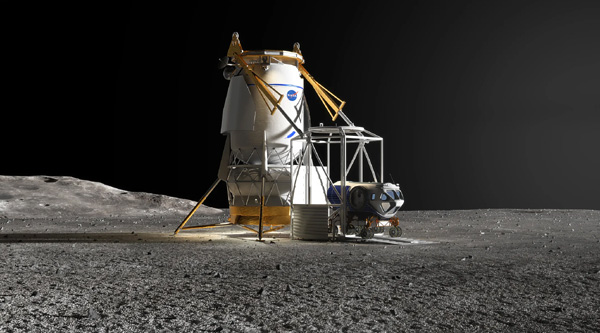
Since NASA selected the companies, Intuitive Machines, Lunar Outpost and Venturi Astrolab have been working to meet NASA’s requirements through the preliminary design review. In 2025, the agency plans to issue a request for task order proposals to any eligible providers for a demonstration mission to continue developing the LTV, deliver it to the surface of the Moon, and validate its performance and safety ahead of Artemis V, when NASA intends to begin using the LTV for crewed operations.

Through Artemis, NASA will send astronauts – including the next Americans and first international partner astronaut – to explore the Moon for scientific discovery, technology evolution, economic benefits and to build the foundation for future crewed missions to Mars.

Source: NASA.Gov

Monday, October 28, 2024

The Latest Update on the First Crewed Mission to the Lunar Surface in Over 50 Years...

An image taken by NASA's Lunar Reconnaissance Orbiter that shows the nine candidates for the Artemis 3 landing site at the Moon's south polar region.
NASA

NASA Provides Update on Artemis III Moon Landing Regions (News Release)

As NASA prepares for the first crewed Moon landing in more than five decades, the agency has identified an updated set of nine potential landing regions near the lunar South Pole for its Artemis III mission. These areas will be further investigated through scientific and engineering study. NASA will continue to survey potential areas for missions following Artemis III, including areas beyond these nine regions.

“Artemis will return humanity to the Moon and visit unexplored areas. NASA’s selection of these regions shows our commitment to landing crew safely near the lunar South Pole, where they will help uncover new scientific discoveries and learn to live on the lunar surface,” said Lakiesha Hawkins, assistant deputy associate administrator, Moon to Mars Program Office.

NASA’s Cross Agency Site Selection Analysis team, working closely with science and industry partners, added, and excluded potential landing regions, which were assessed for their science value and mission availability.

The refined candidate Artemis III lunar landing regions are, in no priority order:

- Peak near Cabeus B
- Haworth
- Malapert Massif
- Mons Mouton Plateau
- Mons Mouton
- Nobile Rim 1
- Nobile Rim 2
- de Gerlache Rim 2
- Slater Plain

These regions contain diverse geological characteristics and offer flexibility for mission availability. The lunar South Pole has never been explored by a crewed mission and contains permanently shadowed areas that can preserve resources, including water.

“The Moon’s South Pole is a completely different environment than where we landed during the Apollo missions,” said Sarah Noble, Artemis lunar science lead at NASA Headquarters in Washington. “It offers access to some of the Moon’s oldest terrain, as well as cold, shadowed regions that may contain water and other compounds. Any of these landing regions will enable us to do amazing science and make new discoveries.”

To select these landing regions, a multidisciplinary team of scientists and engineers analyzed the lunar South Pole region using data from NASA’s Lunar Reconnaissance Orbiter and a vast body of lunar science research. Factors in the selection process included science potential, launch window availability, terrain suitability, communication capabilities with Earth, and lighting conditions. Additionally, the team assessed the combined trajectory capabilities of NASA’s SLS (Space Launch System) rocket, the Orion spacecraft and Starship HLS (Human Landing System) to ensure safe and accessible landing sites.

The Artemis III geology team evaluated the landing regions for their scientific promise. Sites within each of the nine identified regions have the potential to provide key new insights into our understanding of rocky planets, lunar resources and the history of our Solar System.

“Artemis III will be the first time that astronauts will land in the south polar region of the Moon. They will be flying on a new lander into a terrain that is unique from our past Apollo experience,” said Jacob Bleacher, NASA’s chief exploration scientist. “Finding the right locations for this historic moment begins with identifying safe places for this first landing, and then trying to match that with opportunities for science from this new place on the Moon.”

NASA’s site assessment team will engage the lunar science community through conferences and workshops to gather data, build geologic maps and assess the regional geology of eventual landing sites. The team will also continue surveying the entire lunar South Pole region for science value and mission availability for future Artemis missions. This will include planning for expanded science opportunities during Artemis IV, and suitability for the LTV (Lunar Terrain Vehicle) as part of Artemis V.

The agency will select sites within regions for Artemis III after it identifies the mission’s target launch dates, which dictate transfer trajectories, or orbital paths, and surface environment conditions.

Under NASA’s Artemis campaign, the agency will establish the foundation for long-term scientific exploration at the Moon, land the first woman, first person of color and its first international partner astronaut on the lunar surface, and prepare for human expeditions to Mars for the benefit of all.

Source: NASA.Gov

Tuesday, October 15, 2024

The Latest Update on Humanity's First Lunar Space Station...

An artist's concept of the European Space Agency's Lunar View refuelling module on the Gateway space station.
NASA

Gateway Refuelling Module Gets a Boost (News Release - October 14)

ESA and Thales Alenia Space have signed a contract amendment today at the International Astronautical Congress in Milan to extend the Lunar View refuelling module for the lunar Gateway.

The amendment concerns ESA’s Lunar View, a crucial element for the Gateway which will supply the lunar station with xenon and chemical propellants to extend its lifetime, as well as provide a pressurised volume with six large windows, where astronauts will be able to store cargo and supplies and enjoy a 360° view of the outside of Gateway and the Moon.

As a result of NASA’s choice to launch Lunar View aboard the larger and more powerful version of the SLS launcher, ESA and Thales Alenia Space have agreed to significantly increase the size of Lunar View, which will now span 4.6 metres wide and be 6.4 metres long, with a total mass of 10 metric tonnes (versus the initial measurements of 3.4 metres wide, 3 metres long and 6 metric tonnes). This increase will allow:

- more storage space to accommodate up to 1.5 tonnes of cargo at launch, reducing resupply flights to the lunar outpost
- installation of two attachment points on Lunar View to accommodate the Canadian Space Agency’s robotic arm Canadarm3
- housing the avionics suite equipment inside the module for easier maintenance

ESA selected Thales Alenia Space in France as the main contractor to develop the module, which is in the preliminary design phase until next year, after which a detailed design phase will occur followed by manufacturing. Initially, the pressurised structure of the module will be built in Turin by Thales Alenia Space, with contributions also from Thales Alenia Space in the United Kingdom and OHB.

Once built, the module will be tested before delivery to NASA ahead of its launch.

The Artemis V mission will bring Lunar View to the Gateway, propelled towards the station by the Orion spacecraft and its powerhouse, the European Service Module. There, it will meet ESA’s Lunar I-Hab as well as NASA’s power and propulsion module PPE and habitation module HALO, on which ESA’s Lunar Link will be attached.

Source: European Space Agency

Tuesday, July 16, 2024

The Second SLS Booster Is Bound for Florida on the 55th Anniversary of Apollo 11's Launch...

NASA, Boeing and other contractor personnel gather for a group photo in front of the Space Launch System's second core stage booster at the Michoud Assembly Facility in Louisiana...on July 16, 2024.
NASA / Steven Seipel

NASA Ships Moon Rocket Stage Ahead of First Crewed Artemis Flight (News Release)

NASA rolled out the SLS (Space Launch System) rocket’s core stage for the Artemis II test flight from its manufacturing facility in New Orleans on Tuesday for shipment to the agency’s spaceport in Florida. The rollout is key progress on the path to NASA’s first crewed mission to the Moon under the Artemis campaign.

Using highly-specialized transporters, engineers maneuvered the giant core stage from inside NASA’s Michoud Assembly Facility in New Orleans to the agency’s Pegasus barge. The barge will ferry the stage more than 900 miles to NASA’s Kennedy Space Center in Florida, where engineers will prepare it in the Vehicle Assembly Building for attachment to other rocket and Orion spacecraft elements.

“With Artemis, we’ve set our sights on doing something big and incredibly complex that will inspire a new generation, advance our scientific endeavors, and move U.S. competitiveness forward,” said Catherine Koerner, associate administrator for NASA’s Exploration Systems Development Mission Directorate at NASA Headquarters in Washington. “The SLS rocket is a key component of our efforts to develop a long-term presence at the Moon.”

Technicians moved the SLS rocket stage from inside NASA Michoud on the 55th anniversary of the launch of Apollo 11 on July 16, 1969. The move of the rocket stage for Artemis marks the first time since the Apollo Program that a fully-assembled Moon rocket stage for a crewed mission rolled out from NASA Michoud.

The SLS rocket’s core stage is the largest that NASA has ever produced. At 212 feet-tall, it consists of five major elements, including two huge propellant tanks that collectively hold more than 733,000 gallons of super-chilled liquid propellant to feed four RS-25 engines.

During launch and flight, the stage will operate for just over eight minutes, producing more than 2 million pounds of thrust to propel four astronauts inside NASA’s Orion spacecraft toward the Moon.

“The delivery of the SLS core stage for Artemis II to Kennedy Space Center signals a shift from manufacturing to launch readiness as teams continue to make progress on hardware for all major elements for future SLS rockets,” said John Honeycutt, SLS program manager at NASA’s Marshall Space Flight Center in Huntsville, Alabama. “We are motivated by the success of Artemis I and focused on working toward the first crewed flight under Artemis.”

After arrival at NASA Kennedy, the stage will undergo additional outfitting inside the Vehicle Assembly Building. Engineers will then join it with the segments that form the rocket’s twin solid rocket boosters.

Adapters for the Moon rocket that connect it to the Orion spacecraft will be shipped to NASA Kennedy this fall, while the interim cryogenic propulsion stage is already in Florida. Engineers continue to prepare Orion, already at Kennedy, and exploration ground systems for launch and flight.

All major structures for every SLS core stage are fully manufactured at NASA Michoud. Inside the factory, core stages and future Exploration Upper Stages for the next evolution of SLS, called the Block 1B configuration, are currently in various phases of production for Artemis III, IV and V.

Beginning with Artemis III, to better optimize space at Michoud, Boeing, the SLS core stage prime contractor, will use space at NASA Kennedy for final assembly and outfitting activities.

Building, assembling and transporting the SLS core stage is a collaborative effort for NASA, Boeing and lead RS-25 engines contractor Aerojet Rocketdyne, an L3Harris Technologies company. All 10 NASA centers contribute to its development with more than 1,100 companies across the United States contributing to its production.

NASA is working to land the first woman, first person of color and its first international partner astronaut on the Moon under Artemis. SLS is part of NASA’s backbone for deep space exploration, along with the Orion spacecraft, supporting ground systems, advanced spacesuits and rovers, the Gateway in orbit around the Moon, and commercial human landing systems.

SLS is the only rocket that can send Orion, astronauts and supplies to the Moon in a single launch.

****

The Space Launch System's second core stage booster is about to be transported to the Pegasus barge for delivery to NASA's Kennedy Space Center in Florida from the Michoud Assembly Facility in Louisiana...on July 16, 2024.
NASA / Sam Lott

The Space Launch System's second core stage booster is about to be transported to the Pegasus barge for delivery to NASA's Kennedy Space Center in Florida from the Michoud Assembly Facility in Louisiana...on July 16, 2024.
NASA / Sam Lott

Two U.S. Air Force F-15 Eagle fighter jets fly over the Space Launch System's second core stage booster while it is being transported to the Pegasus barge for delivery to NASA's Kennedy Space Center in Florida from the Michoud Assembly Facility in Louisiana...on July 16, 2024.
NASA / Sam Lott

Artemis 2 astronauts Reid Wiseman and Jeremy Hansen pose in front of the Space Launch System booster that will begin their trip to the Moon for next year's mission...on July 16, 2024.
NASA / Sam Lott

The Space Launch System's second core stage booster is transported to the Pegasus barge for delivery to NASA's Kennedy Space Center in Florida from the Michoud Assembly Facility in Louisiana...on July 16, 2024.
NASA / Eric Bordelon & Michael DeMocker

The Space Launch System's second core stage booster is placed inside the Pegasus barge for delivery to NASA's Kennedy Space Center in Florida from the Michoud Assembly Facility in Louisiana...on July 16, 2024.
NASA / Eric Bordelon & Michael DeMocker

The Space Launch System's second core stage booster is placed inside the Pegasus barge for delivery to NASA's Kennedy Space Center in Florida from the Michoud Assembly Facility in Louisiana...on July 16, 2024.
NASA / Evan Deroche

The Space Launch System's second core stage booster is placed inside the Pegasus barge for delivery to NASA's Kennedy Space Center in Florida from the Michoud Assembly Facility in Louisiana...on July 16, 2024.
NASA / Evan Deroche

A Saturn V rocket carrying NASA's Apollo 11 spacecraft launches to the Moon on July 16, 1969.
NASA

Sunday, April 21, 2024

SpaceX and Blue Origin Begin Development on Unmanned Variants of Their Human Landing Systems...

An artist's concept of a cargo variant of SpaceX's Lunar Starship as it deploys pressurized rovers onto the lunar surface.
SpaceX

Work Underway on Large Cargo Landers for NASA’s Artemis Moon Missions (News Release - April 19)

Under NASA’s Artemis campaign, the agency and its partners will send large pieces of equipment to the lunar surface to enable long-term scientific exploration of the Moon for the benefit of all. NASA’s human landing system providers, SpaceX and Blue Origin, are beginning development of lunar landers for large cargo deliveries to support these needs.

NASA has contracted SpaceX and Blue Origin to provide landing systems to take astronauts to the Moon’s surface from lunar orbit, beginning with Artemis III. The agency has asked the two companies to develop cargo versions of their human lunar landers as an option under their existing contracts.

These cargo variants are expected to land approximately 26,000 – 33,000 pounds (12 to 15 metric tons) of payload on the lunar surface and be in service no earlier than the Artemis VII mission.

“It’s essential that NASA has the capability to land not just astronauts, but large pieces of equipment, such as pressurized rovers, on the Moon for maximum return on science and exploration activities,” said Lisa Watson-Morgan, Human Landing System Program Manager at NASA’s Marshall Space Flight Center in Huntsville, Alabama. “Beginning this work now allows SpaceX and Blue Origin to leverage their respective human lander designs to provide cargo variants that NASA will need in the future.”

NASA expects the cargo versions of the companies’ landers to be modified versions of the human landing systems currently being developed for Artemis III, IV and V. Modifications will include adjustments for payload interfaces and deployment mechanisms, and the cargo variants will not have human life-support systems.

This initial work allows the companies to proceed with development for their cargo landers through a preliminary design review, the step that establishes the basis for proceeding with detailed design. SpaceX is conducting its work under the NextSTEP Appendix H contract, and Blue Origin is conducting its work under NextSTEP Appendix P.

NASA officially exercised the options under those contracts in November 2023 to begin work on the large cargo landers.

With Artemis, NASA will explore more of the Moon than ever before, learn how to live and work away from home, and prepare for future human missions to the Red Planet. Artemis requires the best of international space agencies, private industry and academia to establish the infrastructure for long-term scientific research and exploration.

NASA’s SLS (Space Launch System) rocket, exploration ground systems and Orion spacecraft, along with the human landing system, next-generation spacesuits and rovers, and Gateway lunar space station are the agency’s foundation for human exploration of deep space.

Source: NASA.Gov

****

An artist's concept of a cargo variant of Blue Origin's Blue Moon lander as it deploys a pressurized rover onto the lunar surface.
Blue Origin

Thursday, April 4, 2024

The 12th and Final Hot Fire Is Now Complete in the Last Round of Testing for the Next-Generation SLS Engine!

A next-generation RS-25 engine is tested on the Fred Haise Test Stand at NASA's Stennis Space Center in Bay St. Louis, Mississippi...on April 3, 2024.
NASA / Danny Nowlin

NASA Achieves Milestone for Engines to Power Future Artemis Missions (News Release)

NASA achieved a major milestone on April 3 for production of new RS-25 engines to help power its Artemis campaign to the Moon and beyond with completion of a critical engine certification test series at NASA’s Stennis Space Center near Bay St. Louis, Mississippi.

The 12-test series represents a key step for lead engines contractor Aerojet Rocketdyne, an L3Harris Technologies company, to build new RS-25 engines, using modern processes and manufacturing techniques, for NASA’s SLS (Space Launch System) rockets that will power future lunar missions, beginning with Artemis V.

“The conclusion of the certification test series at NASA Stennis is just the beginning for the next generation of RS-25 engines that will help power human spaceflight for Artemis,” said Johnny Heflin, SLS liquid engines manager. “The newly-produced engines on future SLS rockets will maintain the high reliability and safe flight operational legacy the RS-25 is known for while enabling more affordable high-performance engines for the next era of deep space exploration.”

Through Artemis, NASA will establish the foundation for long-term scientific exploration at the Moon; land the first woman, first person of color and first international partner astronaut on the lunar surface; and prepare for human expeditions to Mars for the benefit of all.

Contributing to that effort, the NASA Stennis test team conducted a full-duration, 500-second hot fire to complete the 12-test series on developmental engine E0525, providing critical performance data for the final RS-25 design certification review. The April 3 hot fire completed a test series that began in October 2023.

RS-25 engines are evolved space shuttle main engines, upgraded with new components to produce the additional power needed to help launch NASA’s SLS rocket. The first four Artemis missions are using modified space shuttle main engines also tested at NASA Stennis.

For each Artemis mission, four RS-25 engines, along with a pair of solid rocket boosters, power the SLS rocket; producing more than 8.8 million pounds of total combined thrust at liftoff.

“This was a critical test series, and credit goes to the entire test team for their dedication and unique skills that allowed us to meet the schedule and provide the needed performance data,” said Chip Ellis, project manager for RS-25 testing at NASA Stennis. “The tests conducted at NASA Stennis help ensure the safety of our astronauts and their future mission success. We are proud to be part of the Artemis mission.”

The E0525 developmental engine featured new key components – including a nozzle, hydraulic actuators, flex ducts and turbopumps – that matched design features of those used during an initial certification test series completed at NASA Stennis last summer.

The two certification test series helped verify that the new engine components meet all Artemis flight requirements moving forward. Aerojet Rocketdyne is using techniques such as 3D printing to produce new RS-25 engines more efficiently, while maintaining high performance and reliability.

NASA has awarded the company contracts to provide 24 new engines, supporting SLS launches for Artemis V through Artemis IX.

“Successfully completing this rigorous test series is a testament to the outstanding work done by the team to design, implement and test this upgraded version of the RS-25 that reduces the cost by 30% from the space shuttle program,” said Mike Lauer, RS-25 program director at Aerojet Rocketdyne. “We tested the new RS-25 engines to the extreme limits of operation to ensure the engines can operate at a higher power level needed for SLS and complete the mission with margin.”

All RS-25 engines are tested and proven flightworthy at NASA Stennis prior to use on Artemis missions. RS-25 tests at the center are conducted by a diverse team of operators from NASA, Aerojet Rocketdyne and Syncom Space Services, prime contractor for site facilities and operations.

Source: NASA.Gov

Wednesday, April 3, 2024

Looking Ahead to the Next Lunar Rover for Astronauts...

An artist's concept of Lunar Outpost's Lunar Dawn rover.
Lunar Outpost

NASA Selects Companies to Advance Moon Mobility for Artemis Missions (News Release)

NASA has selected Intuitive Machines, Lunar Outpost and Venturi Astrolab to advance capabilities for a Lunar Terrain Vehicle (LTV) that Artemis astronauts will use to travel around the lunar surface, conducting scientific research during the agency’s Artemis campaign at the Moon and preparing for human missions to Mars.

The awards leverage NASA’s expertise in developing and operating rovers to build commercial capabilities that support scientific discovery and long-term human exploration on the Moon. NASA intends to begin using the LTV for crewed operations during Artemis V.

“We look forward to the development of the Artemis Generation lunar exploration vehicle to help us advance what we learn at the Moon,” said Vanessa Wyche, director of NASA’s Johnson Space Center in Houston. “This vehicle will greatly increase our astronauts’ ability to explore and conduct science on the lunar surface while also serving as a science platform between crewed missions.”

NASA will acquire the LTV as a service from industry. The indefinite-delivery/indefinite-quantity, milestone-based Lunar Terrain Vehicle Services contract with firm-fixed-price task orders has a combined maximum potential value of $4.6 billion for all awards.

Each provider will begin with a feasibility task order, which will be a year-long special study to develop a system that meets NASA’s requirements through the preliminary design maturity project phase. The agency will issue a subsequent request for task order proposal to eligible provider(s) for a demonstration mission to continue developing the LTV, deliver it to the surface of the Moon, and validate its performance and safety ahead of Artemis V.

NASA anticipates making an award to only one provider for the demonstration. NASA will issue additional task orders to provide unpressurized rover capabilities for the agency’s moonwalking and scientific exploration needs through 2039.

The LTV will be able to handle the extreme conditions at the Moon’s South Pole and will feature advanced technologies for power management, autonomous driving, and state-of-the-art communications and navigation systems. Crews will use the LTV to explore, transport scientific equipment and collect samples of the lunar surface, much farther than they could on foot, enabling increased science returns.

Between Artemis missions, when crews are not on the Moon, the LTV will operate remotely to support NASA’s scientific objectives as needed. Outside those times, the provider will have the ability to use their LTV for commercial lunar surface activities unrelated to NASA missions.

“We will use the LTV to travel to locations we might not otherwise be able to reach on foot, increasing our ability to explore and make new scientific discoveries,” said Jacob Bleacher, chief exploration scientist in the Exploration Systems Development Mission Directorate at NASA Headquarters in Washington. “With the Artemis crewed missions, and during remote operations when there is not a crew on the surface, we are enabling science and discovery on the Moon year-round.”

NASA provided technical requirements, capabilities and safety standards needed for LTV development and operations, and the selected companies have agreed to meet the key agency requirements. The contract request for proposal required each provider to propose a solution to provide end-to-end services, including LTV development, delivery to the Moon and execution of operations on the lunar surface.

Through Artemis, NASA will send astronauts – including the first woman, first person of color and its first international partner astronaut – to explore the Moon for scientific discovery, technology evolution, economic benefits and to build the foundation for crewed missions to Mars. Advanced rovers, along with the agency’s SLS (Space Launch System) rocket and Orion spacecraft, commercial human landing systems and next-generation spacesuits, and Gateway are NASA’s foundation for deep space exploration.

Source: NASA.Gov

****

An artist's concept of Intuitive Machines' Moon RACER rover.
Intuitive Machines

An artist's concept of Venturi Astrolab's FLEX rover.
Astrolab

Sunday, March 31, 2024

Comparing the Two Launch Platforms for SLS...

An infographic comparing Mobile Launcher 1 (for the SLS Block 1 rocket) with Mobile Launcher 2 (for the SLS Block 1B and 2 rockets).
NASA

ML-1 and ML-2 Comparison Infographic (Photo Release - March 28)

This infographic explains NASA’s mobile launchers designed for the agency's Artemis missions to send the Space Launch System rocket, Orion spacecraft and large payloads to the Moon in a single launch.

Source: NASA.Gov

Friday, March 22, 2024

Hot Fire #10 Is Now Complete in the Final Round of Testing for the Next-Generation SLS Engine...

A next-generation RS-25 engine is tested on the Fred Haise Test Stand at NASA's Stennis Space Center in Bay St. Louis, Mississippi...on March 22, 2024.
NASA / Danny Nowlin

NASA Conducts Full-Duration Artemis Moon Rocket Engine Test (News Release)

NASA continued a key RS-25 engine test series for future Artemis flights of the agency’s powerful SLS (Space Launch System) rocket on March 22 with a hot fire on the Fred Haise Test Stand at NASA’s Stennis Space Center near Bay St. Louis, Mississippi. It marked the 10th hot fire in a 12-test series to certify production of new RS-25 engines by lead contractor Aerojet Rocketdyne, an L3 Harris Technologies company.

The NASA Stennis test team fired the certification engine for 500 seconds, or the same amount of time that engines must fire to help launch the SLS rocket to space with astronauts aboard the Orion spacecraft. Operators powered the engine up to a level of 113%, which is beyond the 111% power level that new RS-25 engines use to provide additional thrust.

Testing up to the 113% power level provides a margin of operational safety. Newly-produced engines will power NASA’s SLS rocket on Artemis missions to the Moon and beyond, beginning with Artemis V.

For Artemis missions I-IV, NASA and Aerojet Rocketdyne modified 16 former space shuttle engines for use on the SLS rocket. Four RS-25 engines fire simultaneously to help launch each SLS rocket, producing up to 2 million pounds of combined thrust.

Through Artemis, NASA will establish the foundation for long-term scientific exploration at the Moon, land the first woman, first person of color and first international partner astronaut on the lunar surface, and prepare for human expeditions to Mars for the benefit of all. RS-25 tests at NASA Stennis are conducted by a diverse team of operators from NASA, Aerojet Rocketdyne and Syncom Space Services, prime contractor for site facilities and operations.

Source: NASA.Gov

Monday, January 29, 2024

Hot Fires #5 and #6 Are Now Complete in the Final Round of Testing for the Next-Generation SLS Engine...

A next-generation RS-25 engine is tested on the Fred Haise Test Stand at NASA's Stennis Space Center in Bay St. Louis, Mississippi...on January 27, 2024.
NASA / Danny Nowlin

NASA Marks Halfway Point for Artemis Moon Rocket Engine Certification Series (News Release)

NASA completed the sixth of 12 scheduled RS-25 engine certification tests in a critical series for future flights of the agency’s SLS (Space Launch System) rocket as engineers conducted a full-duration hot fire on January 27 at NASA’s Stennis Space Center near Bay St. Louis, Mississippi.

The current series builds on previous hot fire testing conducted at NASA Stennis to help certify production of new RS-25 engines by lead contractor Aerojet Rocketdyne, an L3 Harris Technologies company. The new engines will help power NASA’s SLS rocket on future Artemis missions to the Moon and beyond, beginning with Artemis V.

Operators fired the RS-25 engine on the Fred Haise Test Stand for almost eight-and-a-half minutes (500 seconds) – the same amount of time needed to help launch SLS – and at power levels ranging between 80% to 113%. New RS-25 engines will power up to the 111% level to provide additional thrust for launch of SLS.

Testing up to the 113% power level provides a margin of operational safety.

Now at the halfway point in the series, teams will install a new certification nozzle on the engine. Installation of the new nozzle will allow engineers to gather additional performance data from a second production unit.

Following installation next month, testing will resume at Stennis with six additional hot fires scheduled through March.

For each Artemis mission, four RS-25 engines, along with a pair of solid rocket boosters, power the SLS, producing more than 8.8 million pounds of thrust at liftoff. Under NASA’s Artemis campaign, the agency will establish the foundation for long-term scientific exploration at the Moon, land the first woman, first person of color, and its first international partner astronaut on the lunar surface, and prepare for human expeditions to Mars for the benefit of all.

Source: NASA.Gov

****