Friday, April 30, 2021

The Next Leader of NASA Has Been Confirmed by the U.S. Senate...

Bill Nelson unveils the design of the Space Launch System on September 14, 2011.
Bill Clark / CQ Roll Call via AP Images

Statements on Bill Nelson’s Senate Confirmation as NASA Administrator (Press Release - April 29)

The following are statements from Sen. Bill Nelson and acting NASA Administrator Steve Jurczyk on Thursday’s U.S. Senate confirmation of Nelson as the 14th administrator of the National Aeronautics and Space Administration:

“I am honored by the President’s nomination and the Senate vote,” Nelson said. “I will try to merit that trust. Onward and upward!”

“I’m happy to welcome Bill to the NASA family,”
said Jurczyk. “It’s been an amazing year for NASA and our commercial and international partners, and I look forward to working with Bill and the Biden-Harris Administration to build on the incredible momentum we’ve built so far. It has been an honor to serve as acting administrator, but it’s the NASA workforce that makes the agency one-of-a-kind. Thank you for all you do to advance NASA’s critical missions.”

****

Thursday, April 29, 2021

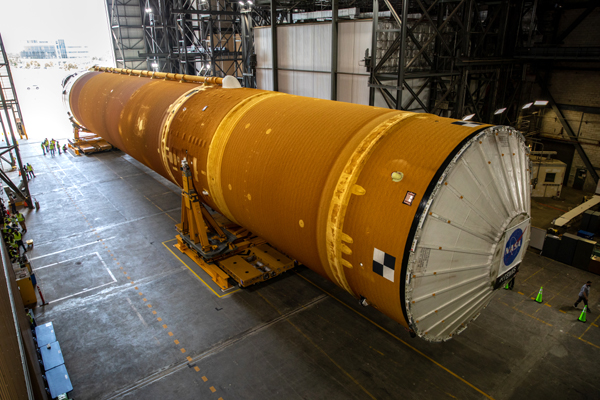
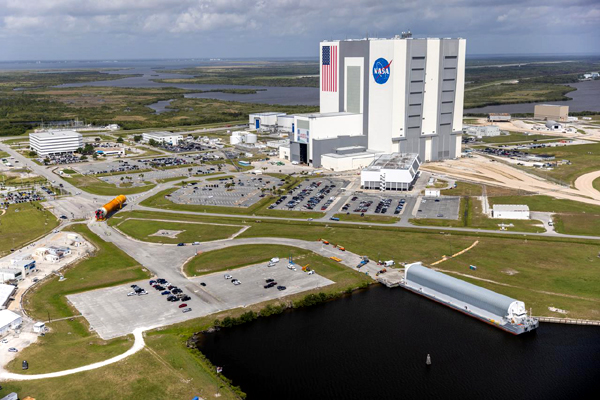
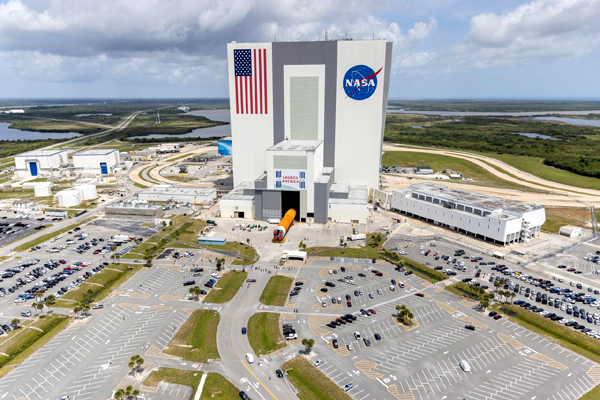
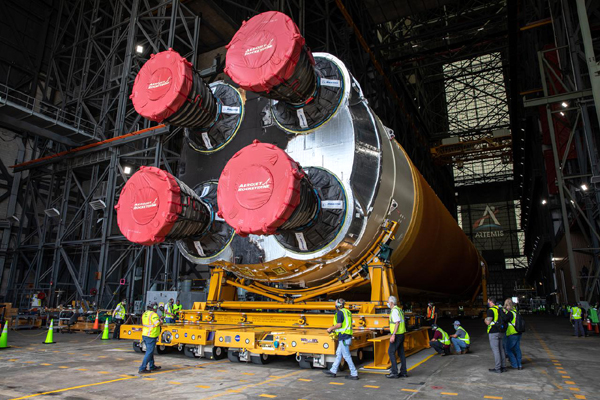
Photos of the Day: The SLS Core Stage Booster Is Ready to Begin Launch Preps at KSC!

The Space Launch System's (SLS) core stage booster for Artemis 1 is transported into the Vehicle Assembly Building at NASA's Kennedy Space Center in Florida...on April 29, 2021.
NASA / Kim Shiflett

Artemis I Core Stage Transported to Its New Home (News Release)

NASA’s Space Launch System (SLS) core stage for the Artemis I mission arrived on April 27, 2021, at the agency’s Kennedy Space Center in Florida. The core stage arrived aboard the Pegasus barge from NASA’s Stennis Space Center in Mississippi to Kennedy’s Launch Complex 39 turn basin wharf.

The core stage is shown being transported into the iconic Vehicle Assembly Building on a self-propelled module transporter on April 29, 2021. Teams from the center’s Exploration Ground Systems and contractor Jacobs will perform checkouts ahead of integrating the massive rocket stage with the twin solid rocket boosters, Orion spacecraft, and additional flight hardware ahead of the Artemis I launch.

Artemis I will be the first integrated test of SLS and Orion and will pave the way for landing the first woman and first person of color on the lunar surface. It will be a proving ground for deep space exploration, leading the agency’s efforts under the Artemis program for a sustainable presence on the Moon and preparing for human missions to Mars.

Source: NASA.Gov

****

The SLS core stage booster for Artemis 1 is removed from the Pegasus barge prior to being transported to the Vehicle Assembly Building at NASA's Kennedy Space Center in Florida...on April 29, 2021.
NASA / Kim Shiflett

The SLS core stage booster for Artemis 1 is removed from the Pegasus barge prior to being transported to the Vehicle Assembly Building at NASA's Kennedy Space Center in Florida...on April 29, 2021.
NASA / Kim Shiflett

The SLS core stage booster for Artemis 1 is transported to the Vehicle Assembly Building at NASA's Kennedy Space Center in Florida...on April 29, 2021.
NASA / Kim Shiflett

An aerial view of the SLS core stage booster for Artemis 1 being transported to the Vehicle Assembly Building at NASA's Kennedy Space Center in Florida...on April 29, 2021.
NASA / Frank Michaux

An aerial view of the SLS core stage booster for Artemis 1 being transported to the Vehicle Assembly Building at NASA's Kennedy Space Center in Florida...on April 29, 2021.
NASA / Jamie Peer and Mike Downs

An aerial view of the SLS core stage booster for Artemis 1 being transported into the Vehicle Assembly Building at NASA's Kennedy Space Center in Florida...on April 29, 2021.
NASA / Frank Michaux

The SLS core stage booster for Artemis 1 is transported into the Vehicle Assembly Building at NASA's Kennedy Space Center in Florida...on April 29, 2021.
NASA / Ben Smegelsky

The SLS core stage booster for Artemis 1 is transported into the Vehicle Assembly Building at NASA's Kennedy Space Center in Florida...on April 29, 2021.
NASA / Ben Smegelsky

The SLS core stage booster for Artemis 1 now sits inside the Vehicle Assembly Building at NASA's Kennedy Space Center in Florida...on April 29, 2021.
NASA / Ben Smegelsky

Wednesday, April 28, 2021

The White House Remembers an Apollo 11 Hero...

Columbia command module pilot Michael Collins takes a break from his Apollo 11 mission training at NASA's Kennedy Space Center in Florida...on June 19, 1969.
AP Photo / File

Statement of President Joe Biden on the Passing of Michael Collins (Press Release)

Michael Collins lived a life of service to our country. From his time in the Air Force, to his career with NASA, to his service at the State Department, to his leadership of the Smithsonian National Air and Space Museum; Michael Collins both wrote and helped tell the story of our nation’s remarkable accomplishments in space.

Many remember him as the astronaut who was by himself, orbiting the Moon as Buzz Aldrin and Neil Armstrong walked on the lunar surface. He may not have received equal glory, but he was an equal partner, reminding our nation about the importance of collaboration in service of great goals. From his vantage point high above the Earth, he reminded us of the fragility of our own planet, and called on us to care for it like the treasure it is.

Although, in his life of accomplishment, he earned many titles and achieved the rank of general, he demanded that everyone call him, simply, Mike.

Our prayers are with General Collins’ family. Godspeed, Mike.

Source: WhiteHouse.gov

****

A snapshot of the Eagle lunar module's ascent stage--with fellow Apollo 11 astronauts Neil Armstrong and Buzz Aldrin onboard--taken by Michael Collins in the Columbia command module as he was about to reunite with his crew members in lunar orbit...on July 21, 1969.
NASA - Michael Collins

Tuesday, April 27, 2021

Photo of the Day: The SLS Core Stage Booster Has Arrived at Kennedy Space Center in Florida!

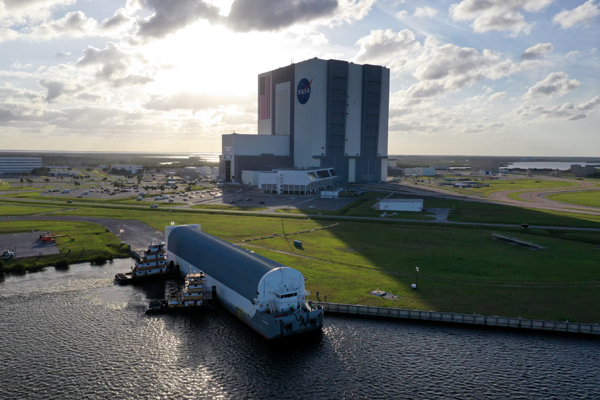
With the Space Launch System's core stage booster for Artemis 1 onboard, NASA's Pegagus barge docks at Kennedy Space Center's turn basin wharf...on April 27, 2021.
NASA

Several hours ago, NASA's Pegasus barge carrying the Space Launch System's (SLS) core stage booster for Artemis 1 arrived at Kennedy Space Center's turn basin wharf...following a 900-mile sea voyage from Stennis Space Center in Mississippi that began last week. With Pegasus now parked hundreds of meters from the Vehicle Assembly Building (VAB)—where SLS will be stacked over the coming months for its maiden flight (currently scheduled for as early as November 4)—crews will wait till this Thursday, April 29, to unload the booster from the barge and transport it to the VAB. The first big milestone after that should take place around May 11; when the core stage is mated to its twin solid rocket boosters (which have been assembled for flight since early March) atop the mobile launcher. Stay tuned.

Sunday, April 25, 2021

Artemis 1 Update: The SLS Core Stage Booster is on Its Way to Florida!

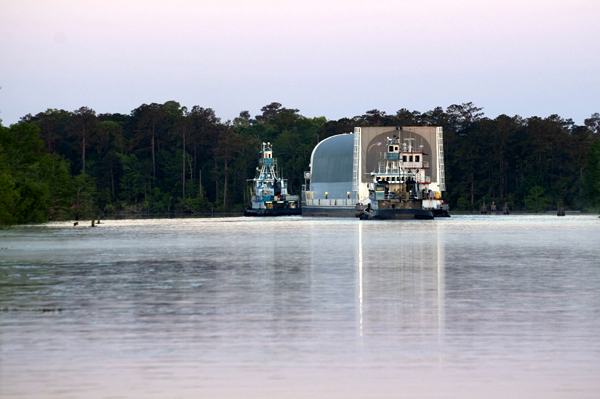
With the Space Launch System's (SLS) Artemis 1 core stage booster onboard, NASA's Pegasus barge heads to Kennedy Space Center in Florida over one month after the booster conducted a successful Green Run hot fire test at the Stennis Space Center in Bay St. Louis, Mississippi...on March 18, 2021.
NASA

NASA’s Space Launch System Core Stage Heads to Kennedy Space Center (News Release - April 23)

The first core stage of NASA’s Space Launch System (SLS) rocket departs Stennis Space Center near Bay St. Louis, Mississippi, following completion of the Green Run series of tests of its design and systems. The stage is now en route to the agency’s Kennedy Space Center in Florida, its final stop prior to NASA’s launch of the Artemis I mission around the Moon. At Kennedy, the core stage will be integrated with the rest of the SLS rocket and the Orion spacecraft in preparation for launch. Through the Artemis program, NASA will return humans, including the first woman and first person of color, to the Moon and prepare for eventual journeys to Mars.

NASA is building SLS as the world’s most powerful rocket to serve as the backbone of the Artemis program and the nation’s future deep space exploration missions. The SLS core stage, measuring 212 feet tall and 27.6 feet in diameter, is the tallest flight component ever built by NASA. It is equipped with four RS-25 engines to help power the SLS rocket at launch. Built by prime contractor Boeing at NASA’s Michoud Assembly Facility in New Orleans, the stage was delivered to Stennis aboard the agency’s Pegasus barge in January 2020. Once installed on the B-2 Test Stand at Stennis, the series of eight Green Run tests began. After pausing for about two months at the start of the COVID-19 pandemic, the work continued with new safety and health protocols in place. The team also endured a record-setting hurricane season that featured multiple storms. Nevertheless, each stage system – including avionics, hydraulics, and propulsion – were turned on and checked out during the eight-test campaign that concluded with a hot fire of the stage’s RS-25 engines, just as during an actual launch.

After an initial hot fire test of the engines experienced an automatic shutdown early this year, teams conducted a second test on March 18, characterized by agency spokespersons as “flawless.” During the test, the engines fired for more than eight minutes, generating a combined 1.6 million pounds of thrust and representing the most powerful test conducted at Stennis in more than 40 years. The test team then worked to refurbish the stage for launch and to remove it from the B-2 Test Stand, a precise operation that requires optimal weather and wind conditions.

Teams succeeded in removing the booster April 19-20, lifting it from its vertical installed position and using a pair of cranes to break it over and lower it to a horizontal position on the B-2 Test Stand tarmac. Following operations to prepare the stage, teams used specially designed transporters to load and hold the massive stage on the Pegasus barge. The work at Stennis was conducted by a multifaceted team of employees from NASA; Boeing, lead contractor for the SLS core stage; Aerojet Rocketdyne, lead contractor for the RS-25 engines; and Syncom Space Services, lead contractor for facility maintenance and operations at Stennis and Michoud.

Source: NASA.Gov

****

The SLS core stage booster is placed in horizontal position after being removed from the B-2 Test Stand at NASA's Stennis Space Center in Bay St. Louis, Mississippi...on April 20, 2021.
NASA

Technicians look up at the core stage booster's four RS-25 engines at NASA's Stennis Space Center in Bay St. Louis, Mississippi...on April 20, 2021.
NASA

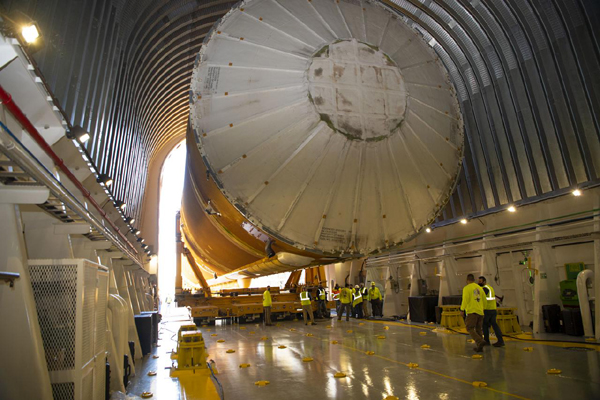
Technicians begin placing the SLS core stage booster inside the Pegagus barge at NASA's Stennis Space Center in Bay St. Louis, Mississippi...on April 20, 2021.
NASA

Technicians begin placing the SLS core stage booster inside the Pegagus barge at NASA's Stennis Space Center in Bay St. Louis, Mississippi...on April 20, 2021.
NASA

Technicians place the SLS core stage booster inside the Pegagus barge at NASA's Stennis Space Center in Bay St. Louis, Mississippi...on April 20, 2021.
NASA

Technicians place the SLS core stage booster inside the Pegagus barge at NASA's Stennis Space Center in Bay St. Louis, Mississippi...on April 20, 2021.
NASA

Technicians place the SLS core stage booster inside the Pegagus barge at NASA's Stennis Space Center in Bay St. Louis, Mississippi...on April 20, 2021.
NASA

The SLS core stage booster is placed inside the Pegagus barge at NASA's Stennis Space Center in Bay St. Louis, Mississippi...on April 20, 2021.
NASA

With the SLS core stage booster onboard, NASA's Pegasus barge prepares to head to Kennedy Space Center in Florida over one month after the booster conducted a successful Green Run hot fire test at the Stennis Space Center in Bay St. Louis, Mississippi...on March 18, 2021.
NASA

Saturday, April 24, 2021

SpaceX Update: Endeavour Has Docked with the ISS...

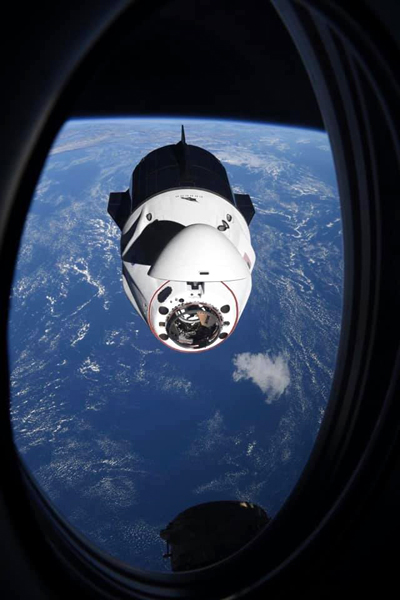
As seen from inside Crew Dragon Resilience, Crew Dragon Endeavour is about to dock with the International Space Station (ISS) on April 24, 2021.
NASA - Mike Hopkins

Earlier today, Crew Dragon Endeavour ended her almost 24-hour chase of the International Space Station (ISS) when she finally docked to the orbital outpost at 5:08 AM, Eastern Daylight Time (2:08 AM, Pacific Daylight Time). For the next four days, the ISS will be populated by 11 crew members (four astronauts from the newly-arrived Crew-2, four astronauts from Crew-1 and one astronaut, plus two cosmonauts, who launched aboard Russia's Soyuz MS-18 vehicle from Baikonur Cosmodrome in Kazakhstan on April 9). The Crew-1 astronauts will then board their Crew Dragon Resilience vehicle on April 28 and return to Earth for a splashdown in the Atlantic Ocean...off the coast of Florida later that day.

Crew-3 is set to launch to the ISS no earlier than late October—while Resilience will be refurbished and reused for the 3-day Inspiration4 mission, which will have an all-civilian crew, that's scheduled to fly in mid-September.

With the arrival of Crew-2 on April 24, the ISS will be populated by 11 astronauts until April 28...when Crew-1 returns to Earth for a splashdown off the coast of Florida.
NASA TV

Friday, April 23, 2021

ISS Update: Crew Dragon Endeavour Officially Begins Her Second Trip to the Orbital Outpost...

The Falcon 9 rocket carrying Dragon Endeavour and her four Crew-2 astronauts head to the International Space Station...on April 23, 2021.
SpaceX

NASA’s SpaceX Crew-2 Astronauts Headed to International Space Station (Press Release)

NASA’s SpaceX Crew-2 astronauts are in orbit following their early morning launch bound for the International Space Station for the second commercial crew rotation mission aboard the microgravity laboratory. The international crew of astronauts lifted off at 5:49 a.m. EDT Friday from Launch Complex 39A at NASA’s Kennedy Space Center in Florida.

The SpaceX Falcon 9 rocket propelled the Crew Dragon spacecraft with NASA astronauts Shane Kimbrough and Megan McArthur, along with JAXA (Japan Aerospace Exploration Agency) astronaut Akihiko Hoshide and ESA (European Space Agency) astronaut Thomas Pesquet, into orbit to begin a six-month science mission on the space station.

During Crew Dragon’s flight, SpaceX will command the spacecraft from its mission control center in Hawthorne, California, and NASA teams will monitor space station operations throughout the flight from Mission Control Center at the agency’s Johnson Space Center in Houston.

“It has been an incredible year for NASA and our Commercial Crew Program, with three crewed launches to the space station since last May,” said NASA Acting Administrator Steve Jurczyk. “This is another important milestone for NASA, SpaceX, and our international partners at ESA and JAXA, and for the future of scientific research onboard the space station. It will be an exciting moment to see our crews greet one another on station for our first crew handover under the Commercial Crew Program.”

The Crew Dragon spacecraft, named Endeavour, will dock autonomously to the forward port of the station’s Harmony module about 5:10 a.m. Saturday, April 24. NASA Television, the NASA app, and the agency’s website are providing ongoing live coverage through docking, hatch opening, and the ceremony to welcome the crew aboard the orbital outpost.

“I’m really proud of the SpaceX team and honored to be partnered with NASA and helping JAXA and ESA as well,” said Elon Musk, Chief Engineer at SpaceX. “We’re thrilled to be a part of advancing human spaceflight and looking forward to going beyond Earth orbit to the Moon and Mars and helping make humanity a space-faring civilization and a multi-planet species one day.”

The Crew-2 mission is the second of six crewed missions NASA and SpaceX will fly as part of the agency’s Commercial Crew Program. This mission has several firsts, including:

- First commercial crew mission to fly two international partners;
- First commercial crew handover between astronauts on the space station as Crew-1 and Crew-2 astronauts will spend about five days together on station before Crew-1 returns to Earth;
- First reuse of the Crew Dragon spacecraft and Falcon 9 rocket on a crew mission – Crew Dragon Endeavour flew the historic Demo-2 mission and the Falcon 9 flew astronauts on the Crew-1 mission; and,
- First time two commercial crew spacecraft will be docked to station at the same time.

“When I see a launch I immediately think of what it took to reach this milestone and the dedication of all the people who made it happen,” said Steve Stich, manager of NASA’s Commercial Crew Program. “There’s obviously a long way to go, but now we can celebrate the Crew-2 launch and look forward to seeing them join their other Expedition 65 colleagues as we prepare to bring Crew-1 home next week.”

Kimbrough, McArthur, Hoshide, and Pesquet will join the Expedition 65 crew of Shannon Walker, Michael Hopkins, Victor Glover, and Mark Vande Hei of NASA, as well as Soichi Noguchi of JAXA and Roscosmos cosmonauts Oleg Novitskiy and Pyotr Dubrov. For a short time, the number of crew on the space station will increase to 11 people until Crew-1 astronauts Walker, Hopkins, Glover, and Noguchi return a few days later.

This the second commercial crew mission to fly a JAXA astronaut. When Hoshide joins astronaut Noguchi during the commercial crew handover period, it will mark the first time two JAXA astronauts are on station at the same time.

“I am extremely honored to witness the successful launch today. It is my utmost pleasure and also for Japan that Japanese astronauts Soichi Noguchi and Aki Hoshide boarded the operational spacecraft of Crew Dragon twice in a row,” said Hiroshi Sasaki, Vice President for Human Spaceflight and Space Exploration. “I believe this is brought by the many years of close cooperation cultivated amongst the international partners, especially between U.S. and Japan through the ISS program. I hope Aki will play an integral role as the second Japanese ISS commander along with his colleague astronauts, creating fruitful outcomes and expanding the human frontier to the Lunar Gateway, the surface of the Moon and even beyond.”

Crew-2 also is the first commercial crew mission to fly an ESA astronaut. Pesquet is the first of three ESA crew members assigned to fly to station on commercial crew spacecraft, kicking off a continuous stay of ESA astronauts on the space station for about a year and a half – in total – for the first time in more than 20 years.

"This is a thrilling time for human spaceflight and this new success of the Commercial Crew Program embodies it – congratulations once again to NASA and SpaceX,” said David Parker, director of human and robotic exploration at ESA. “Starting with astronaut Thomas Pesquet, ESA is delighted to join this new space station chapter, paving the way to the future of exploration side by side with diverse partners. Six months of excellent science and state-of-the-art technology demonstrations now await him, and we know he cannot wait to start working."

Crew-2 Astronauts

Shane Kimbrough is commander of the Crew Dragon spacecraft and the Crew-2 mission. Kimbrough is responsible for all phases of flight, from launch to re-entry. He also will serve as an Expedition 65 flight engineer aboard the station. Selected as a NASA astronaut in 2004, Kimbrough first launched aboard space shuttle Endeavour for a visit to the station on the STS-126 mission in 2008, and then aboard a Russian Soyuz spacecraft for his first long-duration mission for Expedition 49/50 in 2016. He has spent a total of 189 days in space and performed six spacewalks. Kimbrough also is a retired U.S. Army colonel and earned a bachelor’s degree in aerospace engineering from the United States Military Academy at West Point, New York, and a master’s degree in operations research from the Georgia Institute of Technology in Atlanta.

Megan McArthur is the pilot of the Crew Dragon spacecraft and second-in-command for the mission. McArthur is responsible for spacecraft systems and performance. She also will be a long-duration space station crew member, making her first trip to the space station. Selected as an astronaut in 2000, McArthur launched on space shuttle Atlantis as a mission specialist on STS-125, the final Hubble Space Telescope servicing mission, in 2009. McArthur operated the shuttle’s robotic arm over the course of the 12 days, 21 hours she spent in space, capturing the telescope and moving crew members during the five spacewalks needed to repair and upgrade it. She holds a bachelor’s degree in aerospace engineering from the University of California, Los Angeles and a doctorate in oceanography from the University of California, San Diego.

Akihiko Hoshide is a mission specialist for Crew-2. As a mission specialist, he will work closely with the commander and pilot to monitor the spacecraft during the dynamic launch and re-entry phases of flight. Once aboard the station, Hoshide will become a flight engineer for Expedition 65. Hoshide joined the National Space Development Agency of Japan (NASDA, currently JAXA) in 1992 and was selected as an astronaut candidate in February 1999. Hoshide is a veteran of two spaceflights. In June 2008, he flew to the International Space Station on the STS-124 mission to deliver the Japanese Experiment Module Kibo to the station. From July to November 2012, he stayed on the space station for 124 days as a flight engineer for the Expedition 32/33 mission. The Crew Dragon will be the third spacecraft that Noguchi has flown to the orbiting laboratory.

Thomas Pesquet also will be a mission specialist for Crew-2, working with the commander and pilot to monitor the spacecraft during the dynamic launch and re-entry phases of flight. Pesquet also will become a long-duration crew member aboard the space station. He was selected as an astronaut candidate by ESA in May 2009 and worked as a Eurocom, communicating with astronauts during spaceflights from the mission control center. He previously flew as part of Expeditions 50 and 51, launching aboard a Russian Soyuz spacecraft in October 2016 and spending 196 days in space, returning to Earth in June 2017. His mission also included two spacewalks to maintain the station: one to replace batteries on an electrical channel, and one to detect a cooling leak and service the robotic arm.

Mission Objectives

The Crew-2 members will conduct science and maintenance during a six-month stay aboard the orbiting laboratory and will return no earlier than Oct. 31. The Crew Dragon spacecraft can stay in orbit for at least 210 days, which is a NASA requirement.

Adding more crew members aboard the microgravity laboratory increases the time available for scientific activities. The November 2020 arrival of the Crew-1 astronauts more than doubled crew hours spent on scientific research and support activities, and Crew-2 will continue the important investigations and technology demonstrations that are preparing for future Artemis missions to the Moon, helping us improve our understanding of Earth’s climate, and improving life on our home planet. An important scientific focus on this expedition is continuing a series of Tissue Chips in Space studies. Tissue chips are small models of human organs containing multiple cell types that behave much the same as they do in the body. Another important element of Crew-2’s mission is augmenting the station’s solar power system by installing the first pair of six new ISS Roll-out Solar Arrays.

Crew Dragon also is delivering almost 250 pounds of cargo, new science hardware, and experiments, including a university student-led investigation to study possible causes for suppressed immune response in microgravity.

During their stay on the orbiting laboratory, Crew-2 astronauts expect to see a range of U.S. commercial spacecraft, including the Northrop Grumman Cygnus; SpaceX cargo Dragon; Boeing CST-100 Starliner, on its uncrewed flight to station; and NASA’s SpaceX Crew-3 Dragon; which is targeted for launch no earlier than Oct. 23. During Crew-2, astronauts also will conduct a variety of spacewalks outside the space station, including the solar array installation.

At the conclusion of the mission, the Crew-2 astronauts will board Crew Dragon, which will then autonomously undock, depart the space station, and re-enter Earth’s atmosphere. Crew Dragon also will return to Earth important and time-sensitive research. NASA and SpaceX are capable of supporting seven splashdown sites located off Florida's east coast and in the Gulf of Mexico. Upon splashdown, the SpaceX recovery ship will pick up the crew and return to shore.

NASA’s Commercial Crew Program is delivering on its goal of safe, reliable, and cost-effective transportation to and from the International Space Station from the United States through partnership with American private industry. This partnership is changing the arc of human spaceflight history by opening access to low-Earth orbit and the International Space Station to more people, more science, and more commercial opportunities.

The space station remains the springboard to NASA's next great leap in space exploration, including future missions to the Moon and, eventually, to Mars. For more than 20 years, humans have lived and worked continuously aboard the International Space Station, advancing scientific knowledge and demonstrating new technologies, making research breakthroughs not possible on Earth. As a global endeavor, 243 people from 19 countries have visited the unique microgravity laboratory that has hosted more than 3,000 research and educational investigations from researchers in 108 countries and areas.

Source: NASA.Gov

****
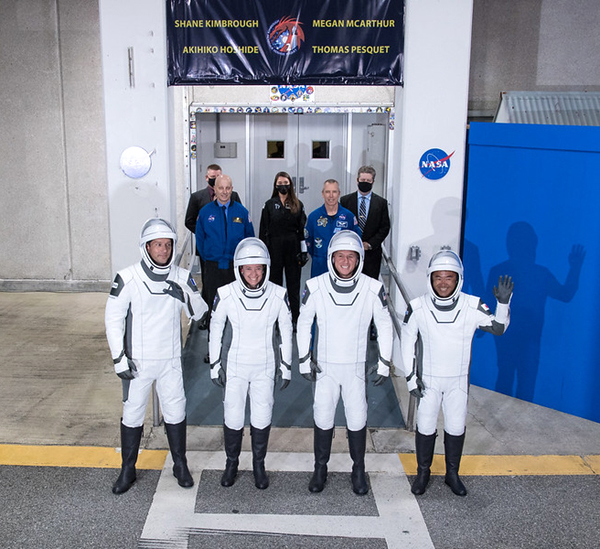
The four Crew-2 astronauts greet their families and friends outside of the Neil A. Armstrong Operations and Checkout Building before heading to Launch Complex 39A, where Falcon 9 and Dragon Endeavour await, at NASA's Kennedy Space Center in Florida...on April 23, 2021.
NASA / Aubrey Gemignani

European Space Agency astronaut Thomas Pesquet and Japan Aerospace Exploration Agency astronaut Akihiko Hoshide can be seen walking through the Crew Access Arm to Dragon Endeavour at Kennedy Space Center's Launch Complex 39A...on April 23, 2021.
NASA / Joel Kowsky

The engine plume from the Falcon 9 rocket carrying the Crew-2 astronauts is visible from the U.S. Capitol Building in Washington, DC...on April 23, 2021.
NASA / Bill Ingalls
Thursday, April 22, 2021

Photo of the Day: The Crew-2 Astronauts Are Ready to Soar to the International Space Station...

Just thought I'd share this image, which was posted on Twitter four days ago, of the Crew-2 astronauts posing in front of their Falcon 9 vehicle atop Launch Complex 39A at NASA's Kennedy Space Center in Florida. Crew-2—which consists of NASA astronauts Megan McArthur and Shane Kimbrough, European Space Agency astronaut Thomas Pesquet and Japan Aerospace Exploration Agency astronaut Akihiko Hoshide—is set to blast off aboard SpaceX's Crew Dragon Endeavour (which last flew on the Demo-2 flight almost a year ago) to the International Space Station tomorrow morning. Launch is currently set for 5:49 AM, Eastern Daylight Time (2:49 AM, Pacific Daylight Time) on April 23. Godspeed!

The Crew-2 astronauts pose in front of their Falcon 9 vehicle atop Launch Complex 39A at NASA's Kennedy Space Center in Florida...on April 18, 2021.
NASA - Shane Kimbrough

Tuesday, April 20, 2021

The SLS Core Stage Booster Moves One Step Closer to Its Next Destination: Kennedy Space Center in Florida...

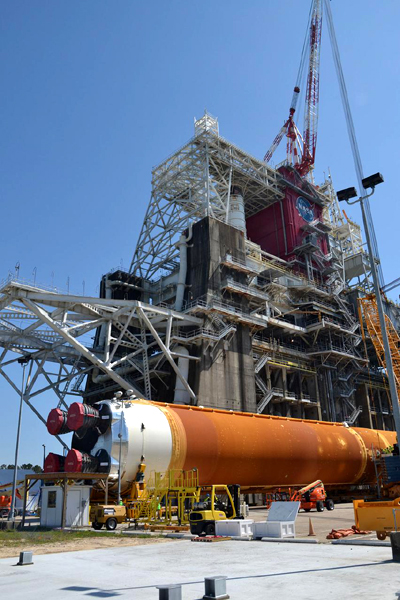
The Space Launch System's (SLS) Artemis 1 core stage booster is removed from the B-2 Test Stand at NASA's Stennis Space Center in Bay St. Louis, Mississippi...on April 19, 2021.
NASA

NASA Removes Rocket Core Stage for Artemis Moon Mission from Stennis Test Stand (News Release)

Crews at NASA’s Stennis Space Center near Bay St. Louis, Mississippi, worked April 19-20 to remove the first flight core stage of the agency’s Space Launch System rocket from the B-2 Test Stand in preparation for its transport to Kennedy Space Center in Florida. Operations required crews to lift the core stage from its vertical placement in the stand and lower it to a horizontal position on the B-2 Test Stand tarmac. The stage will now be loaded on NASA’s Pegasus barge for transport to Kennedy, where it will be prepared for launch of the Artemis I mission.

Removal of the largest rocket stage ever built by NASA followed completion of a series of eight Green Run tests over the past year. During the Green Run series, teams performed a comprehensive test of the stand’s sophisticated and integrated systems. The series culminated in a hot fire of the stage’s four RS-25 engines on the B-2 stand March 18. During the hot fire, the four engines generated a combined 1.6 million pounds of thrust, just as during an actual launch. The test was the most powerful performed at Stennis in more than 40 years.

NASA is building SLS, the world’s most powerful rocket, to return humans to deep space missions. As part of the backbone of NASA’s Artemis program, SLS will return humans, including the first woman and person of color, to the surface of the Moon to establish a sustainable presence and prepare for eventual missions to Mars.

Source: NASA.Gov

****

The SLS core stage booster is placed in horizontal position after being removed from the B-2 Test Stand at NASA's Stennis Space Center in Bay St. Louis, Mississippi...on April 20, 2021.
NASA

Friday, April 16, 2021

SpaceX Update: NASA Selects Starship to Land the First Artemis Astronauts on the Moon...

An artist's concept of astronauts conducting a moonwalk near the base of SpaceX's Starship lunar lander.
SpaceX

As Artemis Moves Forward, NASA Picks SpaceX Human Lunar Lander (Press Release)

NASA is getting ready to send astronauts to explore more of the Moon as part of the Artemis program, and the agency has selected SpaceX to continue development of the first commercial human lander that will safely carry the next two American astronauts to the lunar surface. At least one of those astronauts will make history as the first woman on the Moon. Another goal of the Artemis program includes landing the first person of color on the lunar surface.

The agency’s powerful Space Launch System rocket will launch four astronauts aboard the Orion spacecraft for their multi-day journey to lunar orbit. There, two crew members will transfer to the SpaceX Human Landing System (HLS) for the final leg of their journey to the surface of the Moon. After approximately a week exploring the surface, they will board the lander for their short trip back to orbit where they will return to Orion and their colleagues before heading back to Earth.

The firm-fixed price, milestone-based contract total award value is $2.89 billion.

"With this award, NASA and our partners will complete the first crewed demonstration mission to the surface of the Moon in the 21st century as the agency takes a step forward for women’s equality and long-term deep space exploration,” said Kathy Lueders, NASA's associate administrator for Human Explorations and Operations Mission Directorate. “This critical step puts humanity on a path to sustainable lunar exploration and keeps our eyes on missions farther into the solar system, including Mars.”

SpaceX has been working closely with NASA experts during the HLS base period of performance to inform its lander design and ensure it meets NASA’s performance requirements and human spaceflight standards. A key tenet for safe systems, these agreed-upon standards range from areas of engineering, safety, health, and medical technical areas.

“This is an exciting time for NASA and especially the Artemis team,” said Lisa Watson-Morgan, program manager for HLS at NASA’s Marshall Space Flight Center in Huntsville, Alabama. “During the Apollo program, we proved that it is possible to do the seemingly impossible: land humans on the Moon. By taking a collaborative approach in working with industry while leveraging NASA’s proven technical expertise and capabilities, we will return American astronauts to the Moon’s surface once again, this time to explore new areas for longer periods of time.”

SpaceX’s HLS Starship, designed to land on the Moon, leans on the company’s tested Raptor engines and flight heritage of the Falcon and Dragon vehicles. Starship includes a spacious cabin and two airlocks for astronaut moonwalks. The Starship architecture is intended to evolve to a fully reusable launch and landing system designed for travel to the Moon, Mars, and other destinations.

The HLS award is made under the Next Space Technologies for Exploration Partnerships (NextSTEP-2) Appendix H Broad Agency Announcement (BAA).

In parallel with executing the Appendix H award, NASA intends to implement a competitive procurement for sustainable crewed lunar surface transportation services that will provide human access to the lunar surface using the Gateway on a regularly recurring basis beyond the initial crewed demonstration mission.

With NASA’s Space Launch System rocket, Orion spacecraft, HLS, and the Gateway lunar outpost, NASA and its commercial and international partners are returning to the Moon for scientific discovery, economic benefits, and inspiration for a new generation. Working with its partners throughout the Artemis program, the agency will fine-tune precision landing technologies and develop new mobility capabilities to enable exploration of new regions of the Moon. On the surface, the agency has proposed building a new habitat and rovers, testing new power systems and more. These and other innovations and advancements made under the Artemis program will ensure that NASA and its partners are ready for human exploration’s next big step—the exploration of Mars.

****