Tuesday, May 30, 2023

The Second All-Private Crew to Visit the ISS Is Ready to Come Home...

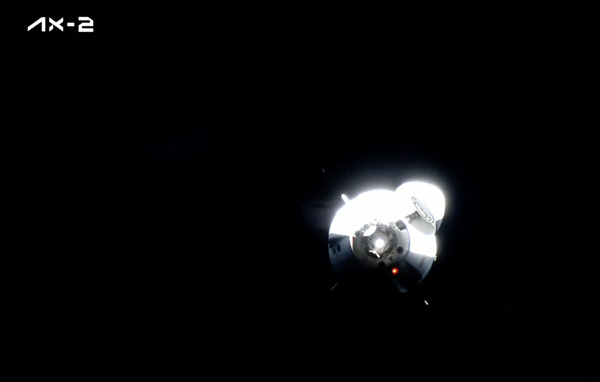
Crew Dragon Freedom as seen from the International Space Station...after the SpaceX capsule, with the four Ax-2 astronauts onboard, undocked from the orbital outpost on May 30, 2023.
NASA TV

Ax-2 Astronauts Undock from Station Inside Dragon Freedom (News Release)

The SpaceX Dragon spacecraft undocked from the space-facing port of the International Space Station’s Harmony module at 11:05 a.m. EDT to complete the second all-private astronaut mission to the orbiting laboratory, Axiom Mission 2 (Ax-2).

Dragon is slowly maneuvering away from the orbiting laboratory into an orbital track that will return the astronaut crew and its cargo safely to Earth, targeting a splashdown off the coast of Panama City, Florida, targeted about 11:04 p.m. EDT on Tuesday, May 30.

Ax-2 Commander Peggy Whitson, John Shoffner, Ali Alqarni and Rayyanah Barnawi will complete 9 days in space at the conclusion of their mission. The SpaceX Dragon will return to Earth with more than 300 pounds of science and supplies, including NASA experiments and hardware.

Joint operations with the Axiom and SpaceX mission teams end and NASA coverage of the mission concludes when the spacecraft exits the area of the space station, approximately 30 minutes after undocking.

Axiom Space leads independent mission operations for Ax-2 and will resume coverage of Dragon’s re-entry and splashdown.

Source: NASA.Gov

Monday, May 29, 2023

SpaceX Looks Ahead to the Next Starship Launch...

An aerial photo, shared by SpaceX on May 18, showing Starship 25 being transported to a suborbital pad at Starbase, Texas...in preparation for the vehicle's upcoming static fire of its six Raptor 2 engines.
SpaceX

Happy Memorial Day to my fellow Yanks! Just thought I'd share that SpaceX has confirmed which Starship vehicle and Super Heavy booster will be used for the next flight test of this mega-Moon rocket.

The first video below—which shows exclusive footage of last month's Starship Flight Test (SFT)—reveals that Starship Serial No. 25 (SN25) and Super Heavy Booster 9 (B9) will be utilized for the next orbital demonstration. When this launch takes place remains to be seen...as SpaceX continues to make final repairs and improvements (as indicated in the second video shared below) to the Orbital Launch Site at Starbase, Texas, and the Federal Aviation Administration carries on with its investigation into the damage and environmental impact incurred at Starship's launch pad and the surrounding Boca Chica Beach area as a result of the SFT.

Hopefully, the second time will be the charm and SN25 and B9 will perform as expected in the next flight test! Stay tuned.


Sunday, May 28, 2023

A Flight Component for NASA's Artemis 3 Mission Is All But Completed...

A technician applies thermal protection system material to the launch vehicle stage adapter that will be used on NASA's Space Launch System (SLS) rocket for the Artemis 3 mission...at the Marshall Space Flight Center in Huntsville, Alabama.
NASA / Brandon Hancock

Technicians Apply Thermal Protection Material to NASA Moon Rocket Hardware (News Release - May 26)

Technicians at NASA’s Marshall Space Flight Center in Huntsville, Alabama, have completed applying thermal protection system material to the launch vehicle stage adapter (LVSA) of NASA’s SLS (Space Launch System) rocket for Artemis III, which will land astronauts on the Moon to advance long-term lunar exploration and scientific discovery and inspire the Artemis Generation. The LVSA is a cone-shaped element connecting the mega rocket’s core stage to its interim cryogenic propulsion stage (ICPS), partially enclosing it and protecting its avionics and electrical systems from the extreme pressures, sounds and temperatures during launch and flight.

Teams at Marshall began applying the thermal protection system material earlier this spring. Unlike other parts of the SLS rocket, the thermal protection system material for the LVSA is applied entirely by hand using a spray gun.

During application, the technicians use a thin measuring rod to gauge the proper thickness. Once the thermal protection system has cured, certain areas are sanded down to meet parameters.

The entire process takes several months.

The LVSA is fully manufactured at Marshall by NASA, lead contractor Teledyne Brown Engineering and the Jacobs Space Exploration Group’s ESSCA contract. The LVSA for Artemis III is the last of its kind as future SLS rockets will transition to its next, more powerful Block 1B configuration beginning with Artemis IV.

NASA is working to land the first woman and first person of color on the Moon under Artemis. SLS is part of NASA’s backbone for deep space exploration, along with the Orion spacecraft, advanced spacesuits and rovers, the Gateway in orbit around the Moon, and commercial human landing systems.

SLS is the only rocket that can send Orion, astronauts and supplies to the Moon in a single mission.

Source: NASA.Gov

****

The launch vehicle stage adapter for NASA's SLS rocket that will fly on Artemis 3...after thermal protection system material was fully applied to the flight component at the Marshall Space Flight Center in Huntsville, Alabama.
NASA / Brandon Hancock

Saturday, May 27, 2023

The First Crewed Flight of the CST-100 Is Still Targeted for Late July...

At NASA's Kennedy Space Center in Florida, the CST-100 Starliner spacecraft is moved into the Hazardous Processing Area inside Boeing's Commercial Crew and Cargo Processing Facility...on February 8, 2023.
NASA

NASA, Boeing Provide Update on Starliner Flight Test Readiness (News Release - May 26)

NASA and Boeing completed a joint Crew Flight Test checkpoint review on May 25, ahead of the first flight of Starliner with astronauts to the International Space Station. During the checkpoint, mission teams reviewed open work ahead of launch planned for no earlier than July 21, including emerging issues that need a path to closure prior to a decision to fuel the spacecraft in June.

“We are taking a methodical approach to the first crewed flight of Starliner incorporating all of the lessons learned from the various in-depth testing campaigns, including Starliner’s flight tests and the agency’s verification efforts,” said Steve Stich, manager of NASA’s Commercial Crew Program. “All Orbital Flight Test-2 anomalies are closed. In addition to the closeout of ongoing work, the team remains vigilant on tracking new technical issues as we complete certification for crewed flight.”

As part of the ongoing effort, 95% of the Crew Flight Test certification products are complete. This includes approval of Starliner’s crew module batteries, based on additional testing and analysis, along with post-certification flight mitigations and a proposed battery upgrade for future missions.

Teams are conducting final spacecraft closeouts and preparing for upcoming hardware milestones, including spacecraft fueling, spacecraft rollout to the launch site, and integration with the United Launch Alliance Atlas V rocket.

While the team continues to work on the remaining certification products, they are also working resolution paths for the following items:

- Teams will remove and replace a bypass valve on the active thermal control system, which is located on the Starliner service module and is used to flow coolant into the system to cool the onboard avionics. The Starliner team is replacing the valve that was restricting flow to one of two redundant loops, and running a diagnostic to confirm the suspected issue with the malfunctioning hardware.

This work is expected to take about a week with no overall impact to the launch schedule at this time.

- Engineers are also working to evaluate any elevated risk from a specific type of tape used on the spacecraft to protect wires from chaffing. Although the tape is commonly used in spaceflight, the adhesive properties of the tape could present a flammability risk under certain conditions.

- NASA and Boeing are evaluating this material and the system’s overall wiring protection to confirm that it is acceptable for crewed flight. Those efforts are ongoing and are expected to complete before Boeing begins fueling operations on the spacecraft.

- NASA and Boeing are also working to reassess Starliner’s parachute system margins based on new data reviews as part of the ongoing design certification process. Engineers are reviewing the overall efficiency of certain joints within the parachute system to confirm they meet all required factors of safety for crewed flight.

“Crew safety remains the highest priority for NASA and its industry providers, and emerging issues are not uncommon in human spaceflight especially during development,” said Stich. “If you look back two months ago at the work we had ahead of us, it’s almost all complete. The combined team is resilient and resolute in their goal of flying crew on Starliner as soon as it is safe to do so. If a schedule adjustment needs to be made in the future, then we will certainly do that as we have done before. We will only fly when we are ready.”

Starliner spacecraft fueling is expected to begin as early as mid-June, and there is some operational flexibility in that timeline that can be used if needed. Teams will continue to monitor the forward work and determine whether an adjustment in the current launch date is needed.

An update on the team’s progress will be provided in the coming weeks.

Source: NASA.Gov

Friday, May 26, 2023

NASA Sets Its Sights on a Next-Generation Moon Rover for Astronauts...

An artist's concept of two astronauts riding in a Lunar Terrain Vehicle across the Moon's surface.
NASA

NASA Pursues Lunar Terrain Vehicle Services for Artemis Mission (Press Release)

NASA is seeking industry proposals for a next-generation LTV (Lunar Terrain Vehicle) that will allow astronauts to go farther and conduct more science than ever before as they explore the south polar region of the Moon during Artemis missions.

Artemis astronauts will drive to explore and sample more of the lunar surface using the LTV than they could on foot. NASA will contract LTV as a service from industry rather than owning the rover.

Contracting services from industry partners allows NASA to leverage commercial innovation and provide the best value to U.S. taxpayers while achieving its human spaceflight scientific and exploration goals.

“We want to leverage industry’s knowledge and innovation, combined with NASA’s history of successfully operating rovers, to make the best possible surface rover for our astronaut crews and scientific researchers,” said Lara Kearney, manager of NASA’s Extravehicular Activity and Human Surface Mobility program at the agency’s Johnson Space Center in Houston.

The LTV will function like a cross between an Apollo-style lunar rover and a Mars-style uncrewed rover. It will support phases driven by astronauts and phases as an uncrewed mobile science exploration platform, similar to NASA’s Curiosity and Perseverance Mars rovers.

This will enable continued performance of science even when crews are not present on the lunar surface. Artemis astronauts will use the LTV to traverse the lunar surface and transport scientific equipment, extending the distances they can cover on each moonwalk.

Under the Lunar Terrain Vehicle Services request for proposals, NASA has provided requirements for companies interested in developing and demonstrating the LTV, including an approach that encourages companies to produce an innovative rover for use by NASA and other commercial customers for multiple years.

Engineers will be able to operate the LTV remotely to transport cargo and scientific payloads between crewed landing sites, enabling additional science returns, resource prospecting and lunar exploration. This will expand scientific research opportunities on the Moon during uncrewed operations, allow scientists to investigate future surface mission locations, and inform research goals and objectives for each site.

To handle the unique environment near the lunar South Pole, which includes permanently-shadowed regions and extended periods without sunlight, the LTV will need to incorporate several systems to support both crewed and uncrewed operations. Some of the more critical systems include advanced power management, semi-autonomous driving, state-of-the-art communication and navigation systems, and protection from the extreme environment.

As part of the proposals, companies are required to provide end-to-end services, from development and delivery to the lunar surface, to execution of operations. Each rover must be able to carry two suited astronauts, accommodate a robotic arm or mechanism to support science exploration, and survive the extreme temperatures at the lunar South Pole.

The company will be asked to successfully demonstrate the LTV in the lunar environment prior to using it in a crewed capacity.

NASA intends to use the LTV for crewed operations beginning with Artemis V in 2029. Prior to crew arrival, the rover will be used for uncrewed and commercial activities once it lands on the lunar surface.

Proposals for the LTV services contract are due on July 10, 2023, with the contract award scheduled for November 2023. This request for proposals incorporates feedback from industry through a draft request for proposals and a previous request for information.

Through Artemis, NASA will send astronauts – including the first woman and first person of color – to explore the Moon for scientific discovery, economic benefits and to build the foundation for crewed missions to Mars. Together, NASA’s Space Launch System rocket, Orion spacecraft, Gateway lunar orbital outpost, advanced spacesuits and rovers, and human landing systems are the agency’s foundation for deep space exploration.

Source: NASA.Gov

Thursday, May 25, 2023

SpaceShipTwo Update: Virgin Galactic Achieves a Major Milestone with the UNITY 25 Flight...

VSS Unity's tail-boom is raised into the 'feathered' position as the vehicle prepares for re-entry into Earth's atmosphere...on May 25, 2023.
Virgin Galactic

Earlier today, the VSS Unity soared towards the edge of space for the first time since the Unity 22 mission on July 11, 2021. Aboard the suborbital spacecraft for this morning's test flight were Virgin Galactic astronaut trainer Beth Moses (making her third flight towards the Kármán line on SpaceShipTwo, or SS2) and three fellow passengers: Jamila Gilbert, Christopher Huie and Luke Mays.

Mike Masucci and CJ Sturckow were at the controls on VSS Unity, while Jameel Janjua and Nicola Pecile piloted SS2's mothership, VMS Eve, for Unity 25.

Here are the stats from today's flight:

Take-off Time: 9:15 AM, MDT (8:15 AM, PDT)

Release Altitude: 44,500 feet (13,564 meters)

Apogee: 54.2 miles (87.2 kilometers)

Landing Time: 10:37 AM, MDT (9:37 AM, PDT)

Assuming that the results from today's rocket-powered test above New Mexico look really good, Virgin Galactic will begin commercial spaceline operations next month! The first paying passengers will fly aboard VSS Unity on the Galactic 01 research mission in late June.

Stay tuned!

Three of the Unity 25 crewmembers are visible (Virgin Galactic astronaut trainer Beth Moses is out of frame) as they head towards space after VSS Unity's rocket motor ignites around 44,500 feet (13,564 meters) above New Mexico...on May 25, 2023.
Virgin Galactic

The Unity 25 crewmembers float around inside VSS Unity's cabin during their 54.2-mile (87.2-kilometer) journey towards space...on May 25, 2023.
Virgin Galactic

Tuesday, May 23, 2023

SLS Update: An Upgraded RS-25 Lights Up Successfully for the 8th Time at Stennis Space Center...

A next-generation RS-25 engine is tested on the Fred Haise Test Stand at NASA's Stennis Space Center in Bay St. Louis, Mississippi...on May 23, 2023.
NASA / Stennis

NASA Continues Key Test Series with Moon Rocket Engine Hot Fire (News Release)

NASA completed a full-duration hot fire of the RS-25 certification engine on May 23, continuing a critical test series to support future SLS (Space Launch System) missions to deep space as NASA explores the secrets of the Universe for the benefit of all.

The test on the Fred Haise Test Stand at NASA’s Stennis Space Center near Bay St. Louis, Mississippi, marked the eighth in a 12-test certification series that will support production of RS-25 engines by lead engine contractor Aerojet Rocketdyne for future Artemis missions, beginning with Artemis V. Engineers fired the RS-25 engine for almost eight-and-a-half minutes (500 seconds), the same amount of time it must operate to help send astronauts in the Orion spacecraft to space.

The engine operated up to the 113% power level during the test, beyond the required 111% needed to get SLS to orbit. The increased power provides engineers with a margin of operational safety during testing.

Four RS-25 engines fire simultaneously to generate a combined 1.6 million pounds of thrust at launch and 2 million pounds of thrust during ascent to help power each SLS flight. Through Artemis, NASA will land the first woman and first person of color on the Moon and collaborate with commercial and international partners to establish the first long-term presence on the Moon.

The agency will use what it learns on and around the Moon to then send the first astronauts to Mars.

Source: NASA.Gov

Monday, May 22, 2023

The Ax-2 Crew Has Arrived at the ISS...

Crew Dragon Freedom as seen from the International Space Station...before the capsule carrying the Ax-2 astronauts docked to the orbital outpost on May 22, 2023.
NASA TV

Four Axiom Mission-2 Private Astronauts Enter Station (News Release)

Axiom Mission 2 (Ax-2) astronauts Peggy Whitson, John Shoffner, Ali Alqarni and Rayyanah Barnawi are now aboard the International Space Station following Dragon’s hatch opening at 11 a.m. EDT on Monday, May 22.

Ax-2 docked to the orbital complex at 9:12 a.m. on the second mission with an entirely private crew to arrive at the orbiting laboratory.

The Axiom Space crew are joining Expedition 69 crew members aboard station, including NASA astronauts Frank Rubio, Woody Hoburg and Stephen Bowen, UAE (United Arab Emirates) astronaut Sultan Alneyadi, as well as Roscosmos cosmonauts Dmitri Petelin, Andrey Fedyaev and Sergey Prokopyev.

Next up, the station crew members will take part in a welcome ceremony aboard the International Space Station.

Axiom Space astronauts are expected to depart the space station on May 30, pending weather, for a return to Earth and splashdown at a landing site off the coast of Florida.

Source: NASA.Gov

****

The four-member AX-2 crew gathers with the seven-member Expedition 69 astronauts during a welcome ceremony aboard the International Space Station...on May 22, 2023.
NASA TV

Sunday, May 21, 2023

ISS Update: Another All-Civilian Crew Has Launched to the Orbital Outpost...

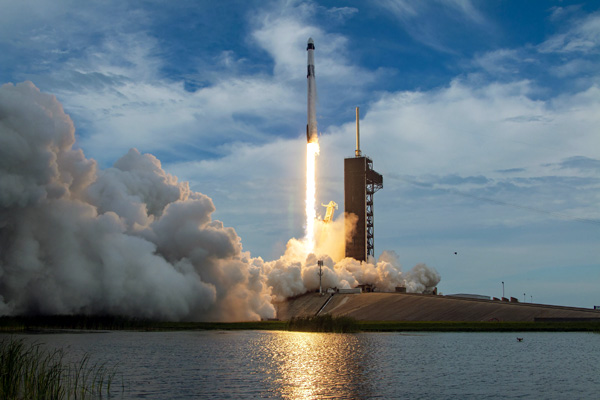
SpaceX's Falcon 9 rocket carrying Crew Dragon Freedom and the Axiom Mission 2 astronauts lifts off from Launch Complex 39A at NASA's Kennedy Space Center in Florida...on May 21, 2023.
SpaceX

Axiom Space Private Astronauts Headed to International Space Station (Press Release)

Four private astronauts are in orbit following the successful launch of Axiom Mission 2 (Ax-2), the second all-private astronaut mission to the International Space Station. Axiom Space astronauts lifted off at 5:37 p.m. EDT on Sunday, May 21, from Launch Complex 39A at NASA’s Kennedy Space Center in Florida.

A SpaceX Falcon 9 rocket propelled the company’s Dragon spacecraft carrying Ax-2 crew members Commander Peggy Whitson, Pilot John Shoffner, and Mission Specialists Ali Alqarni and Rayyanah Barnawi into orbit on a mission to conduct scientific research, outreach and commercial activities on the space station.

“Congratulations to Axiom, SpaceX and the Axiom Mission 2 crew on a successful launch! During their time aboard the International Space Station, the Ax-2 astronauts will carry out more than 20 scientific experiments, helping us better understand space radiation, weather in low-gravity conditions and more,” said NASA Administrator Bill Nelson. “This mission is more proof of NASA’s commitment to help our industry partners develop the next generation of space technology and support a growing commercial space economy.”

Beginning at 7:30 a.m. on Monday, May 22, NASA will provide live coverage of SpaceX Dragon docking, hatch opening and a ceremony to welcome the crew on NASA Television, the NASA app and the agency’s website.

The SpaceX Dragon will autonomously dock to the space-facing port of the station’s Harmony module around 9:16 a.m. on Monday, with hatch opening around 11:13 a.m. Live mission coverage will conclude following the welcome ceremony around 11:45 a.m.

The mission will also be covered by Axiom Space on its website.

Once aboard the station, the Ax-2 crew will be welcomed by Expedition 69 crew members, including NASA astronauts Frank Rubio, Stephen Bowen and Woody Hoburg, UAE (United Arab Emirates) astronaut Sultan Alneyadi, and Roscosmos cosmonauts Dmitri Petelin, Sergey Prokopyev and Andrey Fedyaev.

Axiom Space astronauts are expected to depart the space station on May 30, pending weather, for a return to Earth and splashdown at a landing site off the coast of Florida.

****

The Axiom Mission 2 astronauts pose for the camera after taking their seats inside SpaceX's Crew Dragon Freedom for launch...on May 21, 2023.

Saturday, May 20, 2023

NASA's First Artemis Mission Takes Its First Photo from Lunar Orbit...

A photo of the Moon's northern region that was taken by NASA's CAPSTONE spacecraft on May 3, 2023.
©Advanced Space 2023

CAPSTONE Takes Moon Shot, Successfully Tests Navigation Technology (News Release - May 18)

CAPSTONE successfully tested a navigation technology akin to Earth’s GPS for the first time in May, advancing a capability that could help future space missions more efficiently navigate at the Moon. The spacecraft also captured its first images of the Moon, showing the lunar surface near the Moon's North Pole as CAPSTONE made a close approach to the Moon on May 3.

CAPSTONE, short for Cislunar Autonomous Positioning System Technology Operations and Navigation Experiment, is a microwave oven-sized CubeSat flying a unique, elliptical orbit at the Moon that will be used by Gateway. The test of the mission's CAPS technology involved two spacecraft: CAPSTONE and NASA's Lunar Reconnaissance Orbiter (LRO).

During the May 9 experiment, CAPSTONE sent a signal to LRO designed to measure the distance and relative velocity between the two spacecraft. LRO then returned the signal to CAPSTONE, where it was converted into a measurement.

The test proved the ability to collect measurements that will be utilized by CAPS software to determine the positioning of both spacecraft. This capability could provide autonomous onboard navigation information for future lunar missions.

In addition to the successful CAPS test, CAPSTONE achieved another mission objective to fly the near-rectilinear halo orbit for at least six months. This marks the end of the spacecraft's primary mission, and CAPSTONE will continue flying in the orbit and testing onboard technologies for up to a year during its enhanced mission phase.

Source: NASA.Gov