Friday, May 19, 2023

A New Moon Lander Has Been Selected for the Artemis 5 Mission and Beyond...

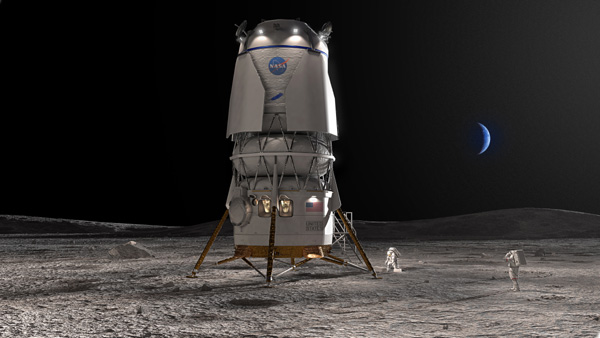
An artist's concept of Blue Origin's Blue Moon lander on the lunar surface.
Blue Origin

NASA Selects Blue Origin as Second Artemis Lunar Lander Provider (Press Release)

To develop a human landing system for the agency’s Artemis V mission to the Moon, NASA has selected Blue Origin of Kent, Washington. Through Artemis, NASA will explore more of the Moon than ever before, uncovering more scientific discoveries and preparing for future astronaut missions to Mars.

Blue Origin will design, develop, test and verify its Blue Moon lander to meet NASA’s human landing system requirements for recurring astronaut expeditions to the lunar surface, including docking with Gateway, a space station where crew transfer in lunar orbit. In addition to design and development work, the contract includes one uncrewed demonstration mission to the lunar surface before a crewed demo on the Artemis V mission in 2029.

The total award value of the firm-fixed price contract is $3.4 billion.

“Today we are excited to announce Blue Origin will build a human landing system as NASA’s second provider to deliver Artemis astronauts to the lunar surface,” said NASA Administrator Bill Nelson. “We are in a golden age of human spaceflight, which is made possible by NASA’s commercial and international partnerships. Together, we are making an investment in the infrastructure that will pave the way to land the first astronauts on Mars.”

For the Artemis V mission, NASA’s SLS (Space Launch System) rocket will launch four astronauts to lunar orbit aboard the Orion spacecraft. Once Orion docks with Gateway, two astronauts will transfer to Blue Origin’s human landing system for about a weeklong trip to the Moon’s South Pole region where they will conduct science and exploration activities.

Artemis V is at the intersection of demonstrating NASA’s initial lunar exploration capabilities and establishing the foundational systems to support recurring complex missions in lunar orbit and on the surface as part of the agency’s Moon to Mars exploration approach.

Adding another human landing system partner to NASA’s Artemis program will increase competition, reduce costs to taxpayers, support a regular cadence of lunar landings, further invest in the lunar economy and help NASA achieve its goals on and around the Moon in preparation for future astronaut missions to Mars.

The agency previously contracted SpaceX to demonstrate an initial human landing system for the Artemis III mission. Under that contract, the agency also directed SpaceX to evolve its design to meet the agency’s requirements for sustainable exploration and to demonstrate the lander on Artemis IV.

As a result of the contract with Blue Origin to demonstrate on Artemis V a lander that meets these same sustainable lander requirements, including capabilities for increased crew size, longer mission duration and delivery of more mass to the Moon, multiple providers will be available to compete for future opportunities to fulfill NASA’s lunar surface access needs for Artemis missions.

By supporting industry’s development of innovative human landing system concepts and designs, NASA will help increase access to space for the benefit of all.

“Having two distinct lunar lander designs, with different approaches to how they meet NASA's mission needs, provides more robustness and ensures a regular cadence of Moon landings,” said Lisa Watson-Morgan, manager, Human Landing System Program at NASA’s Marshall Space Flight Center in Huntsville, Alabama. “This competitive approach drives innovation, brings down costs and invests in commercial capabilities to grow the business opportunities that can serve other customers and foster a lunar economy.”

NASA issued the solicitation, known as Appendix P, of its second Next Space Technologies for Exploration Partnerships Broad Agency Announcement (Next-STEP2 BAA), in September 2022 as part of the ongoing development of advanced space exploration technologies, capabilities and concepts.

Through Artemis, NASA will send astronauts – including the first woman and first person of color – to explore the Moon for scientific discovery, economic benefits and to build the foundation for crewed missions to Mars. Together, the SLS rocket, Orion, Gateway, advanced spacesuits and human landing systems are NASA’s foundation for deep space exploration.

****

NASA's Artemis program will soon have two lunar landers - SpaceX's Starship and Blue Origin's Blue Moon vehicles - at its disposal.
SpaceX / Blue Origin

A Photoshopped image showing the estimated size comparison between the Blue Moon and Starship lunar landers.
SpaceX / Blue Origin / Ken Kirtland IV

Thursday, May 18, 2023

ISS Update: The Expedition 69 Crew Gets Ready for the Arrival of the Next Private Astronauts Next Week...

The Crew Dragon Freedom capsule and its Falcon 9 rocket prepare to roll out of SpaceX's Horizontal Integration Facility at Kennedy Space Center's Launch Complex 39A on May 18, 2023...in preparation for this Sunday's launch on the Ax-2 mission.
SpaceX

Station Preps for Axiom Mission 2 Nearing Sunday Launch (News Release)

The Expedition 69 crew members continue preparing the International Space Station for the arrival of four private astronauts early next week. Meanwhile, the orbital residents also stayed focused on their life science activities and lab maintenance tasks.

The SpaceX Falcon 9 rocket, with the Dragon Freedom crew ship attached, rolled out to its launch pad at the Kennedy Space Center in Florida on Thursday morning. It is scheduled to launch four Axiom Mission-2 (Ax-2) astronauts at 5:37 p.m. EDT on Sunday to the orbital outpost.

Former NASA astronaut and Ax-2 Commander Peggy Whitson will lead first-time space flyers Pilot John Shoffner and Mission Specialists Ali Alqarni and Rayyanah Barnawi aboard Dragon during its space flight. Dragon will automatically approach and dock to the space-facing port on the Harmony module at 9:24 a.m. on Monday.

Two station flight engineers spent a portion of Thursday configuring station equipment to support the four Ax-2 crew members during their stay aboard the orbital lab. NASA astronaut Stephen Bowen gathered and staged emergency hardware on midday Thursday to accommodate the additional astronauts and their Dragon vehicle.

UAE (United Arab Emirates) astronaut Sultan Alneyadi relocated a station computer from the Kibo laboratory module to the Harmony module for Ax-2 crew use.

Bowen would go on and work the rest of the day inside the Destiny laboratory module servicing life support gear that cools station hardware and rejects heat using water loops. Alneyadi charged batteries, removed components, and practiced installing jetpacks on the Extravehicular Mobility Units, or spacesuits, in preparation for upcoming spacewalks.

NASA Flight Engineer Frank Rubio worked inside the Kibo lab installing protein crystal research hardware and a centrifuge supporting life science and physics research. NASA astronaut Woody Hoburg wrapped up the checkout and activation of the Treadmill 2 in the Tranquility module following its inspection and cleaning earlier in the week.

Commander Sergey Prokopyev joined Flight Engineer Dmitri Petelin after breakfast for ultrasound scans of their stomachs to understand microgravity’s affect on the digestion process. Roscosmos Flight Engineer Andrey Fedyaev attached sensors to himself recording his heart activity while pedaling on an exercise cycle for a fitness evaluation.

Fedyaev then partnered with Prokopyev at the end of the day transferring cargo from the ISS Progress 83 resupply ship docked to the Zvezda service module’s aft port.

Source: NASA.Gov

****

Tuesday, May 16, 2023

A Moon Lander Will Soon Be Chosen for Artemis 5...

An artist's concept of an Artemis astronaut about to set foot onto the lunar surface.
NASA

NASA to Select Second Lunar Lander Partner for Artemis Moon Mission (Press Release)

During an event at 10 a.m. EDT Friday, May 19, at NASA Headquarters in Washington, the agency will announce the company selected to develop a sustainable human landing system for the Artemis V Moon mission. The human landing system will take astronauts to and from Gateway in lunar orbit to the surface and back to the lunar space station as part of NASA’s return to the Moon for science, exploration and inspiration.

The announcement will air on NASA Television, the NASA app and the agency’s website.

NASA participants will include:

- NASA Administrator Bill Nelson
- Jim Free, associate administrator, Exploration Systems Development Mission Directorate, NASA Headquarters
- Lisa Watson-Morgan, manager, Human Landing System Program, NASA’s Marshall Space Flight Center in Huntsville, Alabama

Media are invited to attend in person or participate virtually via teleconference. Media must RSVP no later than two hours prior to the start of the event to Vanessa Lloyd, vanessa.c.lloyd@nasa.gov.

A copy of NASA’s media accreditation policy is online.

NASA is partnering with industry providers to develop, build, test and launch innovative and technically advanced landers for the Artemis Generation. The second selected company will design, develop, test and evaluate a human landing system under the Next-STEP Appendix P broad agency announcement for sustaining lunar development.

The agency already is working with SpaceX to develop landers for the Artemis III and Artemis IV missions.

With Artemis, NASA will land the first woman and first person of color on the lunar surface and establish long-term exploration for scientific discovery and to prepare for human missions to Mars. The agency’s Space Launch System rocket and NASA’s Orion spacecraft, along with the human landing system, next-generation spacesuits and the lunar spaceship Gateway, are NASA’s foundation for deep space exploration.

Source: NASA.Gov

Monday, May 15, 2023

Training Will Soon Begin for the First 4 Astronauts to Fly on Orion and SLS...

A group portrait of Artemis 2 astronauts (from clockwise) Reid Wiseman, Christina Koch, Victor Glover and Jeremy Hansen.
NASA

NASA Gears Up to Train Artemis II Crew for Moon Mission (News Release)

The four astronauts who will fly on NASA’s Artemis II flight are getting ready to begin their training in June, as NASA prepares for the first crewed mission on the agency’s path to establishing a long-term presence at the Moon for science and exploration.

NASA astronauts Reid Wiseman, Victor Glover, Christina Hammock Koch and CSA (Canadian Space Agency) astronaut Jeremy Hansen will complete their training over the course of about 18 months before their 10-day mission. They’ll receive detailed lessons on Orion spacecraft and SLS (Space Launch System) rocket systems, and learn to operate and monitor systems for the ascent, orbit and coast, and entry phases of the mission, and how to respond in emergency situations.

"The crew of our Artemis II test flight will pave the way for the incredible science at the forefront of all of our future crewed missions," said NASA Deputy Administrator Pam Melroy. "Their flight test expertise and personal bravery as they journey to the Moon will enable the next big step in our Moon to Mars strategy."

During the first phase of training, the crew will learn about key systems to establish a foundation for the rest of their training. Experts from NASA’s Flight Operations Directorate at the agency’s Johnson Space Center in Houston will train them on daily operations in space and mission phases, and the crew will begin practicing how to operate Orion’s crew displays, vehicle controls, and audio and imagery systems.

“We’re building a robust training plan for the crew to ensure they’re ready for every aspect of this first mission to the Moon under Artemis on our newest spacecraft and rocket,” said Jacki Mahaffey, lead training officer for the Artemis II crew. “Since this is the first time we’ll train crew for Artemis missions, Reid, Victor, Christina and Jeremy are going to be integral to helping us refine future training requirements, as well.”

During the ascent and entry training phases, the crew will focus on vehicle systems and operations to support normal and potential emergency situations during the two most highly-dynamic phases of the mission. Ascent training will include prelaunch operations around the launch pad and give the crew a deep understanding of major milestones leading up to and during launch, as well as the first few hours in orbit.

To prepare for their return to Earth, the crew will learn how to monitor and execute entry operations, how to communicate with recovery teams, and how to handle different post-splashdown scenarios they could face as they await recovery on the ocean surface.

Orbit and coast training will show the crew how to carry out planned mission activities, and how to handle any unplanned situations that arise. This phase of training will give the crew the skills they need to execute the rest of their first day in space after launch, when they will carry out a rendezvous and proximity operations demonstration.

The demonstration in high-Earth orbit will help systems experts and flight controllers better understand Orion’s manual-piloting qualities and reduce risk for future Artemis missions when Orion docks with the Gateway lunar space station or lunar human landing systems. The crew will also learn about the solar arrays that provide power for Orion, how to troubleshoot communication issues, and respond to other potential situations.

Throughout their training flow, the crew will also refine their understanding of water survival and emergency exit operations, practice medical and exercise device use, and learn how to use Orion’s other day-to-day life support systems including for food preparation.

“The majority of the crew’s training will take place at Johnson Space Center, where we have an Orion simulator and a mockup of the crew module to help the crew understand placement and orientation of what’s inside, and at Kennedy Space Center in Florida, where rocket and spacecraft hardware will come together and launch countdown activities occur,” said Mahaffey. “The crew will begin their training in our launch and entry simulator in Houston in the fall, and we plan to begin our integrated simulations between the crew and mission control about 12 months before launch.”

NASA teams are developing robust plans to simulate every aspect of the mission, including the countdown, in-flight operations, entry and recovery, to practice procedures. While some rehearsals will involve crew and others take place among systems operators, the agency will conduct a host of integrated simulations with the crew, launch and flight control teams in the months before the mission.

Through Artemis missions, NASA will use innovative technologies to explore more of the lunar surface than ever before. NASA will collaborate with commercial and international partners and establish the first long-term presence on the Moon.

Then, we will use what we learn on and around the Moon to take the next giant leap: sending the first astronauts to Mars.

Source: NASA.Gov

****

Wearing their launch and entry spacesuits, four crew members work inside a full-scale mockup of the Orion capsule at NASA's Johnson Space Center in Houston, Texas...back in July of 2020.
NASA

Sunday, May 14, 2023

On This Day in 1973: America's First Space Station Takes Flight...

An uncrewed Saturn V rocket carrying the Skylab space station launches from Launch Complex 39A at NASA's Kennedy Space Center in Florida...on May 14, 1973.
NASA

Skylab (Photo Release)

This photograph shows the launch of the SA-513, a modified unmanned two-stage Saturn V vehicle for the Skylab-1 mission, which placed the Skylab cluster into low-Earth orbit on May 14, 1973. The initial step in the Skylab mission was the launch of a two-stage Saturn V booster, consisting of the S-IC first stage and the S-II second stage, from Launch Complex 39A at the Kennedy Space Center in Florida.

Its payload was the unmanned Skylab, which consisted of the Orbital Workshop, the Airlock Module, the Multiple Docking Adapter, the Apollo Telescope Mount and an Instrument Unit.

Source: NASA.Gov

****

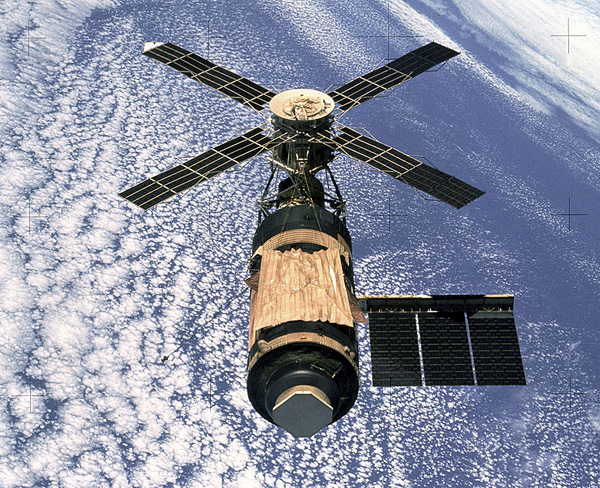
A snapshot of Skylab in low-Earth orbit...as seen by the Skylab 4 astronauts on February 8, 1974.
NASA

Friday, May 12, 2023

A Pre-Launch Milestone Is Achieved for the First Crewed Lunar Flyby Mission Since 1972...

Inside the Neil Armstrong Operations and Checkout Building at NASA's Kennedy Space Center in Florida, acoustic testing has been completed on the European Service Module that will fly with the Orion capsule on the Artemis 2 mission.
NASA / Amanda Stevenson

Artemis II Orion Service Module Completes Acoustic Testing (News Release)

Engineers recently completed a series of acoustic tests on the European Service Module for NASA’s Artemis II mission while inside the Neil Armstrong Operations and Checkout Building at NASA’s Kennedy Space Center in Florida.

During the testing, engineers surrounded the service module with large speakers and attached microphones, accelerometers and other equipment to measure the effects of different acoustic levels. Engineers and technicians will analyze the data collected during the tests to ensure that the service module can withstand the speed and vibration it will experience during launch and throughout the mission.

With this test complete, the team is on track to integrate Orion’s crew and service modules together later this year.

Source: NASA.Gov

Wednesday, May 10, 2023

Another Commercial Space Station Lurks on the Horizon...

An artist's concept of a SpaceX Crew Dragon capsule docked to Vast's Haven-1 orbital outpost.
Vast

VAST Announces the Haven-1 and VAST-1 Missions (Press Release)

Scheduled to be the world's first commercial space station, Haven-1 and subsequent human spaceflight missions will accelerate access to space exploration.

LONG BEACH, Calif. — Vast, a pioneer in space habitation technologies, announced today their plans to launch the world’s first commercial space station, called Haven-1. Scheduled to launch on a SpaceX Falcon 9 rocket to low-Earth orbit no earlier than August 2025, Haven-1 will initially act as an independent crewed space station prior to being connected as a module to a larger Vast space station currently in development.

The mission will be quickly followed by Vast-1, the first human spaceflight mission to Haven-1 on a SpaceX Dragon spacecraft. The vehicle and its four-person crew will dock with Haven-1 for up to 30 days while orbiting Earth.

Vast also secured an option with SpaceX for an additional human spaceflight mission to Haven-1.

This represents the first time in history that a commercial space station company has both a contracted launch for its space station and a visiting human spaceflight mission.

“Vast is thrilled to embark on this journey of launching the world's first commercial space station, Haven-1, and its first crew, Vast-1,” said Jed McCaleb, CEO of Vast. “We are grateful to SpaceX for this exciting partnership that represents the first steps in Vast’s long-term vision of launching much larger, artificial gravity space stations in Earth orbit and beyond.”

“A commercial rocket launching a commercial spacecraft with commercial astronauts to a commercial space station is the future of low-Earth orbit, and with Vast we’re taking another step toward making that future a reality,” said Tom Ochinero, Senior Vice President of Commercial Business at SpaceX. “The SpaceX team couldn’t be more excited to launch Vast’s Haven-1 and support their follow-on human spaceflight missions to the orbiting commercial space station.”

Vast’s long-term goal is to develop a 100-meter-long multi-module spinning artificial gravity space station launched by SpaceX’s Starship transportation system. In support of this, Vast will explore conducting the world’s first spinning artificial gravity experiment on a commercial space station with Haven-1.

Vast is selling up to four crewed seats on the inaugural mission to Haven-1. Expected customers include domestic and international space agencies and private individuals involved in science and philanthropic projects. Visit vastspace.com/reserve for more details.

SpaceX will also provide crew training on Falcon 9 and the Dragon spacecraft, emergency preparedness, spacesuit and spacecraft ingress and egress exercises, as well as partial and full mission simulations including docking and undocking with Haven-1 for return to Earth.

Source: VastSpace.com

****

Thursday, May 4, 2023

ISS Update: Russia's Newest Module Underwent a Reconfiguration During Yesterday's EVA...

Cosmonauts Sergey Prokopyev and Dmitri Petelin conduct an extra-vehicular activity outside Russia's Nauka science module at the International Space Station...on May 3, 2023.
NASA TV

Cosmonauts Move Experiment Airlock and Complete Spacewalk (News Release - May 3)

Roscosmos cosmonauts Sergey Prokopyev and Dmitri Petelin concluded their spacewalk May 3 at 11:11 p.m. EDT after 7 hours and 11 minutes.

Prokopyev and Petelin completed their major objectives, which included relocating an experiment airlock from the Rassvet module to the Nauka science module with assistance from European robotic arm operator cosmonaut Andrey Fedyaev.

This was the fifth spacewalk in Prokopyev’s career, and the third for Petelin. It is the fifth spacewalk at the station in 2023 and the 262nd spacewalk for space station assembly, maintenance and upgrades.

The two Roscosmos cosmonauts will also conduct a spacewalk on Friday, May 12, to deploy a radiator on Nauka and connect mechanical, electrical and hydraulic lines.

Source: NASA.Gov

Wednesday, May 3, 2023

NASA's Moon and Mars Exploration Initiative Has Received a New European Member...

NASA Administrator Bill Nelson looks on as Jan Lipavský, the Foreign Affairs Minister for the Czech Republic, signs the Artemis Accords at NASA Headquarters in Washington, DC...on May 3, 2023.
NASA / Joel Kowsky

NASA Welcomes Czech Foreign Minister for Artemis Accords Signing (Press Release)

During a ceremony at NASA Headquarters in Washington on Wednesday, the Czech Republic became the 24th country to sign the Artemis Accords. NASA Administrator Bill Nelson participated in the signing ceremony for the agency and Foreign Minister Jan Lipavský signed the Artemis Accords on behalf of the Czech Republic.

The Artemis Accords establish a practical set of principles to guide space exploration cooperation among nations, including those participating in NASA’s Artemis program.

“We are living through a golden age of exploration. Gone are the days of one nation exploring the cosmos alone,” said NASA Administrator Bill Nelson. “Along with our fellow Artemis Accords signatories, the United States and Czech Republic are setting a standard for 21st century exploration and use of space. As we explore together, we will explore peacefully, safely and transparently.”

Acting Assistant Secretary of State for Oceans and International Environmental and Scientific Affairs Jennifer R. Littlejohn and Czech Ambassador to the United States Miloslav Stašek also took part in the ceremony.

"I see it as a historic signature. We are joining our likeminded partners in advancing peaceful, cooperative and sustainable exploration of space,” said Foreign Minister Jan Lipavský. “Czechia’s space ecosystem has a lot to offer. We believe that this signature will kick-start the development of an institutional and industrial cooperation within the Artemis community, as well as directly between Czechia and the U.S., in the field of space activities.”

NASA, in coordination with the U.S. Department of State, established the Artemis Accords in 2020 along with the other eight original signatories. The Artemis Accords reinforce and implement the 1967 Outer Space Treaty.

They also reinforce the commitment by the United States and partner nations to the Registration Convention, the Rescue and Return Agreement, as well as best practices and norms of responsible behavior that NASA and its partners have supported, including the public release of scientific data.

“The Artemis Accords guide us towards a future of optimism and promise,” stated Acting Assistant Secretary of State for Oceans and International Environmental and Scientific Affairs Jennifer R. Littlejohn. “They encourage cooperation and responsible behavior in space. This is a vital foundation for space exploration. Congratulations to the Czech Republic!”

Additional countries will sign the Artemis Accords in the months and years ahead, as NASA continues to work with its international partners to establish a safe, peaceful and prosperous future in space. Working with both new and existing partners will add new energy and capabilities to ensure the entire world can benefit from our journey of exploration and discovery.

****

NASA will return astronauts to the Moon through its Artemis program, before setting its sights on sending a crew to Mars.
NASA

Monday, May 1, 2023

Photo of the Day: VSS Unity Is on the Verge of Returning Back to the Edge of Space After a Successful Glide Test...

VSS Unity conducts a glide test above the New Mexico desert...on April 26, 2023.
Virgin Galactic

Five days ago, Virgin Galactic successfully completed a glide test for VSS Unity above the New Mexico desert. This is SpaceShipTwo's first flight since she brought Sir Richard Branson and three co-passengers to the edge of space back in 2021.

Here are the stats from the April 26 test:

Take-off Time: 6:53 AM, MDT (5:53 AM, PDT)

Release Altitude: 47,000 ft (8.9 miles, or 14.3 kilometers)

Release Time: 7:47 AM, MDT (6:47 AM, PDT)

Landing Time: 7:56 AM, MDT (6:56 AM, PDT)

Assuming that the flight data analysis for this glide test is satisfactory, VSS Unity's next mission will be a rocket-powered suborbital flight to assess the customer experience and ground-based testing for SpaceShipTwo and her mothership, VMS Eve, prior to the launch of commercial spaceflight service from Spaceport America in just a few months. Stay tuned!