Tuesday, February 14, 2023

The Core Stage Booster for the Space Launch System's Second Flight Moves a Step Closer to Completion...

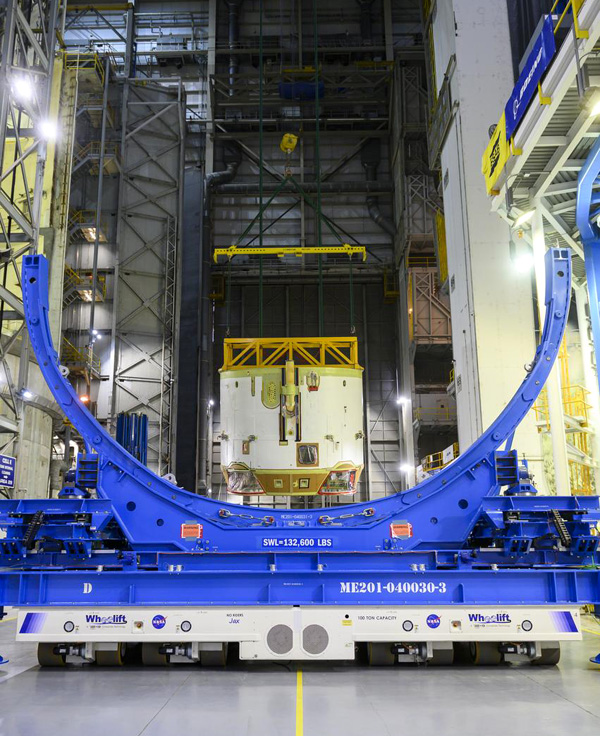
At NASA's Michoud Assembly Facility in New Orleans, Louisiana, engineers are about to place the engine section for the Space Launch System's Artemis 2 core stage booster into horizontal position...on February 11, 2023.
Eric Bordelon

NASA Flips Artemis II Engine Section, Prepares for Final Join (Photo Release - February 11)

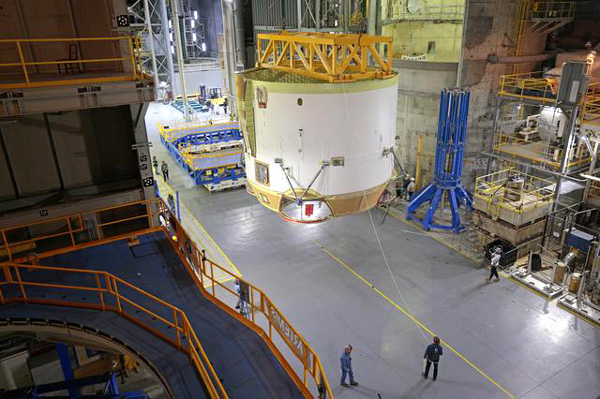
Technicians at NASA’s Michoud Assembly Facility in New Orleans flipped the engine section of NASA’s Space Launch System rocket for Artemis II from a vertical to horizontal position on February 11. The flip, also known as a breakover, is in preparation for the final assembly and integration into the core stage for the second SLS rocket.

The engine section is the bottom-most portion of the 212-foot-tall core stage and is one of the most complex and intricate portions of the rocket that will help power the first crewed Artemis mission to the Moon. It is the last of five elements that is needed to join the stage as one structure.

In addition to its miles of cabling and hundreds of sensors, the engine section is a crucial attachment point for the four RS-25 engines and two solid rocket boosters that produce a combined 8.8 million pounds of thrust at liftoff and flight. Next, teams will move the engine section into the final assembly area where they will complete the join.

After the join is complete, teams will begin to add each of the four RS-25 engines. The completely-assembled stage with its four RS-25 engines will be shipped to NASA’s Kennedy Space Center in Florida later this year.

The SLS rocket is the only rocket capable of carrying astronauts in Orion around the Moon in a single mission.

Source: NASA.Gov

****

At NASA's Michoud Assembly Facility in New Orleans, Louisiana, engineers are about to place the engine section for the Space Launch System's Artemis 2 core stage booster into horizontal position...on February 11, 2023.
Eric Bordelon

At NASA's Michoud Assembly Facility in New Orleans, Louisiana, engineers are about to place the engine section for the Space Launch System's Artemis 2 core stage booster into horizontal position...on February 11, 2023.
Michael DeMocker

At NASA's Michoud Assembly Facility in New Orleans, Louisiana, engineers begin placing the engine section for the Space Launch System's Artemis 2 core stage booster into horizontal position...on February 11, 2023.
Michael DeMocker

At NASA's Michoud Assembly Facility in New Orleans, Louisiana, engineers place the engine section for the Space Launch System's Artemis 2 core stage booster into horizontal position...on February 11, 2023.
Michael DeMocker

Monday, February 13, 2023

The Next Private Crew to Visit the ISS Has Been Given the Green Flight to Proceed Towards Launch...

Axiom Space's Ax-2 crewmembers from left to right: Commander Peggy Whitson, Pilot John Shoffner, and Mission Specialists Ali Alqarni and Rayyanah Barnawi.
Axiom Space

NASA, Partners Clear Axiom’s Second Private Astronaut Mission Crew (Press Release)

NASA and its international partners have approved the crew for Axiom Space’s second private astronaut mission to the International Space Station, Axiom Mission 2 (Ax-2).

Axiom Space’s Director of Human Spaceflight and former NASA astronaut Peggy Whitson will command the privately-funded mission. John Shoffner of Knoxville, Tennessee, will serve as pilot.

The two mission specialists, Ali Alqarni and Rayyanah Barnawi from the Kingdom of Saudi Arabia (KSA), are members of the inaugural Saudi national astronaut program. They are flying through an arrangement between KSA and Axiom Space.

“Enabling more people to go to space is an important component of NASA’s continuing efforts to grow the low-Earth orbit economy,” said Angela Hart, manager of NASA’s Commercial Low-Earth Orbit Development Program. “Private astronaut missions are a key component to enable a successful transition to a model of commercially owned and operated platforms in low-Earth orbit. I appreciate the commitment of our International Space Station and commercial partners to help us achieve this future.”

The Ax-2 crew will launch from NASA’s Kennedy Space Center in Florida aboard a SpaceX Dragon spacecraft and travel to the space station. Once docked, the private astronauts plan to spend 10 days aboard the orbiting laboratory implementing a full mission of science, outreach and commercial activities.

The mission, targeted for launch in spring 2023, will be the first private space mission to include both private astronauts and astronauts representing foreign governments, as well as the first private mission commanded by a woman.

“Axiom Space’s second private astronaut mission to the International Space Station cements our mission of expanding access to space worldwide and supporting the growth of the low-Earth orbit economy as we build Axiom Station,” said Michael Suffredini, president and CEO of Axiom Space. “Ax-2 moves Axiom Space one step closer toward the realization of a commercial space station in low-Earth orbit and enables us to build on the legacy and achievements of the station, leveraging the benefits of microgravity to better life on Earth.”

Whitson will become the first female commander of a private space mission, adding to her prior accomplishments, including as NASA’s chief astronaut and the first female commander of the space station. In addition, she will add to her standing record for the longest cumulative time in space by a NASA astronaut.

“I’m honored to be heading back to the station for the fourth time, leading this talented Ax-2 crew on their first mission,” said Whitson. “This is a strong and cohesive team determined to conduct meaningful scientific research in space and inspire a new generation about the benefits of microgravity. It’s a testament to the power of science and discovery to unify and build international collaboration.”

Shoffner, a businessman, has always had an interest in space, the stars and flying, becoming a pilot at the age of 17 and since amassing more than 8,500 flight hours and earning ratings for multiple aircraft types. He is also an advocate for science, technology engineering, arts and mathematics (STEAM) education.

The first private astronaut mission to the International Space Station, Axiom Mission 1 (Ax-1), launched on April 8, 2022, with four private astronauts who spent 17 days in orbit working on 26 science payloads aboard the station and conducting more than 30 STEAM educational and public outreach engagements. The crew splashed down off the coast of Florida on April 25, 2022, to conclude the mission.

Private astronaut missions to the space station are a precursor to privately-funded commercial space stations as part of NASA’s efforts to develop a thriving low-Earth orbit ecosystem and marketplace. NASA is currently reviewing proposals for the third and fourth private astronaut missions to the space station.

For more than 22 years, NASA has supported a continuous U.S. human presence in low-Earth orbit aboard the space station. The agency's goal is to enable a strong, commercial marketplace in low-Earth orbit where NASA is one of many customers for private industry.

This strategy will provide services the government needs at a lower cost, enabling the agency to focus on its Artemis missions to the Moon in preparation for Mars while continuing to use low-Earth orbit as a training and proving ground for those deep-space missions.

****

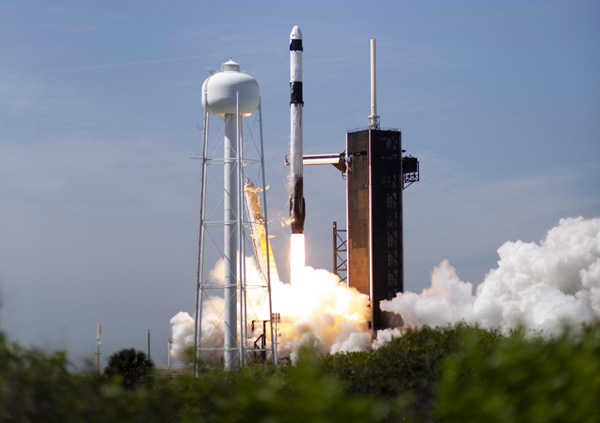
SpaceX's Falcon 9 rocket carrying Crew Dragon Endeavour and the Axiom Mission 1 astronauts lifts off from Launch Complex 39A at NASA's Kennedy Space Center in Florida...on April 8, 2022.
NASA / Joel Kowsky

Sunday, February 12, 2023

Photo of the Day: Super Heavy Booster 7 Gets LIT...

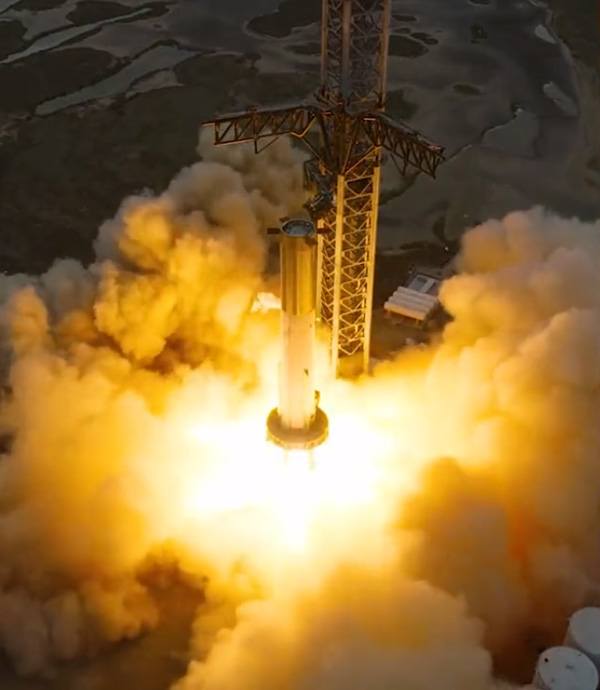
A high-angle view of Starship's Super Heavy Booster 7 firing 31 of its 33 Raptor 2 engines during a test at Starbase, Texas...on February 9, 2023.
Elon Musk

Just thought I'd share this fiery image from Super Heavy Booster 7's (B7) February 9 static fire that Elon Musk tweeted yesterday!

Mentioned in another tweet by Musk is that B7 will ignite its 33 Raptor 2 engines at 90% thrust during the actual launch (which is still scheduled for next month)...when the 31 engines that fired three days ago 'only' operated at 50% thrust, which is still more powerful than that of the Saturn V.

The lower thrust level for the inaugural flight might be due to SpaceX wanting more engine redundancy for B7 in case a few Raptor 2s shut down during launch or ascent, and also to reduce the stress on the Orbital Launch Mount—which currently doesn't have a sound suppression system installed. As shown below, such a system is in the midst of being put in place at Starbase's launch site for Starship's maiden voyage to Earth orbit!

Saturday, February 11, 2023

NASA's First Artemis Mission Continues to Do Its Thing in Lunar Orbit...

An artist's concept of NASA's CAPSTONE spacecraft orbiting the Moon.
NASA

CAPSTONE to Test Technologies After Recovery from Communications Issue (News Release - February 8)

NASA’s CAPSTONE – short for Cislunar Autonomous Positioning System Technology Operations and Navigation Experiment – is in good health following a communications issue that began in late January, and the mission team is preparing for upcoming technology demonstration tests.

Beginning on January 26, CAPSTONE was unable to receive commands from ground operators. The spacecraft remained overall healthy and on-course throughout the issue, sending telemetry data back to Earth.

On February 6, an automatic command-loss timer rebooted CAPSTONE, clearing the issue and restoring two-way communication between CAPSTONE and the ground. The CAPSTONE team, led by Advanced Space, is now preparing for continued testing of the spacecraft’s Cislunar Autonomous Positioning System, or CAPS, and other technology demonstrations.

CAPS is a navigation technology developed by Advanced Space that uses data between two or more spacecraft to pinpoint a satellite’s location in space. The test will involve two spacecraft: CAPSTONE and NASA’s Lunar Reconnaissance Orbiter (LRO).

Following interface testing with LRO’s ground systems, the CAPSTONE team attempted to gather crosslink measurements in mid-January. During this test, LRO received a signal from CAPSTONE, but CAPSTONE did not collect crosslink ranging measurements from the returned signal.

These results will help improve additional CAPS tests over the coming weeks. The team is also preparing for the mission’s other technology demonstrations, including a new CAPS data type that will use one-way uplink measurements enabled by the spacecraft’s Chip Scale Atomic Clock.

Since arriving in orbit on November 13, CAPSTONE has completed more than 12 orbits in its near-rectilinear halo orbit (NRHO) – the same orbit for Gateway – surpassing one of the mission’s objectives to achieve at least six orbits. The mission team has performed two orbit maintenance maneuvers in this time.

These maneuvers were originally scheduled to happen once per orbit, but the mission team was able to reduce the frequency while maintaining the correct orbit. This reduces risk and complexity for the mission and informs plans for future spacecraft flying in this orbit, like Gateway.

CAPSTONE is owned by Advanced Space and the spacecraft was designed and built by Terran Orbital. Operations are performed jointly by teams at Advanced Space and Terran Orbital.

The mission is funded by the Small Spacecraft Technology Program in NASA’s Space Technology Mission Directorate.

Source: NASA.Gov

****

An artist's concept of NASA's Gateway orbiting the Moon.
NASA

Friday, February 10, 2023

Starship Update #2: SpaceX Releases Official Photos (Plus New Info) About Yesterday's 31-Engine Static Fire...

A snapshot of Starship's Super Heavy Booster 7 firing 31 of its 33 Raptor 2 engines during a test at Starbase, Texas...on February 9, 2023.
SpaceX

A few hours ago, SpaceX shared this tweet featuring these four amazing photos that were taken during Super Heavy Booster 7's (B7) 31-engine static fire yesterday.

Contrary to what I typed in this previous entry, B7 didn't fire its 31 Raptor 2 engines at full power. Instead, the Raptor 2s 'only' throttled up to 7.9 million pounds (around 3,600 metric tons) of thrust...which is less than half of the vehicle's 17.1 million-pound (about 7,800 metric tons) thrust capability.

Despite the lower performance conducted during yesterday's static fire, the power generated by B7 was still greater than the 7.6 million pounds (over 3,400 metric tons) of thrust that the Saturn V unleashed at liftoff.

And since its four RS-25 engines and twin solid rocket boosters generate a combined 8.8 million pounds (up to 4,000 metric tons) of thrust during flight, NASA's Space Launch System is still the world's most powerful rocket! For the time being, that is.

A snapshot of Starship's Super Heavy Booster 7 firing 31 of its 33 Raptor 2 engines during a test at Starbase, Texas...on February 9, 2023.
SpaceX

An aerial shot of Starship's Super Heavy Booster 7 firing 31 of its 33 Raptor 2 engines during a test at Starbase, Texas...on February 9, 2023.
SpaceX

A high-angle view of Starship's Super Heavy Booster 7 firing 31 of its 33 Raptor 2 engines during a test at Starbase, Texas...on February 9, 2023.
SpaceX

Thursday, February 9, 2023

Starship Update: 31 Out of 33 Engines Successfully Come to Life in Today's Static Fire...

An aerial shot of Starship's Super Heavy Booster 7 firing 31 of its 33 Raptor 2 engines during a test at Starbase, Texas...on February 9, 2023.
SpaceX

A few hours ago, SpaceX successfully ignited 31 out of 33 Raptor 2 engines on Super Heavy Booster 7 (B7) at Starbase in Texas.

According to a tweet posted by Elon Musk shortly after the static fire, one Raptor 2 was deactivated shortly before B7 ignited its engines by Starbase mission controllers, and another Raptor 2 went offline during the 5-second test. The 31-engine thrust achieved by B7 was still great enough that it would've sent this vehicle to Earth orbit!

Even though this static fire wasn't flawless, it was still historic. Assuming that all 31 Raptor 2 engines reached full power, B7 achieved a thrust of over 15 million pounds...which is essentially double the amount that Saturn V (7.6 million pounds) and the Space Launch System (8.8 million pounds) achieved at liftoff.

Today's static fire began with the most powerful rocket ignition ever.

It remains to be seen if SpaceX will conduct another test in an attempt to ignite all 33 engines, or if B7 will be re-stacked with Starship 24 for their maiden flight into space...which is still targeted for next month.

Stay tuned!

An overhead shot, taken by a drone, of Super Heavy Booster 7 firing 31 of its 33 Raptor 2 engines during its test at Starbase, Texas...on February 9, 2023.
SpaceX

Wednesday, February 8, 2023

SLS Update: A Next-Generation RS-25 Is Tested for Artemis 5 and Beyond...

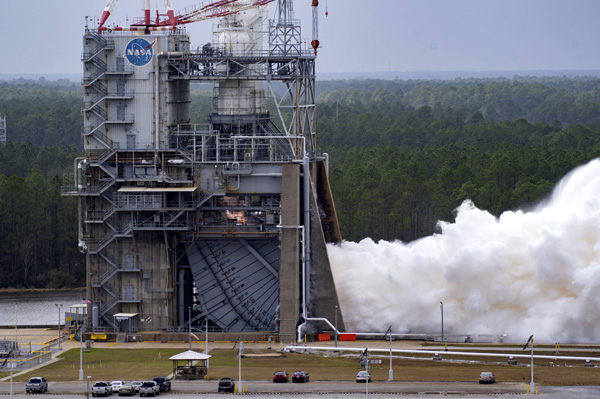
A next-generation RS-25 engine is tested on the Fred Haise Test Stand at NASA's Stennis Space Center in Bay St. Louis, Mississippi...on February 8, 2023.
NASA / Stennis

NASA Conducts First 2023 Test of Redesigned Moon Rocket Engine (Press Release)

NASA’s newly-redesigned RS-25 engine for future flights of the Space Launch System (SLS) rocket underwent its first hot fire test of the year on February 8, at the agency’s Stennis Space Center near Bay St. Louis, Mississippi.

The series of testing supports production of new RS-25 engines by lead SLS engine contractor Aerojet Rocketdyne. The new engines will help power future Artemis missions to the Moon beginning with Artemis V as NASA explores the Universe for the benefit of all.

The single-engine hot fire on the Fred Haise Test Stand followed a confidence test in 2022, which tested whether all was ready to proceed with the certification series.

During the latest test, engineers fired the RS-25 engine for a full duration of about eight and a half minutes (500 seconds), the same amount of time the engines must operate to help power SLS to space. The RS-25 engine also operated at 111% power for most of the test, the same level needed to help lift SLS to orbit.

The test featured a range of new components, most of which were installed for the December hot fire. One additional component – a new nozzle – was installed prior to the most recent hot fire.

Four RS-25 engines fire simultaneously to generate a combined 1.6 million pounds of thrust at launch and 2 million pounds of thrust during ascent to help power each SLS flight. NASA and Aerojet Rocketdyne modified 16 engines remaining from the Space Shuttle Program, which were proven flightworthy at Stennis for Artemis missions I through IV.

Every RS-25 engine that will help power SLS will be tested at NASA Stennis. RS-25 tests at the site are conducted by a combined team of NASA, Aerojet Rocketdyne and Syncom Space Services operators.

Syncom Space Services is the prime contractor for Stennis facilities and operations.

Through Artemis missions, NASA will land the first woman and first person of color on the surface of the Moon, paving the way for a long-term lunar presence and serving as a steppingstone on the way to Mars.

Source: NASA.Gov

****

The next-generation RS-25 engine is tested on the Fred Haise Test Stand at NASA's Stennis Space Center in Bay St. Louis, Mississippi...on February 8, 2023.
NASA / Stennis

Monday, February 6, 2023

On This Day in 2018: Falcon Heavy Launches for the First Time...

SpaceX's Falcon Heavy rocket lifts off on its maiden flight from Launch Complex 39A at NASA's Kennedy Space Center in Florida...on February 6, 2018.
SpaceX

It was 5 years ago today that SpaceX successfully launched its first Falcon Heavy rocket from NASA's Kennedy Space Center in Florida.

Since then, this powerful launch vehicle—comprised of three Falcon 9 core stage boosters strapped together—has successfully lifted off from Kennedy Space Center's Pad 39A five times...the most recent flight being last month for the U.S. Space Force's USSF-67 mission. That launch took place on January 15.

While SpaceX doesn't intend on human-rating Falcon Heavy (as the company's much-larger and more-capable Starship vehicle will embark on its first orbital test flight as early as next month), this rocket will play a big role in NASA's Artemis Program. It will be as soon as late November of 2024 that Falcon Heavy lifts off with the first components for NASA's Gateway lunar space station: The Power and Propulsion Element and Habitation and Logistics Outpost!

Stay tuned.

An artist's concept of the Power and Propulsion Element and Habitation and Logistics Outpost for NASA's lunar Gateway cruising through space.
NASA / Maxar Technologies

Thursday, February 2, 2023

The mobile launcher is about to enter Kennedy Space Center's Vehicle Assembly Building in Florida on December 9, 2022...after successfully sending NASA's Artemis 1 mission towards the Moon on November 16, 2022.
NASA / Ben Smegelsky

Kennedy Prepares Facilities, Spacecraft for Artemis II Mission (News Release - January 31)

On the heels of a successful Artemis I mission, NASA is focused on preparing for Artemis II – the first crewed flight of the agency’s Space Launch System (SLS) rocket and Orion spacecraft that will test all of the spacecraft’s systems with astronauts aboard. Teams with Exploration Ground Systems are upgrading and modifying facilities at the agency’s Kennedy Space Center in Florida to support Artemis II, paving the way for human exploration of the Moon and Mars.

Rocco A. Petrone Launch Control Center

Launch team members are updating the Artemis launch countdown for future missions with crew. During the countdown, teams in Firing Room 1 and 2 conduct pre-launch and liftoff activities.

Teams are updating timelines to include the crew donning spacesuits, making the trip to the launch pad, and getting into the spacecraft atop the rocket, among other activities.

Vehicle Assembly Building

Inside the Vehicle Assembly Building (VAB), engineers are replacing the portable purge units used for Artemis I with a new environmental control system (ECS) for crewed missions. The ECS provides air supply, thermal control and pressurization to the rocket and spacecraft during stacking operations in High Bay 3.

The work is scheduled for completion this year, followed by verification and validation tests performed by NASA and contractor Jacobs.

Launch Complex 39B

A new 1.4-million-gallon liquid hydrogen tank is under construction at Launch Complex 39B. The increased volume of liquid hydrogen onsite will help decrease the time between launch attempts.

Construction of the emergency egress system terminus area, which is used in the event of an emergency during launch countdown for astronauts to safely exit the spacecraft and launch pad area, is also underway. The emergency egress system will be similar to the system used during the Space Shuttle Program, which had baskets that rode on cables.

For Artemis missions, the cables will be deployed from the mobile launcher every time it moves to the pad, and the new basket will include new materials and increased capacity. Like the VAB, the pad ECS system is being upgraded to meet the needs of Artemis II and the new Block 1B SLS rocket for Artemis IV and beyond.

Engineers are on track to complete construction and upgrades this year, ahead of verification and validation tests.

Mobile Launcher 1

Modifications to the mobile launcher are underway to support astronauts and emergency egress life safety systems, capabilities that were not required for the launch of the uncrewed Artemis I flight. Modifications include developing the egress path from Orion to the new emergency egress baskets and away from the mobile launcher.

The system will enable astronauts to exit Orion at the Crew Access Arm white room through the mobile launcher tower down to the emergency transportation vehicles on the ground and onward to a safe haven. Some subsystems will undergo minor improvements.

Technicians are also repairing damage sustained during the Artemis I liftoff. Engineers expect to complete modifications later this year.

Crawler-Transporter 2

Teams are in the process of modifying and upgrading the crawler-transporter 2 (CT-2). They will replace the “shoes” on the two large tracks the crawler rolls on.

The first shipment of 16 new steering cylinders have arrived and technicians will perform corrosion control on the truck’s interior. Later this year, CT-2 will transport the mobile launcher to Launch Complex 39B for testing.

Orion Processing Facility

Engineers are nearing completion of assembly, integration and testing for the Artemis II Orion crew module. The module has additional hardware required for astronauts to live in space not included on the Artemis I spacecraft, including normal and emergency communication components, display units, hand controllers, full-fidelity side and docking hatches, environmental control and life support subsystems for nitrogen, oxygen, water and air, as well as waste management, and fire detection and suppression.

Crew seats, a system for reheating and rehydrating food, and medical and exercise equipment will also be in the crew module. The crew module will undergo thermal cycle testing this spring, followed by final functional tests and acoustics testing.

Engineers have nearly completed assembly and testing for the service module. Remaining operations include installation of the spacecraft adapter cone, spacecraft separation mechanisms, and nozzle on the orbital maneuvering system engine.

Acoustics testing is also planned for this spring, and optical communication hardware will also be installed and tested.

Orion Heat Shield

Processing continues on Orion’s heat shield for Artemis II. The heat shield is projected to be ready for attachment to the crew module this spring.

Altitude Chambers

Upgrades are being made to one of two altitude chambers inside the Neil Armstrong Operations and Checkout Building high bay to support Artemis II testing. The chambers can simulate the conditions of a deep-space environment with a vacuum equivalent of approximately 200,000 feet in space.

Launch Abort System

The launch abort system motor is about 90% through assembly, integration and testing. The jettison motor has been secured to the abort motor, and the forward interstage has been attached to the attitude control motor.

Remaining operations include installing and testing electrical and development flight instrumentation harnesses, ordnance, covers and panels and conducting a functional test of the attitude control motor.

Orion Recovery

The landing and recovery team is training to safely recover astronauts and Orion after splashdown in the Pacific Ocean. Preparations include practicing scenarios with the crew module test article and conducting recovery tests off the coast of California.

After splashing down on crewed missions, astronauts will exit the capsule onto an inflatable “front porch” where they will be picked up by helicopters and flown back to the recovery ship.

Source: NASA.Gov

****

On January 16, 2023, the orbital maneuvering system nozzle is attached to the European Service Module that will fly on NASA's Artemis 2 mission.
NASA

Wednesday, February 1, 2023

On This Day in 2003: The Columbia is Lost...

A video screenshot showing debris falling out of the sky after the orbiter Columbia disintegrated above Texas during re-entry into Earth's atmosphere...on February 1, 2003.

It was 20 years ago this morning, at 8:59 AM, EST (5:59 AM, PST), that tragedy took place in the skies above Texas and Louisiana.

15 minutes away from touching down at Kennedy Space Center's Shuttle Landing Facility in Florida to complete mission STS-107, Columbia fell short of its destination when the searing heat of re-entry penetrated the orbiter thanks to a hole in its left wing caused by a piece of foam that broke off of Columbia's external tank during its January 16 launch...and struck the wing's reinforced carbon–carbon panel less than a second later. The seven astronauts onboard didn't know what was about to befall them until it was too late.

Rest In Peace, Rick D. Husband, William C. McCool, David M. Brown, Kalpana Chawla, Michael P. Anderson, Laurel B. Clark and Ilan Ramon. As former President George W. Bush said in a nationally-televised speech to stunned Americans a few hours after the disaster:

"The cause in which they died will continue. Mankind is led into the darkness beyond our world by the inspiration of discovery and the longing to understand. Our journey into space will go on."

A group photo of the STS-107 astronauts that was recovered after the Columbia disaster.
NASA / Rick D. Husband

And indeed, our journey into space did go on. While President Bush announced in 2004 the eventual retirement of the space shuttle fleet, Columbia's sister ships Discovery, Atlantis and Endeavour flew long enough to see that the core assembly of the International Space Station was completed in 2011, the Hubble Space Telescope enjoyed a visit by servicing astronauts one last time in 2009, and the baton would be passed to commercial companies like SpaceX, as well as NASA's next spaceship and super heavy-lift booster: the Orion Multi-Purpose Crew Vehicle and the Space Launch System rocket.

The Columbia's loss led to the end of the Space Shuttle Program, but it also resulted in something grander: Our return to the Moon and beyond.

From the Vision for Space Exploration in 2004 to Constellation in 2006, and to the now-fledgling Artemis Program, humanity's journey back to deep space is only just beginning...

And that is the true legacy of the STS-107 astronauts. Ad astra.

A snapshot of NASA's Orion spacecraft with the Moon visible in the distance...on November 20, 2022.
NASA