Saturday, November 5, 2022

The Space Launch System's Block 1B Variant Moves Closer to Attaining a Finalized Design...

An artist's concept of the Space Launch System Block 1B rocket standing tall at Kennedy Space Center's Launch Complex 39B in Florida.
NASA

NASA Progresses Design of More Powerful SLS Rocket (News Release - November 4)

NASA reached a milestone toward enhancing the Space Launch System (SLS) rocket for future missions to deep space. Managers convened November 3 for the critical design review of the Block 1B evolved configuration of the rocket and determined teams will continue with design and initial production work for the evolved rocket design.

Beginning with Artemis IV, the SLS rocket will fly using the evolved Block 1B configuration with a more powerful Exploration Upper Stage (EUS) that includes larger fuel tanks and four RL10 engines, and a new stage adapter and payload adapter to send the crewed Orion spacecraft and large cargos to the Moon on a single mission.

This Block 1B configuration will be capable of launching more than 80,000 pounds of payload to the Moon, includes new flight software capabilities, allows for more launch date opportunities and enhances crew safety. It will be capable of lifting 40% more mass than the current Block 1 SLS configuration that will soon launch the uncrewed Artemis I flight test, as well as the Artemis II and III missions.

The Block 1 configuration uses an interim cryogenic propulsion stage with one RL10 engine to provide in-space propulsion to send Orion to the Moon.

Early production work on an EUS structural test article is already in progress at NASA’s Michoud Assembly Facility in New Orleans, and teams recently delivered the interstage simulator to NASA’s Stennis Space Center near Bay St. Louis, Mississippi, for future testing.

As teams at Michoud build SLS core stages for future Artemis missions, they are also testing the weld parameters on the recently manufactured EUS hydrogen tank barrel weld confidence article. These tests will allow engineers to construct the EUS structural test article that will be used to qualify the stage for flight.

Manufacturing the upper stage is a collaborative effort between NASA and Boeing, the lead contractor for EUS and the SLS core stage.

Through Artemis, NASA will land the first woman and first person of color on the lunar surface and establish long-term exploration on the Moon in preparation for human missions to Mars. SLS and NASA’s Orion spacecraft, along with the commercial Human Landing System and Gateway in orbit around the Moon, are NASA’s backbone for deep space exploration.

SLS is the only rocket that can send Orion, astronauts and supplies to the Moon in a single mission.

Source: NASA.Gov

****

An artist's concept of the Space Launch System Block 1B rocket soaring into the sky.
NASA

Friday, November 4, 2022

SLS Is Back at Pad 39B for Its November 14 Launch Attempt...

NASA's Space Launch System rocket stands tall on Pad 39B at Kennedy Space Center in Florida...on November 4, 2022.
NASA / Joel Kowsky

Artemis I Moon Rocket Arrives at Launch Pad Ahead of Historic Mission (News Release)

Around 8:30 a.m. EDT on November 4, the Space Launch System rocket and Orion spacecraft for the Artemis I mission arrived at Launch Complex 39B at NASA’s Kennedy Space Center in Florida after a nearly nine-hour journey from the Vehicle Assembly Building.

Teams will continue working to configure SLS and Orion for the upcoming November 14 launch attempt.

Source: NASA.Gov

****

A fish-eye view of NASA's Space Launch System rocket as it departs from Kennedy Space Center's Vehicle Assembly Building in Florida...just before midnight on November 4, 2022.
NASA / Joel Kowsky

NASA's Space Launch System rocket approaches the pedestal at Kennedy Space Center's Pad 39B in Florida...on November 4, 2022.
NASA / Joel Kowsky

As seen from the crawlerway, NASA's Space Launch System rocket stands tall at Kennedy Space Center's Pad 39B in Florida...on November 4, 2022.
NASA / Joel Kowsky

Thursday, November 3, 2022

The CST-100's First Crewed Flight to the ISS Will Now Launch in Spring of Next Year...

Boeing's Starliner capsule is about to dock with the International Space Station...on May 20, 2022.
Serg Korsakov

NASA, Boeing Adjust Starliner Crew Flight Test Launch Date (News Release)

The Crew Flight Test (CFT) of Boeing’s CST-100 Starliner is now targeted to launch in April 2023, a window Boeing and NASA agree is the optimal timeframe for the International Space Station's visiting vehicle schedule.

“We understand our customer must consider the needs of the International Space Station in scheduling the certification flight of a second U.S. commercial crew transportation system,” said Mark Nappi, vice president and program manager for the Starliner program. “We are working to have the CFT vehicle ready to fly ahead of the new launch date.”

The refurbishment of a previously-flown crew module and production of a new service module for CFT are continuing at Boeing’s Commercial Crew and Cargo Processing Facility in Florida. Once both modules are complete, they’ll be mated and tested for flight.

The Starliner team recently completed a successful Crew Validation Test (CVT) with NASA astronauts Butch Wilmore, Suni Williams and Mike Fincke. CVT is a critical milestone conducted near completion of the crew module and is a measure of confidence for the astronauts as they progress towards launch.

Boeing and NASA are working together to achieve flight readiness. In-flight anomalies from Starliner’s Orbital Flight Test-2 (OFT-2) are on a path to close in the coming weeks, following thorough data reviews, fault tree analyses and agreed-to mitigation plans.

“Starliner’s two uncrewed orbital flight tests provided invaluable information about our spacecraft,” Nappi said. “Additional learnings are expected as Starliner transitions from a fully autonomous flight without crew to flights with crew. With the help of experienced NASA test pilots, Wilmore and Williams, we are closer to our goal of flying a safe and capable spacecraft.”

Source: StarlinerUpdates.com

Wednesday, November 2, 2022

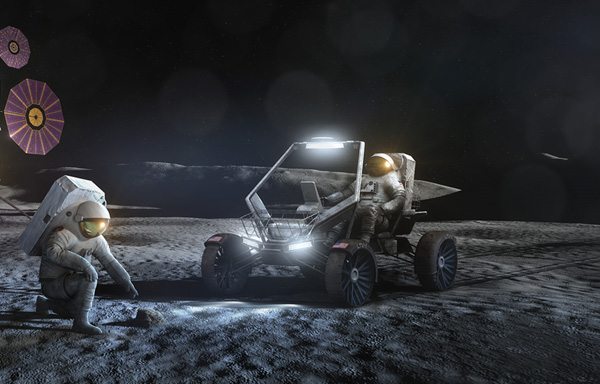
Conceptual Planning Continues for the Lunar Rover That Will Be Utilized in the Artemis Program...

An artist's concept of two astronauts exploring the Moon's surface using a Lunar Terrain Vehicle.
NASA

NASA Makes Progress with New Lunar Terrain Vehicle Moon Rover Services (News Release)

As astronauts explore the South Pole region of the Moon during Artemis missions, they will be able to go farther and conduct more science than ever before thanks to a new Lunar Terrain Vehicle (LTV). Instead of owning the vehicle, NASA plans to contract it as a service from industry.

The draft request for proposals for the LTV Services (LTVS) contract is now ready for industry to review, and NASA will accept feedback until December 1. The draft outlines NASA’s expectation for use of the LTV on the lunar surface in the 2028 timeframe. After taking industry feedback into account, NASA plans to issue a final request for proposals by early 2023.

“This draft is one of the first important steps in this exciting project that will allow astronauts to explore farther on the Moon than ever before,” says Lara Kearney, manager of the Extravehicular Activity (EVA) and Human Surface Mobility (HSM) Program at NASA’s Johnson Space Center in Houston. “Gaining industry feedback is crucial as we move forward in issuing a final request for proposal.”

This iconic style of unpressurized, human-class rover—which debuted during the Apollo missions—is a cornerstone in NASA’s plans to develop a long-term presence on the lunar surface. While those human-driven vehicles expanded lunar exploration capabilities significantly, the new Artemis LTV will feature multiple upgrades and advanced technology.

Because Artemis missions will be targeting the lunar South Pole area, the new LTV must be able to withstand and operate in cold and unique lighting conditions. The Artemis LTV is also expected to be able to cover a range of hundreds of miles per year, enabling access to diverse locations that will facilitate science discoveries, resource prospecting and exploration. It will also be capable of remote operation and will be available for other commercial uses when not carrying out NASA research and operations.

Contracting services from industry partners allows NASA to leverage commercial innovation and provide the best value to U.S. taxpayers while achieving its human spaceflight and exploration goals. The contract will support continued science and long-term human exploration at the Moon under Artemis, which will land the first woman and first person of color on the lunar surface.

Source: NASA.Gov

Monday, October 31, 2022

Happy Halloween, Everyone! NASA's First Artemis Mission Is 13 Days Away from Arriving at the Moon...

An artist's concept of NASA's CAPSTONE spacecraft orbiting the Moon.
NASA

CAPSTONE Completes Successful Maneuver, Teeing Up Moon Orbit (News Release)

The CAPSTONE spacecraft successfully completed a trajectory correction maneuver on Thursday, October 27, teeing up the spacecraft’s arrival in lunar orbit on November 13.

CAPSTONE is no longer in safe mode following an issue in early September that caused the spacecraft to spin. The team identified the most likely cause as a valve-related issue in one of the spacecraft’s eight thrusters. The mission team will design future maneuvers to work around the affected valve, including the two remaining trajectory correction maneuvers scheduled before CAPSTONE’s arrival in orbit at the Moon.

CAPSTONE – short for Cislunar Autonomous Positioning System Technology Operations and Navigation Experiment – is owned by Advanced Space on behalf of NASA. The spacecraft was designed and built by Terran Orbital. Operations are performed jointly by teams at Advanced Space and Terran Orbital.

Source: NASA.Gov

****

Friday, October 28, 2022

The SLS Rocket Is Set to Return to Launch Complex 39B on November 4...

NASA's Space Launch System rocket stands tall on the pad at Kennedy Space Center's Launch Complex 39B in Florida...on September 15, 2022.
NASA / Jason Parrish

NASA to Provide Update on Artemis I Moon Mission (Press Release)

NASA will host a media teleconference at 12 p.m. EDT Thursday, November 3, to discuss the status of its Artemis I flight test that will launch the Space Launch System (SLS) rocket from NASA’s Kennedy Space Center in Florida. The uncrewed mission will send the Orion spacecraft beyond the Moon and back to Earth before future missions with crew.

Audio of the call will livestream on the agency’s website at:

https://www.nasa.gov/live

Briefing participants include:

- Jim Free, associate administrator, Exploration Systems Development Mission Directorate, NASA Headquarters
- Cliff Lanham, senior vehicle operations manager, Exploration Ground Systems Program, Kennedy

To participate by telephone, media must RSVP no later than two hours before the briefing to: ksc-newsroom@mail.nasa.gov.

NASA is planning to roll the SLS rocket and Orion spacecraft to Launch Complex 39B at Kennedy Friday, November 4, at 12:01 a.m. ahead of launch.

The agency continues to target launch for Monday, November 14, with liftoff planned during a 69-minute launch window that opens at 12:07 a.m. EST. A launch on November 14 would result in a mission duration of about 25-and-a-half days with a splashdown in the Pacific Ocean Friday, December 9.

Through Artemis missions, NASA will land the first woman and first person of color on the Moon, paving the way for a long-term lunar presence, and serving as a steppingstone to send astronauts to Mars.

****

Thursday, October 20, 2022

NASA Continues to Gear Up for Artemis 3 and Lunar Flights Beyond...

Inside the Neil Armstrong Operations & Checkout Building at NASA's Kennedy Space Center in Florida, workers process the newly-arrived heat shield that will fly on Orion for the Artemis 3 mission.
NASA

Progress Continues for Future Orion Missions (News Release)

As NASA readies for the Artemis I flight test, the agency is gearing up for future Artemis missions that will send astronauts to the Moon for the first time in 50 years.

Engineers are outfitting the Orion crew and service modules for Artemis II, the first mission with astronauts that will carry astronauts around the Moon, in the Neil Armstrong Operations & Checkout (O&C) Building at Kennedy Space Center in Florida. Both elements were powered on for the first time in recent months, and technicians have been performing electrical and mechanical work to support a series of functional tests to ensure the spacecraft systems are routing power and operating as designed. All three of Orion’s launch abort system motors for the Artemis II test flight are also at Kennedy and ready for integration and stacking.

At the same time, engineers and technicians are making progress towards Artemis III. NASA’s Super Guppy aircraft delivered the heat shield for Artemis III from Lockheed Martin’s facility in Waterton, Colorado, to Kennedy on October 18. In the coming months, technicians will attach more than 180 blocks of Avcoat, an ablative material, to the heat shield and install them on the bottom of Orion’s crew module. The Artemis III crew module is also undergoing assembly of interior and exterior secondary structures in the O&C, while teams at Airbus, the European Space Agency’s lead contract for the service module, are working on the Artemis III European Service Module in Bremen, Germany.

“Our team is ready for Orion’s first flight atop the Space Launch System rocket on Artemis I and working in parallel to support future Artemis missions to the Moon,” said Howard Hu, Orion program manager at NASA’s Johnson Space Center in Houston. “We are making significant progress on multiple Orion spacecraft in various stages of production and assembly for Artemis II, III and IV.”

Teams at NASA’s Michoud Assembly Facility in New Orleans are welding the Artemis IV pressure vessel that will protect astronauts from the vacuum of space, with final welding expected to occur later this fall. The primary structure of the Artemis IV European-built service module also has been completed and shipped from Thales Alenia Space in Turin, Italy, to Airbus facilities in Bremen where it will undergo assembly and integration.

NASA has also ordered production of Orion spacecraft for Artemis VI through Artemis VIII. The order is valued at $1.99 billion and is part of the agency’s Orion Production and Operations Contract with Lockheed Martin, lead contractor for Orion. NASA procured the spacecraft for Artemis III through V in 2019 for $2.7 billion under the contract.

By ordering Orion production in groups of three spacecraft, NASA is capitalizing on efficiencies available in the supply chain to improve production, lower costs and allow for reusability. NASA and Lockheed Martin plan to refurbish the Artemis III pressure vessel for Artemis VI. A host of interior elements such as flight computers, crew seats, switch panels and other avionics will be reused.

With Artemis, NASA will land the first woman and first person of color on the lunar surface and establish long-term exploration at the Moon in preparation for human missions to Mars. NASA’s Space Launch System rocket and Orion spacecraft, along with the commercial Human Landing System and Gateway in orbit around the Moon, are NASA’s backbone for deep space exploration.

Source: NASA.Gov

****

An artist's concept of NASA's Orion spacecraft flying above the Moon.
NASA

Monday, October 17, 2022

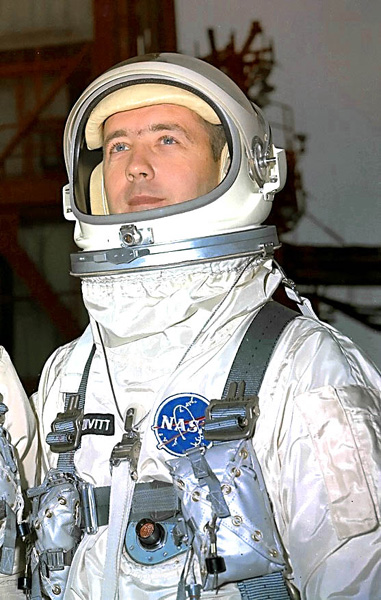
Remembering Another Space Pioneer from the Apollo Era...

A file photo of NASA astronaut James McDivitt in his spacesuit for the Gemini 4 mission.
NASA

Apollo Astronaut James McDivitt Dies at Age 93 (Press Release)

Former NASA astronaut James A. McDivitt, who commanded the Gemini IV and Apollo 9 missions, died October 13. McDivitt passed away peacefully in his sleep surrounded by his family and friends in Tucson, Arizona. He was 93 years old.

McDivitt was born June 10, 1929, in Chicago. He graduated from Kalamazoo Central High School, in Kalamazoo, Michigan, before going on to receive a Bachelor of Science degree in Aeronautical Engineering from the University of Michigan, graduating first in his class in 1959.

He joined the Air Force in 1951 and retired with the rank of Brigadier General. He flew 145 combat missions during the Korean War in F-80 and F-86 aircraft. He was a graduate of the U.S. Air Force Experimental Test Pilot School and the U.S. Air Force Aerospace Research Pilot course and served as an experimental test pilot at Edwards Air Force Base, California. He logged more than 5,000 flying hours during his piloting career.

McDivitt was selected as an astronaut by NASA in September 1962 as part of NASA's second astronaut class.

He first flew in space as commander of the Gemini IV mission in June 1965. McDivitt was joined by fellow Air Force pilot Ed White on the program’s most ambitious flight to date. During Gemini IV, White would become the first American to venture outside of his spacecraft for what is officially known as an extravehicular activity (EVA) or as the world has come to know it, a spacewalk. In the following years, it was a skill that allowed Apollo explorers to walk on the Moon and American astronauts and their partners from around the world to build the International Space Station. The mission’s four-day duration nearly doubled NASA astronauts’ previous time in space to that point, with the longest American spaceflight previously being Gordon Cooper’s 34-hour Mercury 9 mission.

McDivitt’s second spaceflight as the commander of Apollo 9 played a critical role in landing the first humans on the Moon. This was the first flight of the complete set of Apollo hardware and was the first flight of the Lunar Module. The mission launched from NASA’s Kennedy Space Center on March 3, 1969, with Commander James McDivitt, Command Module Pilot David Scott and Lunar Module Pilot Russell Schweickart. After launch, Apollo 9 entered Earth orbit and the crew performed an engineering test of the first crewed lunar module, nicknamed “Spider,” from beginning to end. They simulated the maneuvers that would be performed during actual lunar missions.

During the mission, the astronauts performed a series of flight tasks with the command and service modules and the lunar module. The top priority was rendezvous and docking of the lunar module with the command and service modules. The crew also configured the lunar module to support a spacewalk by McDivitt and Schweickart. On Flight Day 10, March 13, 1969, the Apollo 9 capsule re-entered Earth’s atmosphere and splashed down in the Atlantic Ocean, within three miles and in full view of the recovery ship, the USS Guadalcanal, about 341 miles north of Puerto Rico.

McDivitt logged more than 14 days in space.

After Apollo 9, he became manager of lunar landing operations, and led a team that planned the lunar exploration program and redesigned the spacecraft to accomplish this task. In August 1969, he became manager of the Apollo Spacecraft Program, guiding the program through Apollo 12, 13, 14, 15 and 16.

McDivitt retired from the U.S. Air Force and left NASA in June 1972, to take the position of executive vice-president, corporate affairs for Consumers Power Company. In March 1975, he joined Pullman, Inc. as executive vice-president and a director. In October 1975 he became president of the Pullman Standard Division, The Railcar Division, and later had additional responsibility for the leasing, engineering and construction areas of the company. In January 1981 he joined Rockwell International as senior vice president, government operations, and Rockwell International Corporation, Washington, D.C.

His numerous awards included two NASA Distinguished Service Medals and the NASA Exceptional Service Medal. For his service in the U.S. Air Force, he also was awarded two Air Force Distinguished Service Medals, four Distinguished Flying Crosses, five Air Medals and U.S. Air Force Astronaut Wings. McDivitt also received the Chong Moo Medal from South Korea, the U.S. Air Force Systems Command Aerospace Primus Award, the Arnold Air Society JFK Trophy, the Sword of Loyola and the Michigan Wolverine Frontiersman Award.

****

Friday, October 14, 2022

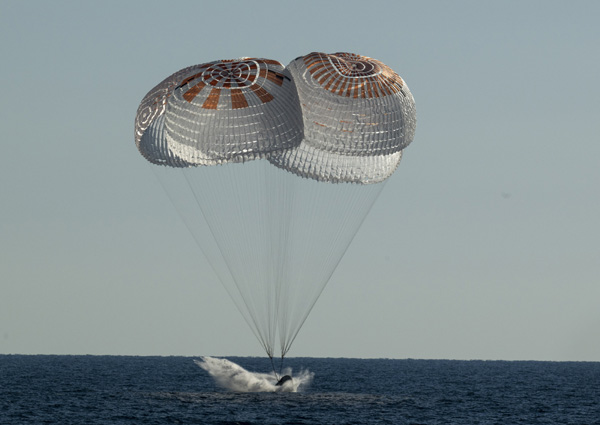
Crew Dragon Freedom Has Successfully Returned Home...

SpaceX's Crew Dragon Freedom capsule safely splashes down in the Atlantic Ocean, off the coast of Jacksonville, Florida, on October 14, 2022.
NASA / Bill Ingalls

NASA’s SpaceX Crew-4 Astronauts Safely Splash Down in Atlantic (Press Release)

NASA’s SpaceX Crew-4 astronauts aboard the Dragon spacecraft safely splashed down Friday off the coast of Jacksonville, Florida, completing the agency’s fourth commercial crew mission to the International Space Station. The international crew of four spent 170 days in orbit.

NASA astronauts Bob Hines, Kjell Lindgren and Jessica Watkins, and ESA (European Space Agency) astronaut Samantha Cristoforetti returned to Earth in a parachute-assisted splashdown at 4:55 p.m. EDT. Teams aboard SpaceX recovery vessels retrieved the spacecraft and astronauts. After returning to shore, all astronauts will fly to NASA’s Johnson Space Center in Houston. Cristoforetti will then board a plane to Europe.

“Welcome home Crew-4! This international crew has spent nearly six months on the International Space Station conducting science for the benefit of all. Their work aboard the orbiting laboratory will help prepare future explorers for future space missions,” said NASA Administrator Bill Nelson. “Working and living on the space station is the opportunity of a lifetime, but it also requires these explorers to make sacrifices, especially time away from loved ones. Kjell, Bob, Jessica and Samantha, thank you for your contributions over the past six months to science, innovation and discovery!"

The Crew-4 mission launched at 3:52 a.m. EDT April 27 on a Falcon 9 rocket from NASA’s Kennedy Space Center in Florida. Less than 16 hours later, Dragon docked to the Harmony module’s space-facing port. The astronauts undocked from the same port at 12:05 p.m. Friday, to begin the trip home.

Hines, Lindgren, Watkins and Cristoforetti traveled 72,168,935 miles during their mission, spent 170 days aboard the space station and completed 2,720 orbits around Earth. Lindgren has logged 311 days in space over his two flights, and with the completion of their flight today, Cristoforetti has logged 369 days in space on her two flights, making her second on the all-time list for most days in space by a woman. The Crew-4 mission was the first spaceflight for Hines and Watkins.

Throughout their mission, the Crew-4 astronauts contributed to a host of science and maintenance activities and technology demonstrations. Cristoforetti completed two spacewalks with Roscosmos cosmonaut Oleg Artemyev to perform station maintenance and upgrades.

Crew-4 continued work on investigations documenting how improvements to the space diet affect immune function and the gut microbiome, determining the effect of fuel temperature on the flammability of a material, exploring possible adverse effects on astronaut hearing from equipment noise and microgravity, and studying whether additives increase or decrease the stability of emulsions. The astronauts also investigated microgravity-induced changes in the human immune system similar to aging, tested a novel water-reclamation membrane, and examined a concrete alternative made with a material found in lunar and Martian dust.

The spacecraft, named Freedom by Crew-4, will return to Florida for inspection and processing at SpaceX’s Dragon Lair, where teams will examine the spacecraft’s data and performance throughout the flight.

The Crew-4 flight is part of NASA’s Commercial Crew Program and its return to Earth follows on the heels of NASA’s SpaceX Crew-5 launch, which docked to the station October 6, beginning another science expedition.

The goal of NASA’s Commercial Crew Program is safe, reliable and cost-effective transportation to and from the International Space Station. This already has provided additional research time and has increased the opportunity for discovery aboard humanity’s microgravity testbed for exploration, including helping NASA prepare for human exploration of the Moon and Mars.

****

Thursday, October 13, 2022

The Maiden Flight of the SLS Rocket Is Officially Scheduled for Mid-November...

NASA's Space Launch System rocket inside the Vehicle Assembly Building at Kennedy Space Center in Florida.
NASA

NASA Sets Date for Next Launch Attempt for Artemis I Moon Mission (News Release - October 12)

NASA is targeting the next launch attempt of the Artemis I mission for Monday, November 14 with liftoff of the Space Launch System (SLS) rocket carrying the Orion spacecraft planned during a 69-minute launch window that opens at 12:07 a.m. EST. Artemis I is an uncrewed flight test to launch SLS and send Orion around the Moon and back to Earth to thoroughly test its system before flights with astronauts.

Inspections and analyses over the previous week have confirmed minimal work is required to prepare the rocket and spacecraft to roll out to Launch Complex 39B at Kennedy Space Center in Florida following the rollback due to Hurricane Ian. Teams will perform standard maintenance to repair minor damage to the foam and cork on the thermal protection system and recharge or replace batteries on the rocket, several secondary payloads and the flight termination system. The agency plans to roll the rocket back to the launch pad as early as Friday, November 4.

NASA has requested back-up launch opportunities for Wednesday, November 16, at 1:04 a.m. and Saturday, November 19, at 1:45 a.m., which are both two-hour launch windows. A launch on November 14 would result in a mission duration of about 25-and-a-half days with a splashdown in the Pacific Ocean Friday, December 9.

Source: NASA.Gov

****