Showing posts with label Artemis 6. Show all posts

Friday, August 14, 2026

Assembly Has Begun on the Sixth Space Launch System!

At NASA's Michoud Assembly Facility in New Orleans, Louisiana, the first component for Artemis 6's Space Launch System rocket stage is completed...as of August 14, 2026.
Michael DeMocker

Production Begins on Artemis VI Core Stage Hardware (Photo Release)

Teams at NASA’s Michoud Assembly Facility in New Orleans continue to make progress manufacturing core stages for the SLS (Space Launch System) rocket. In August, teams with NASA and Boeing, SLS core stage prime contractor, completed the first ring for the sixth SLS core stage. The core stage rings are welded together through a friction-stir welding process.

A completed ring is 27.6 feet in diameter and serves as a connection point to join the large core stage structures together. The rings also provide structural stability to the bottom of the domes.

The 212-foot-tall SLS rocket core stage is made up of 10 major barrel sections, four dome sections, and seven rings. The components come together to form the five major sections of the core stage – the engine section, liquid hydrogen tank, intertank, liquid oxygen tank, and forward skirt.

Source: NASA.Gov

****

At NASA's Michoud Assembly Facility in New Orleans, Louisiana, the first component for Artemis 6's Space Launch System rocket stage is completed...as of August 14, 2026.
Michael DeMocker

Saturday, September 16, 2023

Germany Is Now Working on Crucial Flight Hardware for Artemis 6...

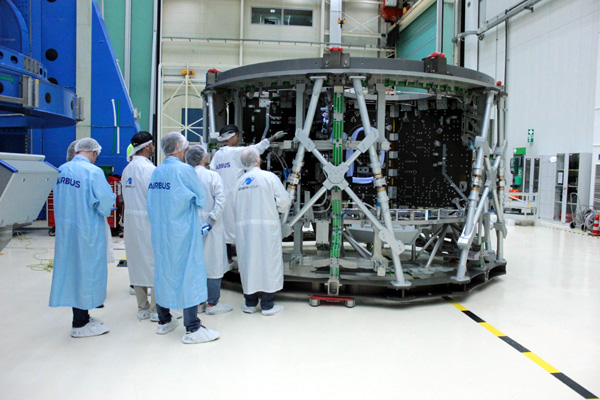
A snapshot of the European Service Module that will fly on the Artemis 6 mission.
Airbus Space

European Service Module-6 Structure Ready for Integration (News Release - September 14)

First steps to the Moon: on 31 August the sixth European Service Module structure moved from its Thales Alenia Space manufacturing hall in Turin, Italy, to arrive at the Airbus integration halls in Bremen, Germany on 8 September. The structure will be used to support all the equipment to keep Artemis astronauts alive and propel them to the lunar Gateway on the Artemis VI mission.

The trip took nine days over European roads via Austria in a special convoy.

Much like a car chassis, this structure forms the basis for all further assembly of the spacecraft, including 11 km of wiring, 33 engines, four tanks to hold over 8,000 litres of fuel, enough water and air to keep four astronauts alive for 20 days in space and the seven-metre ‘X-wing’ solar arrays that provide enough electricity to power two households.

The European Service Module structure provides rigidity to the Orion spacecraft and absorbs the vibrations and energy from launch while protecting the hardware from micrometeoroids and space debris during flight.

There are now no less than four European Service Modules lined up and in production in the Airbus integration halls. The third service module for Artemis is finalising production and will be shipped to NASA’s Kennedy Space Center later this year.

The fourth European Service Module is starting to be built up so that it can power four astronauts and the first European Gateway module around the Moon, I-Hab, similarly to its younger sibling, the European Service Module-5.

The Artemis II astronauts will be visiting the four modules in Bremen this week as part of a general progress meeting between NASA, ESA and suppliers for the Orion spacecraft.

When ready for launch, each module will weigh 13,500 kg on the launch pad, almost two-thirds of which is propellant (rocket fuel).

Source: European Space Agency

Thursday, October 20, 2022

NASA Continues to Gear Up for Artemis 3 and Lunar Flights Beyond...

Inside the Neil Armstrong Operations & Checkout Building at NASA's Kennedy Space Center in Florida, workers process the newly-arrived heat shield that will fly on Orion for the Artemis 3 mission.
NASA

Progress Continues for Future Orion Missions (News Release)

As NASA readies for the Artemis I flight test, the agency is gearing up for future Artemis missions that will send astronauts to the Moon for the first time in 50 years.

Engineers are outfitting the Orion crew and service modules for Artemis II, the first mission with astronauts that will carry astronauts around the Moon, in the Neil Armstrong Operations & Checkout (O&C) Building at Kennedy Space Center in Florida. Both elements were powered on for the first time in recent months, and technicians have been performing electrical and mechanical work to support a series of functional tests to ensure the spacecraft systems are routing power and operating as designed. All three of Orion’s launch abort system motors for the Artemis II test flight are also at Kennedy and ready for integration and stacking.

At the same time, engineers and technicians are making progress towards Artemis III. NASA’s Super Guppy aircraft delivered the heat shield for Artemis III from Lockheed Martin’s facility in Waterton, Colorado, to Kennedy on October 18. In the coming months, technicians will attach more than 180 blocks of Avcoat, an ablative material, to the heat shield and install them on the bottom of Orion’s crew module. The Artemis III crew module is also undergoing assembly of interior and exterior secondary structures in the O&C, while teams at Airbus, the European Space Agency’s lead contract for the service module, are working on the Artemis III European Service Module in Bremen, Germany.

“Our team is ready for Orion’s first flight atop the Space Launch System rocket on Artemis I and working in parallel to support future Artemis missions to the Moon,” said Howard Hu, Orion program manager at NASA’s Johnson Space Center in Houston. “We are making significant progress on multiple Orion spacecraft in various stages of production and assembly for Artemis II, III and IV.”

Teams at NASA’s Michoud Assembly Facility in New Orleans are welding the Artemis IV pressure vessel that will protect astronauts from the vacuum of space, with final welding expected to occur later this fall. The primary structure of the Artemis IV European-built service module also has been completed and shipped from Thales Alenia Space in Turin, Italy, to Airbus facilities in Bremen where it will undergo assembly and integration.

NASA has also ordered production of Orion spacecraft for Artemis VI through Artemis VIII. The order is valued at $1.99 billion and is part of the agency’s Orion Production and Operations Contract with Lockheed Martin, lead contractor for Orion. NASA procured the spacecraft for Artemis III through V in 2019 for $2.7 billion under the contract.

By ordering Orion production in groups of three spacecraft, NASA is capitalizing on efficiencies available in the supply chain to improve production, lower costs and allow for reusability. NASA and Lockheed Martin plan to refurbish the Artemis III pressure vessel for Artemis VI. A host of interior elements such as flight computers, crew seats, switch panels and other avionics will be reused.

With Artemis, NASA will land the first woman and first person of color on the lunar surface and establish long-term exploration at the Moon in preparation for human missions to Mars. NASA’s Space Launch System rocket and Orion spacecraft, along with the commercial Human Landing System and Gateway in orbit around the Moon, are NASA’s backbone for deep space exploration.

Source: NASA.Gov

****

An artist's concept of NASA's Orion spacecraft flying above the Moon.
NASA

Monday, September 23, 2019

NASA Orders At Least 6 More Orion Spacecraft for the Artemis Moon Program...

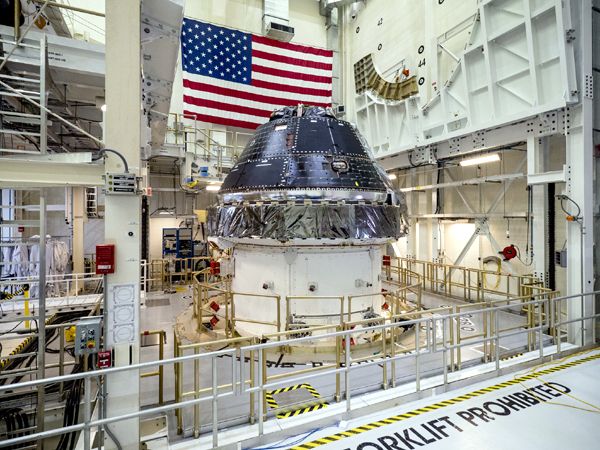
The Orion spacecraft that will fly on the Artemis 1 mission is on display at NASA's Kennedy Space Center in Florida.
NASA / Radislav Sinyak

NASA Commits to Long-term Artemis Missions with Orion Production Contract (Press Release)

NASA is setting in motion the Orion spacecraft production line to support as many as 12 Artemis missions, including the mission that will carry the first woman and next man to the Moon by 2024.

The agency has awarded the Orion Production and Operations Contract (OPOC) to Lockheed Martin of Littleton, Colorado. Spacecraft production for the Orion program, managed at NASA’s Johnson Space Center in Houston, will focus on reusability and building a sustainable presence on the lunar surface.

“This is a great day for the men and women at Johnson Space Center. They are crucial to our national space program, and have an undeniable legacy and record of success in advancing America’s leadership in the human exploration of space,” said Sen. Ted Cruz of Texas. “I am pleased that Administrator Bridenstine has heeded my calls and is taking significant steps to ensure that Johnson continues to grow with the exciting future of manned exploration that lies ahead. More needs to be done, and I look forward to production ramping up in the weeks and months to come and to more opportunities with NASA.”

OPOC is an indefinite-delivery/indefinite-quantity contract that includes a commitment to order a minimum of six and a maximum of 12 Orion spacecraft, with an ordering period through Sept. 30, 2030. Production and operations of the spacecraft for six to 12 missions will establish a core set of capabilities, stabilize the production process, and demonstrate reusability of spacecraft components.

“This contract secures Orion production through the next decade, demonstrating NASA’s commitment to establishing a sustainable presence at the Moon to bring back new knowledge and prepare for sending astronauts to Mars,” said NASA Administrator Jim Bridenstine. “Orion is a highly-capable, state-of-the-art spacecraft, designed specifically for deep space missions with astronauts, and an integral part of NASA’s infrastructure for Artemis missions and future exploration of the solar system.”

With this award, NASA is ordering three Orion spacecraft for Artemis missions III through V for $2.7 billion. The agency plans to order three additional Orion capsules in fiscal year 2022 for Artemis missions VI through VIII, at a total of $1.9 billion. Ordering the spacecraft in groups of three allows NASA to benefit from efficiencies that become available in the supply chain over time – efficiencies that optimize production and lower costs.

Spacecraft reusability – itself a significant cost saver for the agency – will help NASA build the capabilities for sustainable exploration at the Moon and beyond. The long-term plan is to reuse the recovered crew modules at least once. The first phase of reusability will start with Artemis II. Interior components of the spacecraft, such as flight computers and other high value electronics, as well as crew seats and switch panels, will be re-flown on Artemis V. The Artemis III crew module will be re-flown on Artemis VI.

The first six spacecraft will be acquired by cost-plus-incentive-fee ordering. Because the cost of a complex, high-tech system generally decreases over time as the design stabilizes and production processes mature, NASA will negotiate firm-fixed-price orders for future missions to take advantage of the anticipated spacecraft production cost decreases. Furthermore, the cost incentives on the cost-plus-incentive-fee orders are designed to motivate favorable cost performance during early OPOC production and drive substantially lower prices for any subsequent firm-fixed-price orders issued under this contract.

“As the only vehicle capable of deep space exploration, the Orion spacecraft is critical to America’s continued leadership,” said Rep. Brian Babin of Texas. “Today’s announcement signals that we are moving closer towards operation and production. While I look forward to learning more of the details, it’s encouraging to see that this program is moving along as it should be. I am proud of the Orion program team and contractor partners at Johnson Space Center as they move towards getting the vehicle ‘flight ready.’ Without the brilliant minds and extraordinary leadership of the hard-working men and women at Johnson, our country would not be the preeminent spacefaring nation in the world.”

Work under this contract also will support production of NASA’s lunar-orbiting Gateway and evolving mission requirements. Production of certain spacecraft components already designed and qualified for Orion will be provided for Gateway use, eliminating the need for the Gateway Program to develop and qualify similar components.

“The men and women at Johnson Space Center represent the best and brightest scientific minds, and I’m confident with additional Orion spacecraft they will push the limits of exploration to the Moon and beyond,” said Sen. John Cornyn of Texas. “I commend the Trump Administration for recognizing the importance and tradition of Houston as the center of human spaceflight and exploring the next frontier.”

Houston has long been the hub of America’s human space exploration program, from the early days of Gemini, Mercury, and Apollo to Artemis. With NASA’s accelerated return to the Moon, Johnson Space Center now is managing more major human spaceflight programs than ever before. In addition to the Orion program, the Texas facility also manages NASA’s Gateway and International Space Station programs, and is home to the Mission Control Center and America’s astronaut corps – the next moonwalkers. Johnson also manages the agency’s Commercial Lunar Payload Services, the first two deliveries for which are targeted to launch to the Moon in July 2021.

“No other spacecraft in the world can keep humans alive hundreds of thousands of miles from Earth for weeks at a time with the safety features, crew accommodations, technical innovations, and reliability that Orion provides,” said Mark Kirasich, Orion Program manager at Johnson. “With the design and development phase of Orion largely behind us, this new contract will enable us to increase efficiencies, reuse the spacecraft, and bring down the cost of reliably transporting people between Earth and the Gateway.”

NASA is working to land the first woman and next man on the Moon in five years as part of the agency’s Artemis program. Orion, the Space Launch System rocket and Gateway are part of NASA’s backbone for deep space exploration. Work is well underway on both the Artemis I and II Orion spacecraft. Engineers at Kennedy Space Center in Florida have completed and attached the crew and service modules for Artemis I and are preparing the spacecraft for environmental testing. Meanwhile, teams at Kennedy are integrating thousands of parts into the crew module for Artemis II in preparation for the first crewed Artemis mission.

The Artemis program is the next step in human space exploration. It’s part of NASA’s broader Moon to Mars exploration approach, in which we will quickly and sustainably explore the Moon and use what we learn there to enable humanity’s next giant leap, sending astronauts to Mars.

Source: NASA.Gov