Sunday, July 11, 2021

SpaceShipTwo Update: Sir Richard Branson and His UNITY 22 Crew Have Safely Flown to the Edge of Space Today!

Virgin Galactic founder Sir Richard Branson and his three Unity 22 crewmembers float around inside VSS Unity's cabin during their 53.5-mile (86-kilometer) journey into space...on July 11, 2021.
Virgin Galactic

Virgin Galactic Successfully Completes First Fully-Crewed Spaceflight (Press Release)

Virgin Galactic today announced that VSS Unity successfully reached space, completing the Company’s fourth rocket-powered spaceflight.

Today’s flight was the 22nd test flight of VSS Unity and the first test flight with a full crew in the cabin, including the Company’s founder, Sir Richard Branson. The crew fulfilled a number of test objectives related to the cabin and customer experience, including evaluating the commercial customer cabin, the views of Earth from space, the conditions for conducting research and the effectiveness of the five-day pre-flight training program at Spaceport America.

Michael Colglazier, Chief Executive Officer of Virgin Galactic, said: “Today is a landmark achievement for the Company and a historic moment for the new commercial space industry. With each successful mission we are paving the way for the next generation of astronauts. I want to thank our talented team, including our pilots and crew, whose dedication and commitment made today possible. They are helping open the door for greater access to space – so it can be for the many and not just for the few.”

VSS Unity achieved a speed of Mach 3 after being released from the mothership, VMS Eve. The vehicle reached space, at an altitude of 53.5 miles, before gliding smoothly to a runway landing at Spaceport America.

This seminal moment for Virgin Galactic and Sir Richard Branson was witnessed by audiences around the world. It gave a glimpse of the journey Virgin Galactic’s Future Astronauts can expect when the Company launches commercial service following the completion of its test flight program. A recording of the livestream can be accessed on Virgin Galactic’s YouTube channel.

Sir Richard Branson said: “I have dreamt about this moment since I was a child, but nothing could have prepared me for the view of Earth from space. We are at the vanguard of a new space age. As Virgin’s founder, I was honoured to test the incredible customer experience as part of this remarkable crew of mission specialists and now astronauts. I can’t wait to share this experience with aspiring astronauts around the world.”

Branson continued, “Our mission is to make space more accessible to all. In that spirit, and with today’s successful flight of VSS Unity, I’m thrilled to announce a partnership with Omaze and Space for Humanity to inspire the next generation of dreamers. For so long, we have looked back in wonder at the space pioneers of yesterday. Now, I want the astronauts of tomorrow to look forward and make their own dreams come true.”

The mission specialists in the cabin were Beth Moses, Chief Astronaut Instructor; Colin Bennett, Lead Flight Operations Engineer; Sirisha Bandla, Vice President of Government Affairs and Research Operations; and the Company’s founder, Sir Richard Branson. The VSS Unity pilots were Dave Mackay and Michael Masucci, while Kelly Latimer and CJ Sturckow piloted VMS Eve.

Source: Virgin Galactic

****

Sir Richard Branson and his Unity 22 crewmembers head to space after VSS Unity's rocket motor ignites over 46,300 feet (14,112 meters) above New Mexico...on July 11, 2021.
Virgin Galactic

VSS Unity soars 53.5 miles (86 kilometers) above the Earth during the Unity 22 flight...on July 11, 2021.
Virgin Galactic

VSS Unity is towed down the runway at New Mexico's Spaceport America after successfully completing the Unity 22 flight...on July 11, 2021.
Virgin Galactic


Saturday, July 10, 2021

Orion Update: The Moon-bound Capsule Is One Step Away from Being Mated to Its SLS Rocket for Artemis 1...

The Orion Artemis 1 capsule is transported to the Launch Abort System Facility at NASA's Kennedy Space Center in Florida...on July 10, 2021.
NASA

Earlier today, the Orion spacecraft that will fly on the Artemis 1 mission as early as this November was transported to the Launch Abort System Facility (LASF) at NASA's Kennedy Space Center (KSC) in Florida. Inside the LASF, Orion will be encapsulated by its dome-shaped fairing assembly and attached to the jettison motors that will separate from Orion over two minutes after liftoff. Once this launch abort system is installed, Orion will be sent to KSC's Vehicle Assembly Building...where it will finally be mated with the Space Launch System rocket that will send the capsule on its multi-week journey to the Moon and back. This last assembly milestone is set to take place next month.

Orion started today's journey across KSC from the Multi-Payload Processing Facility—where the capsule and its European Service Module were loaded with fuel for flight.

The Orion Artemis 1 capsule sits inside the Multi-Payload Processing Facility at NASA's Kennedy Space Center in Florida...on July 10, 2021.
NASA

The Orion Artemis 1 capsule is rolled out of the Multi-Payload Processing Facility at NASA's Kennedy Space Center in Florida...on July 10, 2021.
NASA

The Orion Artemis 1 capsule is transported to the Launch Abort System Facility at NASA's Kennedy Space Center in Florida...on July 10, 2021.
NASA

Friday, July 9, 2021

Artemis Update: The Gateway Moves One Step Closer to Becoming a Cornerstone for Sustainable Lunar Exploration...

An artist's concept of NASA's Gateway space station in orbit around the Moon.
NASA

NASA, Northrop Grumman Finalize Moon Outpost Living Quarters Contract (Press Release)

NASA and Northrop Grumman of Dulles, Virginia, have finalized a contract to develop the Habitation and Logistics Outpost (HALO) for Gateway, which will be a critical way station and outpost in orbit around the Moon as part of NASA’s Artemis program.

NASA and its commercial and international partners are building Gateway to support science investigations and enable surface landings at the Moon, which will help prepare astronauts for future missions to Mars.

The firm, fixed-price contract is valued at $935 million. Under the contract, Northrop Grumman will be responsible for attaching and testing the integrated HALO with the Power and Propulsion Element (PPE) being built by Maxar Technologies. Northrop Grumman will also lead the integrated PPE and HALO spacecraft turnover and launch preparation with SpaceX, and support activation and checkout of HALO during the flight to lunar orbit. NASA is targeting November 2024 to launch the integrated spacecraft on a SpaceX Falcon Heavy rocket.

“NASA is building the infrastructure to expand human exploration further out into the solar system than ever before, including Gateway, the lunar space station that will help us make inspirational scientific discoveries at and around the Moon. Just as importantly, these investments will help NASA carry out the United States’ horizon goal: to further develop and test the technology and science needed for a human trip to Mars,” said NASA Administrator Bill Nelson. “The HALO is a critical component of Gateway, and this exciting announcement today brings us one step closer to landing American boots on both the Moon and Mars.”

HALO is where astronauts will live and conduct research while visiting the Gateway. The pressurized living quarters will provide command and control systems for the lunar outpost, and docking ports for visiting spacecraft, such as NASA’s Orion spacecraft, lunar landers, and logistics resupply craft. The HALO module will serve as the backbone for command and control and power distribution across Gateway and will perform other core functions, including hosting science investigations via internal and external payload accommodations and communicating with lunar surface expeditions. HALO also will enable the aggregation of additional habitable elements to expand Gateway capabilities. Immediately after launch, the Heliophysics Environmental and Radiation Measurement Experiment Suite, built by NASA’s Goddard Space Flight Center in Greenbelt, Maryland, will begin conducting research outside of the integrated spacecraft.

“This is a major step on the path for Artemis, not just for NASA, but for the combined team, including our commercial and international partners,” said Kathy Lueders, NASA associate administrator for Human Explorations and Operations. “Gateway will provide unprecedented access to the Moon and symbolizes the expansion of our partnerships into deep space.”

The integrated PPE and HALO will be the Gateway’s foundation, enabling humanity’s first permanent outpost in orbit around the Moon. Located tens of thousands of miles from the lunar surface at its farthest point and within easy range of lunar landers at its closest, the Gateway will be in a near-rectilinear halo orbit. This orbit will allow NASA and its international and commercial partners to conduct unprecedented deep space science and technology investigations, and conduct sustainable lunar exploration.

“This action puts in place the final contract component of a diverse, multi-faceted team – distributed across the country and within some international partner facilities – working together to create and implement the initial Gateway capability. We are excited to work with Northrop Grumman and all the partners to deliver the cornerstone of sustainable human exploration in cis-lunar space,” said Dr. Jon Olansen, NASA’s manager of the HALO project.

HALO leverages contributions from the Gateway international partners for robust capabilities. Batteries provided by the Japan Aerospace Exploration Agency (JAXA) will power HALO until PPE solar arrays can be deployed and during eclipse periods. Robotic interfaces provided by the Canadian Space Agency will host payloads and provide base points for Canadarm3 robotic operations. ESA (European Space Agency) will provide a lunar communications system to enable high-data-rate communications between the lunar surface and Gateway. With three docking ports, HALO will be the hub for international Gateway expansion in the future, including an international habitat that ESA and JAXA will provide, and an ESA-provided refueling module. The docking ports also will host a human landing system for lunar surface expeditions and logistics resupply spacecraft. As the Gateway hub, HALO will provide power, data, airflow to each of these ports, as well as thermal conditioning to assist future elements and spacecraft in controlling the temperature of their equipment and habitable environment.

“Leveraging our success with our Cygnus spacecraft, Northrop Grumman is perfectly positioned to deliver the HALO module, a critical piece for NASA’s Artemis program and our journey to the Moon and beyond,” said Frank DeMauro, vice president and general manager for tactical space systems at Northrop Grumman. “After recently completing a successful preliminary design review, we now look forward to completing the detailed design efforts and eventually bringing HALO to life in our Gilbert, Arizona, facility while also providing integration services for the final, combined vehicle before launch.”

HALO’s design is based on Northrop Grumman’s Cygnus spacecraft, which has completed 15 resupply missions to the International Space Station to date. A previous contract for HALO, awarded in June 2020, funded work through preliminary design review, one of a series of checkpoints for the complex engineering project. The review process for the module, completed in May, assessed all of the spacecraft’s design to ensure the overall system is safe and reliable for flight and meets NASA’s mission requirements.

****

Thursday, July 8, 2021

Remembering STS-135: Marking One Decade Since the Last Space Shuttle Mission Took Flight...

Space shuttle Atlantis lifts off from Launch Complex 39A at NASA's Kennedy Space Center in Florida...beginning mission STS-135 on July 8, 2011.
NASA / Bill Ingalls

It was on this day back in 2011 that Atlantis took off from Launch Complex 39A at NASA's Kennedy Space Center in Florida...beginning mission STS-135 to the International Space Station (ISS) that lasted 12 days, 18 hours, 28 minutes and 50 seconds, and successfully concluded the 30-year space shuttle program. 10 years later, this anniversary is marked by privately-made capsules (SpaceX's Crew Dragon and soon, Boeing's Starliner) transporting astronauts to the ISS, two super heavy-lift rockets—NASA's Space Launch System and SpaceX's Starship vehicles—that will return crew to the lunar surface via the Artemis program within the next five years, and other commercial companies such as Blue Origin and Virgin Galactic now on the verge of sending paying passengers into space using their suborbital New Shepard and SpaceShipTwo vehicles, respectively.

The time period between 2011 and 2020 (when SpaceX's Demo-2 flight resumed crewed launches from U.S. soil for the first time since STS-135) was marked by delays and uncertainty in America's human spaceflight program, but this new decade should end with mankind moving ever so closer to maintaining a sustainable presence at the Moon, and finally, sending humanity on a much-awaited voyage to Mars. The future of space exploration has never been more promising than this!

Wednesday, July 7, 2021

Photos of the Day: Installing the ICPS on the SLS Rocket That Will Fly on Artemis 1 This Year...

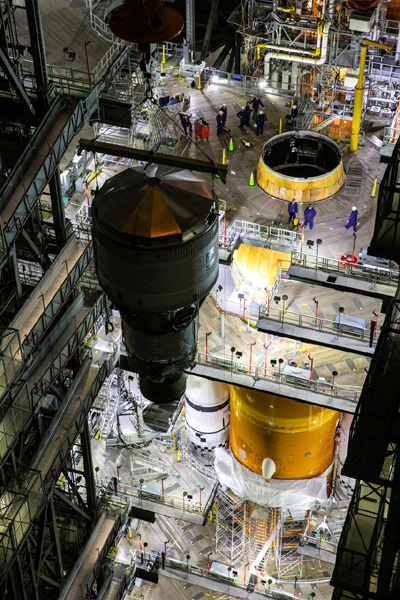
Inside the Vehicle Assembly Building (VAB) at NASA's Kennedy Space Center in Florida, engineers watch as the Interim Cryogenic Propulsion Stage (ICPS) is brought towards the Space Launch System (SLS) stack for mating...on July 5, 2021.
NASA / Kim Shiflett

Just thought I'd share these new images that were recently posted online by NASA showing the Interim Cryogenic Propulsion Stage being mated to the Space Launch System (SLS) two days ago. As noted in my previous entry, the Orion Stage Adapter and the Mass Simulator for Orion are the next components that will be attached to the vehicle before testing commences on the Artemis 1 rocket and its mobile launcher inside Kennedy Space Center's (KSC) Vehicle Assembly Building. Orion itself will be installed on SLS next month, while the assembled rocket will roll out to KSC's Launch Complex 39B as early as September for a multi-week wet dress rehearsal. The Artemis 1 flight is scheduled for no earlier than November 22.

Inside the VAB at NASA's Kennedy Space Center in Florida, the ICPS is lifted out of its protective container before the booster is brought up to the SLS stack for mating...on July 5, 2021.
NASA / Kim Shiflett

Inside the VAB at NASA's Kennedy Space Center in Florida, the ICPS is lifted out of its protective container before the booster is brought up to the SLS stack for mating...on July 5, 2021.
NASA / Kim Shiflett

Inside the VAB at NASA's Kennedy Space Center in Florida, the ICPS is brought up to the SLS stack for mating...on July 5, 2021.
NASA / Kim Shiflett

Inside the VAB at NASA's Kennedy Space Center in Florida, the ICPS is brought up to the SLS stack for mating...on July 5, 2021.
NASA / Kim Shiflett

Inside the VAB at NASA's Kennedy Space Center in Florida, the ICPS is lifted towards the SLS stack for mating...on July 5, 2021.
NASA / Kim Shiflett

Inside the VAB at NASA's Kennedy Space Center in Florida, the ICPS is lifted towards the SLS stack for mating...on July 5, 2021.
NASA / Kim Shiflett

Inside the VAB at NASA's Kennedy Space Center in Florida, the ICPS is lowered towards the launch vehicle stage adapter on the SLS stack for mating...on July 5, 2021.
NASA / Kim Shiflett

Inside the VAB at NASA's Kennedy Space Center in Florida, the ICPS is lowered towards the launch vehicle stage adapter on the SLS stack for mating...on July 5, 2021.
NASA / Kim Shiflett

Inside the VAB at NASA's Kennedy Space Center in Florida, the ICPS is about to be mated to the launch vehicle stage adapter on the SLS rocket...on July 5, 2021.
NASA / Kim Shiflett

Tuesday, July 6, 2021

Artemis 1 Update: The Space Launch System Now Has Its Second Stage Booster...

The Interim Cryogenic Propulsion Stage is now installed on Artemis 1's Space Launch System rocket...as of July 6, 2021.
NASA

Earlier today, the Space Launch System (SLS) that will embark on Artemis 1 as soon as this November became 7,690 pounds (3,488 kilograms) heavier when its second stage booster, known as the Interim Cryogenic Propulsion Stage (ICPS), was installed on the giant rocket at NASA's Kennedy Space Center (KSC) in Florida. With the ICPS now part of the SLS stack, the Orion Stage Adapter (OSA) will be the next component to be attached to the rocket inside KSC's cavernous Vehicle Assembly Building (VAB). However, it remains to be seen whether a test article for the OSA or the flight version of the OSA itself—which will hold 13 CubeSats that will be deployed towards the Moon after launch—will be joined to the ICPS. NASA wants to give each CubeSat team as much time as possible to get their spacecraft ready for flight before they are delivered to KSC for integration onto SLS—and using the OSA replica for upcoming tests will provide that extra time.

Once the OSA is mated to the ICPS, a full-size simulator for the Orion spacecraft (technically known as the Mass Simulator for Orion) will be attached next...and then SLS and its mobile launcher will begin a couple of weeks worth of testing inside the VAB before Orion itself is installed on the Artemis 1 vehicle. That final assembly milestone is set to take place next month. Stay tuned.

The Interim Cryogenic Propulsion Stage is now installed on Artemis 1's Space Launch System rocket...as of July 6, 2021.
NASA

Thursday, July 1, 2021

SpaceShipTwo Update: Sir Richard Branson Is Set to Fly on VSS Unity 10 Days from Now...

Two pilots and four crew members, including Virgin Galactic founder Sir Richard Branson himself, will soar on SpaceShipTwo during the UNITY 22 flight...set to take place on July 11, 2021.
Virgin Galactic

Virgin Galactic Announces First Fully Crewed Spaceflight (Press Release)

Virgin Galactic today announced that the flight window for the next rocket-powered test flight of its SpaceShipTwo Unity opens July 11, pending weather and technical checks.

The “Unity 22” mission will be the twenty-second flight test for VSS Unity and the Company’s fourth crewed spaceflight. It will also be the first to carry a full crew of two pilots and four mission specialists in the cabin, including the Company’s founder, Sir Richard Branson, who will be testing the private astronaut experience.

Building on the success of the Company’s most recent spaceflight in May, Unity 22 will focus on cabin and customer experience objectives, including:

- Evaluating the commercial customer cabin with a full crew, including the cabin environment, seat comfort, the weightless experience, and the views of Earth that the spaceship delivers — all to ensure every moment of the astronaut’s journey maximizes the wonder and awe created by space travel

- Demonstrating the conditions for conducting human-tended research experiments

- Confirming the training program at Spaceport America supports the spaceflight experience

For the first time, Virgin Galactic will share a global livestream of the spaceflight. Audiences around the world are invited to participate virtually in the Unity 22 test flight and see first-hand the extraordinary experience Virgin Galactic is creating for future astronauts. The livestream will be available to watch on Virgin Galactic.com and will be simulcast on the Virgin Galactic Twitter, YouTube, and Facebook channels. It is expected to begin at 7:00 am MDT / 9:00 am EDT on the day of the flight.

The flight’s four mission specialists will be:

- Beth Moses, Chief Astronaut Instructor at Virgin Galactic. Moses will serve as cabin lead and test director in space, overseeing the safe and efficient execution of the test flight objectives.

- Colin Bennett, Lead Operations Engineer at Virgin Galactic. Bennett will evaluate cabin equipment, procedures, and experience during both the boost phase and in the weightless environment.

- Sirisha Bandla, Vice President of Government Affairs and Research Operations at Virgin Galactic. Bandla will be evaluating the human-tended research experience, using an experiment from the University of Florida that requires several handheld fixation tubes that will be activated at various points in the flight profile.

- Sir Richard Branson, founder of Virgin Galactic. Branson will evaluate the private astronaut experience and will undergo the same training, preparation and flight as Virgin Galactic’s future astronauts. The Company will use his observations from his flight training and spaceflight experience to enhance the journey for all future astronaut customers.

The pilots for this mission are Dave Mackay and Michael Masucci flying VSS Unity, and CJ Sturckow and Kelly Latimer flying VMS Eve.

Following this flight, and in line with normal procedures, the team will complete inspections of the vehicles and an extensive data review, which will inform the next steps in the test flight program. Two additional test flights are planned before the Company expects to commence commercial service in 2022.

Michael Colglazier, Chief Executive Officer of Virgin Galactic, said: “Our next flight—the 22nd flight test for VSS Unity and our first fully crewed flight test—is a testament to the dedication and technical brilliance of our entire team, and I’d like to extend a special thank you to our pilots and mission specialists, each of whom will be performing important work. Tapping into Sir Richard’s expertise and long history of creating amazing customer experiences will be invaluable as we work to open the wonder of space travel and create awe-inspiring journeys for our customers.”

Sir Richard Branson said: “I truly believe that space belongs to all of us. After more than 16 years of research, engineering, and testing, Virgin Galactic stands at the vanguard of a new commercial space industry, which is set to open space to humankind and change the world for good. It’s one thing to have a dream of making space more accessible to all; it’s another for an incredible team to collectively turn that dream into reality. As part of a remarkable crew of mission specialists, I’m honoured to help validate the journey our future astronauts will undertake and ensure we deliver the unique customer experience people expect from Virgin.”

Source: Virgin Galactic

****

Above the Mojave Desert in California, the VSS Unity fires her rocket motor for the second time on May 29, 2018.

A 'Mercury 13' Candidate Will Take Flight with Jeff Bezos Aboard the New Shepard Capsule on July 20...

A New Shepard rocket lifts off from Blue Origin's launch site in West Texas on a flight that took it 389,846 feet above the Earth...on July 18, 2018.
Blue Origin

Wally Funk Will Fly to Space on New Shepard’s First Human Flight (News Release)

Fulfilling a lifelong mission to become an astronaut, Wally Funk will fly to space on New Shepard’s first human flight on July 20 as an honored guest. She will join Jeff Bezos, his brother Mark Bezos, and the auction winner on the flight.

Wally’s journey to space began in the 1960s when she was the youngest graduate of the Woman in Space Program, a privately-funded project which tested female pilots for astronaut fitness. Later known as the “Mercury 13” – thirteen American women successfully underwent the same physiological and psychological screening tests as the astronauts selected by NASA for Project Mercury, but they never flew to space. Wally was the youngest graduate of this program.

She was the first female FAA inspector and first female NTSB air safety investigator. The 82-year-old pilot will now be part of the first crew on New Shepard, and the oldest person ever to fly to space.

Here’s the moment Jeff Bezos asked Wally Funk to join our first human flight on July 20 as his honored guest:


Source: Blue Origin

Wednesday, June 30, 2021

Orion Update: The Capsule's First 'Passenger' Has Been Given a Name...

'Commander Moonikin Campos' will be aboard NASA's Orion spacecraft when it launches on the Artemis 1 mission later this year.
NASA

Public Names ‘Moonikin’ Flying Around Moon on NASA’s Artemis I Mission (Press Release - June 29)

“Commander Moonikin Campos” is the official name of the manikin launching on Artemis I, NASA’s uncrewed flight test of the Space Launch System (SLS) rocket and Orion spacecraft around the Moon later this year. The Moonikin received its name as the result of a competitive bracket contest honoring NASA figures, programs, or astronomical objects. NASA received more than 300,000 votes.

The name Campos is a dedication to Arturo Campos, a key player in bringing Apollo 13 safely back to Earth. The final bracket challenge was between Campos and Delos, a reference to the island where Apollo and Artemis were born, according to Greek mythology.

“Our return to the Moon through Artemis is a global effort – and we’re always looking at new ways to engage the public in our missions. This contest, which is helping pave the way for a human return to the Moon, also honors an important individual in our NASA family – Arturo Campos,” said Brian Odom, NASA’s acting chief historian at Marshall Space Flight Center in Huntsville, Alabama. “It is a fitting tribute that the data gained from Artemis I will help us prepare to fly astronauts – including the first woman and first person of color – to the Moon, where we will get ready for Mars.”

The other six names under consideration were:

- ACE, for “Artemis Crew Explorer.”
- DUHART, a dedication to Irene Duhart Long, chief medical officer at Kennedy Space Center from 2000 to 2010.
- MONTGOMERY, dedication to Julius Montgomery, first African American to work as a technical professional at Cape Canaveral Air Force Station, now known as Cape Canaveral Space Force Station.
- RIGEL, a giant superstar in the Orion constellation.
- SHACKLETON, a crater on the Moon’s South Pole, which is named after famous Antarctic explorer Ernest Shackleton.
- WARGO, a dedication to Michael Wargo, NASA’s first chief exploration scientist.

The Moonikin is a male-bodied manikin previously used in Orion vibration tests. Campos will occupy the commander’s seat inside and wear an Orion Crew Survival System suit– the same spacesuit that Artemis astronauts will use during launch, entry, and other dynamic phases of their missions.

Campos will be equipped with two radiation sensors and have additional sensors under its headrest and behind its seat to record acceleration and vibration data throughout the mission. Data from the Moonikin’s experience will help NASA protect astronauts during Artemis II, the first mission in more than 50 years that will send crew around the Moon.

The Moonikin is one of three “passengers” flying aboard Orion to test the spacecraft’s systems. Two female-bodied model human torsos, called phantoms, also will be aboard. “Zohar” and “Helga,” named by the Israel Space Agency (ISA) and the German Aerospace Center (DLR) respectively, will support the Matroshka AstroRad Radiation Experiment (MARE), an experiment to provide data on radiation levels during lunar missions.

NASA’s SLS rocket and Orion spacecraft, along with a commercial Human Landing System and Gateway in lunar orbit, are vital to the agency’s deep space exploration plans. Working with commercial and international partners, NASA is committed to establishing the first long-term presence on and around the Moon under Artemis. Using robots and humans to explore more than ever before, NASA also will use the Moon for humanity’s next giant leap – sending the first astronauts to Mars.

****

Friday, June 25, 2021

SpaceShipTwo Update: The VSS Unity Is Now Allowed to Fly Passengers into Space!

VSS Unity's tail-boom is raised into the 'feathered' position as the vehicle prepares for re-entry into Earth's atmosphere...on May 22, 2021.
Virgin Galactic

Virgin Galactic Receives Approval From FAA for Full Commercial Launch License Following Success of May Test Flight (Press Release)

Virgin Galactic today announced that the Federal Aviation Administration (“FAA”) updated the Company’s existing commercial space transportation operator license to allow the spaceline to fly customers to space.

The Company also announced that it has completed an extensive review of data gathered from its May 22 test flight and confirmed that the flight performed well against all flight objectives.

The adjustment to Virgin Galactic’s operator’s license, which the Company has held since 2016, marks the first time the FAA has licensed a spaceline to fly customers. It is further validation of the Company’s methodical testing program, which has met the verification and validation criteria required by the FAA.

Michael Colglazier, Chief Executive Officer of Virgin Galactic, said, “We’re incredibly pleased with the results of our most recent test flight, which achieved our stated flight test objectives. The flight performed flawlessly, and the results demonstrate the safety and elegance of our flight system. Today’s approval by the FAA of our full commercial launch license, in conjunction with the success of our May 22 test flight, give us confidence as we proceed toward our first fully-crewed test flight this summer.”

The May 22 test flight of VMS Eve and VSS Unity was the Company’s third crewed spaceflight and the first-ever spaceflight from Spaceport America, New Mexico. The flight achieved a speed of Mach 3 and reached space at an altitude of 55.5 miles. After an extensive review of the data collected during the flight, the Company confirmed that:

- The rocket-powered test of the spaceship’s upgraded horizontal stabilizers and flight controls demonstrated strong performance, in line with predictions. These enhanced systems, which allow for finer pilot control, will also be deployed in future spaceships in the Company’s fleet.

- The cabin environment data was in line with predictions.

- The flight successfully carried three revenue-generating research experiments that tested and demonstrated technologies in microgravity as part of NASA’s Flight Opportunities Program. The pilots flew VSS Unity on a specific trajectory designed to meet the objectives of these research experiments.

With the data analysis from the May flight now complete, Virgin Galactic will continue preparing for the remaining three test flights.

Source: Virgin Galactic

****

VSS Unity approaches the runway at New Mexico's Spaceport America after conducting a successful glide test...on June 25, 2020.
Virgin Galactic