Sunday, March 31, 2024

Comparing the Two Launch Platforms for SLS...

An infographic comparing Mobile Launcher 1 (for the SLS Block 1 rocket) with Mobile Launcher 2 (for the SLS Block 1B and 2 rockets).
NASA

ML-1 and ML-2 Comparison Infographic (Photo Release - March 28)

This infographic explains NASA’s mobile launchers designed for the agency's Artemis missions to send the Space Launch System rocket, Orion spacecraft and large payloads to the Moon in a single launch.

Source: NASA.Gov

Thursday, March 28, 2024

SpaceX Continues to Prep for Starship's Fourth Flight Test...

SpaceX's Ship 29 sits on its suborbital launch pad at Starbase in Texas...as of March 22, 2024.
SpaceX

With Integrated Flight Test (IFT)-4 targeted for a potential launch this May, SpaceX has been moving full steam ahead in testing the next vehicle to fly—Ship 29—at Starbase in Texas during this week.

Last Monday, Ship 29 successfully fired all six of its Raptor 2 engines at Starbase's suborbital launch pad. And yesterday, the vehicle flawlessly ignited a single Raptor 2 engine during its static fire as SpaceX is planning to conduct an in-space firing of a Raptor 2 during IFT-4...an objective that wasn't met during IFT-3 two weeks ago.

Just like the three previous Starship Super Heavy launches, this flight hinges on how soon the Federal Aviation Administration (FAA) will grant approval to conduct the next demonstration. Considering the fact that IFT-3 was enormously successful despite Booster 10 and Ship 28 not reaching their ocean splashdown zones intact at the end of their orbital demo, the so-called mishap investigation by the FAA should not take as long as the ones for the two previous integrated flight tests.


Wednesday, March 27, 2024

Three Tools Have Been Chosen for Use by the First Crew to Walk on the Moon Since 1972...

An artist's concept of an astronaut placing a science instrument on the lunar surface.
NASA

NASA Selects First Lunar Instruments for Artemis Astronaut Deployment (News Release - March 26)

NASA has chosen the first science instruments designed for astronauts to deploy on the surface of the Moon during Artemis III. Once installed near the lunar South Pole, the three instruments will collect valuable scientific data about the lunar environment, the lunar interior and how to sustain a long-duration human presence on the Moon, which will help prepare NASA to send astronauts to Mars.

Artemis marks a bold new era of exploration, where human presence amplifies scientific discovery. With these innovative instruments stationed on the Moon’s surface, we’re embarking on a transformative journey that will kick-start the ability to conduct human-machine teaming – an entirely new way of doing science,” said NASA Deputy Administrator Pam Melroy. “These three deployed instruments were chosen to begin scientific investigations that will address key Moon to Mars science objectives.”

The instruments will address three Artemis science objectives: understanding planetary processes, understanding the character and origin of lunar polar volatiles, and investigating and mitigating exploration risks. They were specifically chosen because of their unique installation requirements that necessitate deployment by humans during moonwalks.

All three payloads were selected for further development to fly on Artemis III that’s targeted to launch in 2026, however, final manifesting decisions about the mission will be determined at a later date. Members of these payload teams will become members of NASA’s Artemis III science team.

The Lunar Environment Monitoring Station (LEMS) is a compact, autonomous seismometer suite designed to carry out continuous, long-term monitoring of the seismic environment, namely ground motion from moonquakes, in the lunar south polar region. The instrument will characterize the regional structure of the Moon’s crust and mantle, which will add valuable information to lunar formation and evolution models.

LEMS previously received four years of NASA’s Development and Advancement of Lunar Instrumentation funding for engineering development and risk reduction. It is intended to operate on the lunar surface from three months up to two years and may become a key station in a future global lunar geophysical network.

LEMS is led by Dr. Mehdi Benna, from the University of Maryland, Baltimore County.

Lunar Effects on Agricultural Flora (LEAF) will investigate the lunar surface environment’s effects on space crops. LEAF will be the first experiment to observe plant photosynthesis, growth and systemic stress responses in space-radiation and partial gravity.

Plant growth and development data, along with environmental parameters measured by LEAF, will help scientists understand the use of plants grown on the Moon for both human nutrition and life support on the Moon and beyond. LEAF is led by Christine Escobar of Space Lab Technologies, LLC, in Boulder, Colorado.

The Lunar Dielectric Analyzer (LDA) will measure the regolith’s ability to propagate an electric field, which is a key parameter in the search for lunar volatiles, especially ice. It will gather essential information about the structure of the Moon’s subsurface, monitor dielectric changes caused by the changing angle of the Sun as the Moon rotates, and look for possible frost formation or ice deposits.

LDA, an internationally-contributed payload, is led by Dr. Hideaki Miyamoto of the University of Tokyo and supported by JAXA (Japan Aerospace Exploration Agency).

“These three scientific instruments will be our first opportunity since Apollo to leverage the unique capabilities of human explorers to conduct transformative lunar science,” said Joel Kearns, deputy associate administrator for exploration in NASA’s Science Mission Directorate in Washington. “These payloads mark our first steps toward implementing the recommendations for the high-priority science outlined in the Artemis III Science Definition Team report.”

Artemis III, the first mission to return astronauts to the surface of the Moon in more than 50 years, will explore the south polar region of the Moon, within 6 degrees of latitude from the South Pole. Several proposed landing regions for the mission are located among some of the oldest parts of the Moon.

Together with the permanently-shadowed regions, they provide the opportunity to learn about the history of the Moon through previously unstudied lunar materials.

With the Artemis campaign, NASA will land the first woman, first person of color and its first international partner astronaut on the Moon, and establish long-term exploration for scientific discovery and preparation for human missions to Mars for the benefit of all.

****

Tuesday, March 26, 2024

Development Continues on Vital Hardware for the Space Launch System's Block 1B Variant...

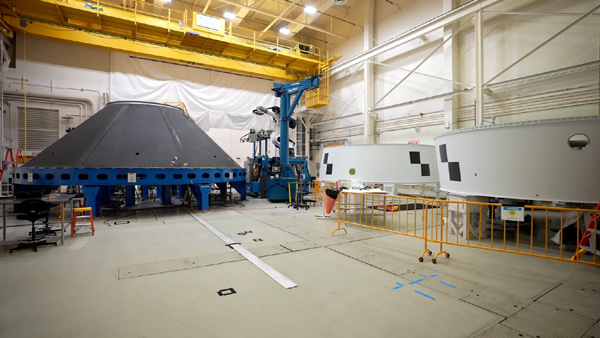
At NASA's Marshall Space Flight Center in Huntsville, Alabama, a test version of the payload adapter that will be used on the Space Launch System's (SLS) Block 1B rocket is displayed next to the Orion stage adapters that will fly on the Artemis 2 and 3 missions, respectively.
NASA / Sam Lott

Payload Adapter Testing: A Key Step for Artemis IV Rocket’s Success (News Release - March 21)

A test version of the SLS (Space Launch System) rocket’s payload adapter is ready for evaluation, marking a critical milestone on the journey to the hardware’s debut on NASA’s Artemis IV mission.

Comprised of two metal rings and eight composite panels, the cone-shaped payload adapter will be part of the SLS Block 1B configuration and housed inside the universal stage adapter atop the rocket’s more powerful in-space stage, called the Exploration Upper Stage. The payload adapter is an evolution from the Orion stage adapter used in the Block 1 configuration of the first three Artemis missions that sits at the topmost portion of the rocket and helps connect the rocket and spacecraft.

“Like the Orion stage adapter and the launch vehicle stage adapter used for the first three SLS flights, the payload adapter for the evolved SLS Block 1B configuration is fully manufactured and tested at NASA’s Marshall Space Flight Center in Huntsville, Alabama,” said Casey Wolfe, assistant branch chief for the advanced manufacturing branch at Marshall. “Marshall’s automated fiber placement and large-scale integration facilities provide our teams the ability to build composite hardware elements for multiple Artemis missions in parallel, allowing for cost and schedule savings.”

At about 8.5 feet tall, the payload adapter’s eight composite sandwich panels, which measure about 12 feet each in length, contain a metallic honeycomb-style structure at their thickest point but taper to a single carbon fiber layer at each end. The panels are pieced together using a high-precision process called determinant assembly, in which each component is designed to fit securely in a specific place, like puzzle pieces.

After manufacturing, the payload adapter will also be structurally tested at Marshall, which manages the SLS Program. The first structural test series begins this spring.

Test teams will use the engineering development unit – an exact replica of the flight version of the hardware – to check the structure’s strength and durability by twisting, shaking and applying extreme pressure.

While every Block 1B configuration of the SLS rocket will use a payload adapter, each will be customized to fit the mission’s needs. The determinant assembly method and digital tooling ensure a more efficient and uniform manufacturing process, regardless of the mission profile, to ensure that the hardware remains on schedule.

Data from this test series will further inform design and manufacturing processes as teams begin manufacturing the qualification and flight hardware for Artemis IV.

NASA is working to land the first woman, first person of color and its first international partner astronaut on the Moon under Artemis. SLS is part of NASA’s backbone for deep space exploration, along with the Orion spacecraft and Gateway in orbit around the Moon as well as commercial human landing systems, next-generation spacesuits and rovers on the lunar surface.

SLS is the only rocket that can send Orion, astronauts and supplies to the Moon in a single launch.

Source: NASA.Gov

****

The test version of the SLS Block 1B rocket's payload adapter is moved to a test stand at NASA's Marshall Space Flight Center in Huntsville, Alabama.
NASA

Monday, March 25, 2024

The Seven ISS Residents Greet Three New Arrivals Aboard the Orbital Outpost...

The three crew members of Soyuz MS-25 take part in a welcome ceremony with the seven Expedition 70 residents aboard the International Space Station...on March 25, 2024.
NASA TV

Soyuz Hatches Open, Expedition 70 Welcomes Crew Aboard Station (News Release)

The hatches between the International Space Station and the newly-arrived Soyuz MS-25 spacecraft officially opened at 1:26 p.m. EDT. The arrival of three new crew members to the existing seven people already aboard for Expedition 70 temporarily increases the station’s population to 10.

NASA astronaut Tracy C. Dyson, Roscosmos cosmonaut Oleg Novitskiy and spaceflight participant Marina Vasilevskaya of Belarus joined NASA astronauts Loral O’Hara, Matthew Dominick, Mike Barratt and Jeanette Epps, as well as Roscosmos cosmonauts Oleg Kononenko, Nikolai Chub and Alexander Grebenkin, already living and working aboard the space station.

Dyson will spend six months aboard the station as an Expedition 70 and 71 flight engineer, returning to Earth in September with Oleg Kononenko and Nikolai Chub of Roscosmos, who will complete a year-long mission on the laboratory.

Novitskiy and Vasilevskaya will be aboard the station for 12 days, providing the ride home for O’Hara on Saturday, April 6, aboard Soyuz MS-24 for a parachute-assisted landing on the steppe of Kazakhstan. O’Hara will have spent 204 days in space when she returns.

Source: NASA.Gov

****

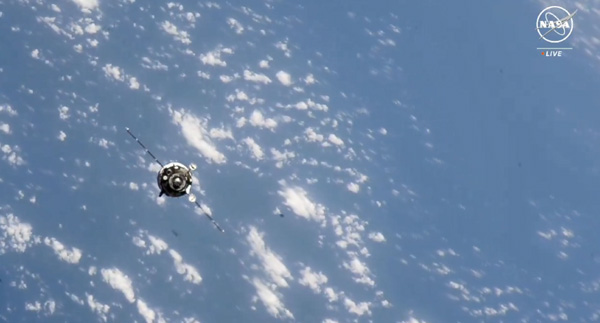
The Soyuz MS-25 capsule prior to docking to the International Space Station at 11:03 AM, EDT (3:30 PM, UTC) on March 25, 2024.
NASA TV

Sunday, March 24, 2024

New Members of the Expedition 70/71 Crew Launch Aboard a Soyuz Rocket to the ISS...

The Soyuz MS-25 rocket carrying three Expedition 70/71 space station crew members launches from Kazakhstan's Baikonur Cosmodrome on March 23, 2024.
NASA / Bill Ingalls

NASA Astronaut Tracy Dyson, Crewmates Safely En Route to Space Station (News Release - March 23)

Three crew members including NASA astronaut Tracy C. Dyson successfully launched at 8:36 a.m. EDT on Saturday from the Baikonur Cosmodrome in Kazakhstan to the International Space Station.

Dyson, along with her crewmates Roscosmos cosmonaut Oleg Novitskiy and spaceflight participant Marina Vasilevskaya of Belarus, will dock to the space station’s Prichal module about 11:09 a.m. on Monday, March 25, on the Soyuz MS-25 spacecraft.

Docking coverage will begin at 10:15 a.m. on NASA+, NASA Television, the NASA app, YouTube and the agency’s website. NASA will also air coverage, starting at 1:15 p.m., of the crew welcome ceremony on NASA+ once they are aboard the orbital outpost.

Learn how to stream NASA TV through a variety of platforms including social media.

When the hatches between the station and Soyuz open about 1:40 p.m., the new crew members will join NASA astronauts Loral O’Hara, Matthew Dominick, Mike Barratt and Jeanette Epps, as well as Roscosmos cosmonauts Oleg Kononenko, Nikolai Chub and Alexander Grebenkin, already living and working aboard the space station.

Novitskiy and Vasilevskaya will be aboard the station for 12 days, before providing the ride home for O’Hara on Saturday, April 6, aboard Soyuz MS-24 for a parachute-assisted landing on the steppe of Kazakhstan.

Dyson will spend six months aboard the station as an Expedition 70 and 71 flight engineer, returning to Earth in September with Oleg Kononenko and Nikolai Chub of Roscosmos, who will complete a year-long mission on the laboratory.

This will be the third spaceflight for Dyson, the fourth for Novitskiy, and the first for Vasilevskaya.

****

The Expedition 70/71 crew members that launched aboard the Soyuz MS-25 rocket to the International Space Station.
GCTC / Andrey Shelepin

Saturday, March 23, 2024

The Dragon CRS-30 Freighter Has Arrived at the ISS...

A video screenshot of SpaceX's Dragon CRS-30 freighter after it docked to the International Space Station...on March 23, 2024.
NASA TV

Dragon Spacecraft Docks to Station With New Science, Supplies (News Release)

While the International Space Station was traveling more than 262 miles over the South Atlantic Ocean, a SpaceX Dragon cargo spacecraft autonomously docked to the station’s Harmony module at 7:19 a.m. EDT, with NASA astronauts Loral O’Hara and Michael Barratt monitoring operations from the station.

The Dragon launched on SpaceX’s 30th contracted commercial resupply mission for NASA at 4:55 p.m. EDT on March 21, from Space Launch Complex 40 at Cape Canaveral Space Force Station in Florida. After Dragon spends about one month attached to the space station, the spacecraft will return to Earth with cargo and research.

Among the science experiments that Dragon is delivering to the space station are:

Monitoring Sea Ice Thickness and Wave Height

Nanoracks-Killick-1 is a CubeSat that measures sea ice parameters using Global Navigation Satellite System (GNSS) reflectometry or reflected signals. This monitoring system could contribute to a better understanding of important ocean phenomena and improved weather and climate models.

New Sensors for ASTROBEE

The Multi-Resolution Scanner (MRS) Payload for the Astrobee (Multi-Resolution Scanning) tests a new set of sensors to support automated 3D sensing, mapping and situational awareness functions. These systems could support future Gateway and lunar surface missions by providing automated defect detection, automated and remote maintenance, and autonomous vehicle operations.

Improving Efficiency of Quantum-Dot Solar Cells

The Nano Particle Haloing Suspension payload tests the controlled assembly of nanoparticles in a liquid solution. A process called nanoparticle haloing uses charged nanoparticles to enable precise particle arrangements that improve the efficiency of quantum-dot synthesized solar cells.

Conducting these processes in microgravity provides insight into the relationship between shape, charge, concentration and interaction of particles.

Observing Photosynthesis in Space

Advanced Plant Experiment-09 (APEX-09), also known as C4 Photosynthesis in Space, observes carbon dioxide capture and mechanisms in two types of grasses. Researchers hope to learn more about photosynthesis and plant metabolism changes overall in space.

Knowledge gained could support development of bioregenerative life support systems on future missions.

Source: NASA.Gov

Friday, March 22, 2024

Hot Fire #10 Is Now Complete in the Final Round of Testing for the Next-Generation SLS Engine...

A next-generation RS-25 engine is tested on the Fred Haise Test Stand at NASA's Stennis Space Center in Bay St. Louis, Mississippi...on March 22, 2024.
NASA / Danny Nowlin

NASA Conducts Full-Duration Artemis Moon Rocket Engine Test (News Release)

NASA continued a key RS-25 engine test series for future Artemis flights of the agency’s powerful SLS (Space Launch System) rocket on March 22 with a hot fire on the Fred Haise Test Stand at NASA’s Stennis Space Center near Bay St. Louis, Mississippi. It marked the 10th hot fire in a 12-test series to certify production of new RS-25 engines by lead contractor Aerojet Rocketdyne, an L3 Harris Technologies company.

The NASA Stennis test team fired the certification engine for 500 seconds, or the same amount of time that engines must fire to help launch the SLS rocket to space with astronauts aboard the Orion spacecraft. Operators powered the engine up to a level of 113%, which is beyond the 111% power level that new RS-25 engines use to provide additional thrust.

Testing up to the 113% power level provides a margin of operational safety. Newly-produced engines will power NASA’s SLS rocket on Artemis missions to the Moon and beyond, beginning with Artemis V.

For Artemis missions I-IV, NASA and Aerojet Rocketdyne modified 16 former space shuttle engines for use on the SLS rocket. Four RS-25 engines fire simultaneously to help launch each SLS rocket, producing up to 2 million pounds of combined thrust.

Through Artemis, NASA will establish the foundation for long-term scientific exploration at the Moon, land the first woman, first person of color and first international partner astronaut on the lunar surface, and prepare for human expeditions to Mars for the benefit of all. RS-25 tests at NASA Stennis are conducted by a diverse team of operators from NASA, Aerojet Rocketdyne and Syncom Space Services, prime contractor for site facilities and operations.

Source: NASA.Gov

Thursday, March 21, 2024

A Cargo Dragon Is Headed to the ISS from Cape Canaveral Space Force Station (Not Kennedy Space Center) in Florida...

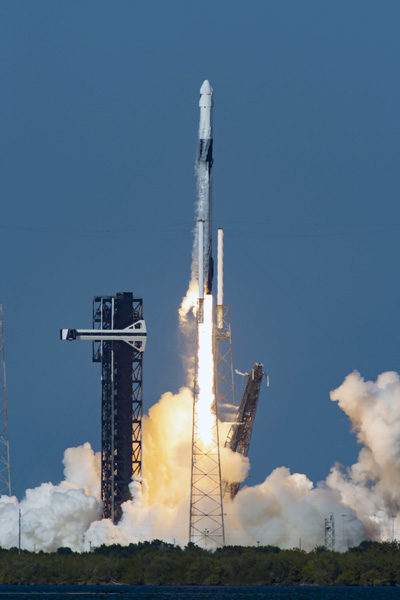
A SpaceX Falcon 9 rocket carrying the Dragon freighter for NASA's CRS-30 mission to the International Space Station launches from Cape Canaveral Space Force Station's SLC-40 pad in Florida...on March 21, 2024.
SpaceX

NASA Science, Hardware Aboard SpaceX’s 30th Resupply Launch to Station (News Release)

Following a successful launch of NASA’s SpaceX 30th commercial resupply mission, new scientific experiments and technology demonstrations for the agency are on the way to the International Space Station, including studies of technologies to measure sea ice and plant growth in space.

SpaceX’s Dragon resupply spacecraft, carrying more than 6,000 pounds of cargo to the orbiting laboratory, launched on the company’s Falcon 9 rocket at 4:55 p.m. EDT on Thursday, from Space Launch Complex 40 at Cape Canaveral Space Force Station in Florida.

The cargo spacecraft is scheduled to autonomously dock at the space station on Saturday, March 23, at approximately 7:30 a.m. and remain at the orbital outpost for about a month.

Live coverage of the arrival will begin at 5:30 a.m. on NASA+, NASA Television and on the agency’s website. Learn how to stream NASA TV through a variety of platforms.

The Dragon will deliver a new set of sensors for Astrobee robots to support automated 3D sensing, mapping and situational awareness functions. These systems could support future Gateway and lunar surface missions by providing automated maintenance and surface scanning using rovers.

Additionally, the spacecraft will deliver BurstCube, a small satellite that is designed to study gamma-ray bursts that occur when two neutron stars collide. This satellite could widen our coverage of the gamma-ray sky, improving our chances of studying bursts both with light and gravitational waves, or ripples in space-time, detected by ground-based observatories.

Finally, the spacecraft will also deliver sampling hardware for Genomic Enumeration of Antibiotic Resistance in Space (GEARS), an initiative that will test different locations of the space station for antibiotic-resistant microbes. In-flight gene sequencing could show how these bacteria adapt to the space environment, providing knowledge that informs measures to protect astronauts on future long-duration missions.

These are just a few of the hundreds of investigations conducted aboard the orbiting laboratory in the areas of biology and biotechnology, physical sciences, and Earth and space science. Advances from this scientific research will help keep astronauts healthy during long-duration space travel and demonstrate technologies for future human and robotic exploration beyond low-Earth orbit to the Moon through NASA’s Artemis campaign, in advance of the first crewed mission to Mars.

****

Wednesday, March 20, 2024

The Multi-Purpose Crew Vehicle Will Practice Docking Maneuvers During Its Second Trip to the Moon...

An infographic showing how Orion's astronauts will perform the proximity operations demonstration during NASA's Artemis 2 mission.
NASA

Key Test Drive of Orion on NASA’s Artemis II to Aid Future Missions (News Release)

Astronauts will test drive NASA’s Orion spacecraft for the first time during the agency’s Artemis II test flight next year. While many of the spacecraft’s maneuvers like big propulsive burns are automated, a key test called the proximity operations demonstration will evaluate the manual handling qualities of Orion.

During the approximately 70-minute demonstration set to begin about three hours into the mission, the crew will command Orion through a series of moves using the detached upper stage of the SLS (Space Launch System) rocket as a mark. The in-space propulsion stage, called the ICPS (interim cryogenic propulsion stage), includes an approximately two-foot target that will be used to evaluate how Orion flies with astronauts at the controls.

“There are always differences between a ground simulation and what an actual spacecraft will fly like in space,” said Brian Anderson, Orion rendezvous, proximity operations and docking manager within the Orion Program at NASA’s Johnson Space Center in Houston. “The demonstration is a flight test objective that helps us reduce risk for future missions that involve rendezvous and docking with other spacecraft.”

After NASA’s Reid Wiseman, Victor Glover and Christina Koch, and CSA (Canadian Space Agency) astronaut Jeremy Hansen are safely in space, the Moon rocket’s upper stage will fire twice to put Orion on a high-Earth orbit trajectory. Then, the spacecraft will automatically separate from the rocket stage, firing several separation bolts before springs push Orion a safe distance away.

As the spacecraft and its crew move away, Orion will perform an automated backflip to turn around and face the stage. At approximately 300 feet away, Orion will stop its relative motion.

The crew will take control and use the translational and rotational hand controllers and display system to make very small movements to ensure that Orion is responding as expected.

Next, the crew will very slowly pilot Orion to within approximately 30 feet of the stage. A two-foot auxiliary target mounted inside the top of the stage, similar to the docking target used by spacecraft visiting the International Space Station, will guide their aim.

“The crew will view the target by using a docking camera mounted inside the docking hatch window on the top of the crew module to see how well-aligned they are with the docking target mounted to the ICPS,” Anderson said.

“It’s a good stand in for what crews will see when they dock with Starship on Artemis III and to the Gateway on future missions.”

About 30 feet from the stage, Orion will stop and the crew will check out the spacecraft’s fine handling qualities to evaluate how it performs in close proximity to another spacecraft. Small maneuvers performed very close to the ICPS will be done using the reaction control system thrusters on Orion’s European Service Module.

Orion will then back away and allow the stage to turn to protect its thermal properties. The crew will follow the stage, initiate a second round of manual maneuvers using another target mounted on the side of the stage, approach within approximately 30 feet, perform another fine handling quality checkout, then back away.

At the end of the demonstration, Orion will perform an automated departure burn to move away from the ICPS before the stage then fires to re-enter Earth’s atmosphere over a remote location in the Pacific Ocean. During Orion’s departure burn, engineers will use the spacecraft’s docking camera to gather precise positioning measurements, which will help inform navigation during rendezvous activities on future missions in the lunar environment, where there is no GPS system.

Because the Artemis II Orion is not docking with another spacecraft, it is not equipped with a docking module containing lights and therefore is reliant on the ICPS to be lit enough by the Sun to allow the crew to see the targets.

“As with many of our tests, it’s possible the proximity operations demonstration won’t go exactly as expected,” said Anderson. “Even if we don’t accomplish every part of the demonstration, we’ll continue on with the test flight as planned to accomplish our primary objectives, including evaluating Orion’s systems with crew aboard in the deep space environment and keeping the crew safe during the mission.”

The approximately 10-day Artemis II flight will test NASA’s foundational human deep space exploration capabilities, the SLS rocket and Orion spacecraft, for the first time with astronauts and will pave the way for lunar surface missions, including landing the first woman, first person of color and first international partner astronaut on the Moon.

Source: NASA.Gov

****

A critical auxiliary target is added to the interim cryogenic propulsion stage for NASA's Artemis 2 mission inside United Launch Alliance's Delta Operations Center...at Cape Canaveral Space Force Station in Florida on May 16, 2023.
United Launch Alliance