Monday, November 21, 2022

A Human-rated Spacecraft Has Flown Past the Moon for the First Time Since 1972!

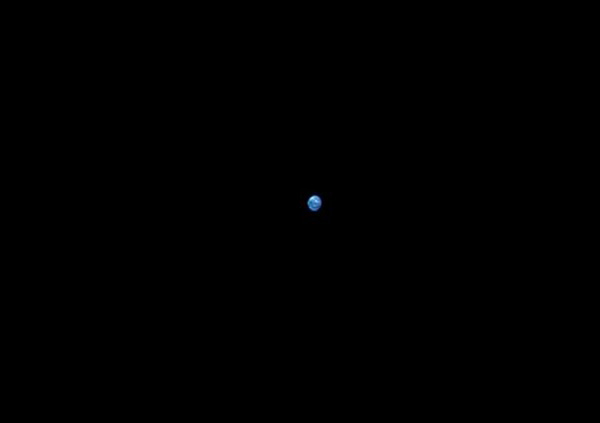
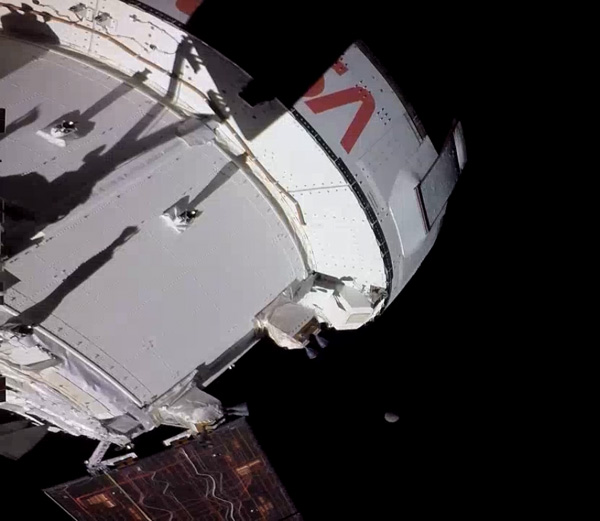
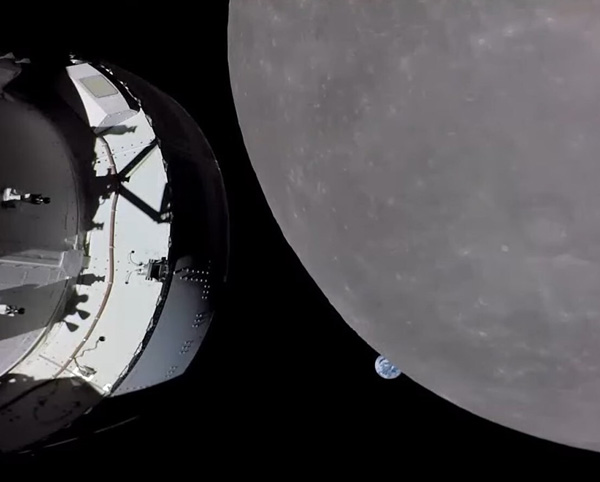
A video screenshot of NASA's Orion spacecraft approaching the Moon as the Earth sets in the distance...on November 21, 2022.
NASA TV

Artemis I – Flight Day Six: Orion Performs Lunar Flyby, Closest Outbound Approach (News Release)

On its sixth day into the Artemis I mission, Orion successfully completed its fourth orbital trajectory correction burn using the auxiliary engines at 1:44 a.m. CST ahead of the first of two maneuvers required to enter a distant retrograde orbit around the Moon. The first three trajectory correction burns provided an opportunity to fire all three thruster types on Orion with the first using the large orbital maneuvering system engine, the second using the small reaction control system thrusters and the third using the medium-sized auxiliary engines.

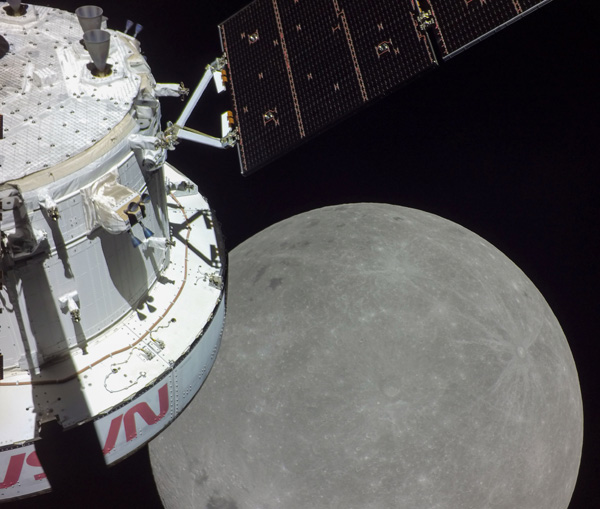
Orion completed the outbound powered flyby at 6:44 a.m., passing about 81 miles above the surface at 6:57 a.m. The spacecraft's speed increased from 2,128 mph before the burn to 5,102 mph after the burn.

Shortly after the outbound flyby burn, the spacecraft passed about 1,400 miles above the Apollo 11 landing site at Tranquility Base at 7:37 a.m. Orion later flew over the Apollo 14 site at about 6,000 miles in altitude and then over the Apollo 12 site at an altitude of about 7,700 miles.

“The mission continues to proceed as we had planned, and the ground systems, our operations teams and the Orion spacecraft continue to exceed expectations, and we continue to learn along the way about this new, deep-space spacecraft,” said Mike Sarafin, Artemis I mission manager, in a November 21 briefing at Johnson Space Center.

Orion will enter a distant retrograde orbit beyond the Moon on Friday, November 25 with the second maneuver, called the distant retrograde orbit insertion burn. The orbit is “distant” in the sense that it’s at a high altitude from the surface of the Moon, and it’s “retrograde” because Orion will travel around the Moon opposite the direction the Moon travels around Earth.

This orbit provides a highly-stable orbit where little fuel is required to stay for an extended trip in deep space to put Orion’s systems to the test in an extreme environment far from Earth.

Orion will travel about 57,287 miles beyond the Moon at its farthest point from the Moon on November 25, pass the record set by Apollo 13 for the farthest distance traveled by a spacecraft designed for humans at 248,655 miles from Earth on Saturday, November 26, and reach its maximum distance from Earth of 268,552 miles Monday, November 28.

As of Monday, November 21, a total of 3,715.7 pounds of propellant has been used, 76.2 pounds less than prelaunch expected values. There are 2,112.2 pounds of margin available over what is planned for use during the mission, an increase of 201.7 pounds from prelaunch expected values.

Just after 2:45 p.m. CST on November 21, Orion had traveled 216,842 miles from Earth and was 13,444 miles from the Moon, cruising at 3,489 miles per hour.

Follow along and track Orion via the Artemis Real-Time Orbit Website, or AROW, and watch live footage from the spacecraft. You can find the latest images from Orion on the Johnson Space Center Flickr account.

Source: NASA.Gov

****
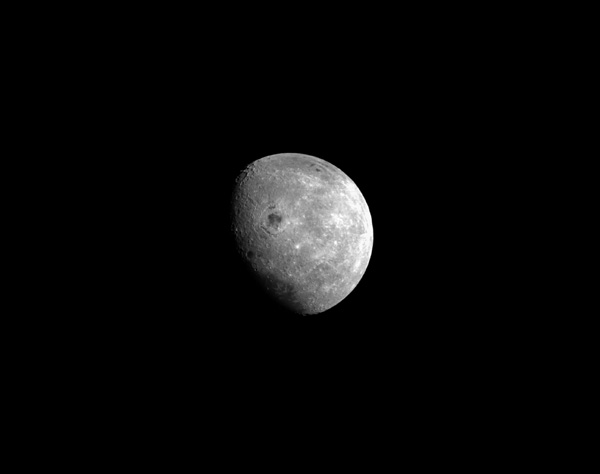
A snapshot of the Moon taken by NASA's Orion spacecraft on November 21, 2022.
NASA

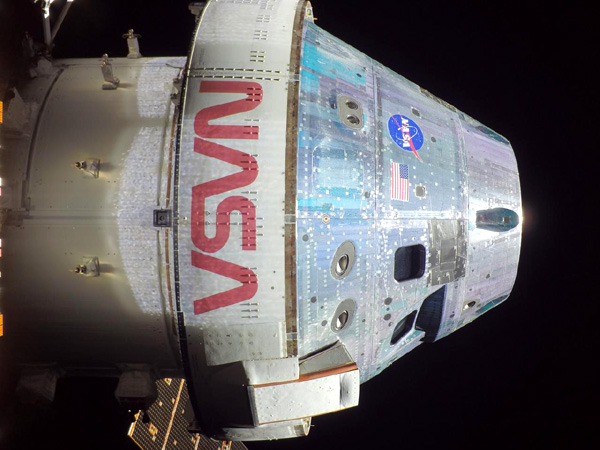
A snapshot of NASA's Orion spacecraft as it approached the Moon for its outbound powered flyby...on November 21, 2022.
NASA

Another snapshot of NASA's Orion spacecraft as it approached the Moon for its outbound powered flyby...on November 21, 2022.
NASA

Another snapshot of NASA's Orion spacecraft as it approached the Moon for its outbound powered flyby...on November 21, 2022.
NASA

A snapshot taken by NASA's Orion spacecraft of the Earth sitting in the cosmic abyss...on November 21, 2022.
NASA

Sunday, November 20, 2022

Apollo's Successor Gets Ready for Its Closest Approach to the Moon's Surface Tomorrow Morning...

A snapshot of NASA's Orion spacecraft with the Moon visible in the distance...on November 20, 2022.
NASA

Artemis I – Flight Day Five: Orion Enters Lunar Sphere of Influence Ahead of Lunar Flyby (News Release)

Five days into the 25.5-day Artemis I mission, Orion continues on its trajectory toward the Moon. Flight controllers in the White Flight Control Room at NASA’s Johnson Space Center in Houston captured additional imagery of the Moon using the optical navigation camera.

Gathering imagery of the Earth and the Moon at different phases and distances will provide an enhanced body of data to certify its effectiveness as a location determination aid for future missions under changing lighting conditions.

Orion completed its third outbound trajectory correction burn at 6:12 a.m. CST, firing the auxiliary thruster engines for a duration of 6 seconds at a rate of 3.39 feet per second to accelerate Orion and adjust the spacecraft’s path while en route to the Moon. The amount of speed change determines which of Orion’s service module engines – reaction control, auxiliary or orbital maneuvering system – to use for a particular maneuver.

The spacecraft entered into the lunar sphere of influence at 1:09 p.m. CST, making the Moon, instead of Earth, the main gravitational force acting on the spacecraft. Overnight, Orion will conduct the fourth outbound trajectory correction burn in advance of the outbound powered flyby burn.

Flight controllers will conduct the outbound powered flyby burn by firing the orbital maneuvering system engine for 2 minutes and 30 seconds to accelerate the spacecraft, harness the force from the Moon’s gravity, and direct it toward a distant retrograde orbit beyond the Moon.

The outbound powered flyby burn is the first of a pair of maneuvers required to enter a distant retrograde orbit around the Moon. NASA will cover the maneuver live starting at 7:15 a.m. EST on the agency’s website, NASA Television and the NASA app.

The outbound powered flyby will begin at 7:44 a.m., with Orion’s closest approach to the Moon targeted for 7:57 a.m., when it will pass about 80 miles above the lunar surface. Engineers expect to lose communication with the spacecraft as it passes behind the Moon for approximately 34 minutes starting at 7:26 a.m.

The Goldstone ground station, part of NASA’s Deep Space Network, will acquire the spacecraft once it emerges from behind the Moon.

Mission managers currently have two active anomaly resolution teams. Anomaly resolution teams are a standard part of managing the mission by pulling together a team of technical experts to focus on a specific issue by examining data to understand the implications in a particular system.

Activating a separate team for this work enables engineers and flight controllers to continue focusing on commanding and monitoring the spacecraft and assessing the progress of the flight test.

One team is currently looking at the star tracker system to understand a number of faults in the random access memory, which have been successfully recovered with power cycles. A second team is analyzing a few instances in which one of eight units located in the service module that provides solar array power to the crew module, called a power conditioning and distribution unit umbilical latching current limiter, opened without a command.

The umbilical was successfully commanded closed each time and there was no loss of power flowing to avionics on the spacecraft. Both systems are currently functioning as required, and there are no mission impacts related to these efforts.

Analyzing the data for these systems and understanding their behavior during an active flight test while the hardware is in the deep space environment will improve mission operations on Artemis I and future missions.

At 1:25 p.m. CST on November 20, Orion had traveled 232,683 miles from Earth and was 39,501 miles from the Moon, cruising at 371 miles per hour. See which antennas are communicating with Orion in real-time on Deep Space Network Now and track Orion via the Artemis Real-Time Orbit Website, or AROW.

Source: NASA.Gov

****

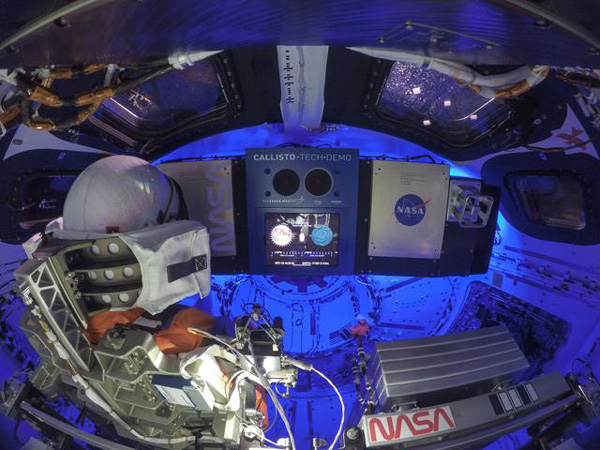
A snapshot of the crew cabin inside NASA's Orion spacecraft...on November 18, 2022.
NASA

Saturday, November 19, 2022

Orion Remains on Track to Fly Near the Moon on November 21...

NASA's Orion spacecraft takes a selfie during its ongoing journey to the Moon...on November 18, 2022.
NASA

Artemis I – Flight Day Four: Testing WiFi Signals, Radiator System, GO for Outbound Powered Flyby (News Release)

On Saturday, November 19, the Mission Management Team polled “go” for Orion’s outbound powered flyby past the Moon. NASA will cover the flyby live on NASA TV, the agency’s website and the NASA app starting at 7:15 a.m. EST Monday, November 21.

The burn is planned for 7:44 a.m. Orion will lose communication with Earth as it passes behind the Moon from 7:25 a.m. through 7:59 a.m., making its closest approach of approximately 80 miles from the surface at 7:57 a.m.

During flight day four, flight controllers moved each solar array to a different position to test the strength of the WiFi signal with the arrays in different configurations. The Integrated Communications Officer, or INCO, tested the WiFi transfer rate between the camera on the tip of the solar array panels and the camera controller.

The goal was to determine the best position to most efficiently transfer imagery files. Teams learned that having multiple cameras on at once can impact the WiFi data rate, and therefore, future solar array wing file transfer activities will be accomplished from one solar array wing at a time to optimize transfer time.

The Emergency, Environmental and Consumables Manager, or EECOM, tested Orion’s radiator system. Two radiator loops on the spacecraft’s European Service Module help expel excess heat generated by different systems throughout the flight.

Flight controllers are testing sensors that maintain the coolant flow in the radiator loops, switching between different modes of operation and monitoring performance. During speed mode, the coolant pumps operate at a constant rate. This is the primary mode used during Artemis I.

Flow control mode adjusts the pump speed as needed to maintain a constant flow through the system. The flight test objective is to monitor system performance and the accuracy of flow sensors to characterize the stability of this mode of operation. Each loop is monitored in flow control mode for 72 hours to provide sufficient data for use on future missions.

As part of planned testing throughout the mission, the guidance, navigation and control officer, also known as GNC, performed the first of several tests of the star trackers that support Orion’s navigation system. Star trackers are a navigation tool that measure the positions of stars to help the spacecraft determine its orientation.

In previous flight days, engineers evaluated initial data to understand star tracker readings correlated to thruster firings. Engineers hope to characterize the alignment between the star trackers that are part of the guidance, navigation and control system and the Orion inertial measurements units, by exposing different areas of the spacecraft to the Sun and activating the star trackers in different thermal states.

Just after 5:30 p.m. on November 19, Orion had traveled 222,823 miles from Earth and was 79,011 miles from the Moon, cruising at 812 miles per hour. You can track Orion via the Artemis Real-Time Orbit Website, or AROW.

Overnight, engineers in mission control will uplink large data files to Orion to better understand how much time it takes for the spacecraft to receive sizeable files. On flight day five, Orion will undergo its third planned outbound trajectory correction burn to maneuver the spacecraft and stay on course for the Moon.

Source: NASA.Gov

****

A video screenshot of NASA's Orion spacecraft with the Moon visible in the distance...on November 18, 2022.
NASA

Wednesday, November 16, 2022

SLS Update: Humanity's Return to the Lunar Surface Has Moved Closer to Reality!

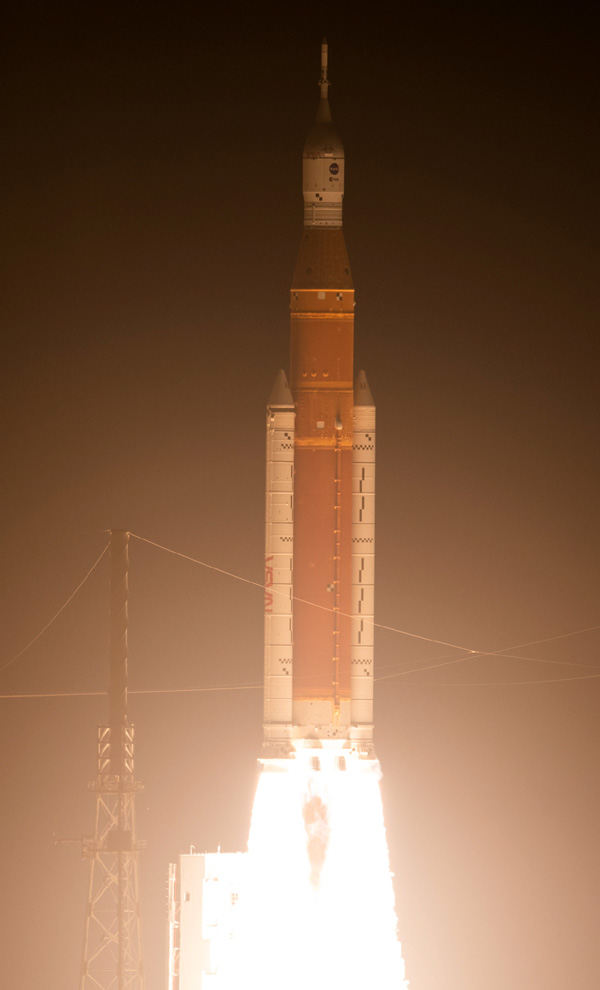
NASA's Space Launch System rocket lifts off on Artemis 1 from Kennedy Space Center's Launch Complex 39B in Florida...on November 16, 2022.
NASA / Joel Kowsky

Liftoff! NASA’s Artemis I Mega Rocket Launches Orion to Moon (Press Release)

Following a successful launch of NASA’s Space Launch System (SLS), the most powerful rocket in the world, the agency’s Orion spacecraft is on its way to the Moon as part of the Artemis program. Carrying an uncrewed Orion, SLS lifted off for its flight test debut at 1:47 a.m. EST Wednesday from Launch Complex 39B at NASA’s Kennedy Space Center in Florida.

The launch is the first leg of a mission in which Orion is planned to travel approximately 40,000 miles beyond the Moon and return to Earth over the course of 25.5 days. Known as Artemis I, the mission is a critical part of NASA’s Moon to Mars exploration approach, in which the agency explores for the benefit of humanity. It’s an important test for the agency before flying astronauts on the Artemis II mission.

“What an incredible sight to see NASA’s Space Launch System rocket and Orion spacecraft launch together for the first time. This uncrewed flight test will push Orion to the limits in the rigors of deep space, helping us prepare for human exploration on the Moon and, ultimately, Mars,” said NASA Administrator Bill Nelson.

After reaching its initial orbit, Orion deployed its solar arrays and engineers began performing checkouts of the spacecraft’s systems. About 1.5 hours into flight, the rocket’s upper stage engine successfully fired for approximately 18 minutes to give Orion the big push needed to send it out of Earth orbit and toward the Moon.

Orion has separated from its upper stage and is on its outbound coast to the Moon powered by its service module, which is the propulsive powerhouse provided by ESA (European Space Agency) through an international collaboration.

“It’s taken a lot to get here, but Orion is now on its way to the Moon,” said Jim Free, NASA deputy associate administrator for the Exploration Systems Development Mission Directorate. “This successful launch means NASA and our partners are on a path to explore farther in space than ever before for the benefit of humanity.”

Over the next several hours, a series of 10 small science investigations and technology demonstrations, called CubeSats, will deploy from a ring that connected the upper stage to the spacecraft. Each CubeSat has its own mission that has the potential to fill gaps in our knowledge of the solar system or demonstrate technologies that may benefit the design of future missions to explore the Moon and beyond.

Orion’s service module will also perform the first of a series of burns to keep Orion on course toward the Moon approximately eight hours after launch. In the coming days, mission controllers at NASA’s Johnson Space Center in Houston will conduct additional checkouts and course corrections as needed. Orion is expected to fly by the Moon on November 21, performing a close approach of the lunar surface on its way to a distant retrograde orbit, a highly stable orbit thousands of miles beyond the Moon.

“The Space Launch System rocket delivered the power and performance to send Orion on its way to the Moon,” said Mike Sarafin, Artemis I mission manager. “With the accomplishment of the first major milestone of the mission, Orion will now embark on the next phase to test its systems and prepare for future missions with astronauts.”

The SLS rocket and Orion spacecraft arrived at Kennedy’s Launch Complex 39B on November 4 where they rode out Hurricane Nicole. Following the storm, teams conducted thorough assessments of the rocket, spacecraft and associated ground systems, and confirmed that there were no significant impacts from the severe weather.

Engineers previously rolled the rocket back to the Vehicle Assembly Building (VAB) September 26 ahead of Hurricane Ian and after waving off two previous launch attempts August 29 due to a faulty temperature sensor, and September 4 due to a liquid hydrogen leak at an interface between the rocket and mobile launcher. Prior to rolling back to the VAB, teams successfully repaired the leak and demonstrated updated tanking procedures. While in the VAB, teams performed standard maintenance to repair minor damage to the foam and cork on the thermal protection system and recharge or replace batteries throughout the system.

Artemis I is supported by thousands of people around the world, from contractors who built Orion and SLS, and the ground infrastructure needed to launch them, to international and university partners, to small businesses supplying subsystems and components.

Through Artemis missions, NASA will land the first woman and first person of color on the surface of the Moon, paving the way for a long-term lunar presence and serving as a steppingstone for astronauts on the way to Mars.

****

NASA's Space Launch System rocket lifts off on Artemis 1 from Kennedy Space Center's Launch Complex 39B in Florida...on November 16, 2022.
NASA / Keegan Barber

A video screenshot of NASA's Orion spacecraft flying 58,000 miles (93,342 kilometers) from the Earth as the human-rated capsule headed to the Moon...on November 16, 2022.
NASA TV

A photo of the flash drive bearing the names of 3.4 million people who submitted them for flight on the Artemis 1 mission.
NASA

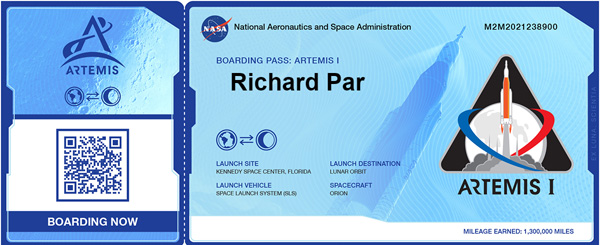
My mission certificate for the Artemis 1 mission.

Tuesday, November 15, 2022

Starship Will Play a Pivotal Role in the Artemis 4 Mission...

An artist's concept of astronauts conducting a moonwalk near the base of SpaceX's Starship lunar lander.
SpaceX

NASA Awards SpaceX Second Contract Option for Artemis Moon Landing (Press Release)

NASA has awarded a contract modification to SpaceX to further develop its Starship human landing system to meet agency requirements for long-term human exploration of the Moon under Artemis.

With this addition, SpaceX will provide a second crewed landing demonstration mission in 2027 as part of NASA’s Artemis IV mission.

“Returning astronauts to the Moon to learn, live and work is a bold endeavor. With multiple planned landers, from SpaceX and future partners, NASA will be better positioned to accomplish the missions of tomorrow: conducting more science on the surface of the Moon than ever before and preparing for crewed missions to Mars,” said NASA Administrator Bill Nelson.

Known as Option B, the modification follows an original award to SpaceX in April 2021 under the Next Space Technologies for Exploration Partnerships-2 (NextSTEP-2) Appendix H Option A contract. NASA previously announced plans to pursue this Option B with SpaceX.

“Continuing our collaborative efforts with SpaceX through Option B furthers our resilient plans for regular crewed transportation to the lunar surface and establishing a long-term human presence under Artemis,” said Lisa Watson-Morgan, manager for the Human Landing System program at NASA’s Marshall Space Flight Center in Huntsville, Alabama. “This critical work will help us focus on the development of sustainable, service-based lunar landers anchored to NASA’s requirements for regularly recurring missions to the lunar surface.”

The aim of this new work under Option B is to develop and demonstrate a Starship lunar lander that meets NASA’s sustaining requirements for missions beyond Artemis III, including docking with Gateway, accommodating four crew members, and delivering more mass to the surface.

NASA initially selected SpaceX to develop a human landing system variant of Starship to land the next American astronauts on the Moon under Artemis III, which will mark humanity’s first return to the lunar surface in more than 50 years. As part of that contract, SpaceX will also conduct an uncrewed demonstration mission to the Moon prior to Artemis III.

The agency is pursuing two parallel paths for human lunar landers developed according to NASA’s sustained requirements to increase the competitive pool of capable industry providers – the existing contract with SpaceX and another solicitation released earlier this year. The other solicitation, NextSTEP-2 Appendix P, is open to all other U.S. companies to develop additional human landing system capabilities and includes uncrewed and crewed demonstration missions from lunar orbit to the surface of the Moon.

Astronaut Moon landers are a vital part of NASA’s deep space exploration plans, along with the Space Launch System rocket, Orion spacecraft, ground systems, spacesuits and rovers, and Gateway.

Under Artemis, NASA will send a suite of new lunar science instruments and technology demonstrations to study the Moon, land the first woman and first person of color on the lunar surface, establish a long term lunar presence, and more. The agency will leverage its Artemis experiences and technologies to prepare for the next giant leap – sending astronauts to Mars.

****

Sunday, November 13, 2022

The First Artemis Mission Has Officially Reached Its Lunar Destination!

An artist's concept of NASA's CAPSTONE spacecraft orbiting the Moon.
NASA

CAPSTONE Arrives to Orbit at the Moon (News Release)

The CAPSTONE mission operations team confirmed that NASA’s CAPSTONE spacecraft arrived in its orbit at the Moon Sunday evening. The CubeSat completed an initial orbit insertion maneuver, firing its thrusters to put the spacecraft into orbit, at 7:39 p.m. EST.

CAPSTONE is now in a near-rectilinear halo orbit, or NRHO. This particular NRHO is the same orbit that will be used by Gateway, the Moon-orbiting space station that will support NASA’s Artemis missions. CAPSTONE is the first spacecraft to fly an NRHO, and the first CubeSat to operate at the Moon.

In the next five days, CAPSTONE will perform two additional clean-up maneuvers to refine its orbit. After these maneuvers, the team will review data to confirm that CAPSTONE remains on track in the NRHO.

Source: NASA.Gov

****

An artist's concept of NASA's Gateway orbiting the Moon.
NASA

Friday, November 11, 2022

SLS Remains Scheduled for a Nov. 16 Launch After Bearing the Brunt of Hurricane Nicole...

NASA's Space Launch System rocket stands tall at Kennedy Space Center's Pad 39B in Florida...on November 11, 2022.
NASA / Joel Kowsky

Teams Conduct Check-outs, Preparations Ahead of Next Artemis I Launch Attempt (News Release)

NASA continues to target launch of its Artemis I mission from the agency’s Kennedy Space Center in Florida at 1:04 a.m. EST, Wednesday, November 16. There is a two-hour launch window for the agency’s first integrated flight test of its Space Launch System (SLS) rocket and Orion spacecraft.

Teams conducted thorough assessments at Launch Complex 39B beginning Thursday evening, closely inspecting SLS, Orion, the mobile launcher and other pad-related assets to confirm there were no significant impacts from Hurricane Nicole, which made landfall more than 70 miles south of the launch pad. The physical inspections augmented remote monitoring via sensors and high-resolution cameras performed during the storm by a team in a safe location at Kennedy.

Space Launch System engineers have performed detailed analysis to confirm the sustained and peak winds experienced during the storm have no adverse effect on the structural strength of the rocket. While varying peak winds were measured by sensors at different heights at the pad, all measurements remained below 75% of SLS design limits, which also are intentionally conservative.

Data from testing with actual hardware during the structural test series and modal testing, as well as other evaluations and modeling, provide confidence that there is margin beyond the design ratings.

Technicians are also working to fix several minor items from the storm. Most repairs involve loose caulk or weather coverings. An umbilical used to provide purge air, or proper environmental conditions to the Orion spacecraft, was out of position. The umbilical maintained purge throughout the storm and has been repositioned to allow proper retraction at liftoff.

Engineers have also removed the hard cover over the launch abort system window installed before the storm and will inspect the window to confirm it is in good condition for launch.

Today, as part of normal launch preparation, engineers are in the process of powering up rocket and spacecraft elements to confirm all systems are healthy. Powered health checks will continue until Saturday. Engineers plan to conduct the standard final software and hardware-related tests required before launch, on Sunday. The Artemis I mission management team will convene Sunday afternoon to review the preparations for launch.

Source: NASA.Gov

Thursday, November 10, 2022

An Accomplished Space Explorer Will Soon Leave America's Astronaut Corps...

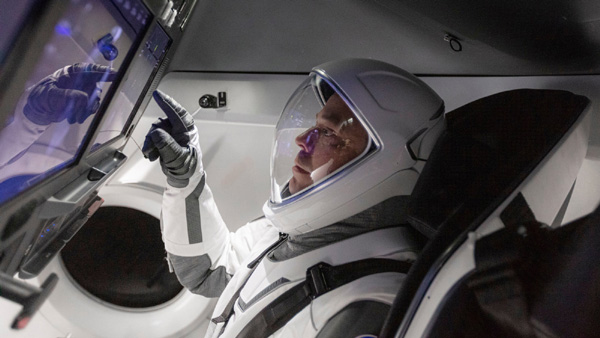
Inside SpaceX's Crew Dragon capsule, NASA astronaut Bob Behnken prepares for launch on the historic Demo-2 mission...which lifted off for the International Space Station on May 30, 2020.
SpaceX

Pioneering Astronaut Bob Behnken Retires from NASA (Press Release)

NASA astronaut and former U.S. Air Force Col. Bob Behnken is retiring from NASA after 22 years of service. His last day with the agency is Friday, November 11.

“Bob Behnken is a distinguished and talented astronaut, and an effective ambassador for our never-ending mission to explore the cosmos,” said Administrator Bill Nelson. “Bob and fellow NASA astronaut Doug Hurley launched into history with their impeccable command of NASA and SpaceX’s Demo-2 mission, and played a pivotal role in helping a new era of commercial space take flight. Along with the entire NASA family, I appreciate Bob’s service to our country and wish him all the best in his next endeavor.”

Behnken’s career highlights included 93 days in space on two space shuttle Endeavour flights and the first crewed flight of the SpaceX Dragon spacecraft.

Behnken was pilot and joint operations commander for the first crewed flight test of the SpaceX Dragon. Known as Demo-2, that flight launched Behnken and former NASA astronaut Doug Hurley to the International Space Station on May 30, 2020, and safely returned them to Earth on August 2, 2020.

The Demo-2 flight inaugurated a new era of human spaceflight, which continues today with reliable crew launches to the space station from American soil on commercially built and owned spacecraft. As a space station crew member for 62 days, Behnken performed four spacewalks with former NASA astronaut Chris Cassidy and contributed more than 100 hours to the orbiting laboratory’s scientific investigations.

“Bob served and led the astronaut office with calm hands and exceptional expertise,” said Reid Weisman, chief of the astronaut office at NASA’s Johnson Space Center in Houston. “There are few as experienced and trusted in this industry. We will miss him, and we wish him well in his next endeavor.”

Behnken joined NASA at Johnson in July 2000 as an astronaut candidate. On his first spaceflight, in 2008, Behnken was a space shuttle Endeavour mission specialist for the STS-123 delivery of the Japan Aerospace Exploration Agency’s Kibo laboratory and the Canadian Space Agency’s Special Purpose Dexterous Manipulator (Dextre) to the space station. Behnken performed three spacewalks, and operated the station’s robotic arm both with and without Dextre attached.

Behnken flew again in 2010, as a mission specialist for STS‐130, which delivered the station’s Tranquility module and its cupola, the station’s seven‑window Earth-facing observation post. He served as the mission’s lead spacewalker, performing three additional spacewalks to install the newly-arrived module. Behnken completed 10 spacewalks across his three missions, spending more than 61 hours working in the vacuum of space.

“Bob served the agency in a vital role as an astronaut and contributed greatly to some of NASA’s most important and groundbreaking endeavors,” said Kathryn Lueders, associate administrator for space operations at NASA Headquarters. “During his career, he flew missions to help build a world-class science laboratory in space, flew the first commercial crew spacecraft to orbit, and left his mark in the astronaut corps. All of these contributions to human spaceflight will continue to benefit all of us as we continue to push new boundaries.”

Behnken also supported NASA astronauts on Earth in a variety of roles. Following the completion of two years of training and evaluation, he was assigned technical duties in the astronaut office, supporting space shuttle launch and landing activities. Behnken trained as an International Space Station crew member following the loss of space shuttle Columbia in 2003 and as a mission specialist for STS-400, the launch-on-need rescue flight for the last Hubble servicing mission. He served as NASA’s chief astronaut from 2012 to 2015, and deputy of NASA’s Flight Operations Directorate from September 2021 to April 2022.

“I am humbled to have had the opportunity to represent our nation as a NASA astronaut, and thankful to have been a part of the team that returned human spaceflight to the United States back in 2020,” said Behnken. “I am so looking forward to seeing and being amazed by what people of this great agency will accomplish next.”

Behnken grew up in St. Ann, Missouri, and graduated from Pattonville High School in Maryland Heights, Missouri. He earned dual Bachelor of Science degrees in physics and mechanical engineering from Washington University in St. Louis in 1992, a Master of Science in mechanical engineering from the California Institute of Technology in Pasadena in 1993, and a Doctorate in mechanical engineering from the California Institute of Technology in 1997. Behnken was commissioned via the Air Force Reserve Officers’ Training Corps and attended the Air Force Test Pilot School at Edwards Air Force Base in California.

Before retiring from active military service in February 2022, Behnken had achieved the rank of colonel and flown more than 2,000 flight hours in more than 25 different types of aircraft.

****

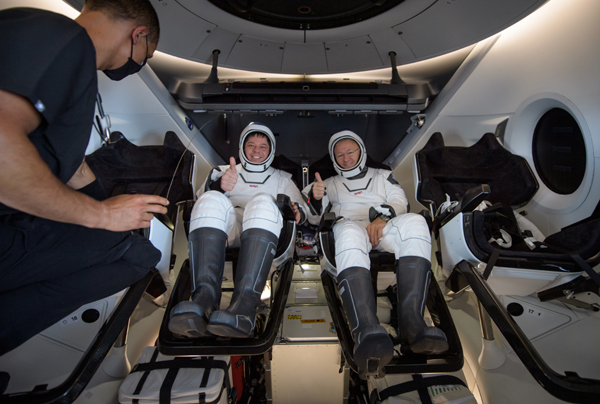
NASA astronauts Bob Behnken and Doug Hurley (now retired as well) give thumbs-up before they egress from SpaceX's Dragon Endeavour capsule...after successfully completing the historic Demo-2 mission on August 2, 2020.
NASA / Bill Ingalls

Wednesday, November 9, 2022

SLS Battens Down the Hatches for Rough Weather Ahead...

NASA's Space Launch System rocket stands tall at Kennedy Space Center's Pad 39B in Florida...on the morning of November 7, 2022.
NASA / Joel Kowsky

NASA Prepares Rocket, Spacecraft Ahead of Tropical Storm Nicole, Re-targets Launch (News Release - November 8)

NASA is continuing to monitor Tropical Storm Nicole and has decided to re-target a launch for the Artemis I mission for Wednesday, November 16, pending safe conditions for employees to return to work, as well as inspections after the storm has passed. Adjusting the target launch date will allow the workforce to tend to the needs of their families and homes, and provide sufficient logistical time to get back into launch status following the storm.

Kennedy is currently in a HURCON (Hurricane Condition) III status, which includes securing facilities, property and equipment at the center, as well as briefing and deploying the “ride-out” team. As part of NASA’s hurricane preparedness protocol, a “ride-out” team includes a set of personnel who will remain in a safe location at Kennedy throughout the storm to monitor centerwide conditions, including the flight hardware for the Artemis I mission.

Kennedy will release non-essential personnel at the HURCON II status as the agency continues to prioritize its employees in the Kennedy area. Based on expected weather conditions and options to roll back ahead of the storm, the agency determined Sunday evening the safest option for the launch hardware was to keep the Space Launch System (SLS) rocket and Orion spacecraft secured at the pad.

The SLS rocket is designed to withstand 85 mph (74.4 knot) winds at the 60-foot level with structural margin.

Current forecasts predict the greatest risks at the pad are high winds that are not expected to exceed the SLS design. The rocket is designed to withstand heavy rains at the launch pad and the spacecraft hatches have been secured to prevent water intrusion.

In preparation for the storm, teams have powered down the Orion spacecraft, SLS core stage, interim cryogenic propulsion stage and boosters. Engineers have also installed a hard cover over the launch abort system window, retracted and secured the crew access arm on the mobile launcher and configured the settings for the environmental control system on the spacecraft and rocket elements.

Teams are also securing nearby hardware and performing walkdowns for potential debris in the area.

Teams are poised to resume work as soon as weather and Kennedy center status allows. Once back on-site, technicians will perform walkdowns and inspections at the pad to assess the status of the rocket and spacecraft as soon as practicable.

A launch during a two-hour window that opens at 1:04 a.m. EST on November 16 would result in a splashdown on Sunday, December 11. If needed, NASA has a back-up launch opportunity on Saturday, November 19, and will coordinate with the U.S. Space Force for additional launch opportunities.

The agency continues to rely on the most up-to-date information from the National Oceanic and Atmospheric Administration, U.S. Space Force and the National Hurricane Center throughout its evaluations and continues to closely monitor conditions for the Kennedy area.

Source: NASA.Gov

Tuesday, November 8, 2022

Images of the Day: A Blood Moon and the Mega-Moon Rocket...

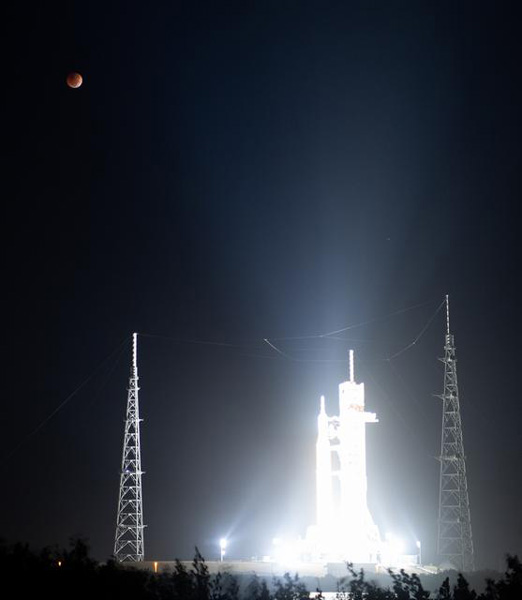
NASA's Space Launch System rocket stands tall at Kennedy Space Center's Pad 39B in Florida as a total lunar eclipse looms high above it...on November 8, 2022.
NASA / Joel Kowsky

As of right now, there's a chance that NASA's Space Launch System rocket won't launch as scheduled on November 14 due to Tropical Storm Nicole...which should make landfall in Florida tomorrow. November 16 is reportedly the earliest date that Artemis 1 can get off the ground.

Stay tuned for more information.

****

Total Lunar Eclipse (Photo Release)

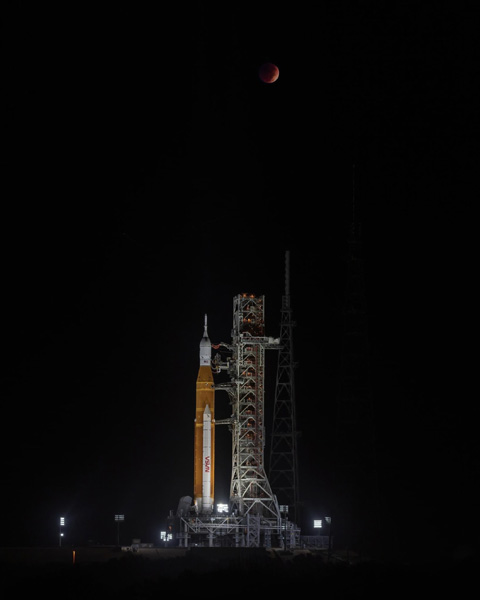
The Moon is seen during a total lunar eclipse above NASA’s Space Launch System (SLS) rocket—with the Orion spacecraft aboard—atop a mobile launcher at Launch Complex 39B, Tuesday, November 8, 2022, at NASA’s Kennedy Space Center in Florida.

NASA’s Artemis I flight test is the first integrated test of the agency’s deep space exploration systems: the Orion spacecraft, SLS rocket and supporting ground systems.

Source: NASA.Gov

****

NASA's Space Launch System rocket stands tall at Kennedy Space Center's Pad 39B in Florida as a total lunar eclipse looms high above it...on November 8, 2022.
NASA / Sean Cannon