Thursday, August 12, 2021

ISS Update: The S.S. Ellison Onizuka Is Now Berthed to the Orbital Outpost...

An infographic showing where Crew Dragon, Soyuz, Progress and the Cygnus freighter are currently docked to the International Space Station.
NASA

Earlier today, Northrop Grumman's Cygnus cargo freighter—christened the S.S. Ellison Onizuka in honor of the fallen space shuttle Challenger astronaut—was successfully berthed to the International Space Station (ISS). The freighter was bolted in place to the Earth-facing port of the Unity module at 9:42 AM, Eastern Daylight Time (6:42 AM, Pacific Daylight Time).

The S.S. Onizuka, which launched two days ago and brought 8,200 pounds of science experiments and supplies to the ISS, will remain at the orbital outpost till November. Trash will be loaded onto the Cygnus spacecraft before it is unberthed from the space station and intentionally conducts a destructive re-entry into Earth's atmosphere.

Wednesday, August 11, 2021

Photo of the Day: The Orion Stage Adapter Is One Step Closer to Being Mated to the SLS Rocket...

A snapshot of the Orion Stage Adapter--with 9 CubeSat dispensers already attached to the inside of it--that will be mated to the Space Launch System rocket for NASA's Artemis 1 mission.
NASA / Cory Huston

Orion Stage Adapter Readied for Ride on Artemis I (News Release)

Technicians continue to prepare small satellites, called CubeSats, at NASA’s Kennedy Space Center in Florida for their upcoming launch on the Artemis I mission. Technicians from the agency’s Exploration Ground Systems and contractor Jacobs worked with developers of the shoebox-sized secondary payloads as they underwent final processing and were secured inside the Orion Stage Adapter.

The ring-shaped stage adapter will be connected to the Space Launch System (SLS) Interim Cryogenic Propulsion Stage, and the Orion spacecraft will be secured on top. All CubeSats will be deployed after SLS completes its primary mission, launching the Orion spacecraft on a trajectory toward the Moon. Although small in size, the CubeSats will conduct a variety of science experiments and technology demonstrations including some that will expand our knowledge of the lunar surface during the Artemis I mission.

Artemis I will be the first integrated flight test of NASA’s deep space exploration system: the Orion spacecraft, SLS rocket, and the ground systems at Kennedy. The first in a series of increasingly complex missions, Artemis I will provide a foundation for human deep space exploration, and demonstrate commitment and capability to extend human existence to the Moon and beyond.

Source: NASA.Gov

Tuesday, August 10, 2021

ISS Update: The S.S. Ellison Onizuka Is Headed to the Orbital Outpost...

A Cygnus spacecraft--named the S.S. Ellison Onizuka after the fallen space shuttle Challenger astronaut--launches aboard an Antares 230+ rocket from NASA's Wallops Flight Facility in Virginia...on August 10, 2021.
NASA / Jamie Adkins

NASA Science, Cargo Launches on Northrop Grumman Resupply Mission (Press Release)

A Northrop Grumman Cygnus resupply spacecraft is on its way to the International Space Station with more than 8,200 pounds of science investigations and cargo after launching at 6:01 p.m. EDT Tuesday from NASA’s Wallops Flight Facility in Virginia. At 8:46 p.m., the spacecraft’s solar arrays successfully deployed to collect sunlight to power Cygnus on its journey to the station.

Cygnus is scheduled to arrive at the space station around 6:10 a.m. Thursday, Aug. 12. NASA Television, the NASA app, and the agency’s website will provide live coverage of the spacecraft’s approach and arrival beginning at 4:45 a.m.

NASA astronaut Megan McArthur will use the space station’s robotic Canadarm2 to capture Cygnus upon its arrival, while ESA (European Space Agency) astronaut Thomas Pesquet monitors telemetry during rendezvous, capture, and installation on the Earth-facing port of the Unity module.

This is Northrop Grumman’s 16th cargo flight to the space station and is the fifth under its Commercial Resupply Services 2 contract with NASA. Cygnus launched on an Antares 230+ rocket from the Virginia Mid-Atlantic Regional Spaceport’s Pad 0A at Wallops.

The resupply flight will support dozens of new and existing investigations. Included in the scientific investigations Cygnus is delivering to the space station are:

From dust to dwelling

Using resources available on the Moon and Mars to build structures and habitats could reduce how much material future explorers need to bring from Earth, significantly reducing launch mass and cost. The Redwire Regolith Print (RRP) study demonstrates 3D printing on the space station using a material simulating regolith, or loose rock and soil, found on the surfaces of planetary bodies such as the Moon. Results could help determine the feasibility of using regolith as the raw material and 3D printing as a technique for on-demand construction of habitats and other structures on future space exploration missions.

Maintaining muscles

As people age and become more sedentary on Earth, they gradually lose muscle mass, a condition called sarcopenia. Identifying drugs to treat this condition is difficult because it develops over decades. Cardinal Muscle tests whether microgravity can be used as a research tool for understanding and preventing sarcopenia. The study, funded by the National Science Foundation in collaboration with the ISS U.S. National Laboratory, seeks to determine whether an engineered tissue platform in microgravity forms the characteristic muscle tubes found in muscle tissue. Such a platform could provide a way to rapidly assess potential drugs prior to clinical trials.

Taking the heat out of space travel

Longer space missions will need to generate more power, producing more heat that must be dissipated. Transitioning from current single-phase heat transfer systems to two-phase thermal management systems reduces size and weight of the system and provides more efficient heat removal. Because greater heat energy is exchanged through vaporization and condensation, a two-phase system can remove more heat for the same amount of weight than current single-phase systems. The Flow Boiling and Condensation Experiment (FBCE) aims to develop a facility for collecting data about two-phase flow and heat transfer in microgravity. Comparisons of data from microgravity and Earth’s gravity are needed to validate numerical simulation tools for designing thermal management systems.

Cooler re-entries

The Kentucky Re-Entry Probe Experiment (KREPE) demonstrates an affordable thermal protection system (TPS) to protect spacecraft and their contents during re-entry into Earth’s atmosphere. Making these systems efficient remains one of space exploration’s biggest challenges, but the unique environment of atmospheric entry makes it difficult to accurately replicate conditions in ground simulations. TPS designers rely on numerical models that often lack flight validation. This investigation serves as an inexpensive way to compare these models to actual flight data and validate possible designs. Before flying the technology on the space station, researchers conducted a high-altitude balloon test to validate performance of the electronics and communications.

Getting the carbon dioxide out

Four Bed CO2 Scrubber demonstrates a technology to remove carbon dioxide from a spacecraft. Based on the current system and lessons learned from its nearly 20 years of operation, the Four Bed CO2 Scrubber includes mechanical upgrades and an improved, longer-lasting absorbent material that reduces erosion and dust formation. Absorption beds remove water vapor and carbon dioxide from the atmosphere, returning water vapor to the cabin and venting carbon dioxide overboard or diverting it to a system that uses it to produce water. This technology could improve the reliability and performance of carbon dioxide removal systems in future spacecraft, helping to maintain the health of crews and ensure mission success. It has potential applications on Earth in closed environments that require carbon dioxide removal to protect workers and equipment.

Mold in microgravity

An ESA investigation, Blob, allows students aged 10 to 18 to study a naturally-occurring slime mold, Physarum polycephalum, that is capable of basic forms of learning and adaptation. Although it is just one cell and lacks a brain, Blob can move, feed, organize itself, and even transmit knowledge to other slime molds. Students replicate experiments conducted by ESA astronaut Thomas Pesquet to see how the Blob’s behavior is affected by microgravity. Using time-lapse video from space, students can compare the speed, shape, and growth of the slime molds in space and on the ground. The French space agency Centre National d'Etudes Spatiales and the French National Center for Scientific Research coordinate Blob.

These are just a few of the hundreds of investigations currently being conducted aboard the orbiting laboratory in the areas of biology and biotechnology, physical sciences, and Earth and space science. Advances in these areas will help keep astronauts healthy during long-duration space travel and demonstrate technologies for future human and robotic exploration missions as part of NASA’s Moon and Mars exploration approach, including lunar missions through NASA’s Artemis program.

Cygnus also will deliver a new mounting bracket that astronauts will attach to the port side of the station’s backbone truss during a spacewalk planned for late August. The mounting bracket will enable the installation of one of the next pair of new solar arrays at a later date.

The Cygnus spacecraft will remain at the space station until November before it disposes of several thousand pounds of trash through its destructive re-entry into Earth’s atmosphere.

****

Monday, August 9, 2021

Artemis 1 Update: SLS Has Been Powered Up for the First Time at Kennedy Space Center...

The Space Launch System rocket that will fly on NASA's Artemis 1 mission undergoes processing inside the Vehicle Assembly Building at Kennedy Space Center in Florida.
NASA / Kim Shiflett

NASA Moon Rocket Flight Software Readied for Artemis I Launch (News Release)

As crews at NASA’s Kennedy Space Center in Florida assemble the Moon rocket for the Artemis I mission, teams have installed the flight software that will help steer, fly, track, and guide the Space Launch System (SLS) rocket during launch and ascent to space. Engineers loaded the flight software onto the rocket on Aug. 6 after powering up the core stage that contains the flight computers for the first time since stacking began.

With the software installed, the engineers that developed the flight software at NASA’s Marshall Space Flight Center in Huntsville, Alabama, are supporting final checkouts and completing tests to certify the software for the mission.

“NASA’s Space Launch System is on the path to the pad, and the SLS flight computer application software is complete and ready to perform the mission,” said David Beaman, SLS systems engineering and integration manager. “The mission certification and performance certification tests are the next step for the rocket’s software on the path to launch and flight ahead of Artemis I.”

The software is loaded on three flight computers, along with the avionics systems inside the SLS rocket’s core stage. On the day of launch, the SLS’s twin solid rocket boosters and four RS-25 engines fire together to produce more than 8.8 million pounds of thrust to send NASA’s Orion spacecraft to the Moon. The software and avionics operate with the rocket’s three flight computers to harness the power of the rocket through ascent and communicate with avionics systems inside the engines and the boosters. That same software is monitored in real time by NASA’s Exploration Ground Systems team at the agency’s launch complex at Kennedy and SLS Program engineers at the SLS Engineering Support Center at Marshall.

Once the rocket and Orion are fully stacked and assembled on the mobile launcher, they will undergo several additional tests and checkouts leading up to launch. The software is designed to be tested and certified for each launch window so that ascent performance parameters can be updated right up until launch to enhance mission success.

“It is important to test and certify the SLS flight software for each launch opportunity to account for day of launch weather and other factors,” said Dan Mitchell, lead SLS integrated avionics and software engineer. “Those tests also ensure that all the software elements and systems on the rocket, Orion, and the ground work together seamlessly for prelaunch checks and preparations, liftoff, and ascent.”

NASA conducts integrated end-to-end testing for the software, hardware, avionics, and integrated systems needed to fly Artemis missions. In addition to testing with each hardware element before delivery to Kennedy, testing in the agency’s sophisticated software development laboratories use actual SLS, Orion, and Exploration Ground Systems flight hardware and software, as well as emulators—versions of the software that each team employs to test how their code works with the integrated system—to support both system-level interface testing and integrated mission testing to ensure software and avionics systems work together.

Earlier this year, the flight software and avionics systems completed a series of checkouts and tests as part of the comprehensive, eight-part SLS core stage Green Run test series at NASA’s Stennis Space Center near Bay St. Louis, Mississippi. Key tests and checkouts included powering on the stage, simulating the launch countdown, and operating the flight computers and avionics systems during the eight-minute hot fire test on March 18.

During Green Run, the core stage flight computers, software, and avionics systems performed as expected as test teams monitored and operated the flight software just like they would in a launch environment for the first time. Those data findings were then used to inform the mission certification testing for the Artemis I flight software.

The flight computer application software for Artemis I also completed extensive testing in Marshall’s System Integration Lab. Inside, software engineers create real-time launch simulations to further test the flight software under normal and unplanned mission scenarios.

“The flight software test campaign for the Artemis I mission involves more than 300,000 different mission scenarios to satisfy all flight software requirements,” said Shaun Phillips, SLS flight software project team lead based at Marshall. “Each of these scenarios are focused on evaluating different interfaces and situations the vehicle may face during launch and flight.”

NASA thoroughly tests and evaluates all software and hardware for every phase of the Artemis I mission to ensure that it meets safety requirements and is fully qualified for human spaceflight. With Artemis, NASA will land the first woman and the first person of color on the Moon and establish a long-term presence while preparing for human missions to Mars. SLS and NASA’s Orion spacecraft, along with the commercial Human Landing System and the Gateway in orbit around the Moon, are NASA’s backbone for deep space exploration. SLS is the only rocket that can send Orion, astronauts, and supplies to the Moon in a single mission.

Source: NASA.Gov

Saturday, August 7, 2021

The First Lunar Mission Under the Artemis Program Is Set to Launch Later This Year...

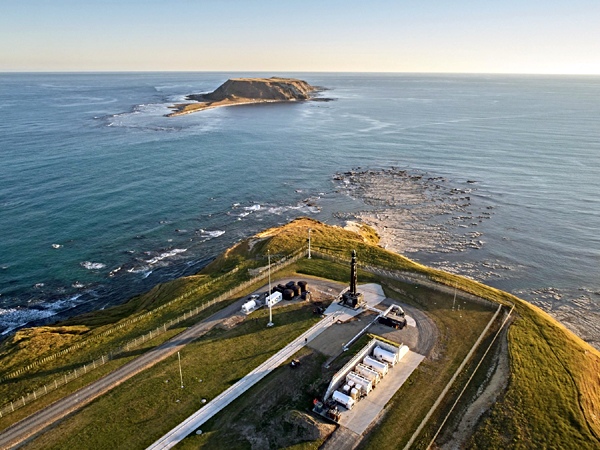
An Electron rocket sits atop its pad at Rocket Lab's Launch Complex 1 in New Zealand.
Rocket Lab

Rocket Lab to Launch NASA-Funded Commercial Moon Mission from New Zealand (Press Release - August 6)

The CAPSTONE mission will be Rocket Lab’s first launch to the Moon

Long Beach, California – Rocket Lab, the leading launch and space systems company, today announced it will launch the CAPSTONE mission to the Moon from Launch Complex 1 in New Zealand from Q4 2021. It will be Rocket Lab’s first launch to the Moon. CAPSTONE (the Cislunar Autonomous Positioning System Technology Operations and Navigation Experiment) aids NASA’s Artemis program, which includes landing the first woman and the first person of color on the Moon and establishing a long-term presence there.

Launching on an Electron launch vehicle and deploying from Rocket Lab’s Photon spacecraft platform, CAPSTONE is a 55-pound satellite created by Advanced Space that will serve as the first spacecraft to test a unique, elliptical lunar orbit. As a precursor for Gateway and other Artemis elements, an international and commercial Moon-orbiting outpost that is part of NASA’s Artemis program, CAPSTONE will help reduce risk for future spacecraft by validating innovative navigation technologies and verifying the dynamics of this halo-shaped orbit.

The mission is the first time Rocket Lab will use its Photon spacecraft platform as a trans-lunar injection stage to place a satellite on a trajectory that will take it beyond Earth orbit to the Moon. After lifting off on Electron to an initial elliptical low-Earth orbit, Photon will separate and use its 3D printed HyperCurie engine to provide in-space propulsion to allow CAPSTONE to break free of Earth’s gravity and set a course for the Moon. After deploying the CAPSTONE satellite, Photon will continue on its own trajectory to conduct a lunar fly-by, while CAPSTONE will use its own propulsion system to enter a cislunar orbit.

Following a three-to-four-month trip to the Moon, the CAPSTONE CubeSat will enter a near rectilinear halo orbit (NRHO), which is a highly elliptical orbit over the Moon’s poles. During its six-month primary mission in orbit around the Moon, CAPSTONE will validate the propulsion requirements for maintaining this type of orbit as predicted by models, reducing logistical uncertainties for future missions. It will also test the accuracy of innovative spacecraft-to-spacecraft navigation solutions as well as demonstrate capabilities for commercial support of future lunar missions. The NRHO provides the advantage of an unobstructed view of Earth in addition to coverage of the lunar South Pole.

Originally slated for lift-off from Rocket Lab’s Launch Complex 2 in Virginia, the CAPSTONE mission will now take place from Launch Complex 1 to support a Q4 launch window.

“Flexible isn’t a word usually used to describe lunar missions but operating two launch complexes gives us the freedom to select a site that best meets mission requirements and schedule,” said Rocket Lab Chief Executive Officer, Mr. Peter Beck. “Our team is immensely proud to be launching one of the first pathfinding missions to support NASA’s goal of delivering a sustainable and robust presence on the Moon. We’ve teamed up with the NASA Launch Services Program on previous Electron missions to low-Earth orbit, so it’s exciting to be working with them again to go just a bit further than usual...some 380,000 km further.”

Advanced Space of Colorado, a leading commercial space solutions company, owns the satellite and operates the mission. CAPSTONE development is supported by NASA’s Space Technology Mission Directorate via the Small Spacecraft Technology Program at NASA’s Ames Research Center in California’s Silicon Valley. Advanced Exploration Systems within NASA’s Human Exploration and Operations Mission Directorate supports the launch and mission operations. NASA’s Launch Services Program at Kennedy Space Center in Florida is responsible for launch management.

Source: Rocket Lab

****

CAPSTONE’s propulsion system undergoes environmental testing at Stellar Exploration Inc. in San Luis Obispo, California.
Stellar Exploration Inc.

An artist's concept of Rocket Lab's Photon spacecraft transporting CAPSTONE to the Moon.
Rocket Lab

An artist's concept of NASA's Gateway orbiting the Moon.
NASA

Friday, August 6, 2021

STARSHIP SUPER HEAVY Has Officially Become a Reality!

Starship Super Heavy stands tall on its Orbital Launch Table at Starbase, Texas...on August 6, 2021.
Elon Musk

A few hours ago, Starship Serial No. 20 (SN20) was briefly mated to Super Heavy Booster 4 (B4) at Starbase, Texas...giving the world a quick glimpse of the giant Mars rocket that SpaceX founder Elon Musk first unveiled in late 2016.

For about an hour, SpaceX employees and public spectators who dropped by Starbase had the opportunity to photograph Starship Super Heavy as it stood tall on its Orbital Launch Table. SN20 was then destacked from B4 after that.

According to Musk, SN20 will be rolled back to the Starbase production site to have the final heat shield tiles installed (98% of the tiles have now been attached to the vehicle), while B4 itself will have thermal protection placed around its 29 methane-fueled Raptor engines. Work will also be done on completing the installation of cryoshells over ground support equipment at the Orbital Launch Site.

An umbilical arm will also be attached to the Orbital Launch Tower that will provide methane and liquid oxygen fuel to Starship at the pad.

All of the remaining work mentioned above will take about two weeks to accomplish before SN20 and B4 become one once more. At the speed that this rocket is moving towards launch, there's no reason why we can't see its first orbital test flight sometime next season.

Crossing fingers that the Federal Aviation Administration is aware of the history that's being made in South Texas this week, and will give SpaceX the greenlight to launch as soon as it's safe and prudent to do so. Mars est.

Starship Super Heavy as seen from an upper floor on the Orbital Launch Tower at Starbase, Texas...on August 6, 2021.
Elon Musk

Starship Super Heavy stands tall on its Orbital Launch Table at Starbase, Texas...on August 6, 2021.
SpaceX

Thursday, August 5, 2021

SpaceShipTwo Update: Virgin Galactic Lays Out Plans for Its Future Commercial Spaceflight Operations...

VSS Unity soars 53.5 miles (86 kilometers) above the Earth during the Unity 22 flight...on July 11, 2021.
Virgin Galactic

Virgin Galactic Announces Second Quarter 2021 Financial Result (Press Release)

LAS CRUCES, N.M.--(BUSINESS WIRE)-- Virgin Galactic Holdings, Inc. (NYSE: SPCE) (“Virgin Galactic” or the "Company”), a vertically integrated aerospace and space travel company, today announced its financial results for the second quarter ended June 30, 2021.

“In the second quarter, we made meaningful progress towards commencing commercial service in 2022. We successfully completed two spaceflights from New Mexico — the latest carrying a full crew of mission specialists in the cabin and garnering an extraordinary global media and consumer response. In addition, we received FAA approval to expand our existing launch license, marking the first time the FAA has licensed a Spaceline to fly customers to space,” said Michael Colglazier, Chief Executive Officer of Virgin Galactic. “Leveraging the surge in consumer interest following the Unity 22 flight, we are excited to announce the reopening of sales effective today, beginning with our Spacefarer community. As we endeavor to bring the wonder of space to a broad global population, we are delighted to open the door to an entirely new industry and consumer experience.”

Business Highlights:

-- On July 11, 2021, successfully completed first fully-crewed spaceflight. This spaceflight marked VSS Unity’s 22nd flight and its fourth spaceflight. The flight fulfilled test objectives including evaluating the cabin and customer experience.

-- On May 22, 2021, successfully completed first spaceflight from Spaceport America, New Mexico. This spaceflight marked VSS Unity’s 21st flight and its third spaceflight. The flight fulfilled test objectives including confirming the technical readiness of the spaceship’s upgraded flight controls and horizontal stabilizers. The flight also carried revenue-generating scientific research experiments.

-- In June, the Federal Aviation Administration (“FAA”) updated the Company's existing commercial space transportation operator license to allow the spaceline to fly customers to space. The adjustment marked the first time the FAA has licensed a spaceline to fly customers.

-- In June, we announced a new contract for a human-tended research spaceflight. The company will fly Kellie Gerardi, a researcher for the International Institute for Astronautical Sciences (IIAS), on a dedicated research flight, during which Kellie will conduct experiments and test new healthcare technologies while she is in space.

-- Total retention of existing Future Astronaut reservations remained steady at approximately 600, as of June 30, 2021.

-- Announced plans to reopen sales effective today. For the private astronaut market, the Company will have three consumer offerings: i) a single seat; ii) a multi-seat couples / friends / family package; and iii) full-flight buy out. Pricing for these offers will begin at $450,000 per seat. Sales will initially open to the Company's significant list of early hand-raisers, prioritizing the Spacefarer Community, who, as promised, will be given first opportunity to reserve their place in space. A follow-on priority list will be opened to customers interested in reserving future spaceflights.

-- Announced that the next rocket-powered spaceflight, Unity 23, is targeted to occur in late-September from Spaceport America in New Mexico. This flight will be a revenue-generating flight with the Italian Air Force.

Second Quarter 2021 Financial Highlights:

-- Cash position remains strong, with cash and cash equivalents of $552 million as of June 30, 2021.

-- In July, the Company completed an “at-the-market” equity offering program (the “ATM Offering”). In connection with the ATM Offering, the Company filed a prospectus supplement with the U.S. Securities and Exchange Commission to offer and sell up to $500 million of shares of the Company’s common stock from time to time. The Company ultimately generated $500 million in gross proceeds through the sale of approximately 13.7 million shares of common stock. The Company intends to use the net proceeds generated from the ATM Offering for general corporate purposes, with a priority on expansion of its spaceship fleet.

-- GAAP selling, general, and administrative expenses of $39 million, compared to $26 million in the second quarter of 2020. Non-GAAP selling, general and administrative expenses of $26 million in the second quarter of 2021, compared to $21 million in the second quarter of 2020.

-- GAAP research and development expenses of $36 million, compared to $37 million in the second quarter of 2020. Non-GAAP research and development expenses of $31 million in the second quarter of 2020, compared to $34 million in the second quarter of 2020.

-- Adjusted EBITDA totaled $(56) million, compared to $(54) million in the second quarter of 2020.

-- Net loss of $94 million, compared to a $72 million net loss in the second quarter of 2020.

-- Cash paid for capital expenditures totaled $1 million, compared to $6 million in the second quarter of 2020.

COVID-19 Impact

The Company is continuing to experience ongoing delays to its business and operations due to COVID-19. The Company continues to operate under strict protocols and follows rigorous health and safety procedures, in line with CDC, state and local guidelines, to ensure employee safety.

Source: Virgin Galactic

****

Virgin Galactic founder Sir Richard Branson and his three Unity 22 crewmembers float around inside VSS Unity's cabin during their 53.5-mile (86-kilometer) journey into space...on July 11, 2021.
Virgin Galactic

Wednesday, August 4, 2021

Photos of the Day #3: Starship SN20 Now Has All 6 of Her Engines, and Super Heavy B4 Is at the Launch Pad...

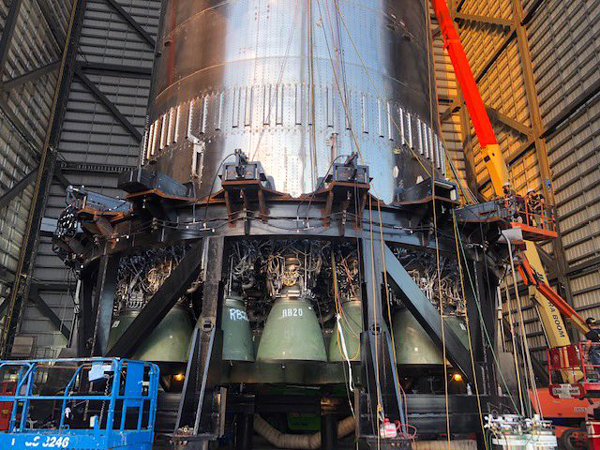
Inside the High Bay at Starbase, Texas, the three Raptor Vacuum engines and a trio of sea-level Raptors are installed on Starship SN20...on August 3, 2021.
Elon Musk

In the latest update on Elon Musk's quest to launch the Starship Super Heavy on its first orbital test flight as soon as possible, Starship Serial No. 20 (SN20) now has all six of her engines installed, and Super Heavy Booster 4 (B4) was placed near Starbase's Orbital Launch Tower about two hours ago.

Unlike the previous Starship prototypes that took flight in Texas since last December, SN20 will not only be equipped with three sea-level Raptor engines, but it will also fly with three larger Raptor Vacuum (RVac) thrusters which will be needed for Starship to maneuver in low-Earth orbit and beyond.

All three RVac engines were installed yesterday.

And at the Orbital Launch Site a few miles from the High Bay where SN20's engines were attached, B4 has now been placed atop its Orbital Launch Table...which itself was mated to its mount near the Orbital Launch Tower less than a week ago.

Also accomplished inside the High Bay was SN20's nosecone installation, of which there are no official photos yet.

Once SN20 is completed (the remaining heat tiles need to be attached to the bottom of its fuselage), it will be rolled over to the Orbital Launch Site and mated to B4 for a photo op that will no doubt set the spaceflight community abuzz.

After the photo op, SN20 will be removed from B4 and placed on a suborbital launch mount for its own engine test firing. Both SN20 and B4 will conduct cryogenic proof tests and static fires before they're re-combined in preparation for their highly-anticipated orbital flight...which does not have a launch date yet.

At Starbase's Orbital Launch Site, Super Heavy Booster 4 (B4) is about to be installed on its Orbital Launch Table near the Orbital Launch Tower...on August 4, 2021.
Elon Musk

At Starbase's Orbital Launch Site, Super Heavy B4 is about to be installed on its Orbital Launch Table near the Orbital Launch Tower...on August 4, 2021.
Elon Musk

A glimpse of the 29 Raptor engines that grace the bottom of Super Heavy B4...as seen on August 4, 2021.
Elon Musk

Tuesday, August 3, 2021

Photos of the Day #2: Super Heavy Booster 4 Is Rolled Out to the Orbital Launch Site at Starbase, Texas...

Super Heavy Booster 4 (B4) as seen from the top of its High Bay at SpaceX's launch facility in Starbase, Texas...on August 3, 2021.
Elon Musk

Earlier today, SpaceX's Super Heavy Booster 4 (B4) was slowly rolled out of the High Bay and transported to the Orbital Launch Site in Starbase, Texas.

This movement comes just a few days after all 29 methane-fueled Raptor engines were installed on B4. With the Super Heavy Booster close to being placed on its launch pedestal near the newly-assembled Orbital Launch Tower, the next milestones to be achieved are static fires...in which B4 and Starship Serial No. 20 (SN20) will conduct separate tests on different launch mounts before the two vehicles are finally mated together (for possibly more static fires).

Starship SN20 itself was rolled out of Starbase's Mid Bay and transported to the High Bay to complete construction a few hours ago.

Even once SN20 is finally mated to B4 to begin launch preps before their inevitable orbital test flight, it remains to be seen when the Federal Aviation Administration will complete its Environmental Impact Study and clear the Starship Super Heavy rocket for its highly-anticipated launch. Stay tuned.

B4 is about to be transported to Starbase's Orbital Launch Site while Starship SN20 is rolled out of the nearby Mid Bay...on August 3, 2021.
Elon Musk


Monday, August 2, 2021

Photos of the Day: SpaceX's Super Heavy Booster Continues to Get Prepped for Starship's First Orbital Test Flight...

Elon Musk and his infant son visit the High Bay where Super Heavy Booster 4 is getting its 29 methane-fueled Raptor engines installed...at the SpaceX launch site in Starbase, Texas.
Elon Musk

Over the past weekend, SpaceX founder Elon Musk tweeted these photos showing the rapid progress being made at Starbase, Texas for Starship's first orbital test flight.

In these two images, engineers are shown installing the 29 methane-fueled Raptor engines that will power Super Heavy Booster 4...which will lift Starship out of Earth's atmosphere.

It remains to be seen when SpaceX's giant Mars rocket will see its inaugural flight to low-Earth orbit...as the Federal Aviation Administration (FAA) continues to conduct an environmental impact study pertaining to Starship heading into space for the first time. It may take months for the FAA to grant its approval for launch.

Once the Starship Super Heavy combo does rocket away from its Texas launch site and heads toward the Kármán line and beyond, this will be a watershed moment in human spaceflight.

Not only will its role as the Human Landing System on Artemis 3 move that much closer to reality, but humanity's goal of journeying to Mars within our lifetimes will also be in reach thanks to Starship. Mars est.

At SpaceX's launch site in Starbase, Texas, all 29 Raptor engines are now installed on Super Heavy Booster 4.
Elon Musk