Sunday, May 16, 2021

Commemorating 10 Years Since OV-105's Final Space Shuttle Mission...

Endeavour launches on her final space shuttle flight, STS-134, from NASA's Kennedy Space Center in Florida...on May 16, 2011.
NASA / Tony Gray and Tom Farrar

On this day in 2011, Endeavour launched on her final space shuttle flight, STS-134—which delivered the Alpha Magnetic Spectrometer to the International Space Station (ISS). Endeavour, officially designated Orbiter Vehicle (OV)-105, would remain in low-Earth orbit for a little over 15 days...before ending her storied, 19-year career on Runway 15 at Kennedy Space Center's Shuttle Landing Facility in Florida. Endeavour's career included such highlights as the first three-man extra-vehicular activity (on OV-105's maiden voyage, STS-49, in 1992), the first servicing mission to the Hubble Space Telescope (on STS-61, in 1993) and the first assembly flight to the ISS (on STS-88, in 1998). Ultimately, Endeavour would have 25 missions under her belt before eventually making her way to her final retirement home at Los Angeles' California Science Center in 2012. Ad astra.

Saturday, May 15, 2021

Photo of the Day #2: Starship SN15 Is Back on the Pad!

Starship SN15 once again sits atop its Pad B pedestal at the SpaceX launch facility in Starbase, Texas...on May 15, 2021.
Photo by cnunezimages - Twitter.com

Ten days after its successful 10-kilometer (6.2-mile) hop and subsequent landing at SpaceX's launch facility in Starbase, Texas, Starship Serial No. 15 (SN15) is back on its Pad B launch pedestal...ready for a re-flight above the Gulf Coast! This amazing photo comes courtesy of CNunezIMAGES...who also has a Patreon page that you can support here. SpaceX itself has recently revealed details about the first orbital test flight of Starship that it hopes to conduct sometime this year. However, it remains to be seen how soon the Federal Aviation Administration and Federal Communications Commission grant approval to fly this historic spaceflight demonstration. Stay tuned.

Tuesday, May 11, 2021

Photo of the Day: The SLS Core Stage Booster Continues to Undergo Pre-launch Refurbishment at Kennedy Space Center in Florida...

The Space Launch System's core stage booster for Artemis 1 continues to undergo refurbishment before it begins official launch preps inside the Vehicle Assembly Building at NASA's Kennedy Space Center in Florida...on May 5, 2021.
NASA / Frank Michaux

Artemis I SLS Core Stage Prep Work (News Release - May 5)

The Space Launch System (SLS) core stage for NASA’s Artemis I mission is in the transfer aisle of the Vehicle Assembly Building at Kennedy Space Center in Florida on May 5, 2021. Teams from the center’s Exploration Ground Systems and contractor Jacobs will perform checkouts ahead of integrating the massive rocket stage with the twin solid rocket boosters, Orion spacecraft, and additional flight hardware ahead of the Artemis I launch. Artemis I will be the first integrated test of SLS and Orion and will pave the way for landing the first woman and first person of color on the lunar surface. It will be a proving ground for deep space exploration, leading the agency’s efforts under the Artemis program for a sustainable presence on the Moon and preparing for human missions to Mars.

Source: NASA.Gov

Monday, May 10, 2021

Axiom Space's Ax-1 crewmembers from left to right: former NASA astronaut Michael López-Alegría, Canadian investor Mark Pathy, American entrepreneur Larry Connor and Israeli philanthropist Eytan Stibbe.
Axiom Space

NASA, Axiom Agree to First Private Astronaut Mission on Space Station (Press Release)

NASA and Axiom Space have signed an order for the first private astronaut mission to the International Space Station to take place no earlier than January 2022.

“We are excited to see more people have access to spaceflight through this first private astronaut mission to the space station,” said Kathy Lueders, associate administrator for human exploration and operations at NASA Headquarters. “One of our original goals with the Commercial Crew Program, and again with our Commercial Low-Earth Orbit Development Program, is that our providers have customers other than NASA to grow a commercial economy in low-Earth orbit.”

The spaceflight, designated as Axiom Mission 1 (Ax-1), will launch from NASA’s Kennedy Space Center in Florida and travel to the International Space Station. Once docked, the Axiom astronauts are scheduled to spend eight days aboard the orbiting laboratory. NASA and Axiom mission planners will coordinate in-orbit activities for the private astronauts to conduct in coordination with space station crew members and flight controllers on the ground.

Axiom will purchase services for the mission from NASA, such as crew supplies, cargo delivery to space, storage, and other in-orbit resources for daily use. NASA will purchase from Axiom the capability to return scientific samples that must be kept cold in transit back to Earth.

“The first private crew to visit the International Space Station is a watershed moment in humanity’s expansion off the planet and we are glad to partner with NASA in making it happen,” said Axiom President and CEO Michael Suffredini. “A thriving commercial marketplace in low-Earth orbit begins with expanding access to serious, nontraditional users and that is exactly the aim of our private astronaut missions.”

NASA has opened up the space station for commercial activities, including private astronaut missions, as part of its plan to develop a robust and competitive economy in low-Earth orbit. The agency’s needs to achieve that goal – such as research on the effects of the space environment on humans, technology development, and in-flight crew testing – will remain in place after the retirement of the International Space Station. Commercial entities can meet those needs, providing destinations and transportation capabilities. Enabling Ax-1 is an important step to stimulate demand for commercial human spaceflight services so NASA can be one of many customers in low-Earth orbit.

For the Ax-1 mission, Axiom has proposed Michael López-Alegría, Larry Connor, Mark Pathy, and Eytan Stibbe as prime crew members. These private astronauts will be reviewed by NASA and its international partners, as is standard for any space station crew, and undergo NASA medical qualification testing to be approved for flight. López-Alegría will serve as the mission commander, with Peggy Whitson and John Shoffner as backups.

Once the proposed crew passes review and qualification, the four members will train for their flight with NASA, international partners, and SpaceX, which Axiom has contracted as launch provider for transportation to the space station. Trainers will familiarize the private astronauts with systems, procedures, and emergency preparedness for the space station and the Crew Dragon spacecraft. Based on current mission planning, training is scheduled to begin this summer.

The development and growth of the low-Earth orbit economy continues. In January 2020, NASA selected Axiom to provide at least one habitable commercial module to be attached to the forward port of the International Space Station’s Harmony node in late 2024. Most recently, NASA announced the agency is seeking input from industry on future commercial low-Earth orbit destinations that will provide services, such as crew training, scientific research, and advanced systems development for both government and private-sector astronauts and customers.

For more than 20 years, NASA has supported a continuous U.S. human presence in low-Earth orbit. The agency's goal is a low-Earth orbit marketplace where NASA is one of many customers, and the private sector leads the way. This strategy will provide services the government needs at a lower cost, enabling the agency to focus on its Artemis missions to the Moon and on to Mars while continuing to use low-Earth orbit as a training and proving ground for those deep space missions.

Source: NASA.Gov

****

An artist's concept of Axiom Space's commercial modules attached to the International Space Station.
Axiom Space

Sunday, May 9, 2021

Video of the Day: Elon Musk's Best Skit on SNL Last Night!

Dogecoin investors apparently wished that Elon Musk and the crypto's canine mascot appeared together on SATURDAY NIGHT LIVE yesterday, like they do in this meme aboard SpaceX's Crew Dragon capsule!

"So there are still heroes in this world."

As many of you are aware, SpaceX founder Elon Musk made his debut as host on Saturday Night Live yesterday. Overall, I think he did a commendable job (he's a billionaire rocket scientist, not a professionally-trained thespian, after all)...though I'm sure investors of the popular cryptocurrency Dogecoin wished that the adorable Shiba Inu who's the mascot of this crypto appeared with Elon on screen last night! But this blog entry is about the best sketch from yesterday's episode—which had Musk portraying himself in a SpaceX-inspired skit about a colony on Mars. Much props to Pete Davidson and SNL co-host Miley Cyrus for adding to the hilarity that is The Astronaut!

Thursday, May 6, 2021

Blue Origin Is Set to Launch Its First Astronaut Crew on Apollo 11's Landing Anniversary...

A video screenshot of a mannequin aboard Blue Origin's New Shepard capsule during flight NS-15...on April 14, 2021.
Blue Origin

Bid For the Very First Seat on New Shepard (News Release - May 5)

On July 20th, New Shepard will fly its first astronaut crew to space. We are offering one seat on this first flight to the winning bidder of Blue Origin’s online auction. Starting today, anyone can place an opening bid by going to BlueOrigin.com.

Here are the three phases of the auction:

1. May 5-19: Sealed online bidding – you can bid any amount you want on the auction website (no bids are visible)

2. May 19: Unsealed online bidding – bidding becomes visible and participants must exceed the highest bid to continue in the auction

3. June 12: Live auction – the bidding concludes with a live online auction

The winning bid amount will be donated to Blue Origin’s foundation, Club for the Future, to inspire future generations to pursue careers in STEM and help invent the future of life in space.

On this day 60 years ago, Alan Shepard made history by becoming the first American to fly to space. In the decades since, fewer than 600 astronauts have been to space above the Kármán Line to see the borderless Earth and the thin limb of our atmosphere. They all say this experience changes them.

We named our launch vehicle after Alan Shepard to honor his historic flight. New Shepard has flown 15 successful consecutive missions to space and back above the Kármán Line through a meticulous and incremental flight program to test its multiple redundant safety systems. Now, it’s time for astronauts to climb onboard.

This seat will change how you see the world.

- Gradatim Ferociter

Source: Blue Origin

****

Blue Origin's Audrey Powers simulates astronaut ingress aboard the New Shepard capsule for flight NS-15...on April 14, 2021.
Blue Origin

Wednesday, May 5, 2021

SpaceX Update: Starship SN15 Nails Its Landing on a Historic Day...

Launching aboard a Mercury-Redstone 3 rocket carrying his Freedom 7 capsule, NASA astronaut Alan Shepard became the first American to fly into space...on May 5, 1961.
NASA

Exactly 60 years after NASA astronaut Alan Shepard became the first American to fly into space thanks to his Mercury-Redstone 3 rocket and Freedom 7 capsule, SpaceX made history of its own when it successfully managed to land its Starship Serial No. 15 (SN15) rocket at the company's launch facility in Starbase, Texas...following a flawless 10-kilometer (6.2-mile) hop above the coastline. Unlike the flight of SN10 two months earlier, however, SN15 managed to stay intact long after touchdown—with the vehicle successfully purging its remaining cryogenic fuel and being safed post-landing over the next few hours.

After a successful flight to an altitude of 10 kilometers (6.2 miles), Starship SN15 triumphantly sits on its landing pad at SpaceX's launch facility in Starbase, Texas...on May 5, 2021.
SpaceX

With SN15's flawless test flight now in the history books, it remains to be seen if it will fly again, or if it will take its spot near Starhopper at Starbase as currently the only Starship prototypes to survive their aerial demonstrations. Up next is SN16...and if the flight of this vehicle is successful, then that will only prove that NASA made the right choice in selecting Starship as the Human Landing System (HLS) which will take Artemis astronauts to the Moon's surface as soon as 2024 (even though the HLS contract has been put on hold thanks to protests recently filed by fellow HLS contenders Blue Origin and Dynetics against NASA). Once gain, well-done, SN15!


Monday, May 3, 2021

With an Apollo 16 Moon Rock on Display Nearby, the New Head of NASA Has Officially Been Sworn In...

After being sworn in as the new NASA Administrator in Washington, D.C., Bill Nelson takes a group photo with his family, Vice President Kamala Harris, former NASA Administrators Charles Bolden and Jim Bridenstine (who attended the ceremony virtually through a video conference), and NASA Deputy Administrator nominee Pam Melroy...on May 3, 2021.
NASA / Aubrey Gemignani

Vice President Harris Swears in NASA Administrator Sen. Bill Nelson (Press Release)

Sen. Bill Nelson took office as the 14th administrator of NASA Monday, after he was given the oath of office by Vice President Kamala Harris during a ceremony at the Eisenhower Executive Office Building in Washington.

In his new role at NASA, Nelson will lead the nation’s space program as it carries out critical missions, including landing the first woman and first person of color on the Moon with the Artemis program, expanding climate change research, fostering innovation and enhancing the U.S. economy and STEM workforce.

“It’s an honor to be sworn in by Vice President Harris to serve as NASA administrator, and I look forward to a continued, strong relationship with her as chair of the National Space Council,” Nelson said after the ceremony. “I want to thank Steve Jurczyk for his leadership as Acting Administrator over the past few months, helping to carry out the Biden-Harris Administration’s priorities and ensure the success of NASA’s goals and missions. You’ve seen the incredible accomplishments at NASA over the past 100 or so days – the proof is in the pudding.”

As part of the swearing-in ceremony, Vice President Harris and Nelson were joined via video conference by Jim Bridenstine, who preceded Nelson as administrator, and in-person by Charles F. Bolden, who served as administrator from 2009 to 2017. Nelson’s family and Pam Melroy, nominee for NASA deputy administrator, were guests at the ceremony.

“I was glad to be joined today by my rock, my wife, Grace, my children, deputy administrator nominee Col. Pam Melroy, and former NASA Administrators Charlie Bolden and Jim Bridenstine, whose standing with me symbolizes the continuity of purpose and bipartisanship,” Nelson said. “It’s an incredible time for the aerospace sector, and I’m excited to lead NASA’s workforce into an exciting future!”

“Congratulations, Mr. Administrator, for all the work you’ve done and all you’ve dedicated to our country,” Vice President Harris said. “I couldn’t agree more that this has to be about our nation and what is best for our nation, unencumbered by partisan politics, but based on what we know is the right thing to do.”

The U.S. Senate confirmed Nelson to serve as the NASA administrator April 29.

Nelson has an extensive history of working with NASA and has been integral to the agency’s current successes. Prior to his nomination, he was a member-at-large on NASA’s advisory council. From 2001 to 2019, Nelson represented Florida in the U.S. Senate, where he served as ranking member of the Committee on Commerce, Science and Transportation and led its Subcommittee on Science and Space.

Previously, Nelson represented Florida’s 9th and 11th districts in the U.S. House of Representatives. While chair of the House space subcommittee, Nelson flew aboard the space shuttle Columbia as a payload specialist on the STS-61C mission in 1986, where he conducted 12 medical experiments including the first American stress test in space and a cancer research experiment sponsored by university researchers. The mission also included Bolden, as pilot.

Source: NASA.Gov

****


Sunday, May 2, 2021

SpaceX Update: Crew Dragon Resilience Is Back on Earth...

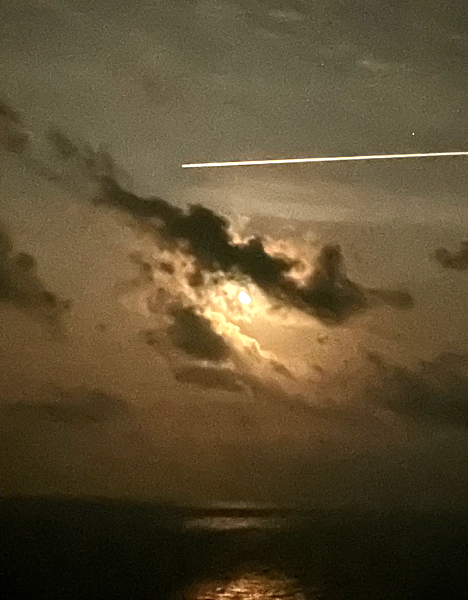
Crew Dragon Resilience re-enters Earth's atmosphere above the Gulf of Mexico...on May 2, 2011.
Photo by BigBoatDriver - Twitter.com

Crew-1 Astronauts Safely Splash Down After Space Station Mission (Press Release)

Four astronauts splashed down safely in the Gulf of Mexico Sunday, completing NASA’s first commercial crew, long-duration mission aboard the International Space Station. The return comes nearly six months after the crew members arrived at the microgravity laboratory and also marks the longest-duration mission of a crewed American spacecraft to date.

SpaceX’s Crew Dragon, carrying NASA astronauts Michael Hopkins, Victor Glover, and Shannon Walker, and Japan Aerospace Exploration Agency astronaut Soichi Noguchi, returned to Earth in a parachute-assisted splashdown at 2:56 a.m. EDT off the coast of Panama City, Florida. Crews aboard SpaceX recovery vessels successfully recovered the spacecraft and astronauts. After returning to shore, the astronauts will fly back to Houston.

“Welcome home Victor, Michael, Shannon, and Soichi, and congratulations to the teams at NASA and SpaceX who worked so hard to ensure their safe and successful splashdown,” said Sen. Bill Nelson, who was confirmed by the Senate to serve as NASA Administrator on April 29. “We’ve accomplished another incredible spaceflight for America and our commercial and international partners. Safe, reliable transportation to the International Space Station is exactly the vision that NASA had when the agency embarked on the commercial crew program.”

NASA’s SpaceX Crew-1 mission launched Nov. 15, 2020, on a Falcon 9 rocket from the agency’s Kennedy Space Center in Florida. The astronauts named the spacecraft Resilience, in honor of their families, colleagues, and fellow citizens and highlighting the dedication displayed by the teams involved with the mission and demonstrating that there is no limit to what humans can achieve when they work together. Crew Dragon Resilience docked to the Harmony module’s forward port of the space station Nov. 16, nearly 27 hours after liftoff.

Overall, Hopkins, Glover, Walker, and Noguchi traveled 71,242,199 statute miles during their 168 days in orbit (with 167 days aboard the space station), completing 2,688 orbits around Earth. With splashdown, the crew also broke the American crewed spacecraft mission duration record of 84 days, 1 hour, 15 minutes, set by the final Skylab crew in February 1974.

Crew-1 also is the first night splashdown of a U.S. crewed spacecraft since Apollo 8’s predawn return in the Pacific Ocean on Dec. 27, 1968, with NASA astronauts Frank Borman, Jim Lovell and Bill Anders.

Throughout their mission, the Crew-1 astronauts contributed to scientific investigations and technology demonstrations, in addition to spacewalks and public engagement events, while aboard the orbiting laboratory. From studying protein crystal development to advance new drug discoveries, to demonstrating robotic assistant technologies, their work advances exploration of the universe while bringing benefits back to Earth.

They also grew crops in both the Advanced Plant Habitat and Veggie plant growth facilities, and conducted tests of a new method for producing semiconductor crystals. The astronauts contributed hundreds of pictures of Earth as part of the Crew Earth Observation investigation, one of the longest-running investigations aboard the space station, which contributes to tracking of natural disasters and changes to our home planet. The crew also tested a new tape dispenser, designed and produced by students as part of the High Schools United with NASA to Create Hardware (HUNCH), during the mission.

In early 2021, the Crew-1 astronauts had significant roles to play in five spacewalks outside the orbiting laboratory. Glover completed his first four spacewalks, including three alongside Hopkins, whose total number of spacewalks is now five. Noguchi joined NASA’s Kate Rubins on the fourth spacewalk of each of their careers. During the spacewalks, the astronauts connected cables on the recently installed Bartolomeo science platform, prepared the station for upcoming solar array upgrades, serviced the station’s cooling system, and completed other station maintenance tasks.

On April 5, all four Crew-1 astronauts boarded Resilience for a port relocation maneuver, moving their spacecraft from the forward-facing port to the space-facing port on the Harmony module. The move allowed for the forward-facing port to receive four Crew-2 astronauts upon their arrival to the station April 24. Later this year, SpaceX’s 22nd Commercial Resupply Services mission is scheduled to dock at the newly vacant zenith port, bringing with it the first pair of new solar arrays.

The Crew-1 flight is part of NASA’s Commercial Crew Program, which has worked with the U.S. aerospace industry to launch astronauts on American rockets and spacecraft from American soil to the space station.

The second splashdown of the Commercial Crew Program comes just over one week after the launch of NASA’s SpaceX Crew-2 mission, the second long-duration mission. The Crew-2 astronauts launched April 23 and will live and work aboard the station until their return to Earth in about six months.

Resilience will return to SpaceX’s Dragon Lair in Florida for inspection and processing. There, teams will examine the spacecraft’s data and performance throughout the flight. The next NASA and SpaceX crewed mission is Crew-3, currently targeted for launch no earlier than Oct. 23. Crew-2 astronauts are scheduled to return to Earth Oct. 31, about a week after welcoming their Crew-3 colleagues to the orbiting outpost.

The goal of NASA’s Commercial Crew Program is safe, reliable, and cost-effective transportation to and from the International Space Station. This has already been proven to provide additional research time and increase the opportunity for discovery aboard humanity’s testbed for exploration, including helping us prepare for human exploration of the Moon and Mars.

****

As seen from Tampa, Florida, Crew Dragon Resilience re-enters Earth's atmosphere above the Gulf of Mexico...on May 2, 2011.
Photo by Kyle Montgomery - Twitter.com
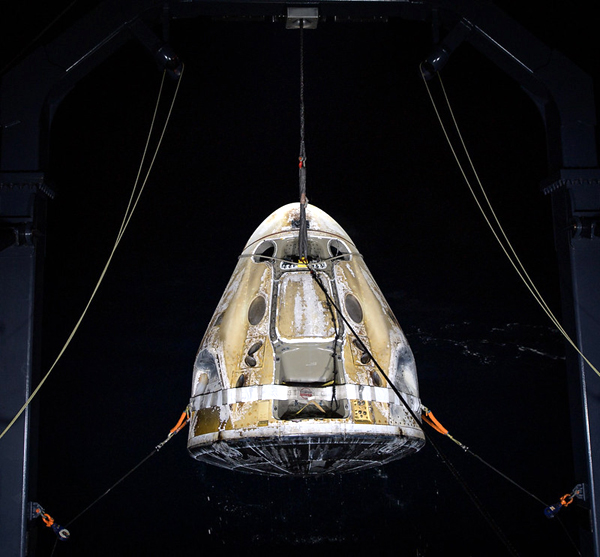
With the Crew-1 astronauts waiting patiently onboard, Resilience is about to be placed onto the deck of SpaceX's GO Navigator recovery ship in the Gulf of Mexico...on May 2, 2011.
NASA / Bill Ingalls

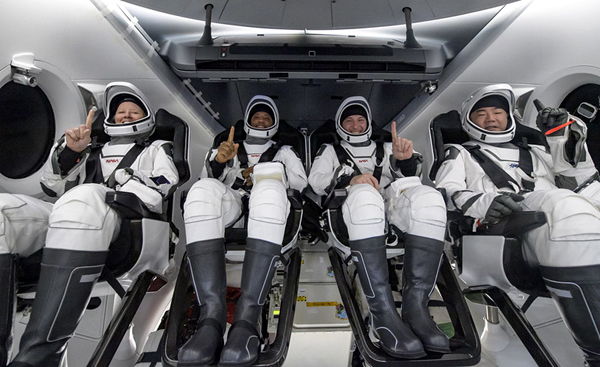
The Crew-1 astronauts take one last group photo aboard Resilience before disembarking from their capsule for the return trip back to Houston, Texas...on May 2, 2011.
NASA / Bill Ingalls

Saturday, May 1, 2021

The National Space Council Has a New Leader...

U.S. Vice President Kamala Harris speaks with NASA astronaut and Crew-1 member Victor Glover aboard the International Space Station...on February 24, 2021.
NASA

Sen. Bill Nelson Statement on National Space Council (Press Release)

The following is a statement from Sen. Bill Nelson, who the U.S. Senate confirmed as the 14th NASA administrator on April 29, regarding the announcement Saturday that Vice President Kamala Harris will chair the National Space Council:

“The Vice President is the perfect person to lead the federal government’s space policy, which is increasingly complex, with many nations in space.

“Vice President Lyndon Johnson was the first chair of the National Space Council when America initially ventured beyond Earth. Now, Vice President Harris will coordinate our nation’s efforts to ensure America continues to lead in space. It is an exciting time for our space program.”

****