Friday, December 30, 2022

Apollo's Successor Is Back Home in Florida to Mark the End of 2022...

NASA's Orion spacecraft is placed inside the Multi-Payload Processing Facility after the Artemis 1 capsule returned to Kennedy Space Center in Florida...on December 30, 2022.
NASA

Artemis I Orion Spacecraft Returns to Kennedy Space Center (News Release)

After its 1.4-million-mile mission beyond the Moon and back, the Orion spacecraft for the Artemis I mission arrived back at NASA’s Kennedy Space Center on December 30. The capsule splashed down in the Pacific Ocean on December 11 and was transported by truck across the country from Naval Base San Diego in California to Kennedy’s Multi-Payload Processing Facility in Florida.

Now that Orion is back at Kennedy, technicians will remove payloads from the capsule as part of de-servicing operations, including Commander Moonikin Campos, zero-gravity indicator Snoopy, and the official flight kit. Orion’s heat shield and other elements will be removed for extensive analysis, and remaining hazards will be offloaded.

Artemis I was a major step forward as part of NASA’s lunar exploration efforts and sets the stage for the next mission of the Space Launch System rocket and Orion to fly crew around the Moon on Artemis II.

Source: NASA.Gov

****

The truck carrying NASA's Orion spacecraft approaches Kennedy Space Center's Multi-Payload Processing Facility (off-screen) after a cross-country road trip from Naval Base San Diego in California...on December 30, 2022.
NASA

The truck carrying NASA's Orion spacecraft approaches Kennedy Space Center's Multi-Payload Processing Facility after a cross-country road trip from Naval Base San Diego in California...on December 30, 2022.
NASA

NASA's Orion spacecraft is about to be offloaded from its cargo truck prior to being moved into Kennedy Space Center's Multi-Payload Processing Facility in Florida...on December 30, 2022.
NASA

Friday, December 23, 2022

NASA Gets Ready to Test New Flight Hardware for the Space Launch System's Block 1B Variant...

An artist's concept of the Space Launch System Block 1B rocket, which will utilize the Exploration Upper Stage booster, soaring into the sky.
NASA

Stennis Continues Preparation for Exploration Upper Stage Testing (News Release - December 21)

Crews at NASA’s Stennis Space Center, near Bay St. Louis, Mississippi, lift the 75-ton interstage simulator test component into place at the B-2 Test Stand on December 15. The test component, 31 feet in diameter and 33 feet tall, will be used during Green Run testing of the new Exploration Upper Stage (EUS), which will fly on future Space Launch System missions as NASA continues its mission to explore the universe for the benefit of all.

The lift exercise served multiple purposes for the NASA Stennis test complex personnel. Overall, crews used the component as a “pathfinder” for the EUS unit, which helped train lift crews on best practices for moving and handling the actual flight hardware when it arrives.

Although the simulator is not exactly the size of the EUS unit, lifting the component into place on the B-2 Test Stand allowed crews to simulate procedures and techniques for handling the flight hardware. The lift also allowed crews to check the test stand clearances to ensure all is configured as needed for the EUS unit.

Several key test stand elements must be nearly perfectly aligned for EUS. The simulator lift and install helped crews take precise measurements to ensure those elements are properly placed.

Finally, the lift allowed operators to return the simulator to proper placement on the B-2 tarmac following its removal from the test stand on December 16. The simulator had been resting on temporary supports since its arrival in September.

With the simulator now placed and leveled on proper tarmac pedestals, the NASA Stennis team will perform finishing work in the coming months to prepare the simulator for full installation onto the test stand. This will include finishing access platforms and precision interfaces prior to sandblasting and painting the test component.

The final step prior to installation will be installing various piping and tubing, as well as wiring connections needed for Green Run testing. By the time the simulator is re-installed on the stand, its weight will have increased to 80 tons.

EUS is being built at NASA’s Michoud Assembly Facility in New Orleans as a more powerful second stage to send the Orion spacecraft to deep space. EUS is expected to fly on the Artemis IV mission.

Before that, it will be installed on the B-2 Test Stand at NASA Stennis to undergo a series of Green Run tests of its integrated systems to demonstrate it is ready to fly.

Source: NASA.Gov

****

The interstage simulator for the Space Launch System's Exploration Upper Stage is about to be installed on the B-2 Test Stand at NASA's Stennis Space Center in Mississippi...on December 15, 2022.
NASA / Danny Nowlin

The interstage simulator for the Space Launch System's Exploration Upper Stage is installed inside the B-2 Test Stand at NASA's Stennis Space Center in Mississippi...on December 15, 2022.
NASA / Danny Nowlin

Thursday, December 22, 2022

The ISS Gets a New Set of Solar Wings Almost Three Weeks After Receiving the Previous One...

NASA astronaut Josh Cassada works on prepping a new iROSA assembly before it is attached to the International Space Station and deployed...on December 22, 2022.
NASA / Frank Rubio

NASA Spacewalkers Install Station’s Fourth Roll-Out Solar Array (News Release)

Expedition 68 Flight Engineers Josh Cassada and Frank Rubio of NASA concluded their spacewalk at 3:27 p.m. EST after 7 hours and 8 minutes.

Cassada and Rubio completed their major objectives for today to install an International Space Station Roll-Out Solar Array (iROSA) on the 4A power channel on the port truss. The iROSAs will increase power generation capability by up to 30%, increasing the station’s total available power from 160 kilowatts to up to 215 kilowatts.

It was the 257th spacewalk in support of space station assembly, upgrades and maintenance, and was the third spacewalk for both astronauts.

Cassada and Rubio are in the midst of a planned six-month science mission living and working aboard the microgravity laboratory to advance scientific knowledge and demonstrate new technologies for future human and robotic exploration missions, including lunar missions through NASA’s Artemis program.

While Thursday’s spacewalk was underway, NASA Space Station Program Manager Joel Montalbano and Roscosmos Human Spaceflight Executive Director Sergei Krikalev participated in an audio-only media teleconference. The two space executives discussed the ongoing investigation of an external leak detected on the Soyuz MS-22 crew ship.

Ground teams continue to assess data and options for the safe return of crew to Earth.

Listen to the teleconference here.

Source: NASA.Gov

****

Wednesday, December 21, 2022

Apollo's Successor Is Finally on Its Way Back to Florida...

NASA's Orion spacecraft is removed from the well deck of the USS Portland before being brought to an inspection and holding zone at Naval Base San Diego in California...on December 14, 2022.
U.S. Navy

Artemis I Orion Spacecraft Departs Naval Base San Diego (News Release)

The Artemis I Orion spacecraft is on its way back to NASA’s Kennedy Space Center in Florida. After completing a 25.5-day, 1.4-million-mile journey beyond the Moon and back on December 11, the spacecraft was recovered from the Pacific Ocean and transported to U.S. Naval Base San Diego, where engineers prepared the spacecraft for its trek by truck to Kennedy.

Orion is scheduled to arrive at Kennedy’s Multi-Payload Processing Facility by the end of the year.

Once at Kennedy, technicians will open the hatch and unload several payloads, including Commander Moonikin Campos, zero-gravity indicator Snoopy, and the official flight kit as part of de-servicing operations. In addition to removing the payloads, Orion’s heat shield and other elements will be removed for analysis, and remaining hazards will be offloaded.

NASA has also released new aerial footage of Orion’s descent through the clouds and splashdown taken from an Unmanned Aircraft System or drone. View new imagery of the spacecraft’s return to Earth here.

Source: NASA.Gov

****

Sunday, December 18, 2022

Images of the Day: Flight Hardware for the Space Launch System's Third Mission Continues to Undergo Fabrication...

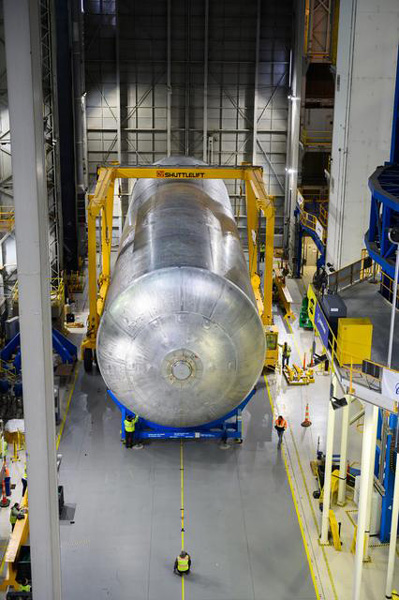
At NASA's Michoud Assembly Facility in New Orleans, Louisiana, the liquid hydrogen tank for the Space Launch System's Artemis 3 core stage booster is moved to Cell A for white light scans during the manufacturing process.
Eric Bordelon

Liquid Hydrogen Tank for Artemis III Moves on to Next Phase of Production (Photo Release)

Technicians at NASA’s Michoud Assembly Facility in New Orleans move the liquid hydrogen tank of NASA’s Space Launch System (SLS) rocket to Cell A for white light scans of the tank’s dimensions in preparation of multiple join activities throughout the manufacturing process. The flight hardware will be used for Artemis III, one of the first crewed Artemis missions.

The liquid hydrogen tank holds 537,000 gallons of liquid hydrogen cooled to minus 432 degrees Fahrenheit and is the largest of the five elements that make up the rocket’s 212-foot-tall core stage. The liquid hydrogen tank is situated between the core stage’s intertank and engine section.

The liquid hydrogen hardware, along with the liquid oxygen tank, will provide propellant to the four RS-25 engines at the bottom of the core stage to produce more than two million pounds of thrust to launch NASA’s Artemis missions to the Moon. Together with its four RS-25 engines, the rocket’s massive 212-foot-tall core stage — the largest stage NASA has ever built — and its twin solid rocket boosters produce 8.8 million pounds of thrust to send NASA’s Orion spacecraft, astronauts and supplies beyond Earth’s orbit to the Moon and, ultimately, Mars.

Offering more payload mass, volume capability and energy to speed missions through space, the SLS rocket, along with NASA’s Gateway in lunar orbit, the Human Landing System and Orion spacecraft, is part of NASA’s backbone for deep space exploration and the Artemis lunar program. No other rocket is capable of carrying astronauts in Orion around the Moon in a single mission.

Source: NASA.Gov

****

At NASA's Michoud Assembly Facility in New Orleans, Louisiana, the liquid hydrogen tank for the Space Launch System's Artemis 3 core stage booster is moved into Cell A for white light scans during the manufacturing process.
Eric Bordelon

At NASA's Michoud Assembly Facility in New Orleans, Louisiana, the liquid hydrogen tank for the Space Launch System's Artemis 3 core stage booster is placed inside Cell A before it will undergo white light scans during the manufacturing process.
Eric Bordelon

Saturday, December 17, 2022

The National Space Council's UAG Will Receive New Members Under the Biden-Harris Administration...

Vice President Kamala Harris chairs her first meeting of the National Space Council at the United States Institute of Peace in Washington, DC...on December 1, 2021.
NASA / Joel Kowsky

Vice President Harris Announces Selections to the National Space Council’s Users Advisory Group (Press Release - December 16)

As Chair of the National Space Council, Vice President Kamala Harris today announced the individuals selected to serve on the National Space Council’s Users Advisory Group (UAG). Pending official appointment by the Administrator of the National Aeronautics and Space Administration, the selected members of the UAG will serve to enable the Biden-Harris Administration’s effort to maintain a robust and responsible U.S. space enterprise and preserve space for current and future generations.

The candidates represent a cross-section of companies and organizations that support the United States’ large and highly-skilled space workforce; users of space services, including climate scientists and agriculture providers; individuals focused on developing the next generation of space professionals; and leading experts in space.

The UAG will provide the National Space Council advice and recommendations on matters related to space policy and strategy, including but not limited to, government policies, laws, regulations, treaties, international instruments, programs, and practices across the civil, commercial, international, and national security space sectors.

The Vice President announced the UAG Chair, General (USAF, Ret) Lester Lyles, during the second space council meeting in September.

Below is the full selection to the National Space Council’s UAG:

General (USAF, Ret) Lester Lyles, UAG Chair

Mr. Rajeev Badyal, VP of Technology, Amazon Project Kuiper

Mr. Charles Bolden, Former NASA Administrator and Former Astronaut

Mr. Salvatore T. Bruno, CEO, United Launch Alliance

Dr. Lance Bush, President & CEO, Challenger Center

Ms. Bridget Chatman, Chairwoman, Women in Aerospace

Mr. Theodore “Ted” Colbert, CEO, Boeing Defense, Space & Security

Ms. Nancy Colleton, President, Institute for Global Environmental Strategies

Ms. Karina Drees, President, Commercial Spaceflight Federation

Mr. Eric Fanning, President and CEO, Aerospace Industries Association

Dr. Daniel Hastings, Head, Department of Aeronautics & Astronautics, Massachusetts Institute of Technology

Ms. Dawne Hickton, Subject Matter Expert

Mr. Daniel Jablonsky, President & CEO, Maxar Technologies

Dr. Dave Kaufman, President, Ball Aerospace

Mr. Patrick Lin, Director of the Ethics & Emerging Sciences Program, California Polytechnic State University

Mr. Ron Lopez, President & Managing Director, Astroscale US

Dr. Harold Lee Martin, Chancellor of North Carolina Agricultural & Technical State University

Dr. Kate Marvel, Climate Scientist at Project Drawdown

Maj Gen (Ret) Roosevelt “Ted” Mercer, CEO & Director, Virginia Space

Dr. Marla Perez-Davis, Former Director, NASA Glenn Research Center

Dr. Sian Proctor, Geoscience Professor, South Mountain Community College

Ms. Gwynne Shotwell, President & COO, SpaceX

Dr. Robert Smith, CEO, Blue Origin

Mr. James Taiclet, President & CEO, Lockheed Martin

Dr. Mandy Vaughn, Subject Matter Expert

Ms. Kathy Warden, Chairwoman & CEO, Northrop Grumman Corp

Mr. Robbie Schingler, Jr., Co-Founder & Chief Strategy Officer, Planet Labs

Ms. Melanie Stricklan, Co-Founder & CEO, Slingshot Aerospace

Dr. Jeremy Williams, Head, Climate Corporation & Digital Farming, Bayer Crop Science

Ms. Katrina Harden Williams, Middle School Teacher, Ames Middle School, Iowa

Source: WhiteHouse.gov

****


Friday, December 16, 2022

A Prototype Module for the LIFE™ Habitat Aced a Crucial Test Last Month...

Before and after images of a LIFE Habitat prototype module after it underwent an Ultimate Burst Pressure Test in Huntsville, Alabama...on November 15, 2022.
Sierra Space

Sierra Space Successfully Completes Series of Major Development Milestones for First Commercial Space Station (Press Release - December 13)

Second Sub-Scale LIFE Habitat Test Article Exceeds NASA Certification Requirements After Ultimate Burst Pressure (UBP) Test

LOUISVILLE, Colo. – Sierra Space, a leading commercial space company building the first end-to-end business and technology platform in space, announced today that the company’s LIFE™ Habitat (Large Integrated Flexible Environment) has successfully completed its second sub-scale Ultimate Burst Pressure (UBP) test. Following the success of its first UBP test in July of this year, this second test further establishes Sierra Space as the leader in commercial space station development and the only active commercial space company to meet multiple successful UBP trials.

This latest test was performed on November 15 under NASA’s NextSTEP project for space habitation systems, which is managed by the agency’s Marshall Space Flight Center. NASA subject matter experts and ILC Dover collaborated with Sierra Space on the test, which occurred in a historic setting on Redstone Arsenal in Huntsville, Alabama.

Due to the explosive nature of the test, the team placed the sub-scale space habitat in the flame trench of the Saturn 1/1B test stand, where NASA tested rockets for the Apollo program.

Sierra Space’s LIFE forms part of the company’s in-space destinations technology portfolio. The inflatable module is a three-story commercial habitation and science platform designed for low-Earth orbit (LEO) that will allow humans to live and work comfortably in space.

LIFE is constructed of high-strength “softgoods” materials, which are sewn and woven fabrics – primarily Vectran – that become rigid structures when pressurized. Sierra Space is working towards NASA softgoods certification and is already exceeding programmatic requirements that demonstrate LIFE has followed a successful systematic and comprehensive design, fabrication and test program.

The two sub-scale UBP tests in July and November achieved maximum burst pressure rates of 192 and 204 psi, respectively. Exceeding the safety requirement of 182.4 psi demonstrates that Sierra Space can meet the 4x safety factor required for softgoods inflatables within its current architecture at one-third scale.

This series of sub-scale tests is designed to support LIFE’s overall, full-scale development and future inflatable habitats, as Sierra Space builds the next generation of inflatable habitat architectures. These early “fleet” leader tests provide the design and analysis data to determine the safety and reliability of the inflatable architecture systems.

“Sierra Space is making incredible strides in the inflatable habitat technology development roadmap. In working with our partners ILC Dover and NASA, Sierra Space is quickly moving closer to softgoods certification,” added Shawn Buckley, LIFE Chief Engineer and Senior Director of Engineering at Sierra Space. “This second successful UBP test proves we can demonstrate design, manufacturing and assembly repeatability, all of which are keys areas for certification.”

Full-scale LIFE UBP tests will begin in 2023, in order to complete NASA’s certification of the habitat’s primary structure for human use in space. NASA’s NextSTEP program falls under the HQ Explorations Systems Development Mission Directorate (ESDMD) Technical Integration’s (TI) Pre-Formulation (PF) Habitation Team.

For NextSTEP-2, Sierra Space is focused on performing critical risk reduction tests and assessing LIFE’s extensibility to multiple space destinations including the Moon and Mars.

Among other missions in coming years, LIFE will serve as both a habitation and payload element for the Orbital Reef commercial space station, a collaboration between Sierra Space and Blue Origin.

To view the Ultimate Burst Pressure Test on YouTube, visit:
Sierra Space’s LIFE Habitat Successfully Completes Second Ultimate Burst Pressure Test

Source: Sierra Space

****

An artist's concept of the Orbital Reef space station.
Amazon Supply Chain / Amazon Web Services / ASU / Boeing / Genesis Engineering Solutions / Redwire Space

Thursday, December 15, 2022

One of Russia's Two Lifeboats at the ISS Is Experiencing an Issue...

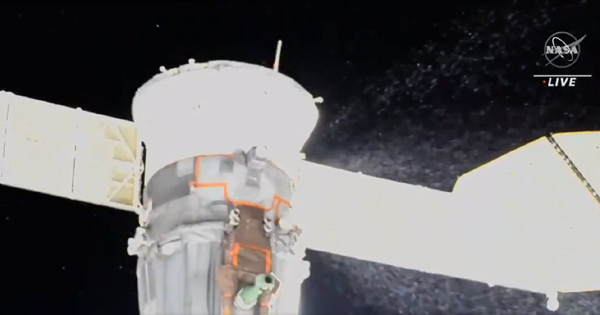
A video screenshot of coolant leaking from the Soyuz MS-22 capsule at the International Space Station...on December 14, 2022.
NASA TV

Mission Controllers Assess Soyuz Coolant Leak (News Release)

Ground teams at Mission Control in Moscow continue to assess a coolant leak detected from the aft end of the Soyuz MS-22 spacecraft docked to the International Space Station. As a result, the planned December 14 Roscosmos spacewalk was canceled to allow time to evaluate the fluid and potential impacts to the integrity of the Soyuz spacecraft.

NASA and Roscosmos will continue to work together to determine the next course of action following the ongoing analysis. The crew members aboard the space station are safe, and were not in any danger during the leak.

The Soyuz MS-22 spacecraft carried NASA astronaut Frank Rubio and Roscosmos cosmonauts Sergey Prokopyev and Dmitri Petelin into space after launching from the Baikonur Cosmodrome in Kazakhstan on September 21.

Source: NASA.Gov

****

Wednesday, December 14, 2022

Three Days After Returning to Earth, Apollo's Successor Has Arrived in Southern California...

NASA's Orion spacecraft is unloaded from its Artemis 1 recovery ship, the USS Portland, at Naval Base San Diego in California...on December 14, 2022.
NASA

Artemis I Update: Orion Offloaded from USS Portland in Preparation for Transport to Kennedy Space Center (News Release)

Team members with NASA’s Exploration Ground Systems program successfully removed the Artemis I Orion spacecraft from the USS Portland on December 14, after the ship arrived at U.S. Naval Base San Diego a day earlier. The spacecraft successfully splashed down December 11 in the Pacific Ocean west of Baja California after completing a 1.4 million-mile journey beyond the Moon and back, and was recovered by NASA’s Landing and Recovery team and personnel from the Department of Defense.

Engineers will conduct inspections around the spacecraft’s windows before installing hard covers and deflating the five airbags on the crew module uprighting system in preparation for the final leg of Orion’s journey over land. It will be loaded on a truck and transported back to the agency’s Kennedy Space Center in Florida for post-flight analysis.

Before its departure, teams will open Orion’s hatch as part of preparations for the trip to Kennedy and remove the Biology Experiment-1 payload which flew onboard Orion. The experiment involves using plant seeds, fungi, yeast and algae to study the effects of space radiation before sending humans to the Moon and, eventually, to Mars.

Removing the payload prior to Orion’s return to Kennedy allows scientists to begin their analysis before the samples begin to degrade.

Once it arrives at Kennedy, Orion will be delivered to the Multi-Payload Processing Facility where additional payloads will be taken out, its heat shield and other elements will be removed for analysis, and remaining hazards will be offloaded.

Source: NASA.Gov

****

Tuesday, December 13, 2022

Two African Nations Are Now Members of NASA's Moon Exploration Initiative...

Assistant Secretary of State for Oceans and International Environmental and Scientific Affairs Monica Medina and NASA Administrator Bill Nelson watch as Isa Ali Ibrahim (on behalf of the Federal Republic of Nigeria) and Francis Ngabo (for the Republic of Rwanda) signed the Artemis Accords...on December 13, 2022.
NASA

NASA Welcomes Nigeria, Rwanda as Newest Artemis Accords Signatories (News Release)

During the U.S.-Africa Leaders Summit in Washington Tuesday, NASA Administrator Bill Nelson joined Assistant Secretary of State for Oceans and International Environmental and Scientific Affairs Monica Medina, U.S. National Space Council Executive Secretary Chirag Parikh, as well as representatives from Nigeria and Rwanda as those nations signed the Artemis Accords.

With the addition of these two signatories, 23 nations have affirmed their commitment to transparent, safe and sustainable space exploration. Through the accords, the signatories are guided by a set of principles that promote the beneficial use of space for all of humanity.

“I’m thrilled Nigeria and Rwanda are committing to the safe, sustainable use of outer space. In an era where more nations than ever have space programs, today’s signings highlight a growing commitment to ensure space exploration is conducted responsibly,” said NASA Administrator Bill Nelson. “As the first African nations to sign the Artemis Accords, Nigeria and Rwanda exemplify the global reach of the accords and are demonstrating their leadership in space exploration.”

The accords were signed on behalf of the Federal Republic of Nigeria by Isa Ali Ibrahim, minister of Communications and Digital Economy.

On behalf of the Republic of Rwanda, Francis Ngabo, chief executive officer of the Rwanda Space Agency, signed the accords.

The summit, hosted by President Joe Biden and led by the U.S. Department of State, brought together leaders from across the African continent to Washington, and began earlier today. The Artemis Accords were signed at the start of the U.S.-Africa Space Forum – an element of the broader summit.

The summit runs through December 15.

NASA and the State Department announced the establishment of the Artemis Accords in 2020. The Artemis Accords are a set of principles to guide the next phase in space exploration, reinforcing and providing for important operational implementation of key obligations in the 1967 Outer Space Treaty.

The Accords also reinforce the commitment by the United States and signatory nations to the Registration Convention, the Rescue and Return Agreement, as well as guidelines and best practices NASA and its partners have supported, including the public release of scientific data.

More countries are anticipated to sign the Artemis Accords in the months and years ahead, as the United States continues to work with international partners for a safe, peaceful and prosperous future in space. Working with both new and existing partners will add new energy and capabilities to help ensure the entire world can benefit from our journey of exploration and discovery.

Source: NASA.Gov

****

A selfie that NASA's Orion spacecraft took with the Moon and Earth in the distance...on November 28, 2022.
NASA