Thursday, March 31, 2022

Another Successful Crewed Flight for New Shepard...

The six-member crew of Blue Origin's NS-20 mission pose for a pre-flight group photo.
Blue Origin

Blue Origin Successfully Completes Fourth Human Spaceflight (News Release)

Today, Blue Origin successfully completed its fourth human spaceflight and 20th overall flight for New Shepard. The astronaut manifest included: Marty Allen, Sharon Hagle, Marc Hagle, Jim Kitchen, Gary Lai, and Dr. George Nield.

“Congratulations to our astronauts on today’s mission above the Kármán Line,” said Phil Joyce, Senior Vice President of New Shepard for Blue Origin. “We had the honor of safely flying this crew of six – each person with their own story of mentorship and passion for human spaceflight. We’re looking forward to many more flights this year, and we’re grateful to our astronaut customers for their trust in this amazing team.”

Blue Origin is planning more crewed and payload flights throughout 2022 and beyond. If you are interested in flying on New Shepard, visit Blue Origin's website.

Source: Blue Origin

****

Wednesday, March 30, 2022

ISS Update: Mark Vande Hei Back on Earth After Spending 355 Days in Space...

NASA astronaut Mark Vande Hei smiles for the camera after he and Russian cosmonauts Anton Shkaplerov and Pyotr Dubrov safely touched down in Kazakhstan...hours after their Soyuz MS-19 capsule departed from the International Space Station on March 30, 2022.
NASA

Record-Setting NASA Astronaut, Crewmates Return from Space Station (Press Release)

After extending the record for the longest single spaceflight in history by an American to 355 days, NASA astronaut Mark Vande Hei returned to Earth on Wednesday, March 30, along with Roscosmos cosmonauts Anton Shkaplerov and Pyotr Dubrov.

The trio departed the International Space Station at 3:21 a.m. EDT and made a safe, parachute-assisted landing at 7:28 a.m. (5:28 p.m. Kazakhstan time) southeast of the remote town of Dzhezkazgan, Kazakhstan.

"Mark's mission is not only record-breaking, but also paving the way for future human explorers on the Moon, Mars, and beyond," said NASA Administrator Bill Nelson. "Our astronauts make incredible sacrifices in the name of science, exploration, and cutting-edge technology development, not least among them time away from loved ones. NASA and the nation are proud to welcome Mark home and grateful for his incredible contributions throughout his year-long stay on the International Space Station."

Vande Hei’s extended mission will provide researchers the opportunity to observe the effects of long-duration spaceflight on humans as the agency plans to return to the Moon under the Artemis program and prepare for exploration of Mars.

Vande Hei launched April 9, 2021, alongside Russian cosmonauts Oleg Novitskiy and Pyotr Dubrov. His second journey into space of 355 days is the longest single spaceflight by a U.S. astronaut, previously held at 340 days, and gives him a lifetime total of 523 days in space. Dubrov also remained onboard for 355 days on his first spaceflight.

Supporting NASA’s goals for future human landings on the Moon, Vande Hei completed approximately 5,680 orbits of the Earth and a journey of more than 150 million miles, roughly the equivalent of 312 trips to the Moon and back. He witnessed the arrival of 15 visiting spacecraft and new modules, and the departure of 14 visiting spacecraft.

Following post-landing medical checks, the crew will return to the recovery-staging city in Karaganda, Kazakhstan, aboard Russian helicopters. Vande Hei will board a NASA plane bound for Cologne, Germany, for refueling prior to his return home. Shkaplerov and Dubrov will board a Gagarin Cosmonaut Training Center aircraft to return to their home in Star City, Russia.

During his record mission, Vande Hei spent many hours on scientific activities aboard the space station, conducting everything from plant research to physical sciences studies.

With the undocking of the Soyuz MS-19 spacecraft with Vande Hei, Shkaplerov, and Dubrov aboard, Expedition 67 officially began aboard the station. NASA astronaut Tom Marshburn recently took over as station commander, and is joined by NASA astronauts Raja Chari and Kayla Barron, ESA (European Space Agency) astronaut Matthias Maurer, and Roscosmos cosmonauts Oleg Artemyev, Denis Matveev, and Sergey Korsakov.

Marshburn, Chari, Barron and Maurer will remain onboard until late April, when NASA astronauts Kjell Lindgren, Bob Hines, and Jessica Watkins, as well as ESA astronaut Samantha Cristoforetti launch to the station as part of NASA’s SpaceX Crew-4 mission.

****

Tuesday, March 29, 2022

Photos of the Day: Snapshots from My Latest Trip to Cape Canaveral!

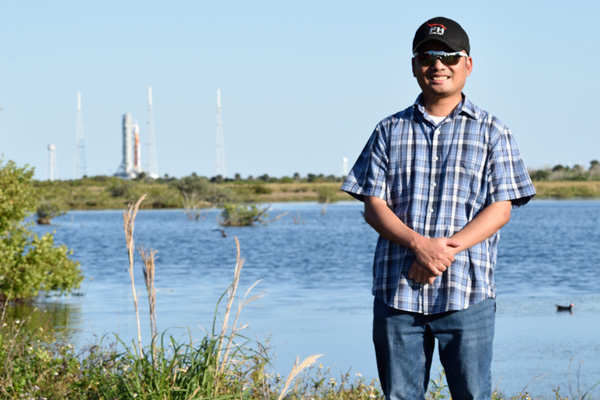
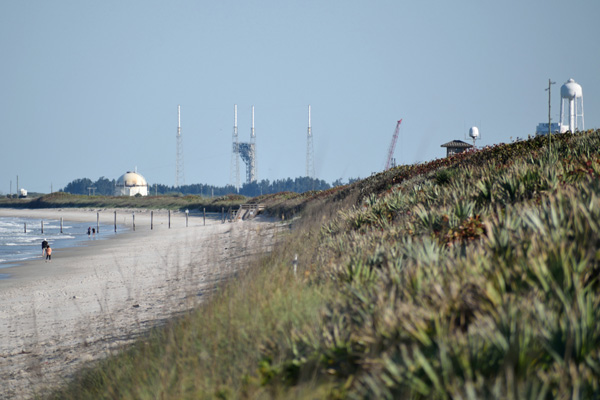
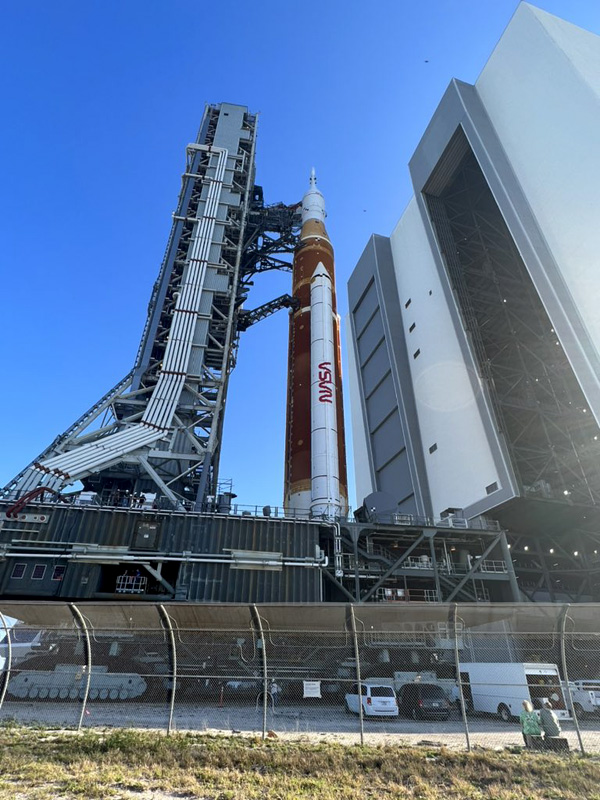
At Canaveral National Seashore with NASA's Space Launch System rocket sitting on Kennedy Space Center's Pad 39B behind me...on March 27, 2022.

Yesterday, I returned to Los Angeles after going to Florida to visit Cape Canaveral for the first time in 13 years!

Unsurprisingly, the main goal of my trip to the Space Coast was to see NASA's Space Launch System (SLS) stand tall at Kennedy Space Center's Launch Complex 39B. As of right now, the mega-Moon rocket remains on-track to conduct its Wet Dress Rehearsal for the Artemis 1 mission next weekend...on April 1-3.

Along with SLS, I also finally got to see the retired orbiter Atlantis on display at the Kennedy Space Center Visitor Complex. And while it's not a crewed vehicle, I was ecstatic to see the unflown Delta 2 booster that is now on display at the Rocket Garden.

Here are pictures of SLS, Atlantis, Delta 2 and a few other awesome attractions at Cape Canaveral that I photographed last weekend. Click on the link below to view my webpage that's devoted to this memorable trip.

LINK: Additional photos I took at Cape Canaveral on March 25-27

And in case you're wondering— I'm pondering about returning to the Cape in 2024, to see the SLS rocket that will hurl astronauts to the Moon on NASA's Artemis 2 mission. Happy Tuesday!

At Canaveral National Seashore with NASA's Space Launch System rocket sitting on Kennedy Space Center's Pad 39B behind me...on March 27, 2022.

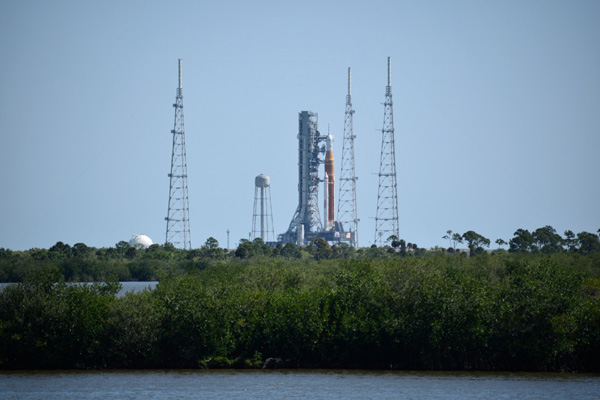
NASA's Space Launch System rocket sits on Kennedy Space Center's Pad 39B...as seen from the Apollo/Saturn V Center on March 27, 2022.

NASA's Space Launch System rocket sits on Kennedy Space Center's Pad 39B...as seen from the Apollo/Saturn V Center on March 27, 2022.

NASA's Space Launch System rocket as seen in my car's side-view mirror at Canaveral National Seashore...on March 26, 2022.

Posing with Atlantis inside her space shuttle exhibit at the Kennedy Space Center Visitor Complex...on March 26, 2022.

Taking a selfie with Atlantis inside her space shuttle exhibit at the Kennedy Space Center Visitor Complex...on March 26, 2022.

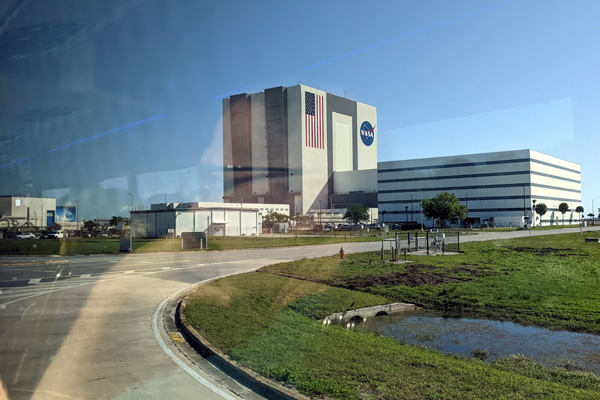
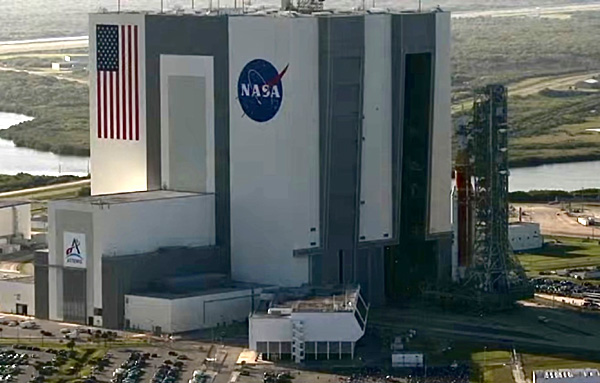
My tour bus is about to drive past the Vehicle Assembly Building on the way to the Apollo/Saturn V Center...on March 27, 2022.

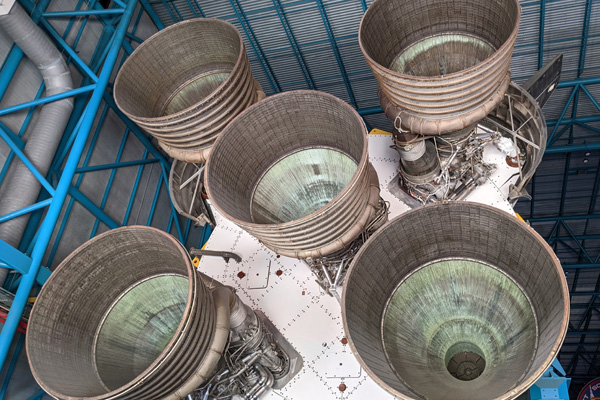
The J-2 engines of the Saturn V rocket on display at the Apollo/Saturn V Center...on March 26, 2022.

Launch Complex 39A and SpaceX's Horizontal Integration Facility as seen from across the lagoon at the Apollo/Saturn V Center...on March 26, 2022.

United Launch Alliance's SLC-41 pad, the launch site for the CST-100 Starliner, as seen from Playalinda Beach...on March 26, 2022.

Blue Origin's facility as seen from inside the Space Shuttle Atlantis Exhibit at Kennedy Space Center Visitor Complex...on March 27, 2022.

Posing with the unflown Delta 2 rocket now on display at the Rocket Garden...on March 26, 2022.

An image I took of NASA's Space Launch System rocket from Playalinda Beach Road Vista 5...on March 26, 2022.

Monday, March 28, 2022

The Biden Administration Proposes an Astounding $26 Billion for NASA's 2023 Budget...

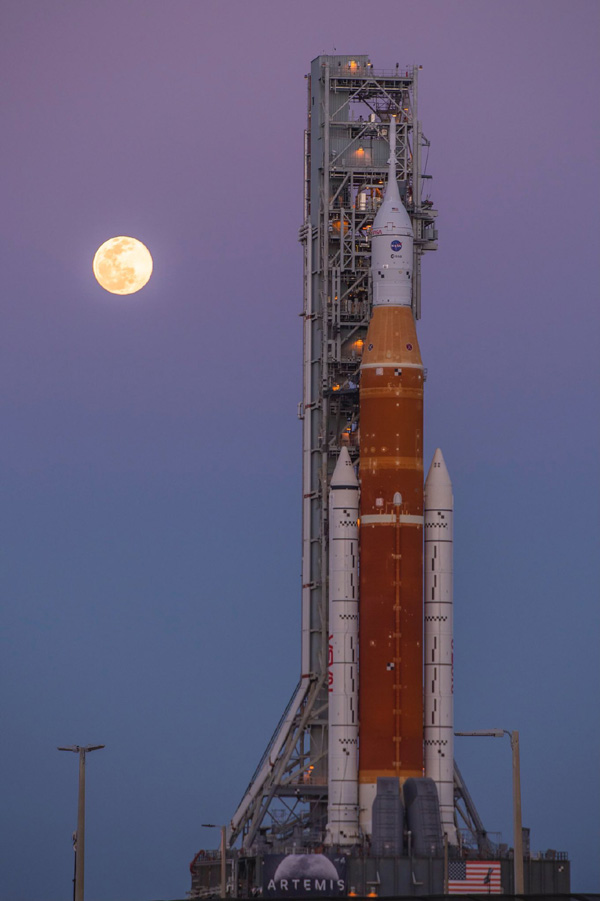
NASA's Space Launch System rocket at Kennedy Space Center's Launch Complex 39B in Florida...with the Full Moon looming large behind it on March 18, 2022.
United Launch Alliance / Ben Cooper

NASA Administrator Statement on President’s FY 2023 Budget Request (Press Release)

The President’s fiscal year 2023 budget would allow NASA to sustain America’s global innovation leadership and keep NASA at the forefront of exploration and discovery by returning to the Moon with the Artemis program, among other efforts. This budget would enable NASA to address climate change, drive economic growth, and promote diversity, equity, inclusion, and accessibility.

The Biden-Harris Administration Monday submitted to Congress President Biden’s budget for fiscal year 2023. The President’s budget details his vision to expand on the historic progress our country has made over the last year and deliver the agenda he laid out in his State of the Union address – to build a better America, reduce the deficit, reduce costs for families, and grow the economy from the bottom up and middle out.

“Greater than a number, statistic, or fact is what the President’s budget request represents,” NASA Administrator Bill Nelson said. “This budget reflects the Biden-Harris Administration’s confidence in the extraordinary workforce that makes NASA the best place to work in the federal government. It’s an investment in the businesses and universities that partner with NASA in all 50 states and the good-paying jobs they are creating. It’s a signal of support for our missions in a new era of exploration and discovery.”

The budget makes critical investments in the American people that will help lay a strong foundation for shared growth and prosperity for generations to come.

At NASA, the budget would:

- Enable missions on and around the Moon through Artemis while preparing for Mars exploration. The budget provides $7.6 billion for deep space exploration. Through Artemis missions, NASA will land the first woman and person of color on the lunar surface, deepen the United States’ scientific understanding of the Moon, and test technologies that will prepare for human exploration of Mars.

- Allow NASA to support and enhance lunar missions. The budget’s $4.7 billion for Common Exploration Systems Development to support lunar missions includes funding for the Orion spacecraft and Space Launch System (SLS). The budget’s $1.5 billion for astronaut Moon landers will enable NASA to increase competition in the development of the final mode of transportation needed to take astronauts to the lunar surface.

- Increase NASA’s Earth science funding for climate and weather monitoring and measurement. The budget’s $2.4 billion for Earth-observing satellites and related research will enhance NASA’s ability to improve the world’s understanding of climate change.

- Help NASA support commercial space activities. The budget’s $1.4 billion for space technology research and development will support new technologies to help the U.S. commercial space industry grow, enhance mission capabilities, create good-paying jobs, and reduce costs.

- Maintain U.S. leadership in aircraft development and improve aviation to deliver benefits to the public. The budget would provide $970 million for aeronautics research. This includes $500 million to reduce aviation’s climate impact through efforts including a Sustainable Flight National Partnership to develop a next-generation passenger aircraft.

- Allow NASA to continue building productive, strategic education collaborations. With $150 million for the Office of STEM Engagement for education and engagement activities, this budget would allow NASA to enhance its support for educational activities, including those that focus on historically underserved communities.

The budget makes these smart investments while also reducing deficits and improving our country’s long-term fiscal outlook.

****

An artist's concept of NASA's Gateway space station in orbit around the Moon.
NASA

An artist's concept of astronauts conducting a moonwalk near the base of SpaceX's Starship lunar lander.
SpaceX

Wednesday, March 23, 2022

SpaceX Will Use Starship as NASA's Crewed Lunar Lander Beyond Artemis 3...

An artist's concept of astronauts conducting a moonwalk near the base of SpaceX's Starship lunar lander.
SpaceX

NASA Provides Update to Astronaut Moon Lander Plans Under Artemis (Press Release)

As NASA makes strides to return humans to the lunar surface under Artemis, the agency announced plans Wednesday to create additional opportunities for commercial companies to develop an astronaut Moon lander.

Under this new approach, NASA is asking American companies to propose lander concepts capable of ferrying astronauts between lunar orbit and the lunar surface for missions beyond Artemis III, which will land the first astronauts on the Moon in more than 50 years.

Built and operated according to NASA’s long-term requirements at the Moon, new landers will have the capability to dock to a lunar-orbiting space station known as Gateway, increase crew capacity, and transport more science and technology to the surface.

“Under Artemis, NASA will carry out a series of groundbreaking missions on and around the Moon to prepare for the next giant leap for humanity: a crewed mission to Mars,” said NASA Administrator Bill Nelson. “Competition is critical to our success on the lunar surface and beyond, ensuring we have the capability to carry out a cadence of missions over the next decade. Thank you to the Biden Administration and Congress for their support of this new astronaut lander opportunity, which will ultimately strengthen and increase flexibility for Artemis.”

NASA’s plans call for long-term lunar exploration and include landing the first woman and first person of color on the Moon as part of future Artemis missions. The agency is pursuing two parallel paths for continuing lunar lander development and demonstration, one that calls for additional work under an existing contract with SpaceX, and another open to all other U.S. companies to provide a new landing demonstration mission from lunar orbit to the surface of the Moon.

In April 2021, NASA selected SpaceX as its partner to land the next American astronauts on the lunar surface. That demonstration mission is targeted for no earlier than April 2025. Exercising an option under the original award, NASA now is asking SpaceX to transform the company’s proposed Human Landing System into a spacecraft that meets the agency’s requirements for recurring services for a second demonstration mission. Pursuing more development work under the original contract maximizes NASA’s investment and partnership with SpaceX.

To bring a second entrant to market for the development of a lunar lander in parallel with SpaceX, NASA will issue a draft solicitation in the coming weeks. This upcoming activity will lay out requirements for a future development and demonstration lunar-landing capability to take astronauts between orbit and the surface of the Moon. This effort is meant to maximize NASA’s support for competition and provides redundancy in services to help ensure NASA’s ability to transport astronauts to the lunar surface.

This upcoming second contract award, known as the Sustaining Lunar Development contract, combined with the second option under SpaceX’s original landing award, will pave the way to future recurring lunar transportation services for astronauts at the Moon.

“This strategy expedites progress toward a long-term, sustaining lander capability as early as the 2026 or 2027 timeframe,” said Lisa Watson-Morgan, program manager for the Human Landing System Program at NASA’s Marshall Space Flight Center in Huntsville, Alabama. “We expect to have two companies safely carry astronauts in their landers to the surface of the Moon under NASA’s guidance before we ask for services, which could result in multiple experienced providers in the market.”

After the new draft solicitation is published, NASA will host a virtual industry day. Once comments and questions from the draft solicitation process have been reviewed, the agency plans to issue the formal request for proposals this summer.

Astronaut Moon landers are a vital part of NASA’s deep space exploration plans, along with the Space Launch System rocket, Orion spacecraft, ground systems, and Gateway. NASA is committed to using a commercial astronaut lunar lander to carry the astronauts to the surface of the Moon, expanding exploration and preparing humanity for the next giant leap: human exploration of Mars.

****

An artist's concept of an Artemis astronaut about to venture onto the lunar surface.
NASA

Monday, March 21, 2022

SLS Update: The Core Stage Booster for the First Crewed Flight to the Moon Since 1972 Is Almost Complete...

The forward assembly and liquid hydrogen tank for the Space Launch System's Artemis 2 core stage booster are about to be mated together at NASA's Michoud Assembly Facility in Louisiana...on March 7, 2022.
NASA / Michael DeMocker

NASA Joins Four Major SLS Rocket Parts to Form Artemis II Core Stage (News Release)

NASA joined the Space Launch System rocket’s core stage forward assembly with the 130-foot liquid hydrogen tank for the Artemis II mission on March 18. This completes assembly of four of the five large structures that make up the core stage that will help send the first astronauts to lunar orbit on Artemis II.

The 66-foot forward assembly consists of the forward skirt, liquid oxygen tank and the intertank, which were mated earlier. Engineers inserted 360 bolts to connect the forward assembly to the liquid hydrogen tank to make up the bulk of the stage. Only the engine section, which is currently being outfitted and includes the main propulsion systems that connect to the four RS-25 engines, remains to be added to form the final core stage.

All parts of the core stage are manufactured by NASA and Boeing, the core stage lead contractor at the agency’s Michoud Assembly Facility in New Orleans. Currently, the team is building core stages for three Artemis missions. The first core stage is stacked with the rest of the SLS rocket, which will launch the Artemis I mission to the Moon this year. Together with its twin solid rocket boosters, the core stage will produce 8.8 million pounds of thrust to send NASA’s Orion spacecraft, astronauts, and supplies beyond Earth’s orbit to the Moon. The SLS rocket and the Orion spacecraft form the foundation for Artemis missions and future deep space exploration.

Source: NASA.Gov

****

The forward assembly and liquid hydrogen tank for the Space Launch System's Artemis 2 core stage booster are mated together at NASA's Michoud Assembly Facility in Louisiana...on March 18, 2022.
NASA / Michael DeMocker

Saturday, March 19, 2022

Photo of the Day: The Moon Rocket and Its Destination...

Yesterday, renowned rocket photographer Ben Cooper tweeted this awesome image of the Space Launch System (SLS) rocket at Kennedy Space Center's (KSC) Launch Complex 39B in Florida...with the Full Moon looming large behind it.

This soon-to-be iconic photo is one for the history books—as Artemis 1 is about three months away from launching (assuming that the SLS Wet Dress Rehearsal takes place in early April as expected) on a mission that will send the Orion Multi-Purpose Crew Vehicle on a weeks-long journey to the Moon and back to Earth.

Seven days from now, I'll hopefully be at KSC to finally see this amazing rocket in person... Knock on wood!

NASA's Space Launch System rocket at Kennedy Space Center's Launch Complex 39B in Florida...with the Full Moon looming large behind it on March 18, 2022.
United Launch Alliance / Ben Cooper

Friday, March 18, 2022

Artemis 1 Update: SLS Has Finally Arrived at Launch Complex 39B for Its Wet Dress Rehearsal!

NASA's Space Launch System rocket stands tall on the pad at Kennedy Space Center's Launch Complex 39B...on March 18, 2022.
NASA

NASA’s Mega-Moon Rocket, Spacecraft Complete First Roll to Launch Pad (Press Release)

NASA’s Space Launch System (SLS) rocket with the Orion spacecraft atop arrived at Launch Complex 39B at the agency’s Kennedy Space Center in Florida Friday in preparation for a final test before its Artemis I Moon mission.

The uncrewed flight test will pave the way for missions to land the first woman and first person of color on the Moon under Artemis, and the rocket rolled to the pad for a final test before launch.

“From this sacred and historical place, humanity will soon embark on a new era of exploration,” said NASA administrator Bill Nelson. “Artemis I will demonstrate NASA’s commitment and capacity to extend humanity’s presence on the Moon – and beyond.”

Stacked on the mobile launcher and mounted on the crawler-transporter for a journey from the Vehicle Assembly Building to Launch Complex 39B, it took 10-hours and 28 minutes for SLS and Orion to reach the launch pad four miles away. The trip began at 5:47 p.m. Thursday, March 17, and the 322-foot tall, 3.5-million-pound rocket and spacecraft arrived at the pad at 4:15 a.m. on March 18.

The upcoming final test, known as the wet dress rehearsal, will run the Artemis I launch team through operations to load propellant into the rocket’s tanks, conduct a full launch countdown, demonstrate the ability to recycle the countdown clock, and also drain the tanks to practice the timelines and procedures the team will use for launch.

“Rolling out of the Vehicle Assembly Building is an iconic moment for this rocket and spacecraft, and this is a key milestone for NASA,” said Tom Whitmeyer, deputy associate administrator for Common Exploration Systems Development at NASA Headquarters in Washington. “Now at the pad for the first time, we will use the integrated systems to practice the launch countdown and load the rocket with the propellants it needs to send Orion on a lunar journey in preparation for launch.”

Before the test, SLS, Orion, and the associated ground systems will undergo checkouts at the pad. After the rehearsal, NASA will review data from the test before setting a specific target launch date for the upcoming Artemis I launch. The integrated rocket and spacecraft will roll back to the Vehicle Assembly Building several days after the test to remove sensors used during the rehearsal, charge system batteries, stow late-load cargo, and run final checkouts. Orion and SLS will then roll to the launch pad for a final time about a week before launch.

With Artemis, NASA will establish long-term exploration at the Moon in preparation for human missions to Mars. SLS and NASA’s Orion spacecraft, along with the Human Landing System and the Gateway in orbit around the Moon, are NASA’s foundation for deep space exploration.

****

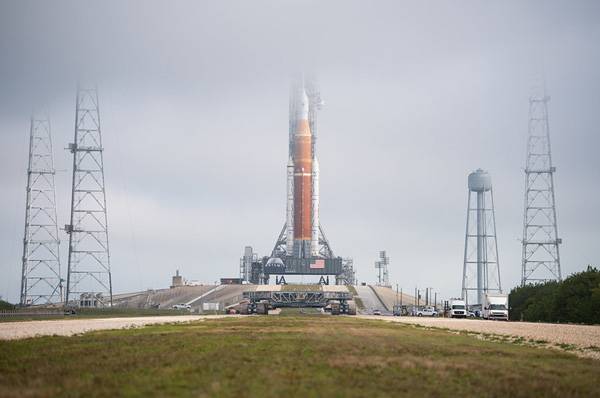
NASA's Space Launch System rocket stands tall on the pad at Kennedy Space Center's Launch Complex 39B...on March 18, 2022.
NASA / Joel Kowsky

A distant snapshot of NASA's Space Launch System rocket standing tall on the pad at Kennedy Space Center's Launch Complex 39B...on March 18, 2022.
NASA / Joel Kowsky

On a foggy morning, NASA's Space Launch System rocket stands tall on the pad at Kennedy Space Center's Launch Complex 39B...on March 18, 2022.
NASA / Aubrey Gemignani

On a foggy morning, NASA's Space Launch System rocket stands tall on the pad at Kennedy Space Center's Launch Complex 39B...on March 18, 2022.
NASA / Aubrey Gemignani

Fog rises above NASA's Space Launch System rocket as it stands tall on the pad at Kennedy Space Center's Launch Complex 39B...on March 18, 2022.
NASA

Thursday, March 17, 2022

Photos of the Day: The SLS Rocket Is Now Headed to KSC's Launch Complex 39B for Final Testing!

An aerial view of the Space Launch System rocket exiting the Vehicle Assembly Building for its trip to Launch Complex 39B at NASA's Kennedy Space Center in Florida...on March 17, 2022.
NASA TV

It has been 18,118 days since the last mega-Moon rocket (Saturn V for Apollo 17) rolled to the pad at NASA's Kennedy Space Center (KSC) in Florida. That changed today...when the Space Launch System (SLS) rocket that will fly on Artemis 1 rolled out of the Vehicle Assembly Building around 6 PM, Eastern Time (3 PM, Pacific Time) for its trek to KSC's Launch Complex (LC)-39B!

It will take up to 11 hours for the mobile launcher carrying SLS to travel 4.2 miles to LC-39B. Once the vehicle is hard down at the pad tomorrow morning, preparations will begin for SLS's wet dress rehearsal (its last major test before launch)—which is scheduled for no earlier than April 3. Stay tuned!

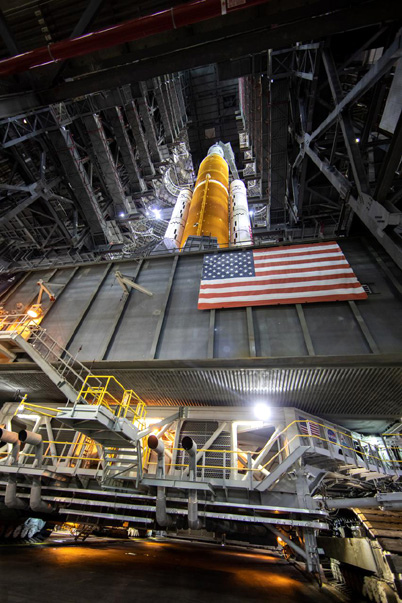
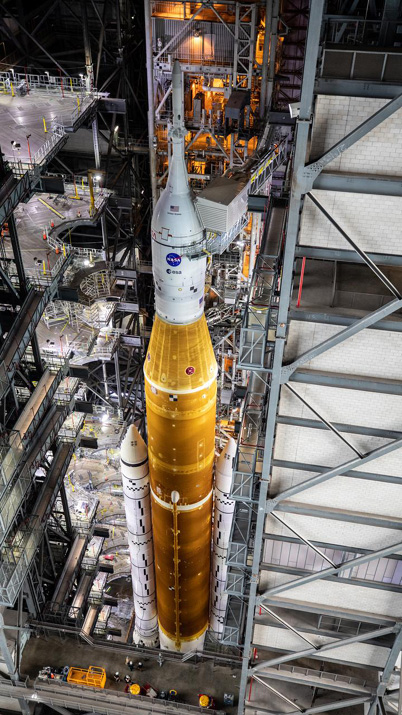
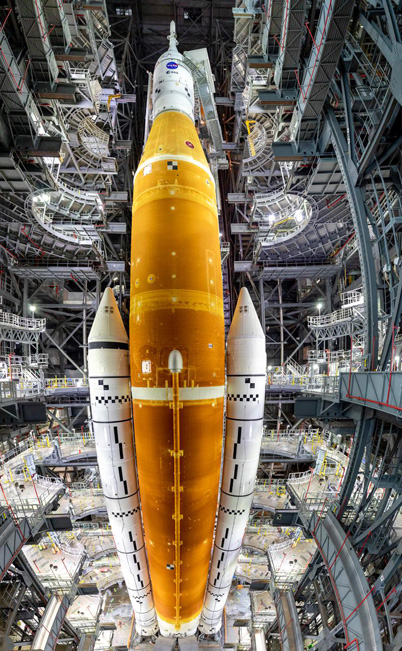
A low-angle snapshot of the Space Launch System rocket inside the Vehicle Assembly Building at NASA's Kennedy Space Center in Florida...on March 16, 2022.
NASA / Glenn Benson

A high-angle snapshot of the Space Launch System rocket inside the Vehicle Assembly Building at NASA's Kennedy Space Center in Florida...on March 16, 2022.
NASA / Glenn Benson

A panoramic shot of the Space Launch System rocket inside the Vehicle Assembly Building at NASA's Kennedy Space Center in Florida...on March 16, 2022.
NASA / Glenn Benson

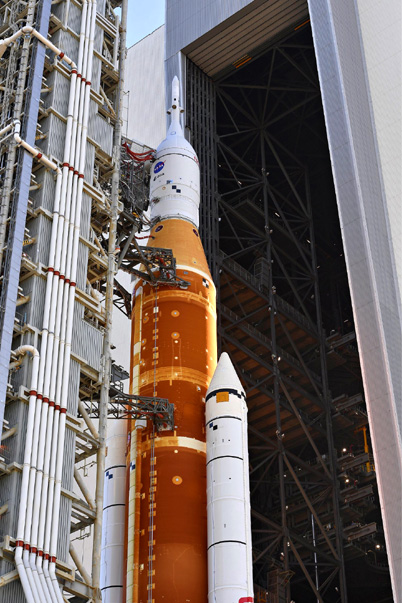
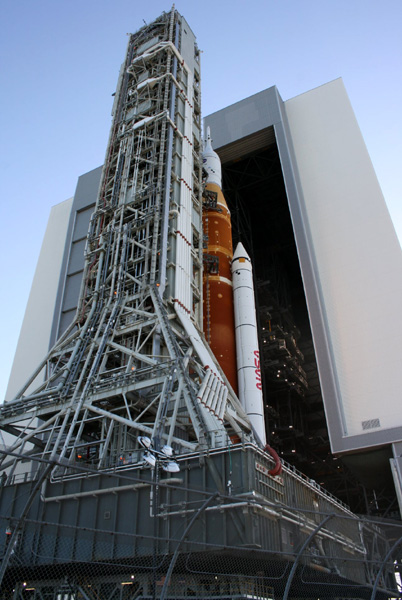
The Space Launch System rocket rolls out of the Vehicle Assembly Building for its journey to Launch Complex 39B at NASA's Kennedy Space Center in Florida...on March 17, 2022.
Lockheed Martin

The Space Launch System rocket rolls out of the Vehicle Assembly Building for its journey to Launch Complex 39B at NASA's Kennedy Space Center in Florida...on March 17, 2022.
NASA

The Space Launch System rocket heads toward Launch Complex 39B after rolling out of the Vehicle Assembly Building at NASA's Kennedy Space Center in Florida...on March 17, 2022.
NASA

The Space Launch System rocket heads toward Launch Complex 39B after rolling out of the Vehicle Assembly Building at NASA's Kennedy Space Center in Florida...on March 17, 2022.
NASA

The Space Launch System rocket heads toward Launch Complex 39B after rolling out of the Vehicle Assembly Building at NASA's Kennedy Space Center in Florida...on March 17, 2022.
NASA

The Full Moon graces the evening sky as the Space Launch System rocket heads toward Launch Complex 39B at NASA's Kennedy Space Center in Florida...on March 17, 2022.
United Launch Alliance

Monday, March 14, 2022

New Shepard's Next Flight Will Continue Blue Origin's Tradition of Sending a Major Celebrity into Space...

The six-member crew of Blue Origin's NS-20 mission.
Blue Origin

Saturday Night Live Star Pete Davidson to Fly on Blue Origin’s 20th Mission Alongside Five Customers (News Release)

Blue Origin today announced the crew flying on its upcoming NS-20 flight on March 23 will include Marty Allen, Pete Davidson, husband and wife duo Sharon and Marc Hagle, Jim Kitchen, and Dr. George Nield.

This mission is the fourth human flight for the New Shepard program and the 20th in its history.

Live launch coverage begins on BlueOrigin.com at T-60 minutes. Liftoff is currently targeted for 8:30 a.m. CDT / 13:30 UTC from Launch Site One in West Texas.

Each astronaut on board NS-20 will carry a postcard to space on behalf of Blue Origin’s foundation, Club for the Future, whose Postcards to Space program gives students access to space on Blue Origin’s rockets. The Club’s mission is to inspire future generations to pursue careers in STEM for the benefit of Earth.

Meet the Crew:

Marty Allen

Marty Allen is a turnaround CEO and angel investor. During his tenure as CEO of Party America, he transformed the company from a broken California retail chain into a large nationwide retailer, leading the company through a bankruptcy restructuring and the acquisition of several competitors. He is also the former CEO of California Closet Company, leading the company to record sales and profitability. Marty also mentors CEOs through his board activities.

Pete Davidson

Pete Davidson joined the cast of Saturday Night Live in 2014. In 2020, he co-wrote and starred in the semi-autobiographical film The King of Staten Island, which also earned a nomination for The Comedy Movie Star of 2020 at the 46th People’s Choice Awards. Pete also appeared in the 2021 film The Suicide Squad directed by James Gunn.

Sharon Hagle

Sharon Hagle founded SpaceKids Global in 2015, a nonprofit whose mission is to inspire students to excel in STEAM+ education with a focus on empowering young girls. SpaceKids hosts several annual challenges designed to inspire kids to pursue careers in the space industry, including national essay competitions and a partnership with the Girl Scouts of Citrus County. SpaceKids also participates in Club for the Future’s Postcards to Space program. To date, Sharon has reached nearly 100,000 students globally.

Marc Hagle

Marc Hagle is president and CEO of Tricor International, a residential and commercial property development corporation. Under his direction, the company has developed and owned more than 17.4 million square feet of properties across the United States, including shopping centers, warehouses, medical facilities, recreational facilities, drug stores, and office projects. Marc and his wife, Sharon, are avid philanthropists for numerous arts, sciences, health, and education-related charities.

Jim Kitchen

Jim Kitchen is a teacher, entrepreneur, and world explorer who has visited all 193 U.N.-recognized countries. He’s been a space dreamer since watching NASA’s Apollo rocket launches in Florida as a child. As a college student in the 1980s, he promoted low-Earth orbit space trips for a startup. Since 2010, Jim has served on the faculty of University of North Carolina’s Kenan-Flagler Business School, teaching students to create world-changing for-profit and nonprofit ventures.

Dr. George Nield

Dr. George Nield is the president of Commercial Space Technologies, LLC, which he founded to encourage, facilitate, and promote commercial space activities. He previously served as associate administrator for the Federal Aviation Administration Office of Commercial Space Transportation and was responsible for licensing and regulating all commercial launch activities. Earlier in his career, he held engineering roles at the Air Force Flight Test Center and the Orbital Sciences Corporation, and he was an assistant professor and research director at the U.S. Air Force Academy. Dr. Nield also served as the manager of the Flight Integration Office for NASA’s Space Shuttle Program.

Source: Blue Origin

****

A New Shepard rocket lifts off from Blue Origin's launch site in West Texas on a flight that took it 389,846 feet above the Earth...on July 18, 2018.
Blue Origin

EDIT (March 17): Blue Origin has reported that Pete Davidson will not fly on New Shepard's next mission as planned.