Friday, November 19, 2021

NASA Looks to Compact Nuclear Reactors to Power Future Artemis Bases on Other Worlds...

An artist's concept of a fission surface power system on the Moon.
NASA

Fission System to Power Exploration on the Moon’s Surface and Beyond (News Release)

Exploration of the Moon and Mars requires the power of human imagination and vision. It also takes the power of electricity to bring science and technology to life when astronauts land and stay on the surface.

NASA has plans for a robust presence on the Moon under Artemis and eventually Mars, including the development of a fission surface power system for safe, efficient, and reliable electrical power. Fission surface power – in conjunction with solar cells, batteries, and fuel cells – can provide the power to operate rovers, conduct experiments, and use the Moon’s resources to produce water, propellant, and other supplies for life support.

“Plentiful energy will be key to future space exploration,” said Jim Reuter, associate administrator for NASA’s Space Technology Mission Directorate (STMD) in Washington, which funds NASA’s fission surface power project. “I expect fission surface power systems to greatly benefit our plans for power architectures for the Moon and Mars and even drive innovation for uses here on Earth.”

NASA, in coordination with the Department of Energy (DOE), is asking American companies for design concepts for a fission surface power system that could be ready to launch within a decade for a demonstration on the Moon. The system should be capable of autonomous operation from the deck of a lunar lander or a lunar surface rover.

Why fission?

- It’s reliable. Fission systems can operate continuously around the clock in shadowy craters and during the weeks-long lunar nights, when power generation from sunlight is difficult.
- It’s powerful. The systems NASA is asking companies to design would provide at least 40 kilowatts of power, enough to continuously power 30 households for ten years.
- It can be compact and lightweight. Systems like these could someday provide enough power to establish an outpost on Mars.

What’s Next?

“NASA and the DOE are collaborating on this important and challenging development that, once completed, will be an incredible step towards long-term human exploration of the Moon and Mars,” said Fission Surface Power Project Manager Todd Tofil at NASA’s Glenn Research Center in Cleveland. “We’ll take advantage of the unique capabilities of the government and private industry to provide reliable, continuous power that is independent of the lunar location.”

Fission surface power technologies will also help NASA mature nuclear propulsion systems that rely on reactors to generate power.

NASA and the DOE (through the Idaho National Laboratory operated by Battelle Energy Alliance) will select competing U.S. companies to develop initial designs over a 12-month period. The resulting designs will inform an industry solicitation for the final design and build of a flight-qualified fission power system to send to the Moon on a demonstration mission.

NASA’s fission surface power project is managed by NASA’s Glenn Research Center in Cleveland. The technology development and demonstration are funded by the Space Technology Mission Directorate’s Technology Demonstration Missions program, which is hosted at Marshall Space Flight Center in Huntsville, Alabama.

Source: NASA.Gov

****

An artist's concept of fission surface power systems on Mars.
NASA

Thursday, November 18, 2021

ISS Update #2: Russia Will Soon Launch the Newest Addition to Its Nauka Module...

Attached to a modified Progress delivery craft, Russia's Prichal module undergoes launch preps at the Baikonur Cosmodrome in Kazakhstan.
Roscosmos

NASA Television to Air Russian Port Module Launch, Docking to Station (Press Release)

NASA will provide live coverage of the upcoming launch and docking of a new Russian docking module to the International Space Station. The events will air on NASA Television, the NASA app, and the agency’s website.

The five-ton Prichal docking module and its modified, uncrewed Russian Progress delivery spacecraft are scheduled to launch atop a Soyuz 2.1b booster from the Baikonur Cosmodrome in Kazakhstan at 8:06 a.m. EST (6:06 p.m. Baikonur time) on Wednesday, Nov. 24. Live coverage will begin at 7:45 a.m.

After separating from the Soyuz rocket’s upper stage, Progress will transport Prichal for an automated docking with the space station’s Nauka multipurpose laboratory module two days later, at 10:26 a.m. Friday, Nov. 26. Coverage of rendezvous and docking will begin at 9:30 a.m.

Prichal, named for the Russian word for port or berth, has five available docking ports to accommodate multiple Russian spacecraft and provide fuel transfer capability to the Nauka module.

To make room for Prichal, the recently relocated, uncrewed Progress 78 cargo craft will undock from Nauka at 6:21 a.m. Thursday, Nov. 25, and follow a path to burn up upon reentry in the Earth’s atmosphere. NASA TV will not cover the Progress 78 undocking or reentry.

The modified Progress transport spacecraft that will guide Prichal to the station will detach from Prichal in late December and burn up during reentry over the Pacific Ocean.

****

Wednesday, November 17, 2021

ISS Update: The Crew-4 Mission Has Received Its Fourth and Final Crew Member...

NASA astronaut Jessica Watkins will be making her first flight into space courtesy of the Crew-4 mission to the International Space Station early next year.
NASA / Bill Ingalls

NASA Assigns Astronaut Jessica Watkins to NASA’s SpaceX Crew-4 Mission (Press Release - November 16)

NASA has assigned astronaut Jessica Watkins to serve as a mission specialist on the agency’s upcoming SpaceX Crew-4 mission, the fourth crew rotation flight of the Crew Dragon spacecraft to the International Space Station.

This will be Watkins’ first trip to space following her selection as an astronaut in 2017. Watkins joins NASA astronauts Kjell Lindgren and Robert Hines, as well as ESA (European Space Agency) astronaut Samantha Cristoforetti, as a crew member for the Crew-4 mission.

NASA previously announced the assignments of Lindgren and Hines as spacecraft commander and pilot, respectively, in February, and ESA announced Cristoforetti as a mission specialist for the mission in May.

Crew-4 is scheduled to launch in April 2022 on a SpaceX Falcon 9 rocket from Launch Complex 39A at NASA’s Kennedy Space Center in Florida for a six-month science mission aboard the microgravity laboratory.

Watkins was born in Gaithersburg, Maryland, and considers Lafayette, Colorado, her hometown. She earned a bachelor’s degree in geological and environmental sciences from Stanford University and a doctorate in geology from the University of California, Los Angeles. Dr. Watkins conducted her graduate research on the emplacement mechanisms of large landslides on Mars and Earth. She began her career at NASA as an intern and has worked at the agency’s Ames Research Center in California and NASA’s Jet Propulsion Laboratory in Southern California. At the time of her astronaut selection, Watkins was a postdoctoral fellow in the Division of Geological and Planetary Sciences at the California Institute of Technology, where she collaborated as a member of the Science Team for the Mars Science Laboratory rover, Curiosity.

For more than 21 years, humans have lived and worked continuously aboard the International Space Station in low-Earth Orbit, advancing scientific knowledge, demonstrating new technologies, and making research breakthroughs not possible on Earth.

Through the Commercial Crew Program and broader commercial efforts, NASA is working with private industry to develop human space transportation services and a robust low-Earth orbit economy that enables the agency to focus on building spacecraft and rockets for deep space missions to the Moon and Mars.

Follow Watkins on Instagram throughout her mission and get the latest space station crew news, images and features on Instagram, Facebook, and Twitter.

****

Tuesday, November 16, 2021

Artemis 1 Update: NASA Gets Ready to Transport SLS to Launch Pad 39B Later Next Month...

The Orion Artemis 1 capsule is soft-mated to NASA's Space Launch System rocket inside High Bay 3 of Kennedy Space Center's Vehicle Assembly Building in Florida...on October 20, 2021.
NASA

NASA to Roll Out Mega-Moon Rocket for First Time, Media Invited (Press Release)

Media registration is now open to capture imagery and video as NASA’s Space Launch System (SLS) rocket and Orion spacecraft roll out of the Vehicle Assembly Building (VAB) at the agency’s Kennedy Space Center in Florida this winter for the first time. SLS and Orion will journey to Launch Pad 39B atop the crawler transporter-2 for a test in preparation for the agency’s Artemis I mission.

The exact date for the move is currently under review. Additional information on timing, as well as interview opportunities and NASA coverage for the final prelaunch test, known as a wet dress rehearsal, will be provided later. No onsite media support is planned during the test itself at this time.

During the rollout, media will have the opportunity to follow the journey from the iconic VAB to the pad from multiple locations. Experts from NASA and its partners will be available to answer questions during the beginning and end of rollout operations.

During the test, planned approximately a week after arriving at the pad, teams from Kennedy’s Exploration Ground Systems, as well as the primary contractor, Jacobs, will load the rocket with more than 700,000 gallons of cryogenic, or supercold, propellants and the team will run through the launch countdown sequence, ending prior to engine ignition. Engineers also will demonstrate procedures to drain the propellants from the rocket. After the test, the rocket and spacecraft will return to the VAB for final checkouts before launch.

Accreditation for this activity is open to U.S. and international media. International media must apply by Sunday, Nov. 28. U.S. media must apply by Wednesday, Dec. 8.

All media accreditation requests must be submitted online at:

https://media.ksc.nasa.gov

NASA’s COVID-19 policies are updated as necessary and to remain consistent with guidelines issued by the Centers for Disease Control and Prevention and White House Safer Federal Workforce Task Force. COVID-19 safety protocols for this event will be communicated closer to the date of the event. The agency also will communicate any updates that may impact mission planning or media access as necessary.

For questions about accreditation, please email: ksc-media-accreditat@mail.nasa.gov.

For other questions, please contact Kennedy’s newsroom at: 321-867-2468.

****

Monday, November 15, 2021

ISS Update: The Crew Aboard the Orbital Outpost Were Endangered by a Russian In-Space Missile Test Conducted Earlier Today...

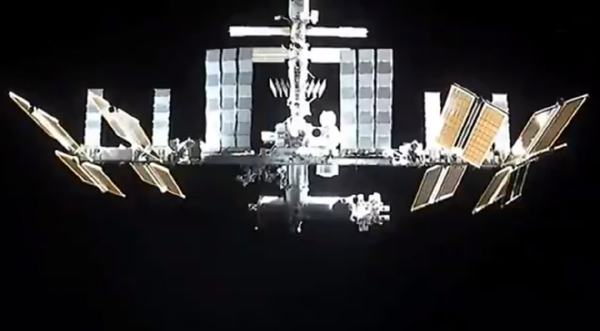
A video screenshot of the International Space Station as seen from SpaceX's Crew Dragon Endeavour capsule...on November 8, 2021.
NASA / SpaceX

NASA Administrator Statement on Russian ASAT Test (Press Release)

On Monday Moscow Standard Time, the International Space Station (ISS) Flight Control team was notified of indications of a satellite breakup that may create sufficient debris to pose a conjunction threat to the station. NASA Administrator Bill Nelson released the following statement about the incident:

“Earlier today, due to the debris generated by the destructive Russian Anti-Satellite (ASAT) test, ISS astronauts and cosmonauts undertook emergency procedures for safety.

“Like Secretary Blinken, I’m outraged by this irresponsible and destabilizing action. With its long and storied history in human spaceflight, it is unthinkable that Russia would endanger not only the American and international partner astronauts on the ISS, but also their own cosmonauts. Their actions are reckless and dangerous, threatening as well the Chinese space station and the taikonauts on board.

“All nations have a responsibility to prevent the purposeful creation of space debris from ASATs and to foster a safe, sustainable space environment.

“NASA will continue monitoring the debris in the coming days and beyond to ensure the safety of our crew in orbit.”

The crew was awakened and directed to close the hatches to radial modules on the station, including Columbus, Kibo, the Permanent Multipurpose Module, Bigelow Expandable Activity Module, and Quest Joint Airlock. Hatches between the U.S. and Russian segments remain open.

An additional precautionary measure of sheltering the crew was executed for two passes through or near the vicinity of the debris cloud. The crew members made their way into their spacecraft shortly before 2 a.m. EST and remained there until about 4 a.m. The space station is passing through or near the cloud every 90 minutes, but the need to shelter for only the second and third passes of the event was based on a risk assessment made by the debris office and ballistics specialists at NASA’s Johnson Space Center in Houston.

****

Saturday, November 13, 2021

Photo of the Day: Starship SN20 Lights Up All Six of Her Engines!

Atop the Pad B pedestal at Starbase in Texas, Starship SN20 ignites all six of her Raptor engines during a static fire on November 12, 2021.
SpaceX

Yesterday, all sea-level Raptor and Raptor Vacuum (RVac) engines aboard Starship Serial No. 20 (SN20) came to life for the first time at Starbase in Texas. Before this important milestone took place, a pre-burner test was conducted to ensure that the six engines would operate as intended once the actual static fire was held atop the pedestal at Starbase's Pad B.

As the last video at the bottom of this entry (courtesy of NASASpaceflight.com) shows, only a handful of heat shield tiles were knocked loose during Friday's test. However, SpaceX will obviously need to find a way to ensure that almost all tiles on the bottom of SN20's fuselage stay put during next year's highly-anticipated orbital test flight...as an exposed gap on a vulnerable area of the rocket's stainless-steel skin could prove to be fatal during its re-entry through Earth's atmosphere after the in-space demonstration.

If past challenges during the early years of Falcon 9 and Crew Dragon are any indication, SpaceX will successfully rectify Starship's tile issue in time to conduct an orbital test that will revolutionize human spaceflight and bring us closer to Mars.


Friday, November 12, 2021

Rest In Peace, Glen de Vries (1972-2021)...

A pre-launch portrait of Glen de Vries in his Blue Origin flight suit last month.
Blue Origin

It's been sadly reported today that Glen de Vries, one of the three crew members who traveled to the edge of space with actor William Shatner on October 13, died from a plane crash in New Jersey yesterday. De Vries was 49.

My condolences to his family and friends.

The legacy of de Vries, a space advocate who was also an entrepreneur who co-founded the company Medidata Solutions and was an alumnus at Carnegie Mellon University in Pennsylvania, will not be forgetten. Ad astra.

Glen de Vries, Audrey Powers, William Shatner and Chris Boshuizen pose for the camera inside the New Shepard capsule while floating 66 miles (106 kilometers) above the Earth...on October 13, 2021.
Blue Origin

Thursday, November 11, 2021

ISS Update #2: SpaceX's Endurance Capsule Embarks on Her Maiden Flight to the Orbital Outpost...

NASA's Crew-3 astronauts head to the International Space Station aboard SpaceX's Endurance capsule...which launched aboard a Falcon 9 rocket from NASA's Kennedy Space Center in Florida, on November 10, 2021.
NASA / Joel Kowsky

NASA’s SpaceX Crew-3 Astronauts Headed to International Space Station (Press Release)

NASA’s SpaceX Crew-3 astronauts are in orbit following their launch to the International Space Station on the third commercial crew rotation mission aboard the microgravity laboratory. The international crew of astronauts lifted off at 9:03 p.m. EST Wednesday from Launch Complex 39A at NASA’s Kennedy Space Center in Florida.

The SpaceX Falcon 9 rocket propelled the Crew Dragon Endurance spacecraft with NASA astronauts Raja Chari, Tom Marshburn, and Kayla Barron, as well as ESA (European Space Agency) astronaut Matthias Maurer, into orbit to begin a six-month science mission on the space station.

This mission is the first spaceflight for astronauts Chari, Barron, and Maurer, and the third for Marshburn. Marshburn is the sixth person to launch from Earth on three different spacecraft.

During Crew Dragon’s flight, SpaceX will monitor a series of automatic spacecraft maneuvers from its mission control center in Hawthorne, California, and NASA teams will monitor space station operations throughout the flight from the Mission Control Center at the agency’s Johnson Space Center in Houston.

“With Raja, Thomas, Kayla and Mattias on their way to the International Space Station just days after Crew-2’s return, we’re seeing the power of American ingenuity right before our eyes,” Nelson said. “NASA’s partnership with SpaceX is not only critical for cutting-edge research, but also for international collaboration. The space station brings together nations around the world for the benefit of all. Godspeed, Crew-3 – I can’t wait to see all that you accomplish.”

The Crew Dragon Endurance will dock autonomously to the forward port of the station’s Harmony module around 6:33 p.m. Thursday, Nov. 11. NASA Television, the NASA app, and the agency’s website are providing ongoing live coverage through docking, hatch opening, and the ceremony to welcome the crew aboard the orbital outpost.

“Ensuring our crews have safe transportation and continued access to space is an enormous responsibility,” said Steve Stich, manager with NASA’s Commercial Crew Program. “We know the crew is excited to get on station and settle into their long-duration mission. The NASA and SpaceX team remains vigilant in support of their safe arrival and eventual return to Earth.”

Chari, Marshburn, Barron, and Maurer will join the Expedition 66 crew of NASA astronaut Mark Vande Hei and cosmonauts Anton Shkaplerov and Pyotr Dubrov of Roscosmos. Crew-3 is the second commercial crew mission to fly an ESA astronaut.

“It is always thrilling to watch a rocket launch, especially when an international crew of astronauts is sitting atop it. Matthias Maurer is the second ESA astronaut to be launched in a Crew Dragon spacecraft under the U.S. Commercial Crew Program,” said Josef Aschbacher, ESA director general. “We are delighted to see him fly alongside NASA astronauts to the International Space Station, continuing a long history of international collaboration in space for the benefit of Earth. On behalf of ESA, I’d like to wish all Crew-3 astronauts a productive and enjoyable mission.”

The Crew-3 astronauts will spend approximately six months aboard the space station conducting new and exciting scientific research in areas such as materials science, health technologies, and plant science to prepare for human exploration beyond low-Earth orbit and to benefit life on Earth.

The Crew-3 mission continues NASA’s efforts to restore and maintain American leadership in human spaceflight. Regular, long-duration commercial crew rotation missions enable NASA to continue the important research and technology investigations taking place aboard the station. Such research benefits people on Earth and lays the groundwork for future exploration of the Moon and Mars, starting with the agency’s Artemis missions, which includes landing the first woman and person of color on the lunar surface.

Crew-3 Astronauts

Chari is commander of the Crew Dragon spacecraft and the Crew-3 mission. He is responsible for all phases of flight, from launch to re-entry. He also will serve as an Expedition 66 flight engineer aboard the station. This will be the first spaceflight for Chari, who was selected as a NASA astronaut candidate in 2017. He was born in Milwaukee, but considers Cedar Falls, Iowa, his hometown. He is a colonel in the U.S. Air Force and joins the mission with extensive experience as a test pilot. He has accumulated more than 2,500 hours of flight time during his career.

Marshburn is the pilot of the Crew Dragon spacecraft and second-in-command for the mission. He is responsible for spacecraft systems and performance. Once aboard station, he will serve as an Expedition 66 flight engineer, and is scheduled to assume command of station for Expedition 67. Marshburn is a Statesville, North Carolina, native who became an astronaut in 2004. Prior to serving in the astronaut corps, the medical doctor served as flight surgeon at NASA Johnson and later became medical operations lead for the International Space Station. The Crew-3 mission will be his third visit to the space station, having flown on three different spacecraft, and his second long-duration mission. Marshburn previously served as a crew member of STS-127 in 2009 flying aboard NASA’s space shuttle Endeavour, and Expedition 34/35, which concluded in 2013, using a Russian Soyuz spacecraft.

Barron is a mission specialist for Crew-3. She will work closely with the commander and pilot to monitor the spacecraft during the dynamic launch and re-entry phases of flight. Once aboard the station, she will become a flight engineer for Expedition 66. Barron was born in Pocatello, Idaho, but considers Richland, Washington, her hometown. She earned a bachelor’s degree in systems engineering from the U.S. Naval Academy in Annapolis, Maryland, in 2010, and a master’s degree in nuclear engineering from the University of Cambridge, in England, in 2011, where she was a Gates Cambridge Scholar. Barron earned her submarine warfare officer qualification and deployed three times while serving aboard the USS Maine. Her current rank in the U.S. Navy is a Lt. Cmdr. At the time of her selection as an astronaut candidate, in 2017, she was serving as the flag aide to the superintendent of the U.S. Naval Academy. Crew-3 will be Barron’s first spaceflight.

Maurer also will be a mission specialist for Crew-3, working with the commander and pilot to monitor the spacecraft during the dynamic launch and re-entry phases of flight. He also will become a long-duration crew member aboard the space station. Like Chari and Barron, he will be making his first trip to space with the Crew-3 mission. Maurer comes from Sankt Wendel, in the German state of Saarland. Before becoming an astronaut, Maurer held a number of engineering and research roles, both in a university setting and at ESA. In 2016, Maurer spent 16 days on an undersea mission as part of NASA’s Extreme Environment Mission Operations space analog.

****

As SpaceX employees shield them from the rain, the Crew-3 astronauts greet family and friends outside Kennedy Space Center's Neil Armstrong Operations and Checkout Building before heading to Launch Complex 39A to board the Endurance capsule for flight...on November 10, 2021.
NASA / Joel Kowsky

Guests at Kennedy Space Center watch as the SpaceX Falcon 9 rocket carrying Crew-3's Endurance capsule sets sail for the International Space Station...on November 10, 2021.
NASA / Joel Kowsky

A long-exposure snapshot showing SpaceX's Falcon 9 rocket carrying NASA's Crew-3 astronauts as it heads for the International Space Station from Kennedy Space Center in Florida...on November 10, 2021.
SpaceX

Tuesday, November 9, 2021

ISS Update: SpaceX's Endeavour Capsule Has Completed Her Second Trip to the Orbital Outpost...

The Crew-2 astronauts give the 'peace sign' after the hatch is opened on their Endeavour capsule after she was safely placed aboard a SpaceX recovery vessel deployed to the Gulf of Mexico...on November 8, 2021.
NASA / Aubrey Gemignani

Crew-2 Astronauts Safely Splash Down in Gulf of Mexico (Press Release)

NASA’s SpaceX Crew-2 astronauts safely splashed down in the Gulf of Mexico off the coast of Florida Monday aboard the Crew Dragon Endeavour spacecraft, completing the agency’s second long-duration commercial crew mission to the International Space Station. The mission set a record for the longest spaceflight by a U.S. crewed spacecraft. The international crew of four spent 199 days in orbit, surpassing the 168 days set by NASA’s SpaceX Crew-1 mission earlier this year.

NASA astronauts Shane Kimbrough and Megan McArthur, JAXA (Japan Aerospace Exploration Agency) astronaut Akihiko Hoshide, and ESA (European Space Agency) astronaut Thomas Pesquet returned to Earth in a parachute-assisted splashdown at 10:33 p.m. EST off the coast of Pensacola, Florida. Crews aboard SpaceX recovery vessels successfully recovered the spacecraft and astronauts. After returning to shore, the astronauts will fly back to NASA’s Johnson Space Center in Houston.

“We’re happy to have Shane, Megan, Aki, and Thomas safely back on Earth after another successful, record-setting long-duration mission to the International Space Station,” said NASA administrator Bill Nelson. “Congratulations to the teams at NASA and SpaceX who worked so hard to ensure their successful splashdown. NASA’s Commercial Crew Program continues to demonstrate safe, reliable transportation to conduct important science and maintenance on the space station.”

The Crew-2 mission launched April 23 on a Falcon 9 rocket from NASA’s Kennedy Space Center in Florida. Crew Dragon Endeavour docked to the Harmony module’s forward port of the space station April 24, nearly 24-hours after liftoff.

Kimbrough, McArthur, Hoshide, and Pesquet traveled 84,653,119 statute miles during their mission, stayed 198 days aboard the space station, and completed 3,194 orbits around Earth.

Throughout their mission, the Crew-2 astronauts contributed to a host of science and maintenance activities, scientific investigations, and technology demonstrations. In addition, they conducted four spacewalks and multiple public engagement events while aboard the orbiting laboratory. They studied how gaseous flames behave in microgravity, grew hatch green chiles in the station’s Plant Habitat Facility, installed free-flying robotic assistants, and even donned virtual reality goggles to test new methods of exercising in space, among many other scientific activities. The astronauts took hundreds of pictures of Earth as part of the Crew Earth Observation investigation, one of the longest-running investigations aboard the space station, which contributes to tracking of natural disasters and changes to our home planet.

Kimbrough, Hoshide, and Pesquet also completed four spacewalks to install, deploy, or otherwise prepare for installation of ISS Roll-out Solar Arrays. This brought the total number of spacewalks for Kimbrough, Hoshide, and Pesquet to nine, four, and six, respectively. The fourth spacewalk, conducted by Hoshide and Pesquet on Sept. 12, was the first in the history of the space station that did not include an American or Russian.

On July 21, all four Crew-2 astronauts boarded Endeavour for a port relocation maneuver, moving their spacecraft from the forward-facing port to the space-facing port on the station’s Harmony module.

The Crew-2 flight is part of NASA’s Commercial Crew Program, which has worked with the U.S. aerospace industry to launch astronauts on American rockets and spacecraft from American soil to the space station. The splashdown of Crew-2 comes just before the launch of NASA’s SpaceX Crew-3 mission, currently scheduled for no earlier than Wednesday, Nov. 10, on another long-duration mission of approximately six months.

Endeavour will return for inspection and processing to SpaceX’s Dragon Lair in Florida, where teams will examine the spacecraft’s data and performance throughout the flight.

Following Crew-3’s launch, the next NASA and SpaceX crew rotation mission is Crew-4, currently targeted for launch in April 2022. Crew-3 astronauts are scheduled to return to Earth shortly after welcoming their Crew-4 colleagues to the orbiting laboratory.

The goal of NASA’s Commercial Crew Program is safe, reliable, and cost-effective transportation to and from the International Space Station. This already has provided additional research time and has increased the opportunity for discovery aboard humanity’s microgravity testbed for exploration, including helping NASA prepare for human exploration of the Moon and Mars.

****

Taken by a remote camera aboard the International Space Station, this video screenshot shows the Endeavour capsule as she conducted a 360-degree flyaround of the orbital outpost on November 8, 2021...the first ISS flyaround by a NASA crew since shuttle flight STS-135 in 2011.
NASA

The fireball created by the Endeavour capsule as she safely re-entered Earth's atmosphere is visible above SpaceX recovery craft waiting in the Gulf of Mexico...on November 8, 2021.
NASA / Aubrey Gemignani

An infrared image taken by a NASA observation aircraft showing the Endeavour capsule, with her four main chutes fully deployed, about to splash down into the Gulf of Mexico...on November 8, 2021.
NASA

Thursday, November 4, 2021

NASA to Resume Working with SpaceX on Its Starship Lunar Lander for the Artemis 3 Mission (FOR REALS This Time)...

An artist's concept of astronauts conducting a moonwalk near the base of SpaceX's Starship lunar lander.
SpaceX

NASA Statement on Artemis Lunar Lander Court Decision (Press Release)

NASA was notified Thursday that the U.S. Court of Federal Claims denied Blue Origin’s bid protest, upholding NASA’s selection of SpaceX to develop and demonstrate a modern human lunar lander. NASA will resume work with SpaceX under the Option A contract as soon as possible.

In addition to this contract, NASA continues working with multiple American companies to bolster competition and commercial readiness for crewed transportation to the lunar surface. There will be forthcoming opportunities for companies to partner with NASA in establishing a long-term human presence at the Moon under the agency’s Artemis program, including a call in 2022 to U.S. industry for recurring crewed lunar landing services.

Through Artemis missions, NASA will lead the world in landing the first woman and first person of color on the lunar surface, conduct extensive operations on and around the Moon, and get ready for human missions to Mars.

****