Thursday, April 2, 2020

Photos of the Day: A Classic NASA Logo Will Fly on SpaceX's First Crewed Flight to the International Space Station!

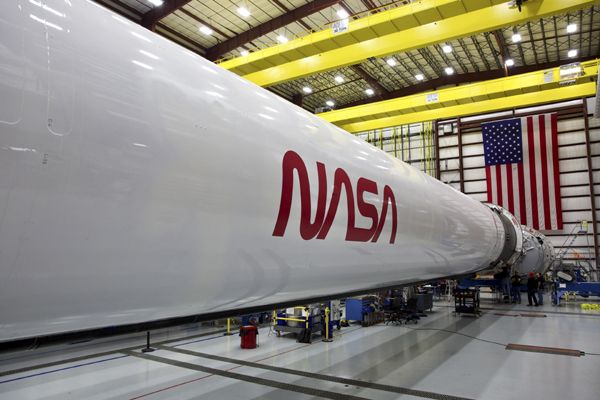
The NASA 'worm' is painted on the side of the SpaceX Falcon 9 rocket that will launch the crewed Demo-2 mission to the International Space Station next month.
SpaceX

The Worm is Back! (News Release)

The original NASA insignia is one of the most powerful symbols in the world. A bold, patriotic red chevron wing piercing a blue sphere, representing a planet, with white stars, and an orbiting spacecraft. Today, we know it as “the meatball.” However, with 1970’s technology, it was a difficult icon to reproduce, print, and many people considered it a complicated metaphor in what was considered, then, a modern aerospace era.

Enter a cleaner, sleeker design born of the Federal Design Improvement Program and officially introduced in 1975. It featured a simple, red unique type style of the word NASA. The world knew it as “the worm.” Created by the firm of Danne & Blackburn, the logo was honored in 1984 by President Reagan for its simplistic, yet innovative design.

NASA was able to thrive with multiple graphic designs. There was a place for both the meatball and the worm. However, in 1992, the 1970s brand was retired - except on clothing and other souvenir items - in favor of the original late 1950s graphic.

Until today.

The worm is back. And just in time to mark the return of human spaceflight on American rockets from American soil.

The retro, modern design of the agency’s logo will help capture the excitement of a new, modern era of human spaceflight on the side of the Falcon 9 launch vehicle that will ferry astronauts to the International Space Station as part of the Demo-2 flight, now scheduled for mid-to-late May.

And there’s a good chance you’ll see the logo featured in other official ways on this mission and in the future. The agency is still assessing how and where it will be used, exactly.

It seems the worm logo wasn’t really retired. It was just resting up for the next chapter of space exploration.

And don’t worry, the meatball will remain NASA’s primary symbol.

Source: NASA.Gov

****

A collage showing the NASA worm as it was used throughout the history of the U.S. space program.
NASA

Wednesday, April 1, 2020

Preparations Continue for Next Month's Launch of SpaceX's Demo-2 Mission to the International Space Station...

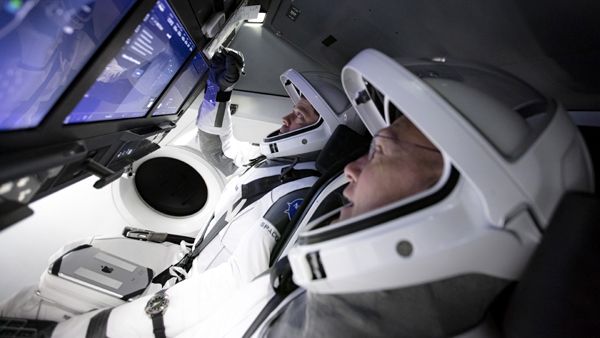
NASA astronauts Bob Behnken and Doug Hurley (foreground) train for the upcoming Demo-2 mission inside SpaceX's flight simulator.
SpaceX

NASA, SpaceX Simulate Upcoming Crew Mission with Astronauts (News Release - March 31)

Joint teams from NASA and SpaceX continue making progress on the first flight test with astronauts to the International Space Station by completing a series of mission simulations from launch to landing. The mission, known as Demo-2, is a close mirror of the company’s uncrewed flight test to station in March 2019, but this time with NASA astronauts Bob Behnken and Doug Hurley aboard the Crew Dragon spacecraft launching atop a Falcon 9 rocket as part of NASA’s Commercial Crew Program (CCP).

Over the last several months, key members of flight control teams working from NASA’s Johnson and Kennedy Space Centers and SpaceX headquarters in Hawthorne, California, simulated different phases of the upcoming mission while the Demo-2 astronaut crew practiced procedures from inside a realistic simulator of Crew Dragon.

“The simulations were a great opportunity to practice procedures and to coordinate decision-making for the mission management team, especially with respect to weather,” said Michael Hess, manager of Operations Integration for CCP. “Simulation supervisors do a great job at picking cases that really make the team think and discuss.”

Recent simulations saw teams execute timelines from hatch closure to undocking with the space station — as well as a free flight in preparation for re-entry and splashdown. In March, the control teams and crew ran through a simulated mission starting at prelaunch and continuing through ascent and eventual rendezvous with the station.

This recent sim makes the excitement all the more tangible, especially for the greater NASA team.

“What’s happening in commercial crew is a big deal,” Hess said. “It will be the first time to launch astronauts from U.S. soil since the end of the Space Shuttle Program in 2011, and it will be the first time since STS-1 that we will launch astronauts in a new spacecraft. This new spacecraft, Crew Dragon, was designed and built by SpaceX, not by NASA and traditional contractor partnerships — another first. Bob (Behnken) and Doug (Hurley) will definitely be earning their spacecraft test pilot wings with this mission. Also, the Space Station Program is really looking forward to another way to rotate crews to station to perform science and experiments to benefit all.”

As the countdown clock winds down, Crew Dragon is undergoing final testing and prelaunch processing in a SpaceX facility on nearby Cape Canaveral Air Force Station. All the activity is also kicking off “more simulations, final crew training and flight readiness reviews to ensure all of the mission systems and subsystems are ready for a crewed test flight,” Hess noted.

When Crew Dragon launches atop a Falcon 9 rocket with Behnken and Hurley strapped inside as early as mid-to-late May, it will herald a new era for human spaceflight, enabling greater access to low-Earth orbit and destinations beyond with the help of commercial partners.

The Demo-2 crew is proceeding with its scheduled training activities. Astronaut trainers, along with all NASA employees, are closely adhering to CDC recommendations on infection control for the coronavirus. As all NASA centers are currently operating in a mode that requires any non-mission-essential work to be done remotely, the number of employees in contact with the crew is limited.

Source: NASA.Gov

Tuesday, March 31, 2020

A Fourth Crew Member Has Been Added to SpaceX's Crew-1 Mission...

NASA astronaut Shannon Walker gazes out of the International Space Station's Cupola at a Caribbean island over 200 miles beneath her...on November 25, 2010.
NASA

NASA Adds Shannon Walker to First Operational Crewed SpaceX Mission (Press Release)

NASA has assigned astronaut Shannon Walker to the first operational crewed flight of the SpaceX Crew Dragon spacecraft on a mission to the International Space Station.

Walker will join NASA astronauts Michael Hopkins and Victor Glover Jr., as well as Soichi Noguchi of the Japan Aerospace Exploration Agency (JAXA), for a six-month expedition aboard the unique space laboratory.

This mission will be the first in a series of regular, rotational flights to the station following NASA’s certification of the new crewed system following completion and validation of SpaceX’s test flight with astronauts, known as Demo-2. This test is expected to take place in mid-to-late May as part of NASA’s Commercial Crew Program.

Pending the successful Demo-2 test, Walker, Glover, Hopkins, and Noguchi will launch aboard Crew Dragon on SpaceX’s Falcon 9 rocket from Launch Pad 39A at NASA’s Kennedy Space Center in Florida. That launch is targeted for later this year.

Walker was born in Houston and began her career at NASA’s Johnson Space Center in Houston in 1987 as a robotics flight controller for the space shuttle with Rockwell Space Operations Co. She became a NASA employee in 1995, working on robotics and avionics hardware for the station with the program’s international partners. She also coordinated on-orbit problem resolution in the Mission Evaluation Room at Johnson and in Moscow and served as acting manager of the On-Orbit Engineering Office before NASA selected her for the 2004 astronaut class. As an astronaut, she spent 163 days as a flight engineer aboard the space station for Expeditions 24 and 25 in 2010. Walker earned a bachelor’s degree in physics and a master’s and doctorate in space physics, all from Rice University in Houston.

NASA already assigned Glover and Hopkins to the first operation SpaceX crewed mission in August 2018. This will be the first spaceflight for Glover and the second for Hopkins, who lived aboard the space station from September 2013 to March 2014 as part of Expeditions 37 and 38.

It will be the third spaceflight for Noguchi, who was a space shuttle crew member on the STS-114 mission in 2005 and a space station crew member from December 2009 to June 2010 as part of Expeditions 22 and 23.

NASA’s Commercial Crew Program is working with the American aerospace industry as companies develop and operate a new generation of spacecraft and launch systems capable of carrying crews to low-Earth orbit and to the space station. Commercial transportation to and from the station will provide expanded utility, additional research time and broader opportunities for discovery on the orbital outpost.

The station is a critical testbed for NASA to understand and overcome the challenges of long-duration spaceflight. As commercial companies focus on providing human transportation services to and from low-Earth orbit, NASA is free to focus on building spacecraft and rockets for deep space missions.

Source: NASA.Gov

Saturday, March 28, 2020

SpaceX's Dragon XL Freighter Will Send Cargo to NASA's Lunar Space Station...

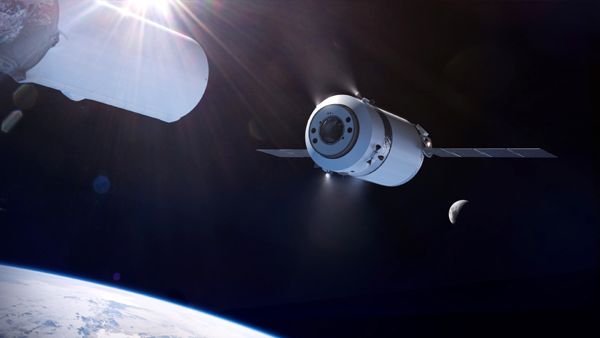
An artist's concept of SpaceX's Dragon XL freighter separating from its Falcon Heavy second stage booster to head to NASA's Gateway at the Moon.
SpaceX

NASA Awards Artemis Contract for Gateway Logistics Services (Press Release - March 27)

NASA has selected SpaceX of Hawthorne, California, as the first U.S. commercial provider under the Gateway Logistics Services contract to deliver cargo, experiments and other supplies to the agency’s Gateway in lunar orbit. The award is a significant step forward for NASA’s Artemis program that will land the first woman and next man on the Moon by 2024 and build a sustainable human lunar presence.

At the Moon, NASA and its partners will gain the experience necessary to mount a historic human mission to Mars.

SpaceX will deliver critical pressurized and unpressurized cargo, science experiments and supplies to the Gateway, such as sample collection materials and other items the crew may need on the Gateway and during their expeditions on the lunar surface.

“This contract award is another critical piece of our plan to return to the Moon sustainably,” said NASA Administrator Jim Bridenstine. “The Gateway is the cornerstone of the long-term Artemis architecture and this deep space commercial cargo capability integrates yet another American industry partner into our plans for human exploration at the Moon in preparation for a future mission to Mars.”

NASA is planning multiple supply missions in which the cargo spacecraft will stay at the Gateway for six to 12 months at a time. These firm-fixed price, indefinite delivery/indefinite quantity contracts for logistics services guarantee two missions per logistics services provider with a maximum total value of $7 billion across all contracts as additional missions are needed.

“Returning to the Moon and supporting future space exploration requires affordable delivery of significant amounts of cargo,” said SpaceX President and Chief Operating Officer Gwynne Shotwell. “Through our partnership with NASA, SpaceX has been delivering scientific research and critical supplies to the International Space Station since 2012, and we are honored to continue the work beyond Earth’s orbit and carry Artemis cargo to Gateway.”

The Gateway Logistics Services contract enables NASA to order missions for as long as 12 years with a 15-year performance period and provides the ability to add new competitive providers. These missions will support NASA’s plans for sustainable exploration with both international and commercial partners, while developing the experience and capabilities necessary to send humans to Mars.

“This is an exciting new chapter for human exploration,” said Mark Wiese, Deep Space Logistics manager at NASA’s Kennedy Space Center in Florida. “We are bringing the innovative thinking of commercial industry into our supply chain and helping ensure we’re able to support crews preparing for lunar surface expeditions by delivering the supplies they need ahead of time.”

Charged with returning to the Moon in the next four years, NASA’s Artemis program will reveal new knowledge about the Moon, Earth and our origins in the solar system. The Gateway is a vital part of NASA’s deep space exploration plans, along with the Space Launch System (SLS) rocket, Orion spacecraft, and Human Landing System that will send astronauts to the Moon. One standard logistics service mission is anticipated for each Artemis SLS/Orion crewed mission to the Gateway. Gaining new experiences on and around the Moon will prepare NASA to send the first humans to Mars in the coming years, and the Gateway will play a vital role in this process.

“We’re making significant progress moving from our concept of the Gateway to reality,” said Dan Hartman, Gateway program manager at NASA’s Johnson Space Center in Houston. “Bringing a logistics provider onboard ensures we can transport all the critical supplies we need for the Gateway and on the lunar surface to do research and technology demonstrations in space that we can’t do anywhere else. We also anticipate performing a variety of research on and within the logistics module.”

Source: NASA.Gov

Friday, March 27, 2020

Artemis 1 Update: The Orion Capsule Moves a Step Closer to Launch Next Year!

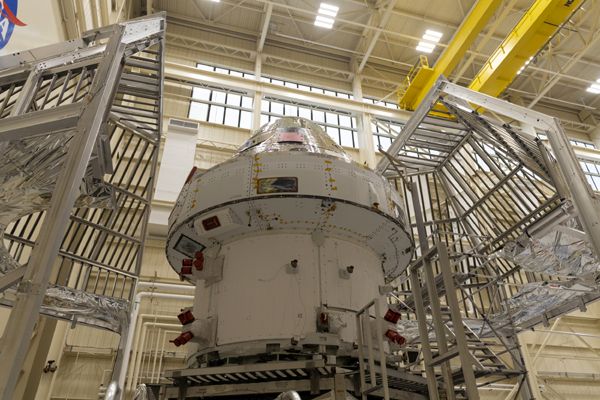
The Orion spacecraft and its European Service Module is about to be placed inside a cage prior to undergoing now-completed multi-month tests at NASA's Plum Brook Station in Sandusky, Ohio.
ESA – S. Corvaja

Last Stop Before Launch: Orion Passes Tests and Returns to Kennedy Space Center (Press Release)

The Orion spacecraft that will fly on the Artemis 1 mission around the Moon has returned to NASA’s Kennedy Space Center in Florida, USA, after finishing space environment tests. The spacecraft, including ESA’s European Service Module, is now at its final destination before launch.

Orion spent four months at NASA’s Plum Brook Station where it was subjected to the vacuum and temperatures of –175°C to 75°C it will experience on its flight to the Moon. After proving its space-worthiness, the electronics ­– including the thousands of parameters and functions of the European Service Module that control the engines, electrical power and steering the solar panels to face the Sun – were checked for electromagnetic interference.

ESA’s Dominique Siruguet from the European Service Module integration and verification team says “The tests were successful and the behaviour of the vehicle was good, passing all requirements.”

Plum Brook Station was chosen for the tests because thermal vacuum and electromagnetic compatibility could be performed in the same facility. This avoided additional transport of Orion, which is the size of a two-story house.

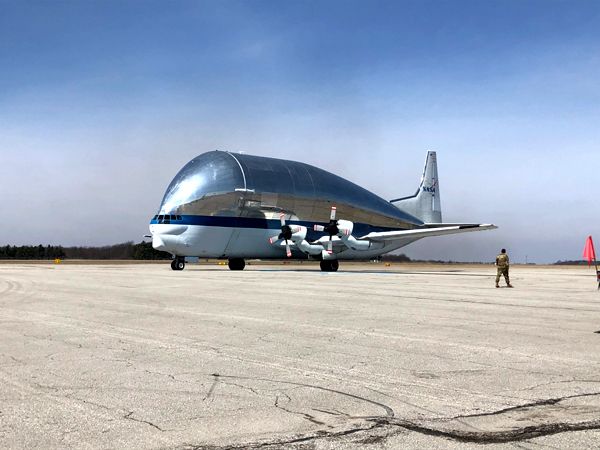
Having passed its trials, the spacecraft was wrapped and moved by truck to an airport in Ohio for its return flight on NASA’s Super Guppy aircraft.

Adding Wings to Orion

The tests are not completely over for Orion; at Kennedy Space Center the crew module will be further prepared and more leak tests conducted. The European Service Module has tanks for fuel, oxygen and water that are critical for the astronauts. The gas tanks are pressurised and are connected to many pipes and valves, so it is vital to make sure there are no leaks.

The solar wings that generate power during its mission will be installed, as well as protective covers called the Spacecraft Adapter Jettisoned fairings for the intense moments of launch on the world’s most powerful rocket.

Later this year ESA will formally transfer ownership of the European Service Module to NASA and the spacecraft will move into the ground system phase where it will be united with the SLS rocket for a lift-off to the Moon.

Orion is a key component of Artemis 1 – an uncrewed test flight around the Moon that paves the way for the Artemis 3 mission, which will land the first woman and next man on the lunar surface by 2024. ESA is designing and supplying the European Service Module for the Orion spacecraft. This provides electricity, water, oxygen and nitrogen. It also keeps the spacecraft at the right temperature and on course, propelling it to the Moon and back once it has separated from the launcher.

Source: European Space Agency

****

The Super Guppy aircraft containing the Orion spacecraft that will launch on Artemis 1 is about to depart from Ohio and head to NASA's Kennedy Space Center in Florida.
NASA – Nicole Smith

Thursday, March 19, 2020

Future SLS and Orion Assembly and Testing in New Orleans Have Been Put on Hold Due to the Coronavirus Pandemic...

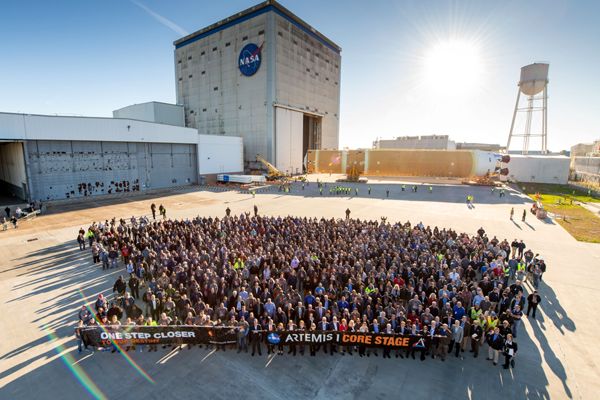
Boeing and Aerojet Rocketdyne personnel gather for a group photo in front of the Space Launch System's first core stage booster at NASA's Michoud Assembly Facility in Louisiana...on January 8, 2020.
NASA

Michoud Assembly Facility Director Statement on Coronavirus Situation (Press Release)

The following is a statement from NASA’s Michoud Assembly Facility Director Robert Champion:

NASA leadership continues to make the health and safety of the Michoud Assembly Facility (MAF) family the top priority. MAF will move to stage 4 of the NASA response framework due to the rising number of coronavirus (COVID-19) cases in the local area, and to comply with all local and federal guidelines. While there are no confirmed cases at MAF, this step is being taken to help slow the transmission of COVID-19 and protect Michoud employees and their families.

Mandatory telework is in effect for ALL personnel until further notice, with the exception of limited personnel required to maintain the safety and security of the facility. All previously approved exceptions for onsite work are rescinded and new approvals will be required in order to gain access to the facility.

This includes that effective immediately NASA will temporarily suspend production and testing of the Space Launch System and Orion hardware.

The NASA and contractor teams will complete an orderly shutdown that puts all hardware in a safe condition until work can resume. Once this is complete, MAF personnel allowed onsite will be limited to those needed to protect life and critical infrastructure.

The facility will begin shutdown operations immediately. Additionally, all travel will be suspended. The status of the facility will be updated regularly and communicated to all employees. Please stay in close contact with your supervisor.

For all other MAF tenants and employees, access to the facility will be restricted to personnel required to protect life and critical infrastructure only, as defined in NASA’s response framework.

Please continue to pay attention to all communications from your supervisors, the agency, and our facility by visiting NASA People and MAFSpace for the latest information, as those sites are updated regularly. And again, I urge you to stay in contact with your supervisor.

Your leadership, NASA leadership, and each of us at Michoud are in this together. Please continue to take care of yourself and your families. Your health and the health of those around you are of the utmost importance.

Source: NASA.Gov

****

Welding begins on the first two components (the tunnel and forward bulkhead) of the Orion Artemis 1 spacecraft at NASA's Michoud Assembly Facility in Louisiana (back in late 2015).
NASA

Wednesday, March 18, 2020

Remembering Alfred Worden (1932-2020)...

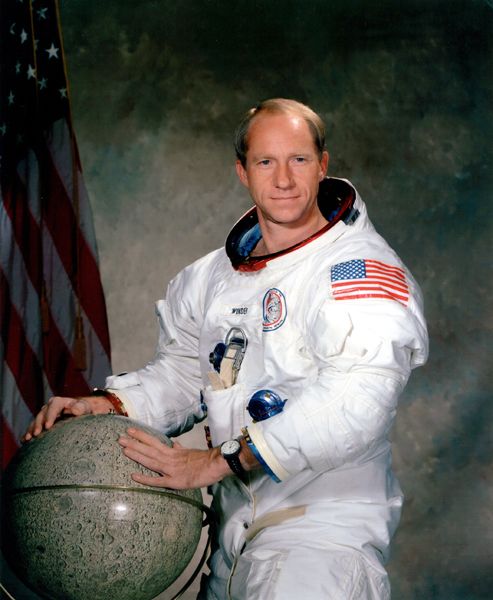
Remembering Apollo 15 command module pilot Al Worden.
NASA

NASA Administrator Statement on Apollo Astronaut Al Worden (Press Release)

The following is a statement from NASA Administrator Jim Bridenstine on the passing of Apollo 15 astronaut Alfred "Al" Worden:

“NASA sends its condolences to the family and loved ones of Apollo astronaut Al Worden, an astronaut whose achievements in space and on Earth will not be forgotten.

“A Colonel in the U.S. Air Force, Worden was a test pilot and instructor before joining NASA as an astronaut in 1966. He flew to the Moon as command module pilot aboard Apollo 15. During this time he earned a world record as “most isolated human being" while his crew mates roamed the lunar surface, and he was 2,235 miles away from anyone else.

“Later in his career, Worden became Senior Aerospace Scientist at NASA’s Ames Research Center in California. His multiple appearances on the children’s show Mr. Rogers’ Neighborhood surely fueled the desire of many children to pursue careers along the lines of his and become future exploration leaders.

“Of his mission Worden said, ‘Now I know why I'm here. Not for a closer look at the Moon, but to look back at our home, the Earth.’

“We remember this pioneer whose work expanded our horizons.”

Source: NASA.Gov

Monday, February 24, 2020

Remembering a Beloved "Hidden Figure"...

Katherine Johnson played an integral role in calculating and analyzing the flight paths of various spacecraft (from the Mercury capsule to the space shuttle) during her more than three decades at NASA.
NASA

NASA Administrator Statement on Passing of Katherine Johnson (Press Release)

The following is a statement from Administrator Jim Bridenstine on the passing of NASA legend Katherine Johnson, who worked for the agency from 1953 to 1986.

“NASA is deeply saddened by the loss of a leader from our pioneering days, and we send our deepest condolences to the family of Katherine Johnson. Ms. Johnson helped our nation enlarge the frontiers of space even as she made huge strides that also opened doors for women and people of color in the universal human quest to explore space. Her dedication and skill as a mathematician helped put humans on the Moon and before that made it possible for our astronauts to take the first steps in space that we now follow on a journey to Mars. Her Presidential Medal of Freedom was a well-deserved recognition.

“At NASA we will never forget her courage and leadership and the milestones we could not have reached without her. We will continue building on her legacy and work tirelessly to increase opportunities for everyone who has something to contribute toward the ongoing work of raising the bar of human potential.”

****

Thursday, February 13, 2020

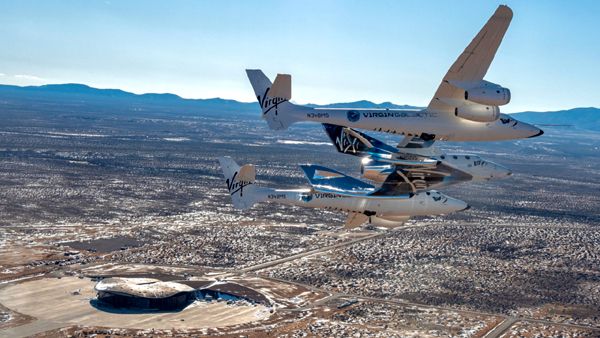
SpaceShipTwo Update: VSS Unity Has Moved to Her New Home in the Land of Enchantment...

The VSS Unity, attached to her mothership VMS Eve, flies over New Mexico's Spaceport America...their new home.
Virgin Galactic

Virgin Galactic Welcomes SpaceShipTwo Unity to Spaceport America, New Mexico (Press Release)

Virgin Galactic Captive Carry Test Flight Marks Relocation of Spaceflight Operations to Spaceport America

Virgin Galactic has successfully completed another vital step on its path to commercial service, relocating SpaceShipTwo, VSS Unity, to its commercial headquarters at Spaceport America’s Gateway to Space building.

VSS Unity, attached to the carrier aircraft, VMS Eve, made the journey from Mojave, California, where the Company’s manufacturing facilities are based. The vehicle landed at 15:49MT, where it was greeted by an enthusiastic group of teammates who will operate the spaceship in New Mexico.

This captive carry flight provided an opportunity for engineers to evaluate VSS Unity for over three hours at high altitude and cold temperatures, a longer period of time than is experienced during missions to space. These environmental evaluations of system performance are difficult to replicate at ground level, making captive carry missions a vital component of VSS Unity’s flight test plan.

The flight also provided a valuable opportunity to conduct pilot training and familiarization, with veteran Italian Air Force Test Pilot Nicola ‘Stick’ Pecile joining Chief Pilot Dave ‘Mac’ Mackay in the cockpit of the spaceship for the first time. Nicola is the fifth pilot to complete a flight in VSS Unity. VMS Eve was piloted by Mike ‘Sooch’ Masucci and Frederick ‘CJ’ Sturckow.

The move of the spaceship to Spaceport America marks a key step in the relocation of Virgin Galactic’s to the state of New Mexico. In May 2019, Virgin Galactic announced that as part of this move, approximately 100 teammates would move to New Mexico from Mojave, California, Spaceport America would become operational and the vehicles would be transferred to the Gateway to Space. Today, nearly all of those team members have relocated, the spaceport is operationally ready, and both VMS Eve and VSS Unity have now arrived. Of Virgin Galactic’s total current New Mexico work force, more than 70 team members have been hired locally, the result of a conscious effort to attract New Mexico-based talent.

“New Mexico is going to be the world’s launch pad for commercial spaceflight,” New Mexico Gov. Michelle Lujan Grisham said. “Today marks another step closer: We will have a genuine Space Valley in Southern New Mexico, a hotbed of innovation and achievement and space tourism development. I congratulate Virgin Galactic’s workers, George Whitesides and Sir Richard Branson on today’s successful flight – and once again I say to them: Welcome to New Mexico, we’re very glad to have you!”

“When Virgin Galactic started moving to New Mexico last year, everyone felt the sheer magnitude of the task ahead, but we were encouraged and excited by the team’s confidence and strong vision for the future,” said George Whitesides, CEO of Virgin Galactic. “Today we realized the next step in that dream by bringing our beautiful spaceship to New Mexico. We still have significant work ahead, but we are grateful to all our teammates who have made this day a reality.”

The relocation of VSS Unity to Spaceport America enables the Company to engage in the final stages of its flight test program. This will begin with a number of initial captive carry and glide flights from the new operating base in New Mexico, allowing the spaceflight operations team to familiarize themselves with the airspace and ground control. Once these tests are complete, the team will carry out a number of rocket-powered test flights from Spaceport America to continue the evaluation of VSS Unity’s performance. During this phase, the final spaceship cabin and customer experience evaluations will also be concluded in preparation for the start of commercial spaceflight operations.

The Spaceship Company, Virgin Galactic’s design, testing and manufacturing arm, remains firmly rooted in Mojave, California. While VMS Eve and VSS Unity are now based in New Mexico, they will make periodic journeys back to Mojave to support ground and flight tests of new spaceships, as well as for vehicle maintenance and upgrade activities. There is significant progress being made on the next two spaceships, including achieving the Weight on Wheels milestone for the second spaceship and completing over 50% of the structural and system part fabrication for the third spaceship, which were announced in January.

Dan Hicks, Spaceport America’s Executive Director, congratulated the Virgin Galactic team, saying “This truly is the dawn of a new era for the commercial space sector. We are tremendously proud of our foundational partner Virgin Galactic – as we see and support their historic progress in making human space flight a reality for our beautiful world. The New Mexico and Spaceport America leadership will continue our strong support for our visionary Virgin Galactic teammates; and we are looking forward to an exciting 2020!”

Source: Virgin Galactic

Monday, February 3, 2020

A Milestone Is Achieved for Future SLS Missions...

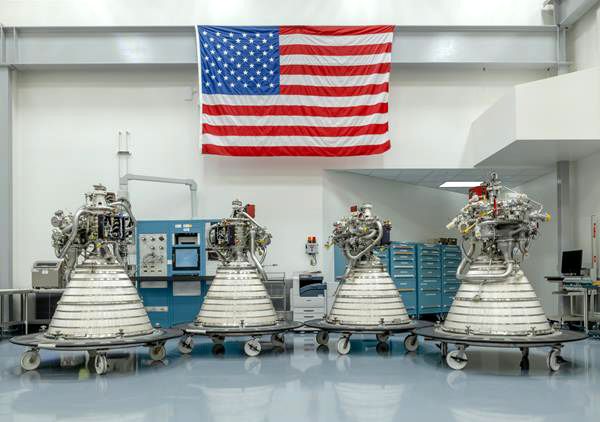
Four RL10 rocket engines – shown here at Aerojet Rocketdyne's facility in West Palm Beach, Florida – were recently delivered to NASA to fly aboard the Space Launch System on future missions.
Aerojet Rocketdyne

Aerojet Rocketdyne Delivers RL10 Engines That Will Help Send NASA Astronauts to Deep Space (Press Release)

WEST PALM BEACH, Fla., Feb. 03, 2020 -- Aerojet Rocketdyne recently delivered four RL10 upper stage engines to NASA’s Stennis Space Center that will help power NASA’s Space Launch System (SLS) rocket as it carries astronauts aboard the Orion spacecraft to deep space. These missions are part of NASA’s Artemis program, which will land the first woman and next man on the Moon, and set the stage to send astronauts to Mars.

“Nearly 500 Aerojet Rocketdyne RL10 engines have powered launches into space,” said Eileen Drake, Aerojet Rocketdyne CEO and president. “Aerojet Rocketdyne continues to upgrade and improve this highly-reliable, flight-proven engine. The RL10’s we just delivered to NASA will power the SLS upper stage on missions that safely launch our astronauts to explore deep space destinations.”

A single RL10 engine will provide nearly 25,000 pounds of thrust and serve as the main propulsion for the Interim Cryogenic Propulsion Stage (ICPS) that will fly atop the SLS rocket Block 1 in support of each of the first three Artemis missions. Later Artemis missions will use the evolved SLS Block 1B rocket configuration that includes the Exploration Upper Stage (EUS) powered by four RL10 engines to send Orion and large cargos to the Moon. The four RL10 engines on EUS provide more than 97,000 pounds of thrust.

Aerojet Rocketdyne is under contract to deliver 10 RL10 engines to NASA to support the Artemis program. One of the four engines that were recently delivered will be used to support the Artemis II mission that will use the ICPS upper stage, while the other three are slated to support future Artemis missions aboard the EUS. Delivery of the remaining six engines will be completed by 2021.

“The EUS is really a game changer for SLS and NASA’s lunar exploration program in terms of payload mass,” said Steve Wofford, Space Launch System Program Liquid Engines manager at NASA’s Marshall Space Flight Center. “These RL10 deliveries are a key stepping stone toward that future success.”

Evolving the SLS rocket to the Block 1B version that uses EUS significantly increases the amount of payload that can be carried to lunar orbit; up to 40 metric tons compared to the 26 metric ton capability provided by the SLS Block 1 configuration. It also provides the option for “co-manifested” payloads such as large components for NASA’s Gateway orbiting lunar outpost, landers, or surface systems.

Aerojet Rocketdyne has completed engine qualification testing for EUS and all other engineering activities, including providing NASA with the information necessary for the agency to human rate the RL10 engines. Qualification of the engines for ICPS will be completed in 2020.

Source: Aerojet Rocketdyne