Saturday, October 30, 2021

SLS Update: NASA Gets Ready to Build More RS-25 Engines for the Mega-Moon Rocket...

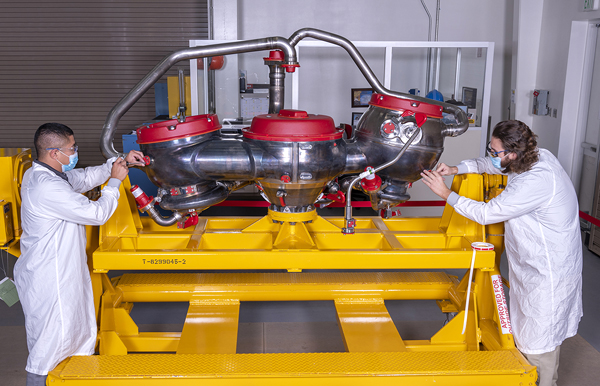
A new RS-25 engine powerhead built by Aerojet Rocketdyne arrives at NASA's Stennis Space Center in Mississippi for testing...on October 25, 2021.
NASA

Major Artemis Engine Part Arrives at Stennis For Certification Testing (News Release - October 29)

The first four Artemis missions will use NASA’s 16 upgraded RS-25 engines that previously powered space shuttle flights. For future flights on the Space Launch System (SLS), NASA and prime contractor Aerojet Rocketdyne are changing the way they build major parts for the RS-25. Engineers and technicians are fabricating some of these parts using advanced manufacturing techniques that increase reliability while reducing both the cost and time to build the engine.

The first RS-25 powerhead produced by Aerojet Rocketdyne in over a decade arrived at NASA’s Stennis Space Center near Bay St. Louis, Mississippi on Oct. 25. Here, it will be installed to a flight certification engine built specifically for testing newly-designed parts for the latest production RS-25 engine that will power SLS flights beyond Artemis IV.

The powerhead serves as the structural backbone to the RS-25. It houses three highly-complex injectors that produce the combustion to power the engine and acts as a junction for several critical parts, including both high-pressure pumps and the main combustion chamber.

Key powerhead components, such as the main injector, heat exchanger, and structural forgings, come with cost and schedule benefits due to the incorporation of advanced machining and forging processes as well as a reduction in welds and part counts, making the powerhead more reliable.

Powerhead unit 7001 recently completed proof-pressure testing at Aerojet Rocketdyne’s site in Los Angeles, California. This test required the part to be pressurized beyond normal operating levels, confirming its capability to safely operate the engine.

The new powerhead, along with other engine parts made from advanced manufacturing technologies such as the engine nozzle and main combustion chamber, will undergo hot-fire testing on the same certification engine early next year. The manufacturing changes incorporated into this new powerhead configuration are an integral part of NASA’s and Aerojet Rocketdyne’s strategy to reduce RS-25 manufacturing costs by more than 30% compared to its shuttle predecessor.

Sixteen new powerhead units are currently in production as part of Aerojet Rocketdyne’s commitment to deliver NASA 24 new RS-25 engines.

SLS and NASA’s Orion spacecraft, along with the commercial Human Landing System and the Gateway in lunar orbit, are NASA’s backbone for deep space exploration. SLS is the only rocket that can send Orion, astronauts, and supplies to the Moon in a single mission. With Artemis, NASA will land the first woman and the first person of color on the Moon and establish sustainable exploration in preparation for missions to Mars.

Source: NASA.Gov

Friday, October 29, 2021

Artemis 2 Update: The Historic Lunar Mission Will Be Documented by NAT GEO...

An artist's concept of NASA's Orion spacecraft flying above the Moon.
NASA

NASA, National Geographic Partner to Show Inside Artemis Moon Mission (Press Release)

NASA has selected National Geographic to help tell the story of Artemis II, the first Artemis flight that will carry astronauts around the Moon and back to Earth aboard the agency’s Orion spacecraft.

Following a competitive selection process, NASA and National Geographic entered into a non-reimbursable (no-exchange-of-funds) Space Act Agreement to collaborate on compact, lightweight audiovisual hardware to fly inside Orion and related support for the project.

“Returning humans to the Moon with Artemis II will inspire the next generation of explorers,” said Kathy Lueders, associate administrator for the Space Operations Mission Directorate at NASA Headquarters in Washington, who served as the selection official. “This time, we are bringing partners and technologies that will create additional opportunities for the world to share in the experience along with our astronauts.”

National Geographic plans to leverage its portfolio of media assets, including magazines, social and digital content, and television programming, for engagement opportunities. Those would include capabilities for creating an immersive experience aboard Orion to share the story of human exploration of the Moon.

In November 2020, NASA called for proposals to collaborate on unique public engagement, starting with Artemis II. National Geographic media company responded with a proposal to use content captured during the mission to create a multi-platform story-telling campaign aimed at a global audience.

Artemis mission activities will include Artemis I, an uncrewed flight test that will launch Orion on NASA’s Space Launch System rocket to orbit the Moon and return to Earth. Artemis II will carry a crew aboard Orion, paving the way for future missions to send the first woman and first person of color to the surface of the Moon. Subsequent missions will explore more of the Moon and test the technologies and procedures needed for human exploration of Mars.

****

Tuesday, October 26, 2021

ORBITAL REEF: Another Private Space Outpost is in the Works...

An artist's concept of the Orbital Reef space station.
Blue Origin / Sierra Space / Boeing / Redwire Space / Genesis Engineering Solutions / ASU

Blue Origin and Sierra Space Developing Commercial Space Station (News Release - October 25)

New Orbital Destination Opens Up Space For Business And Travel, Creating New Ecosystem

Blue Origin and Sierra Space today announced plans for Orbital Reef, a commercially-developed, owned, and operated space station to be built in low-Earth orbit. The station will open the next chapter of human space exploration and development by facilitating the growth of a vibrant ecosystem and business model for the future. Orbital Reef is backed by space industry leaders and teammates including Boeing, Redwire Space, Genesis Engineering Solutions and Arizona State University.

Designed to open multiple new markets in space, Orbital Reef will provide anyone with the opportunity to establish their own address on orbit. This unique destination will offer research, industrial, international, and commercial customers the cost-competitive end-to-end services they need including space transportation and logistics, space habitation, equipment accommodation, and operations including onboard crew. The station will start operating in the second half of this decade.

Orbital Reef will be operated as a “mixed-use business park” in space. Shared infrastructure efficiently supports the proprietary needs of diverse tenants and visitors. It features a human-centered space architecture with world-class services and amenities that is inspiring, practical, and safe. As the premier commercial destination in low-Earth orbit, Orbital Reef will provide the essential infrastructure needed to scale economic activity and open new markets in space. Reusable space transportation and smart design, accompanied by advanced automation and logistics, will minimize cost and complexity for both traditional space operators and new arrivals, allowing the widest range of users to pursue their goals. The open system architecture allows any customer or nation to link up and scale to support demand. Module berths, vehicle ports, utilities, and amenities all increase as the market grows.

The Orbital Reef business model makes it easy for customers and is strategically designed to support a diverse portfolio of uses. The team has all the services and systems to meet the needs of emergent customers, including researchers, manufacturers, and visitors. Orbital Reef offers standard interfaces at all levels – locker, rack, and module. Seasoned space agencies, high-tech consortia, sovereign nations without space programs, media and travel companies, funded entrepreneurs and sponsored inventors, and future-minded investors all have a place on Orbital Reef.

The Orbital Reef team of experts brings proven capabilities and new visions to provide key elements and services, including unique experience from building and operating the International Space Station:

Blue Origin – Utility systems, large-diameter core modules, and reusable heavy-lift New Glenn launch system.
Sierra Space - Large Integrated Flexible Environment (LIFE) module, node module, and runway-landing Dream Chaser spaceplane for crew and cargo transportation, capable of landing on runways worldwide.
Boeing – Science module, station operations, maintenance engineering, and Starliner crew spacecraft.
Redwire Space – Microgravity research, development, and manufacturing; payload operations and deployable structures.
Genesis Engineering Solutions – Single Person Spacecraft for routine operations and tourist excursions.
Arizona State University – Leads a global consortium of universities providing research advisory services and public outreach.

“For over sixty years, NASA and other space agencies have developed orbital space flight and space habitation, setting us up for commercial business to take off in this decade,” said Brent Sherwood, Senior Vice President of Advanced Development Programs for Blue Origin. “We will expand access, lower the cost, and provide all the services and amenities needed to normalize space flight. A vibrant business ecosystem will grow in low-Earth orbit, generating new discoveries, new products, new entertainments, and global awareness.”

“Sierra Space is thrilled to partner with Blue Origin and provide the Dream Chaser spaceplane, the LIFE module and additional space technologies to open up space for commercial research, manufacturing, and tourism. As a former NASA astronaut, I’ve been waiting for the moment where working and living in space is accessible to more people worldwide, and that moment has arrived,” said Dr. Janet Kavandi, former three-time NASA astronaut and Sierra Space president.

“This is exciting for us because this project does not duplicate the immensely successful and enduring ISS, but rather goes a step further to fulfill a unique position in low-Earth orbit where it can serve a diverse array of companies and host non-specialist crews,” said John Mulholland, Boeing VP and program manager for the International Space Station. “It calls for the same kind of expertise we used to first design and then build the International Space Station and the same skills we employ every day to operate, maintain and sustain the ISS.”

“The Orbital Reef represents the next evolution of the commercial space paradigm by creating the first-ever crewed private sector platform in low Earth orbit. The Orbital Reef will carry forward the singular legacy of the ISS, supporting innovative microgravity research, development, and manufacturing activities which will advance fields as diverse as communications and biotechnology,” said Mike Gold, Executive Vice President for Civil Space and External Affairs at Redwire. “The microgravity environment presents an entirely new arena for commercial and scientific development, making Orbital Reef the platform that will launch new technologies and capabilities dramatically improving life on Earth while enabling humanity’s journey to the stars.”

“The Single Person Spacecraft will transform space walking,” said Brand Griffin, Program Manager for Genesis Engineering Solutions. “Space workers and tourists alike will have safe, comfortable, and quick access outside Orbital Reef. Shirt-sleeve environment, great visibility, automated guidance, and advanced precision manipulators will make external operations cost-effective and routine.”

“ASU’s Interplanetary Initiative is honored to be leading the university consortium that is supporting Orbital Reef,” said Lindy Elkins-Tanton, Vice President of ASU’s Interplanetary Initiative and Principal Investigator of the NASA Psyche mission. “We’ve brought together an international group of more than a dozen universities to work on the ethics and guidelines of research — on how we can bring to bear all our expertise in science and research and manufacturing in low gravity, to help nations, corporations and groups that want access to Orbital Reef. It’s about collectively believing in our future and bringing science and engineering to bear on a better future – hugely exciting.”

Source: Blue Origin

****

Sunday, October 24, 2021

SpaceX Update: One of Starship SN20's Raptor Vacuum Engines Comes to Life at Starbase...

A Raptor vacuum engine aboard Starship SN20 comes to life during the first of two static fires conducted at Starbase, Texas...on October 21, 2021.
SpaceX

Last Thursday, SpaceX conducted static fires for one of the Raptor vacuum engines aboard its Starship Serial No. 20 (SN20) rocket at Starbase, Texas.

There were two engine tests for Starship SN20 on October 21...which marked a big milestone for these thrusters—which will allow Starship to maneuver in the vacuum of space during next year's orbital test flight—as they last came to life at SpaceX's test facility in McGregor, Texas.

Below is a photo taken by Elon Musk of Starbase as it continues to take form at Boca Chica Beach near the Gulf Coast. And beneath that is a short video released by SpaceX giving a glimpse of its new spaceport as the company continues its quest to develop vehicles that will assist Orion and the Space Launch System on NASA's Artemis Moon missions (as the Human Landing System), and finally send people to Mars.

Stay tuned.

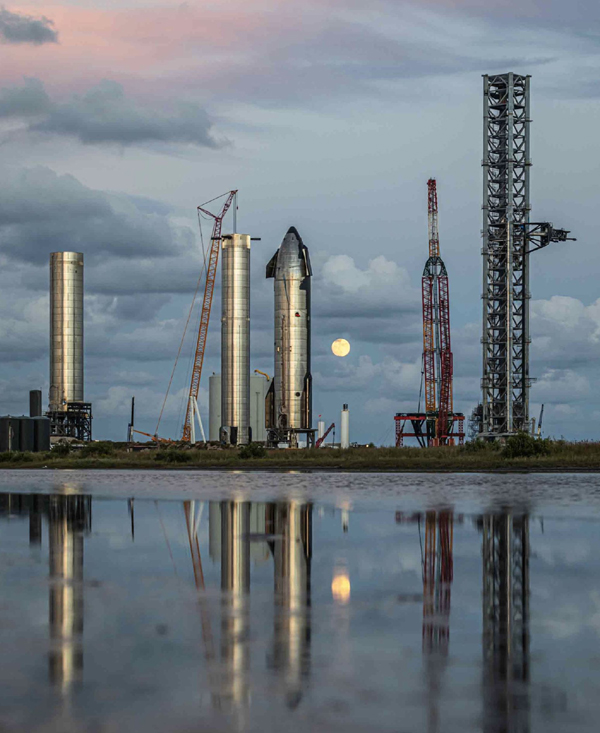
The Full Moon looms behind Starship SN20, Boosters 3 and 4 as well as the Orbital Launch Tower at Starbase, Texas...on October 22, 2021.
Elon Musk


Saturday, October 23, 2021

SLS Update: A Few More Tests Remain Before the Mega-Rocket is Finally Ready for Flight...

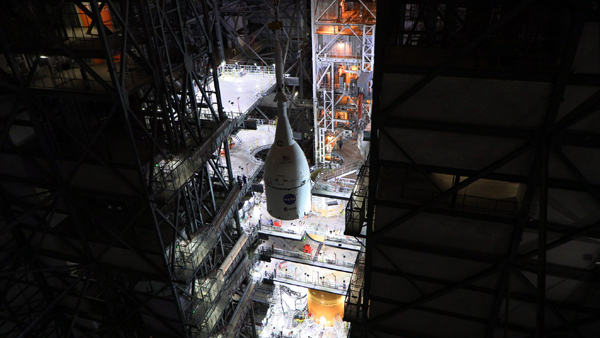
Inside Kennedy Space Center's Vehicle Assembly Building in Florida, the Orion capsule is slowly lowered towards the Space Launch System's Orion stage adapter for mating...on October 20, 2021.
NASA / Frank Michaux

NASA Fully-Stacked for Moon Mission, Readies for Artemis I (News Release - October 22)

NASA’s Orion spacecraft is secured atop the agency’s powerful Space Launch System rocket, and the integrated system is entering the final phase of preparations for an upcoming uncrewed flight test around the Moon. The mission, known as Artemis I, will pave the way for a future flight test with crew before NASA establishes a regular cadence of more complex missions with astronauts on and around the Moon under Artemis. With stacking complete, a series of integrated tests now sit between the mega-Moon rocket and targeted liftoff for deep space in February 2022.

“It’s hard to put into words what this milestone means, not only to us here at Exploration Ground Systems, but to all the incredibly talented people who have worked so hard to help us get to this point,” said Mike Bolger, Exploration Ground Systems program manager. “Our team has demonstrated tremendous dedication preparing for the launch of Artemis I. While there is still work to be done to get to launch, with continued integrated tests and Wet Dress Rehearsal, seeing the fully-stacked SLS is certainly a reward for all of us.”

Each of the test campaigns will evaluate the rocket and spacecraft as an integrated system for the first time, building upon each other and culminating in a simulation at the pad to prepare for launch day.

Interface Verification Testing - verifies the functionality and interoperability of interfaces across the elements and systems. Teams will conduct this test from the firing room in the Launch Control Center and will start by powering up Orion to charge the batteries and perform health and status checks of various systems. Next, the teams will do the same to check interfaces between the core stage and boosters and the ground systems, and ensure functionality of different systems, including core stage engines and booster thrust control, as well as the Interim Cryogenic Propulsion Stage (ICPS). A final integrated test, with all wire harnesses installed throughout the rocket and spacecraft, will verify their ability to talk to each other and to ground systems.

Program Specific Engineering Testing - ensures functionality of a variety of different systems. Following the interface verification test for the core stage and boosters, additional testing will perform several checks in the Vehicle Assembly Building (VAB) for the core stage and booster systems, such as a booster thrust control test. Later, engineers will conduct an additional engineering test during the visit to pad 39B for wet dress rehearsal.

End-to-End Communications Testing - integrated test of radio frequencies from mission control to SLS, ICPS, and Orion – all to demonstrate our ability to communicate with the ground. This test uses a radio frequency antenna in the VAB, another near the pad that will cover the first few seconds of launch, as well as a more powerful antenna that uses the Tracking Data Relay Satellite and the Deep Space Network.

Countdown Sequencing Testing - conducts a simulated launch countdown inside the VAB to demonstrate the ground launch software and ground launch sequencer, which checks for health and status of the vehicle sitting on the pad. The teams will configure the rocket in the VAB for launch and run the sequencer to a predefined point in the countdown – testing the responses from the rocket and spacecraft and ensuring the sequencer can run without any issues. On launch day, the ground launch sequencer hands off to the rocket and spacecraft and an automated launch sequencer takes over around 30 seconds before launch.

Wet Dress Rehearsal Testing - demonstrates the ability to load cryogenic, or supercold, propellants, including detanking the propellants with the Artemis I rocket at the launch pad on the mobile launcher. Several weeks before the actual launch, Artemis I will roll the roughly four miles to Pad 39B atop the crawler-transporter. There it will undergo checkouts at the pad, and teams will practice the launch countdown and then recycle back to T-10 minutes to demonstrate the ability to scrub a launch and de-tank.

Prior to rolling out to the pad for wet dress, teams will conduct the first of a two-part test of the flight termination system inside the VAB. Once the systems are verified, the 322-foot-tall rocket will roll back into the VAB for final inspections and checkouts, including the second part of the flight termination system test, ahead of returning to the pad for launch.

Leading up to launch, Artemis I mission operations teams also will continue additional launch simulations to run the team through its paces, ensuring they are ready for any scenario with this new vehicle come launch day.

The agency will set a specific date for the launch following a successful wet dress rehearsal. The first in a series of increasingly complex missions, Artemis I will provide a foundation for human deep space exploration and demonstrate our commitment and capability to extend human existence to the Moon and beyond prior to the first flight with crew on Artemis II.

Source: NASA.Gov

Friday, October 22, 2021

NASA Officially Announces That The SLS Is Fully Assembled...

The Orion Artemis 1 capsule is about to be soft-mated to NASA's Space Launch System rocket inside High Bay 3 of Kennedy Space Center's Vehicle Assembly Building in Florida...on October 20, 2021.
NASA / Frank Michaux

NASA Completes Mega-Moon Rocket Stacking, Invites Media to Learn More (Press Release)

NASA has completed stacking of the agency’s mega-Moon rocket and spacecraft that will launch the next generation of deep space operations, including Artemis missions on and around the Moon. Engineers and technicians successfully secured the Orion spacecraft atop the fully assembled Space Launch System (SLS) rocket at the agency’s Kennedy Space Center in Florida just before midnight Oct. 21.

NASA will host a media teleconference at 1 p.m. EDT today, Friday, Oct. 22, to discuss the completed stacking operations and progress toward the uncrewed Artemis I mission around the Moon. The teleconference will stream live on the agency’s website.

“With stacking and integration of NASA’s Space Launch System rocket and Orion spacecraft complete, we’re getting closer and closer to embarking on a new era of human deep space exploration,” said NASA Administrator Bill Nelson. “Thanks to the team’s hard work designing, manufacturing, testing, and now completing assembly of NASA’s new rocket and spacecraft, we’re in the home stretch of preparations for the first launch on the Artemis I mission, paving the way to explore the Moon, Mars, and beyond for many years to come.”

Participating in the briefing are:

- Tom Whitmeyer, deputy associate administrator for exploration systems development, NASA Headquarters
- Mike Bolger, Exploration Ground Systems program manager, Kennedy
- Cathy Koerner, Orion program manager, NASA’s Johnson Space Center
- John Honeycutt, SLS program manager, NASA’s Marshall Space Flight Center
- Mike Sarafin, Artemis I mission manager, NASA Headquarters

To participate in the teleconference, media must contact Monica Witt at: monica.j.witt@nasa.gov by noon today, Friday, Oct. 22 for dial-in information.

The stack now stands 322 feet tall inside the Vehicle Assembly Building (VAB) at NASA Kennedy as it enters the final phase of testing before launch.

Next up, NASA’s Exploration Ground Systems teams will conduct integrated tests of Orion and SLS along with the ground equipment, prior to rolling the rocket and spacecraft to the launch pad for a final test, known as the wet dress rehearsal. This final test will run the rocket and launch team through operations to load propellant into the fuel tanks and conduct a full launch countdown. Following a successful rehearsal, NASA will roll the stack back into the VAB for final checks and set a target date for launch.

Through Artemis missions, NASA will land the first woman and the first person of color on the surface of the Moon, paving the way for a long-term lunar presence and serving as a steppingstone on the way to Mars.

****

The Orion Artemis 1 capsule is soft-mated to NASA's Space Launch System rocket inside High Bay 3 of Kennedy Space Center's Vehicle Assembly Building in Florida...on October 20, 2021.
NASA

Thursday, October 21, 2021

STARLAB: A New Private Space Station is in the Works...

An artist's concept of the Starlab space station in low-Earth orbit.
Nanoracks / Voyager Space / Lockheed Martin

Nanoracks, Voyager Space, and Lockheed Martin Teaming to Develop Commercial Space Station (Press Release)

Continuously crewed habitat to support research, industrial activity, and more

DENVER /PRNewswire/ -- Nanoracks, in collaboration with Voyager Space and Lockheed Martin [NYSE: LMT], has formed a team to develop the first-ever free-flying commercial space station. The space station, known as Starlab, will be a continuously crewed commercial platform, dedicated to conducting critical research, fostering industrial activity, and ensuring continued U.S. presence and leadership in low-Earth orbit. Starlab is expected to achieve initial operational capability by 2027.

To meet U.S. government, international space agency, and commercial needs in space, these industry leaders will develop Starlab specifically to enable the growing space economy and meet pent-up customer demand for space services such as materials research, plant growth, and astronaut activity. Together, these companies bring unparalleled experience in commercial space utilization, engineering design and performance, technology innovation, and investment strategy.

"Since the beginning, Nanoracks has sought to own and operate a private space station to fully unlock market demand," says Jeffrey Manber, CEO and Co-Founder of Nanoracks. "Our team has spent the last decade learning the business of space stations, understanding customer needs, charting market growth, and self-investing in private hardware on the ISS like the Bishop Airlock. Nanoracks and our team are excited to work with NASA and our friends across the world as we move forward with Starlab."

NASA recently announced the Commercial Low-Earth Orbit (LEO) Destination (CLD) project to support the development of private space stations. CLD will stimulate a multifaceted LEO economy and provide science and crew capabilities in LEO before the International Space Station (ISS) retires.

Nanoracks will prime the Starlab development effort leveraging over a decade of experience as the pathfinder of and global leader in commercial ISS utilization. Voyager Space, the majority shareholder in Nanoracks, will lead strategy and capital investment and Lockheed Martin, a leader in developing and operating complex spacecraft, will serve as the manufacturer and technical integrator.

The basic elements of the Starlab space station include a large inflatable habitat, designed and built by Lockheed Martin, a metallic docking node, a power and propulsion element, a large robotic arm for servicing cargo and payloads, and a state-of-the-art laboratory system to host a comprehensive research, science, and manufacturing capability. Starlab will be able to continuously host up to four astronauts for conducting critical science and research.

"We're excited to be part of such an innovative and capable team—one that allows each company to leverage their core strengths," said Lisa Callahan, Vice President and General Manager, Commercial Civil Space at Lockheed Martin. "Lockheed Martin's extensive experience in building complex spacecraft and systems, coupled with Nanoracks' commercial business innovation and Voyager's financial expertise allows our team to create a customer-focused space station that will fuel our future vision. We have invested significantly in habitat technology which enables us to propose a cost-effective, mission-driven spacecraft design for Starlab."

Nanoracks' Starlab business model is designed to enable science, research, and manufacturing for global customers, and bring added value to long-duration sovereign astronaut missions. Starlab will also serve tourism and other commercial and business activities.

"Voyager Space is highly confident in the Starlab business model and its ability to be commercially sustainable and well capitalized," says Dylan Taylor, Voyager Space Chairman & CEO. "Voyager Space sees numerous synergies leveraging the capabilities across our organization's operating businesses, as well as within the Lockheed Martin ecosystem. We see this partnership as just the beginning of our work together."

Source: PR Newswire

****

Wednesday, October 20, 2021

Artemis 1 Update #3: Orion Is Finally United with the Space Launch System!

The Orion capsule is secured to NASA's Space Launch System rocket inside Kennedy Space Center's Vehicle Assembly Building in Florida...on October 20, 2021.
NASA

Around midnight today, the Artemis program reached a huge milestone when the Orion capsule was finally mated with NASA's Space Launch System (SLS) rocket inside the Vehicle Assembly Building at Kennedy Space Center (KSC) in Florida!

Several hours were spent afterwards on tightening the 360 bolts that will secure Orion to SLS for the Artemis 1 flight to the Moon...which is set to launch no earlier than this January.

The next event after today's accomplishment will be the transport of the fully-stacked SLS to KSC's Launch Complex 39B for a Wet Dress Rehearsal, which should take place next month. Stay tuned!

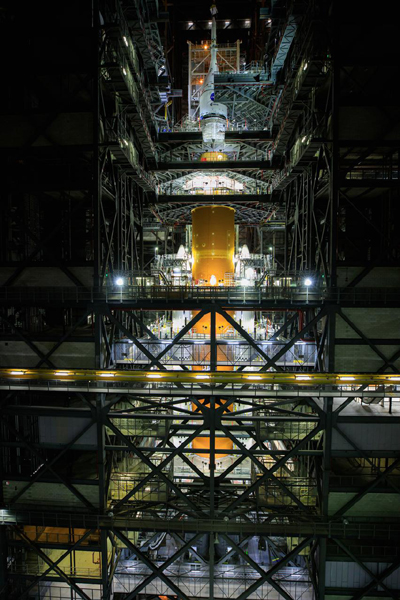
Inside Kennedy Space Center's Vehicle Assembly Building in Florida, the Orion capsule is transferred over to High Bay 3 where it will be secured to NASA's Space Launch System rocket...on October 20, 2021.
NASA

Inside Kennedy Space Center's Vehicle Assembly Building in Florida, the Orion capsule is transferred over to High Bay 3 where it will be secured to NASA's Space Launch System rocket...on October 20, 2021.
NASA

Inside Kennedy Space Center's Vehicle Assembly Building in Florida, the Orion capsule is transferred over to High Bay 3 where it will be secured to NASA's Space Launch System rocket...on October 20, 2021.
NASA

Inside Kennedy Space Center's Vehicle Assembly Building in Florida, the Orion capsule is slowly lowered towards the Space Launch System's Orion stage adapter (which contains 10 CubeSats)...on October 20, 2021.
NASA

A close-up of the Orion capsule after it was secured to NASA's Space Launch System rocket inside Kennedy Space Center's Vehicle Assembly Building in Florida...on October 20, 2021.
NASA

Tuesday, October 19, 2021

Artemis 1 Update #2: Orion Has Arrived at the VAB!

With the Space Launch System rocket visible inside, the Orion Artemis 1 capsule is about to enter the Vehicle Assembly Building at NASA's Kennedy Space Center in Florida...on October 19, 2021.
NASA

After departing from the Launch Abort System Facility about two hours before, the Orion Artemis 1 capsule has arrived at Kennedy Space Center's Vehicle Assembly Building (VAB)...where NASA's Space Launch System (SLS) rocket awaits the Moon-bound vessel!

Within the next 24 hours, Orion will be lifted up and transferred over to the VAB's High Bay 3 where SLS sits atop its mobile launcher.

After years of anticipation, it should be tomorrow morning that the mega-Moon rocket is finally complete!

With the Space Launch System rocket visible behind it, the Orion Artemis 1 capsule is about to enter the Vehicle Assembly Building at NASA's Kennedy Space Center in Florida...on October 19, 2021.
NASA

The Orion Artemis 1 capsule is about to enter the Vehicle Assembly Building at NASA's Kennedy Space Center in Florida...on October 19, 2021.
NASA

Monday, October 18, 2021

Artemis 1 Update: Orion Is Finally Headed to the Vehicle Assembly Building!

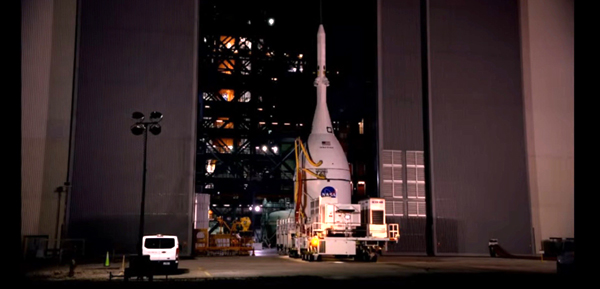
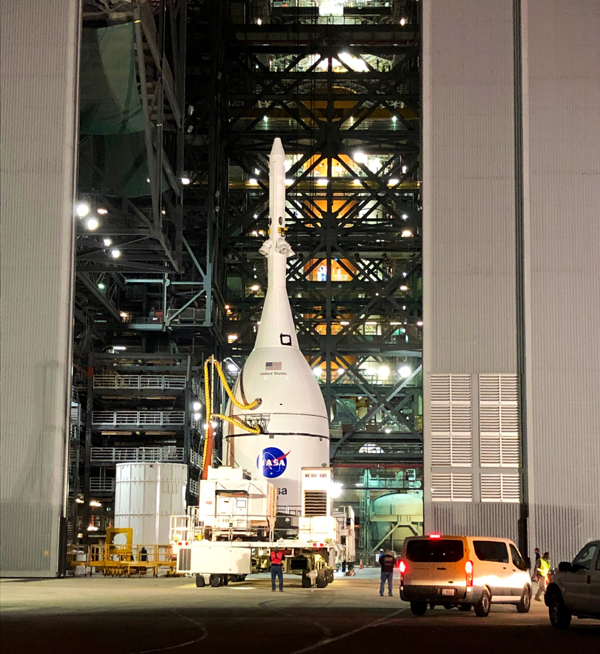
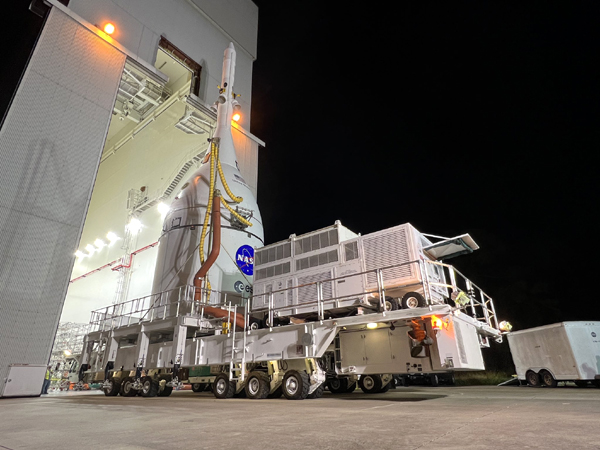
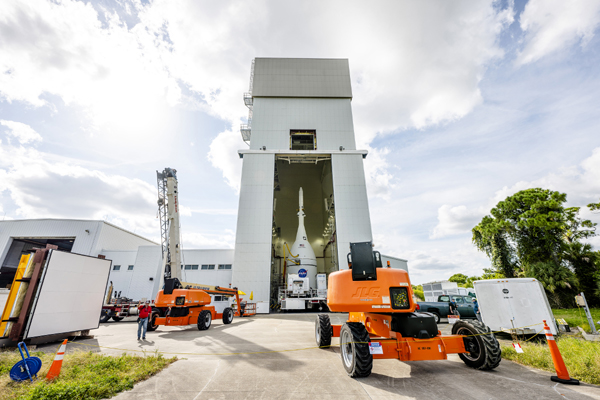
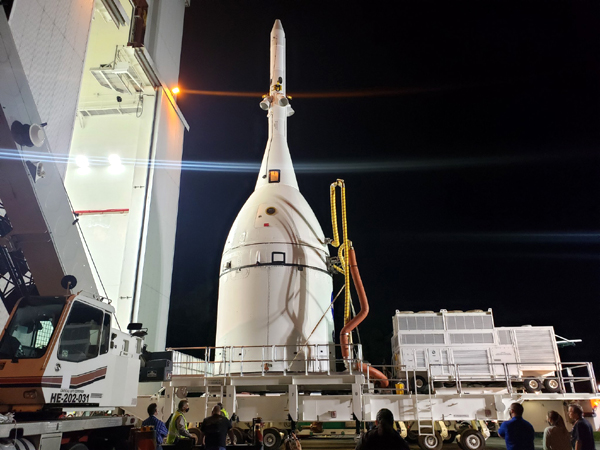
The transporter carrying the Orion Artemis 1 spacecraft exits from the Launch Abort System Facility to make its way to the Vehicle Assembly Building at NASA's Kennedy Space Center in Florida...on October 18, 2021.
NASA

About two hours ago, the transporter carrying the Orion Artemis 1 spacecraft departed from the Launch Abort System Facility to embark on a 6-mile (10-kilometer) trip to the Vehicle Assembly Building at NASA's Kennedy Space Center in Florida.

Here are some photos of tonight's move. Stand by for more images over the next two days as Orion is finally mated to the Space Launch System rocket for its inaugural flight as early as this January!

The transporter carrying the Orion Artemis 1 spacecraft prepares to exit from the Launch Abort System Facility to make its way to the Vehicle Assembly Building at NASA's Kennedy Space Center in Florida...on October 18, 2021.
NASA

The transporter carrying the Orion Artemis 1 spacecraft exits from the Launch Abort System Facility to make its way to the Vehicle Assembly Building at NASA's Kennedy Space Center in Florida...on October 18, 2021.
NASA

The transporter carrying the Orion Artemis 1 spacecraft exits from the Launch Abort System Facility to make its way to the Vehicle Assembly Building at NASA's Kennedy Space Center in Florida...on October 18, 2021.
NASA