Thursday, September 30, 2021

SLS Update: NASA Completes RS-25 Testing Campaign That Paves the Way for Missions Beyond Artemis 4...

An RS-25 engine is test-fired inside the A-1 test stand at NASA's Stennis Space Center in Mississippi...on September 30, 2021.
NASA / SSC

NASA Readies for Future Artemis Moon Missions with Rocket Engine Test Series (Press Release)

NASA marked a significant milestone Sept. 30 in its plans for future missions to the Moon and, eventually, Mars with completion of an RS-25 single-engine Retrofit-2 test series at Stennis Space Center near Bay St. Louis, Mississippi.

A full-duration hot fire of RS-25 developmental engine No. 0528 on the A-1 Test Stand at Stennis culminated a seven-test series to support development and production of new engines for the agency’s Space Launch System (SLS) rocket on future missions.

“This successful test series for the Space Launch System RS-25 engine puts us one step closer to manufacturing the first new set of engines for future Artemis missions to the Moon,” said Johnny Heflin, manager of the SLS liquid engines office at NASA’s Marshall Space Flight Center in Huntsville, Alabama. “We are testing engine parts made with advanced manufacturing techniques that can reduce the cost of each engine by more than 30 percent yet still maintain the RS-25 engine’s reliability and high performance.”

During the Sept. 30 hot fire, operators fired RS-25 developmental engine No. 0528, used for each of the seven tests in the series, for more than eight minutes (500 seconds), the same time required during an actual launch.

The test series provided valuable information to Aerojet Rocketdyne, lead contractor for the SLS engines, as it produces engines for use after the Artemis IV mission to the Moon. Operators collected hot fire data to demonstrate and verify various engine capabilities, and to evaluate new engine components manufactured with cutting-edge and cost-saving technologies and reduce operational risk.

Tested components included a 3D-printed pogo accumulator to dampen pressure oscillations that can cause flight instability and a main combustion chamber fabricated using a hot isostatic pressure (HIP) bonding technique. These components are significant early milestones in NASA’s and Aerojet Rocketdyne’s effort to maximize state-of-the-art manufacturing methods to significantly reduce the cost and time needed to build new RS-25 engines.

The Sept. 30 test was delayed from its original date due to impacts from Hurricane Ida, which struck the Gulf Coast region on Aug. 29. The storm initially impacted propellant deliveries to the center, necessitating a delay as suppliers recovered full capabilities.

“I am proud to see how the test team and our propellant suppliers overcame the impacts of Hurricane Ida to get us back to testing the RS-25,” Stennis RS-25 Project Manager Chip Ellis said. “With each test we learn more and more about the RS-25 engine and how it operates. And it is exciting to know that what we are doing contributes to the safety of the astronauts that will fly on SLS.”

Four RS-25 engines, along with a pair of solid rocket boosters, will help power SLS at launch. Firing simultaneously, the engines will generate a combined 1.6 million pounds of thrust at liftoff and 2 million pounds during ascent.

Previous RS-25 testing at Stennis began Jan. 9, 2015, and concluded April 4, 2019. During this period, NASA completed acceptance testing of former space shuttle main engines that will help power the first four SLS missions, conducted developmental and flightworthiness testing for all 16 new controllers (plus one spare) to be used on the heritage RS-25 engines, and demonstrated the ability of RS-25 engines to perform at the higher power level required to launch the super-heavy SLS rocket.

The first hot fire of the most current series was conducted on Jan. 28, 2021. Over the course of the seven-part test series, which coincided with Green Run testing of the SLS core stage at Stennis, developmental engine No. 0528 underwent 3,650 seconds of hot fire. The schedule included six full-duration, hot fire tests of more than eight minutes (500 seconds) and one hot fire of just under 11 minutes (650 seconds). A full-duration test refers to the time the engine must fire during an actual launch in order to power SLS towards orbit. Longer duration hot fires are conducted to test the limits of engine performance.

The Retrofit-2 test series followed major maintenance and upgrade projects on the A-1 Test Stand, including installation of a new NASA-designed-and-manufactured thrust vector control system on the structure that allows operators to “gimbal” test RS-25 engines, moving them on a tight circular axis. Gimbaling is a critical capability that ensures SLS can maintain a proper flight trajectory.

Operators are scheduled to begin a follow-up Retrofit-3 test series, using RS-25 developmental engine No. 0525, on the A-1 Test Stand later this fall. The new series will continue to collect data for new engine production.

NASA is building SLS as the world’s most powerful rocket. With Artemis, NASA will land the first woman and the first person of color on the lunar surface and establish long-term exploration at the Moon in preparation for human missions to Mars. SLS and the Orion spacecraft, along with the commercial Human Landing System and the Gateway in orbit around the Moon, are NASA’s backbone for deep space exploration. The agency is working towards the launch of the Artemis I uncrewed flight test in upcoming months, which will pave the way for future missions.

RS-25 tests at Stennis are conducted by a combined team of NASA, Aerojet Rocketdyne and Syncom Space Services operators. Syncom Space Services is the prime contractor for Stennis facilities and operations.

Source: NASA.Gov

Wednesday, September 29, 2021

SpaceShipTwo Update: Launch Preparations for UNITY 23 to Resume Following a Weeks-Long Federal Investigation Into Last July's UNITY 22 Flight...

VSS Unity soars 53.5 miles (86 kilometers) above the Earth during the Unity 22 flight...on July 11, 2021.
Virgin Galactic

Virgin Galactic Cleared to Fly Following Conclusion of FAA Inquiry (Press Release)

Virgin Galactic today announced that it is cleared to fly FAA-licenced spaceflights following the conclusion of an FAA inquiry that focused on air traffic control clearance and real-time mission notification related to the Unity 22 flight in July.

The FAA today advised Virgin Galactic that the corrective actions proposed by the Company have been accepted and concluded the FAA inquiry, which began August 11, 2021. They include:

- Updated calculations to expand the protected airspace for future flights. Designating a larger area will ensure that Virgin Galactic has ample protected airspace for a variety of possible flight trajectories during spaceflight missions.

- Additional steps into the Company’s flight procedures to ensure real-time mission notifications to FAA Air Traffic Control.

Michael Colglazier, Chief Executive Officer of Virgin Galactic, said: “Our entire approach to spaceflight is guided by a fundamental commitment to safety at every level, including our spaceflight system and our test flight program. We appreciate the FAA’s thorough review of this inquiry. Our test flight program is specifically designed to continually improve our processes and procedures. The updates to our airspace and real-time mission notification protocols will strengthen our preparations as we move closer to the commercial launch of our spaceflight experience.”

Virgin Galactic continues to focus on its pre-flight readiness for Unity 23. For the latest updates regarding flight timing, please view the Company’s statement on September 10, 2021.

Source: Virgin Galactic

****

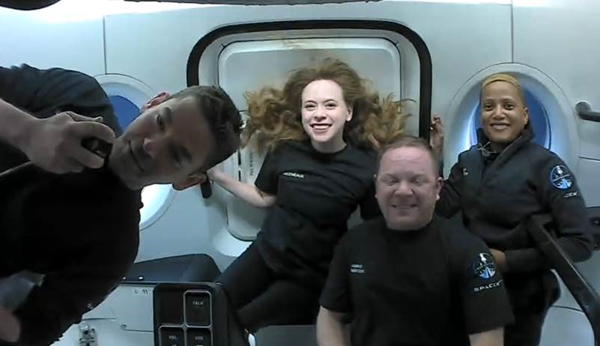
Virgin Galactic founder Sir Richard Branson and his three Unity 22 crewmembers float around inside VSS Unity's cabin during their 53.5-mile (86-kilometer) journey into space...on July 11, 2021.
Virgin Galactic

Tuesday, September 28, 2021

Photos of the Day: Nauka Begins One of Its Roles as the Space Station's Newest Docking Port...

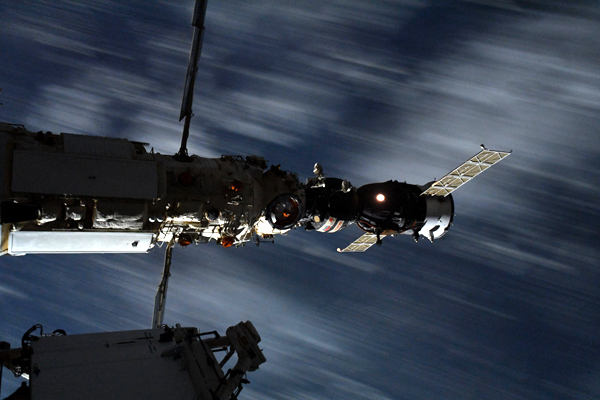
The Soyuz MS-18 vehicle is docked to the Nauka module at the International Space Station (ISS)...on September 28, 2021.
ESA / Thomas Pesquet

Several hours ago, European Space Agency astronaut Thomas Pesquet took these amazing photos showing the Soyuz MS-18 capsule relocating from its docking port on the International Space Station's (ISS) Rassvet module to Russia's brand-new Nauka science laboratory.

The Soyuz spacecraft—which carried cosmonauts Oleg Novitskiy and Pyotr Dubrov, as well as NASA astronaut Mark Vande Hei—docked to Nauka at 9:04 AM, Eastern Daylight Time (6:04 AM, Pacific Daylight Time) today.

The relocation clears the way for next month's arrival of the Soyuz MS-19 capsule...whose crew consists of cosmonaut Anton Shkaplerov, film director Klim Shipenko and actress Yulia Peresild, respectively.

Shipenko and Peresild will shoot scenes for a Russian movie [titled Vyzov (or The Challenge)] aboard the ISS after their Soyuz launches from Baikonur Cosmodrome in Kazakhstan on Tuesday, October 5, and then docks to the Rassvet module later that day.

The Soyuz MS-18 vehicle departs from Russia's Rassvet module at the ISS...on September 28, 2021.
ESA / Thomas Pesquet

The Soyuz MS-18 vehicle in the process of relocating from the Rassvet module to the new Nauka science laboratory at the ISS...on September 28, 2021.
ESA / Thomas Pesquet

Orbiting above the night side of the Earth, the Soyuz MS-18 vehicle is about to dock with the Nauka module at the ISS...on September 28, 2021.
ESA / Thomas Pesquet

The current locations of all visiting vehicles at the ISS...as of September 28, 2021.
NASA

Monday, September 27, 2021

NASA Begins a New Round of Competition to Select the Next Human Landing System...

An artist's concept of an Artemis astronaut about to set foot on the Moon.
NASA

NASA Selects Five U.S. Companies to Mature Artemis Lander Concepts (Press Release - September 14)

NASA has selected five U.S. companies to help the agency enable a steady pace of crewed trips to the lunar surface under the agency’s Artemis program. These companies will make advancements toward sustainable Human Landing System concepts, conduct risk-reduction activities, and provide feedback on NASA’s requirements to cultivate industry capabilities for crewed lunar landing missions.

The awards under the Next Space Technologies for Exploration Partnerships (NextSTEP-2) Appendix N broad agency announcement are firm fixed-price, milestone-based contracts. The total combined value for the awards is $146 million, and the work will be conducted over the next 15 months. The companies that received awards and their award values are:

- Blue Origin Federation of Kent, Washington, $25.6 million.
- Dynetics (a Leidos company) of Huntsville, Alabama, $40.8 million.
- Lockheed Martin of Littleton, Colorado, $35.2 million.
- Northrop Grumman of Dulles, Virginia, $34.8 million.
- SpaceX of Hawthorne, California, $9.4 million.

“Establishing a long-term human presence on the Moon through recurring services using lunar landers is a major Artemis goal,” said Kathy Lueders, NASA’s associate administrator for Human Exploration and Operations at Headquarters in Washington. “This critical step lays the foundation for U.S. leadership in learning more about the Moon and for learning how to live and work in deep space for future missions farther into the solar system.”

The selected companies will develop lander design concepts, evaluating their performance, design, construction standards, mission assurance requirements, interfaces, safety, crew health accommodations, and medical capabilities. The companies will also mitigate lunar lander risks by conducting critical component tests and advancing the maturity of key technologies.

The work from these companies will ultimately help shape the strategy and requirements for a future NASA solicitation to provide regular astronaut transportation from lunar orbit to the surface of the Moon.

"Collaboration with our partners is critical to achieving NASA’s long-term Artemis lunar exploration goals,” said Lisa Watson-Morgan, Human Landing System Program manager at NASA’s Marshall Space Flight Center in Huntsville, Alabama. “By partnering with innovative U.S. companies, we will establish a robust lunar economy while exploring new areas of the Moon for generations to come.”

This opportunity is distinct from the initial crewed lunar landing demonstration mission awarded under the NextSTEP-2 Appendix H procurement, which will serve as the proof of concept for the Artemis architecture.

NASA’s goals under Artemis include enabling a safe and cost-efficient long-term approach to accessing the lunar surface and becoming one of multiple customers purchasing services in a lunar transportation market. Much of what the agency develops for the Moon will be applied to future exploration at Mars.

NASA’s Artemis missions include landing the first woman and first person of color on the lunar surface, sending a suite of new science instruments and technology demonstrations to study the Moon, and establishing a long-term presence there.

****

An artist's concept of astronauts conducting a moonwalk near the base of SpaceX's Starship lunar lander.
SpaceX

Friday, September 24, 2021

Artemis 1 Update: The Space Launch System Has One More Test to Go Before Orion Is Attached to It...

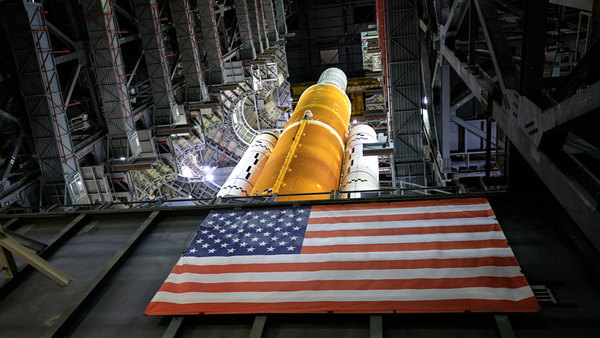
The Space Launch System rocket stands tall inside the Vehicle Assembly Building at NASA's Kennedy Space Center in Florida.
NASA

SLS Modal Testing: Finding the Range of a Rocket’s Reflexes (News Release)

Before NASA’s Space Launch System (SLS) launches the Artemis I mission to the Moon, teams inside the Vehicle Assembly Building at NASA’s Kennedy Space Center in Florida will conduct a series of tests to determine the deep space rocket’s reflexes. During launch and flight, SLS will experience and react to a series of frequencies and vibrations.

Engineers conduct integrated modal testing to determine the full range of these frequencies and vibrations so that the flight software and navigation systems can safely guide the rocket through launch and ascent. To do that, technicians use a test version of the Orion stage adapter and Orion mass simulator to determine the natural frequencies, flexes, and vibration patterns of the SLS rocket.

Artemis I stacking will resume with flight versions of the Orion stage adapter and NASA’s Orion spacecraft following completion of the test series.

With Artemis, NASA will land the first woman and the first person of color on the lunar surface and establish long-term exploration at the Moon in preparation for human missions to Mars.

SLS and NASA’s Orion spacecraft, along with the commercial Human Landing System and the Gateway in orbit around the Moon, are NASA’s backbone for deep space exploration. SLS is the only rocket that can send Orion, astronauts, and supplies to the Moon in a single mission.

Source: NASA.Gov

****

An infographic showing how the Integrated Modal Test will be conducted on the Space Launch System rocket inside Kennedy Space Center's Vehicle Assembly Building.
NASA

Thursday, September 23, 2021

ISS Update: Nauka Is Set to Begin One of Its Roles as the Space Station's Newest Docking Port Next Week...

Russia's 'Nauka' Multipurpose Laboratory Module docks with the International Space Station...on July 29, 2021.
NASA / Shane Kimbrough

Space Station Crew to Relocate Soyuz, Make Room for New Crewmates (Press Release - September 22)

Three residents of the International Space Station will take a short ride aboard a Soyuz MS-18 spacecraft Tuesday, Sept. 28, relocating the spacecraft to prepare for the arrival of the next set of station crew members.

Expedition 65 flight engineers Mark Vande Hei of NASA and Oleg Novitskiy and Pyotr Dubrov of the Russian Space Agency Roscosmos will undock from the station’s Earth-facing Rassvet module at 8:21 a.m. EDT. They will dock again at the Nauka Multipurpose Laboratory Module at 9 a.m. This will be the first time a spacecraft has attached to the new Nauka module, which arrived at the station in July.

Live coverage of the maneuver will begin at 8 a.m. on NASA Television, the NASA app, and the agency’s website.

The relocation will free the Rassvet port for the docking of another Soyuz spacecraft, designated Soyuz MS-19, which will carry three Russian crew members to the station in October. Soyuz commander and cosmonaut Anton Shkaplerov of Roscosmos and spaceflight participants Klim Shipenko and Yulia Peresild are scheduled to launch to the station Tuesday, Oct. 5, from the Baikonur Cosmodrome in Kazakhstan.

This will be the 20th Soyuz port relocation in station history and the first since March 2021.

Vande Hei and Dubrov are scheduled to remain aboard the station until March 2022. At the time of his return, Vande Hei will have set the record for the longest single spaceflight for an American. Novitskiy, Shipenko, and Peresild are scheduled to return to Earth in October aboard the Soyuz MS-18 spacecraft.

For more than 20 years, humans have lived and worked continuously aboard the International Space Station, advancing scientific knowledge and demonstrating new technologies, making research breakthroughs not possible on Earth. As a global endeavor, 244 people from 19 countries have visited the unique microgravity laboratory that has hosted more than 3,000 research and educational investigations from researchers in 108 countries and areas.

****

A file photo of Russia's Soyuz MS-18 vehicle docked to the Rassvet module at the International Space Station.
NASA

Wednesday, September 22, 2021

Photos of the Day: An Unobstructed View of Artemis 1's SLS Rocket Inside the Vehicle Assembly Building...

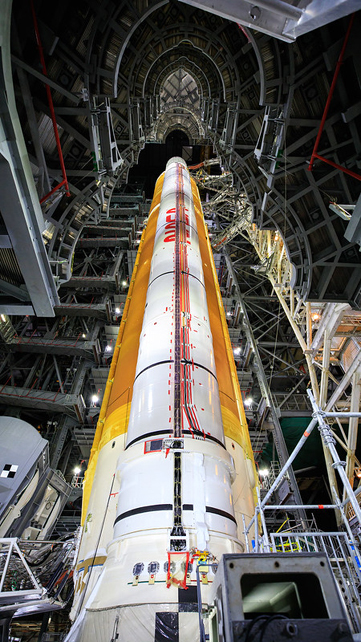
An unobstructed view of the Space Launch System rocket as it sits atop its mobile launcher inside the Vehicle Assembly Building at NASA's Kennedy Space Center in Florida...on September 17, 2021.
NASA / Frank Michaux

Happy First Day of Autumn! Just thought I'd share these four photos showing the Space Launch System (SLS) rocket after work platforms were retracted inside the Vehicle Assembly Building (VAB) at NASA's Kennedy Space Center in Florida...on Friday, September 17.

The removal of these platforms from around SLS paved the way for the Umbilical Release and Retract Test—which was originally supposed to occur about a month ago, but instead conducted last Sunday, September 19.

As of this update, the Integrated Modal Test should've begun on SLS and its mobile launcher inside the VAB. Once completed, this clears the way for the Mass Simulator for Orion and the Orion stage adapter's (OSA) structural test article to be removed from the mammoth Moon rocket.

By early next month, the flight-worthy OSA and the actual Orion spacecraft should be mated to SLS, completing assembly of the giant launch vehicle as it continues to be prepped for Artemis 1. Stay tuned!

An unobstructed view of the Space Launch System rocket as it sits atop its mobile launcher inside the Vehicle Assembly Building at NASA's Kennedy Space Center in Florida...on September 17, 2021.
NASA / Frank Michaux

An unobstructed view of the Space Launch System rocket as it sits atop its mobile launcher inside the Vehicle Assembly Building at NASA's Kennedy Space Center in Florida...on September 17, 2021.
NASA / Frank Michaux

An unobstructed view of the Space Launch System rocket as it sits atop its mobile launcher inside the Vehicle Assembly Building at NASA's Kennedy Space Center in Florida...on September 17, 2021.
NASA


Tuesday, September 21, 2021

Orion Update: NASA Sets Its Sight on Future Missions for the Multi-Purpose Crew Vehicle...

An artist's concept of the Orion spacecraft flying over the Moon.
NASA / ESA / ATG Medialab

NASA Awards Orion Main Engine Contract for Future Artemis Missions (Press Release)

NASA has awarded a contract to Aerojet Rocketdyne Inc. of Redmond, Washington, for the development of the Orion Main Engine (OME), which will be used on the Orion spacecraft as part of the agency’s Artemis program.

The contract includes certification of the OME design, production, and special studies and tasks. It is a single-award, indefinite-delivery/indefinite-quantity contract with firm-fixed-price orders. The period of performance is from Sept. 21, 2021, through April 23, 2032, with a maximum value of $600 million.

The OME will be integrated into Orion’s primary power and propulsion component, the European Service Module, and will replace the Orbital Maneuvering System engine repurposed from the Space Shuttle Program for the service module on Artemis missions VII through XIV. The contract also will allow for the procurement of additional engines for other NASA exploration programs.

Source: NASA.Gov
****

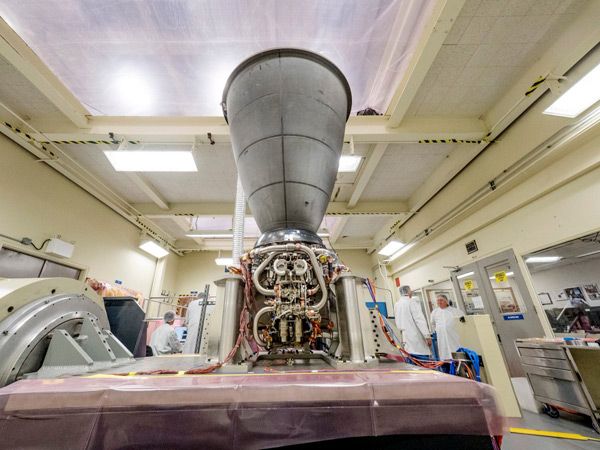
A file photo of the Orbital Maneuvering System engine that will fly on the Orion spacecraft for NASA's Artemis 1 mission.
NASA

Saturday, September 18, 2021

Welcome Home, Inspiration4 Astronauts!

The Crew Dragon Resilience spacecraft carrying the Inspiration4 astronauts is about to splash down into the Atlantic Ocean, off the coast of Florida, on September 18, 2021.
Inspiration4

Inspiration4 Crew Makes Evening Splashdown, Completing World’s First All-Civilian Orbital Mission to Space (Press Release)

KENNEDY SPACE CENTER, FL – After three days orbiting Earth, the astronauts of Inspiration4 flying aboard SpaceX’s Dragon spacecraft safely splashed down in the Atlantic Ocean off the coast of Kennedy Space Center, Florida, at 7:06 p.m. EDT. The return marks the completion of the world’s first all-civilian human spaceflight to orbit, which launched on a flight-proven SpaceX Falcon 9 rocket from historic Launch Complex 39A at NASA’s Kennedy Space Center in Florida on Wednesday, Sept. 15, 2021.

Teams on SpaceX’s Go Searcher recovery ship are in the process of securing the spacecraft to be hoisted onto the main deck of the ship, where the Inspiration4 crew will egress the spacecraft and receive medical checks before a helicopter ride back to Kennedy Space Center.

The mission completed several historic firsts, including the:

· First all-civilian human spaceflight to orbit

· First black female spacecraft pilot

· Youngest American in space

· First person to fly to space with a prosthetic

· Farthest flight for a human spaceflight since the Hubble missions

· First time SpaceX has operated three Dragons in space

· First free-flight of a Dragon spacecraft on a human spaceflight mission

· Largest contiguous window ever flown in space

· First splashdown of a Dragon crew in the Atlantic Ocean

· First thrice-flown Falcon 9 booster to launch a human spaceflight mission

Finally, true to the mission’s name and purpose, Inspiration4 has raised nearly $154M dollars and counting for St. Jude Children’s Research Hospital®.

To learn more and see highlights from the Inspiration4 mission, visit www.inspiration4.com and follow Twitter (@inspiration4x), Facebook (@inspiration4mission), Instagram (@inspiration4) and YouTube (@Inspiration4). To support St. Jude Children’s Research Hospital and learn more about auction items from the flight and additional support opportunities, visit stjude.org/inspiration4.

Source: Inspiration4.com

****

Screenshots showing the Inspiration4 astronauts moments after each of them egressed from Crew Dragon Resilience aboard SpaceX's Go Searcher recovery vessel...on September 18, 2021.
SpaceX

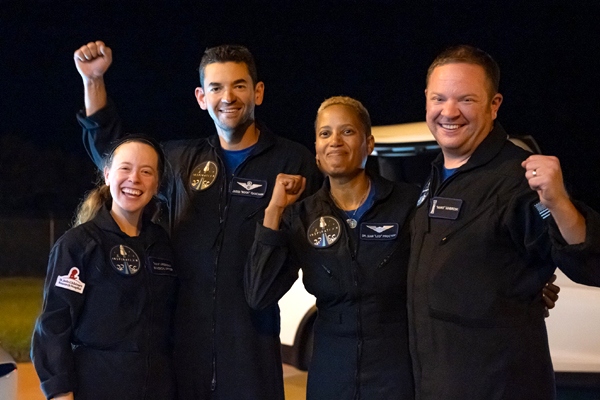
The Inspiration4 astronauts take a group photo at NASA's Kennedy Space Center after being flown in from SpaceX's Go Searcher recovery vessel in the Atlantic Ocean...on September 18, 2021.
Inspiration4


Thursday, September 16, 2021

Images of the Day: The Inspiration4 Crew On-Orbit...

As his crewmates look on, Inspiration4 commander Jared Isaacman speaks during a public relations event aboard SpaceX's Crew Dragon Resilience capsule...on September 16, 2021.
Inspiration4

A few hours ago, the Inspiration4 team posted these images on social media giving the world its first glimpse of the mission's four all-civilian astronauts in low-Earth orbit...one day after launch.

As shown in these video screenshots, the crew members are making full use of the cupola that gives them a stunning 360° view of Earth from a vantage point about 590 kilometers (367 miles) above!

In regards to this update, commander Jared Isaacman and his teammates have spoken to young cancer patients at St. Jude Children's Research Hospital.

To donate to St. Jude via the Inspiration4 mission, click here.

Inspiration4 commander Jared Isaacman speaks during a PR event while staring at Earth through Crew Dragon Resilience's cupola...on September 16, 2021.
Inspiration4

Inspiration4 mission specialist Christopher Sembroski takes photos of Earth from the inside of Crew Dragon Resilience's cupola...on September 16, 2021.
Inspiration4

Inspiration4 chief medical officer Hayley Arceneaux gives a tour of the inside of Crew Dragon Resilience's cupola...on September 16, 2021.
Inspiration4