Monday, May 16, 2022

On This Day in 1992: Endeavour Completes Her First Space Shuttle Mission...

A photo that I took of Endeavour as she was about to land at Edwards Air Force Base in California...completing her first space shuttle mission, STS-49, on May 16, 1992.

30 years ago today, two of my siblings and I went down to Edwards Air Force Base in Southern California to watch Endeavour land after completing her maiden shuttle flight, STS-49.

I was in 6th grade at the time, and unfortunately, I didn't have a DSLR camera with a nice telephoto lens to get a better shot of the brand-new orbiter touching down on the runway in the Mojave Desert. But I'm just grateful that I was in position to take the image above!

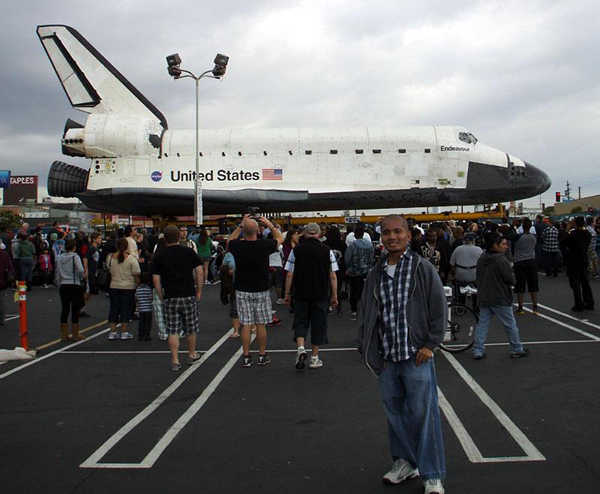
This October will mark 10 years since I went to Westchester, a city near Los Angeles International Airport, to view Endeavour up-close as she began her 3-day journey through the streets of L.A. to her final home at the California Science Center. Hail Endeavour!

Posing with Endeavour in the city of Westchester near Los Angeles International Airport...on October 12, 2012.

Saturday, May 14, 2022

The Core Stage Booster for the Space Launch System's Fourth Flight Continues to be Fabricated in Louisiana...

At NASA's Michoud Assembly Facility in Louisiana, the barrel for the Space Launch System's Artemis 4 liquid oxygen tank is lifted out of the Vertical Weld Center for its next phase of production...on May 10, 2022.
NASA / Michael DeMocker

Artemis IV Liquid Oxygen Tank Aft Barrel Moves to Next Phase of Production (Photo Release)

Move crews at NASA’s Michoud Assembly Facility lift the aft liquid oxygen tank (LOX) barrel out of the Vertical Weld Center (VWC) for its next phase of production. The aft barrel will eventually be mated with the forward barrel and the forward and aft domes to form the LOX tank, which will be used in the Space Launch System’s (SLS) Artemis IV mission.

The LOX tank holds 196,000 gallons of super-cooled liquid oxygen to help fuel four RS-25 engines. The SLS core stage is made up of five unique elements: the forward skirt, liquid oxygen tank, intertank, liquid hydrogen tank, and the engine section.

The liquid oxygen hardware, along with the liquid hydrogen tank will provide propellant to the four RS-25 engines to produce more than two million pounds of thrust to help launch NASA’s Orion spacecraft, astronauts, and supplies beyond Earth’s orbit to the Moon.

Together with its four RS-25 engines, the rocket’s massive 212-foot-tall core stage — the largest stage NASA has ever built — and its twin solid rocket boosters will produce 8.8 million pounds of thrust to send NASA’s Orion spacecraft, astronauts, and supplies beyond Earth’s orbit to the Moon and, ultimately, Mars.

Offering more payload mass, volume capability and energy to speed missions through space, the SLS rocket, along with NASA’s Gateway in lunar orbit, the Human Landing System, and Orion spacecraft, is part of NASA’s backbone for deep space exploration and the Artemis lunar program. No other rocket is capable of carrying astronauts in Orion around the Moon in a single mission.

Source: NASA.Gov

Friday, May 13, 2022

The Space Launch System Moves One Step Closer to Returning to Pad 39B Later This Month...

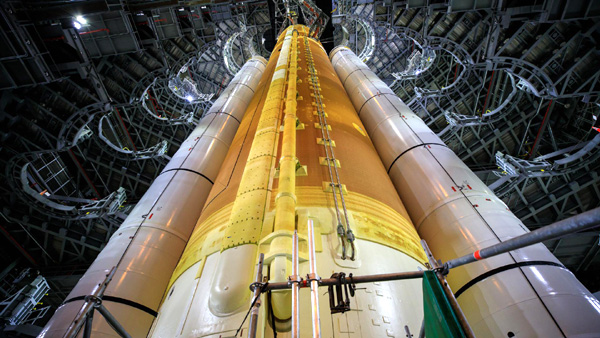
A low-angle view of NASA's Space Launch System rocket inside the Vehicle Assembly Building's High Bay 3 at Kennedy Space Center in Florida...on September 20, 2021.
NASA / Frank Michaux

Work Continues to Return Artemis I Moon Rocket Back to Launch Pad for Next Test (News Release)

Teams at NASA’s Kennedy Space Center in Florida continue to work on the main tasks needed to prepare the Space Launch System (SLS) rocket and Orion spacecraft to return to launch pad 39B for the next wet dress rehearsal attempt.

After re-tightening the flange bolts on the tail service mast umbilical lines to address a hydrogen leak identified during the previous wet dress rehearsal, engineers determined the seals on the bolts are no longer relaxing, and the system should remain tightly sealed during propellant loading. As a precaution, teams also moved the location of a heavy cantilevered filter on the tail service mast umbilical, which filters out any contaminants in the gaseous helium – a purge gas – that travels through the drain assist purge line. Engineers did not identify any leaks at its previous location, but relocating the filter will ensure it does not contribute to future leaks. Engineers conducted additional leak checks and have not detected any leaks at ambient air temperature.

Additionally, after replacing the helium check valve on the interim cryogenic propulsion stage (ICPS), engineers found a damaged rubber O-ring seal in the flight side of the quick disconnect – the area that separates the ICPS from the mobile launcher during launch. The O-ring came loose and entered the valve, preventing the valve from sealing correctly. Teams removed the flight and ground side of the quick disconnect system and replaced support hardware that was downstream of the check valve. Work is underway to determine the root cause to prevent any recurrences. Next, teams will re-pressurize the system and test the replaced hardware on the upper stage.

The supplier for gaseous nitrogen completed upgrades to its facility to meet the requirements for the next wet dress rehearsal attempt. Engineers will test the system next week to ensure its ready to support tanking operations. During wet dress rehearsal and launch, teams pump gaseous nitrogen into dry structures to protect avionics during propellant loading.

Teams also completed additional work needed, such as inspecting the Orion spacecraft for water damage that may have occurred during a heavy thunderstorm at the spaceport during the initial wet dress rehearsal attempt. Teams determined there was no damage to the systems inside the capsule and continue with inspections and wrapping up other work before retracting the platforms inside the Vehicle Assembly Building (VAB) to prepare to roll SLS and Orion back to the launch pad. NASA will announce dates for rolling out to the pad and the next wet dress rehearsal attempt once work inside the VAB and testing of the nitrogen system are nearing completion.

Source: NASA.Gov

Thursday, May 12, 2022

Moon Samples from the Apollo Program Pave the Way for a Future Moon Base in the Artemis Era...

By day 6 of a NASA/University of Florida experiment, there were noticeable differences between plants grown in volcanic ash lunar simulant (left) and those grown in lunar soil (right) obtained by Apollo astronauts in 1969 and 1972.
UF / IFAS photo by Tyler Jones

Scientists Grow Plants in Lunar Soil (News Release)

NASA-funded study breaks new ground in plant research

In the early days of the Space Age, the Apollo astronauts took part in a visionary plan: Bring samples of the lunar surface material, known as regolith, back to Earth where they could be studied with state-of-the-art equipment and saved for future research not yet imagined. Fifty years later, at the dawn of the Artemis era and the next astronaut return to the Moon, three of those samples have been used to successfully grow plants. For the first time ever, researchers have grown the hardy and well-studied Arabidopsis thaliana in the nutrient-poor lunar regolith.

“This research is critical to NASA’s long-term human exploration goals as we’ll need to use resources found on the Moon and Mars to develop food sources for future astronauts living and operating in deep space,” said NASA Administrator Bill Nelson. “This fundamental plant growth research is also a key example of how NASA is working to unlock agricultural innovations that could help us understand how plants might overcome stressful conditions in food-scarce areas here on Earth.”

Scientists at the University of Florida have made a breakthrough discovery — decades in the making — that could both enable space exploration and benefit humanity. “Here we are, 50 years later, completing experiments that were started back in the Apollo labs,” said Robert Ferl, a professor in the Horticultural Sciences department at the University of Florida, Gainesville, and a communicating author on a paper published on May 12, 2022, in Communications Biology. “We first asked the question of whether plants can grow in regolith. And second, how might that one day help humans have an extended stay on the Moon.”

The answer to the first question is a resounding yes. Plants can grow in lunar regolith. They were not as robust as plants grown in Earth soil, or even as those in the control group grown in a lunar simulant made from volcanic ash, but they did indeed grow. And by studying how the plants responded in the lunar samples, the team hopes to go on to answer the second question as well, paving the way for future astronauts to someday grow more nutrient-rich plants on the Moon and thrive in deep space.

To Boldly Go, We Must Boldly Grow

“To explore further and to learn about the solar system we live in, we need to take advantage of what’s on the Moon, so we don’t have to take all of it with us,” said Jacob Bleacher, the Chief Exploration Scientist supporting NASA’s Artemis program at NASA Headquarters in Washington. Bleacher points out that this is also why NASA is sending robotic missions to the Moon’s South Pole where it’s believed there may be water that can be used by future astronauts. “What’s more, growing plants is the kind of thing we’ll study when we go. So, these studies on the ground lay the path to expand that research by the next humans on the Moon.”

Arabidopsis thaliana, native to Eurasia and Africa, is a relative of mustard greens and other cruciferous vegetables like broccoli, cauliflower, and Brussels sprouts. It also plays a key role for scientists: due to its small size and ease of growth, it is one of the most studied plants in the world, used as a model organism for research into all areas of plant biology. As such, scientists already know what its genes look like, how it behaves in different circumstances, even how it grows in space.

Working with Teaspoon-sized Samples

To grow the Arabidopsis, the team used samples collected on the Apollo 11, 12, and 17 missions, with only a gram of regolith allotted for each plant. The team added water and then seeds to the samples. They then put the trays into terrarium boxes in a clean room. A nutrient solution was added daily.

“After two days, they started to sprout!” said Anna-Lisa Paul, who is also a professor in Horticultural Sciences at the University of Florida, and who is first author on the paper. “Everything sprouted. I can’t tell you how astonished we were! Every plant – whether in a lunar sample or in a control – looked the same up until about day six.”

After day six, however, it was clear that the plants were not as robust as the control group plants growing in volcanic ash, and the plants were growing differently depending on which type of sample they were in. The plants grew more slowly and had stunted roots; additionally, some had stunted leaves and sported reddish pigmentation.

After 20 days, just before the plants started to flower, the team harvested the plants, ground them up, and studied the RNA. In a biological system, genes are decoded in multiple steps. First, the genes, or DNA, are transcribed into RNA. Then the RNA is translated into a protein sequence. These proteins are responsible for carrying out many of the biological processes in a living organism. Sequencing the RNA revealed the patterns of genes that were expressed, which showed that the plants were indeed under stress and had reacted the way researchers have seen Arabidopsis respond to growth in other harsh environments, such as when soil has too much salt or heavy metals.

Additionally, the plants reacted differently depending on which sample – each collected from different areas on the Moon – was used. Plants grown in the Apollo 11 samples were not as robust as the other two sets. Nonetheless, the plants did grow.

Sowing the Seeds for Future Research

This research opens the door not only to someday growing plants in habitats on the Moon, but to a wide range of additional questions. Can understanding which genes plants need to adjust to growing in regolith help us understand how to reduce the stressful nature of lunar soil? Are materials from different areas of the Moon more conducive to growing plants than others? Could studying lunar regolith help us understand more about the Mars regolith and potentially growing plants in that material as well? All of these are questions that the team hopes to study next, in support of the future astronauts traveling to the Moon.

“Not only is it pleasing for us to have plants around us, especially as we venture to new destinations in space, but they could provide supplemental nutrition to our diets and enable future human exploration,” said Sharmila Bhattacharya, program scientist with NASA’s Biological and Physical Sciences (BPS) Division. “Plants are what enable us to be explorers.”

This research is part of the Apollo Next Generation Sample Analysis Program, or ANGSA, an effort to study the samples returned from the Apollo Program in advance of the upcoming Artemis missions to the Moon’s South Pole. BPS helped support this work, which also supports other fundamental plant research, including Veggie, PONDS, and Advanced Plant Habitat.

About BPS

NASA’s Biological and Physical Sciences Division pioneers scientific discovery and enables exploration by using space environments to conduct investigations not possible on Earth. Studying biological and physical phenomenon under extreme conditions allows researchers to advance the fundamental scientific knowledge required to go farther and stay longer in space, while also benefitting life on Earth.

Source: NASA.Gov

****

Placing a plant grown during the NASA/University of Florida experiment into a vial for future genetic analysis.
UF / IFAS photo by Tyler Jones

Wednesday, May 11, 2022

OFT-2 Update: Starliner Is Ready to Fly to the International Space Station 8 Days from Now...

The CST-100 Starliner capsule is mated to its Atlas V rocket inside the Vertical Integration Facility at Cape Canaveral Space Force Station's Space Launch Complex-41 in Florida...on May 4, 2022.
NASA / Frank Michaux

Flight Readiness Concludes for Boeing’s Orbital Flight Test-2 (News Release)

NASA and Boeing are proceeding with plans for the uncrewed Orbital Flight Test-2 (OFT-2) to the International Space Station following a full day of briefings and discussions during a Flight Readiness Review that took place at the agency’s Kennedy Space Center in Florida.

Launch of the CST-100 Starliner spacecraft on a United Launch Alliance Atlas V rocket is scheduled for 6:54 p.m. EDT, Thursday, May 19, from Space Launch Complex-41 at Cape Canaveral Space Force Station as part of NASA’s Commercial Crew Program.

OFT-2 will test the end-to-end capabilities of Starliner from launch to docking, atmospheric re-entry, and a desert landing in the western United States. OFT-2 will provide valuable data that will help NASA certify Boeing’s crew transportation system to carry astronauts to and from the space station.

Source: StarlinerUpdates.com

Tuesday, May 10, 2022

A Third Latin American Nation Has Joined NASA's Moon Exploration Initiative...

NASA Deputy Administrator Pam Melroy looks on as Colombian Vice President and Foreign Minister Marta Lucía Ramírez signs the Artemis Accords at NASA Headquarters in Washington, DC...on May 10, 2022.
NASA / Aubrey Gemignani

NASA Welcomes Vice President of Colombia for Artemis Accords Signing (News Release)

During a ceremony at NASA Headquarters in Washington Tuesday, May 10, the Republic of Colombia became the 19th country to sign the Artemis Accords. NASA Deputy Administrator Pam Melroy participated in the signing ceremony for the agency, and Vice President and Foreign Minister Marta Lucía Ramírez signed the Artemis Accords on behalf of Colombia.

The Artemis Accords establish a practical set of principles to guide space exploration cooperation among nations, including those participating in NASA’s Artemis program.

"NASA is proud to have Colombia join the family of nations signing the Artemis Accords,” said Melroy. “Our efforts to create a sustainable presence at the Moon and later Mars requires the partnership and expertise of a diverse and robust cadre of nations that embrace peaceful exploration of space. We look forward to our future collaborations with Colombia as the world explores together.”

Colombia is the third Latin American country to sign the Artemis Accords, following Brazil and Mexico.

“I am very honored being here today at NASA signing the Artemis Accords representing Colombia in a very significant moment of the bilateral relationship as we celebrate this year, the 200th anniversary of the U.S. – Colombia diplomatic relations,” said Ramírez. “It is a substantial steppingstone for my country as we continue to develop our knowledge, national capacity, and understanding of the importance of space for future generations of Colombians to come.”

NASA, in coordination with the U.S. Department of State, announced the establishment of the Artemis Accords in 2020. The Artemis Accords reinforce and implement the 1967 Outer Space Treaty. They also reinforce the commitment by the United States and partner nations to the Registration Convention, the Rescue and Return Agreement, as well as best practices and norms of responsible behavior that NASA and its partners have supported, including the public release of scientific data.

Additional countries will sign the Artemis Accords in the months and years ahead, as NASA continues to work with its international partners to establish a safe, peaceful, and prosperous future in space. Working with both new and existing partners will add new energy and capabilities to ensure the entire world can benefit from our journey of exploration and discovery.

Source: NASA.Gov

****

A computer-generated rendering of NASA's Orion spacecraft docked to the Lunar Gateway.
ESA

Monday, May 9, 2022

Blue Origin Gears Up for Its Next Suborbital Flight to Space...

The six-member crew of Blue Origin's NS-21 mission.
Blue Origin

NS-21 to Fly Six Customer Astronauts, Including First Mexican-Born Woman to Visit Space (News Release)

Blue Origin today announced the crew flying on its NS-21 mission will include: investor and NS-19 Astronaut Evan Dick; electrical engineer and former NASA test lead Katya Echazarreta; business jet pilot and Action Aviation Chairman Hamish Harding; civil production engineer Victor Correa Hespanha; adventurer and Dream Variation Ventures co-founder Jaison Robinson; and explorer and co-founder of private equity firm Insight Equity Victor Vescovo, Commander, USN (Ret.). Katya will become the first Mexican-born woman and youngest American woman to fly to space, and she will be flying as part of Space for Humanity’s sponsored Citizen Astronaut Program. Victor Correa Hespanha will be the second Brazilian to fly to space.

Each astronaut on board NS-21 will carry a postcard to space on behalf of Blue Origin’s foundation, Club for the Future, whose Postcards to Space program gives students access to space on Blue Origin’s rockets. The Club’s mission is to inspire future generations to pursue careers in STEM for the benefit of Earth.

This mission will be the fifth human flight for the New Shepard program and the 21st in its history. The flight date will be announced soon.

Meet the Crew:

Evan Dick

Evan is an engineer, investor, and Managing Member of Dick Holdings, LLC., and flew onboard NS-19 on December 11, 2021. Evan formerly served as Senior Vice President for D.E. Shaw and Managing Director of Highbridge Capital Management, and he is a charitable supporter of the Darwin Foundation and Population Relief International Corp. Evan is an ATP-rated pilot and volunteer for Starfighters Aerospace, as well as an avid sailor and motorcyclist.

Katya Echazarreta

Katya was born in Guadalajara, Mexico. Her mission is to provide representation for women and minorities interested in STEM fields. She is the co-host of the YouTube series Netflix IRL and Electric Kat on the CBS show Mission Unstoppable. Katya is currently pursuing a Master’s degree in electrical and computer engineering at Johns Hopkins University and earned her bachelor’s degree in electrical engineering from UCLA in 2019. Following graduation, she spent nearly four years at NASA's Jet Propulsion Laboratory working on five NASA missions, including the Perseverance Rover and Europa Clipper.

Katya’s seat is sponsored by Space for Humanity, a nonprofit whose mission is to expand access to space for all of humanity.

Hamish Harding

Hamish is Chairman of Action Aviation, a business jet brokerage company he founded in 2004, and also a business jet pilot. In 2019, he and former International Space Station Commander Col. Terry Virts broke the Round-the-World record in a Gulfstream G650ER for any aircraft flying over the North and South poles. In addition to holding several aviation world records, Hamish has travelled to the South Pole twice, and in 2021 dived the Challenger Deep with Victor Vescovo to a depth of 36,000 ft in a two-person sub. Hamish lives in the United Arab Emirates with his wife, two teenage sons, and two golden retrievers.

Victor Correa Hespanha

Victor is a 28-year-old civil production engineer from Minas Gerais (Brazil). As a child he dreamed of becoming an astronaut, and now, after buying his first NFT, he's honored to be the second Brazilian to fly to space and the world’s first cryptonaut.

Victor’s seat is sponsored by the Crypto Space Agency, whose mission is to combine the space industry's technology with the innovation and financial power of the crypto markets to accelerate humankind’s off-world future.

Jaison Robinson

Jaison founded JJM Investments, a commercial real estate company, and co-founded Dream Variations Ventures (DVV) with his wife, Jamie. DVV invests in technology and sports start-ups. He’s an avid scuba diver and skydiver, has broken the sound barrier in a MiG-29 fighter jet, spent a week hiking in Antarctica, and climbed to the tallest waterfall in the world in Venezuela. He was a finalist on Survivor: Samoa in 2009. Jaison earned a bachelor’s degree from Stanford, with study at Oxford, and a JD from the University of Chicago. He is also an Eagle Scout and played water polo at Stanford and on the United States National Team.

Victor Vescovo

Victor is a co-founder of private equity investment firm Insight Equity. He has completed the “Explorer’s Grand Slam,” which includes summiting the world’s seven summits and skiing to the North and South Poles. In 2020, he became the first person to repeatedly dive to the deepest point in the ocean, Challenger Deep (now twelve times). He is the first person to visit the deepest point in the world’s five oceans and executed the deepest wreck dive in history. Victor is a commercially-rated multi-engine jet and helicopter pilot, as well as a certified submersible test pilot. He holds degrees from Stanford, MIT, and Harvard Business School, and served 20 years in the U.S. Navy Reserve as an intelligence officer, retiring as a Commander (O-5).

Source: Blue Origin

****

A New Shepard rocket lifts off from Blue Origin's launch site in West Texas on a flight that took it 389,846 feet above the Earth...on July 18, 2018.
Blue Origin

Friday, May 6, 2022

The Space Launch System Is On Track for Another Wet Dress Rehearsal Attempt Next Month...

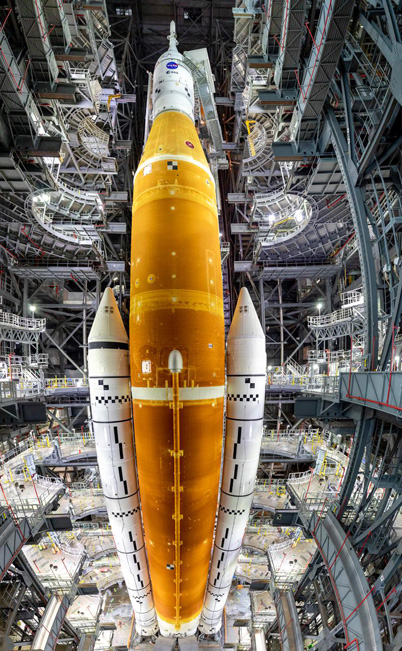
A panoramic shot of the Space Launch System rocket inside the Vehicle Assembly Building at NASA's Kennedy Space Center in Florida...on March 16, 2022.
NASA / Glenn Benson

Artemis I Rocket, Spacecraft Prepare for Return to Launch Pad to Finish Test (News Release)

Since returning to the Vehicle Assembly Building, ground systems teams have worked to prepare the Artemis I Space Launch System (SLS) rocket and Orion spacecraft to roll back to Launch Pad 39B in late May to complete the wet dress rehearsal (WDR) test in the early to mid-June timeframe.

Inside the VAB at NASA’s Kennedy Space Center, engineers replaced a faulty helium check valve on the interim cryogenic propulsion stage (ICPS) that was identified after the second wet dress rehearsal attempt. Engineers have inspected the valve and found a small piece of rubber that prevented the valve from sealing correctly. Teams are looking at possible sources of the debris, but did not see any issues with the valve itself, and plan to test the newly-installed valve later this week to confirm it is operating as expected.

Engineers also performed tests to address a hydrogen leak on one of two tail service mast umbilicals between the mobile launcher and the rocket. These umbilicals provide liquid oxygen and liquid hydrogen propellants, as well as electrical connections, from the mobile launcher to the rocket’s core stage during the launch countdown. Teams conducted leak checks on all the joints and tightened several flange bolts, or fasteners that act as a washer to increase the compression strength, that can loosen over time and were the most likely source of the leak. Teams re-tightened the flange bolts on the liquid hydrogen, liquid oxygen, and core stage intertank umbilicals. Engineers have not detected leaks in subsequent testing at ambient air temperature, and will continue to monitor for leaks when loading the super cold propellants at the launch pad.

The supplier that provides gaseous nitrogen for operations during tanking is upgrading its facility to meet the requirements for the next wet dress rehearsal attempt and the Artemis I launch. Teams are on track to complete the work early next week, followed by testing to ensure the system is ready for tanking. During the test, teams pump gaseous nitrogen into dry structures to protect avionics during propellant loading.

Once all major work is completed, teams will retract the working platforms and prepare the integrated SLS rocket and the Orion spacecraft for the second journey to the launch pad. NASA will announce dates for roll to the pad and the next WDR attempt once work is nearing completion inside the VAB.

Source: NASA.Gov

Thursday, May 5, 2022

ISS Update: The Crew-3 Mission Has Successfully Come to an End Off the Coast of Tampa, Florida...

The fireball created by Crew Dragon Endurance as she re-entered Earth's atmosphere is visible in the night sky above the Gulf of Mexico...on May 6, 2022 (Eastern Time).
NASA / Aubrey Gemignani

NASA, ESA Astronauts Safely Return to Earth (Press Release)

NASA’s SpaceX Crew-3 astronauts aboard the Dragon Endurance spacecraft safely splashed down Friday in the Gulf of Mexico off the coast of Florida, completing the agency’s third long-duration commercial crew mission to the International Space Station. The international crew of four spent 177 days in orbit.

NASA astronauts Kayla Barron, Raja Chari, and Tom Marshburn, and ESA (European Space Agency) astronaut Matthias Maurer returned to Earth in a parachute-assisted splashdown at 12:43 a.m. EDT. Teams aboard SpaceX recovery vessels recovered the spacecraft and astronauts. After returning to shore, the astronauts will fly back to NASA’s Johnson Space Center in Houston.

“NASA’s partnership with SpaceX has again empowered us to deliver a crew safely to the space station and back, enabling groundbreaking science that will help our astronauts travel farther out into the cosmos than ever before. This mission is just one more example that we are truly in the golden era of commercial spaceflight,” said NASA Administrator Bill Nelson. “Kayla, Raja, Tom, and Matthias, thank you for your service and welcome home!”

The Crew-3 mission launched Nov. 10 on a Falcon 9 rocket from NASA’s Kennedy Space Center in Florida. Nearly 24-hours after liftoff, Nov. 11, Endurance docked to the Harmony module’s forward space station port. The astronauts undocked from the same port at 1:05 a.m. May 5, to begin the trip home.

Barron, Chari, Marshburn, and Maurer traveled 75,060,792 miles during their mission, spent 175 days aboard the space station, and completed 2,832 orbits around Earth. Marshburn has logged 339 days in space over his three flights. The Crew-3 mission was the first spaceflight for Barron, Chari, and Marshburn.

Throughout their mission, the Crew-3 astronauts contributed to a host of science and maintenance activities and technology demonstrations. In addition, they conducted three spacewalks to perform station maintenance and upgrades outside the space station. This brought the total number of spacewalks for Marshburn to five, while Chari and Barron have each completed two, and Maurer one.

Crew-3 built on previous work investigating how fibers grow in microgravity, used hydroponic and aeroponic techniques to grow plants without soil or other growth material, captured imagery of their retinas as part of an investigation that could detect eye changes of astronauts in space automatically in the future, and performed a demonstration of technology that provides measurements of biological indicators related to disease and infection, among many other scientific investigations. The astronauts took hundreds of photos of Earth as part of the Crew Earth Observation investigation, one of the longest-running investigations aboard the space station, which helps track natural disasters and changes to our home planet.

Endurance will return to Florida for inspection and processing at SpaceX’s Dragon Lair, where teams will examine the spacecraft’s data and performance throughout the flight.

The Crew-3 flight is part of NASA’s Commercial Crew Program and its return to Earth follows on the heels of NASA’s SpaceX Crew-4 launch, which docked to the station April 27, beginning another science expedition.

The goal of NASA’s Commercial Crew Program is safe, reliable, and cost-effective transportation to and from the International Space Station. This already has provided additional research time and has increased the opportunity for discovery aboard humanity’s microgravity testbed for exploration, including helping NASA prepare for human exploration of the Moon and Mars.

****

The Crew 3 astronauts pose for the camera after the hatch was opened to Crew Dragon Endurance after she was placed aboard SpaceX's recovery ship Shannon...on May 6, 2022 (Eastern Time).
NASA / Aubrey Gemignani

Wednesday, May 4, 2022

OFT-2 Update: Starliner Is Ready for Another Attempt at a Re-flight to the International Space Station...

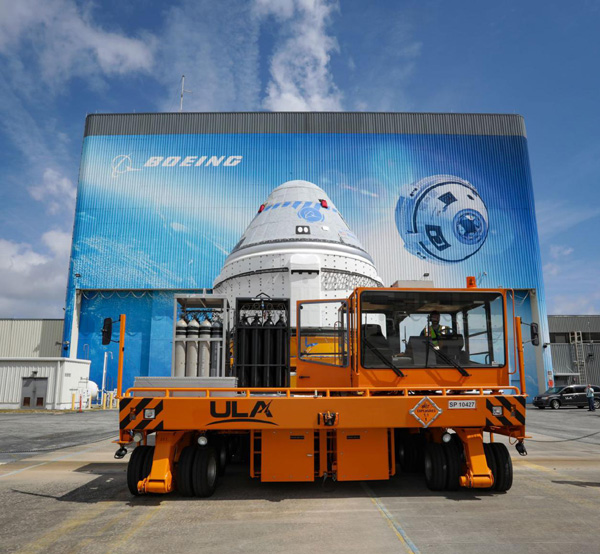
The transporter carrying Boeing's CST-100 Starliner capsule is about to roll away from the company's Commercial Crew and Cargo Processing Facility at NASA's Kennedy Space Center in Florida...on May 4, 2022.
Boeing

Boeing's CST-100 Starliner for OFT-2 Lift and Mate (Photo Release)

The Boeing CST-100 Starliner spacecraft is lifted inside the Vertical Integration Facility at Space Launch Complex-41 at Florida’s Cape Canaveral Space Force Station on May 4, 2022. Starliner will be secured atop a United Launch Alliance Atlas V rocket for Boeing’s second Orbital Flight Test (OFT-2) to the International Space Station for NASA’s Commercial Crew Program.

The spacecraft rolled out from Boeing’s Commercial Crew and Cargo Processing Facility at NASA’s Kennedy Space Center earlier in the day.

Source: NASA.Gov

****

The CST-100 Starliner capsule is mated to its Atlas V rocket inside the Vertical Integration Facility at Cape Canaveral Space Force Station's Space Launch Complex-41 in Florida...on May 4, 2022.
NASA / Frank Michaux