Monday, May 25, 2020

SpaceX Update: The Demo-2 Mission Is Officially Clear to Launch!

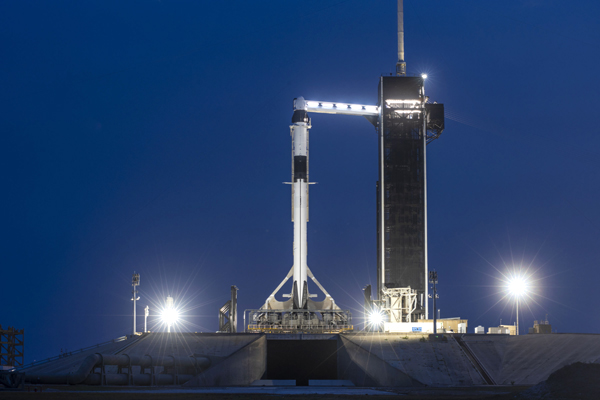
SpaceX's Falcon 9 rocket, with the Crew Dragon Demo-2 capsule at the top, sit quietly at Kennedy Space Center's Launch Complex 39A on the evening of May 25, 2020.
SpaceX

Happy Memorial Day to America! NASA and SpaceX officials conducted the Launch Readiness Review several hours ago, and the launch of astronauts Doug Hurley and Bob Behnken to the International Space Station this Wednesday is officially a GO! Lift-off is still scheduled for 4:33 PM, Eastern Daylight Time (1:33 PM, Pacific Daylight Time), with a 60% chance of the weather cooperating at Cape Canaveral for the afternoon launch. The Falcon 9 rocket—with the Crew Dragon at the top—sit quietly at Kennedy Space Center's Launch Complex 39A...waiting to ignite its nine Merlin 1D engines to send American astronauts to low-Earth orbit from American soil for the first time since 2011, and begin a new era of human spaceflight! Can't wait.

Sunday, May 24, 2020

Artemis 1 Update: Work Resumes on Prepping the SLS Core Stage Booster for Green Run Tests...

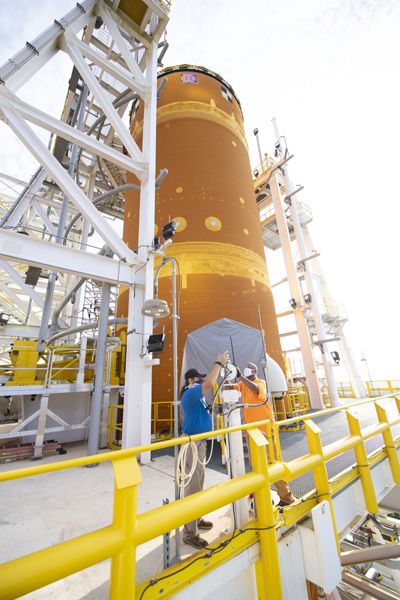
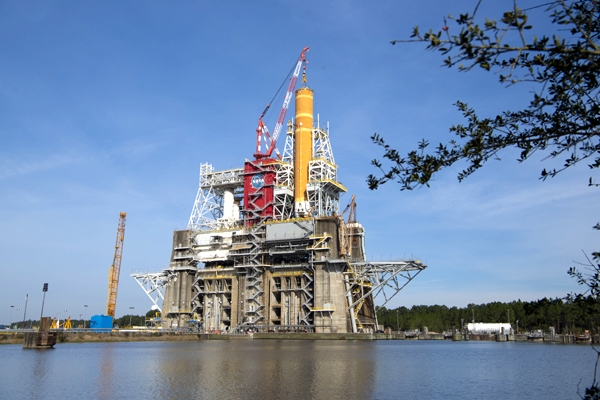
The Space Launch System's (SLS) core stage booster is installed atop the B-2 Test Stand at NASA's Stennis Space Center in Bay St. Louis, Mississippi...back in early January.
NASA / SSC

NASA's SLS Core Stage Green Run Tests Critical Systems For Artemis I (News Release - May 20)

NASA is resuming work on a series of tests to bring the Space Launch System (SLS) rocket core stage to life for the first time, allowing engineers to evaluate the new complex stage that will launch the Artemis I lunar mission.

In January, engineers began activating the stage’s components one by one over several months through a series of initial tests and functional checks designed to identify any issues. Those tests and checks collectively called Green Run will culminate in a test fire replicating the stage’s first flight.

“Green Run is the step-by-step testing and analysis of the new SLS rocket core stage that will send astronauts to the Moon," said Richard Sheppard, the SLS Stages Green Run Test Lead from NASA’s Marshall Space Flight Center in Huntsville, Alabama. “This testing will reduce risks for, not only the first flight, but also for the Artemis mission that will land astronauts on the Moon in 2024.”

The Green Run test series, conducted in the historic B-2 Test Stand at NASA's Stennis Space Center near Bay St. Louis, Mississippi, is a collaborative effort between the SLS program, the Stennis test team, core stage manufacturer Boeing and engine manufacturer Aerojet Rocketdyne. On March 18, work was temporarily suspended on Green Run when Stennis Space Center went to Stage 4 on the Agency Response Framework in response to a rise in COVID-19 cases in the area near Stennis.

Prior to pausing test operations, engineers completed the modal test, the first of the eight tests in the Green Run series, to understand the vibration characteristics of the core stage. Now, work is slowly and methodically starting back, as workers return to prepare the facility and resume testing.

“The team connected the facility with the rocket earlier this year, both electrically and mechanically,” said Ryan McKibben, Green Run test conductor at Stennis. “We are now preparing for the second test, which will power on the vehicle’s avionics and the three computers that control the rocket’s flight as it soars into space.”

The avionics are distributed throughout the stage. Engineers at Marshall designed software similar to the flight software for Green Run. A special stage controller will be used to simulate the Launch Control Center operations that will control the actual launch at Kennedy Space Center in Florida.

“The core stage avionics along with Green Run software have successfully completed tests in our test laboratories at Marshall, said Lisa Espy, the core stage avionics lead at Marshall. “I am excited to see the flight systems come to life that will control the rocket as it sends the first Artemis mission to the Moon.”

Green Run tests minimize risk to the core stage and ensure the stage satisfies design objectives and validates design models:

Test 1- Modal Test: The first test in the Green Run series, a modal test was conducted in January. This test used shakers to impart dynamic forces on the suspended stage to identify primary bending modes of the stage. Information from the modal test will help engineers verify vehicle models needed for the operation of the rocket’s guidance, navigation and control systems.

Test 2- Avionics: The rocket’s avionics, which are distributed throughout the stage, will be turned on and checkout out. This includes not only flight computers and electronics that control the rocket but also those that collect flight data and monitor the overall health of the core stage.

Test 3- Fail-Safes: Engineers will check out all the safety systems that shut down operations during testing. To do this, they will simulate potential issues.

Test 4- Propulsion: This will be the first test of each of the main propulsion system components that connect to the engines. Command and control operations will be verified, and the core stage will be checked for leaks in fluid or gas.

Test 5- Thrust Vector Controls: Engineers will ensure that the thrust vector control system can move the four engines and check all the related hydraulic systems.

Test 6- Countdown: This test simulates the launch countdown, including step-by-step fueling procedures. Core stage avionics are powered on, and propellant loading and pressurization are simulated. The test team will exercise and validate the countdown timeline and sequence of events.

Test Case 7- “Wet” Dress Rehearsal: Engineers will demonstrate loading, controlling and draining more than 700,000 gallons of cryogenic propellants into the two test stand run tanks and then returning the stage to a safe condition.

Test Case 8- Hot Fire: The core stage's four RS-25 engines will operate for up to 8 minutes, generating 1.6 million pounds of thrust, the amount of thrust the engines produce at sea level on the launch pad at liftoff.

After the hot fire test, engineers will refurbish the core stage and configure it for its journey to Kennedy for launch preparations. The next time the RS-25 engines fire, the SLS will launch in an epic debut of Artemis I -- the first in a series of increasingly complex missions that will enable human exploration to the Moon and Mars.

Source: NASA.Gov

****

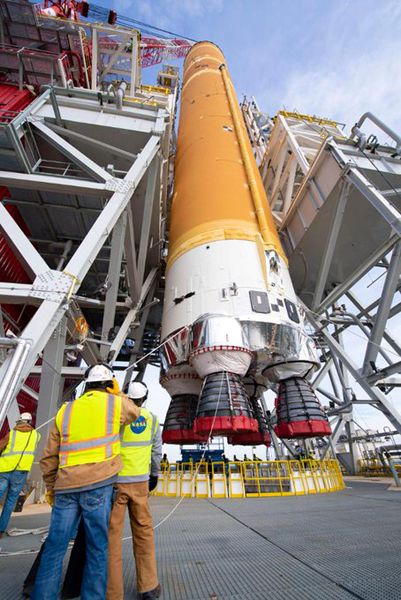
Engineers inspect the SLS core stage booster as it sits atop the B-2 Test Stand at NASA's Stennis Space Center in Bay St. Louis, Mississippi.
Boeing

Saturday, May 23, 2020

Photos of the Day #2: The Demo-2 Dry Dress Rehearsal Is Complete!

At Launch Complex (LC)-39A, NASA astronauts Doug Hurley and Bob Behnken pose in front of the Falcon 9 rocket that will send them to the International Space Station on May 27, 2020...weather permitting.
NASA

Earlier today, Demo-2 astronauts Doug Hurley and Bob Behnken ventured out to Kennedy Space Center's Launch Complex (LC)-39A to conduct a dry dress rehearsal for next Wednesday's hopeful and historic launch to the International Space Station (ISS). Wearing their white SpaceX-fabricated flight suits, Hurley and Behnken got seated inside their Crew Dragon capsule at LC-39A to practice all of the procedures that will be carried out during the May 27 countdown. With the dry dress rehearsal now complete, only the Launch Readiness Review (scheduled for this Monday) needs to be held before Demo-2 is finally ready to go.


As of right now, weather at Kennedy Space Center is 40% 'GO' for lift-off (according to the 45th Weather Squadron at Cape Canaveral) by the Falcon 9 rocket that will send the Demo-2 crew on its way to the ISS this Wednesday. Stay tuned.

NASA astronauts Doug Hurley and Bob Behnken walk down the hallway at their Kennedy Space Center crew quarter prior to heading to LC-39A for the Demo-2 dry dress rehearsal...on May 23, 2020.
NASA

NASA astronauts Doug Hurley and Bob Behnken are suited up and ready to conduct the Demo-2 dry dress rehearsal at Kennedy Space Center's LC-39A...on May 23, 2020.
NASA

Flight controllers monitor Demo-2 dry dress rehearsal activities from the Launch Control Center at NASA's Kennedy Space Center in Florida...on May 23, 2020.
NASA

Flight controllers monitor Demo-2 dry dress rehearsal activities from the Launch Control Center at NASA's Kennedy Space Center in Florida...on May 23, 2020.
NASA

Inside their Crew Dragon capsule, NASA astronauts Doug Hurley and Bob Behnken go through procedures that they will carry out during launch day on May 27, 2020...weather permitting.
NASA

Friday, May 22, 2020

Photos of the Day: The Launch of Demo-2 Is Officially Set for May 27!

At Kennedy Space Center's Launch Complex 39A, the Falcon 9 rocket that will soar on next Wednesday's Demo-2 flight ignites its nine Merlin 1D engines during a static fire...on May 22, 2020.
SpaceX

Earlier today, NASA and SpaceX officials conducted a Flight Readiness Review for the Demo-2 flight at the Kennedy Space Center in Florida...with both parties agreeing to stick with next Wednesday as the historic day when astronauts will launch from U.S. soil for the first time since 2011. Over two hours later—at 1:33 PM, Pacific Daylight Time—a static fire was successfully conducted by the Falcon 9 rocket that will send astronauts Doug Hurley and Bob Behnken on their momentous journey to the International Space Station.

With the launch date officially set, Hurley and Behnken will suit up and conduct a dry dress rehearsal inside their Crew Dragon capsule at Launch Complex 39A tomorrow...with a Launch Readiness Review scheduled for Memorial Day (May 25). Assuming all goes as planned on Saturday and next Monday, the excitement at Cape Canaveral will be palpable leading up to May 27 as America ushers in a new era of human spaceflight!

At Kennedy Space Center's Launch Complex 39A, the Falcon 9 rocket that will soar on next Wednesday's Demo-2 flight ignites its nine Merlin 1D engines during a static fire...on May 22, 2020.
NASA / Bill Ingalls

At Kennedy Space Center's Launch Complex 39A, the Falcon 9 rocket that will soar on next Wednesday's Demo-2 flight ignites its nine Merlin 1D engines during a static fire...on May 22, 2020.
NASA / Joel Kowsky

Thursday, May 21, 2020

Photos of the Day: SpaceX's Demo-2 Launch Vehicle is on the Pad!

In preparation for its static fire (scheduled for tomorrow), SpaceX's Falcon 9 rocket sits vertical on the pad at Kennedy Space Center's Launch Complex 39A...on May 21, 2020.
NASA

Just thought I'd share these photos and video of SpaceX's Falcon 9 rocket, with the Crew Dragon capsule at the top, sitting on the pad at Kennedy Space Center's Launch Complex 39A in Florida after it was raised to vertical position this morning.


As of right now, the Flight Readiness Review by NASA and SpaceX officials to solidify the May 27 launch date for Demo-2 will conclude tomorrow...with the static fire for the Falcon 9 also scheduled to take place on the same day. The excitement is building!

The Falcon 9 Demo-2 rocket is rolled out of SpaceX's Horizontal Integration Facility to be transported to the pad at Launch Complex 39A...on May 21, 2020.
NASA

In preparation for its static fire, SpaceX's Falcon 9 rocket is raised to vertical on the pad at Kennedy Space Center's Launch Complex 39A...on May 21, 2020.
NASA

Wednesday, May 20, 2020

T-Minus 1 WEEK Till Astronauts Head to Low-Earth Orbit from American Soil Once More!

NASA astronauts Douglas Hurley and Robert Behnken pose for the cameras at the Launch and Landing Facility after arriving at the Kennedy Space Center in Florida...on May 20, 2020.
NASA

Earlier today, NASA astronauts Douglas Hurley and Robert Behnken arrived at the Kennedy Space Center in Florida to make final preparations for their historic launch to the International Space Station (ISS) hopefully 7 days from now. The Demo-2 crew members made opening remarks at the Launch and Landing Facility (LLF) after a flight from their home base at the Johnson Space Center in Houston, Texas.

The Crew Dragon Demo-2 capsule is about to be rolled into SpaceX's Horizontal Integration Facility at Kennedy Space Center's Launch Complex (LC)-39A.
SpaceX

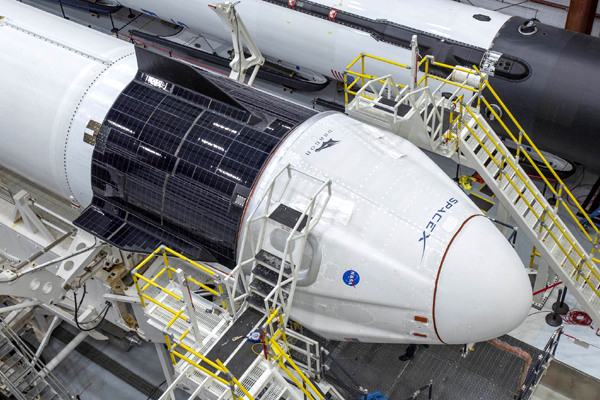
A few miles from the LLF, final preps are also being made on SpaceX's Falcon 9 rocket and Crew Dragon capsule that will send Hurley and Behnken on their way to the ISS. As shown in the pics above and below, the Crew Dragon was transported to SpaceX's Horizontal Integration Facility a few days ago and is now attached to the Falcon 9. The stacked vehicle will be rolled out to Launch Complex 39A tonight to be readied for a static fire on Friday. A Flight Readiness Review between NASA and SpaceX officials to solidify next Wednesday's launch date will be held tomorrow. Stay tuned!

The Crew Dragon Demo-2 capsule prior to it being attached to its Falcon 9 rocket inside SpaceX's Horizontal Integration Facility...on May 20, 2020.
SpaceX

The Crew Dragon Demo-2 capsule is attached to its Falcon 9 rocket inside SpaceX's Horizontal Integration Facility...on May 20, 2020.
SpaceX

The completed Falcon 9 Demo-2 rocket prior to it being rolled from the Horizontal Integration Facility to the launch pad at LC-39A...on May 20, 2020.
SpaceX

Thursday, May 14, 2020

Artemis 1 Update: SLS Core Stage Booster to Resume Green Run Preps After Coronavirus-related Hiatus...

With the Space Launch System's core stage booster behind them, two engineers work atop the B-2 Test Stand at NASA's Stennis Space Center in Bay St. Louis, Mississippi.
NASA / SSC

NASA Takes Preliminary Steps to Resume SLS Core Stage Testing Work (Press Release)

NASA resumed Green Run testing activities this week on the first flight stage of its Space Launch System (SLS) rocket, with the return of limited crews to perform work at the agency’s Stennis Space Center in Bay St. Louis, Mississippi.

“This is an important step toward resuming the critical work to support NASA’s Artemis program that will land the first woman and the next man on the south pole of the Moon by 2024,” Stennis Center Director Rick Gilbrech said. “Though Stennis remains in Stage 4 of NASA’s COVID-19 Response Framework, we assessed state and local conditions and worked with agency leadership to develop a plan to safely and methodically increase critical on-site work toward the launch of the next great era of space exploration.”

Stennis moved to Stage 4 on March 20, with only personnel needed to perform mission-essential activities related to the safety and security of the center allowed on site. NASA’s Marshall Space Flight Center in Huntsville, Alabama, and its Michoud Assembly Facility in New Orleans, which are building SLS, also are in Stage 4.

“The test facility has been in standby mode, so we allotted two days to reestablish some facility support of mechanical and electrical systems that will also assist the vehicle contractors in performing their operations,” said Barry Robinson, project manager for the B-2 Test Stand SLS core stage Green Run testing at Stennis.

Reestablishing, or “waking up,” the Stennis B-2 Test Stand systems in the days ahead includes restoring facility power and controls, as well as ensuring pressurized gas systems are at proper levels for SLS operators to proceed with testing activities.

“Michoud has been cleaning and preparing the rocket manufacturing facility for critical production restart of the SLS core stage and the Orion capsule,” said Michoud Director Robert Champion.

According to Julie Bassler, SLS stages project manager responsible for the core stage work at Stennis, Michoud and Marshall, Marshall also is resuming critical flight software and hardware testing.

Returning workers were trained on general safety procedures, personal protective equipment requirements, and self-monitoring. Site personnel also installed signs and markings to indicate where employees should stand and sit during upcoming activities.

“We want to make sure employees are armed with the appropriate information to be effective on the job and return safely to their families,” Robinson said.

All sites are closely following CDC guidance to safely operate and protect the health and welfare of all employees. Michoud plans to transition to Stage 3 and operate in that stage for 30 days, in coordination with local government plans. Marshall remains at Stage 4.

Stennis plans for 30 days of limited crew activity on site in anticipation of the center’s transition from Stage 4 to Stage 3. Once that transition occurs, increases to on-site work will continue slowly and methodically. The focus then will shift to preparing for the avionics power-up test – the next in a series of core stage Green Run testing milestones. According to Robinson, it’s too early to calculate a precise schedule for the various test milestones.

“Like so many others, in so many places, we’re operating under a new normal. We’re working now to determine exactly what that looks like,” he explained. “The virus, and our knowledge of safety as it relates to the virus, will dictate any changes we consider and implement. We will adjust tasks based on the most current information and guidance.”

Green Run represents the first top-to-bottom integrated test of all flight core stage systems prior to its maiden Artemis I flight. All testing will be conducted on the B-2 Test Stand in the coming months and will culminate with an eight-minute, full-duration hot fire of the core stage with its four RS-25 engines, as during an actual launch.

Source: NASA.Gov

****

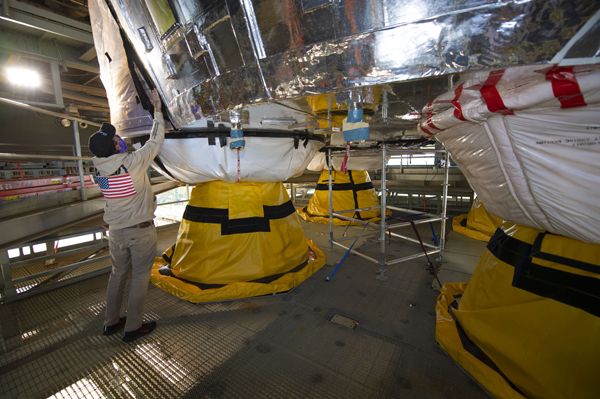
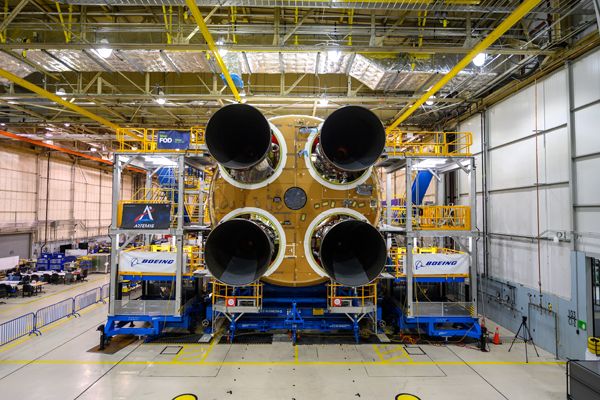
Near the bottom of the B-2 Test Stand, an engineer stands next to the four RS-25 engines at the base of the Space Launch System's core stage booster...at NASA's Stennis Space Center in Bay St. Louis, Mississippi.
NASA / SSC

Wednesday, May 13, 2020

T-Minus 2 WEEKS Till Astronauts Head to Low-Earth Orbit from American Soil Once More!

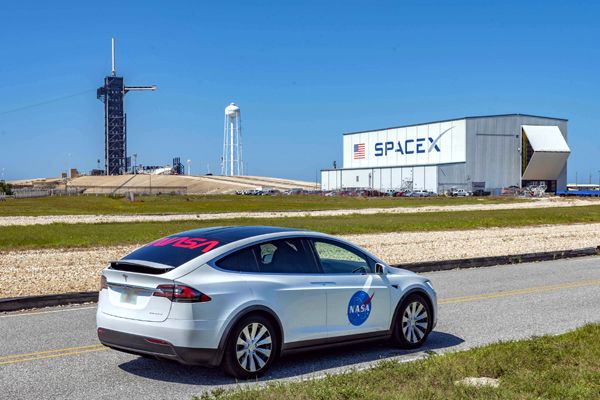
The Tesla Model X that astronauts will ride in on launch day is displayed with SpaceX's Horizontal Integration Facility at Launch Complex 39A in the background.
NASA

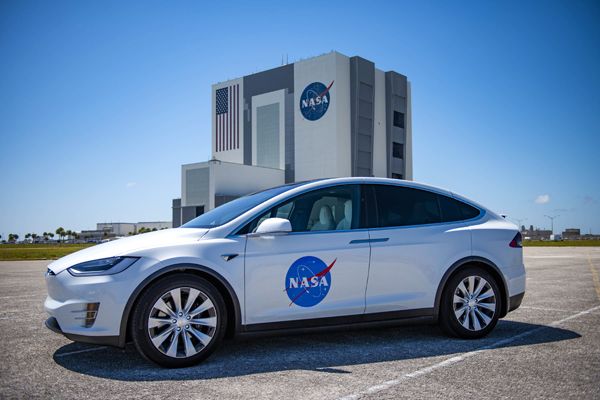
Today marks 14 days till astronauts launch to the International Space Station (ISS) from U.S. soil for the first time in almost 9 years (assuming that the weather cooperates and there are no technical glitches on May 27, of course)! In commemoration of this milestone, NASA Administrator Jim Bridenstine tweeted these great photos of the Tesla Model X that astronauts Douglas G. Hurley and Robert L. Behnken will ride in on a trip from their Kennedy Space Center crew quarters to Launch Complex 39A...where the Falcon 9 rocket and Crew Dragon capsule will await them for their historic voyage to the ISS.

The Tesla Model X that astronauts will ride in on launch day is displayed with Kennedy Space Center's Vehicle Assembly Building in the background.
NASA

The excitement is building! I look forward to watching this historic launch via the SpaceX webcast two weeks from now. And of course, I look forward to viewing the first crewed launch of Boeing's Starliner capsule via NASA TV. Ditto with the maiden flight of NASA's Space Launch System later next year!

Saturday, May 2, 2020

SpaceShipTwo Update: VSS Unity Continues Testing as Powered Flights with Paying Passengers Aboard Loom Closer...

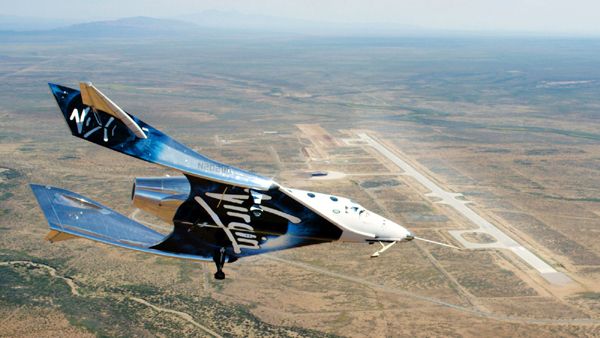
VSS Unity approaches the runway at New Mexico's Spaceport America after conducting a successful glide test.
Virgin Galactic

Virgin Galactic’s SpaceShipTwo Completes First Flight From Spaceport America (Press Release - May 1)

SpaceShipTwo goes solo in New Mexico airspace

LAS CRUCES, N.M.– Virgin Galactic Holdings, Inc. (NYSE: SPCE) (“Virgin Galactic” or “the Company”) and The Spaceship Company (“TSC”) today announced the successful completion of its first SpaceShipTwo test flight from Spaceport America.

This glide flight marks the inaugural solo flight of VSS Unity in New Mexico and as such is an important flight test milestone in preparation for commercial service.

On SpaceShipTwo’s flight deck were Dave Mackay and CJ Sturckow who, together with the team in Mission Control, executed some of the key elements of a spaceflight profile. These included take-off and landing along with high-altitude release from the mothership, VMS Eve, which was piloted by Michael Masucci and Kelly Latimer.

The flight took off from the Spaceport America runway, with VSS Unity attached to the carrier aircraft, VMS Eve. The vehicles climbed to an altitude of 50,000ft before Unity was released, at which point VSS Unity flew freely for the first time in New Mexico airspace. The spaceship achieved a glide speed of Mach 0.70 and completed multiple test-points, before touching back down smoothly for a runway landing at Spaceport America.

This test flight was conducted under a set of stringent operational protocols to ensure safety against COVID-19. Its successful execution was made possible by a concerted effort to redesign all the operational elements required for safe flight test while meeting new health and wellness protocols. These protocols include changes to the work areas and procedures to enforce social distancing as advised by state guidelines as well as universal mask usage.

This flight milestone represents a major achievement which has been in the planning since SpaceShipTwo relocated to Virgin Galactic’s New Mexico commercial headquarters in February. Virgin Galactic also fully concluded the relocation of its spaceline operations team and their families to New Mexico.

This glide flight provided the first opportunity to test all the components required to fly the carrier aircraft and spaceship in glide configuration, from a new home base and in new airspace. Dave and CJ performed a series of maneuvers with VSS Unity designed to gather data about performance and handling qualities in order to enhance our aerodynamic modeling and verify against similar maneuvers that were performed earlier in Unity’s test flight program. The flight test also provided an opportunity for the pilots and spaceflight operations team to continue familiarization with the new airspace around the Gateway to Space and a chance to capture valuable in-flight data and conduct further pilot training.

Friday’s flight successfully completed all test objectives. Virgin Galactic would like to express its thanks to New Mexico Spaceport Authority (NMSA), the White Sands Missile Range (WSMR), Federal Aviation Administration (FAA) Albuquerque Flight Standards District Office (FSDO), and the FAA Air Traffic Control Center in Albuquerque for smooth coordination and efficient integration.

Preparation for the next flight will now begin, starting with an in depth analysis of today’s flight data.

George Whitesides, CEO of Virgin Galactic and The Spaceship Company said, “I’d like to congratulate our team for reaching this flight milestone, especially during these challenging times. I am grateful for the commitment displayed by everyone involved, not only in helping to support relief efforts in both New Mexico and California, but also for the dedication and creativity which will allow us to continue safely towards our goal of commercial launch.”

“Today’s VSS Unity flight is another exciting milestone for Virgin Galactic’s progress in New Mexico. We are extremely happy and proud of Virgin Galactic, not only for today’s success but also for the exceptional way they have integrated into NM and supported the region and State during this stressful time dealing with the COVID-19 pandemic. Spaceport America and Virgin Galactic have adhered to new guidelines set by Governor Michelle Lujan Grisham to include social distancing and wearing masks. A big thank you to our foundational partner at Spaceport America!” said Dan Hicks, Executive Director of the New Mexico Spaceport Authority.

Source: Virgin Galactic

Friday, May 1, 2020

NASA Plants the Seeds for Future Deep Space Missions with the Space Launch System...

The Space Launch System's core stage booster that will fly on the Artemis 1 mission has all four of its RS-25 engines installed...as of November 6, 2019.
NASA / Eric Bordelon

NASA Commits to Future Artemis Missions with More SLS Rocket Engines (Press Release)

NASA has awarded a contract to Aerojet Rocketdyne of Sacramento, California, to manufacture 18 additional Space Launch System (SLS) RS-25 rocket engines to support Artemis missions to the Moon.

The follow-on contract to produce 18 engines is valued at $1.79 billion. This includes labor to build and test the engines, produce tooling and support SLS flights powered by the engines. This modifies the initial contract awarded in November 2015 to recertify and produce six new RS-25 engines and brings the total contract value to almost $3.5 billion with a period of performance through Sept. 30, 2029, and a total of 24 engines to support as many as six additional SLS flights.

“This contract allows NASA to work with Aerojet Rocketdyne to build the rocket engines needed for future missions,” said John Honeycutt, the SLS program manager at NASA’s Marshall Space Flight Center in Huntsville, Alabama. “The same reliable engines that launched more than 100 space shuttle missions have been modified to be even more powerful to launch the next astronauts who will set foot on the lunar surface during the Artemis missions.”

Each SLS rocket uses four RS-25 engines, providing a total of 2 million pounds of thrust to send SLS to space. The SLS rocket leverages the assets, capabilities, and experience of NASA’s Space Shuttle Program, using 16 existing RS-25 shuttle engines for the first four SLS missions. These engines were updated with new controllers – the brains that control the engine – and upgraded and tested to fly at the higher performance level necessary to launch the SLS, which is much larger and more powerful than the shuttle.

The rocket engines are mounted at the base of the 212-foot-tall core stage, which holds more than 700,000 gallons of propellant and provides the flight computers that control the rocket’s flight. The engines for the Artemis I mission to the Moon have already been assembled as part of the core stage, which is undergoing Green Run testing.

“We’ve already begun production on the first six new RS-25 engines,” said Johnny Heflin, the SLS engines manager. “Aerojet Rocketdyne has restarted the production lines, established a supplier base and is building engines using advanced techniques that reduce both the cost and time for manufacturing each engine.”

The engines are built at Aerojet Rocketdyne’s factory in Canoga Park, California. Working with NASA, Aerojet has implemented a plan to reduce the cost of the engines by as much as 30% by using more advanced manufacturing techniques to modify some of the rocket components. Some of these modified components have already been tested during engine tests that replicate the conditions of flight.The new digital controllers are built by Honeywell Aerospace in Clearwater, Florida, a major subcontractor to Aerojet Rocketdyne.

The SLS rocket, Orion spacecraft, Gateway and Human Landing System are part of NASA’s backbone for deep space exploration. Work is well underway on both the Artemis I and II rockets. The Artemis I core stage and its RS-25 engines are in the B-2 test stand at NASA’s Stennis Space Center near Bay St. Louis, Mississippi. Here, the stage is undergoing Green Run testing, an integrated test of the entire new stage that culminates with the firing of all four RS-25 engines. Upon completion of the test, NASA’s Pegasus barge will take the core stage to NASA’s Kennedy Space Center in Florida where it will be integrated with other parts of the rocket and Orion for Artemis I.

The Artemis program is the next step in human space exploration. It’s part of America’s broader Moon to Mars exploration approach, in which astronauts will explore the Moon and experience gained there to enable humanity’s next giant leap, sending humans to Mars.

Source: NASA.Gov

****

The Space Launch System's core stage booster is installed inside the B-2 Test Stand at NASA's Stennis Space Center in Mississippi...during a process that took place on January 21 and 22, 2020.
NASA / SSC