Thursday, November 9, 2023

NASA's Moon Exploration Initiative Has Welcomed Its 32nd Member...

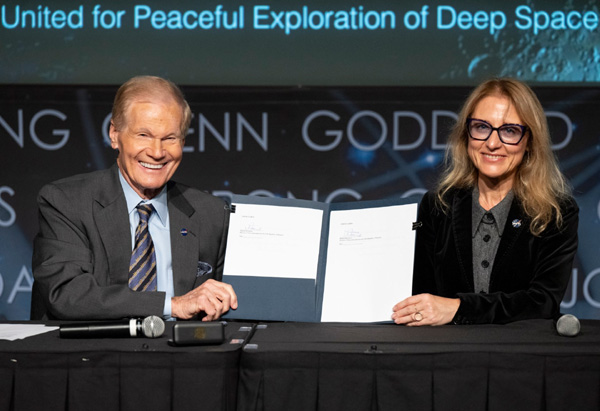
Bulgaria is officially a member of the Artemis Accords...as of November 9, 2023.
NASA / Keegan Barber

Bulgaria Signs Artemis Accords at NASA Headquarters; Joins 31 Nations (Press Release)

NASA Administrator Bill Nelson participated in a signing ceremony on Thursday with Bulgaria’s Milena Stoycheva, minister of innovation and growth, as her country became the 32nd nation to sign the Artemis Accords.

The Artemis Accords establish a practical set of principles to guide space exploration cooperation among nations, including those participating in NASA’s Artemis program.

Also participating in the event at NASA Headquarters in Washington were NASA Deputy Administrator Pam Melroy, Georgi Panayotov, ambassador of Bulgaria to the United States and Sonata Coulter, deputy assistant secretary, U.S. Department of State.

“NASA is honored to welcome Bulgaria as the 32nd nation to sign the Artemis Accords,” said Nelson. “The global partnerships made in the Artemis era will create possibilities that benefit members of the Artemis Generation in both our countries – and around the world. Bulgaria’s leadership will help ensure humanity’s journey to the Moon and beyond is done peacefully, safely and transparently.”

NASA, in coordination with the U.S. Department of State, established the Artemis Accords in 2020 together with seven other original signatories. Since then, the Accords signatories have held focused discussions on how best to implement the Artemis Accords principles.

“It is a historical moment for Bulgaria to join the Artemis Accords. We believe that pushing the boundaries of human quest in space with the support of AI and deep technologies will ensure peaceful and sustainable coexistence on Earth. For years, NASA has been a symbol of aspiration for development through technology and spirit. It is an honor for us to join with our human and artificial intelligence for a peaceful journey into new territories,” said Stoycheva.

The Artemis Accords reinforce and implement key obligations in the 1967 Outer Space Treaty. They also strengthen the commitment by the United States and signatory nations to the Registration Convention, the Rescue and Return Agreement, as well as best practices and norms of responsible behavior that NASA and its partners have supported, including the public release of scientific data.

More countries are expected to sign the Artemis Accords in the months and years ahead, as NASA continues to work with its international partners to establish a safe, peaceful and prosperous future in space. Working with both new and existing partners adds new energy and capabilities to ensure that the entire world can benefit from our journey of exploration and discovery.

****
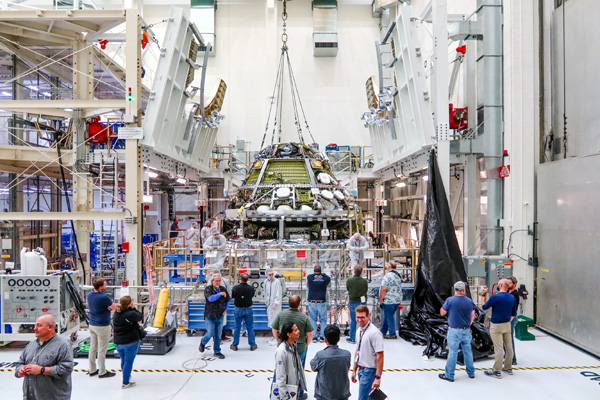
Inside the Neil Armstrong Operations and Checkout Building at NASA's Kennedy Space Center in Florida, the Orion capsule is mated to its European Service Module for the Artemis 2 mission...on October 19, 2023.
NASA

Wednesday, November 8, 2023

Photos of the Day #2: The Second Solid Rocket Motor Is Now Installed at Endeavour's Permanent Home!

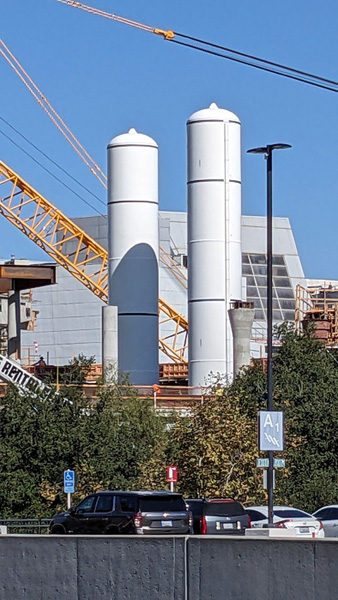
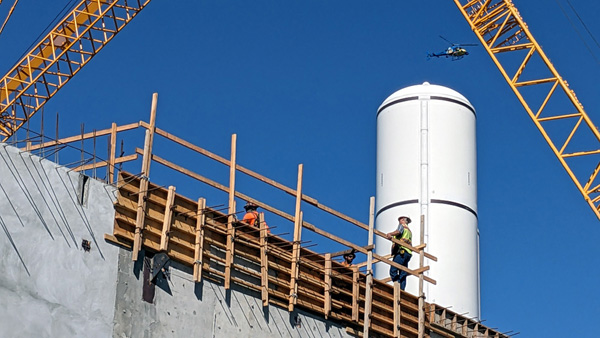
Space shuttle Endeavour's twin solid rocket motors stand tall at the construction site for the California Science Center's Samuel Oschin Air and Space Center in Los Angeles...on November 8, 2023.
Richard T. Par

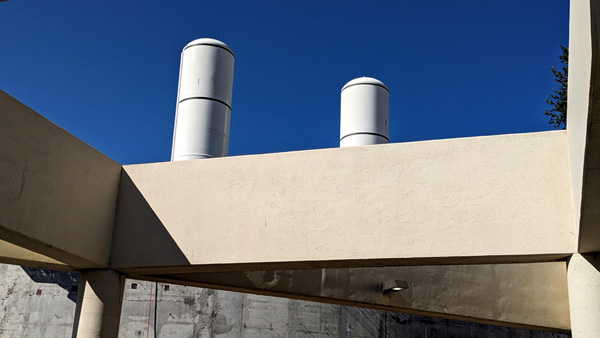
Just thought I'd share these images that I took earlier today of space shuttle Endeavour's two solid rocket motors (SRMs) after the second booster was installed at the construction site for the California Science Center's Samuel Oschin Air and Space Center in Los Angeles this morning!

With both 116-foot-tall booster hardware now in place, scaffolding will immediately be erected around both rockets as workers prepare for the installation of the forward assemblies, or nose cones, onto the SRMs. It remains to be seen if this milestone occurs by Thanksgiving.

And once the solid rocket boosters (SRBs) are finally made whole—with them reaching a height of 149 feet with the addition of the nose cones—the process will soon begin to prepare the SRBs for the arrivals of Endeavour herself and her external fuel tank, ET-94, to the construction site next January.

Stay tuned!

Space shuttle Endeavour's twin solid rocket motors stand tall at the construction site for the California Science Center's Samuel Oschin Air and Space Center in Los Angeles...on November 8, 2023.
Richard T. Par

Space shuttle Endeavour's twin solid rocket motors stand tall at the construction site for the California Science Center's Samuel Oschin Air and Space Center in Los Angeles...on November 8, 2023.
Richard T. Par

One of space shuttle Endeavour's twin solid rocket motors stands tall at the construction site for the California Science Center's Samuel Oschin Air and Space Center in Los Angeles...on November 8, 2023.
Richard T. Par

Space shuttle Endeavour's twin solid rocket motors stand tall at the construction site for the California Science Center's Samuel Oschin Air and Space Center in Los Angeles...on November 8, 2023.
Richard T. Par

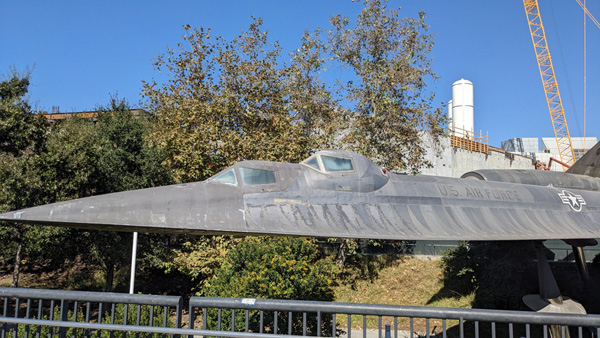
With a retired A-12 Blackbird in the foreground, space shuttle Endeavour's twin solid rocket motors stand tall at the construction site for the California Science Center's Samuel Oschin Air and Space Center in Los Angeles...on November 8, 2023.
Richard T. Par

With their two nose cones visible in the background, space shuttle Endeavour's twin solid rocket motors stand tall at the construction site for the California Science Center's Samuel Oschin Air and Space Center in Los Angeles...on November 8, 2023.
Richard T. Par

The two nose cones for space shuttle Endeavour's twin solid rocket boosters will soon be ready for installation at the construction site for the California Science Center's Samuel Oschin Air and Space Center in Los Angeles...on November 8, 2023.
Richard T. Par

The two nose cones for space shuttle Endeavour's twin solid rocket boosters will soon be ready for installation at the construction site for the California Science Center's Samuel Oschin Air and Space Center in Los Angeles...on November 8, 2023.
Richard T. Par

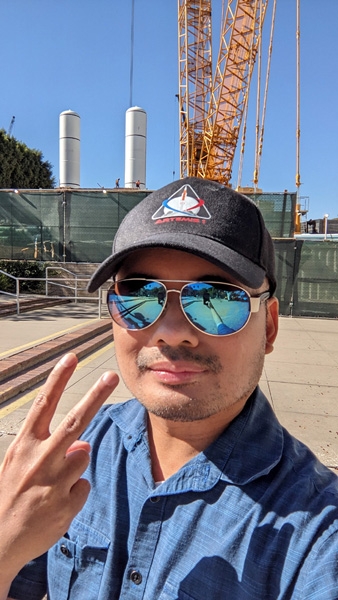
A selfie I took with space shuttle Endeavour's twin solid rocket motors at the California Science Center in Los Angeles...on November 8, 2023.
Richard T. Par

Tuesday, November 7, 2023

Photos of the Day: One SRM Has Been Installed at Endeavour's Permanent Home, with One More to Go...

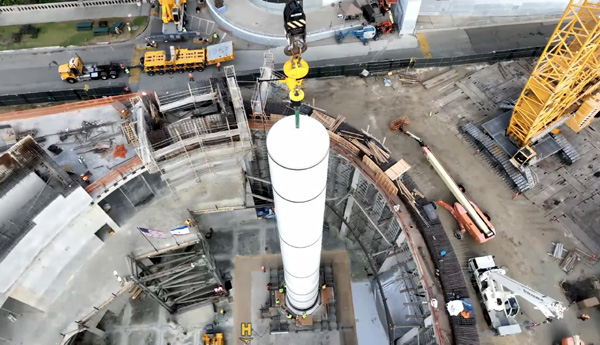
The first of two solid rocket motors that will form the backbone of Endeavour's completed space shuttle stack is installed inside the construction site for the California Science Center's Samuel Oschin Air and Space Center in Los Angeles...on November 7, 2023.
California Science Center

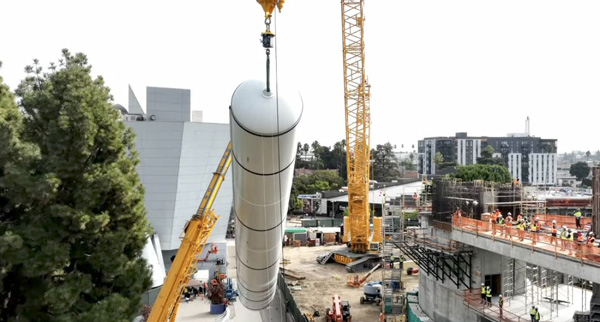
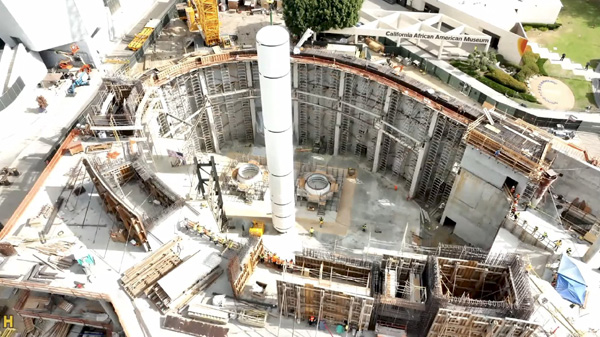
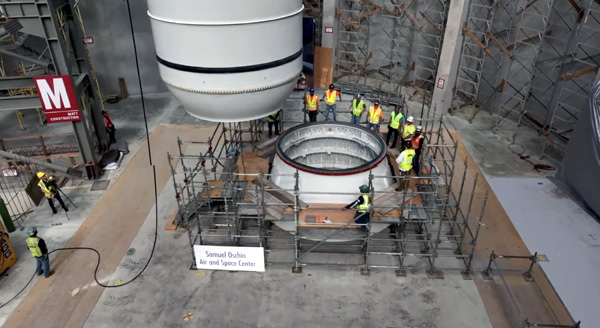
Just thought I'd share these screenshots showing the first of two solid rocket motors (SRMs) that will be installed inside the construction site for Endeavour's final home at the California Science Center—the Samuel Oschin Air and Space Center—in Los Angeles over the next two days.

These images come courtesy of a live YouTube webcast provided by the Science Center this morning, as the 116-foot-long motor (which will grow to 149 feet in length once its nose cone and aft skirt are attached, becoming a full-fledged solid rocket booster) was raised vertically and moved into the final spot where the completed space shuttle stack will stand inside the Air and Space Center. The giant yellow crane used for today's activities came from NASA's Stennis Space Center in Mississippi...where the crane was used to hoist the Space Launch System's core stage booster into Stennis' B-2 test stand for the Green Run campaign that lasted between mid-2020 and early 2021.

As of right now, I'm not sure when the final SRM will be installed inside the Air and Space Center. The move may occur tomorrow, but I'm hoping that it'll happen on Thursday instead for personal reasons.

Stay tuned!

The first of two solid rocket motors that will form the backbone of Endeavour's completed space shuttle stack is lifted from its transporter to prep for the move to the construction site for the Samuel Oschin Air and Space Center in Los Angeles...on November 7, 2023.
California Science Center

The first of two solid rocket motors that will form the backbone of Endeavour's completed space shuttle stack is rotated into vertical position before it is moved to the construction site for the Samuel Oschin Air and Space Center in Los Angeles...on November 7, 2023.
California Science Center

The first of two solid rocket motors that will form the backbone of Endeavour's completed space shuttle stack is about to be lowered into the construction site for the Samuel Oschin Air and Space Center in Los Angeles...on November 7, 2023.
California Science Center

The first of two solid rocket motors that will form the backbone of Endeavour's completed space shuttle stack is lowered into the construction site for the Samuel Oschin Air and Space Center in Los Angeles...on November 7, 2023.
California Science Center

The first of two solid rocket motors that will form the backbone of Endeavour's completed space shuttle stack is lowered into the construction site for the Samuel Oschin Air and Space Center in Los Angeles...on November 7, 2023.
California Science Center

The first of two solid rocket motors that will form the backbone of Endeavour's completed space shuttle stack is about to be placed atop its aft skirt inside the Samuel Oschin Air and Space Center's construction site in Los Angeles...on November 7, 2023.
California Science Center

The first of two solid rocket motors that will form the backbone of Endeavour's completed space shuttle stack is now secured atop its aft skirt inside the Samuel Oschin Air and Space Center's construction site in Los Angeles...on November 7, 2023.
California Science Center

Saturday, November 4, 2023

Honoring a Space Explorer Who Was Integral to NASA's 'Finest Hour' 53 Years Ago...

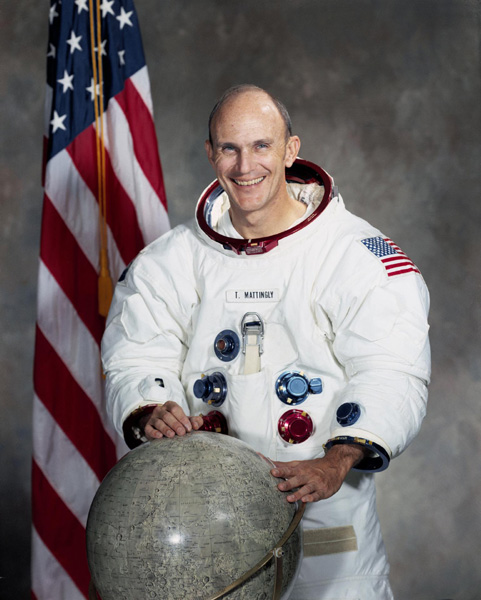
A NASA portrait of former Apollo and space shuttle astronaut Thomas K. Mattingly II...who helped saved the crew of Apollo 13 in April of 1970.
NASA

NASA Administrator Remembers Apollo Astronaut Thomas K. Mattingly II (Press Release - November 2)

The following is a statement from NASA Administrator Bill Nelson on the passing of former NASA astronaut Rear Adm. (ret.) Thomas K. (TK) Mattingly II.

“We lost one of our country’s heroes on October 31. NASA astronaut TK Mattingly was key to the success of our Apollo Program, and his shining personality will ensure he is remembered throughout history.

“Beginning his career with the U.S. Navy, TK received his wings in 1960 and flew various aircraft across multiple assignments. Once he joined the Air Force Aerospace Research Pilot School as a student, NASA chose him to be part of the astronaut class in 1966. Before flying in space, he aided the Apollo Program working as the astronaut support crew and took leadership in the development of the Apollo spacesuit and backpack.

“His unparalleled skill as a pilot aided us when he took on the role of command module pilot for Apollo 16 and spacecraft commander for space shuttle missions STS-4 and STS 51-C. The commitment to innovation and resilience toward opposition made TK an excellent figure to embody our mission and our nation’s admiration.

“Perhaps his most dramatic role at NASA was after exposure to rubella just before the launch of Apollo 13. He stayed behind and provided key real-time decisions to successfully bring home the wounded spacecraft and the crew of Apollo 13 – NASA astronauts James Lovell, Jack Swigert and Fred Haise.

“TK’s contributions have allowed for advancements in our learning beyond that of space. He described his experience in orbit by saying, ‘I had this very palpable fear that if I saw too much, I couldn’t remember. It was just so impressive.’ He viewed the universe’s vastness as an unending forum of possibilities.

As a leader in exploratory missions, TK will be remembered for braving the unknown for the sake of our country’s future.”

****

Friday, November 3, 2023

SpaceShipTwo Update: GALACTIC 05 Is in the Books...

The Galactic 05 passengers enjoy the view outside of VSS Unity's windows during her flight in suborbital space...on November 2, 2023.
Virgin Galactic

Virgin Galactic Completes Sixth Successful Spaceflight in Six Months (Press Release - November 2)

Flight Showcases Company’s Unique Suborbital Science-Lab Capabilities

ORANGE COUNTY, Calif. – Virgin Galactic Holdings, Inc. (NYSE: SPCE) (“Virgin Galactic” or the “Company”) today announced the completion of its sixth space mission in six months and tenth to date. The Galactic 05 mission saw Virgin Galactic’s spaceship converted into a suborbital lab for space-based scientific research for the second time.

Michael Colglazier, CEO of Virgin Galactic, said: “Providing researchers with reliable and repeatable access to a high-quality microgravity environment is vital to our mission of expanding human knowledge and enabling scientific discoveries. We are proud to support the work of the Southwest Research Institute and International Institute for Astronautical Sciences with today’s flight, and we will use insights from the mission to enhance the research capabilities of our future Delta-class spaceships. We look forward to playing an increasingly important role in space research in the years ahead.”

Onboard Galactic 05:

· Astronaut 020 – Dr. Alan Stern, U.S. Planetary Scientist and Associate Vice President in Southwest Research Institute’s (SwRI) Space Sector

· Astronaut 021 – Kellie Gerardi, U.S. Payload Specialist and Bioastronautics Researcher for the International Institute for Astronautical Sciences (IIAS)

· Astronaut 022 – Ketty Pucci-Sisti Maisonrouge, Private Astronaut

Dr. Alan Stern, U.S. Planetary Scientist and Associate Vice President in Southwest Research Institute’s (SwRI) Space Sector, said: “The success of this mission is another important step in the development of the scientific and educational use cases for commercial suborbital vehicles. The potential here is literally astronomical.”

Dr. Stern flew with two human-tended experiments, including a biomedical harness to collect physiological data related to human spaceflight. He also conducted practice routines and procedures in preparation for a future NASA-funded suborbital research flight.

Kellie Gerardi, U.S. Payload Specialist and Bioastronautics Researcher for the International Institute for Astronautical Sciences (IIAS), said: “The suborbital science potential for Institutes like ours is unprecedented and I’m also struck by the broader societal impact of commercial human spaceflight — after today’s mission, Virgin Galactic is now responsible for producing 10% of the world’s female astronauts, and I look forward to seeing that number soar for my daughter’s generation.”

Gerardi flew with three payloads, two of which evaluated novel healthcare technologies in microgravity conditions through the collection of biometric data. The third payload examined how confined fluid behaves to inform future healthcare technologies in space.

Galactic 05 was Virgin Galactic’s sixth spaceflight carrying microgravity and space-based research and its second in 2023, following Galactic 01, a research mission with the Italian Air Force and National Research Council.

VSS Unity was piloted by Commander Mike Masucci and Pilot Kelly Latimer, with Astronaut Instructor Colin Bennett on board. VMS Eve was piloted by Commander Jameel Janjua and Pilot Andy Edgell.

Galactic 05 In-Flight Facts:

Take-off Time: 9:00 AM, MDT (8:00 AM, PDT)

Altitude at Release: 44,701 feet (13,625 meters)

Apogee: 54.2 miles (87.2 kilometers)

Top Speed: Mach 2.96

Landing Time: 9:59 AM, MDT (8:59 AM, PDT)

The Company will now proceed with post-flight analysis and routine as well as planned annual vehicle inspections before re-commencing standard pre-flight readiness procedures ahead of its next commercial space mission, Galactic 06, scheduled for January next year.

Source: Virgin Galactic

****

Thursday, November 2, 2023

Iceland Is Also the Latest Member to Join NASA's Moon Exploration Initiative...

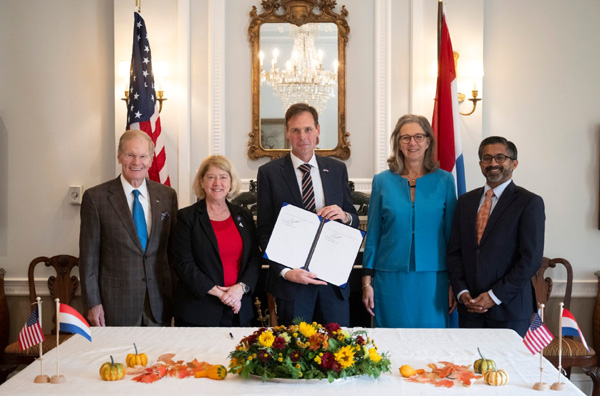
The Netherlands is officially a member of the Artemis Accords...as of November 1, 2023.
NASA / Joel Kowsky

NASA Welcomes Netherlands as Newest Artemis Accords Signatory (Press Release - November 1)

During a ceremony at the Dutch Ambassador’s Residence in Washington on Wednesday, the Netherlands became the 31st country to sign the Artemis Accords. NASA Administrator Bill Nelson participated in the signing ceremony for the agency, and Netherlands Space Office (NSO) director Harm van de Wetering signed on behalf of the Netherlands.

NASA Deputy Administrator Pam Melroy and the following were also in attendance:

- Chirag Parikh, executive secretary of the U.S. National Space Council

- Birgitta Tazelaar, ambassador of the Netherlands to the United States

“NASA welcomes the Netherlands as the newest and 31st member of the Artemis Accords family,” said Nelson. “It takes global leadership and cooperation to ensure the peaceful, transparent exploration of space for the Artemis generation and beyond. As one of America’s oldest allies, NASA is proud to expand our partnership with the Netherlands and build a future defined by limitless opportunity and discovery.”

The Artemis Accords establish a practical set of principles to guide space exploration cooperation among nations, including those participating in NASA’s Artemis program.

“NASA and the Netherlands have been strong partners in space from the early days of space flight. Pushing boundaries by technology brings new responsibilities. By signing the Artemis Accords, we underline the values we share in space, and we acknowledge we have a common responsibility,” said van de Wetering.

NASA, in coordination with the U.S. Department of State, established the Artemis Accords in 2020 together with seven other original signatories. Iceland became the 30th country to sign the Artemis Accords in October.

The Artemis Accords reinforce and implement key obligations in the 1967 Outer Space Treaty. They also strengthen the commitment by the United States and signatory nations to the Registration Convention, the Rescue and Return Agreement, as well as best practices and norms of responsible behavior that NASA and its partners have supported, including the public release of scientific data.

Signatories are also discussing implementation of key Accords principles, including how best to avoid unintended interference on the lunar surface.

More countries are expected to sign the Artemis Accords in the months and years ahead, as NASA continues to work with its international partners to establish a safe, peaceful and prosperous future in space. Working with both new and existing partners adds new energy and capabilities to ensure that the entire world can benefit from our journey of exploration and discovery.

****

Tuesday, October 31, 2023

Photo of the Day: A Dream Chaser Called Tenacity...

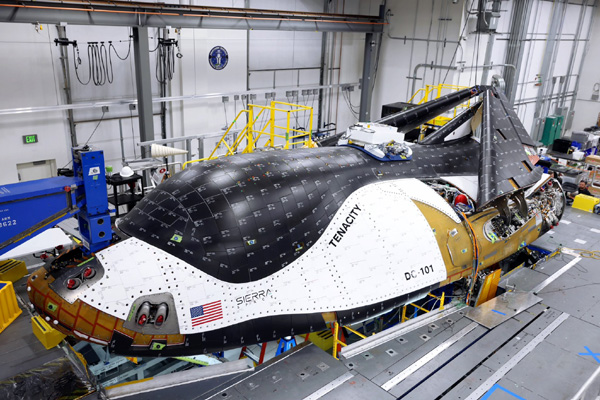
The Dream Chaser Tenacity vehicle is nearly complete at Sierra Space's manufacturing facility in Colorado...as of October 31, 2023.
Sierra Space

Happy Halloween, everyone! Just thought I'd share this great photo that was posted by Sierra Space on X (formerly known as Twitter) today.

Dream Chaser Tenacity, an unmanned spaceplane that will hopefully fly aboard United Launch Alliance's Vulcan Centaur rocket to the International Space Station next year, is close to completion at Sierra Space's manufacturing facility in Colorado. Tenacity will soon head to the Neil Armstrong Test Facility at NASA's Glenn Research Center in Ohio to undergo environmental testing...before the winged cargo freighter is transported to Cape Canaveral Space Force Station in Florida for launch preparation.

As shown below, Sierra Space is also making significant progress on the construction of the second Dream Chaser vehicle. Very exciting!

Wednesday, October 25, 2023

Image of the Day: Testing Continues at Launch Complex 39B Before the Next Flight of SLS...

At Kennedy Space Center's Launch Complex 39B in Florida, a water deluge test is conducted on the mobile launcher as it continues to be prepped for NASA's Artemis 2 mission...on October 24, 2023.
NASA / Kim Shiflett

Artemis II Water Deluge Test (Photo Release - October 24)

NASA’s Exploration Ground Systems conducts a water flow test with the mobile launcher at Kennedy Space Center’s Launch Complex 39B in Florida on October 24, 2023. It is the third in a series of tests to verify that the overpressure protection and sound suppression system is ready for launch of the Artemis II mission.

During liftoff, 400,000 gallons of water will rush onto the pad to help protect NASA’s SLS (Space Launch System) rocket, Orion spacecraft, mobile launcher and launch pad from any over pressurization and extreme sound produced during ignition and liftoff.

Source: NASA.Gov

****

Tuesday, October 24, 2023

The Vehicle That Will Fly the Next Astronauts to the Moon Is Now Whole...

Inside the Neil Armstrong Operations and Checkout Building at NASA's Kennedy Space Center in Florida, the Orion capsule is mated to its European Service Module for the Artemis 2 mission...on October 19, 2023.
NASA

Artemis II Orion Crew and Service Modules Joined Together (News Release - October 23)

On October 19, the Orion crew and service modules for the Artemis II mission were joined together inside the Neil Armstrong Operations and Checkout Building at NASA’s Kennedy Space Center in Florida.

After successfully completing hardware installations and testing over the past several months, engineers connected the two major components of Orion that will fly NASA astronauts Reid Wiseman, Victor Glover and Christina Koch, along with CSA (Canadian Space Agency) astronaut Jeremy Hansen on a mission around the Moon and bring them home safely.

Now that the crew and service modules are integrated, the team will power up the combined crew and service module for the first time. After power-on tests are complete, Orion will begin altitude chamber testing, which will put the spacecraft through conditions as close as possible to the environment it will experience in the vacuum of deep space.

Source: NASA.Gov

Monday, October 23, 2023

CST-100 Update: More Info on Starliner's First Crewed Mission to the ISS Next Spring...

The CST-100 Starliner capsule is about to dock with the International Space Station during Orbital Flight Test-2...on May 20, 2022.
Serg Korsakov

Progress Continues Toward NASA’s Boeing Crew Flight Test to Station (News Release)

NASA and Boeing are working to complete the agency’s verification and validation activities ahead of Starliner’s first flight with astronauts to the International Space Station. While Boeing is targeting March to have the spacecraft ready for flight, teams decided during a launch manifest evaluation that a launch in April will better accommodate upcoming crew rotations and cargo resupply missions this spring.

Once the spacecraft meets the agency’s safety requirements, NASA’s Boeing Starliner Crew Flight Test (CFT) will see astronauts Butch Wilmore and Suni Williams perform the first crewed mission of the spacecraft designed to take astronauts to and from the orbital laboratory.

Ahead of CFT, Boeing has completed P213 tape removal in the upper dome of the Starliner crew compartment and work is underway to remove or remediate the tape in the lower dome of the spacecraft. These hardware remediation efforts inside the Starliner production facility at NASA Kennedy are expected to be completed during the next several weeks.

After the P213 tape remediation efforts conclude, engineers will conduct final assessments to ensure acceptable risk of any remaining tape.

A set of parachutes is on track to be delivered and installed on the CFT spacecraft by the end of this year to support the current target launch date. Separately, the team is also planning a drop test of Starliner’s updated drogue and main parachutes.

The parachutes will incorporate a planned strengthening of main canopy suspension lines and the recent design of the drogue and main parachute soft-link joints, which will increase the safety factor for the system. The drop test is planned for early 2024 based on the current parachute delivery schedule.

Boeing and NASA are also planning modifications to the active thermal control system valves to improve long-term functionality following a radiator bypass valve issue discovered during ground operations earlier this year. As discussed during a Starliner media teleconference in June, teams have modified the spacecraft hardware and identified forward work to prevent a similar issue in the future.

Options include a system purge to prevent stiction, component upgrades and operational mitigations.

Additionally, about 98% of the certification products required for the flight test are complete, and NASA and Boeing anticipate closure on remaining CFT certification products early next year. Meanwhile, NASA and Boeing have made significant progress on requirement closures related to manual crew control of the spacecraft and abort system analysis.

The latest version of Starliner’s CFT flight software completed qualification testing and is undergoing standard hardware and software integration testing inside Boeing’s Avionics and Software Integration Lab. Starliner’s crew and service modules remain mated and await continuation of standard preflight processing.

The United Launch Alliance Atlas V rocket is also in Florida at Cape Canaveral Space Force Station awaiting integration with the spacecraft.

The NASA astronauts who will fly aboard CFT continue to train for their roughly eight-day mission to the orbiting laboratory, which includes working with operations and mission support teams to participate in various simulations across all phases of flight.

Starliner completed two uncrewed flight tests, including Orbital Flight Test-2, which docked to the space station on May 21, 2022, following a launch two days prior from Kennedy. The spacecraft remained docked to the space station for four days before successfully landing at the White Sands Missile Range in New Mexico.

Source: NASA.Gov

****

At NASA's Kennedy Space Center in Florida, the CST-100 Starliner capsule for the Crew Flight Test is moved into the Hazardous Processing Area inside Boeing's Commercial Crew and Cargo Processing Facility...on February 8, 2023.
NASA