Monday, January 31, 2022

ISS Update: Looking Ahead to the Next American-made Outpost in Low-Earth Orbit...

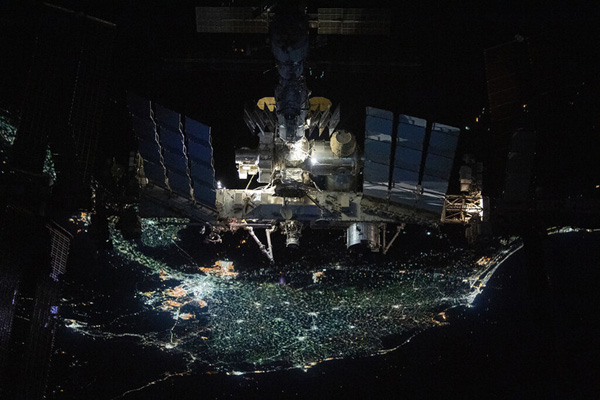
An image of the International Space Station soaring high above Egypt's Nile Delta...as seen by European Space Agency astronaut Thomas Pesquet aboard SpaceX's Crew Dragon Endeavour capsule on November 8, 2021.
NASA / ESA - Thomas Pesquet

NASA Provides Updated International Space Station Transition Plan (News Release)

The International Space Station is a unique laboratory that is returning enormous scientific, educational, and technological developments to benefit people on Earth and is enabling our ability to travel into deep space. The Biden-Harris Administration’s commitment to extend space station operations until 2030 will enable the United States to continue to reap these benefits for the next decade while U.S. industry develops commercial destinations and markets for a thriving space economy.

As NASA looks forward to a decade of results from research and technology development aboard the International Space Station, the agency is taking steps to ensure a successful transition of operations to commercial services. In response to Congressional direction, NASA has now provided an updated International Space Station Transition Report that details the goals for the next decade of station operations leading to a smooth transition to commercial services, the steps being taken to develop both the supply and demand side of the low-Earth orbit commercial economy, and the technical steps and budget required for transition.

“The International Space Station is entering its third and most productive decade as a groundbreaking scientific platform in microgravity,” said Robyn Gatens, director of the International Space Station at NASA Headquarters. “This third decade is one of results, building on our successful global partnership to verify exploration and human research technologies to support deep space exploration, continue to return medical and environmental benefits to humanity, and lay the groundwork for a commercial future in low-Earth orbit. We look forward to maximizing these returns from the space station through 2030 while planning for transition to commercial space destinations that will follow.”

Today, with U.S. commercial crew and cargo transportation systems online, the station is busier than ever. The ISS National Laboratory, responsible for utilizing 50 percent of NASA’s resources aboard the space station, hosts hundreds of experiments from other government agencies, academia, and commercial users to return benefits to people and industry on the ground. Meanwhile, NASA’s research and development activities aboard are advancing the technologies and procedures that will be necessary to send the first woman and first person of color to the Moon and the first humans to Mars.

The extension of operations to 2030 will continue to return these benefits to the United States and to humanity as a whole while preparing for a successful transition of capabilities to one or more commercially-owned and -operated LEO destinations (CLDs). NASA has entered into a contract for commercial modules to be attached to a space station docking port and awarded space act agreements for design of three free-flying commercial space stations. U.S. industry is developing these commercial destinations to begin operations in the late 2020s for both government and private-sector customers, concurrent with space station operations, to ensure these new capabilities can meet the needs of the United States and its partners.

“The private sector is technically and financially capable of developing and operating commercial low-Earth orbit destinations, with NASA’s assistance. We look forward to sharing our lessons learned and operations experience with the private sector to help them develop safe, reliable, and cost-effective destinations in space,” said Phil McAlister, director of commercial space at NASA Headquarters. “The report we have delivered to Congress describes, in detail, our comprehensive plan for ensuring a smooth transition to commercial destinations after retirement of the International Space Station in 2030.”

It is NASA’s goal to be one of many customers of these commercial destination providers, purchasing only the goods and services the agency needs. Commercial destinations, along with commercial crew and cargo transportation, will provide the backbone of the low-Earth orbit economy after the International Space Station retires.

The decision to extend operations and NASA’s recent awards to develop commercial space stations together ensure uninterrupted, continuous human presence and capabilities; both are critical facets of NASA’s International Space Station transition plan.

Source: NASA.Gov

****

Thursday, January 27, 2022

The Holy Land Has Joined NASA's Moon Exploration Initiative...

Israel Space Agency Director General Uri Oron signs the Artemis Accords during a ceremony in Tel Aviv, Israel...on January 26, 2022.
Tzipi Vilmovski

Israel Signs Artemis Accords (News Release)

In becoming the first country to sign the Artemis Accords in 2022, Israel affirmed its commitment to a common set of principles to guide cooperation among nations participating in 21st century space exploration.

"Israel already has demonstrated its commitment to Artemis with the contribution of the AstroRad radiation protection vest on Artemis I, scheduled to launch this spring,” said NASA Administrator Bill Nelson. “Today’s signing of the Artemis Accords will only serve to strengthen the long-standing U.S.-Israeli relationship in the area of space exploration and I look forward to many more years of working together to achieve our common goals for the benefit all of humanity.”

Israel Space Agency Director General Uri Oron signed the document during a ceremony Jan. 26 in Tel Aviv. Ambassador of Israel to the United States Michael Herzog, Deputy Chief of Mission for the U.S. Embassy in Jerusalem Jonathan Shrier, Israeli Minister of Innovation, Science, and Technology Orit Farkash Hacohen, and Assistant Secretary of State for Oceans and International Environmental and Scientific Affairs Monica P. Medina participated in the event remotely, along with Nelson and NASA Deputy Administrator Pam Melroy.

“Today, space once again unveils its enormous potential and endless opportunities for Israel and for the entire world in the fields of innovation, technology, and diplomacy,” said Oron. “I am convinced that the Artemis program will promote humanity a step further, not only in space but also here on Earth. The Israel Space Agency will continue to promote collaborations in research, science, innovation and economy within the framework of the Artemis Accords between Israeli organizations and our international partners.”

Israel joins more than a dozen countries that have signed the Artemis Accords, which will guide space exploration cooperation among nations participating in NASA’s 21st century lunar exploration plans.

"I congratulate the director of the Israel Space Agency on signing the Artemis Accords as Israel joins the most ambitious, complex, and expansive space program in the world,” said Farkash Hacohen. “The signing of the Accords is another building block in our relationship with the United States, our greatest friend in the world."

NASA, in coordination with the U.S. Department of State, announced the establishment of the Artemis Accords in 2020. The Artemis Accords reinforce and implement the 1967 Treaty on Principles Governing the Activities of States in the Exploration and Use of Outer Space, Including the Moon and Other Celestial Bodies, otherwise known as the Outer Space Treaty. They also reinforce the commitment by the United States and partner nations to the Registration Convention, the Agreement on the Rescue of Astronauts, and other norms of behavior that NASA and its partners have supported, including the public release of scientific data.

"This signing ceremony, taking place following the Ilan Ramon International Space Conference, also celebrates the life and continued legacy of the first Israeli astronaut in space,” said Medina. “I am truly proud of our decades long history of collaboration in space. Today – together with our fellow Artemis Accords signatories – we reaffirm our shared commitment to the exploration and research of space for the betterment of mankind and for peaceful use."

Additional countries will join the Artemis Accords in the months and years ahead, as NASA continues to work with its international partners to establish a safe, peaceful, and prosperous future in space. Working with both new and existing partners will add new energy and capabilities to ensure the entire world can benefit from our journey of exploration and discovery.

Source: NASA.Gov

****

An artist's concept of NASA's Orion spacecraft approaching the Gateway near the Moon.
NASA

Tuesday, January 25, 2022

Assembly Continues on the Orion Capsule Set to Fly on NASA's First Crewed Mission to the Lunar Surface Since 1972...

At NASA's Kennedy Space Center in Florida, assembly continues on the Orion capsule that will fly on Artemis 3...the first crewed mission to the lunar surface since Apollo 17 in 1972.
NASA / Frank Michaux

Artemis III Flight Hardware, CM and CMA (Photo Release - January 20)

The Orion crew module for NASA’s Artemis III mission is enclosed on a work stand inside the high bay of the Neil A. Armstrong Operations and Checkout Building at NASA’s Kennedy Space Center in Florida on Jan. 20, 2022. Lockheed Martin technicians are processing and preparing the crew module for its launch atop the Space Launch System rocket.

Launched atop the Space Launch System rocket, Artemis missions will aim to send astronauts, including the first woman and first person of color, on a mission to the surface of the Moon.

Source: NASA.Gov

Monday, January 24, 2022

Honoring Those Who Risked Their Lives for Space Exploration and Discovery...

At Arlington National Cemetery, a wreath is placed near the graves of Apollo 1 astronauts Virgil Grissom and Roger Chaffee...on NASA's 2018 Day of Remembrance.
NASA / Bill Ingalls

NASA Pays Tribute to Fallen Heroes with Day of Remembrance (Press Release)

NASA will honor members of the NASA family who lost their lives while furthering the cause of exploration and discovery, including the crews of Apollo 1 and space shuttles Challenger and Columbia, during the agency's annual Day of Remembrance Thursday, Jan. 27. This year’s NASA Day of Remembrance also marks 55 years since the Apollo 1 tragedy.

“NASA’s Day of Remembrance is an opportunity to honor members of the NASA family who lost their lives in our shared endeavor to advance exploration and discovery for the good of all humanity,” said NASA Administrator Bill Nelson. “Every day, we have an opportunity to further uplift the legacies of those who gave their lives in pursuit of discovery by taking the next giant leap, meeting every challenge head-on, as they did. In doing so, we also must never forget the lessons learned from each tragedy, and embrace our core value of safety.”

Nelson will lead an observance at Arlington National Cemetery in Virginia, which will begin with a traditional wreath-laying ceremony at the Tomb of the Unknown Soldier, followed by observances for the Apollo 1, Challenger, and Columbia crews.

Shortly after the Arlington event, Nelson will join NASA Deputy Administrator Pam Melroy and Associate Administrator Bob Cabana in moderating a panel discussion with agency employees on the topic of safety and lessons learned from the agency’s tragedies. The panel will air live on NASA Television, the agency’s website, and the NASA app beginning at 3:30 p.m. EST.

Various NASA centers also will hold observances for NASA Day of Remembrance. Due to the ongoing coronavirus pandemic, this year’s events across the agency will be limited to invited guests and closed to media.

Kennedy Space Center, Florida

NASA Kennedy, in partnership with The Astronauts Memorial Foundation, will host a Day of Remembrance ceremony at the Space Mirror Memorial at Kennedy’s Visitor Complex with limited in-person invited guests. The ceremony will feature remarks by Kennedy Center Deputy Director Kelvin Manning, as well as Astronauts Memorial Foundation President and CEO Thad Altman. The ceremony will livestream at 10 a.m. on Kennedy’s Facebook channel.

Johnson Space Center, Houston

NASA Johnson will hold a commemoration at the Astronaut Memorial Grove with limited in-person invited guests. The ceremony will feature remarks by Johnson Center Director Vanessa Wyche, as well as NASA astronaut Randy Bresnik and former Johnson Center Director George Abbey.

Marshall Space Flight Center, Huntsville, Alabama

NASA Marshall will observe Day of Remembrance with a prerecorded observance featuring remarks from Marshall Center Director Jody Singer and Bill Hill, director of Marshall’s Office of Safety & Mission Assurance, as well as a moment of silence. The event will appear on Marshall’s YouTube channel and will be shared on the center’s social media account.

Glenn Research Center, Cleveland

NASA Glenn will observe Day of Remembrance with a virtual observance for Glenn staff only.

Images and multimedia from this year’s events will be added to NASA’s online image and video library following the events.

The agency also is paying tribute to its fallen astronauts with special online content, which will be updated on Day of Remembrance, at:

https://www.nasa.gov/specials/dor2022

****

The crew of Apollo 1.

The crew of mission STS-51L.

The crew of mission STS-107.

Sunday, January 23, 2022

A Major Component Continues Fabrication for Orion's First Crewed Lunar Mission...

At NASA's Kennedy Space Center in Florida, painting is completed on the heat shield that will fly on Orion for the Artemis 2 lunar mission...scheduled to launch no earlier than early 2024.
NASA / Frank Michaux

Artemis II Flight Hardware (Photo Release - January 20)

The newly-painted Orion heatshield for NASA’s Artemis II mission is secured on a stand inside the high bay of the Neil A. Armstrong Operations and Checkout Building at NASA’s Kennedy Space Center in Florida on Jan. 20, 2022. Lockheed Martin technicians are preparing the heat shield for installation on the Artemis II Orion crew module.

Launching atop the Space Launch System, Artemis II will be the first mission to confirm all of the Orion spacecraft’s systems operate as designed in the actual environment of deep space with astronauts aboard.

Source: NASA.Gov

Saturday, January 22, 2022

NASA Looks to Find New Ways to Provide Food for Its Astronauts on Future Deep Space Missions...


NASA Offers $1 Million for Innovative Systems to Feed Tomorrow’s Astronauts (News Release - January 20)

As NASA prepares to send astronauts further into the cosmos than ever before, the agency aims to upgrade production of a critical fuel source: food. Giving future explorers the technology to produce nutritious, tasty, and satisfying meals on long-duration space missions will give them the energy required to uncover the great unknown.

In coordination with the Canadian Space Agency, NASA is calling on the public to help develop innovative and sustainable food production technologies or systems that require minimal resources and produce minimal waste. Dubbed the Deep Space Food Challenge, the competition calls on teams to design, build, and demonstrate prototypes of food production technologies that provide tangible nutritional products – or food.

Over time, food loses its nutritional value. That means for a multi-year mission to Mars, bringing along pre-packaged food will not meet all the needs for maintaining astronaut health. Additionally, food insecurity is a significant, chronic problem on Earth in both urban and rural communities. Disasters that disrupt supply chains further aggravate food shortages. Developing compact and innovative advanced food system solutions through initiatives such as the Deep Space Food Challenge could have applications in home and community-based local food production, providing new solutions for humanitarian responses to floods and droughts, and new technologies for rapid deployment following disasters.

"Feeding astronauts over long periods within the constraints of space travel will require innovative solutions," said Jim Reuter, associate administrator for NASA’s Space Technology Mission Directorate at the agency’s headquarters in Washington. "Pushing the boundaries of food technology will keep future explorers healthy and could even help feed people here at home."

In October 2021, Phase 1 of the challenge culminated as NASA awarded 18 teams a total of $450,000 for their concepts for innovative food production technology that produces safe, acceptable, palatable, nutritious food products that are stable and high quality, while minimizing necessary resource inputs. NASA and the Canadian Space Agency jointly recognized 10 international teams for their winning submissions. NASA’s supporting partner of the challenge, the Methuselah Foundation, sponsored two $25,000 awards to international teams for their outstanding innovation. The Canadian Space Agency awarded 10 teams $30,000 CAD each to their winning teams.

NASA now invites both new and existing teams to enter Phase 2, which will require teams to build and demonstrate prototypes of their designs and produce food for judging. Interested participants from the United States can compete in Phase 2 for part of a prize purse up to $1 million.

“We are excited to continue collaborating with the Canadian Space Agency to conduct the next phase of this challenge and identify solutions from across the globe," said Reuter.

The Competition

The Deep Space Food Challenge asks competitors to create a food production technology, system, or approach that could potentially be integrated into a complete food system to sustain a crew of four on a three-year deep space mission. Everything needed to store, prepare and deliver food to the crew, including production, processing, transport, consumption, and disposal of waste should be considered. Proposed technologies such as plant growth systems, manufactured food products, and ready-to-eat solutions combined could provide the future crews with a variety of options that would provide the needed daily nutrition.

In Phase 1, NASA’s judges grouped U.S. submissions based on the food they envisioned producing. Among the designs were a variety of systems that ranged from complex to very simple. Teams proposed technologies to produce ready-to-eat foods such as bread, as well as dehydrated powders that could be processed into food products. Other technologies involved cultivated plants and fungi or engineered food such as cultured meat cells, all of which could be grown or produced by the crew on deep space missions. Details about the winning submissions and teams can be found on the challenge website.

All teams involved in Phase 1 of the challenge met the registration requirements to enter Phase 2. New teams are welcomed and highly encouraged to participate after providing the required registration information, due by February 28. Interested participants from the United States can compete for part of a prize purse of up to $1 million from NASA. The Canadian Space Agency is hosting a parallel competition with a separate application and judging process, as well as its own prize purse, for participating Canadian teams. Qualifying teams from other countries may compete but will not be eligible for monetary prizes.

The Deep Space Food Challenge is a NASA Centennial Challenge. Centennial Challenges are part of the Prizes, Challenges, and Crowdsourcing program within NASA’s Space Technology Mission Directorate at the agency’s Headquarters in Washington and are managed at NASA’s Marshall Space Flight Center in Huntsville, Alabama. Subject matter experts at NASA’s Johnson Space Center in Houston and NASA’s Kennedy Space Center in Florida support the competition. NASA, in partnership with the Methuselah Foundation, manages the U.S. and international Deep Space Food Challenge competition.

Source: NASA.Gov

****

An artist's concept of the Excursion Module about to dock with Lockheed Martin's Mars Base Camp above the Red Planet.
Lockheed Martin

Friday, January 21, 2022

SLS Update: An Asteroid-bound Solar Sail Will Launch on the Mega-Moon Rocket's Maiden Flight a Few Months from Now...

A collage showing photos of NASA's NEA Scout undergoing development, as well as an illustration depicting the solar sail studying a near-Earth asteroid.
NASA

NASA Solar Sail Mission to Chase Tiny Asteroid After Artemis I Launch (News Release - January 20)

NEA Scout will visit an asteroid estimated to be smaller than a school bus – the smallest asteroid ever to be studied by a spacecraft.

Launching with the Artemis I uncrewed test flight, NASA’s shoebox-size Near-Earth Asteroid Scout will chase down what will become the smallest asteroid ever to be visited by a spacecraft. It will get there by unfurling a solar sail to harness solar radiation for propulsion, making this the agency’s first deep space mission of its kind.

The target is 2020 GE, a near-Earth asteroid (NEA) that is less than 60 feet (18 meters) in size. Asteroids smaller than 330 feet (100 meters) across have never been explored up close before. The spacecraft will use its science camera to get a closer look, measuring the object’s size, shape, rotation, and surface properties while looking for any dust and debris that might surround 2020 GE.

Because the camera has a resolution of less than 4 inches (10 centimeters) per pixel, the mission’s science team will be able to determine whether 2020 GE is solid – like a boulder – or if it’s composed of smaller rocks and dust clumped together like some of its larger asteroid cousins, such as asteroid Bennu.

“Thanks to the discoveries of NEAs by Earth-based observatories, several targets had been identified for NEA Scout, all within the 16-to-100-foot [5-to-30-meter] size range,” said Julie Castillo-Rogez, the mission’s principal science investigator at NASA’s Jet Propulsion Laboratory in Southern California. “2020 GE represents a class of asteroid that we currently know very little about.”

2020 GE was first observed on March 12, 2020, by the University of Arizona’s Catalina Sky Survey as part of its search for near-Earth objects for NASA’s Planetary Defense Coordination Office.

Developed under NASA’s Advanced Exploration Systems Division by Marshall Space Flight Center in Huntsville, Alabama, and JPL, NEA Scout is a science and technology demonstration mission that will enhance the agency’s understanding of small NEAs. Using a six-unit CubeSat form factor, it will ride as one of 10 secondary payloads aboard the powerful Space Launch System (SLS) rocket, which will launch no earlier than March 2022 at NASA’s Kennedy Space Center in Florida. NEA Scout will then be deployed from a dispenser attached to the adapter ring that connects the rocket and Orion spacecraft.

The mission will act as a nimble scout for future human and robotic missions that may utilize asteroid resources – and will gain important planetary defense insights about this class of NEA.

“Although large asteroids are of most concern from a planetary defense perspective, objects like 2020 GE are far more common and can pose a hazard to our planet, despite their smaller size,” said Castillo-Rogez. The Chelyabinsk meteor was caused by a small asteroid about 65 feet (20 meters) in diameter – it exploded over the Russian city on Feb. 15, 2013, creating a shockwave that broke windows all over the city and injured more than 1,600 people. That was the same class of NEA as 2020 GE.

Low Mass, High Performance

Learning more about asteroid 2020 GE is only part of NEA Scout’s job. It will also demonstrate solar sail technology for deep space encounters. When released from its dispenser after launch, the spacecraft will use stainless steel alloy booms to unfurl a solar sail that will expand from a small package to a sail about the size of a racquetball court, or 925 square feet (86 square meters).

Made from plastic-coated aluminum thinner than a human hair, this lightweight, mirror-like sail will generate thrust by reflecting solar photons – quantum particles of light radiating from the Sun. The sail will provide most of NEA Scout’s propulsion, but small cold-gas thrusters with a limited propellant supply will also assist with maneuvers and orientation.

“The genesis of this project was a question: Can we really use a tiny spacecraft to do deep space missions and produce useful science at a low cost?” said Les Johnson, the mission’s principal technology investigator at Marshall. “This is a huge challenge. For asteroid characterization missions, there’s simply not enough room on a CubeSat for large propulsion systems and the fuel they require.”

Sunlight acts as a constant force, so a tiny spacecraft equipped with a large solar sail can eventually travel many miles per second. Solar sails are a high-performance propulsion system for low-mass and low-volume spacecraft, according to Johnson. NEA Scout will maneuver by tipping and tilting its sail to change the angle of sunlight, altering the amount of thrust and direction of travel, similar to how a boat uses the wind to sail.

In September 2023, asteroid 2020 GE will make a close approach with Earth, and with a gravitational assist from the Moon, NEA Scout will have gathered enough speed to catch up. Mission navigators will fine-tune NEA Scout’s trajectory before the spacecraft approaches within a mile of the asteroid.

“NEA Scout will accomplish probably the slowest flyby of an asteroid ever – at a relative speed of less than 100 feet [30 meters] per second,” said Castillo-Rogez. “This will give us a few hours to gather invaluable science and allow us to see what asteroids of this class look like up close.”

NEA Scout sets the stage for future solar sails: NASA’s Advanced Composite Solar Sail System will demonstrate novel, lightweight booms to deploy a solar sail from a CubeSat following its 2022 launch. After that, Solar Cruiser, an 18,000-square-foot (nearly 1,700-square-meter) solar sail technology demonstration, will use sunlight to travel toward the Sun in 2025, enabling future missions to better monitor space weather.

Source: NASA.Gov

****

A snapshot of the Orion Stage Adapter--with 9 CubeSat dispensers (one of them containing NASA's NEA Scout solar sail) already attached to the inside of it--that was mated to the Space Launch System rocket for NASA's Artemis 1 mission late last year.
NASA / Cory Huston

Thursday, January 20, 2022

The First-Ever Earth-Orbiting Entertainment Studio Will Be Attached to Axiom's Upcoming Space Station...

An artist's concept of the SEE-1 microgravity studio (the large white sphere near center frame) attached to the Axiom module and the rest of the International Space Station.
Axiom Space / Space Entertainment Enterprise

Axiom Selected to Build Inflatable Microgravity Media Venue (Press Release)

The world’s first commercial space station is set to expand with the first multipurpose entertainment and content studio in space – expanding on the Axiom Space vision of an expansive and thriving low-Earth orbit economy.

Axiom, the leader in human spaceflight services and human-rated space infrastructure, has been contracted by UK-based Space Entertainment Enterprise (S.E.E.) to manufacture SEE-1, an inflatable space station module targeted for launch to the Axiom segment of the International Space Station at the end of 2024. The microgravity media venue will comprise one-fifth of Axiom Station’s initial configuration when it is completed and ready to separate from the ISS.

“Axiom Station, the world’s first commercial space station, is designed as the foundational infrastructure enabling a diverse economy in orbit,” Michael Suffredini, Axiom President/CEO, said. “Adding a dedicated entertainment venue to Axiom Station’s commercial capabilities in the form of SEE-1 will expand the station’s utility as a platform for a global user base and highlight the range of opportunities the new space economy offers.”

Source: Axiom Space

****

Tuesday, January 18, 2022

The Public Relations Campaign Is Ramping Up for the Maiden Flight of the Space Launch System...

The Space Launch System's mobile launcher sits atop the pad at Kennedy Space Center's Launch Complex 39B in Florida...on June 28, 2019.
NASA

NASA Invites Media to Launch of New Mega-Moon Rocket and Spacecraft (Press Release)

Media accreditation is now open for launch and prelaunch activities related to NASA’s Artemis I mission, the first mission in exploration systems built for crew that will travel around the Moon since Apollo. Approximately a week’s worth of events will lead up to the launch of the agency’s Space Launch System rocket and Orion spacecraft, targeted for no earlier than March 2022 from NASA’s Kennedy Space Center in Florida.

The uncrewed Artemis I mission will launch from Kennedy’s Launch Complex 39B and is the first integrated flight test of NASA’s Artemis deep space exploration systems. The first in a series of increasingly complex missions, the mission will provide a foundation for human deep space exploration and demonstrate NASA’s commitment and capability to establish a long-term presence at the Moon and beyond.

NASA will set an official target launch date after a successful wet dress rehearsal test – one of the final tests before launch involving fuel loaded into the rocket – currently planned for late February.

U.S. media must apply by 4 p.m. Monday, Feb. 7, and international media without U.S. citizenship must apply by 4 p.m. Monday, Jan. 31. A copy of NASA’s media accreditation policy is online.

Submit all accreditation requests online at:

https://media.ksc.nasa.gov

The agency continues to monitor developments related to the coronavirus pandemic, and Kennedy will grant access to only a limited number of media to protect the health and safety of media and employees. Due to COVID-19 safety restrictions at Kennedy, international media coming from overseas must follow quarantine requirements.

NASA will follow guidance from the Centers for Disease Control and Prevention and the agency’s chief health and medical officer, and will immediately communicate any updates that may affect media access for this launch.

For questions about media accreditation, email: ksc-media-accreditat@mail.nasa.gov. For other questions, contact Kennedy’s newsroom at: 321-867-2468.

Media who would like to bring large vehicles (satellite trucks, microwave trucks, etc.) or any manner of infrastructure (scaffolding, stages, etc.) must notify the Kennedy media team by filling out a forthcoming survey. The survey will be distributed to media once the accreditation window for this launch has closed.

All parties requesting to bring stages, scaffolding, or raised platforms will be required to submit plans, including access limitations/controls, height/width/length, configuration, capacity, and load ratings of the elevated structure and any training, inspection, or other pertinent requirements.

All plans will be reviewed for placement, height, and platform construction as related to all Occupational Safety and Health Administration and NASA requirements. If accepted by NASA safety officials, the requesting party will be notified to move forward. All plans will be sited appropriately, and exact requests are not guaranteed.

Each accepted structure will be tagged at the event site and all non-accepted structures will be removed or placed off limits. Each accepted structure also is subject to daily inspection and required to maintain OSHA and Kennedy requirements.

All large vehicles and stage/scaffolding structures will be assigned physical locations at the discretion of the Kennedy media team.

Para obtener información sobre cobertura en español en el Centro Espacial Kennedy o si desea solicitar entrevistas en español, comuníquese con Antonia Jaramillo 321-501-8425.

Learn more about NASA’s Artemis I mission at:

https://www.nasa.gov/artemis-1

****

Inside the Vehicle Assembly Building at NASA's Kennedy Space Center in Florida, a technician works on the Orion capsule atop the Space Launch System rocket...on January 10, 2022.
NASA / Cory Huston

A snapshot of the Space Launch System's four RS-25 engines...on January 10, 2022.
NASA / Cory Huston

A snapshot of the bottom half of the Space Launch System inside the Vehicle Assembly Building at NASA's Kennedy Space Center in Florida...on January 10, 2022.
NASA / Cory Huston

Thursday, January 13, 2022

Kennedy Space Center Commemorates a Special Anniversary This Year...

A low-angle view of the Vehicle Assembly Building at NASA's Kennedy Space Center in Florida.
NASA

Kennedy at 60: Vehicle Assembly Building Ready for New Era of Launch Vehicles (News Release)

Standing 525 feet-tall and containing 130 million cubic feet of interior space, the iconic Vehicle Assembly Building (VAB) at Kennedy Space Center in Florida has been a shining beacon for NASA’s space program since the early 1960s. This is the facility where launch vehicles for the Apollo, Skylab and space shuttle programs were stacked and processed before their rollout to Launch Complex 39A or B for liftoff into space.

As the center celebrates its 60th anniversary this year, the VAB is the site where the next generation of launch vehicles will be stacked and processed for NASA’s Artemis missions to the Moon and beyond.

“We have witnessed the beginning of some of the most historical moments of the space program within the walls of the VAB. Saturn V, space shuttle, and now the Space Launch System – each launch vehicle started their journey in the VAB,” said Explorations Ground Systems (EGS) Program Manager, Mike Bolger. “The work that has taken place to get us to this moment with SLS fully stacked in High Bay 3 has been remarkable, and we cannot wait to see it roll out to Launch Pad 39B where it will serve as NASA’s next giant leap in deep space exploration with the launch of Artemis I.”

Currently, the agency’s massive Space Launch System (SLS) rocket and Orion spacecraft for Artemis I are undergoing integrated testing stacked atop the mobile launcher in High Bay 3 before being readied for a trial run to Pad B. The high bay was upgraded by EGS beginning in 2014. The project removed old platforms and installed 10 levels of new work platforms. A total of 20 platform halves surround the rocket and spacecraft to provide access for testing and processing before SLS and Orion roll out atop the crawler-transporter along the crawlerway to Pad B.

Initially conceived as the Vertical Assembly Building, it was renamed the Vehicle Assembly Building in 1965 during construction. The Max O. Urbahn architectural firm in New York City designed it. The VAB spans 8 acres and is one of the largest buildings in the world by volume. At a width of 518 feet, the building is made of 65,000 cubic yards of concrete and its frame contains 98,590 tons of steel. Completed in 1966, the building includes a low bay, four high bays, a transfer aisle, and several heavy-lift cranes.

To date, 12 Apollo missions, four Skylab missions, one Apollo-Soyuz Test Project, one Ares I mission, and all 135 space shuttle missions were processed through the VAB.

The VAB has received a number of distinctions. It was listed in the National Register of Historic Places on Jan. 21, 2000. In January 2020, the American Society of Civil Engineers designated the VAB as a National Historic Civil Engineering Landmark. The Florida Association of The American Institute of Architects honored the facility and its adjacent Launch Control Center with a “Test of Time” design award, recognizing the contributions of the architects and engineers of these unique buildings.

Contrary to popular stories circulated during construction, the VAB, which is mostly not air-conditioned, does not create its own weather – reports of indoor rain, clouds, or fog are myths.

Jose Perez Morales, the EGS senior project manager for the VAB and Pad 39B elements, has worked at Kennedy since 1985. “Because of the massive amount of steel and volume of the building, temperatures inside the VAB can fluctuate from very cold to very hot depending on the outside weather,” Perez Morales said. “To prevent the formation of a wind tunnel in the transfer aisle during high winds, the procedure is to close the north and south doors.”

The VAB sports a large American flag – a 209-foot-tall, 110-foot-wide stars and stripes painted on the exterior of its south side. Each star measures six feet across, and the blue field is the size of a basketball court. The flag originally was painted onto the VAB in 1976 for the Bicentennial Exposition on Space and Technology. A 12,300-square-foot NASA logo also adorns the south side of the facility.

Recently, the flag and NASA logo were repainted using more than 500 gallons of paint. A giant Artemis banner also was added above the low bay entrance, signifying NASA’s goal through Artemis missions to establish a sustainable human presence on and around the Moon to prepare for missions to Mars.

Source: NASA.Gov

****

An unobstructed view of the Space Launch System rocket as it sits atop its mobile launcher inside the Vehicle Assembly Building at NASA's Kennedy Space Center in Florida...on September 17, 2021.
NASA / Frank Michaux