Friday, May 31, 2019

NASA Selects Three Robotic Lunar Missions to Help It Prep for the Crewed Artemis Moon Flights...

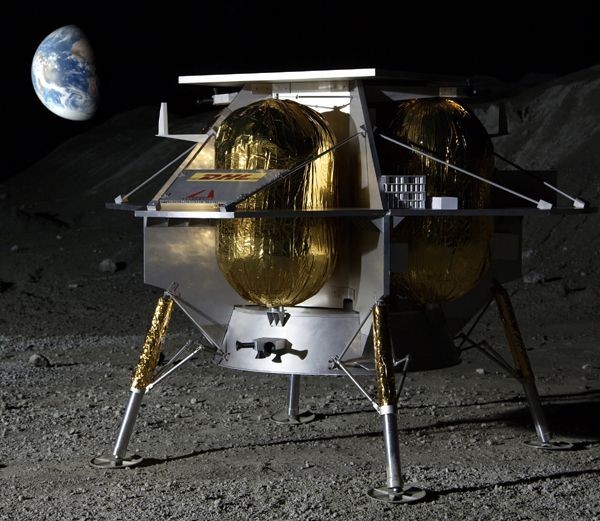
An artist's concept of a commercial lunar lander on the surface of the Moon.
NASA

NASA Selects First Commercial Moon Landing Services for Artemis Program (Press Release)

NASA has selected three commercial Moon landing service providers that will deliver science and technology payloads under Commercial Lunar Payload Services (CLPS) as part of the Artemis program. Each commercial lander will carry NASA-provided payloads that will conduct science investigations and demonstrate advanced technologies on the lunar surface, paving the way for NASA astronauts to land on the lunar surface by 2024.

“Our selection of these U.S. commercial landing service providers represents America’s return to the Moon’s surface for the first time in decades, and it’s a huge step forward for our Artemis lunar exploration plans,” said NASA Administrator Jim Bridenstine. ”Next year, our initial science and technology research will be on the lunar surface, which will help support sending the first woman and the next man to the Moon in five years. Investing in these commercial landing services also is another strong step to build a commercial space economy beyond low-Earth orbit.”

As part of their submissions, each partner proposed flying specific NASA instruments to the lunar surface. By the end of the summer, NASA will determine which payloads will fly on each flight. The potential payloads include instruments that will conduct new lunar science, pinpoint lander position, measure the lunar radiation environment, assess how lander and astronaut activity affects the Moon, and assist with navigation precision, among other capabilities.

The selections are:

- Astrobotic of Pittsburgh has been awarded $79.5 million and has proposed to fly as many as 14 payloads to Lacus Mortis, a large crater on the near side of the Moon, by July 2021.

- Intuitive Machines of Houston has been awarded $77 million. The company has proposed to fly as many as five payloads to Oceanus Procellarum, a scientifically intriguing dark spot on the Moon, by July 2021.

- Orbit Beyond of Edison, New Jersey, has been awarded $97 million and has proposed to fly as many as four payloads to Mare Imbrium, a lava plain in one of the Moon’s craters, by September 2020.

“These landers are just the beginning of exciting commercial partnerships that will bring us closer to solving the many scientific mysteries of our Moon, our solar system, and beyond,” said Thomas Zurbuchen, associate administrator of NASA’s Science Mission Directorate in Washington. “What we learn will not only change our view of the universe, but also prepare our human missions to the Moon and eventually Mars.”

Each partner is providing end-to-end commercial payload delivery services to NASA, including payload integration and operations, launch from Earth and landing on the surface of the Moon. These early missions will enable important technology demonstrations that will inform the development of future landers and other exploration systems needed for humans to return to the lunar surface. They also will help prepare the agency to send astronauts to explore Mars.

“This announcement starts a significant step in NASA's collaboration with our commercial partners,” said Chris Culbert, CLPS program manager at NASA’s Johnson Space Center in Houston. “NASA is committed to working with industry to enable the next round of lunar exploration. The companies we have selected represent a diverse community of exciting small American companies, each with their own unique, innovative approach to getting to the Moon. We look forward to working with them to have our payloads delivered and opening the door for returning humans to the Moon.”

As additional science, technology demonstration, and human exploration requirements for payloads develop, a request for task order bids will go to all current CLPS contractors. All nine companies initially selected in November 2018 for CLPS will be eligible to bid on subsequent task orders.

Charged with returning astronauts to the Moon within five years, NASA’s Artemis lunar exploration plans are based on a two-phase approach: the first is focused on speed – landing astronauts on the Moon by 2024 – while the second will establish a sustained human presence on and around the Moon by 2028. We will use what we learn on the Moon to prepare to send astronauts to Mars.

****
An artist's concept of Astrobotic's lunar lander on the surface of the Moon.
Astrobotic

An artist's concept of Intuitive Machines' lunar lander on the surface of the Moon.
Intuitive Machines

An artist's concept of Orbit Beyond's lunar lander.
Orbit Beyond

Thursday, May 30, 2019

Orion Update: Making Some Noise for the European Service Module...

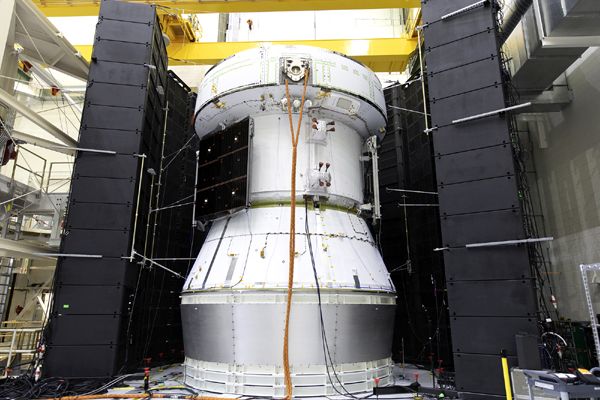
The European Service Module for the Orion EM-1 spacecraft undergoes acoustics testing at NASA's Kennedy Space Center in Florida.
NASA / Frank Michaux

Surround Sound - Orion Service Module for Artemis 1 Undergoes Acoustic Tests (News Release)

Orion’s service module for NASA’s Artemis 1 mission completed acoustic testing inside the Operations and Checkout Building at NASA’s Kennedy Space Center in Florida last week. The tests were the latest step in preparing for the agency’s first uncrewed flight test of Orion on the Space Launch System (SLS) rocket.

Teams completed the test May 25, 2019, and technicians will analyze the data collected during the tests to check for flaws uncovered by the acoustic environment. During the testing, engineers secured the service module inside the test cell and then attached microphones, strain gauges and accelerometers to it. They conducted a series of five tests, with acoustic levels ranging from 128 to 140 decibels – as loud as a jet engine during takeoff.

Artemis 1 will be the first mission launching Orion on the SLS rocket from Kennedy’s Launch Pad 39B. The mission will take Orion thousands of miles past the Moon on an approximately three-week test flight. Orion will return to Earth and splashdown in the Pacific Ocean off the coast of California, where it will be retrieved and returned to Kennedy.

Source: NASA.Gov

Wednesday, May 29, 2019

SLS Update: The Rocket's Core Stage Booster Is 80% Complete...

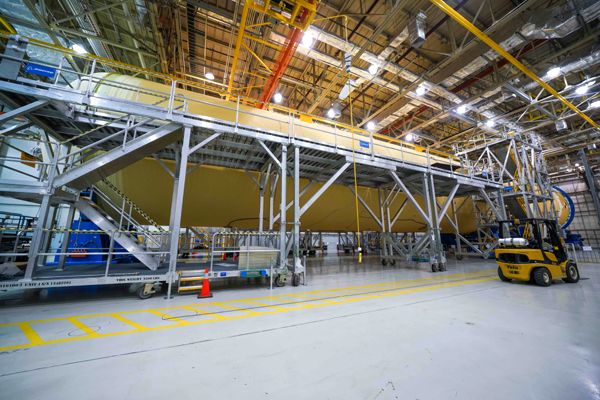
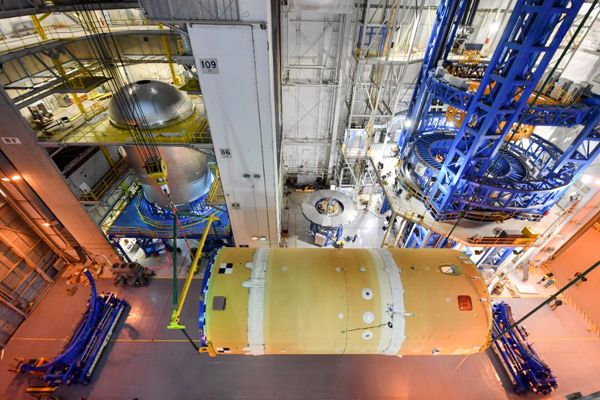
The Space Launch System's core stage booster is 80% complete inside NASA's Michoud Assembly Facility in New Orleans, Louisiana.
NASA / Eric Bordelon

NASA Makes Progress Assembling Massive Space Launch System Rocket Stage (News Release)

NASA and Boeing technicians have begun the second of three major activities to join the large structural parts of the core stage for NASA’s deep space rocket, the Space Launch System. When this task is completed, four of the five major core stage structures -- most of the massive 212-foot stage-- will be assembled. Boeing and NASA will add the engine section and the four RS-25 engines to complete assembly of the core stage. This stage and its four RS-25 engines will produce 2 million pounds of thrust to help send the Artemis 1 Mission, the first integrated flight of SLS and the Orion spacecraft to the Moon.

Crews at NASA’s Michoud Assembly Facility in New Orleans moved the liquid hydrogen tank to the final assembly area at the facility to horizontally connect the massive propellant tank to the top of the core stage, which is made up of the forward skirt, the liquid oxygen tank and the intertank. They moved the forward structure to the final assembly area earlier this spring. Together, the forward structure combined with the liquid hydrogen tank is approximately 190-feet-long, and thus, makes up most of the core stage. The entire core stage will be the largest rocket stage NASA has ever built since manufacturing the Saturn V rocket stages in the same Michoud rocket factory.

NASA is working to land the first woman and next man on the Moon by 2024. SLS is part of NASA’s backbone for deep space exploration, along with Orion and the Gateway in orbit around the Moon. SLS is the only rocket that can send Orion, astronauts and supplies to the Moon on a single mission.

Source: NASA.Gov

Thursday, May 23, 2019

Gateway Update: The First Component of NASA's Lunar Space Station Gets a Contractor...

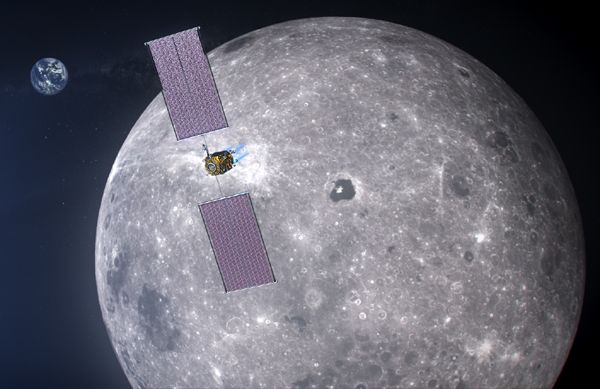
An artist's concept of the power and propulsion element for NASA's lunar Gateway orbiting the Moon.
NASA

NASA Awards Artemis Contract for Lunar Gateway Power, Propulsion (Press Release)

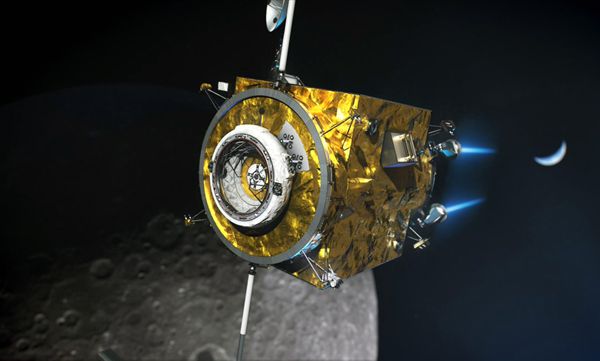
In one of the first steps of the agency’s Artemis lunar exploration plans, NASA announced on Thursday the selection of Maxar Technologies, formerly SSL, in Westminster, Colorado, to develop and demonstrate power, propulsion and communications capabilities for NASA’s lunar Gateway.

“The power and propulsion element is the foundation of Gateway and a fine example of how partnerships with U.S. companies can help expedite NASA’s return to the Moon with the first woman and next man by 2024,” said NASA Administrator Jim Bridenstine. “It will be the key component upon which we will build our lunar Gateway outpost, the cornerstone of NASA’s sustainable and reusable Artemis exploration architecture on and around the Moon.”

The power and propulsion element is a high-power, 50-kilowatt solar electric propulsion spacecraft – three times more powerful than current capabilities. As a mobile command and service module, the Gateway provides a communications relay for human and robotic expeditions to the lunar surface, starting at the Moon’s South Pole.

This firm-fixed price award includes an indefinite-delivery/indefinite-quantity portion and carries a maximum total value of $375 million. The contract begins with a 12-month base period of performance and is followed by a 26-month option, a 14-month option and two 12-month options.

Spacecraft design will be completed during the base period, after which the exercise of options will provide for the development, launch, and in-space flight demonstration. The flight demonstration will last as long as one year, during which the spacecraft will be fully owned and operated by Maxar. Following a successful demonstration, NASA will have the option to acquire the spacecraft for use as the first element of the Gateway. NASA is targeting launch of the power and propulsion element on a commercial rocket in late 2022.

“We’re excited to demonstrate our newest technology on the power and propulsion element. Solar electric propulsion is extremely efficient, making it perfect for the Gateway,” said Mike Barrett, power and propulsion element project manager at NASA’s Glenn Research Center in Cleveland. “This system requires much less propellant than traditional chemical systems, which will allow the Gateway to move more mass around the Moon, like a human landing system and large modules for living and working in orbit.”

Charged with returning to the Moon within five years, NASA’s lunar exploration plans are based on a two-phase approach: the first is focused on speed – landing on the Moon by 2024 – while the second will establish a sustained human presence on and around the Moon by 2028. We then will use what we learn on the Moon to prepare to send astronauts to Mars.

****

Another art concept of the power and propulsion element for NASA's lunar Gateway orbiting the Moon.
NASA

Tuesday, May 14, 2019

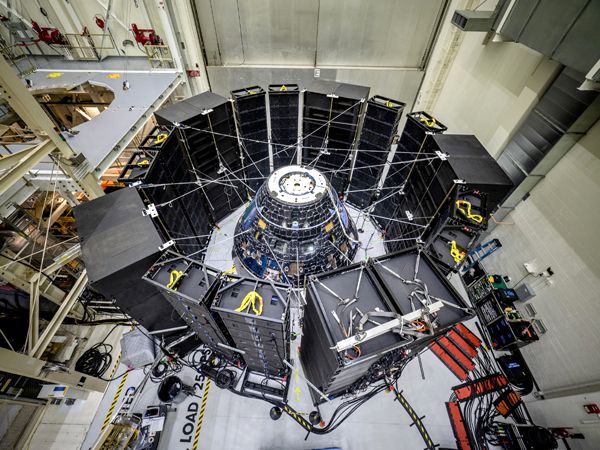
Photo of the Day: Making Some Noise for the Orion EM-1 Capsule...

The Orion capsule that will fly on Exploration Mission-1 undergoes acoustics testing at NASA's Kennedy Space Center in Florida.
Radislav Sinyak

Good Vibrations: Orion Crew Module Undergoes Testing (News Release)

The Orion crew module for Exploration Mission-1 was blasted with 141 decibels of extreme vibrations during acoustics testing at the Kennedy Space Center, simulating what the vehicle will experience in space. Spacecraft response and sound pressure data were collected with microphones, strain gauges and accelerometers.

Orion is the spacecraft that will take astronauts on missions to deep space and will help enable astronauts to set foot on the Moon by 2024.

Source: NASA.Gov

Monday, May 13, 2019

Video of the Day: NASA Announces ARTEMIS, the 2024 Successor to the Apollo Program...

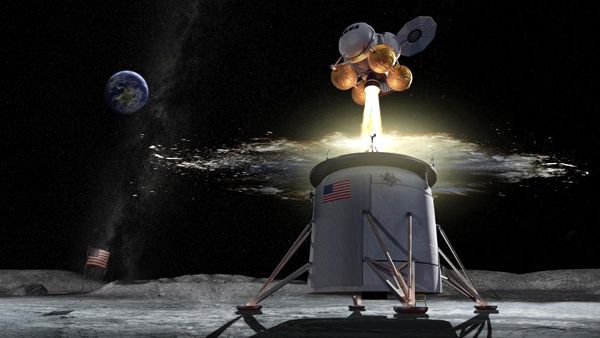
An artist's concept of the ascent stage of a lunar lander lifting off from the Moon's surface.
NASA

NASA Highlights Moon 2024 Mission with FY 2020 Budget Amendment (Press Release)

NASA Administrator Jim Bridenstine sent a video message to agency employees Monday about the president’s fiscal year 2020 budget amendment, which will support accelerated plans to land astronauts on the Moon by 2024.


NASA is sending astronauts to the Moon and then on to Mars, in a measured, sustainable way. The direction from Space Policy Directive-1 builds on the hard work NASA is doing on its Space Launch System rocket and Orion spacecraft, agency efforts to enable commercial partners, its work with international partners at the International Space Station in low-Earth orbit, and what NASA learns from its current robotic missions at the Moon and Mars.

****

Friday, May 10, 2019

SpaceShipTwo Will Soon Relocate to New Mexico, and Soon Move One Step Closer to Flying Paying Passengers into Space...

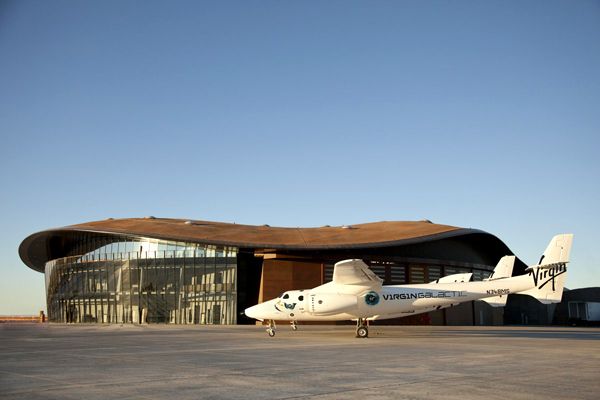
A snapshot of the main hangar at Spaceport America in New Mexico.
Virgin Galactic

Sir Richard Branson Announces Virgin Galactic Move to Spaceport America this Summer, as Company Readies for Commercial Service (News Release)

Santa Fe, New Mexico, USA: At a press conference today at the New Mexico State Capitol Building in Santa Fe, hosted by New Mexico Governor Michelle Lujan Grisham, Virgin Founder Sir Richard Branson announced that Virgin Galactic’s development and testing program had advanced sufficiently to move the spaceline staff and space vehicles from Mojave, California to their commercial operations headquarters at Spaceport America, New Mexico. The move, which involves more than 100 staff, will commence immediately and continue through the summer, to minimise schooling disruption for families.

Virgin Galactic partnered with New Mexico in an agreement which saw the state complete construction of Spaceport America, the world’s first, purpose-built commercial spaceport, and Virgin Galactic committing to center its commercial spaceflight activities at the facilities once its vehicles and operations were ready for service.

This announcement signals the final countdown to a regular commercial spaceflight service for paying passengers and science research from Spaceport America. It follows the great progress in operational readiness at Spaceport, including the completion of the hanger, offices, fuel farm, warehouse and antenna for telemetry and communications, as well as interior fit-out. It also positions New Mexico on the frontline of technological innovation and, as one of the very few places on Earth that plays host to regular human spaceflight launches, a magnet for inward investment.

Virgin Galactic will reposition its space system consisting of carrier aircraft VMS Eve and spaceship VSS Unity from Mojave, California to Spaceport America over the summer months once cabin interior and other work has been completed by Virgin Galactic’s sister manufacturing organisation, The Spaceship Company (TSC). It will complete its final test flights from New Mexico for commencing a full commercial service for passengers and research payload. TSC will remain based in Mojave where it will continue building Virgin Galactic’s planned fleet of SpaceShipTwo and carrier aircraft WhiteKnightTwo vehicles.

Commenting on the announcement, New Mexico Governor Michelle Lujan Grisham said: “Virgin Galactic’s announcement today is an incredibly exciting development for both our state’s economic future and the future of aerospace in general. With these workers here and with these plans firmly in place, I’m certain New Mexico will serve as the launchpad for the rapid industry growth we’ve been expecting for so many years. Today marks the beginning of the next chapter of aerospace in New Mexico.”

Sir Richard Branson said: “Our Virgin Galactic adventure has been intertwined with New Mexico and Spaceport America right from the start and our stories have unfolded together. New Mexico delivered on its promise to build a world-first and world-class spaceport. Today, I could not be more excited to announce, that in return, we are now ready to bring New Mexico a world-first, world-class spaceline. Virgin Galactic is coming home to New Mexico where together we will open space to change the world for good.”

George Whitesides, CEO of Virgin Galactic and The Spaceship Company said: “The first photograph of Earth from space was taken over New Mexico in October of 1946. How inspiring and appropriate that the state will soon host the first regular commercial spaceflight service, which will enable thousands of people to see Earth from space with their own eyes. We are deeply grateful to the citizens and leadership of New Mexico for having the vision to create a better future for their children and all of humanity.”

Dan Hicks, CEO of Spaceport America added, “Going to space and exploring the universe is a team effort. It takes strong partnerships that are courageous and also vulnerable. Sir Richard’s visionary leadership to take meaningful risks along with New Mexico leadership’s far-sighted commitment – epitomizes the successful partnerships that are truly needed for the space industry. I and the rest of the Spaceport America staff are extremely excited to support Virgin Galactic’s continued growth and future success here in New Mexico.”

Source: Virgin Galactic

****

A snapshot of Virgin Galactic's White Knight II parked near the main hangar at Spaceport America in New Mexico.
Virgin Galactic

Wednesday, May 1, 2019

EM-1 Update: The Space Launch System's Core Stage Booster Is About to Reach a Big Milestone...

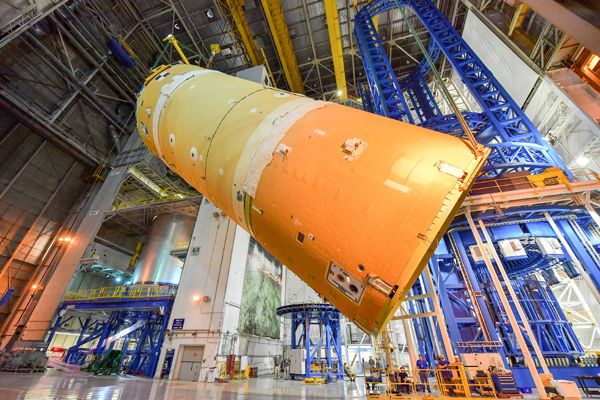
The forward join for the Space Launch System (SLS) rocket is about to be lowered into horizontal position at NASA's Michoud Assembly Faciliy in New Orleans, Louisiana...in preparation for its mate to the SLS' liquid hydrogen tank.
NASA / Steven Seipel

SLS Forward Join Set for Horizontal Assembly to Liquid Hydrogen Tank (News Release)

Crews at NASA’s Michoud Assembly Facility in New Orleans have moved the forward join, or forward part, of the massive core stage for NASA’s Space Launch System in preparation for its final assembly and integration to the liquid hydrogen tank. In a change from the previous core stage assembly plan, technicians and engineers will mate the forward join with the liquid hydrogen tank horizontally rather than vertically. This revised approach of mating the two critical components allows technicians and engineers to finalize the outfitting and testing of the engine section concurrently. Combined with the use of new production tools, the new assembly process keeps core stage production on target for completion this year. The forward join consists of three parts: the forward skirt, liquid oxygen tank and intertank. It makes up 66 feet of the 212-foot-tall core stage. The core stage includes the liquid hydrogen tank and liquid oxygen tank that together hold 733,000 gallons of propellant to power the stage’s four RS-25 engines needed to launch SLS and NASA’s Orion spacecraft beyond Earth’s orbit forward to the Moon.

NASA is charged to get American astronauts to the Moon by 2024. SLS and Orion are our backbone for deep space exploration including missions to the Gateway in lunar orbit. The agency will launch SLS and Orion from NASA’s Kennedy Space Center in Florida on their first integrated test flight around the Moon in 2020.

Source: NASA.Gov

****

The forward join for the SLS rocket is now in horizontal position at NASA's Michoud Assembly Faciliy in New Orleans, Louisiana...in preparation for its mate to the SLS' liquid hydrogen tank.
NASA

Tuesday, April 16, 2019

SLS Update #2: Progress Continues to be Made on the Core Stage Booster for Exploration Mission-1...

The engine section (foreground) for the first Space Launch System rocket continues to undergo assembly at NASA's Michoud Assembly Facility in New Orleans, Louisiana.
NASA

NASA Accelerates Pace of Core Stage Production with New Tool (News Release)

The boat-tail structure, a fairing-like cover designed to protect the bottom end of the core stage and the RS-25 engines, has been joined to one of the most complicated and intricate parts of NASA’s Space Launch System, the engine section. The engine section comprises the lowest portion of the massive core stage of the deep space rocket. It houses four RS-25 engines that will produce 2 million pounds of thrust to send the rocket and NASA’s Orion spacecraft on lunar missions. Technicians moved the engine section and boat-tail for final assembly to a climate-controlled area of NASA’s Michoud Assembly Facility in New Orleans.

Engineers will use the new tool and an internal access kit to finish assembly. The tool, seen here in the blue frame around the bottom of the engine section, allows more people to work on engine section tasks at the same time — accelerating the pace of production and reducing engine section integration and assembly time. This tool, along with other production and processing improvements, will help enable the core stage to be completed this year. The liquid oxygen tank structural test article as well as the liquid hydrogen tank flight hardware for the first mission of SLS are located just behind the engine section.

NASA is charged to get American astronauts to the Moon by 2024. Our backbone for deep space exploration is SLS, the Orion spacecraft, which will launch from NASA’s Kennedy Space Center in Florida on missions to the Gateway in lunar orbit for missions to the surface of the Moon. The agency will launch SLS and Orion on their first integrated test flight around the Moon in 2020.

Source: NASA.Gov

Thursday, April 4, 2019

SLS Update: An Engine Test Paves the Way for the Space Launch System's First Four Flights...

An RS-25 engine is test-fired inside the A-1 test stand at NASA's Stennis Space Center in Mississippi...on April 4, 2019.
NASA / SSC

NASA Achieves Rocket Engine Test Milestone Needed for Moon Missions (News Release)

NASA is a step closer to returning astronauts to the Moon in the next five years following a successful engine test on Thursday at NASA’s Stennis Space Center near Bay St. Louis, Mississippi. The latest “hot fire” was the culmination of four-plus years of testing for the RS-25 engines that will send the first four Space Launch System (SLS) rockets into space.

“This completes four years of focused work by an exceptional Stennis test team,” Stennis Director Rick Gilbrech said. “It represents yet another chapter in Stennis’ long history of testing leadership and excellence in support of this nation’s space exploration efforts. Everyone involved should feel proud of their work and contributions.”

Thursday’s hot fire on Stennis’ A-1 Test Stand completed:

Acceptance testing of all 16 former space shuttle main engines that will help launch the first four SLS missions. NASA has contracted with Aerojet Rocketdyne to build new RS-25 engines for additional SLS missions, and work already is underway to do so in the company’s factory in Canoga Park, California.

Developmental and flightworthy testing for new controllers (plus one spare) to be used by the heritage RS-25 engines for the first four missions.

A 51-month test series that demonstrated RS-25 engines can perform at the higher power level needed to launch the super heavy-lift SLS rocket.

“Engines are now a ‘go’ for missions to send astronauts forward to the Moon to learn and prepare for missions to Mars,” said Johnny Heflin, deputy manager of the SLS Liquid Engines Office at NASA’s Marshall Space Flight Center in Huntsville, Alabama. “We’re ready to provide the power to explore the Moon and beyond.”

The RS-25 rocket engine test era began Jan. 9, 2015, with a 500-second – more than 8 minutes – hot fire of RS-25 developmental engine No. 0525 on the A-1 Test Stand at Stennis. NASA tested the first SLS flight engine on March 10, 2016. Altogether, the agency has conducted 32 developmental and flight engine tests for a total of 14,754 seconds – more than four hours – of cumulative hot fire – all on the A-1 stand at Stennis.

Having launched 135 space shuttle missions, these main engines are considered the most tested engines in the world. When the Space Shuttle Program ended in 2011, NASA still had 16 engines that ultimately were modified for SLS.

These engines were originally designed to perform at a certain power level, known as 100 percent. Over time, the engines were upgraded to operate at higher and higher power levels, up to 104.5 percent operating power level by the end of the shuttle program. For SLS, that operating level has to be pushed even higher.

To help accomplish that, and to interface with new rocket avionics systems, NASA designed and tested a new engine controller, which serves as the “brain” of the engine to help monitor engine operation and facilitate communication between the engine and rocket. Early developmental testing at Stennis provided critical information for designing the new controller.

The first new flight engine controller was tested at Stennis in March 2017, with a string of controller hot fires to follow. The April 4 test marked the testing of the 17th engine controller for use on SLS flights, providing enough for all 16 heritage RS-25 engines.

With development of the new controllers, NASA had to test the new power level as well. First, it was demonstrated that the engine could perform at the needed 111 percent power level. Next, NASA needed to prove a margin of operating safety.

In February 2018, operators pushed the engine to 113 percent power for a total of 50 seconds. It lengthened that firing time in two subsequent tests, until late this February, when the engine was fired at 113 percent power for 430 seconds of a 510-second test.

That set the stage for Thursday’s successful test of flight engine No. 2062. When this specific engine fires again, it will help send astronauts aboard Orion around the Moon on a test flight known as Exploration Mission-2.

The president’s direction from Space Policy Directive-1 galvanizes NASA to return to the Moon and builds on progress on the Space Launch System rocket and Orion spacecraft, efforts with commercial and international partners, and knowledge gained from the current robotic presence at the Moon and Mars.

Source: NASA.Gov