Wednesday, October 20, 2021

Artemis 1 Update #3: Orion Is Finally United with the Space Launch System!

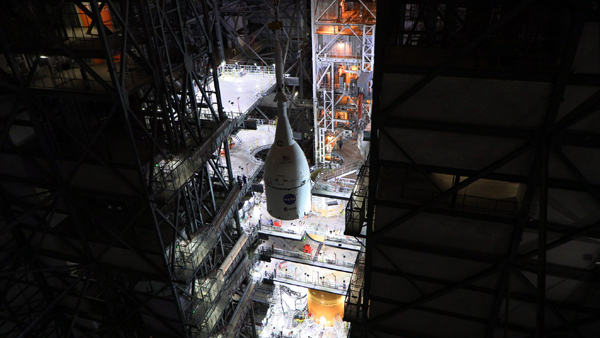
The Orion capsule is secured to NASA's Space Launch System rocket inside Kennedy Space Center's Vehicle Assembly Building in Florida...on October 20, 2021.
NASA

Around midnight today, the Artemis program reached a huge milestone when the Orion capsule was finally mated with NASA's Space Launch System (SLS) rocket inside the Vehicle Assembly Building at Kennedy Space Center (KSC) in Florida!

Several hours were spent afterwards on tightening the 360 bolts that will secure Orion to SLS for the Artemis 1 flight to the Moon...which is set to launch no earlier than this January.

The next event after today's accomplishment will be the transport of the fully-stacked SLS to KSC's Launch Complex 39B for a Wet Dress Rehearsal, which should take place next month. Stay tuned!

Inside Kennedy Space Center's Vehicle Assembly Building in Florida, the Orion capsule is transferred over to High Bay 3 where it will be secured to NASA's Space Launch System rocket...on October 20, 2021.
NASA

Inside Kennedy Space Center's Vehicle Assembly Building in Florida, the Orion capsule is transferred over to High Bay 3 where it will be secured to NASA's Space Launch System rocket...on October 20, 2021.
NASA

Inside Kennedy Space Center's Vehicle Assembly Building in Florida, the Orion capsule is transferred over to High Bay 3 where it will be secured to NASA's Space Launch System rocket...on October 20, 2021.
NASA

Inside Kennedy Space Center's Vehicle Assembly Building in Florida, the Orion capsule is slowly lowered towards the Space Launch System's Orion stage adapter (which contains 10 CubeSats)...on October 20, 2021.
NASA

A close-up of the Orion capsule after it was secured to NASA's Space Launch System rocket inside Kennedy Space Center's Vehicle Assembly Building in Florida...on October 20, 2021.
NASA

Tuesday, October 19, 2021

Artemis 1 Update #2: Orion Has Arrived at the VAB!

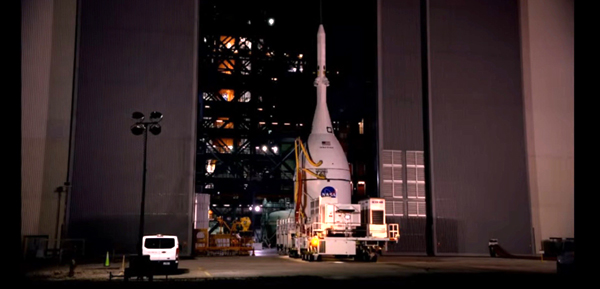
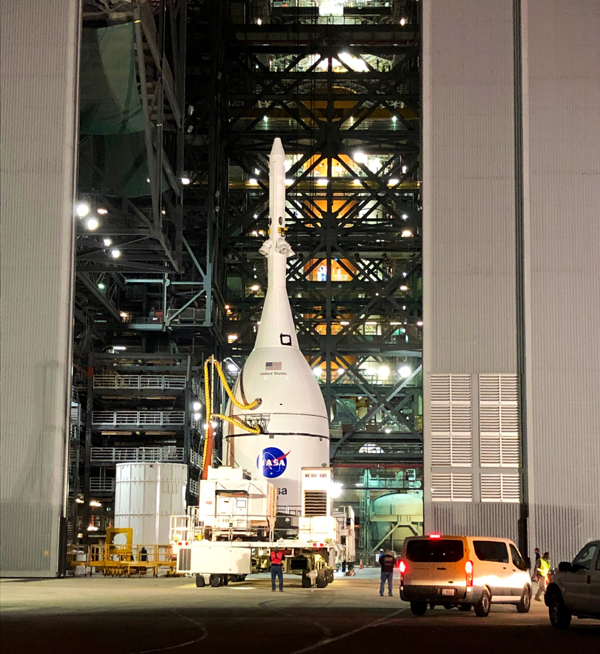
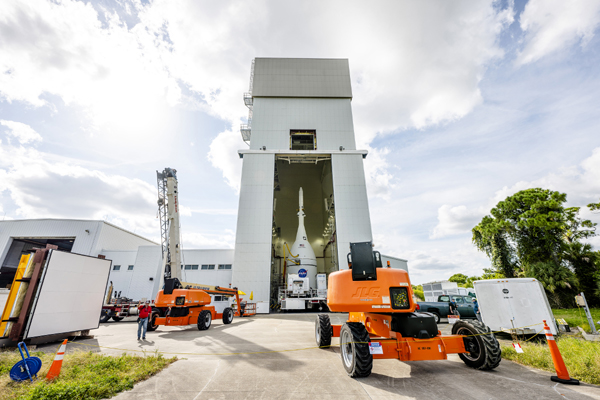
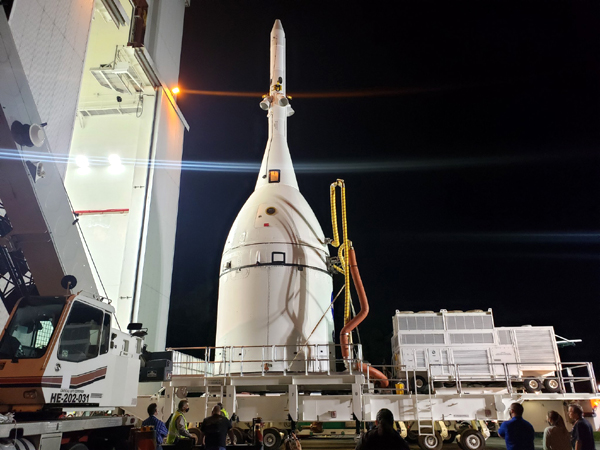
With the Space Launch System rocket visible inside, the Orion Artemis 1 capsule is about to enter the Vehicle Assembly Building at NASA's Kennedy Space Center in Florida...on October 19, 2021.
NASA

After departing from the Launch Abort System Facility about two hours before, the Orion Artemis 1 capsule has arrived at Kennedy Space Center's Vehicle Assembly Building (VAB)...where NASA's Space Launch System (SLS) rocket awaits the Moon-bound vessel!

Within the next 24 hours, Orion will be lifted up and transferred over to the VAB's High Bay 3 where SLS sits atop its mobile launcher.

After years of anticipation, it should be tomorrow morning that the mega-Moon rocket is finally complete!

With the Space Launch System rocket visible behind it, the Orion Artemis 1 capsule is about to enter the Vehicle Assembly Building at NASA's Kennedy Space Center in Florida...on October 19, 2021.
NASA

The Orion Artemis 1 capsule is about to enter the Vehicle Assembly Building at NASA's Kennedy Space Center in Florida...on October 19, 2021.
NASA

Monday, October 18, 2021

Artemis 1 Update: Orion Is Finally Headed to the Vehicle Assembly Building!

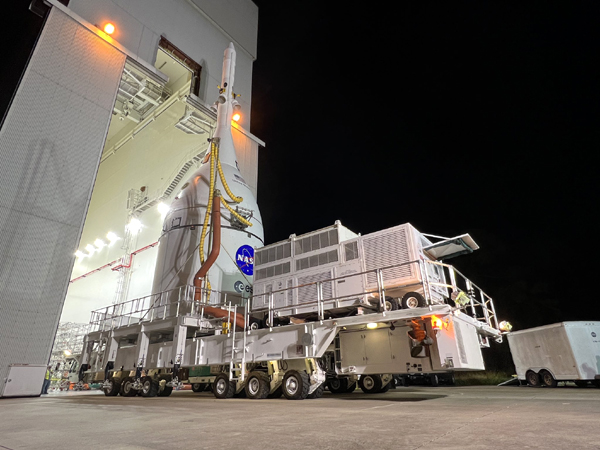
The transporter carrying the Orion Artemis 1 spacecraft exits from the Launch Abort System Facility to make its way to the Vehicle Assembly Building at NASA's Kennedy Space Center in Florida...on October 18, 2021.
NASA

About two hours ago, the transporter carrying the Orion Artemis 1 spacecraft departed from the Launch Abort System Facility to embark on a 6-mile (10-kilometer) trip to the Vehicle Assembly Building at NASA's Kennedy Space Center in Florida.

Here are some photos of tonight's move. Stand by for more images over the next two days as Orion is finally mated to the Space Launch System rocket for its inaugural flight as early as this January!

The transporter carrying the Orion Artemis 1 spacecraft prepares to exit from the Launch Abort System Facility to make its way to the Vehicle Assembly Building at NASA's Kennedy Space Center in Florida...on October 18, 2021.
NASA

The transporter carrying the Orion Artemis 1 spacecraft exits from the Launch Abort System Facility to make its way to the Vehicle Assembly Building at NASA's Kennedy Space Center in Florida...on October 18, 2021.
NASA

The transporter carrying the Orion Artemis 1 spacecraft exits from the Launch Abort System Facility to make its way to the Vehicle Assembly Building at NASA's Kennedy Space Center in Florida...on October 18, 2021.
NASA

Sunday, October 17, 2021

Photos of the Day: Two Major Flight Components Have Arrived in Florida for the Artemis 2 and 3 Missions!

The payload canister carrying Orion's pressure vessel for NASA's Artemis 3 mission is transported to the Neil Armstrong Operations and Checkout Building at Kennedy Space Center's Industrial Area.
NASA

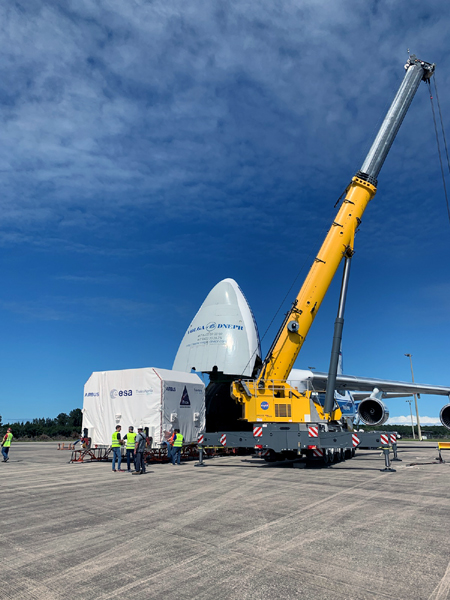
Last week, two major milestones were attained in NASA's Artemis program when the Orion pressure vessel for the Artemis 3 mission, as well as the European Service Module for Artemis 2, arrived at NASA's Kennedy Space Center (KSC) in Florida to complete final assembly.

The Artemis 3 pressure vessel was sent to Florida from NASA's Michoud Assembly Facility near New Orleans, Louisiana, while the Artemis 2 service module was transported to Cape Canaveral from Bremen, Germany, respectively.

Both major flight hardware will soon finish construction inside the Neil Armstrong Operations and Checkout Building at the KSC Industrial Area.

Artemis 2—the first crewed flight of Orion—is currently scheduled for launch in late 2023. Artemis 3, which will see astronauts set foot on the lunar surface for the first time since Apollo 17 in 1972, is targeted for liftoff no earlier than 2024.

And as soon as tomorrow night, the Orion spacecraft for Artemis 1 will be transported to KSC's Vehicle Assembly Building to finally be stacked with the Space Launch System rocket! Stay tuned.

The payload canister carrying the European Service Module for NASA's Artemis 2 mission is about to be transported from the Launch and Landing Facility to the Neil Armstrong Operations and Checkout Building at Kennedy Space Center's Industrial Area...on October 14, 2021.
NASA

Thursday, October 14, 2021

SpaceShipTwo Update: VSS Unity's Next Suborbital Flight Will Take Place in 2022...

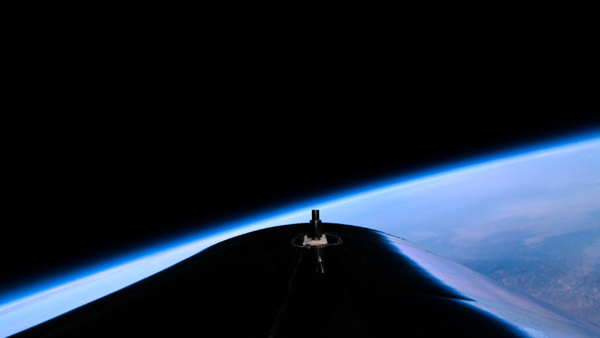
A remote camera image, which was taken from the top of VSS Unity's fuselage, showing the vehicle near the edge of space.
Virgin Galactic

Virgin Galactic Begins Planned Vehicle Enhancement and Modification Period; Unity 23 Test Flight Rescheduled to Follow Completion of This Program (Press Release)

Virgin Galactic today announced that it will now begin its planned enhancement program for VMS Eve and VSS Unity, and will conduct the Unity 23 test flight after this work is complete.

The enhancement program is designed to improve vehicle performance and flight-rate capability for VMS Eve and VSS Unity. In preparation for this work, Virgin Galactic has been performing routine tests and analyses to update its material properties database. This data predicts how materials are expected to perform under certain load and environmental conditions and is used to inform the design and manufacturing enhancements that will support increased flight frequency. One of these recent laboratory-based tests flagged a possible reduction in the strength margins of certain materials used to modify specific joints, and this requires further physical inspection.

As is standard in aerospace test and evaluation practices, Virgin Galactic ships are designed to withstand forces that are substantially higher than those experienced in regular use, providing additional margin and layers of safety. The enhancement program is designed to further increase margins that will enable improved reliability, durability and reduced maintenance requirements when in commercial service. While this new lab test data has had no impact on the vehicles, our test flight protocols have clearly defined strength margins, and further analysis will assess whether any additional work is required to keep them at or above established levels. Given the time required for this effort, the Company has determined the most efficient and expedient path to commercial service is to complete this work now in parallel with the planned enhancement program.

Following the enhancement period, the Company intends to complete the vehicle testing program for VMS Eve and VSS Unity, including the planned research test flight with the Italian Air Force, before starting commercial flights.

Michael Colglazier, Chief Executive Officer of Virgin Galactic, said: “Our decisions are driven by detailed and thorough analysis, and we fly based on the most accurate and comprehensive data available. Virgin Galactic vehicles are designed with significant margins for safety, providing layers of protection that far exceed loads experienced and expected to occur on our flights. The re-sequencing of our enhancement period and the Unity 23 flight underscores our safety-first procedures, provides the most efficient path to commercial service, and is the right approach for our business and our customers. We are deeply appreciative of the Italian Air Force Research Mission and grateful for their continued partnership with us in this test flight program.”

This schedule update is unrelated to the Company’s recent inquiry into a potential defect in a supplier component announced on September 10, 2021, which has been successfully resolved. While the supplied component in question was not on either VMS Eve or VSS Unity, in accordance with safety protocols, Virgin Galactic completed detailed inspections and scans which found all components met quality and safety standards and were ready for flight. The enhancement period is now beginning approximately one month later than anticipated, and commercial service is now expected to commence in Q4 2022.

Source: Virgin Galactic

Wednesday, October 13, 2021

Photos of the Day #2: Captain Kirk Ventures into the REAL Final Frontier...

A pre-flight group photo of NS-18 crewmembers Chris Boshuizen, William Shatner, Audrey Powers and Glen de Vries.
Blue Origin

Congratulations to William Shatner and his fellow passengers Chris Boshuizen, Audrey Powers and Glen de Vries on this morning's successful New Shepard launch on Blue Origin's NS-18 flight!

At the age of 90, Shatner is now the oldest individual to have ventured beyond the Kármán line...the internationally-accepted boundary between Earth's atmosphere and space.

With Star Trek's most famous actor now having gotten a taste of actual spaceflight, when will a Star Wars icon like Mark Hamill follow suit?

I'm a bigger fan of that "galaxy far far away" than I am of the United Federation of Planets, so I would really like to know!

William Shatner is in awe during his NS-18 flight aboard Blue Origin's New Shepard capsule above Texas...on October 13, 2021.
Blue Origin

William Shatner looks out the window during his NS-18 flight aboard Blue Origin's New Shepard capsule above Texas...on October 13, 2021.
Blue Origin

William Shatner confers with Blue Origin founder Jeff Bezos after the New Shepard capsule safely touched down at Launch Site One in Texas...on October 13, 2021.
Blue Origin

Tuesday, October 12, 2021

Photos of the Day: Orion Is Finally Ready to be Mated to the Space Launch System!

Inside the Vehicle Assembly Building at NASA's Kennedy Space Center in Florida, the Orion stage adapter is mated to the Space Launch System rocket...on October 9, 2021.
NASA / Kim Shiflett

Last weekend, engineers attached the Orion stage adapter (OSA) to the Space Launch System (SLS) rocket at NASA's Kennedy Space Center (KSC) in Florida.

This important milestone—which occurred on Saturday, October 9—sets the stage for the Orion spacecraft itself to be mated to NASA's newest Moon rocket inside KSC's Vehicle Assembly Building (VAB) within the next week or so.

Now aboard SLS, thanks to the installation of OSA, are 10 CubeSats that will venture into deep space along with Orion after launch.

Originally, there were supposed to be 13 CubeSats that would hitch a ride to the Moon and beyond on the Artemis 1 mission...but unfortunately, 3 CubeSats (including NASA's Lunar Flashlight) were unable to meet the deadline for delivery to KSC.

Within the next several days, Orion will be transported from KSC's Launch Abort System Facility to the VAB to complete assembly of the rocket that will embark on Artemis 1.

Once stacking is finished, the SLS will be rolled over to KSC's Launch Complex 39B to undergo a Wet Dress Rehearsal next month. Artemis 1 is now scheduled to lift off no earlier than January of next year.

Stay tuned!

Inside the Vehicle Assembly Building at NASA's Kennedy Space Center in Florida, the Orion stage adapter is mated to the Space Launch System rocket...on October 9, 2021.
NASA / Kim Shiflett

Inside the Vehicle Assembly Building at NASA's Kennedy Space Center in Florida, the Orion stage adapter is mated to the Space Launch System rocket...on October 9, 2021.
NASA / Kim Shiflett

Inside the Vehicle Assembly Building at NASA's Kennedy Space Center in Florida, the Orion stage adapter is mated to the Space Launch System rocket...on October 9, 2021.
NASA / Kim Shiflett

Wednesday, October 6, 2021

CST-100 Update: Two Starliner Astronauts Will Now Fly to Space Aboard a Crew Dragon Vehicle Later Next Year...

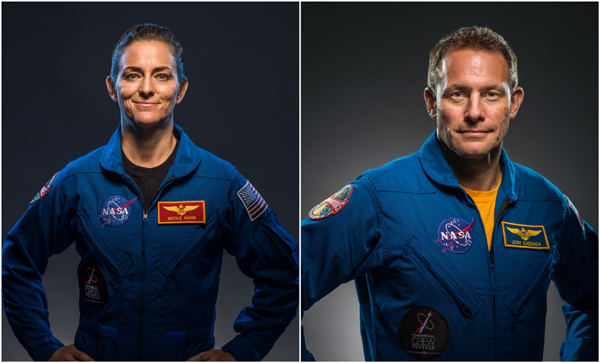
NASA astronauts Nicole Mann and Josh Cassada will head to the International Space Station on SpaceX's Crew-5 mission in late 2022.
NASA

NASA Announces Astronaut Changes for Upcoming Commercial Crew Missions (Press Release)

NASA has reassigned astronauts Nicole Mann and Josh Cassada to the agency’s SpaceX Crew-5 mission to the International Space Station as part of the Commercial Crew Program.

Mann and Cassada will serve as spacecraft commander and pilot, respectively, for the Crew-5 mission. Additional crew members will be announced later.

Crew-5 is expected to launch no earlier than fall 2022 on a Falcon 9 rocket from Launch Complex 39A at NASA’s Kennedy Space Center in Florida. The duo and their crewmates will join an expedition crew aboard station for a long duration stay to conduct science activities for the benefit of humanity and exploration.

“Nicole and Josh have done a tremendous job pioneering the training and path forward for astronauts to fly on Boeing’s Starliner spacecraft. They have gained experience that they will take forward as they train to fly in SpaceX’s Crew Dragon spacecraft and serve aboard the International Space Station,” said Kathryn Lueders, associate administrator of the Space Operations Mission Directorate at NASA Headquarters in Washington. “The NASA team is fortunate to have two commercial crew partners and will continue to work with Boeing and SpaceX to prepare NASA astronauts and our international partners to fly to and from the International Space Station on U.S. spacecraft.”

Mann and Cassada previously were assigned to missions on NASA’s Boeing Crew Flight Test and NASA’s Boeing Starliner-1 mission, respectively. NASA decided it was important to make these reassignments to allow Boeing time to complete the development of Starliner while continuing plans for astronauts to gain spaceflight experience for the future needs of the agency’s missions.

NASA astronauts Butch Wilmore, Mike Fincke, and Suni Williams will continue to provide experience for Boeing as the agency prepares for NASA’s Boeing Crew Flight Test. Additional Boeing flight assignments will be made in the future.

Mann is a California native and a colonel in the Marine Corps. She earned a Bachelor of Science in mechanical engineering from the United States Naval Academy and a Master of Science in mechanical engineering with a specialty in fluid mechanics from Stanford University. She is an F/A-18 test pilot with more than 2,500 flight hours in more than 25 aircraft. NASA selected Mann as an astronaut in 2013. This will be her first trip to space.

“It has been the opportunity of a lifetime to train on a brand-new spacecraft, the Boeing Starliner, and it has been fantastic to work with the Boeing team,” Mann said. “I am thrilled to have the opportunity to train on another new spacecraft – the SpaceX Crew Dragon – and appreciate the teams at NASA who have made that possible. I am ready to fly and serve on the International Space Station.”

Cassada grew up in White Bear Lake, Minnesota, and is a physicist and U.S. Navy test pilot. He attended college in Michigan and then completed his Ph.D. research at Fermi National Accelerator Laboratory before becoming a naval aviator. Cassada has accumulated more than 4,000 flight hours in over 45 different aircraft. NASA selected him as an astronaut in 2013. This will be his first spaceflight.

“It has been great to spend the last few years training with the joint Boeing and NASA team, and I am really looking forward to now have a chance to also train with SpaceX on a new spacecraft. Cross training on both programs is a unique opportunity to learn, but also to provide valuable insight to future astronauts flying these spacecraft,” Cassada said. “And, of course, Nicole and I are incredibly excited to get to work aboard the International Space Station, executing current operations and also contributing to future exploration beyond low-earth orbit.”

For more than 20 years, NASA has continuously had astronauts living and working aboard the International Space Station, advancing scientific knowledge and demonstrating new technologies, making research breakthroughs not possible on Earth. As a global endeavor, 242 people from 19 countries have visited the unique microgravity laboratory that has hosted more than 3,000 research and educational investigations from researchers in 108 countries.

The station is a critical testbed for NASA to understand and overcome the challenges of long-duration spaceflight and to expand commercial opportunities in low-Earth orbit. As commercial companies focus on providing human space transportation services and developing a robust low-Earth orbit economy, NASA is free to focus on building spacecraft and rockets for deep space missions to the Moon and Mars.

Source: NASA.Gov

Tuesday, October 5, 2021

SLS Update: NASA's Newest Launch Vehicle Achieves a Developmental Milestone on Its Way to First Flight...

A low-angle view of NASA's Space Launch System rocket inside the Vehicle Assembly Building at Kennedy Space Center in Florida...on September 20, 2021.
NASA / Frank Michaux

NASA’s Mega Moon Rocket Passes Key Review for Artemis I Mission (News Release)

NASA has completed the design certification review (DCR) for the Space Launch System Program (SLS) rocket ahead of the Artemis I mission to send the Orion spacecraft to the Moon. The review examined all the SLS systems, all test data, inspection reports, and analyses that support verification, to ensure every aspect of the rocket is technically mature and meets the requirements for SLS’s first flight on Artemis I.

“With this review, NASA has given its final stamp of approval to the entire integrated rocket design and completed the final formal milestone to pass before we move forward to the SLS and Artemis I flight readiness reviews,” said John Honeycutt, the SLS Program Manager who chaired the DCR board held at NASA’s Marshall Space Flight Center in Huntsville, Alabama.

In addition to the rocket’s design, the review certified all reliability and safety analyses, production quality and configuration management systems, and operations manuals across all parts of the rocket, including interfaces with the Orion spacecraft and Exploration Ground Systems (EGS) hardware. With the completion of the SLS DCR, NASA has now certified the SLS and Orion spacecraft designs, as well as the new Launch Control Center at the agency’s Kennedy Space Center in Florida, for the mission.

The DCR is part of the formal review system NASA employs as a systematic method for manufacturing, testing, and certifying space hardware for flight. The process starts with defining what the rocket needs to do to achieve missions, such as its performance; these are called systems requirements. Throughout this process the design of the hardware is refined and validated by many processes: inspection, analysis, modeling, and testing that ranges from single components to major integrated systems. As the design matures, the team evaluates it during a preliminary design review, then a critical design review, and finally after the hardware is built and tested, the design certification review. The review process culminates with the Artemis I Flight Readiness Review when NASA gives a “go” to proceed with launch.

“We have certified the first NASA super heavy-lift rocket built for human spaceflight in 50 years for missions to the Moon and beyond," said David Beaman, the manager for SLS Systems Engineering and Integration who led the review team. “NASA’s mature processes and testing philosophy help us ask the right questions, so we can design and build a rocket that is powerful, safe, and makes the boldest missions possible.”

Artemis I will be the first integrated flight test of the SLS and Orion spacecraft. In later Artemis missions, NASA will land the first woman and the first person of color on the surface of the Moon, paving the way for a long-term lunar presence and serving as a steppingstone on the way to Mars.

Source: NASA.Gov

****

The Orion stage adapter sits at the middle of High Bay 4 inside Kennedy Space Center's Vehicle Assembly Building on October 4, 2021...waiting to be mated to NASA's Space Launch System rocket.
NASA / Ben Smegelsky

Saturday, October 2, 2021

Photo of the Day: The Inspiration4 Astronauts Have Received Their Wings!

The Inspiration4 crewmembers pose with the astronaut wings that they received during a surprise ceremony at SpaceX Headquarters in Hawthorne, California...on October 1, 2021.
Inspiration4

Congratulations to Inspiration4 crewmembers Christopher Sembroski, Dr. Sian Proctor, Jared Isaacman and Hayley Arceneaux for receiving their astronaut wings yesterday!

The all-private crew received its dragon-shaped award during a visit to SpaceX Headquarters in Hawthorne, California...in a surprise ceremony held by the company's employees.

It remains to be seen if the Federal Aviation Administration will bestow its own commercial astronaut wings onto the Inspiration4 crewmembers—since they were designated as 'spaceflight participants' by SpaceX (due to FAA regulation) while the mission was being conceived earlier this year.

In the meantime, these four pioneers should celebrate the fact that they'll hopefully be the first group of many who'll receive this beautiful recognition by SpaceX after flying aboard its Crew Dragon (and someday Starship) vehicle on a journey above the Earth and beyond. That is all.