Thursday, September 19, 2019

SLS Update: The Artemis 1 Core Stage Booster Is Close to Completion!

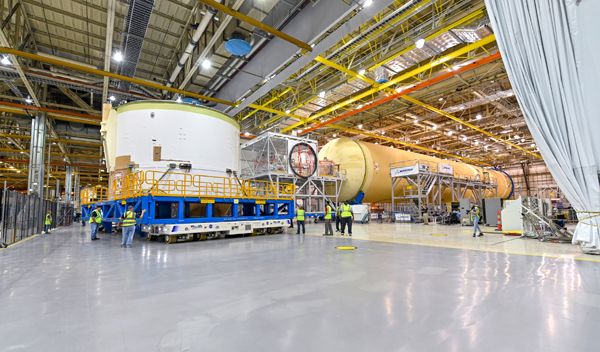
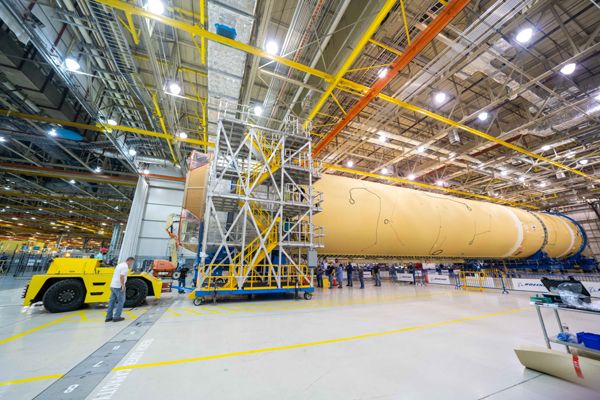
Engineers at NASA's Michoud Assembly Facility in New Orleans, Louisiana attach the engine section to the rest of the Space Launch System's core stage booster...on September 19, 2019.
NASA / Steven Seipel

NASA Joins Last of Five Sections for Space Launch System Rocket Stage (News Release)

NASA finished assembling and joining the main structural components for the largest rocket stage the agency has built since the Saturn V that sent Apollo astronauts to the Moon. Engineers at the agency’s Michoud Assembly Facility in New Orleans connected the last of the five sections of the Space Launch System (SLS) rocket core stage on Sept. 19. The stage will produce 2 million pounds of thrust to send Artemis I, the first flight of SLS and NASA’s Orion spacecraft to the Moon.

“NASA has achieved a historic first milestone by completing the final join of the core stage structure for NASA’s Space Launch System, the world’s most powerful rocket,” said Julie Bassler, the NASA SLS stages manager. “Now, to complete the stage, NASA will add the four RS-25 engines and complete the final integrated avionics and propulsion functional tests. This is an exciting time as we finish the first-time production of the complex core stage that will provide the power to send the Artemis I mission to the Moon.”

The last piece added to the stage was the engine section located at the bottom of the 212-foot-tall core stage. To complete the structure, technicians bolted the engine section to the stage’s liquid hydrogen propellant tank, which was recently attached to the other core stage structures. The engine section is one of the most complicated pieces of hardware for the SLS rocket and is the attachment point for the four RS-25 rockets and the two solid rocket boosters that produce a combined 8.8 millions pounds of thrust. The engine section also includes vital systems for mounting, controlling and delivering fuel from the stage’s two liquid propellant tanks to the rocket’s engines. This fall, NASA will work with core stage lead contractor, Boeing, and the RS-25 engine lead contractor, Aerojet Rocketdyne, to attach the four RS-25 engines and connect them to the main propulsion systems inside the engine section.

“Boeing expects to complete final assembly of the Artemis I core stage in December,” said Jennifer Boland-Masterson, Boeing operations direct at MAF. “After we deliver the stage, NASA will transport it on the agency’s Pegasus barge from Michoud to NASA’s Stennis Space Center near Bay St. Louis, Mississippi, for Green Run testing. Our team here at Michoud will continue work with NASA to build, outfit and assemble the core stage for Artemis II, the first mission that will send astronauts to orbit the Moon. Lessons learned and innovations developed in building the first core stage are making the second one progress much faster.”

During Green Run testing, engineers will install the core stage into the B-2 Test Stand at Stennis for a series of tests that will build like a crescendo over several months. This will be the first fully fueled test of this brand new rocket stage. Many aspects will be carried out for the first time, such as fueling and pressurizing the stage, and the test series culminates with firing up all four engines to demonstrate that the engines, tanks, fuel lines, valves, pressurization system, and software can all perform together as they will on launch day.

The SLS team also achieved another recent milestone by completing structural testing for the stage’s liquid hydrogen tank. The testing confirmed that the structural design for the tank on the rocket’s initial configuration, called Block 1, can withstand extreme conditions during launch and flight. Teams at NASA’s Marshall Space Flight Center in Huntsville, Alabama, put a test version of the tank through the paces during 37 separate test cases that exceed what engineers expect the SLS rocket to experience. The final test used 80,000 gallons of liquid nitrogen to simulate the cryogenic conditions, or extreme cold, that the liquid hydrogen tank will experience in flight. Testing will continue later this year to show the tank’s structural design is adequate for future designs of the vehicle as it evolves to a Block IB configuration and missions with even greater forces.

In addition to providing propellant and power to get the SLS rocket and Orion spacecraft to space, the core stage houses the flight computers and avionics components that control the first 8 minutes of flight. The avionics system, including the flight computers, completed integrated system level qualification testing showing the components all work together to control the rocket in the Software Integration and Test Facility (SITF) at Marshall. The next step is to test the flight software with all the ground system software, Orion and launch control in the Systems Integration Laboratory at Marshall.

“NASA and our contractor teams are making tremendous progress on every aspect of manufacturing, assembling and testing the complex systems needed to land American astronauts on the lunar surface by 2024,” Bassler said. “I am confident this hard work will result in a rocket that can provide the backbone for deep space transportation to the Moon and ultimately to Mars.”

NASA is working to land the first woman and the next man on the Moon by 2024. SLS and NASA’s Orion spacecraft, along with the Gateway in orbit around the Moon, and the Human Landing System are the backbone for deep space exploration. SLS is the only rocket that can send Orion, astronauts and supplies to the Moon in a single mission.

Source: NASA.Gov

Wednesday, September 4, 2019

Artemis 1 Update: The SLS Core Stage Booster Moves One Step Closer to Completion...

Engineers at NASA's Michoud Assembly Facility in New Orleans, Louisiana prepare the engine section for its eventual mating to the rest of the Space Launch System's core stage booster.
NASA / Steven Seipel

Engine Section for NASA's SLS Rocket Moved for Final Integration (News Release)

Technicians at NASA’s Michoud Assembly Facility in New Orleans moved the engine section for NASA’s Space Launch System (SLS) rocket to another part of the facility on Sept. 3 to prepare it for joining to the rest of the rocket’s core stage. The engine section, which comprises the lowest portion of the 212-foot-tall stage, is the last major component to be horizontally integrated to the core stage. The flight hardware will be used for Artemis I, the first lunar mission of SLS and NASA’s Orion spacecraft.

Crews completed assembly on the engine section on Aug. 29. NASA and Boeing engineers removed the scaffolding surrounding the hardware to use a special tool to properly position the engine section for its attachment to the rest of the stage. The core stage’s two liquid propellant tanks and four RS-25 engines will produce more than 2 million pounds of thrust to send the SLS rocket and Orion on the Artemis lunar missions. The engine section houses the four RS-25 engines and includes vital systems for mounting, controlling and delivering fuel from the propellant tanks to the rocket’s engines.

NASA is working to land the first woman and the next man on the Moon by 2024. SLS and NASA’s Orion spacecraft, along with the Gateway in orbit around the Moon, are the backbone for deep space exploration. SLS is the only rocket that can send Orion, astronauts and supplies to the Moon in a single mission.

Source: NASA.Gov

Tuesday, August 27, 2019

SpaceX Update: The Rise of Starhopper...

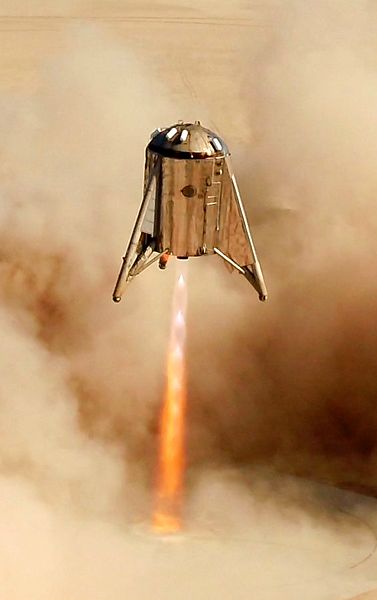
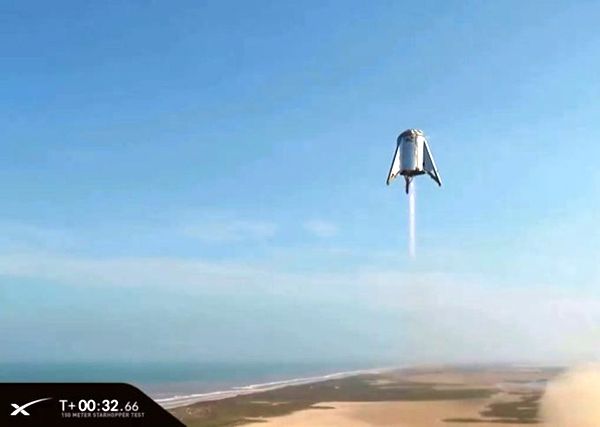
SpaceX's Starhopper prototype vehicle reaches an altitude of 150 meters (almost 500 feet) during its flight test above Boca Chica, Texas...on August 27, 2019.
SpaceX

Almost three hours ago, SpaceX's Starhopper prototype vehicle successfully lifted off from its launch site at the company's Boca Chica facility in southern Texas. The test flight lasted 57 seconds...with the watertower-shaped booster, which was powered by a single methane-fueled Raptor engine, reaching an altitude of 150 meters (almost 500 feet) before making a bulls-eye landing in the middle of an adjoining landing pad to conclude this demonstration. Supposedly, this will be Starhopper's final flight—as SpaceX will prepare for orbital tests using a pair of Starship replicas that are simultaneously being built in Boca Chica and Florida's Space Coast, respectively. It remains to be seen when those rockets will soar into the air...but for the time being, SpaceX should celebrate this latest accomplishment that shows that Elon Musk's aerospace firm is truly on the path to sending a human-rated spacecraft to Mars by the end of next decade.

SpaceX's Starhopper prototype vehicle prepares to touch down at its landing site after conducting a test flight that lasted 57 seconds above Boca Chica, Texas...on August 27, 2019.
SpaceX


Video courtesy of Mary - @BocaChicaGal on Twitter.com

Monday, August 26, 2019

Artemis 1 Update: Paving the Way for Next Year's SLS Green Run Test...

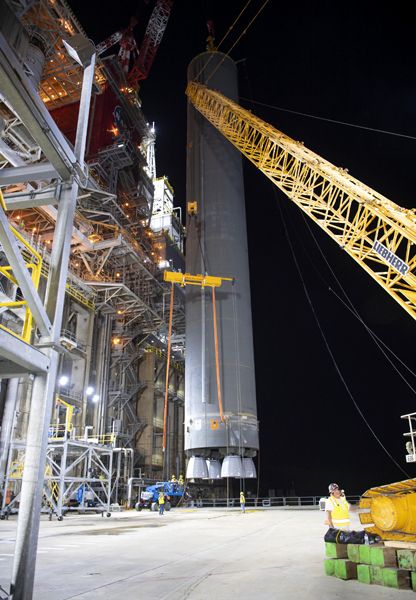
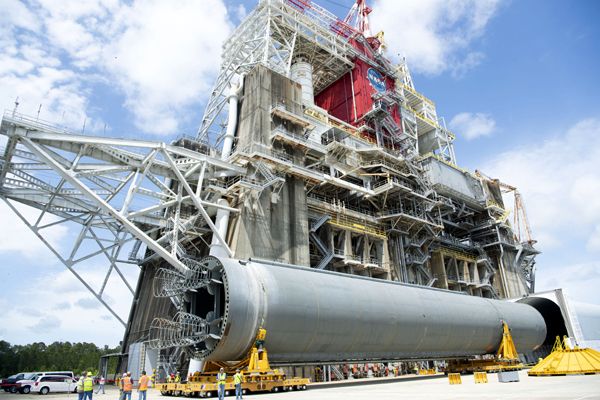
The Space Launch System's (SLS) core stage pathfinder article is vertically lifted prior to its installation onto the B-2 Test Stand at NASA's Stennis Space Center in Mississippi.
NASA / SSC

NASA Prepares for Green Run Testing, Practices Lifting SLS Core Stage (News Release)

NASA cleared a milestone in preparation for Green Run testing of its Space Launch System (SLS) core stage with an Aug. 23/24 lift and installation of the core stage pathfinder simulator onto the B-2 Test Stand at Stennis Space Center near Bay St. Louis, Miss. The lift and installation of the core stage pathfinder – a size and weight replica of the SLS core stage – is helping teams at Stennis prepare for the Green Run test series. For this test of the new core stage, Stennis will lift the flight core stage for Artemis 1, the first SLS mission into the stand. SLS and the new Orion spacecraft being built are the foundation for NASA’s Artemis Program, which will send the first woman and next man to walk on the Moon by 2024.

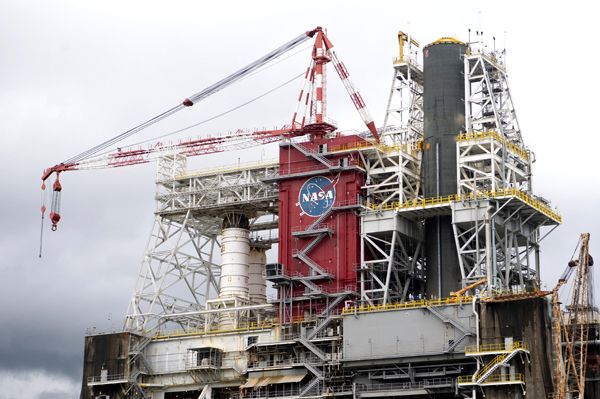
Stennis modified the B-2 Test Stand for the core stage Green Run testing. The procedure involved lifting the core stage pathfinder from its horizontal position on the B-2 Test Stand tarmac with the facility boom crane line attached to the forward end and a ground crane line attached to the aft end. The pathfinder then was “broken over” into a vertical position. Once the ground crane line was disconnected, the core stage pathfinder was lifted into place by the stand boom crane. This “fit test” validated auxiliary lift equipment, procedures, and verified that stand modifications and preparations are in place and prepared for delivery and testing of the SLS core stage flight hardware.

To prepare for the test, Stennis modified or upgraded every major area and system of the test stand, as well as the high-pressure industrial water system and high-pressure gas facility that support test operations. NASA is building the SLS flight core stage at its Michoud Assembly Facility in New Orleans and is scheduled for transport to Stennis by the end of the year. The stage recently completed a critical review in preparation for adding the last piece of the core stage structure: the engine section. After this piece is added, the four RS-25 engines can be connected to the stage. When the stage is completely assembled, NASA’s Pegasus barge will deliver it to Stennis.

For the Green Run test, the core stage flight unit will be lifted and installed onto the B-2 stand, using procedures developed and practiced during the recent core stage pathfinder lift. NASA then will conduct a series of tests to check out stage systems and make sure all are working as needed. Once systems are checked, NASA will conduct a full hot fire test of the stage, firing its four RS-25 engines simultaneously, just as during an actual launch. The hot fire test will generate more than 2 million pounds of combined thrust and provide critical performance data needed to demonstrate the core stage design is flightworthy and ready for launch.

Following necessary refurbishment of the stage, it will be transported by barge to Kennedy Space Center in Florida. At Kennedy, the stage will be mated with other SLS major elements and prepared for launch of the Artemis 1 mission.

Source: NASA.Gov

****

The SLS core stage pathfinder article is installed onto the B-2 Test Stand at NASA's Stennis Space Center in Mississippi.
NASA / SSC

Friday, August 16, 2019

Artemis Update: The Development of the 'Moon 2024' Lander Will Be Spearheaded in Huntsville, Alabama...

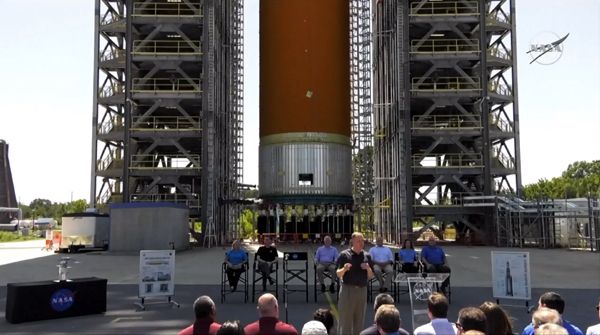
NASA Adminstrator Jim Bridenstine speaks in front of the structural test article for the Space Launch System's liquid hydrogen fuel tank at the Marshall Space Flight Center in Huntsville, Alabama...on August 16, 2019.
NASA TV

NASA Marshall to Lead Artemis Program’s Human Lunar Lander Development (Press Release)

NASA Administrator Jim Bridenstine was joined Friday by U.S. Representatives Mo Brooks and Robert Aderholt of Alabama and Scott DesJarlais of Tennessee at the agency’s Marshall Space Flight Center in Huntsville, Alabama, to announce the center’s new role leading the agency’s Human Landing System Program for its return to the Moon by 2024.

“Marshall Space Flight Center is the birthplace of America’s space program. It was Marshall scientists and engineers who designed, built, tested, and helped launch the giant Saturn V rocket that carried astronauts on the Apollo missions to the Moon,” Brooks said. “Marshall has unique capabilities and expertise not found at other NASA centers. I’m pleased NASA has chosen Marshall to spearhead a key component of America’s return to the Moon and usher in the Artemis era. Thanks to Administrator Bridenstine for travelling here to share the great news in person.”

Bridenstine discussed the announcement in front of the 149-foot-tall Space Launch System (SLS) rocket liquid hydrogen tank structural test article currently being tested.

“We greatly appreciate the support shown here today by our representatives in Congress for NASA’s Artemis program and America’s return to the Moon, where we will prepare for our greatest feat for humankind – putting astronauts on Mars,” Bridenstine said. “We focus on a ‘One NASA’ integrated approach that uses the technical capabilities of many centers. Marshall has the right combination of expertise and experience to accomplish this critical piece of the mission.”

Informed by years of expertise in propulsion systems integration and technology development, engineers at Marshall will work with American companies to rapidly develop, integrate, and demonstrate a human lunar landing system that can launch to the Gateway, pick up astronauts and ferry them between the Gateway and the surface of the Moon.

“Marshall Space Flight Center, and North Alabama, have played a key role in every American human mission to space since the days of Mercury 7. I am proud that Marshall has been selected to be the lead for the landers program,” said Aderholt. “I am also very proud that Marshall has designed and built the rocket system, the Space Launch System, which will make missions to the Moon and Mars possible. We look forward to working with our industry partners and our NASA partners from around the country."

NASA’s Johnson Space Center in Houston, which manages major NASA human spaceflight programs including the Gateway, Orion, Commercial Crew and International Space Station, will oversee all aspects related to preparing the landers and astronauts to work together. Johnson also will manage all Artemis missions, beginning with Artemis 1, the first integrated test of NASA’s deep space exploration systems.

The trip to Marshall came the day after Bridenstine visited NASA’s Michoud Assembly Facility in New Orleans, where he viewed progress on the SLS core stage that will power NASA’s Artemis 1 lunar mission. With the start of testing in June on the liquid hydrogen tank article, and the recent arrival of the liquid oxygen tank at Marshall, which manages the SLS Program, NASA is more than halfway through SLS structural testing.

“The Tennessee Valley, including Huntsville and stretching across Middle Tennessee, is a dynamic, exciting region, home to thousands of men and women – working at both public and private institutions – who are leading the United States into the next age of space exploration,” said DesJarlais. “As a member of the House Armed Services Committee, I am thrilled to visit one of our country’s premier facilities, near Arnold Air Force Base and others, developing the latest spaceflight technology. NASA’s Artemis program will help our country to create another American Century. We can be proud of our achievements, especially here at the Marshall Space Flight Center.”

NASA recently issued a draft solicitation and requested comments from American companies interested in providing an integrated human landing system – a precursor to the final solicitation targeted for release in the coming months. The agency’s human lunar exploration plans are based on a two-phase approach: the first is focused on speed – landing on the Moon within five years, while the second will establish a sustained human presence on and around the Moon by 2028. The agency will use what we learn on the Moon to prepare for the next giant leap – sending astronauts to Mars.

****

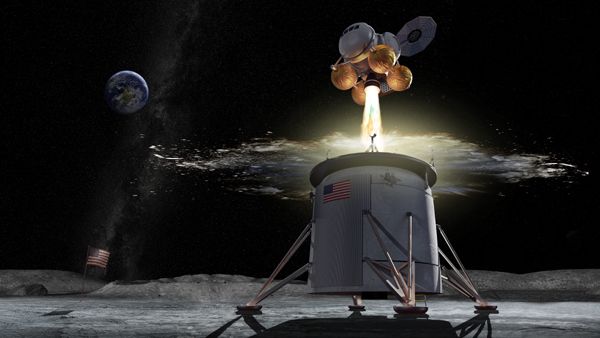
An artist's concept of the ascent module for NASA's Human Landing System lifting off from the lunar surface.
NASA

Friday, July 26, 2019

An Eventful Day for SpaceX...

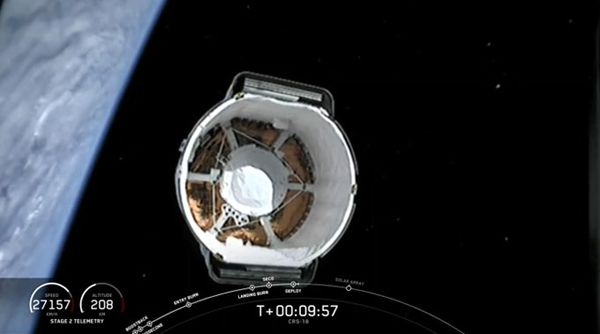
The Dragon CRS-18 capsule (which is making its third flight in space) separates from its upper stage booster following launch aboard a Falcon 9 rocket from Cape Canaveral Air Force Station in Florida...on July 25, 2019.
SpaceX

SpaceX Dragon on Route to Space Station with NASA Science, Cargo (Press Release - July 25)

A SpaceX Dragon cargo spacecraft is on its way to deliver the second commercial crew docking port and about 5,000 pounds of science investigations and supplies for the International Space Station after a 6:01 p.m. EDT Thursday launch from Florida.

The spacecraft launched on a Falcon 9 rocket from Space Launch Complex 40 at Cape Canaveral Air Force Station, and is scheduled to arrive at the orbiting laboratory Saturday, July 27. Coverage of the spacecraft’s approach and arrival will begin at 8:30 a.m. on NASA Television and the agency’s website.

Dragon will join three other spacecraft currently at the space station. Expedition 60 Flight Engineers Nick Hague and Christina Koch of NASA will use the station’s robotic arm, Canadarm2, to grab, or grapple, Dragon around 10 a.m. Coverage of robotic installation to the Earth-facing port of the Harmony module will begin at 12 p.m.

A key item in Dragon’s unpressurized cargo section is International Docking Adapter-3 (IDA-3). Flight controllers at mission control in Houston will use the robotic arm to extract IDA-3 from Dragon and position it over Pressurized Mating Adapter-3, on the space-facing side of the Harmony module. Hague and NASA astronaut Drew Morgan, who arrived at the station Saturday, July 20, will conduct a spacewalk in mid-August to install the docking port, connect power and data cables, and set up a high-definition camera on a boom arm.

Robotics flight control teams from NASA and the Canadian Space Agency will move the docking port into position remotely before the astronauts perform the final installation steps. IDA-3 and IDA-2, which was installed in the summer of 2016, provide a new standardized and automated docking system for future spacecraft, including upcoming commercial spacecraft that will transport astronauts through contracts with NASA.

This delivery, SpaceX’s 18th cargo flight to the space station under a Commercial Resupply Services contract with NASA, will support dozens of new and existing investigations. The space station continues to be a one-of-a-kind laboratory where NASA is conducting world-class research in fields, such as biology, physics, and materials science. NASA’s research and development work aboard the space station contributes to the agency’s deep space exploration plans, including returning astronauts to the Moon’s surface in five years and preparing to send humans to Mars.

Here are details about some of the scientific investigations Dragon is delivering to the space station:

Bio-Mining in Microgravity

The Biorock investigation will provide insight into the physical interactions of liquid, rocks and microorganisms under microgravity conditions and improve the efficiency and understanding of mining materials in space. Bio-mining eventually could help explorers on the Moon or Mars acquire needed materials, lessening the need to use precious resources from Earth and reducing the amount of supplies that explorers must take with them.

Printing Biological Tissues in Space

Using 3D biological printers to produce usable human organs has long been a dream of scientists and doctors around the globe. However, printing the tiny, complex structures found inside human organs, such as capillary structures, has proven difficult to accomplish in Earth’s gravity. To overcome this challenge, Techshot designed their BioFabrication Facility to print organ-like tissues in microgravity – a stepping stone in a long-term plan to manufacture whole human organs in space using refined biological 3D printing techniques.

Improving Tire Manufacturing from Orbit

The Goodyear Tire investigation will use microgravity to push the limits of silica fillers for tire applications. A better understanding of silica morphology and the relationship between silica structure and its properties could improve the silica design process, silica rubber formulation and tire manufacturing and performance. Such improvements could include increased fuel efficiency, which would reduce transportation costs and help to protect Earth’s environment.

Effects of Microgravity on Microglia 3D Models

Induced pluripotent stem cells (iPSC) – adult cells genetically programmed to return to an embryonic stem cell-like state – have the ability to develop into any cell type in the human body, potentially providing an unlimited source of human cells for therapeutic purposes. Space Tango-Induced Pluripotent Stem Cells examines how specialized white blood cells derived from iPSCs of patients with Parkinson’s disease and multiple sclerosis grow and move in 3D cultures, and any changes in gene expression that occur as a result of exposure to a microgravity environment. Results could lead to the development of potential therapies.

Mechanisms of Moss in Microgravity

Space Moss compares mosses grown aboard the space station with those grown on Earth to determine how microgravity affects its growth, development, and other characteristics. Tiny plants without roots, mosses need only a small area for growth, an advantage for their potential use in space and future bases on the Moon or Mars. This investigation also could yield information that aids in engineering other plants to grow better on the Moon and Mars, as well as on Earth.

These are just a few of the hundreds of investigations providing opportunities for U.S. government agencies, private industry, and academic and research institutions to conduct microgravity research that leads to new technologies, medical treatments, and products that improve life on Earth. Conducting science aboard the orbiting laboratory will help us learn how to keep astronauts healthy during long-duration space travel and demonstrate technologies for future human and robotic exploration beyond low-Earth orbit to the Moon and Mars.

For more than 18 years, humans have lived and worked continuously aboard the International Space Station, advancing scientific knowledge and demonstrating new technologies, making research breakthroughs not possible on Earth that will enable long-duration human and robotic exploration into deep space. A global endeavor, more than 230 people from 18 countries have visited the unique microgravity laboratory that has hosted more than 2,500 research investigations from researchers in 106 countries.

****

A video screenshot of SpaceX's Starship vehicle prototype, called Starhopper, enshrouded in a cloud of smoke as it lifts off from the company's Boca Chica launch site on July 25, 2019.
SpaceX

Thursday, July 25, 2019

Artemis 1 Update: The SLS Core Stage Booster Will Stop By Mississippi Before It's Sent to Kennedy Space Center for Launch...

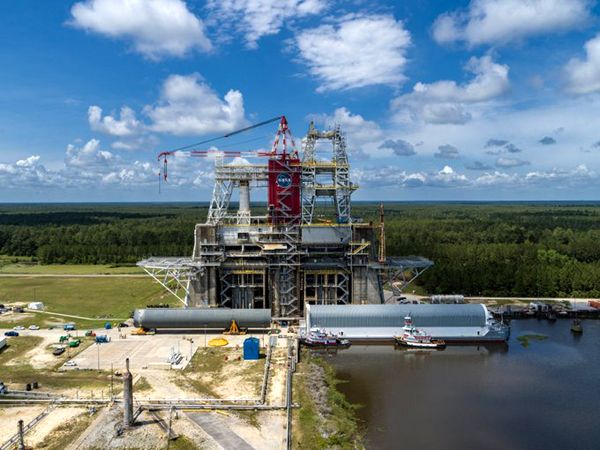
An aerial view of the Space Launch System's (SLS) core stage pathfinder article near the base of the B-2 Test Stand at NASA's Stennis Space Center in Mississippi.
NASA

“Green Run” Test Will Pave the Way for Successful NASA Moon Missions (News Release)

NASA Administrator Jim Bridenstine announced July 25 the agency will conduct a “Green Run” core stage test for the Space Launch System rocket ahead of the upcoming Artemis 1 lunar mission.


This is how the Green Run will work:

The first eight minutes of every Artemis mission with NASA’s Space Launch System (SLS) rocket will begin with core stage and solid rocket boosters producing 8.8 million pounds of thrust to launch the agency’s Orion spacecraft to the Moon. NASA will test the rocket’s 212-foot tall core stage—the tallest rocket stage the agency has ever built—with a “Green Run” test on Earth before launch day to help ensure mission success and pave the way for future Artemis missions carrying crew to the Moon. Missions at the Moon will be a stepping stone to prepare for human exploration of Mars.

During the Green Run testing, engineers will install the core stage that will send Orion to the Moon in the B-2 Test Stand at NASA’s Stennis Space Center near Bay St. Louis, Mississippi for a series of tests that will build like a crescendo over several months. The term “green” refers to the new hardware that will work together to power the stage, and “run” refers to operating all the components together simultaneously for the first time. Many aspects will be carried out for the first time, such as fueling and pressurizing the stage, and the test series culminates with firing up all four RS-25 engines to demonstrate that the engines, tanks, fuel lines, valves, pressurization system, and software can all perform together just as they will on launch day.

“The SLS core stage is an engineering feat that includes not only the largest rocket propellant tanks ever built but also sophisticated avionics and main propulsion systems,” said Lisa Bates, SLS deputy stages manager. “While the rocket is designed to evolve over time for different mission objectives, the core stage design will remain basically the same. The Green Run acceptance test gives NASA the confidence needed to know the new core stage will perform again and again as it is intended.”

The SLS core stage includes state-of-the-art avionics, miles of cables and propulsion systems and two huge liquid propellant tanks that collectively hold 733,000 gallons of liquid oxygen and liquid hydrogen to power the four RS-25 engines. Together, they will produce more than 2 million pounds of thrust to help send Artemis 1 beyond Earth’s orbit to the Moon.

The test program for the core stage at Stennis will begin with installing the stage into the test stand. Then, engineers will turn the components on one by one through a series of initial tests and functional checks designed to identify any issues. Those tests and checks will culminate in an eight-minute-long test fire, mimicking the full duration of the stage’s first flight with ignition, ascent and engine shutdown. The results of this test also will provide important data that will confirm how the system reacts as the fuel is depleted from the propellant tanks.

“With Green Run, we verify each individual component operates well within the core stage system,” said Bates. “It’s more than testing. It’s the first time the stage will come to life and be fully operational from the avionics in the top of the core stage to the engines at the bottom.”

The test series is a collaborative effort between a number of NASA field centers, programs and contractors. The entire stage was built and manufactured at NASA’s Michoud Assembly Facility in New Orleans. The structural test articles, also built at Michoud, were shipped to NASA’s Marshall Space Flight Center in Huntsville, Alabama, for structural testing. The work done by Marshall’s test teams certifies the structural integrity of the rocket’s core stage, while Green Run shows that the integrated stage operates correctly. The Stennis teams renovated the historic B-2 Test Stand used to test stages for multiple programs including the Saturn V and the space shuttle propulsion system in the 1970s.

“Green Run is a historic moment for NASA and Stennis for a number of reasons,” said Dr. Richard Gilbrech, Director, Stennis Space Center. “For the first time in NASA’s history, a launch vehicle will use flight hardware for its first test, and the Stennis test stands will once again test the core stage for Moon missions.”

Historically, other NASA rockets built to carry astronauts have used main propulsion test articles to test the integrated engines and main propulsion system. The SLS program is performing the stage testing with flight hardware. Once the validation of the stage is complete, the entire stage will be checked out, refurbished as needed, and then shipped to NASA’s Kennedy Space Center in Florida for the Artemis 1 launch. The next time the core stage engines roar to life will be on the launch pad at Kennedy.

NASA is working to land the first woman and next man on the Moon by 2024. SLS and Orion, along with the Gateway in orbit around the Moon, are NASA’s backbone for deep space exploration. SLS is the only rocket that can send Orion, astronauts and supplies to the Moon on a single mission.

Source: NASA.Gov
****

A ground-level view of the SLS core stage pathfinder article near the base of the B-2 Test Stand at NASA's Stennis Space Center in Mississippi.
NASA

Saturday, July 20, 2019

The Next Orion Spacecraft Is Declared Complete on the 50th Anniversary of Apollo 11's Moon Landing...

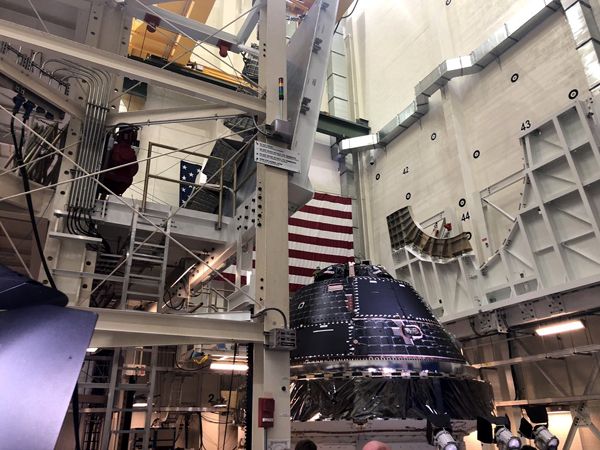
On display inside the Neil Armstrong Operations and Checkout Building at NASA's Kennedy Space Center in Florida, the Orion capsule that will fly on the Artemis 1 mission is officially declared complete on July 20, 2019...the 50th anniversary of the Apollo 11 Moon landing.
NASA / Mark Kirasich

Vice President Unveils NASA Spacecraft for Artemis 1 Lunar Mission on Moon Landing Anniversary (Press Release)

Vice President Mike Pence visited and gave remarks in the Neil Armstrong Operations and Checkout Building at NASA’s Kennedy Space Center in Florida on Saturday to commemorate the 50th anniversary of the agency’s Apollo 11 Moon landing and announce to America the completion of NASA’s Orion crew capsule for the first Artemis lunar mission.

“Thanks to the hard work of the men and women of NASA, and of American industry, the Orion crew vehicle for the Artemis 1 mission is complete and ready to begin preparations for its historic first flight,” said Vice President Pence.

He was joined on stage by Florida Governor Ron DeSantis, NASA Administrator Jim Bridenstine, Apollo 11 Lunar Module Pilot Buzz Aldrin, Kennedy Center Director Robert Cabana, Lockheed Martin Chairman, President and Chief Executive Officer Marillyn Hewson, and Rick Armstrong, son of Apollo 11 Commander Neil Armstrong. Before going to the Operations and Checkout Building, the Vice President, Aldrin and Armstrong visited Kennedy’s historic launch pad, 39A, where the Apollo 11 mission lifted off.

NASA’s goal 50 years ago was to prove the agency could land humans on the Moon and return them safely to Earth. The goal now is to return to the Moon in a sustainable way to prepare for the next giant leap – sending astronauts to Mars for the first time ever.

Artemis 1 will launch NASA’s Orion spacecraft and Space Launch System (SLS) rocket around the Moon to test the system and pave the way for landing the first woman and the next man on the Moon in five years, as well as future missions to Mars.

“Similar to the 1960s, we too have an opportunity to take a giant leap forward for all of humanity,” said Bridenstine. “President Trump and Vice President Pence have given us a bold direction to return to the Moon by 2024 and then go forward to Mars. Their direction is not empty rhetoric. They have backed up their vision with the budget requests need to accomplish this objective. NASA is calling this the Artemis program in honor of Apollo’s twin sister in Greek mythology, the goddess of the Moon. And we are well on our way to getting this done.”

Engineers recently completed building and outfitting the Orion crew module at Kennedy. The underlying structure of the crew module, known as the pressure vessel, was manufactured at NASA’s Michoud Assembly Facility in New Orleans and shipped to Kennedy, where teams have integrated thousands of parts into the crew module and conducted tests to certify all of its systems for flight.

Orion’s European Service Module, which will provide the power and propulsion for Orion during the mission, also is complete. Contributed by ESA (European Space Agency), the service module was manufactured by Airbus in Bremen, Germany, and shipped to Kennedy in November 2018 for final assembly and integration. Engineers have begun operations to join the crew module to the service module, and teams are connecting power and fluid lines to complete hardware attachment.

Once the two modules are joined, engineers will install a heatshield backshell panel on the spacecraft and prepare it for a September flight inside the agency’s Super Guppy aircraft to NASA’s Plum Brook Station in Sandusky, Ohio. Testing at Plum Brook will ensure the joined modules can withstand the deep space environment.

When testing in Ohio is complete, the spacecraft will return to Kennedy for final processing and inspections. Teams then will fuel the spacecraft and transport it to Kennedy’s iconic Vehicle Assembly Building for integration with the SLS rocket before it is rolled out to Launch Pad 39B for the launch of Artemis 1.

Orion is part of NASA’s backbone for deep space exploration, along with SLS and the lunar Gateway. During Artemis 1, SLS will send the uncrewed spacecraft – consisting of the crew and service modules – thousands of miles past the Moon for the first in a series of increasingly complex missions. Artemis 2 will be the first of these new missions to the Moon with astronauts on board, followed by Artemis 3, which will launch the next American moonwalkers into a new era of exploration.

Working with U.S. companies and international partners, NASA will push the boundaries of human exploration forward to the Moon. Through Artemis, the agency will establish a sustainable human presence at the Moon by 2028 to continue scientific research and discovery, demonstrate new technologies, and lay the foundation for future missions to Mars.

****

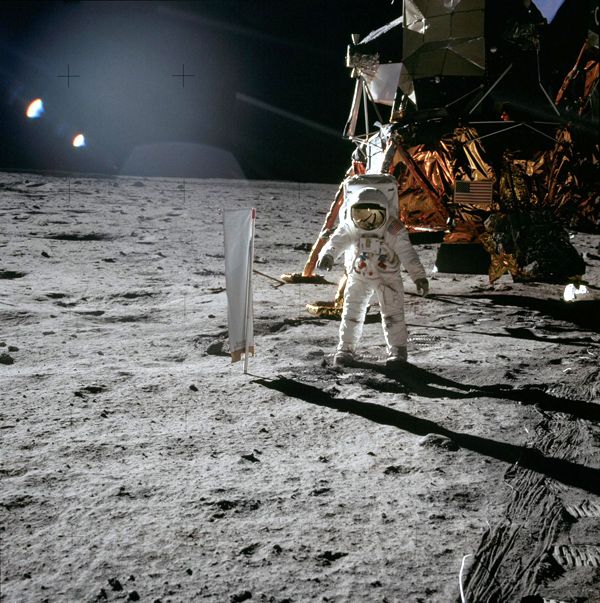
With the Eagle lunar module behind him, Apollo 11 astronaut Buzz Aldrin stands next to the Solar Wind Composition Experiment at Tranquility Base...on July 20, 1969.
NASA / Neil Armstrong

Tuesday, July 16, 2019

Half A Century Ago Today...

50 YEARS AGO TODAY, at this very moment, a Saturn V rocket carrying NASA's Apollo 11 spacecraft and its three astronauts launched from Kennedy Space Center in Florida on a 3-day voyage to the Moon. This photo speaks for itself. It's a powerful image like this which is why NASA and its international partners should do everything they can to make the 2024 landing of the first woman and next man on the lunar surface, via Orion and the Space Launch System on the Artemis 3 mission, a reality... Carry on.

A Saturn V rocket carrying NASA's Apollo 11 spacecraft launches to the Moon on July 16, 1969.
NASA

Tuesday, July 2, 2019

The Last Major Flight Test for Orion Is Achieved Before It Flies on the Artemis 1 Mission to the Moon...

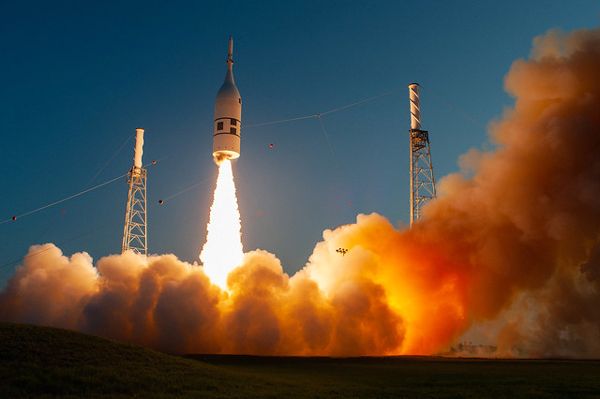
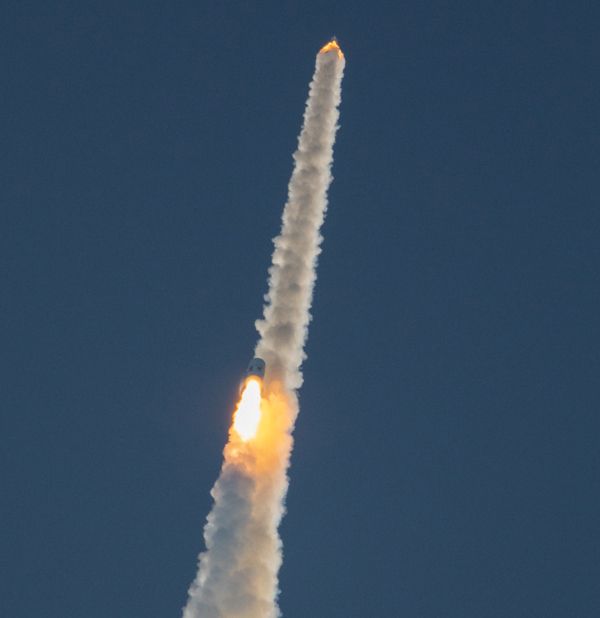
A modified Peacekeeper missile carrying an Orion mass simulator and its launch abort system lifts off on the Ascent Abort-2 test from Cape Canaveral Air Force Station in Florida...on July 2, 2019.
NASA / Tony Gray and Kevin O’Connell

Successful Orion Test Brings NASA Closer to Moon, Mars Missions (Press Release)

NASA successfully demonstrated Tuesday the Orion spacecraft’s launch abort system can outrun a speeding rocket and pull astronauts to safety during an emergency during launch. The test is another milestone in the agency’s preparation for Artemis missions to the Moon that will lead to astronaut missions to Mars.

During the approximately three-minute test, called Ascent Abort-2, a test version of the Orion crew module launched at 7 a.m. EDT from Space Launch Complex 46 at Cape Canaveral Air Force Station in Florida on a modified Peacekeeper missile procured through the U.S. Air Force and built by Northrop Grumman.

The Orion test spacecraft traveled to an altitude of about six miles, at which point it experienced high-stress aerodynamic conditions expected during ascent. The abort sequence triggered and, within milliseconds, the abort motor fired to pull the crew module away from the rocket. Its attitude control motor flipped the capsule end-over-end to properly orient it, and then the jettison motor fired, releasing the crew module for splashdown in the Atlantic Ocean.

A team is collecting the 12 data recorders that were ejected during the test capsule’s descent. Analysis of the information will provide insight into the abort system’s performance.

“We're building the most powerful rocket in the world to send astronauts to the Moon in the Orion spacecraft for Artemis missions,” said Bill Hill, deputy associate administrator for Exploration Systems Development at NASA Headquarters in Washington. “With this exploration system designed to safely carry humans farther into space than ever before, we'll also have an equally powerful launch abort system that will pull the crew away if there is a problem with the rocket during the early portion of ascent.”

The tower-like abort structure consists of two parts: the fairing assembly, which is a shell composed of a lightweight composite material that protects the capsule from the heat, air flow and acoustics of the launch, ascent, and abort environments; and the launch abort tower, which includes the abort motor, attitude control motor, and jettison motor. The system is built specifically for deep space missions and to ride on NASA’s powerful Space Launch System (SLS) rocket.

“Launching into space is one of the most difficult and dangerous parts of going to the Moon,” said Mark Kirasich, Orion program manager at Johnson Space Center in Houston. “This test mimicked some of the most challenging conditions Orion will ever face should an emergency develop during the ascent phase of flight. Today, the team demonstrated our abort capabilities under these demanding conditions and put us one huge step closer to the first Artemis flight carrying people to the Moon.”

NASA was able to accelerate the test schedule and lower costs by simplifying the test spacecraft and eliminating parachutes and related systems. NASA already qualified the parachute system for crewed flights through an extensive series of 17 developmental tests and eight qualification tests completed at the end of 2018.

Engineers are making progress building and testing the Orion spacecraft for Artemis 1, the first uncrewed mission with the SLS rocket – an integrated system traveling thousands of miles beyond the Moon – and for Artemis 2, the first mission with astronauts.

At NASA’s Kennedy Space Center in Florida, technicians are preparing to attach the Orion crew and service modules before testing at the agency’s Plum Brook Station in Sandusky, Ohio, later this year. The crew module for Artemis 2 is being outfitted with thousands of elements – from bolts and strain gauges to parachutes and propulsion lines.

The agency recently reached major milestones for the SLS rocket, assembling four of the five parts that make up the massive core stage that will launch Artemis 1 and delivering the four engines that will be integrated into the core stage, along with the engine section, later this summer. When completed, the entire core stage will be the largest rocket stage NASA has built since manufacturing the Saturn V stages for NASA’s Apollo lunar missions in the 1960s.

Orion is part of NASA’s backbone for deep space exploration, along with the SLS and Gateway, that will land the first woman and next man on the Moon by 2024. Through the Artemis program, the next American Moon walkers will depart Earth aboard Orion and begin a new era of exploration.

****

The launch abort system carrying an Orion mass simulator rockets away from the modified Peacekeeper missile during the Ascent Abort-2 test from Cape Canaveral Air Force Station in Florida...on July 2, 2019.
NASA / Kim Shiflett