Wednesday, August 31, 2022

ISS Update: Astronauts Will Ride Crew Dragons to the Orbital Outpost Until 2030...

A snapshot of SpaceX's Crew Dragon capsule docked to the International Space Station's Harmony module.
NASA

NASA Awards SpaceX More Crew Flights to Space Station (News Release)

NASA has awarded five additional missions to Space Exploration Technologies Corporation (SpaceX) of Hawthorne, California, for crew transportation services to the International Space Station as part of the agency’s Commercial Crew Transportation Capability (CCtCap) contract. The CCtCap modification brings the total missions for SpaceX to 14 and allows NASA to maintain an uninterrupted U.S. capability for human access to the space station until 2030, with two unique commercial crew industry partners.

This is a firm fixed-price, indefinite-delivery/indefinite-quantity contract modification for the Crew-10, Crew-11, Crew-12, Crew-13 and Crew-14 flights. The value of this modification for all five missions and related mission services is $1,436,438,446. The amount includes ground, launch, in-orbit, and return and recovery operations, cargo transportation for each mission, and a lifeboat capability while docked to the International Space Station. The period of performance runs through 2030 and brings the total CCtCap contract value with SpaceX to $4,927,306,350.

The award follows the agency issuing a notice of intent in June 2022 to purchase the additional missions. The current sole source modification does not preclude NASA from seeking future contract modifications for additional transportation services, as needed.

In 2014, NASA awarded the CCtCap contracts to Boeing and SpaceX through a public-private partnership as part of the agency’s Commercial Crew Program. Under CCtCap, NASA certifies that a provider’s space transportation system meets the agency’s requirements prior to flying missions with astronauts.

SpaceX was certified by NASA for crew transportation in November 2020. The company's fourth crew rotation mission for the agency, the Crew-4 mission, is currently in orbit at the space station. As part of the missions, SpaceX’s Crew Dragon spacecraft and Falcon 9 rocket transport up to four astronauts, along with critical cargo, to the space station.

Source: NASA.Gov

Tuesday, August 30, 2022

The Space Launch System's Maiden Flight Is Now Scheduled for Next Saturday...

An infrared image of NASA's Space Launch System rocket as it stands tall at Kennedy Space Center's Pad 39B in Florida...on August 30, 2022.
NASA / Joel Kowsky

NASA Targets Sept. 3 for Next Artemis I Moon Mission Launch Attempt (News Release)

NASA will target Saturday, September 3 at 2:17 p.m. EDT, the beginning of a two-hour window, for the launch of Artemis I, the first integrated test of NASA’s Orion spacecraft, Space Launch System (SLS) rocket and the ground systems at the agency’s Kennedy Space Center in Florida.

Mission managers met Tuesday to discuss data and develop a forward plan to address issues that arose during an August 29 launch attempt for the flight test. During that launch attempt, teams were not able to chill down the four RS-25 engines to approximately -420°F, with engine 3 showing higher temperatures than the other engines. Teams also saw a hydrogen leak on a component of the tail service mast umbilical quick disconnect, called the purge can, and managed the leak by manually adjusting propellant flow rates.

In the coming days, teams will modify and practice propellant-loading procedures to follow a procedure similar to what was successfully performed during the Green Run at NASA’s Stennis Space Center in Mississippi. The updated procedures would perform the chilldown test of the engines, also called the kickstart bleed test, about 30 to 45 minutes earlier in the countdown during the liquid hydrogen fast-fill liquid phase for the core stage.

Teams are also configuring platforms at Launch Complex 39B to enable engineers access to the purge can on the tail service mast umbilical. Once access is established, technicians will perform assessments and torque connection points where necessary.

Meteorologists with the U.S. Space Force's Space Launch Delta 45 predict favorable weather conditions for Saturday. While rain showers are expected, they are predicted to be sporadic during the launch window.

The mission management team will reconvene Thursday to review data and overall readiness.

Source: NASA.Gov

****

Monday, August 29, 2022

The Artemis 1 Launch Is Called Off Due to Engine and Hydrogen Valve Issues During the Countdown...

NASA's Space Launch System rocket is loaded with cryogenic fuel during its first launch attempt at Kennedy Space Center's Pad 39B in Florida...on August 29, 2022.
NASA / Joel Kowsky

Engineers Assess Data After Scrub, Mission Managers to Meet Tuesday Afternoon (News Release)

Engineers are evaluating data gathered during the Artemis I launch attempt Monday, August 29, when teams could not get the rocket’s engines to the proper temperature range required to start the engines at liftoff, and ran out of time in the two-hour launch window to continue. The mission management team will convene Tuesday afternoon to discuss the data and develop a plan forward.

The Space Launch System’s four RS-25 engines must be thermally conditioned before super cold propellant begins flowing through them for liftoff. Launch controllers condition them by increasing the pressure on the core stage liquid hydrogen tank to route, or “bleed” as it is often called, a portion of the approximately -423°F liquid hydrogen to the engines. Managers suspect the issue, seen on engine 3, is unlikely to be the result of a problem with the engine itself.

During the countdown, launch controllers worked through several additional issues, including storms in the area that delayed the start of propellant-loading operations, a leak at the quick disconnect on the 8-inch line used to fill and drain core stage liquid hydrogen, and a hydrogen leak from a valve used to vent the propellant from the core stage intertank.

NASA will host a media teleconference Tuesday, August 30, at approximately 6 p.m. EDT to provide an update on data analysis and discussions. The time is subject to change. While managers have not yet set a date for the next launch attempt, the earliest possible opportunity is Friday, September 2, during a two-hour launch window that opens at 12:48 p.m.

Source: NASA.Gov

****

At sunrise, cumulus clouds loom high above NASA's Space Launch System rocket at Kennedy Space Center's Pad 39B in Florida...on August 29, 2022.
NASA / Joel Kowsky

Sunday, August 28, 2022

It's Artemis Eve! The Latest Launch Update for NASA's First Moon Rocket in 50 Years...

With the Space Launch System rocket standing tall at the pad, NASA is less than 24 hours away from sending the first human-rated spacecraft, Orion, to the Moon in 50 years.
Boeing Space

Countdown Continues, Teams Confirm No Impacts from Lightning Strikes (News Release)

Overnight engineers evaluated data from lightning strikes to the lightning protection system at Launch Complex 39B that occurred yesterday. They confirmed the strikes were of low magnitude and had no impacts to the Space Launch System, Orion or ground systems.

Meteorologists with the U.S. Space Force's Space Launch Delta 45 predict an 80% chance of favorable weather conditions at the beginning of the two-hour launch window that opens at 8:33 a.m. EDT August 29, with a 60% chance of favorable weather conditions toward the later part of the window. The primary weather concern for the two-hour launch window remains scattered rain showers. The weather guidelines for NASA’s Artemis I flight test identify conditions to launch the agency’s Space Launch System and Orion spacecraft.

Overnight teams also powered up the Space Launch System rocket’s core stage, charged Orion and core stage batteries, and conducted final preparations on the umbilicals. A pre-launch walkdown are continuing at the launch pad this morning. Teams will continue working their way through the countdown today, including powering up the interim cryogenic propulsion stage and conducting planned health checks on Orion systems.

Live coverage of tanking operations will begin at midnight on NASA Television, the agency’s website and the NASA app. Full launch coverage begin at 6:30 a.m. EDT on NASA Television and the agency’s website, as well as YouTube, Twitter, Facebook, LinkedIn, Twitch, Daily Motion, Theta.TV and the NASA app.

The uncrewed flight test will test SLS and Orion as an integrated system, demonstrating the performance of the rocket and testing the spacecraft’s capabilities as it journeys about 40,000 miles beyond the Moon over the course of about six weeks.

The first in an increasingly complex series of missions, Artemis I will pave the way for long-term lunar exploration, providing the foundation for extending human presence to the Moon and beyond.

Source: NASA.Gov

****

Donning an Artemis baseball cap to commemorate tomorrow's hopeful launch of the Artemis 1 mission.

Saturday, August 27, 2022

The Artemis 1 Countdown Officially Begins as Stormy Weather Persists at Cape Canaveral 2 Days Before Launch...

A lightning bolt strikes one of the three 600-foot-tall towers that protect NASA's Space Launch System rocket at Kennedy Space Center's Pad 39B in Florida...on August 27, 2022.
NASA / Keegan Barber

Team Assessing Lightning Strikes to Towers at Launch Pad (News Release)

As the Artemis I countdown progresses, rain and thunderstorms have continued throughout the afternoon at NASA’s Kennedy Space Center in Florida. Earlier this afternoon, there were three lightning strikes to the lightning protection system towers at Launch Complex 39B – a strike to Tower 1, and two strikes to Tower 2.

Initial indications are that the strikes were of low magnitude. A weather team has begun an assessment that includes collecting voltage and current data, as well as imagery. The data will be shared with a team of experts on electromagnetic environment efforts who will determine if any constraints on vehicle or ground systems were violated.

Engineers will conduct a walkdown at the pad tonight, and if needed, conduct additional assessments with subsystems experts.

Overnight, engineers also will conduct preparations on the umbilicals, power up the core stage, and begin charging the Orion and Space Launch System core stage batteries.

The lightning protection system at the launch pad includes three 600-foot-tall towers and catenary wires positioned to protect the rocket, spacecraft, and mobile launcher. The wires run to the ground almost diagonally, steering the lightning current away from the rocket.

Source: NASA.Gov

****

Friday, August 26, 2022

CST-100 Update: Starliner's Next Flight, with Astronauts Onboard, is Targeted for Early 2023...

Boeing's Starliner capsule docked to the International Space Station...as seen from inside SpaceX's Crew Dragon Freedom vehicle on May 20, 2022.
Samantha Cristoforetti

NASA, Boeing Prepare for Crew Flight Test (News Release - August 25)

NASA and Boeing are targeting an early February 2023 launch for the first CST-100 Starliner flight with astronauts to the International Space Station.

Preparations are underway for the launch of NASA’s Boeing Crew Flight Test (CFT) as teams work to ready the hardware, crew, and mission support teams for flight as part of NASA’s Commercial Crew Program.

Two NASA astronaut test pilots, Barry “Butch” Wilmore and Suni Williams, will fly on CFT to the space station, where they will live and work for approximately eight days. Mission and crew support teams and the CFT astronauts are continuing with preparations and training. NASA and Boeing teams recently conducted an integrated crew exercise to rehearse the prelaunch timeline and responses to various launch event scenarios. In the coming weeks, Wilmore and Williams will don their spacesuits and climb aboard their crew module to check out the vehicle systems and interfaces that support their health and safety.

Refurbishment of the CFT crew module following the first Orbital Flight Test in December 2019 is progressing. Its external shell and thermal protection system will be completed next, followed by preflight checks to finalize the crew module build and test phase. Production of a new service module also is progressing, with teams wrapping up acceptance testing of the thermal control system, installing the pressurant system and integrating the propulsion system. This service module incorporates the same valve mitigations as the OFT-2 spacecraft. That purge system performed as needed during OFT-2 and a similar system has been implemented into the service module for CFT as a preventative measure. Once both the crew module and service module are completed, the two will be mated for flight.

During OFT-2, which launched May 19, Starliner spent six days in space, orbited the Earth 94 times and covered a total distance of 2,467,406 miles. Starliner achieved all flight test objectives and mission operations demonstrations, including rendezvous and docking maneuvers and the ability to execute an abort if needed once in the vicinity of the space station. Additionally, Starliner had a normal launch, trajectory, orbital insertion, and approach, rendezvous and docking with space station.

Throughout the OFT-2 data reviews, the team has verified Starliner’s subsystems performed as needed during the flight. This included environmental control and life support, landing, power, guidance navigation and control, docking and ascent abort emergency detection system validation, and atmospheric entry with aero-deceleration.

NASA and Boeing also are working to close out the OFT-2 in-flight anomalies prior to Starliner’s next flight with astronauts. Those include the early shutoff of some thrusters and a cooling loop anomaly. System enhancements to improve crew interfaces and streamline spacecraft operations are also planned.

For the crewed flight, Boeing’s Starliner will launch on a United Launch Alliance Atlas V rocket from Space Launch Complex-41 at Cape Canaveral Space Force Station in Florida.

Following a successful CFT mission, NASA will begin the final process of certifying the Starliner spacecraft and systems for crew missions to the space station. Regular commercial crew-rotation missions enable NASA to continue the important research and technology investigations taking place aboard the orbiting laboratory. Such research benefits people on Earth and lays the groundwork for future exploration. As part of Artemis, NASA will send astronauts to the Moon to prepare for future human exploration of Mars. Inspiring the next generation of explorers – the Artemis Generation – ensures America will continue to lead in space exploration and discovery.

Source: StarlinerUpdates.com

****

From left to right, NASA astronauts Suni Williams, Barry 'Butch' Wilmore and Mike Fincke stare at the Atlas V rocket and Starliner OFT-2 spacecraft at Cape Canaveral Space Force Station in Florida...on May 18, 2022.
NASA / Joel Kowsky

Thursday, August 25, 2022

T-Minus 4 DAYS Till Artemis 1 Takes Flight...

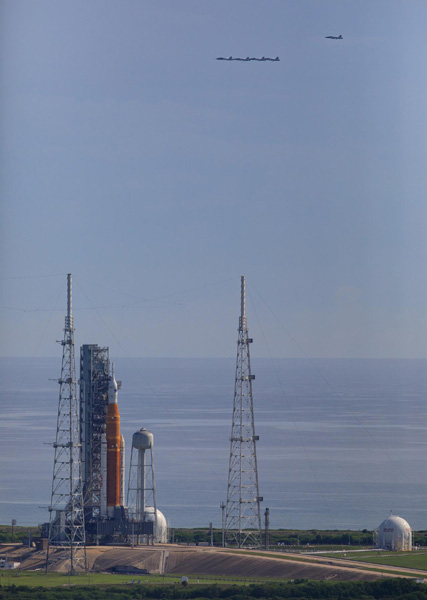
Five T-38 aircraft carrying NASA astronauts and photographers perform a flyover of the Space Launch System rocket at Kennedy Space Center's Pad 39B in Florida...on August 23, 2022.
NASA / Kim Shiflett

Launch Preparations Remain on Track, Weather 70% Favorable (News Release)

Engineers continue to prepare NASA’s mega-Moon rocket, Orion spacecraft, and ground systems for the Artemis I launch. The two-hour launch window opens at 8:33 a.m. EDT on Monday, August 29.

At Launch Complex 39B, technicians completed servicing the hydraulic power units on the Space Launch System rocket’s boosters Wednesday. After finishing final work inside the Orion crew module, including loading the Snoopy zero-gravity indicator and removing soft covers protecting Orion’s windows and seats, the crew module hatch was closed at approximately 3:30 a.m. Thursday. Next, engineers will close the launch abort system hatch and retract the crew access arm used to provide access to the spacecraft. Booster and core stage engine service platforms as well as side flame deflectors have been moved into position for launch.

Meteorologists with the U.S. Space Force Space Launch Delta 45 currently predict a 70% chance of favorable weather conditions for launch on August 29. The primary weather concern for the two-hour launch window is scattered rain showers. A list of launch weather criteria is available here.

NASA is providing a live stream of the rocket and spacecraft at the pad. The countdown is set to officially begin at 10:23 a.m. on Saturday, August 27.

Source: NASA.Gov

****

Four T-38 aircraft carrying NASA astronauts perform a flyover of the Space Launch System rocket at Kennedy Space Center's Pad 39B in Florida...on August 23, 2022.
NASA / Josh Valcarcel

Wednesday, August 24, 2022

Image of the Day: NASA and CSA Astronauts Visit Their Future Ride to the Moon...

NASA and Canadian Space Agency astronauts pose in front of the Space Launch System rocket at Kennedy Space Center's Pad 39B in Florida...on August 22, 2022.
NASA / Josh Valcarcel

Photo Release - August 22

Astronauts and astronaut candidates pose for a photo at Launch Complex 39B after arriving in their T-38 jets in support of Artemis I launch operations at NASA's Kennedy Space Center in Florida.

From Left: Canadian Space Agency Astronaut Jeremy Hansen, NASA Astronauts Drew Morgan, Christina Koch, NASA Astronaut Candidates Nicole Ayers, Jack Hathaway, NASA Astronauts Reid Wiseman, Zena Cardman, NASA Pilot Chris Condon, NASA Astronaut Joe Acaba.

Source: NASA.Gov

Tuesday, August 23, 2022

A Privately-Made 'Microgravity Factory' Moves One Step Closer to Reality...

An artist's concept of the Orbital Reef space station.
Amazon Supply Chain / Amazon Web Services / ASU / Boeing / Genesis Engineering Solutions / Redwire Space

Sierra Space and Blue Origin Successfully Complete Orbital Reef System Definition Review (Press Release - August 22)

Orbital Reef Space Station Advances to Design Phase After NASA Review

LOUISVILLE, Colo. and KENT, Wash. – The Orbital Reef team, led by partners Sierra Space and Blue Origin, has successfully completed its System Definition Review (SDR) with NASA.

The SDR is an important program milestone to establish the functional baseline for Orbital Reef, a commercially developed, owned and operated space station to be built in low-Earth orbit (LEO). It demonstrates to NASA that the space station design is feasible and achievable while validating that the Orbital Reef system is on-track to proceed into the design phase.

The Orbital Reef team, including Amazon Supply Chain, Amazon Web Services, Arizona State University, Boeing, Genesis Engineering Solutions and Redwire Space, is maturing the design of its space station in partnership with NASA under the agency’s Commercial Low-Earth Orbit Development (CLDP) program. NASA awarded the agreement in December 2021 to shift NASA’s research and exploration activities in LEO to commercial space stations and help stimulate a growing space economy.

The SDR included an extensive review to ensure that the proposed Orbital Reef architecture is responsive to the functional and performance requirements; it examined the proposed system architecture and the flow-down to all functional elements of the Orbital Reef system. The successful SDR supported NASA’s decision to further develop the system architecture and design. Representatives from Blue Origin, Sierra Space, team members, and NASA participated in the review, conducted between mid-June and mid-July to allow in-depth review of documentation and feedback to the team.

“We are on the doorstep of the most profound industrial revolution in human history. An industrial revolution marked by the transition from the last 60 years of space exploration to a future where humanity extends our factories and cities into space. It isn’t solely about tourism – it is about unlocking the next great discoveries using the microgravity factories that we will build just 250 miles above the Earth’s surface,” said Tom Vice, CEO of Sierra Space. “The microgravity factories and services provided by Orbital Reef have the potential to revolutionize every industry and become a major growth contributor to the U.S. and world economies.”

“This SDR moves Orbital Reef forward,” said Brent Sherwood, Senior Vice President of Advanced Development Programs at Blue Origin. “We are meeting the needs of both the commercial marketplace and NASA’s requirements. Orbital Reef will change the game for human spaceflight in Earth orbit.”

Orbital Reef will open the next chapter of human space exploration and development by facilitating the growth of a vibrant ecosystem and business model for the future. Designed to open multiple new markets in space, Orbital Reef will provide anyone with the opportunity to establish their own address in orbit. This unique destination will offer research, industrial, international, and commercial customers the cost-competitive end-to-end services that they need including space transportation and logistics, space habitation, equipment accommodation and operations including onboard crew. The station is expected to be operational by 2027.

Source: Sierra Space

Monday, August 22, 2022

T-Minus 7 DAYS and Counting... SLS Has Officially Been Cleared to Launch Next Week!

An image I took of NASA's Space Launch System rocket from Playalinda Beach Road Vista 5...on March 26, 2022.

Artemis I Flight Readiness Review Concludes; NASA “Go” for August 29 Launch, Briefing Set for 8 P.M. (News Release)

The Flight Readiness Review for NASA’s Artemis I mission has concluded, and teams are proceeding toward a two-hour launch window that opens at 8:33 a.m. EDT Monday, August 29, from Kennedy Space Center’s Launch Complex 39B in Florida. NASA will hold a media conference at approximately 8 p.m. to discuss the outcome of the review. Listen live on the agency’s website.

Participants in the teleconference are:

- Janet Petro, director, Kennedy Space Center
- Bob Cabana, associate administrator, NASA Headquarters
- Jim Free, associate administrator for Exploration Systems Development Mission Directorate, NASA Headquarters
- Mike Sarafin, Artemis mission manager, NASA Headquarters
- Charlie Blackwell-Thompson, Artemis launch director, Exploration Ground Systems Program, Kennedy
- Howard Hu, Orion Program manager, Johnson Space Center in Houston
- Chris Cianciola, Space Launch System Program deputy manager, NASA’s Marshall Space Flight Center

More details about the mission and Artemis can be found in the press kit, or by following the Artemis blog.

Source: NASA.Gov