Monday, September 13, 2021

T-Minus 2 DAYS Till the Historic Launch of the Inspiration4 Mission!

Inspiration4 commander Jared Isaacman and chief medical officer Hayley Arceneaux are about to enter their Tesla Model X vehicles as they prepare to conduct a launch dress rehearsal aboard their Crew Dragon Resilience capsule at Kennedy Space Center's Launch Complex 39A...on September 12, 2021.
Inspiration4

Earlier this morning, a static fire was conducted for SpaceX's Falcon 9 rocket that will send the four Inspiration4 astronauts to low-Earth orbit this coming Wednesday.

The nine Merlin engines on the Falcon 9 successfully ignited for a few seconds at 2:30 AM, Eastern Daylight Time (11:30 PM, Pacific Daylight Time yesterday). This milestone came only a few hours after Inspiration4 commander Jared Isaacman and his three crew members conducted a launch dress rehearsal inside their Crew Dragon Resilience capsule at Kennedy Space Center's Launch Complex (LC)-39A in Florida.

With only two days remaining till the start of their three-day mission, the Inspiration 4 astronauts spent today conducting multiple flyovers of their launch vehicle at LC-39A—courtesy of their support team piloting four L-39 jets that each astronaut rode shotgun in.

As of right now, liftoff of the Falcon 9 rocket from Cape Canaveral is set for 8:02 PM, EDT (5:02 PM, PDT)...which will be at the start of a five-hour launch window that evening. The weather forecast for the night of September 15 is currently 80% GO. Stay tuned!

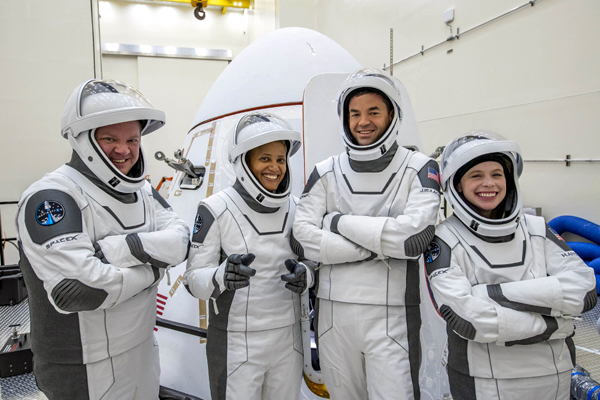
During their launch dress rehearsal, the Inspiration4 astronauts pose for a photo aboard Crew Dragon Resilience at Kennedy Space Center's Launch Complex-39A...on September 12, 2021.
Inspiration4


Sunday, September 12, 2021

Photos of the Day: Inspiration4's Launch Vehicle Is on the Pad!

Inspiration4's Falcon 9 rocket is raised into vertical position on the pad at Kennedy Space Center's Launch Complex (LC)-39A in Florida...on September 12, 2021.
William Harwood / CBS News

Late last night, the Falcon 9 rocket for the Inspiration4 mission was rolled from SpaceX's Horizontal Integration Facility to the pad at Kennedy Space Center's Launch Complex (LC)-39A in Florida.

A static fire of Falcon 9's nine Merlin engines will be conducted as early as today to verify that the launch vehicle is fit to fly commander Jared Isaacman, pilot Sian Proctor, chief medical officer Hayley Arceneaux and mission specialist Christopher Sembroski on their highly-anticipated 3-day flight.

A launch dress rehearsal should take place for the crew at the pad if the static fire is successful.

The Inspiration4 mission is set to lift off from LC-39A on September 15, at 8:00 PM Eastern Daylight Time (5:00 PM Pacific Daylight Time).

T-minus 3 days till the first all-civilian crew makes spaceflight history!

The Crew Dragon Resilience vehicle that will be home to the Inspiration4 astronauts for 3 days is attached to her Falcon 9 rocket inside SpaceX's Horizontal Integration Facility in Florida...as of September 10, 2021.
SpaceX

Crew Dragon Resilience and her Falcon 9 rocket are about to be rolled out to the pad at Kennedy Space Center's LC-39A in Florida...on September 12, 2021 (Eastern Time).
Inspiration4

Crew Dragon Resilience and her Falcon 9 rocket are rolled out to the pad at Kennedy Space Center's LC-39A in Florida...on September 12, 2021 (Eastern Time).
Inspiration4

The Inspiration4 astronauts watch as their rocket is rolled out to the pad at Kennedy Space Center's LC-39A in Florida...on September 12, 2021 (Eastern Time).
Inspiration4

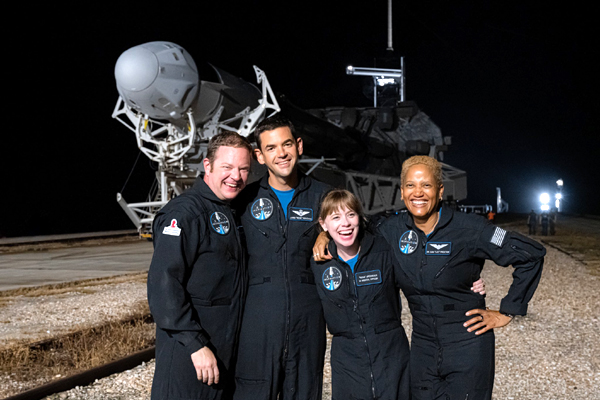
The Inspiration4 astronauts pose for a group photo as their rocket is rolled out to the pad at Kennedy Space Center's LC-39A in Florida...on September 12, 2021 (Eastern Time).
Inspiration4

Inspiration4's Falcon 9 rocket is now in vertical position on the pad at Kennedy Space Center's LC-39A in Florida...on September 12, 2021.
SpaceX

Crew Dragon Resilience and her Falcon 9 rocket stand poised for launch at Kennedy Space Center's LC-39A in Florida...on September 12, 2021.
SpaceX

Saturday, September 11, 2021

20 YEARS LATER...

Smoke rises from the destroyed World Trade Center complex in New York City following the terrorist attacks on September 11, 2001...as seen from aboard the International Space Station.
NASA

Today marks two decades since the horrific terrorist attacks that killed a total of 2,977 people (including the 19 perpetrators) in New York City, Washington, D.C., and Pennsylvania.

Frank Culbertson, who was the commander of the Expedition 3 crew aboard the International Space Station at the time, was also the only American off the planet when this world-altering tragedy occurred.

It must've obviously been a helpless feeling for Culbertson to witness such a hateful act by human beings while situated on a spacecraft meant to benefit all of humanity.

Here's hoping that no other astronaut and/or cosmonaut will have to gaze down at Earth and view another evil man-made calamity from the beauty of space...ever again. That is all.

Friday, September 10, 2021

Artemis 3 Update: The Orion Crew Module for NASA's Lunar Landing Mission Achieves a Manufacturing Milestone...

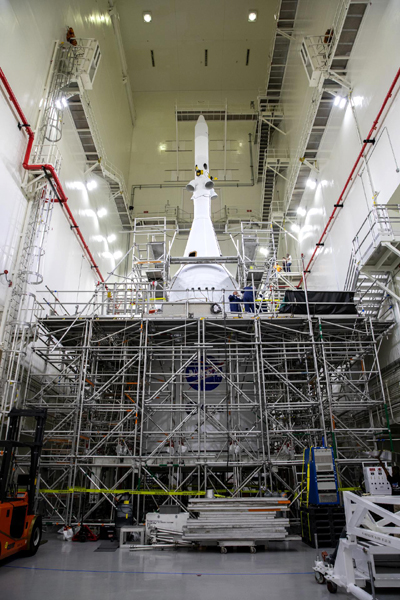
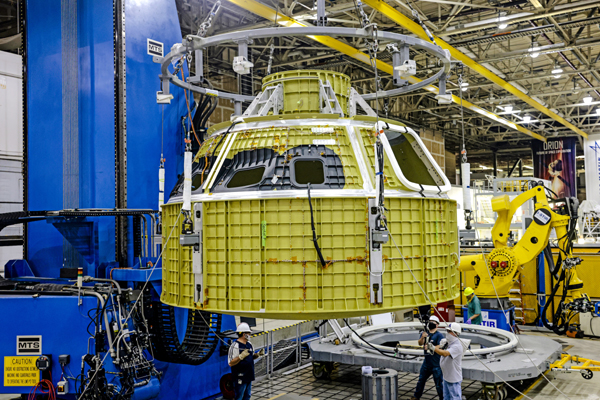
The pressure vessel for the Orion spacecraft that will fly on the Artemis 3 mission is completed at NASA's Michoud Assembly Facility in New Orleans, Louisiana...as of August 27, 2021.
NASA / Eric Bordelon

Next Generation of Orion Spacecraft in Production for Future Artemis Missions (News Release)

Over the next decade, NASA’s Orion spacecraft will carry astronauts during Artemis missions to the Moon to help prepare for human missions to Mars. Work on the spacecraft for Artemis I is nearly complete, Artemis II is well underway, and NASA is making progress on vehicles for the missions beyond.

The agency recently completed welding on the Artemis III Orion pressure vessel, the underlying frame of the air-tight capsule for astronauts called the crew module. This structure is the first major piece of hardware in Orion’s production phase with lead contractor Lockheed Martin.

“NASA is shifting its focus from the development phase to the production phase for the Orion spacecraft to enable a long-term presence on and around the Moon,” said Cathy Koerner, Orion program manager.

The development phase — called design, development, test, and evaluation (DDT&E) — is when Orion’s requirements are defined, the design undergoes review and refinement, and the spacecraft and its systems go through rigorous testing.

“All of the intensive testing we’ve done has proven out the design of Orion’s structure,” said Stu McClung, chief of staff for Orion program, planning, and control. “A structure that’s well understood and defined gives us high confidence to move forward into the production phase.”

Each component of Orion has undergone thorough testing since the beginning of DDT&E to prepare Orion for this transition. This includes Exploration Flight Test-1, Orion’s first flight test in 2014 that demonstrated its space-worthiness in a high-Earth orbit, and tested the spacecraft’s heat shield during entry into Earth’s atmosphere and the capsule’s recovery systems.

NASA has also completed successful testing of Orion’s parachute system, as well as the launch abort system with two flight tests known as Pad Abort-1 and Ascent Abort-2. Simulated in-space environments testing also verified that Orion’s systems will perform as expected during Artemis missions, among countless other tests of the spacecraft.

The DDT&E phase will officially conclude with the Artemis II mission, the first test flight with crew. Although no structural changes on the vehicle are expected to come from Artemis I and II, the mission outcomes may drive minor changes or upgrades into subsequent builds.

“As we fly, we will learn and adapt the spacecraft to the missions as needed,” said Assistant Orion Program Manager Paul Marshall. This could include modifying crew systems or crew interfaces to help astronauts perform future missions as smoothly as possible.

In the production phase, engineers will apply refinements to Orion’s design to ensure that manufacturing and assembly are as efficient as possible. One of many improvements was reducing the number of welded pieces that make up Orion’s pressure vessel. The pressure vessel’s original design had 33 welded pieces, which was streamlined to seven for Artemis I and up, to improve manufacturability and save more than 700 pounds of excess weight.

With these seven welds recently completed on the Artemis III pressure vessel at NASA’s Michoud Assembly Facility in New Orleans — and structural design changes and testing complete — a more efficient and streamlined production line for spacecraft begins. Under the Orion Production and Operations Contract (OPOC) awarded to Lockheed Martin, NASA committed to ordering a minimum of six and a maximum of 12 Orion spacecraft. The agency ordered three Orion spacecraft in 2019 for Artemis missions III through V, and plans to order three additional Orion capsules in fiscal year 2022 for Artemis missions VI through VIII.

“Our strategy to go from design and development to production focuses on optimization by making changes in several different areas to emerge with a more efficient flow,” said Kelly DeFazio, program director for production operations at Lockheed Martin.

Some examples of optimizing Orion production include:

- Changing the organizational structure of employees from a large, integrated product team structure centered on design, development, and qualification, to smaller multifunctional work teams focused on production throughput and quality of product.
- Incorporating systems to identify and address constraints in production flow, and the use of smart tools like augmented reality on the production floor.
- The opening of Lockheed Martin’s Spacecraft, Test, Assembly and Resource (STAR) Center in Titusville, Florida, earlier this summer to streamline manufacturing capacity.
- Reusing Orion crew modules and high-value systems, combined with the ability to bulk buy material and components, which contribute to considerable cost reductions compared to spacecraft produced under DDT&E.

“Our production plan activates unique manufacturing efficiencies that ensure we achieve the desired mission cadence while driving cost reductions,” said Marshall.

Those savings give NASA more resources to invest in developing the elements needed to pursue the lunar exploration campaign in the coming years, he added.

“The transition into production provides the opportunity to shift the focus of the Orion workforce to defining, implementing, and executing the exploration missions that Orion is built to fly,” said Marshall.

Source: NASA.Gov

****

The European Service Module that will be attached to Orion for the Artemis 3 mission undergoes assembly in Bremen, Germany.
AirbusSpace

Thursday, September 9, 2021

Photos of the Day: The Inspiration4 Crew Has Arrived at Kennedy Space Center in Florida for Launch!

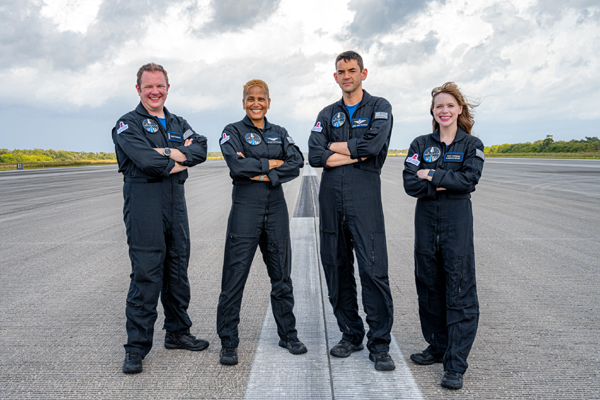
Astronauts Christopher Sembroski, Sian Proctor, Jared Isaacman and Hayley Arceneaux pose at the Launch and Landing Facility after arriving in Florida to prepare for the launch of their Inspiration4 mission...on September 9, 2021.
Inspiration4

A few hours ago, four L-39 and two Alpha jets carrying the Inspiration4 astronauts and their support crew touched down at Space Florida's Launch and Landing Facility—formerly known as the Shuttle Landing Facility at NASA's Kennedy Space Center (KSC).

Commander Jared Isaacman, pilot Sian Proctor, chief medical officer Hayley Arceneaux and mission specialist Christopher Sembroski will spend the next six days conducting final preps for their flight...which is currently scheduled to lift off from KSC's Launch Complex 39A on September 15, at 8:00 PM Eastern Daylight Time (5:00 PM Pacific Daylight Time).

SpaceX and Inspiration4 planners will reduce the launch window to five hours approximately three days before Crew Dragon Resilience embarks on the three-day mission aboard a Falcon 9 rocket.


Wednesday, September 8, 2021

Artemis 1 Update: The Orion Spacecraft Is Now Fully Encapsulated by Its Launch Abort System Fairing...

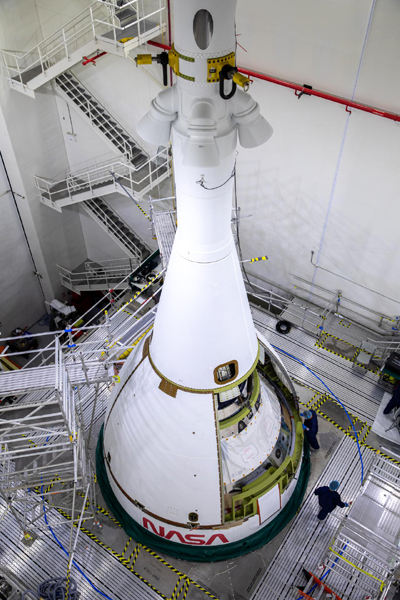
The fourth and final ogive panel is attached to Orion's launch abort motor...fully encapsulating the vehicle inside Kennedy Space Center's Launch Abort System Facility in Florida, on September 7, 2021.
NASA / Kim Shiflett

As of yesterday, the Orion vehicle that will head to the Moon on NASA's Artemis 1 mission is fully enclosed by the four ogive panels of its launch abort system (LAS) fairing. This milestone occurred as Orion is now spending its final days inside the Launch Abort System Facility (LASF) at Kennedy Space Center in Florida.

With the LAS fairing now completed, Orion should be prepped for its impending move from the LASF to the Vehicle Assembly Building (VAB) a few miles down the street. At the VAB, the capsule will be attached to the Orion stage adapter once this component itself is mated to the Space Launch System (SLS) rocket as it sits atop its mobile launcher.

It will be at the end of this month or early October that Orion and SLS finally become one...and Artemis 1 begins taking the final steps to launching on its highly-anticipated flight to the Moon!

The fourth and final ogive panel is attached to Orion's launch abort motor...fully encapsulating the vehicle inside Kennedy Space Center's Launch Abort System Facility in Florida, on September 7, 2021.
NASA / Kim Shiflett

The fourth and final ogive panel is attached to Orion's launch abort motor...fully encapsulating the vehicle inside Kennedy Space Center's Launch Abort System Facility in Florida, on September 7, 2021.
NASA / Kim Shiflett

Tuesday, September 7, 2021

Image of the Day: NASA Conducts a Post-Labor Day Communications Test for Artemis 1...

A screenshot of the DSN Now webpage showing that two Deep Space Network antennas in Madrid were communicating with Artemis 1 mission hardware...on September 6, 2021 (Pacific Time).
Late last night, I visited NASA's DSN Now website to see which interplanetary missions were currently in contact with the three Deep Space Network stations in Spain, California and Australia as Labor Day was ending here in the United States.

To my surprise, I saw that two radio antennas at the DSN station in Madrid were apparently communicating with flight hardware for the Artemis 1 mission!

The call sign for this test was EM1...as in Exploration Mission 1, the original name for the Space Launch System's (SLS) maiden voyage.

Not sure if this communications test was with the SLS core stage booster [which recently underwent an integrated modal test inside the Vehicle Assembly Building at NASA's Kennedy Space Center (KSC) in Florida] or the Orion capsule (which is about to be fully encapsulated by the four ogive panels of its launch abort system at KSC), but this seems to show that the unmanned lunar flight is moving a step closer to flight.

(The more-likely explanation is that Mission Control at NASA's Johnson Space Center in Houston was running this communications test.)

In regards to SLS and Orion, they should finally be mated later this month or early October.

The launch of Artemis 1 is now scheduled for no earlier than late December... Stay tuned!

Saturday, September 4, 2021

SLS Update: The Mega Moon Rocket Will Be Fully Assembled for Launch Soon...

The intertank umbilical arm is attached to the Space Launch System rocket inside the Vehicle Assembly Building at NASA's Kennedy Space Center in Florida...on August 12, 2021.
NASA / Kim Shiflett

NASA Invites Media to Kennedy for Artemis Activities (Press Release - September 3)

NASA is inviting a limited number of media to capture imagery of the fully-stacked and integrated Artemis I mission Orion spacecraft and Space Launch System (SLS) rocket at the Kennedy Space Center in Florida. Experts from NASA, industry partners, and contractors will be available for interviews at the media availability, which the agency anticipates will take place over two days in early fall.

Media will see the rocket and spacecraft inside Kennedy’s Vehicle Assembly Building, where teams from NASA’s Exploration Ground Systems currently are completing assembly. Attendees will have the opportunity to see Artemis II and III Orion spacecraft and other flight components as well.

Through Artemis missions, NASA will land the first woman and the first person of color on the surface of the Moon, paving the way for a long-term lunar presence and serving as a steppingstone on the way to Mars.

To mitigate the risk of COVID-19 transmission, only a limited number of media will be permitted to participate in this event. Credentialing deadlines are as follows:

- International media residing in the United States must apply by Friday, Sept 10.
- U.S. media must apply by Friday, Sept 24.
- All media accreditation requests should be submitted online at:

https://media.ksc.nasa.gov

NASA’s COVID-19 policies are updated as necessary and to remain consistent with guidelines issued by the Centers for Disease Control and Prevention and White House Safer Federal Workforce Taskforce. COVID-19 safety protocols for this event will be communicated closer to the date of the event. The agency also will communicate any updates that may impact mission planning or media access as necessary.

For questions about accreditation, please email ksc-media-accreditat@mail.nasa.gov.

For other questions, please contact Kennedy’s newsroom at 321-867-2468.

Para obtener información sobre cobertura en español en el Centro Espacial Kennedy o si desea solicitar entrevistas en español, comuníquese con Antonia Jaramillo 321-501-8425.

Learn more about NASA’s Artemis I mission at:

https://www.nasa.gov/artemis-1

****

The third of four ogive panels is attached to Orion's launch abort motor as the capsule continues to undergo Artemis 1 flight preps inside the Launch Abort System Facility at NASA's Kennedy Space Center in Florida...on September 1, 2021.
NASA / Kim Shiflett

Friday, September 3, 2021

SpaceX Update: Inspiration4 Is Officially Cleared for Flight...

The Inspiration4 astronauts pose in front of the Crew Dragon Resilience vehicle inside SpaceX's Dragonland facility in Florida...on August 30, 2021.
Inspiration4

Inspiration4 ‘Go’ for First All-Civilian Orbital Mission to Space (Press Release)

HAWTHORNE, CA – Teams from SpaceX and Inspiration4 met yesterday at SpaceX’s headquarters in Hawthorne, California to evaluate the readiness of the Falcon 9 rocket, Dragon spacecraft, ground systems, recovery assets, crew training, and other key elements of SpaceX’s human spaceflight system for Inspiration4 – the historic first all-civilian human spaceflight mission to orbit. Upon conclusion of the Flight Readiness Review, teams are proceeding toward a targeted launch on Wednesday, September 15 UTC (September 14 EDT) from Launch Complex 39A at NASA’s Kennedy Space Center in Florida. A backup launch opportunity is available on Thursday, September 16 UTC (September 15 EDT). Both 24-hour launch windows start at 12:00 a.m. Coordinated Universal Time (UTC).

Approximately three days before liftoff, SpaceX will narrow down the launch window to five hours based upon weather conditions at the launch site, along the ascent corridor, and at landing locations off the coasts of Florida for a safe return of the crew and splashdown a few days later.

The Inspiration4 crew – consisting of Mission Commander Jared Isaacman, Mission Pilot Dr. Sian Proctor, Medical Officer Hayley Arceneaux, and Mission Specialist Chris Sembroski – are scheduled to arrive in Florida on Thursday, September 9 to begin final preparations for their mission. For background on the Inspiration4 crew, see the original crew announcement from March 2021 as well as crew bios at https://inspiration4.com/crew.

Since the March 2021 announcement, the Inspiration4 crew has focused extensively on mission training and preparation, spending the past six months completing a wide range of training activities including centrifuge training, Dragon simulations, observations of other SpaceX launch operations, Zero-G plane training, altitude training and additional classroom, simulation and medical testing. This focused preparation was essential in team development and being ready to execute their role as the first commercial crew to orbit the Earth.

To follow Inspiration4’s journey throughout the mission, visit www.inspiration4.com and follow along on Twitter (@inspiration4x), Facebook (@inspiration4mission), Instagram (@inspiration4) and YouTube (@Inspiration4).

Source: Inspiration4.com

Wednesday, September 1, 2021

Photos of the Day: T-Minus TWO WEEKS Till the Historic Launch of Inspiration4!

At SpaceX Headquarters in Hawthorne, California, Inspiration4 commander Jared Isaacman poses inside the cupola that will provide stunning views of Earth and the cosmos during his 3-day flight.
Inspiration4

Today marks 14 days till SpaceX's Crew Dragon Resilience vehicle carrying the Inspiration4 astronauts lifts off from Launch Complex 39A at NASA's Kennedy Space Center (KSC) in Florida!

To commemorate this milestone, these four images were released online today showing each crew member posing inside the cupola that will provide stunning views of Earth and the cosmos during their 3-day flight. The cupola was still at SpaceX Headquarters in Hawthorne, California, before it was shipped to KSC to be installed atop the Resilience capsule.

As of right now, there is no exact launch time given for Inspiration4 by SpaceX. But here's hoping the weather and flight hardware will cooperate on Wednesday, September 15, and that the four all-civilian astronauts will soar aboard a Falcon 9 rocket into low-Earth orbit on schedule. This will be a momentous day for human spaceflight if that's the case.

Happy Hump Day and 1st Day of September.

At SpaceX Headquarters in Hawthorne, California, Inspiration4 pilot Dr. Sian Proctor poses inside the cupola that will provide stunning views of Earth and the cosmos during her 3-day flight.
Inspiration4

At SpaceX Headquarters in Hawthorne, California, Inspiration4 chief medical officer Hayley Arceneaux poses inside the cupola that will provide stunning views of Earth and the cosmos during her 3-day flight.
Inspiration4

At SpaceX Headquarters in Hawthorne, California, Inspiration4 mission specialist Christopher Sembroski poses inside the cupola that will provide stunning views of Earth and the cosmos during his 3-day flight.
Inspiration4